Little Monk Writes Rain – written and illustrated by Hsu-Kung Liu, translated by Rachel Wāng Yῠng-Hsín
Eerdmans Books for Young Readers, 2026
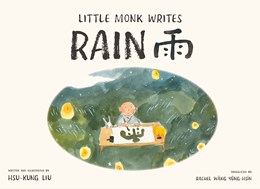
This exceptionally beautiful and gently philosophical picture book is about a Buddhist monk who has difficulty learning written language, with the exception of one Chinese character. He is singularly focused on writing the character for “rain,” and this limited but powerful ability persists throughout all the onslaughts, as well as the peaceful times, of his life. The book opens vertically, like a writing tablet. Delicate watercolor and ink drawings reflect traditional art, without mere imitation. When the book begins, the character is a young boy. Of course, character has two meanings here, an individual human and a symbol for written expression.
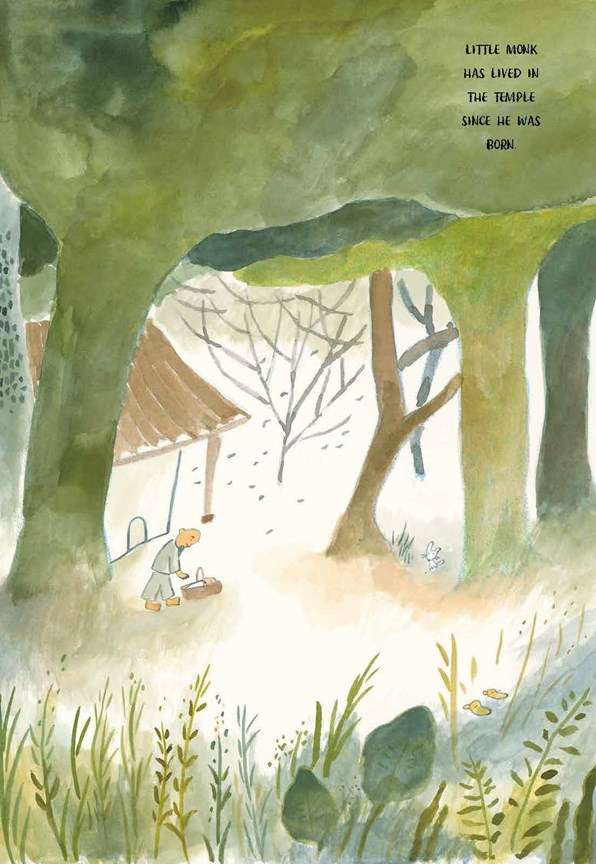
He first appears at the monastery in a tiny woven basket; as he grows, he is integrated into the community of prayer and manual labor, as well as reading and writing. For better or worse, he is not completely isolated from the outside world. A mention of casual cruelty makes this clear, because “Little Monk is not able to learn to read. And sometimes, other people laugh at him.” Those people are shown as children peering through a doorway. One has a bird on his head, an allusion to innocence, or perhaps of something worse. That oddly positioned bird may point do a different and less excusable deficiency, lack of empathy.
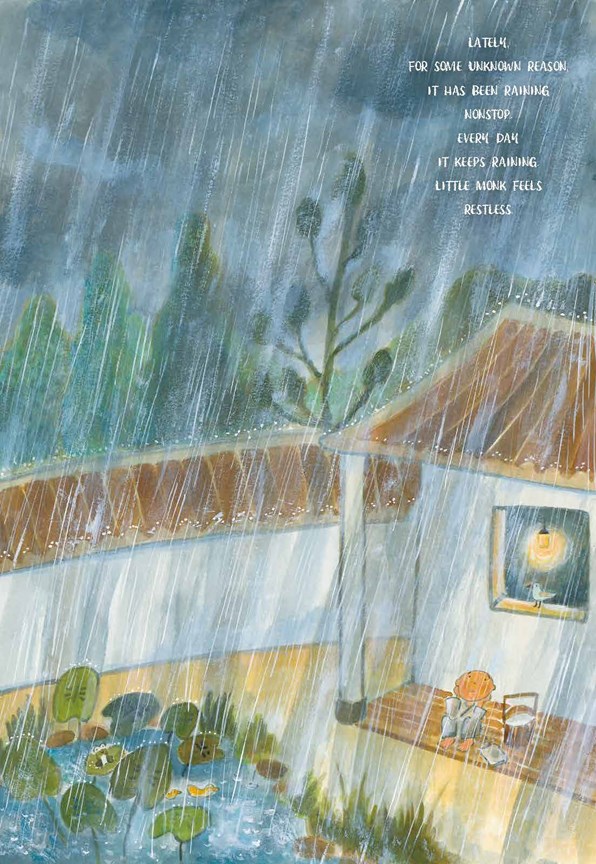
Suddenly, “for some unknown reason,” it begins to rain incessantly. Joining an older monk indoors, the little monk learns to write the character for rain. After introduction of the character, whenever it appears in the book, it is simply left standing without any guide to pronunciation. The reader may choose to read the character as “rain,” or to research how to pronounce it and attempt to do so. This seems a deliberate feature of the book, given that the nature of language, at least as people use it every day, is as framed by “some unknown reason” as the rain itself.
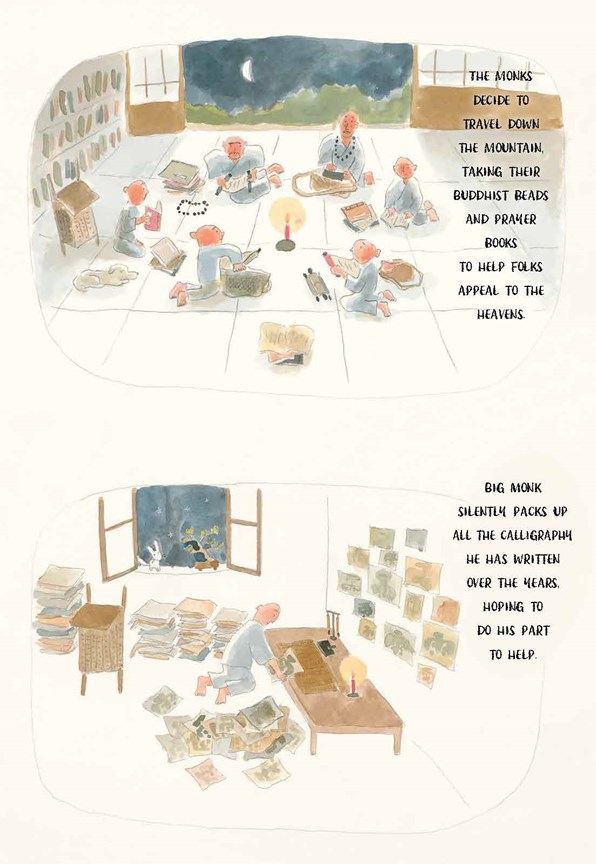
As in a fairy tale, the hero persists against adversity. Every day he performs his work tasks, but also writes the one character he has been able to master. Over the years, he grows up, becoming “Big Monk,” but his inner character remains unchanged. Then the environment suffers a reversal, and a drought threatens the world. The monks take responsibility for leading others in prayers to end the drought. They are well-equipped and organized, “taking their Buddhist beads and prayer books to help folks appeal to the heavens.” There is no sense of superiority in their actions. Meanwhile, Big Monk also prepares, by gathering together his impressive collection of calligraphy, all consisting of the one character for rain..
A vertical two pace spread is a magnificent scene washed in red and gold, of a plaza where ordinary “folks” pray while important men and “splendid altars” dazzle. “Even the Emperor is here.” When the monks arrive, they also appear important to the reader, wearing their crown-like broad hats and bearing their sacred scrolls. But their clothes are “shabby.” In folklore, many times the high and mighty are brought low by their sense of self-importance. At first the monks are unable to respond, feeling faint and weakened by the intense heat. But, seeing the distinguished shifu, for all their knowledge, reduced to angry and petty squabbling, they gather to pray. Big Monk cannot read the prayers, but opens his basket of rain characters and is “flooded with memories.”
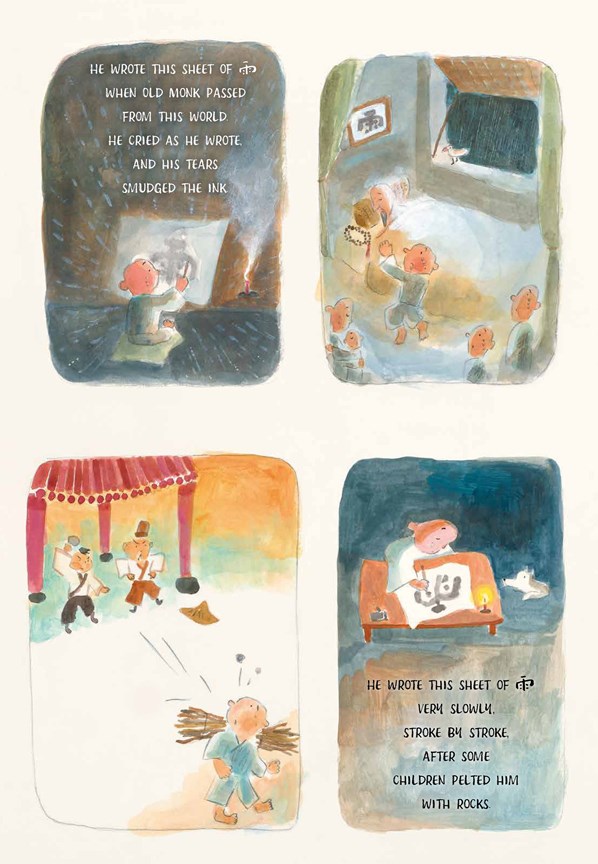
Now the monk has a biography. He remembers a conversation overheard long ago. He learned that he was an orphan who had been brought to the monastery. At the age of five, he began to learn writing. His teacher, originally a child, grew old, and the died. The cruelty mentioned earlier in the book intensifies in his memories, as he is “pelted with rocks.” All his thoughts of the past, and all his distinctive qualities, together form a response. He offers his sheets of writing to the heavens and the rain begins. An “ecstatic” crowd of people personifies the rain, elevated above the rain drops with joy.
Little Monk Writes Rain does not use the word “dyslexia.” An afterword, as thoughtful in tone as the rest of the book, explains that some people have difficulties learning to read. Hsu-Kung Liu presents thoughts and questions about the relationship between pictures, words, and the stories that they record. He reminds readers that sometimes “one word means everything.” Of course, those readers may be either children or adults. This remarkable book is a work of art, and a bridge to understanding life itself.
 Imaginary Elevators