How To Draw a Strawberry

15 Minute Art Drawing: Learn How to Draw, Colour and Shade – written and illustrated by Jessica Smith
Hardie Grant Books, 2023

I have many books that teach aspiring artists how to draw, using different media.  Some are specifically designed for children, and others for adults.  Jessica Smith’s 15 Minute Art Drawing is beautifully adaptable for older children and young adults, even if those groups are not its exclusive audience.  Smith’s instructions are clear, her tone reassuring, and the illustrations’ simplicity and rich color are inspiring.  Creating images of a strawberry, a dalmatian, or a pattern of repeating stars are within reach of almost anyone.
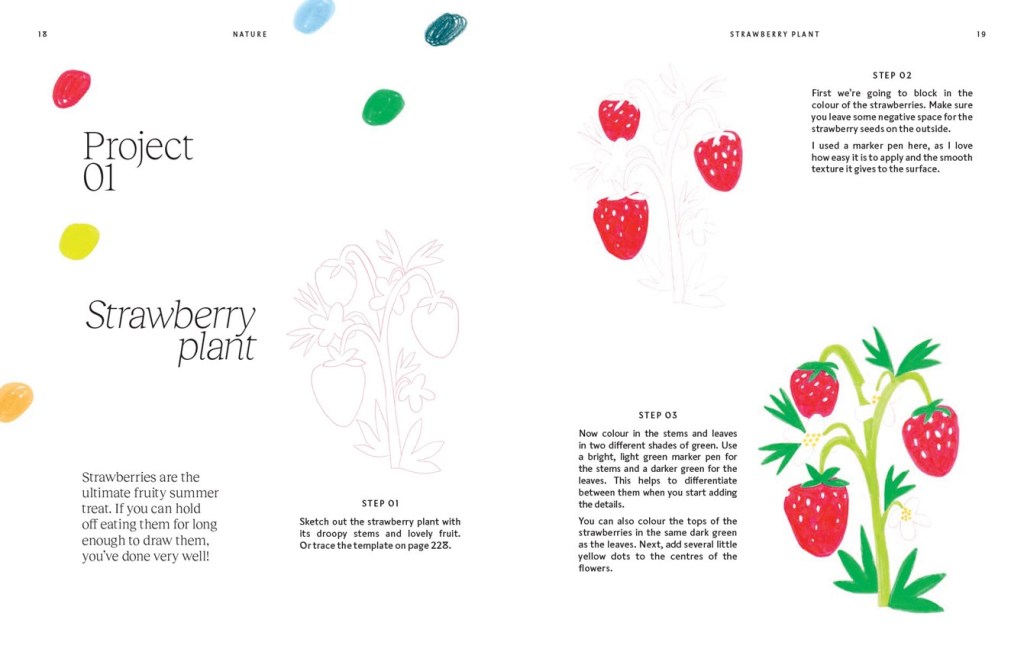
Drawing can be frustrating, especially for children, or adults, who are concerned with making mistakes. If you have ever watched a child crumple up a piece of paper when results don’t match her expectations, you will appreciate the design of this book, where optimism and realism both guide the artist.  Two wonderful books for both children and adults that offer an overview of the artistic process are Elizabeth Haidle’s Drawing Is and Jeff Mack’s time To Make Art. For young children, the stories in Builder Mouse, by Sofia Eldarova, and Spaghetti: A Mouse and His Treasure, by Merrilees Brown, depict animal artists who are undaunted by obstacles.

The composition of Smith’s book, including the ratio of image to white space, is perfect. “Project 2: Citrus” starts with a freely sketched oval of color in primary and pastels, and moves toward a finished fruit.  Pens, markers, and pencils can all be part of the project; Smith offers specific suggestions, but oil pastels and watercolor would also work. Often she writes in the first person, advising, but not directing: “I used a blue pen here to add the shadow and I love how you can still see the color of the orange through it.” I love how she phrases that, expressing emotions about how rewarding it is to draw.

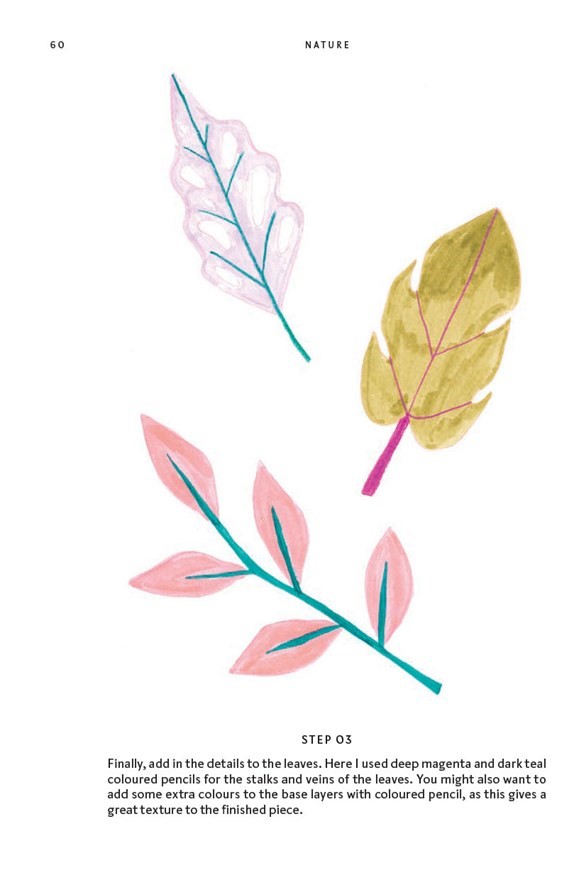
“Project 11: Leaves” could not be better for the artistically timid: “This simple project is nice and speedy, and uses only three steps!” Yet the resulting drawings look sophisticated and evocative. I can’t emphasize enough how difficult that is to achieve in an instructional art book.  Smith goal seems to be a genuine desire to enlist the reader’s enthusiasm. She manages to combine a sense of humility and enthusiasm about the results of her work, and, by extension, that of her readers.  Some of the other projects include a bowl of noodles, a house, a mermaid, and a woman dressed in “busy patterns and popping colours” and holding a grid-patterned shopping bag.  There are even two-page spreads of drawings that take a step back from the instructions and simply focus on beauty. The color reproduction is excellent.

The sum of an art book may be greater or less than its parts.  15 Minute Art Drawing lays out a premise, verbally and visually, and guarantees success within its terms.  The book begins with an autobiographical sketch and includes an overview of tools, materials, and the use of color.

Drawing Welcome Conclusions

Drawing Is…Your Guide to Scribbled Adventures – written and illustrated by Elizabeth Haidle
Tundra Books, 2025

The somewhat clichéd term “interactive” is only marginally useful for describing Elizabeth Haidle’s Drawing Is…Your Guide to Scribbled Adventures.  Reading, and using, this practical and philosophical guide does not involve lifting flaps or choosing endings, although it does encourage choosing paths. Instead, from the very first page, it challenges young (and older) readers to think about what it means to use your imagination in a visual form.  There are questions and suggested pathways, graphics, lists, numbers, black, white, and color.  Every sentence and image is related to all the others, becoming points of entry to the creative process.  All this happens without a touch of pretense!

First, you open the book to see the endpapers, a collection of photographed tools of the trade: pencils, erasers, pens, crayons, brushes.  Then, a black and white doodle with grey sketching presents a small man lifting a, proportionally, huge pencil, reflecting his effort. Haidle prepares you to steer the course with a definition that is simultaneously ambitious and reassuring: “Drawing is two-dimensional traveling. You can travel far away. You can drive inward.”  If you have ever felt discouraged trying to draw, her negative definitions will resonate. Drawing is definitely not a contest, an endeavor exclusively for the talented, nor a “waste of time.” Once you get that out of the way, you can move forward.  As Haidle’s checklist humorously points out, if you blink, inhale, exhale, read, or listen, you can draw.

The demonstrative drawings include lines, shading, color, scale, contrast, and texture, all presented with no assumptions about prior knowledge.  But those elements are not isolated from others: magic, wonder, feeling, and focus.  Haidle convinces the reader to be open to experience through her own example.  Along with guidance through concrete steps, she openly acknowledges the ineffable part of self-expression.  “Here are some places that I’ve visited in my sketchbook” lists, not the Eiffel Tower or the neighborhood park, but a “magical library,” a place where she “can feel safe,” and the state of feeling “calm,” pictured as a figure safely ensconced in a volume with smiling eyes and mouth. On the other hand, sometimes an attempt fails, otherwise known as “drawings that turn out awful.”  Don’t worry, but do “watch out for the part of your brain that wants to quit!”

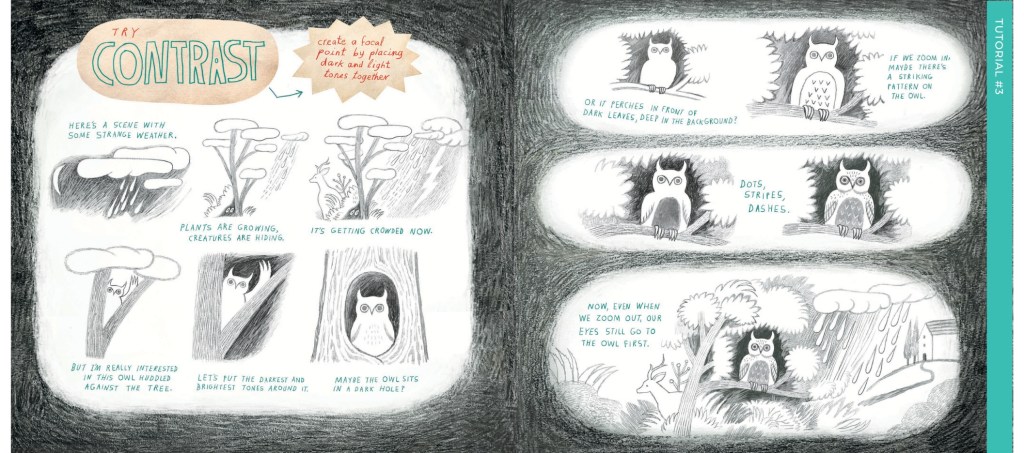
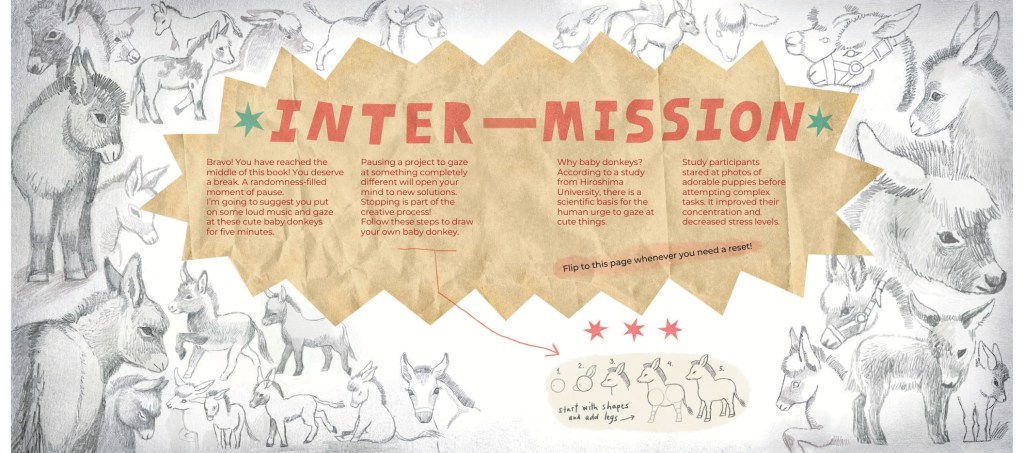
The more mechanically oriented pages are just as filled with delight as the emotional ones. Using contrast to create a lovely owl out of lines, dots, dark, and light is a section you can immediately put to use, while still contemplating Haidle’s vision of art.  There is even a glorious two-age “Intermission” at the middle of the book, informing you that images of baby donkeys, or something the equivalent in cuteness, will help you to pause and recalibrate your gaze. If you are contemplating a self-portrait, (image) unexpected directions can lead to a surprising kind of accuracy. 

There are a number of wonderful books about drawing for children and adults to share, and I have used many of them. Ed Emberley is definitely the grandfather of simplicity in drawing. Contemporary authors such as Kamo, Sachicko Umoto, Annelore Parot, and Kimiko Sakimoto, among authors, have written lovely guides with beautiful graphics. Elizabeth Haidle has approached her subject from a completely different angle; this is one of the best, most complete, books on the subject I have seen, a truly essential work.

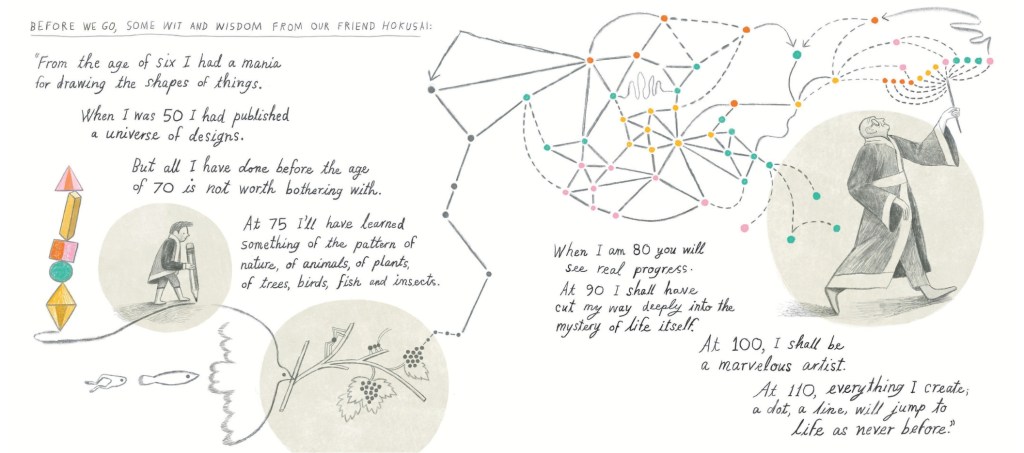
There are a number of inspiring people within the pages of this book: André Breton, an inventor of surrealism; the cartoonist Lynda Barry, poet Emily Dickinson, and the great Japanese master of print making, Hokusai. The humility interwoven with genius led him to state that his work before the age of 70 is unrealized, compared to what he hopes to produce when he reaches 90 or 100.  Even as metaphor, this endless faith in persistent creativity will motivate readers to return to Haidle’s book over and over, and to put her ideas into practice.