Cloudy with a Chance of Beauty

Kumo the Bashful Cloud – written by Kyo Maclear, illustrated by Nathalie Dion
Tundra Books, 2022
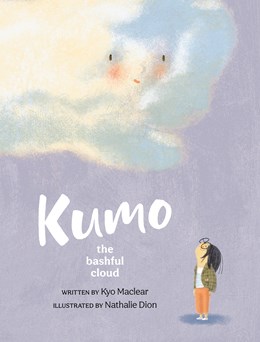
Children sometimes personify clouds, and so do adults. While the actual scientific facts about their existence is also enthralling, spinning stories about their evanescent shapes is an important pastime. Kumo is bashful, insecure, but also socially enough inclined to welcome the friendship of Cumulus and Cirrus.

When the book opens, Kumo is so pale as to be almost invisible. As Kyo Maclear narrates (I’ve reviewed her other works here and here and here and here and here), “for many years, her only wish was to float unseen.” Yet circumstances change and she adapts, if, at first, reluctantly. “Her mind was heavy with doubt” may seem an intense statement of consciousness to a child, but it makes sense. She is frightened, then trapped in a tree. A friendly kite, not a cloud by cloud-adjacent, helps her out. So does the wind, and a lake, fields, and “singing glaciers.” The natural world is her ally. But When Cumulus feels “under the weather” and Cirrus departs for a cloud convention, she is worried.
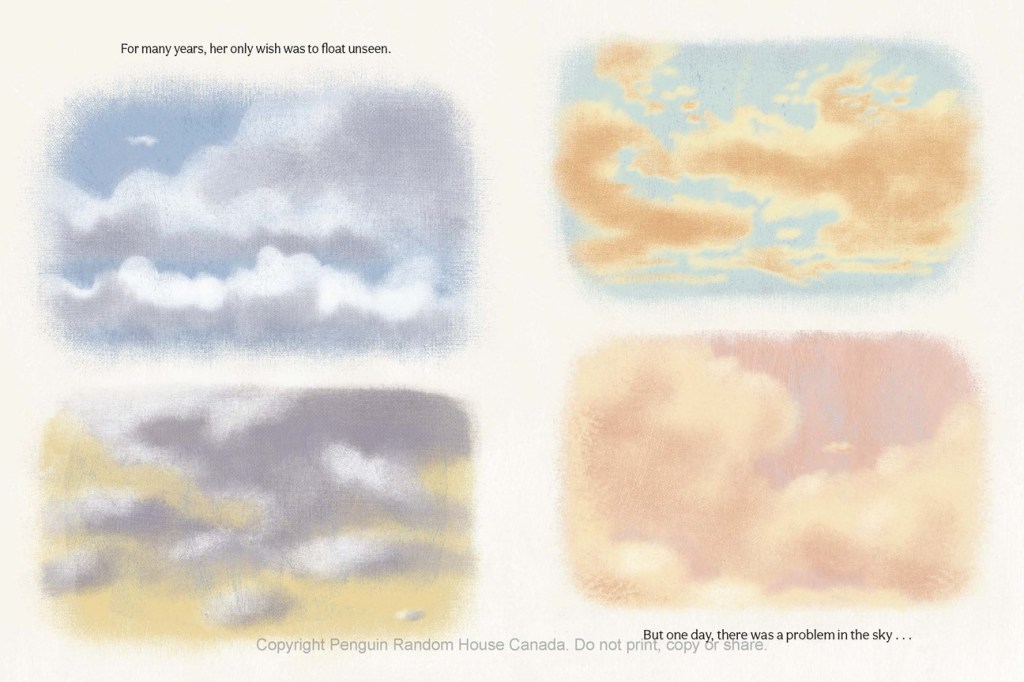
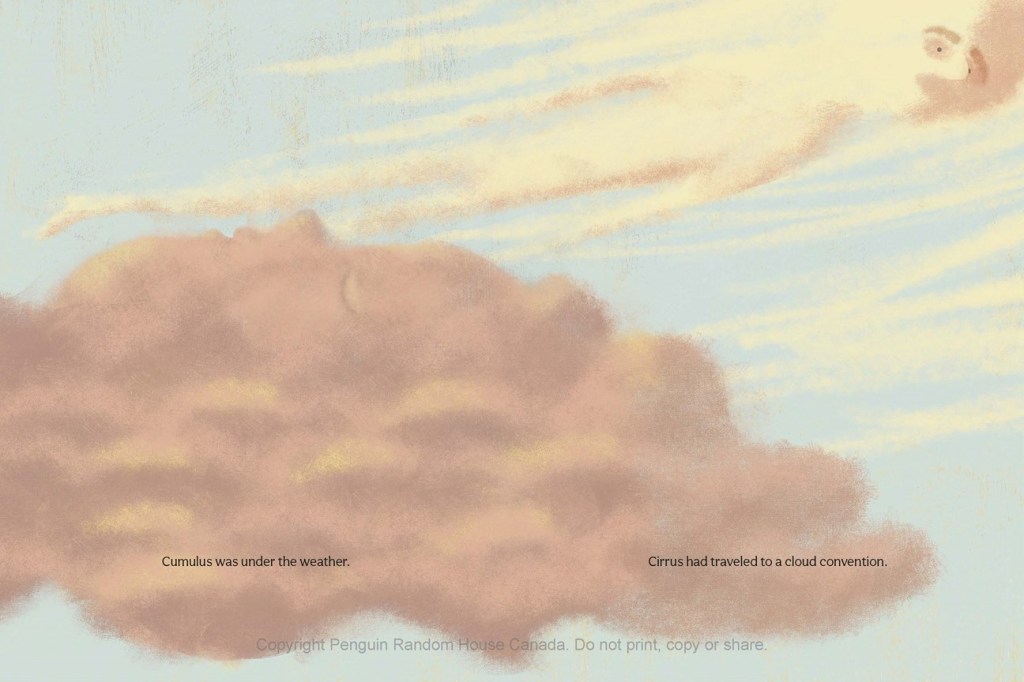
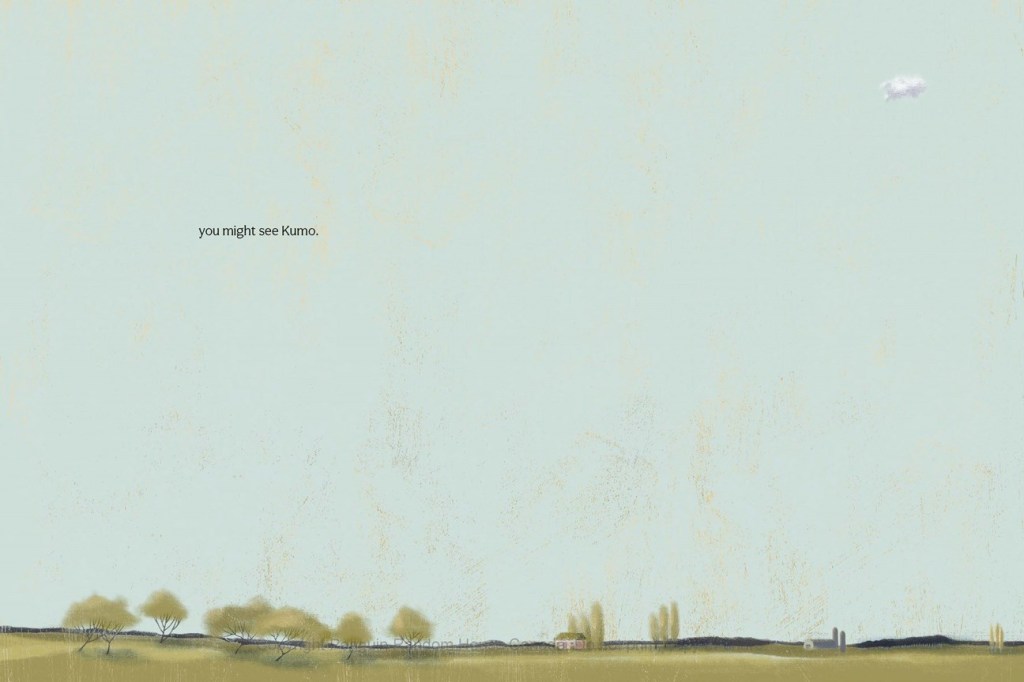
Nathalie Dion’s pastel images with touches of brighter color perfectly match the poetry of the text. Eventually, Kumo begins to interact more with the human world, helping a man to plant petunias, and even enjoying an urban scene full of lively families. One child holds a red balloon, while another, with oversized black glasses and dark hair, wears matching red pants. That child is revealed to be somewhat like Kumo. With his head in the proverbial clouds, he loves to dream. Soon he transforms Kumo into a bunny, a car, and a flying horse.

With the boy’s help, Kumo ascends to “the top of the world,” and even reaches out to new friends. With the lovely Japanese names of Fuwa-chan, Miruku, and Mochi, helpfully explained in a short glossary, they support one another, both literally and figuratively. Being alone and having friends, both meteorological and human, both turn out to be within Kumo’s flexible reach. Kumo the Bashful Cloud reveals wisdom with a light touch.
Snowy Paradox

First Snow – written and illustrated by Peter McCarty
Balzer + Bray, 2015

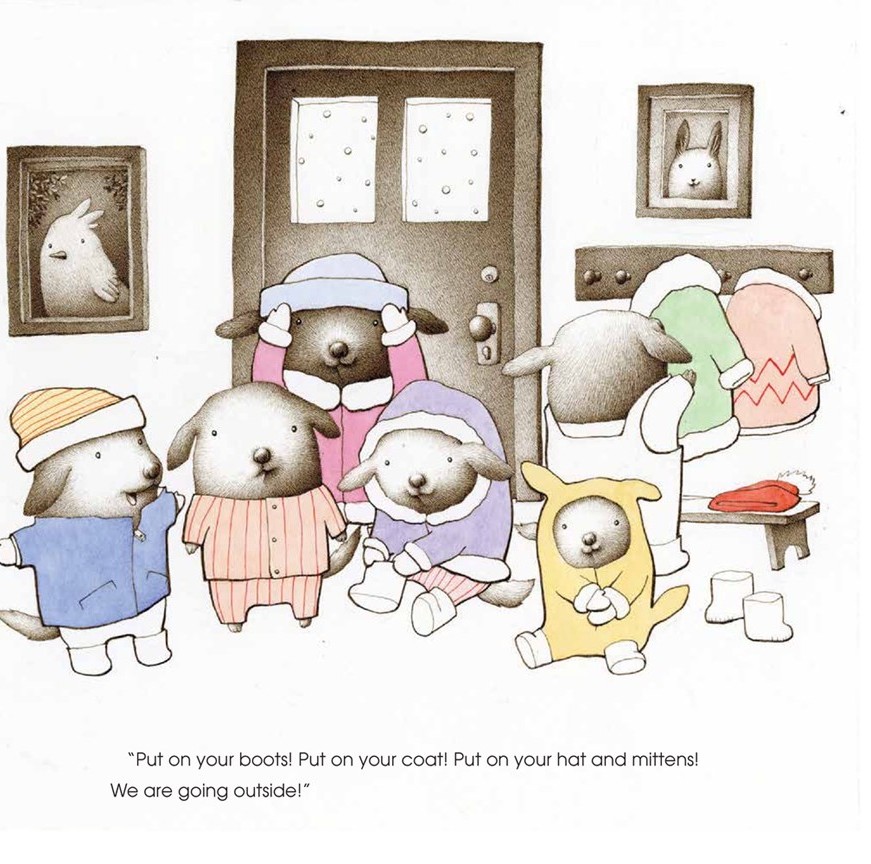
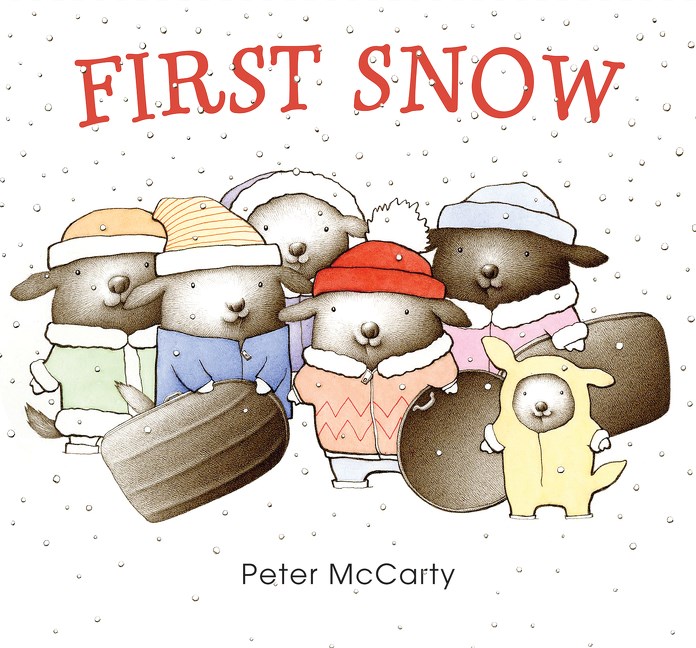
It may not be the first snow, but, due to climate change, it certainly feels like it in many parts of the country.  In Peter McCarty’s classic, First Snow, a group of different stylized animals responds with excitement to the event, although one skeptic objects to the cold and the unfamiliarity.  Pedro, the “special visitor” who announces his reservations is both the voice of reason and kind of annoying. After all, in order for it to snow it has to be cold, but if he can’t adapt he will miss the beautifully illustrated fun.

There is a mysterious tone to the story, or perhaps it just reflects the perceptions of children. Pedro has traveled unaccompanied to visit his cousins.  They appear to be dogs, drawn in simple, rectangular forms. The mother has pink bows in her hair. The children, with the resonant names of Sancho, Bella, Lola, Ava, and Maria, welcome him. (Later, Bridget, Chloe, and Henry will appear.) At bedtime, Sancho points out the snow has begun to fall. His bedroom has pictures on the walls of dogs bicycling and playing baseball. There is a toy dinosaur on the dresser.  Pedro expresses his fears.

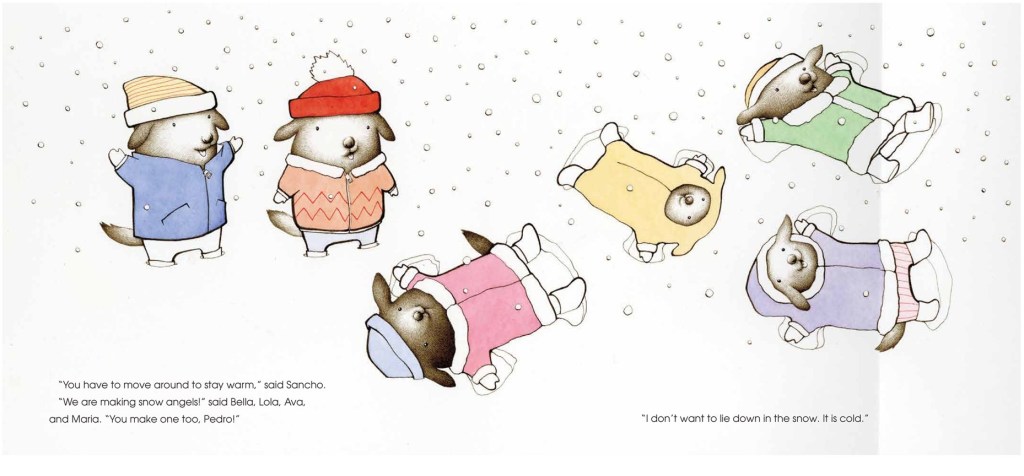
The scene then moves from domestic calm to exuberance, as everyone but Pedro gets ready to emerge from the house and play. They dress in puffy snow gear and make snow angels. Sancho helpfully points out that moving around is key to staying warm, but Pedro repeats his reservations. Readers may identify with his hesitancy, or feel frustrated by his obstinance.  Those different possible reactions frame the entire story.

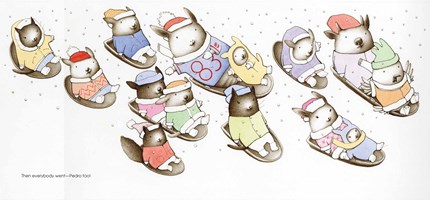
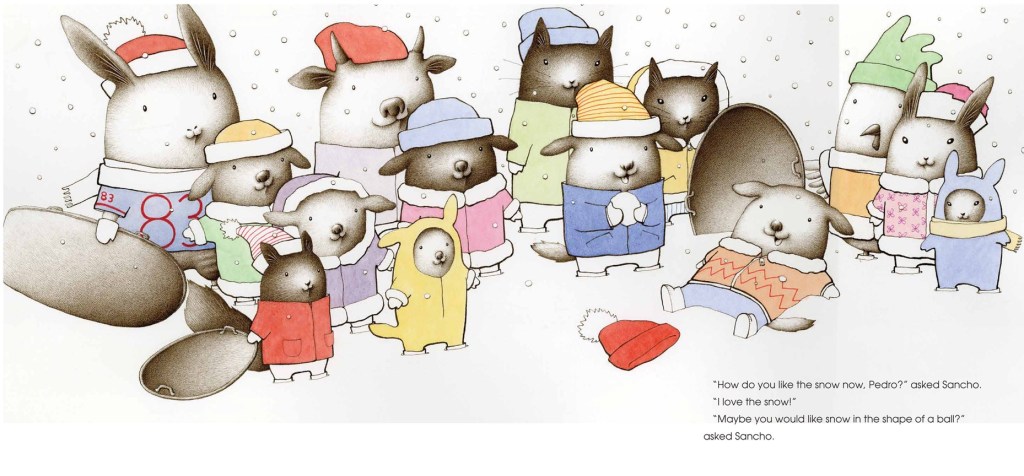
Other neighborhood children join in. There are birds, cats, and cows, united in their happiness.  Abby describes the sensation of feeling snowflakes on your tongue, to which Pedro predictably answers, “It tastes cold.” Eventually, having voiced all possible objections, he begins to participate in sledding. There is plenty of white space separating the pictures, giving a sense of movement.  When Pedro decides, or admits, to loving the snow any sense of surprise may be either muted, or genuinely impressed by the change in the visitor’s attitude.  Any child, or adult, who welcomes snow, even while acknowledging its potential nuisances, will appreciate this book.

Let It Snow

The Snow Theater – written and illustrated by Ryoji Arai, translated from the Japanese by David Boyd
Enchanted Lion Books, 2025

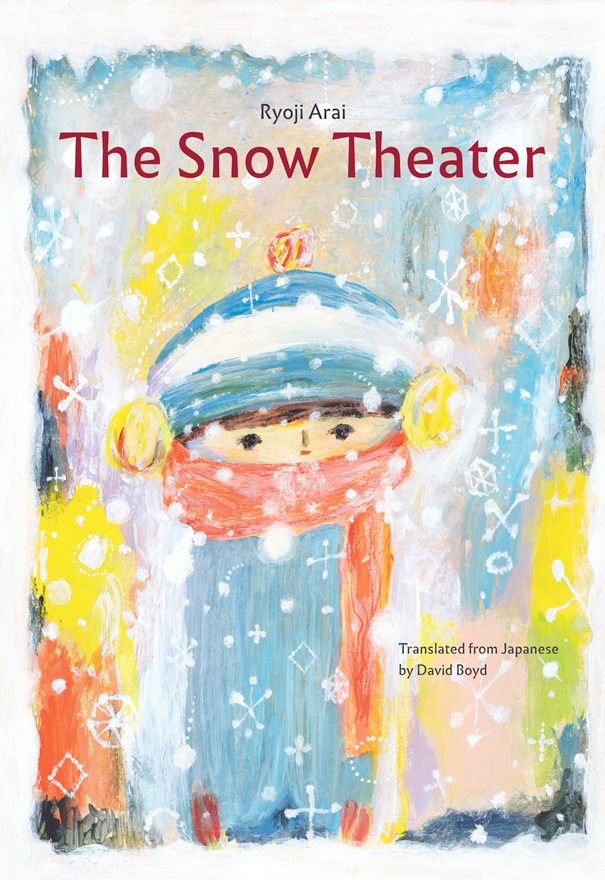
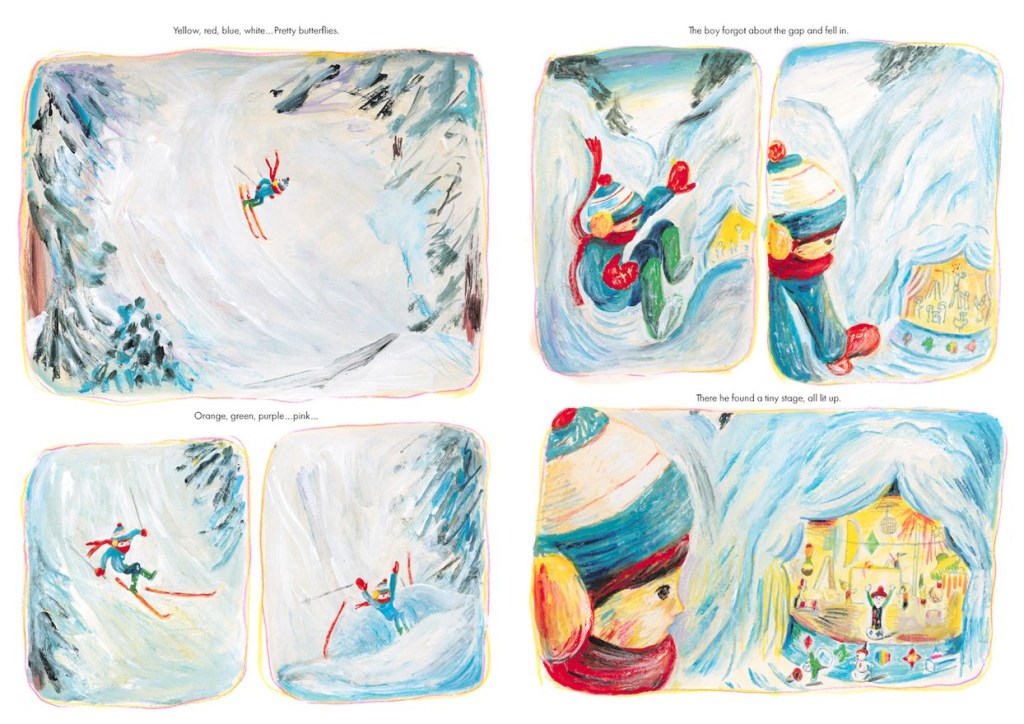
The art of Ryoji Arai’s The Snow Theater demands strong adjectives: intense, stunning, original, but also: unpretentious, dream-like, and accessible. The reason for this contrast, aside from the artist’s incredible gifts, is the imagery’s blend of naiveté and sophistication, with splashes of color as well as carefully delineated figures. Arai’s pictures capture what it feels like to be a child, and specifically to be captivated by the experience of snow. Snow as theater is not at all artificial, from a child’s point of view. It is a gift, perhaps unanticipated, that then takes on different qualities, including joy. It is familiar, but can also be strange.

There are innumerable children’s picture books about snow, and many are excellent, beginning with the Ezra Jack Keats classic The Snowy Day (see some other examples here and here and here and here and here and here and here). The Snow Theater is not unique, but both its design and philosophy and language are distinctive enough to merit acclaim (it is translated by David Boyd, who has translated some of the Chirri and Chirra books, also published in English by Enchanted Lion). It opens indoors, where two boys are “keeping warm” and “looking at a book.” The first picture has the reader looking towards them from outside, where they are framed in the window, almost like residents of a dollhouse. Then, a two-page spread is divided into several more specific descriptions of their activity, and one larger scene of it result. At first they are sharing a picture book about butterflies in a cooperative spirit. Then, the friend of the boy who lives in the house “badly wants to borrow the book,” and the idyll is ruined. That adjective, “badly,” prepares you for the act of, perhaps accidental, aggression that results when the book is damaged.

Now the boy is devastated. Worse, the book is actually one of his father’s favorites, adding a dimension of anxiety to an already tense situation. Arai traces the arc of the boy’s feelings. They boy had wanted to share the book with his friend, not only because they both liked butterflies, but in order to communicate its special status in his family. Worried, he leaves the house and begins to ski through the snow. Suddenly, he finds himself looking into a miniature theatrical production. There are “snow people,” including ballerinas. They surround him physically, occupying his senses. Then the scale seems to change, as he sees “a large theater in front of him.” Yet the performers, who include singers, still appear to be tiny. “Everybody floated quietly to their places, like freshly fallen snow.” There are echoes of Tchaikovsky’s Nutcracker, with impressionistic colors. Snow people reflect the color of rainbows. Icicles are suspended from their limbs and odd pieces of scenery, like an Easter Island head, occupy the elaborate background.

Then the show ends. As in The Nutcracker, viewers wonder if the performance was a dream, or if the protagonist had really undertaken a mysterious journey. The kinetic, and ephemeral, experience of a snowstorm seems to have been the boy’s escape from emotional difficulty. He reaches across the snow to find his friend against a field of butterflies, only some of which are enclosed within a book. The boy’s father appears with the awaited resolution: “Let’s get you home.” A cup of hot cocoa by a warm stove brings back domestic security, but the song of the snow people is reprised in the boy’s memory.

Roman Holiday

Piccolo – written and illustrated by Dan Yaccarino
Christy Ottaviano Books (Little, Brown and Company), 2025

Piccolo is not actually set in Rome, but rather in Bella Città, a marvelous place where animals speak Italian, visit cultural treasures, and eat delicious gelato. A lively shrew who enjoys riding his moped and frequenting cafés, the title character has several friends who help him when he goes in search of his favorite hazelnut ice cream. There are several detours along the way, and Piccolo will never say “no” to an amusing distraction, or a chance to help out.

Dan Yaccarino’s picture book world is generally reassuring. Populated by people, and the animals who sometimes are similar to them, his stories maintain a balance of challenges and happiness. Whether in Every Friday, whose father and son pair enjoy a special weekly time together, Doug Unplugged, where a young robot breaks free of his charger, or I Am a Story, an ode to literacy, readers connect to his colorful images and comfortingly familiar characters.  Every Yaccarino book is different, but identifiable for its warmth and humanity.

Piccolo has created a list with his fountain pen while sipping espresso and planning his day. He “loves his friends very much,” and the truth of this statement, while obvious, is also proven by multiple examples.  Enzo the hedgehog, Mr. Rosso the fox, and Brother Mantis are all greeted with an enthusiastic Buongiorno or Ciao.

Piccolo’s need for gelato is not so pressing that he can’t help Mr. Rosso, an artist, to carry his painting to the museum, or to ensure that Mrs. Gallina and her chicks safely cross a busy street. (This errand seems like an homage to Robert McCloskey’s Boston street scene in Make Way for Ducklings.)

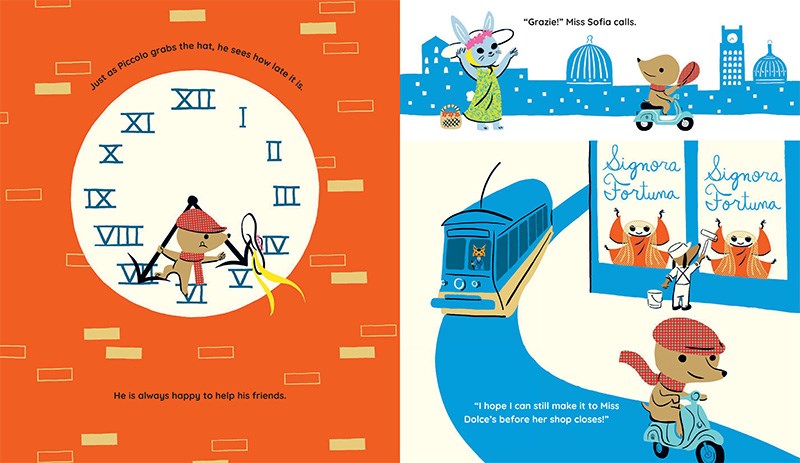
The cinematic scenes include Piccolo racing to rescue his friend Sofia’s hat by climbing to the top of Tempo Tower clutching the hands of its clock with bravery and skill. In another artist’s vision, this feat could be frightening, but Piccolo’s determined expression makes it clear that he is not taking an unnecessary risk.  Not every one of his detours is so dramatic. He is also happy to retrieve a soccer ball from the fountain and play for a while, and to assist a young crocodile with his necktie.  Yaccarino can easily devote his attention to the smallest actions as well as the most difficult ones. There is some real tension when Piccolo reaches the gelateria and presses his nose against the glass, his purple shadow illustrating the hour, and that “he is too late.” But when Miss Dolce arrives, her leftover hazelnut gelato becomes a simple problem to solve. Grazie, Dan Yaccarino, for this affectionate introduction to Italian culture, perfectly designed for young, and older, readers.