
Emiko – by Chieri Uegaki
Tundra Books, 2025
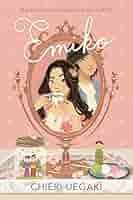
It’s hard to keep track of all the novels, movies, and other varieties of allegedly Jane Austen-inspired works (there are children’s biographies of her as well, such as this and this). Some of quite good, a few excellent, and others teeter on the border between obtuse and exploitative. Chieri Uegaki’s Kimiko is an outstanding young adult novel that adults will enjoy, as well. (I also reviewed an earlier picture book by her.) She is a true heir to Jane Austen, not in the sense of attempting to replicate the novelist’s Emma, but in offering how own distinct version in conversation with the 19th century masterpiece.
Emiko Kimori is a Japanese Canadian high school student living in a spacious and idyllic home on the Pacific coast. Her parents died when she was very young, but the memories she is too young to have retained have been transformed into an almost spiritual presence in her consciousness. She lives with Ojiichan, her grandfather, a character endowed by Chieri Uegaki with a level of wisdom and patience that, in the hands of another author, might lack credibility. Yet, like every person in Emiko’s life, from the closest to the most tangential, he is utterly believable.
If you remember your Jane Austen, Emma Woodhouse is engaged in well intentioned matchmaking, motivated by genuine concern for others, but also
unacknowledged arrogance. Uegaki’s Emiko is also consumed with helping her friends find the partner who will complete their happiness, and a controlling element definitely plays a role in her machinations. She is also kind, sensitive, and sometimes able to examine her actions with some critical distance. She has been friends with Kenzo Sanada since they were children, enjoying the embrace of his family and the peace that being with them confers. “Kimochi ii,” as Emiko explains this warmth, “floats through my mind…The closest I can come to explain what I mean…is that…it makes my spirit feel at ease.”
All novelistic characters have an ethnic identity, whether as an integral part of the narrative or a kind of default, of less significance. Uegaki weaves Japanese culture throughout the book, with a graceful conviction of its importance. She is not taking readers on a tour, but inculcating a feeling of interest and empathy. Whether describing foods in detail or naturally choosing phrases that are the best way to convey the events and her responses to them, Emiko is at ease in two intersecting worlds. She shares with Ojiichan the ritual of offering incense at the butsudan (altar) to honor deceased family members, closing her eyes in front of their photos and requesting guidance. She and Ojiichan also bond watching Audrey Hepburn in Sabrina.
There are several surprises for readers. Like Austen’s characters, Uegaki’s are three dimensional. A friend, like Harumi, may be oblivious to her own needs. Jun, the stepson of Emiko’s aunt, Mitsuko, is brimming with both pride and prejudice that place him on a dangerous course. Kenzo’s basic decent strength is never in doubt, but, like everyone, he needs to find a counterpart.
There is a scene that epitomizes the way that Uegaki translates Austen into Emiko’s movement towards growth. Mitsuko prepares to help Emiko transform one of her mother’s kimonos into a prom dress. First, she dresses in the kimono and traditional accessories, then poses for a picture. Finally, Ojiichan blesses the project: “I am happy for you to do as you wish, Emiko. I think your mother would be as well, knowing you are taking something of hers and making it your own.” Then it’s time to “deconstruct” the kimono and recreate it into something new. Emiko eventually learns both how to scrutinize the past and present, and how to start from scratch.


 Imaginary Elevators