Listen Carefully

Sound: Discovering the Vibrations We Hear – written and illustrated by Olga Fadeeva, translated from the Russian by Lena Traer
Eerdmans Books for Young Readers, 2025
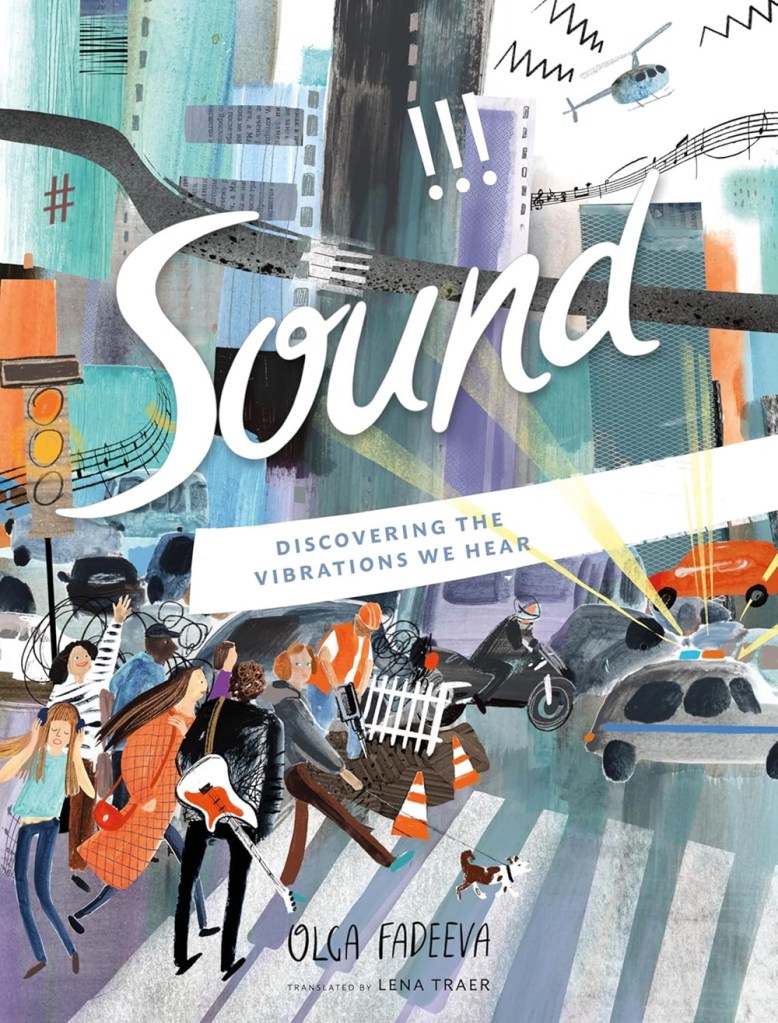
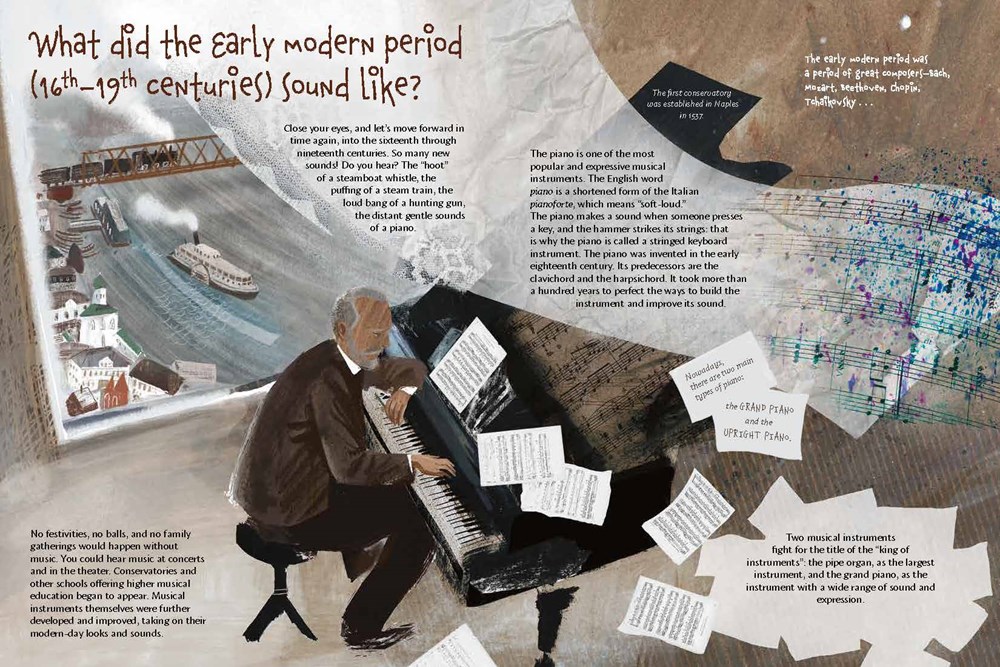
Imagine for a moment that you are about to pick up a children’s book explaining the physics of sound. How do we hear and transmit noises? Then being to page through it, noticing that the illustrations, in acrylic paint and water, would be worth the proverbial price of admission. Then, as you begin to read, you realize that the ambitions behind this project go way beyond the scope of what you had anticipated. Author and artist Olga Fadeeva has produced an information-rich picture book that moves among physics, biology, history both distant and recent, spoken and signed languages, culture from music to architecture, and technology. That list is still incomplete.

Sound requires careful attention and rewards it on every level.  Opening the book, we see a mother cradling a baby; this is the setting for how we first experience sound. Then, we enter a kitchen, the familiar setting for objects emitting noises, so ordinary that we might ignore them: a boiling teakettle, a clock, a phone, a pot of soup. There is no division between the informational and artistic components of this picture, or in any other section of the book.  Aware of how attention is naturally segmented, Fadeeva places her intriguing introductory premise in a rhombus that is actually in inside of an open window. The metaphor is perfect. A window is opening onto the meaning of sound.

Some pages use different sizes and colors of font, and have captions, as well as words that are sound effects framing the text. There are carefully employed graphics, such as a line indicating the intensity of decibels, or the organs of hearing and speaking labeled and described. The progression among topics is not frenetic; every idea is clearly linked to the ones preceding and following.  While Fadeeva cannot anticipate every question about sound, there are many common sources of wonder that are clarified. How do bats hear? What are some common birdcalls?  What is distinctive about underwater sounds?

There are other angles from which to explore sound and Fadeeva credits young readers with the curiosity to include them. She actively engages them with invitations to consider different contexts.  What was sound like in prehistory? How did the audience hear in the amphitheaters of the ancient world? (images). Medieval music makes an appearance, visualized with the excitement of charging knights and the lovely concert of flute, timbrel, bagpipe, and lute. Musical notation has its own pages. Even if children have never read music, they will be drawn in by the basic premise: “How can you write down music on a page – and turn it back into sound?” Glamorous performers and intricate pages of notes give the effect of collage. Pages on recording sound includes images of antique devices, and the question of “How do you fill the world with sound?” is followed by a concise but detailed answer superimposed on a dial telephone. Even the cord is covered with words.
The concluding endpapers feature brightly colored pictures and instructions for experiments.  Even after this incredible excursion into the world of sound, children may still want to fill a plastic bottle with buttons or beans, and create an orchestra.  Sound is an intricate and engaging performance for children and adult audiences.
Tune In

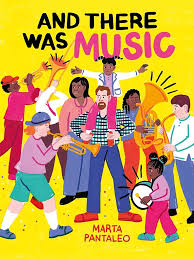
And There Was Music – written and illustrated by Marta Pantaleo, translated from the Italian by Debbie Bibo
Eerdmans Books for Young Readers, 2025

Sometimes children’s books address a question that may seem obvious. How can you explain the meaning of music, the way that people use it to communicate regardless of whether they share a language or a culture? Marta Pantaleo’s And There Was Music offers an answer through spare, poetic language, and bright imagery.  Her answer is non-academic, not definitional. Instead, she approaches the subject through examples that are diverse enough to constitute a whole. Music is shared by everyone, arises from our senses, memories, and emotions, and utilizes different instruments, as well as our voices and bodies, to make itself heard.

The book’s text is pitch perfect.  It alternates statements and questions: “When you listen to music, your heart changes rhythm. Can you hear it?  Some of the statements may seem self-evident: “If you are sad, it can make you feel better.” Still, they need to be said.  The feelings evoked by listening to, or making, music, are largely involuntary: “You don’t decide all this. It just happens.” Some statements are broader, with social and political implications: “Music is a bridge that unites us.”

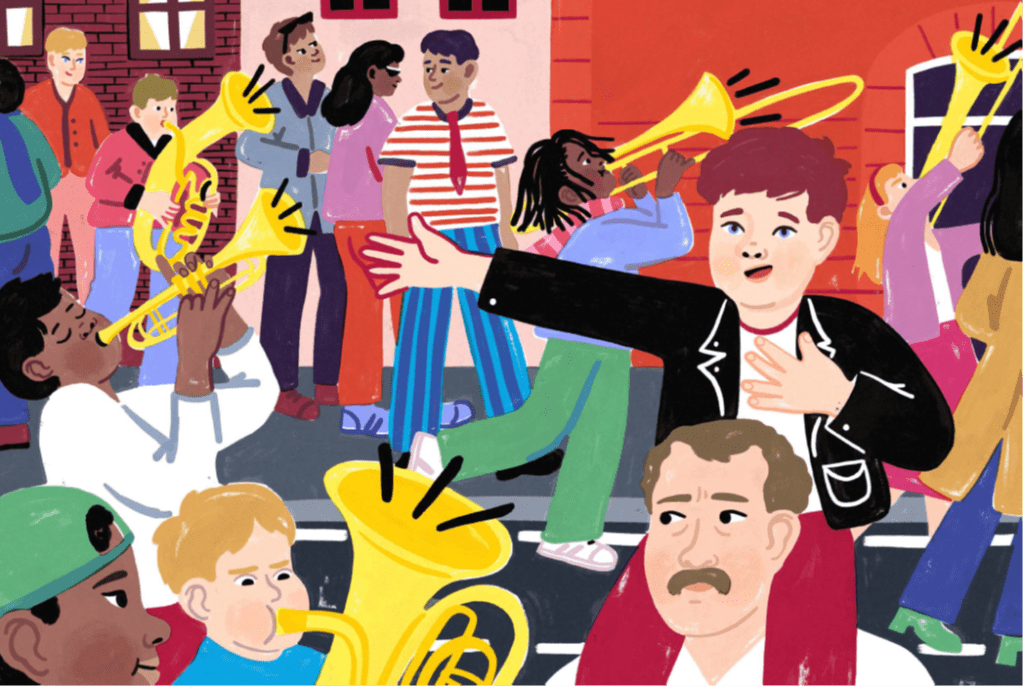
A book composed of generalities about music would be less useful than this one. Readers of. Pantaleo’s work will learn about several distinctive forms of music, which are briefly explained a section at the end of the book. There are bagpipes, acoustic guitars, drums, harmonicas, and brass band.  Musicians are from India, Bali, New Orleans, the American South, and Hawaii, and, of course, from your own community.  The illustrations are boldly colored, and influenced by traditional art.  (The also remind me of Maira Kalman’s work.) They also portray activity, but caught in a specific moment, as in a snapshot.  A girl moves her hands across a piano keyboard, her eyes closed in concentration. A gospel choir captures “hope,” with their voices and hands. A girl sings in the bathtub with a brush as her microphone.  Each image is its own performance.

The design of the book and the composition of each page are also key notes to its success. Four young people surround a campfire. Each one has equal weight in contributing to the whole. A boy strums the guitar. A girl plays a flute. Two others do not play instruments, but they look up towards the sky at shooting stars and the moon.  “Music is connection,” yet, at the same, time each individual in the scene experiences it differently.

The melody of words, the harmony of voices, the choreography of figures, all make And There Was Music instrumental in helping children to understand this form of language. After you share it with them you will both continue to hear the echoes.

Music is connection.

Woman of Heart and Mind

Joni: The Lyrical Life of Joni Mitchell and illustrated by Selina Alko
HarperCollins, 2020

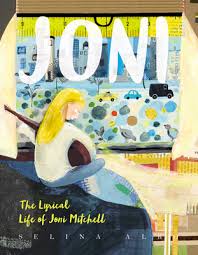
When Roberta Joan Anderson, eventually known to the world as Joni Mitchell, was in school, she had an inspiring English teacher. Mr. Kratzman advised her to approach her writing as she did her visual artworks: “If you can paint with a brush, you can paint with words.”  Selina Alko’s picture book biography of Mitchell embodies that principle in both its text and pictures, which are inextricably linked in this voyage through the singer and composer’s life and work. The author/illustrator and her subject are perfectly matched, making her book accurate, illuminating, and a stunning work of art in itself, as are her earlier books.

Combining acrylic paint and collage, including found objects, Alko creates a complete vision of Joni’s (as she refers to the singer), early life and subsequent development as an artist.  The young Joni is identifiable as the mature woman, and the elements of both “heart and mind,” as one of her memorable lyrics, are intertwined.  First we see Joni as a young girl on the prairie of western Canada, dancing to the sound of birds. Her parents stand in the background, and a train, composed of geometric shapes, collage elements and stamps, passes by.  Every page frames Joni’s life in this inventive format, each object attracting the reader’s eye with a specific relevance to the narrative. A bird’s-eye view of Joni playing the piano shows both her hands and the top of her head, which is crowned with a helix of words, notes, and ink-like spots.

Joni recovers from the childhood scourge of polio. She listens to Pete Seeger and Elvis Presley, attends art school in Calgary, and performs in coffeehouses.  Alko does not omit her failed marriage to folk singer Chuck Taylor, but she chooses not to discuss the painful decision Joni made to give up her daughter for adoption. Nevertheless, this trauma obliquely appears in a picture of Joni writing the lyrics to “Little Green” in dark, bold pencil. Alko could not have referred to every formative experience in her subject’s life, yet she is committed to acknowledge as many of them as possible.

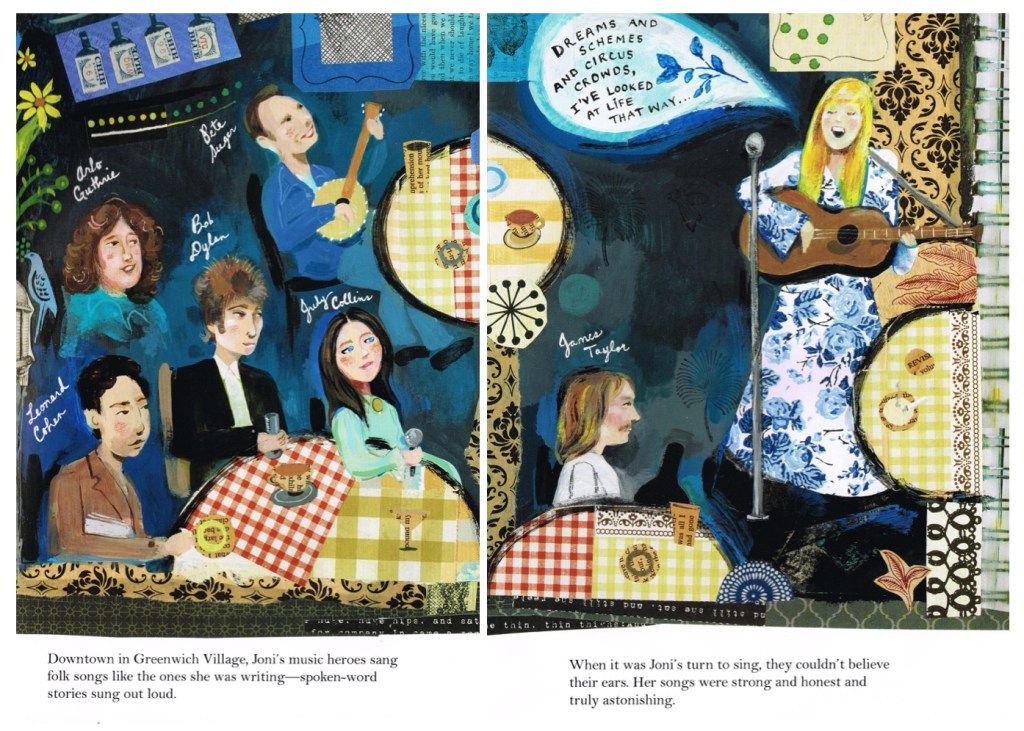
The two pages that chronicle the genesis of Chelsea Morning are another example of this fidelity. Everything is there: the butterscotch curtains, the traffic, the bowl of oranges. You can practically smell the incense.  When Joni performs in Greenwich Village, there are cameos of Leonard Cohen, Judy Collins, Bob Dylan, and other engrossed listeners. Here is your chance to explain to children who these great innovators are.  It will not be difficult to convince kids that listening to Joni “helped people feel understood,” or that, when her fans demanded her older style rather than experiments in jazz, “Joni didn’t care.” 

Alko includes a discography, bibliography, and a thoughtful author’s note explaining why she was drawn to write and illustrate Joni. The result is an explosion of color and poetry, along with a meticulous record of Joni Mitchell’s legacy. This book is for children, teens, and adults.