A Bridge to Somewhere

Late Today – written by Jungyoon Huh, illustrated by Myungae Lee, translated from the Korean by Aerin Park
Eerdmans Books for Young Readers, 2025

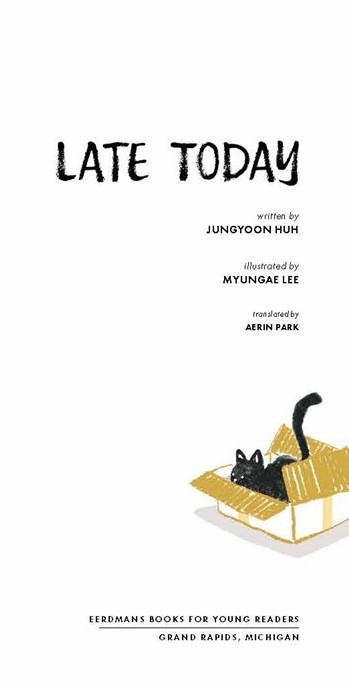
The opening endpapers of Late Today show an overcast sky. The following two pages feature the consequence, a bridge accompanied by the warning that “Morning rush hour traffic is congested all over Seoul,” with the report’s words alternating in word of the report alternating in level relative to the image.  The title page shows an adorable kitten with golden brown eyes that match the lid of the carton which has become her bed. Readers join the traffic jam and the rescue mission.
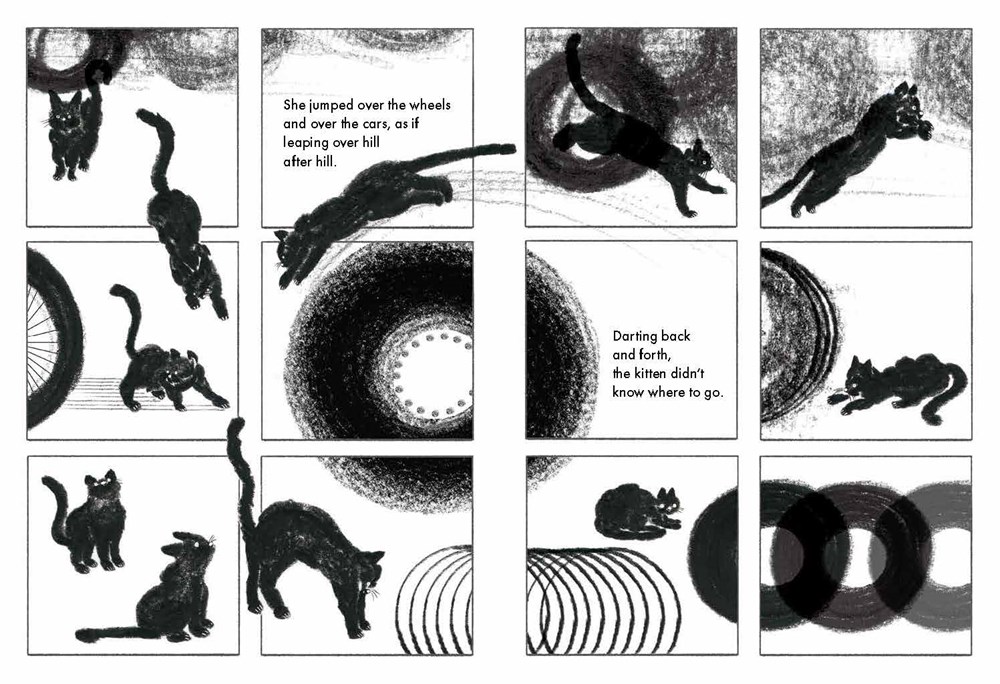
Jungyoon Huh’s minimalist text (ably translated by Aerin Park) conveys just exactly the amount of information needed.  Myungae Lee’s illustrations, rendered in colored pencils and oil pastels, combine black and white scenes, graphic novel panels, and earth and jewel tones against white background. They are beautiful in their simplicity, but also convey motion, sense impressions, and the imminent threat of losing a kitten on a traffic-clogged bridge.  The black font ranges in size, with some pages reminding me of the lettering used in Margaret Wise Brown and Leonard Weisgard’s The Noisy Book, and sequels. (The Winter Noisy Book is illustrated by Charles G. Shaw.)
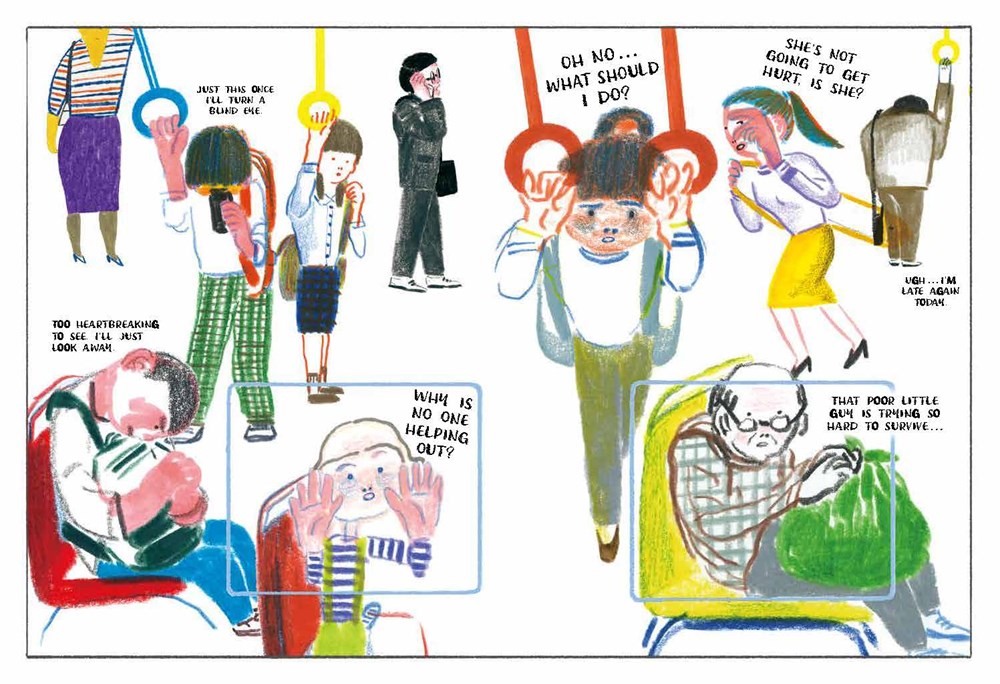
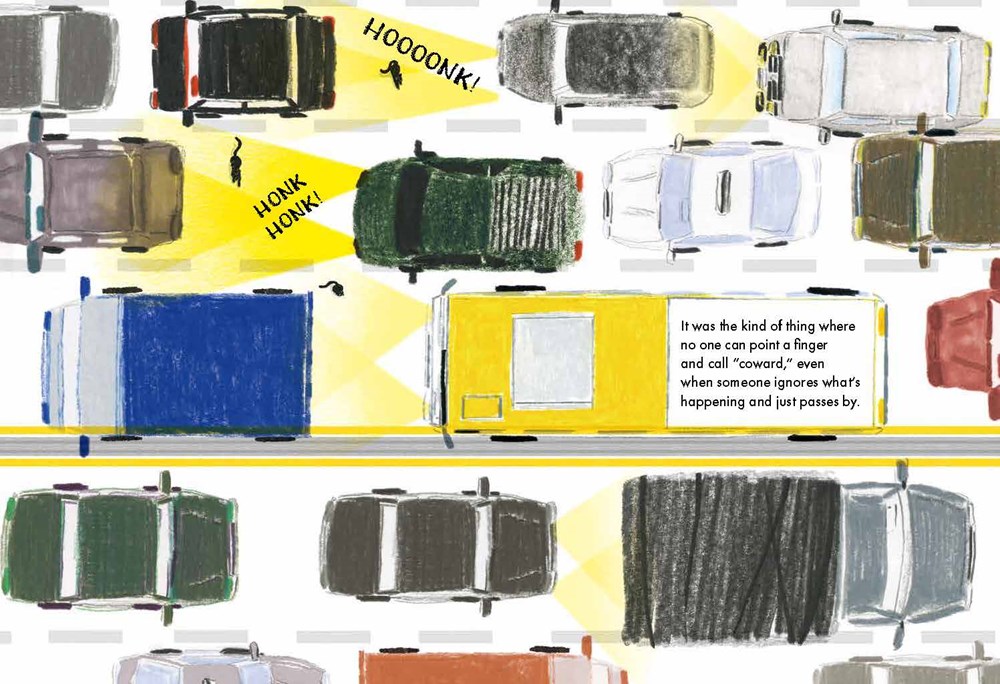
Public transportation passengers, each in isolation, express their own thoughts about the danger, and their appropriate response to the kitten’s plight.  Parents and caregivers sharing the book with children will want to discuss all the implications of these natural, but possibly inadequate, emotions: “Why is no one helping out,” “Too heartbreaking to see. I’ll just look away,” and Oh no…what should I do?” One incredible two-page spread is a bird’s eye view of the vehicles, each one inadvertently threatening the tiny kitten weaving between them. The text is enclosed in a rectangle similar in size to the vehicles themselves, the words visualizing the ominous situation.
Cinematic techniques dedicate to full pages to a darkening storm, and another two to pelting raindrops.  Readers pause and take a deep breath. Then, a driver rescues the kitten, his or her hands cradling the animal in a gesture of human kindness. Someone has intervened at exactly the right moment. The cars and buses move. Everyone is relieved.  Being late is sometimes exactly right.

Navigating Together

Together We Are Family – written and illustrated by Emily Hamilton
Bloomsbury Children’s Books, 2025

Wonderful children’s books each have their own outstanding qualities.  There is no one formula for producing the authenticity and beauty inherent in a distinctive picture book.  Emily Hamilton’s Together We Are Family features a tone of empathy with kids, simplicity that is not patronizing, and pictures that are reminiscent of children’s artwork without mere imitation. 

In the opening picture, the mother lowers her body slightly to speak with her daughter, a young girl using a walker.  The mother’s words are enclosed in a speech bubble bordered by unconnected dashes rather than a continuous curved line.  “You are you and I am me. Together, we are family.”  There is nothing trite about those words to a child.  The facing page shows family portraits framed and posted in their home. Each scene captures a moment: a bird carrying off part of a girl’s ice cream cone, a father holding one daughter and an older daughter’s face peering over the bottom of the photo, sisters on the beach with their back to the viewer.

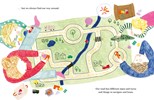
Hamilton’s illustrations are rendered in watercolor and pencil, along with Photoshop.  Simply using media that children might also prefer, including colored pencils and paint, does not necessarily convince readers that the illustrator identifies with their point of view.  The primary colors and naïve brushstrokes need to be accompanied by a sense of identification. In a terrific two-page spread, Hamilton presents a bird’s eye view of a family that embodies the metaphor of finding their way together.  Sitting around a floor mat designed as a town with roads connecting the community, each family member chooses a different activity, but they are working in harmony. The father “drives” a red car in a traffic circle, while one child drives a similar vehicle on her mother’s pants leg. The mother builds a structure with blocks. The younger girl, who is moving a toy alligator, which seems more fanciful and less related to the overall purpose of the game, is just as integrated into the scene.

Frustration is also part of a child’s life, as Hamilton visualizes without judgment.  Putting on her shoes is a challenge for the young girl, as is climbing stairs without the aid of her walker.  As with all children, whether or not they have special needs, anger can erupt unpredictably, as “the moods that catch you unawares.”  While her older sister calmly picks up a piece of fruit at their picnic, the younger girl, frowning, tosses a sandwich into the air. The chaotic merriment of a party is off putting to the child, who stays close to her mother watching the scene with some discomfort. Anyone, young or old, who has ever experienced frenetic social activity as less than an unalloyed joy will relate to this scene.

In a sensitive author’s note, Hamilton explains how her daughter’s disability has influenced their life as a family in specific ways, but she emphasizes how all families inevitably cope with difficulties through support and love.  Together We Are Family resonates with that truth for all readers.

Hello, Baby

My Book of Firsts: Poems Celebrating a Baby’s Milestones – written by Lee Wardlaw, illustrated by Bruno Brogna
Red Comet Press, 2025

Opening Lee Wardlaw and Bruno Brogna’s endearing book about the milestones in a baby’s life is like taking a step, or rather two. The first is into the perspective of a baby or toddler, as well as her caretakers, as each one experiences a sense of accomplishment. The second step leads into classic mid-twentieth century illustration, with pictures that promote nostalgia, but not fantasy.  Babies have always been babies, but ways of visualizing our delight in them have taken different forms.

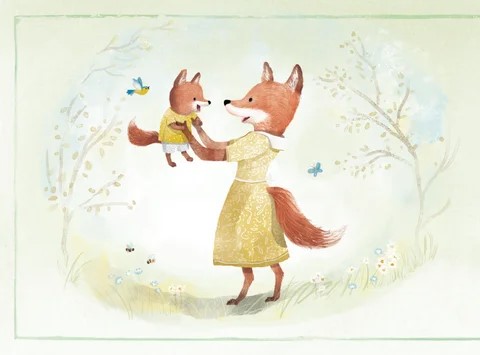
Wardlaw is a prolific poet, with most of her work aimed at older children. In My Book of Firsts she uses direct and off-rhyme, onomatopoeia, and other familiar forms from traditional poetry for the young.  In “First Word,” she charts the series of incomprehensible sounds that eventually become human speech: “Squeaked,/shrieked,/squawked,/and scowled,” “Babbled,/gabbled, jabbered, mooed…” resolves into the surprise of the child’s first word.  Brogna’s accompanying picture shows a mother fox in a smart yellow housedress with white collar, as well as a bushy red tail. She is holding up her kit and they are clearly communicating their mutual joy.

The same mom is at a first birthday party for a bear cub, with other species in attendance. (image).  The bear parents are much stockier than the fox mother, and they are wearing appropriately looser, but still attractive, clothing.  Wardlaw’s poem begins with rhyming couplets that build momentum: “Up early./Family flurry./Bake a cake./Decorate./Guests arrive./Come inside!”  In addition to the cake there is pizza, juice boxes (a more contemporary touch), and other delicately colored pastel items that may be vegetables, pastry, and candy.

Each poem refers to events that parents will recognize. “First Outing” catalogues the crucial items necessary for this milestone. These include the general categories of sunscreen, diapers, and tasty snack, but also the more specific “Flossy cap that Grandma knit.”  A raccoon mother holds her careful checklist and pushes the stroller as fast as she can as her child points to the “adoring fans” waiting to meet him.

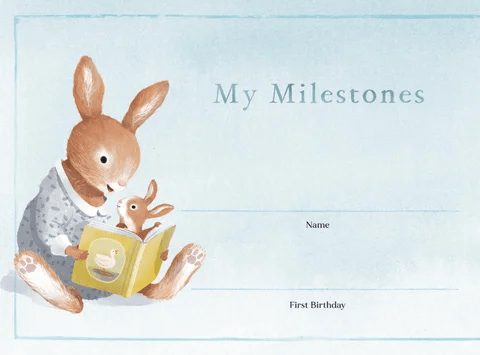
Naturally, one poem is devoted to the accomplishment that any reader of this book would expect. In “First Book,” a rabbit reads to her kit. The book has a duck on its cover, because children’s interest is not limited to their own identity. The first stanza describes how a child first engages with this new object: “What is that?/Let me hold it!/I promise not to bend/or/fold it” She is excited to learn that mother and child can share the experience of this wonderful object. The book is “a perfect fit” for her hands, but “We both can sit/and look at pictures inside of it.” Of course, books end, but reading does not, and the kit demands a second reading, and inevitably many more.

My Book of Firsts includes spaces to record a child’s name, first birthday, first steps, and several more milestones, reinforcing the allusion to classic poetry and illustration. Childrearing methods change, but charting a baby’s progress, with patience and awe, does not.

The Moon is a Melon

How Do You Eat Color – written by Mabi David, illustrated by Yas Doctor, translated by Karen Llagas
Eerdmans Books for Young Readers, 2025

The answer to the question posed in the title of Mabi David and Yas Doctor’s new picture book might be obvious to a child. Color is one of the first categories that children learn to identify. It then becomes integrated into both their imaginary and real worlds. Food, of course, is inextricably associated with color.  How Do You Eat Color, translated from the work of a Filipina author and illustrator, combines simple language with deep metaphors, and images in oil on paper, to express all these connections. 

David poses questions, gives answers, and offers suggestions. (Karen Llagas is an experienced translator, as well as a poet, and the text reflects her expertise.)  The book opens with an intriguing series of inquiries that establish its theme: “Do you know how red tastes?…Is green sweet and cold like your favorite sorbet?”  If so, or if you have never considered those ideas but would like to, then “Feast on color when you eat fruits and vegetables.” Each two-page spread considers the possibility of looking at a color in a new way, as the setting for a multisensory experience.

Yellow first appears as a river surrounded by giant pineapples and ears of corn. A boy and girl, and their lizard friend, row in boats made of mangos. After this journey, they rest on bunches of bananas. The scale and composition of the pictures inverts the sizes of people and plants, with tall carrots rising against the sky as the children, receding into the background, run towards half an orange as the setting sun.  The purple pages mix fruits, vegetables, and human activity, “As you tuck yourself in like a yam, bundled like plums in a basket.” Horizontal stripes on the girl’s dress contrast with the vertical ones on her blanket, as she clutches oversized plums. 

After the core of the book invites children to appreciate the artistic and joyful natures of food, there are several more pages introducing the actual characteristics of different foods and their health benefits.  Instead of a chart, the format is a dialogue, with answers to questions about each food’s definition, how to eat it, and why it is healthful. Finally, David and Doctor complete the circle, emphasizing how a variety of foods, in their rainbow of colors, have both physical and aesthetic benefits. An in-depth exploration of a simple idea, How Do You Eat Color, suggests multiple answers to that fundamental question.