Poems for Every Season: A Year of Haiku, Sonnets, and More – written by Bette Westera, illustrated by Henriette Boerendans, translated from the Dutch by David Colmer
Eerdmans Books for Young Readers, 2026
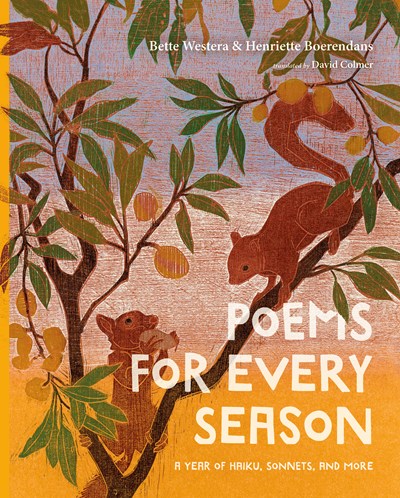
Poems for Every Season is tranquil, beautiful, and also, thorough. There are many excellent illustrated anthologies of poetry for young people (here, for example), and also manuals for how to compose specific types of poetry. Often these how-to books are also anthologies with representative examples of verse forms. Bette Westera, Henriette Boerendans, and translator David Colmer have produced an exceptional book of wonder, for those who are drawn to poetry as well as readers who are tentative about exploring it.
The book’s endpapers open with a flock of birds. Boerendans’s woodcuts embed poems in the world of nature, and the birds seem to be inviting readers to enter this environment, where poems and pictures are more than the sum of their parts. (A brief and useful preface explains how the author and translator have adapted the choice of verse forms to reflect differences between Dutch and English.). Each section begins with the name of the season in large font, placed vertically down the side of one page.
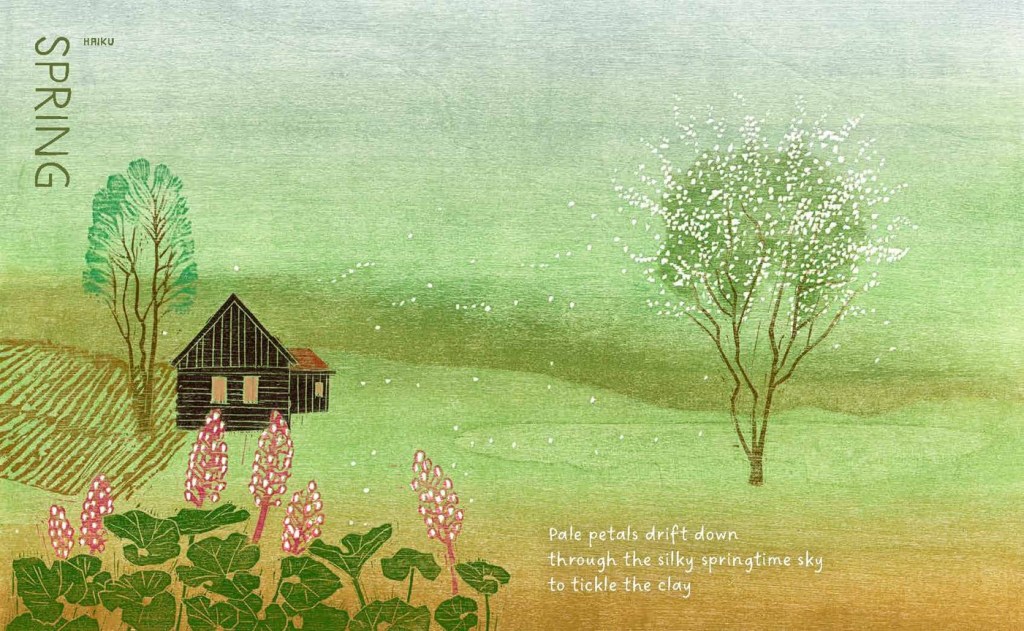
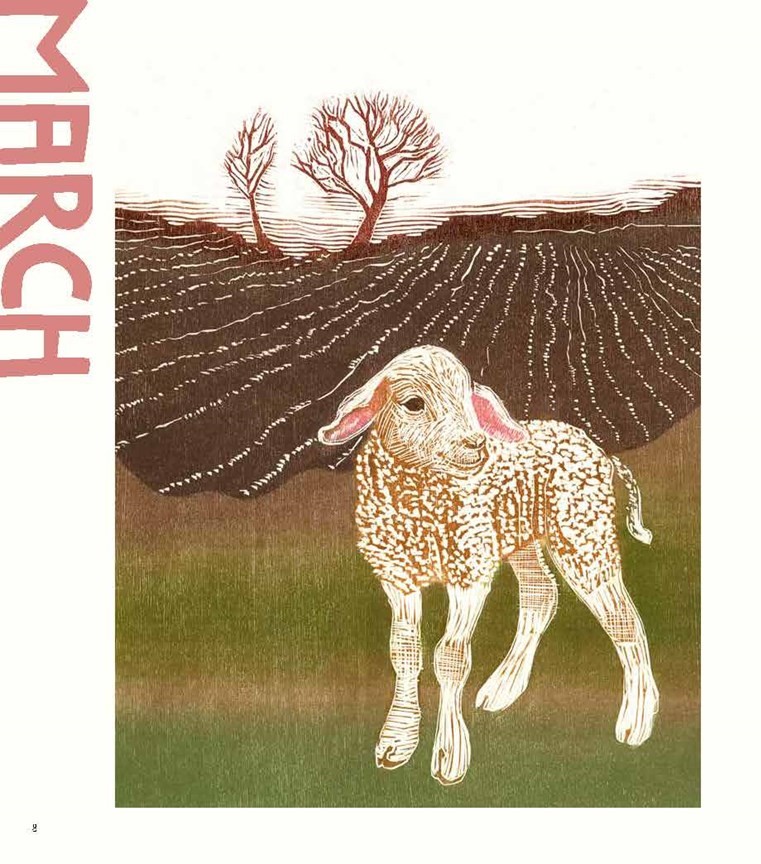
The seasonal page and poem are followed by a page identifying the month, in larger font. This is one of several interesting artistic choices which are not obvious. Do months require more attention than seasons? The variety ensures that reader experience each page and poem as something new.
The animals and plants that share the space of the book each belong where they are placed, but not necessarily in a literal way. For September, a crow sits among apples, both red and gold. The image suggests Asian block prints. On the facing page, two squirrels, facing in opposite directions, seem alert. They may notice the apples, or be looking for other food. The poem is a quatrain. As Westera explains, this form could refer to any poem with four lines, or to a more specific set of rules about rhyme. The tone is informative, but minimally prescriptive. The work of Persian poet Omar Khayyam moved the four lines in the direction of a changed rhyme in the third one. No previous knowledge is assumed. In fact, the famed poet is introduced with the phrase, “He was called Omar Khayyam.”
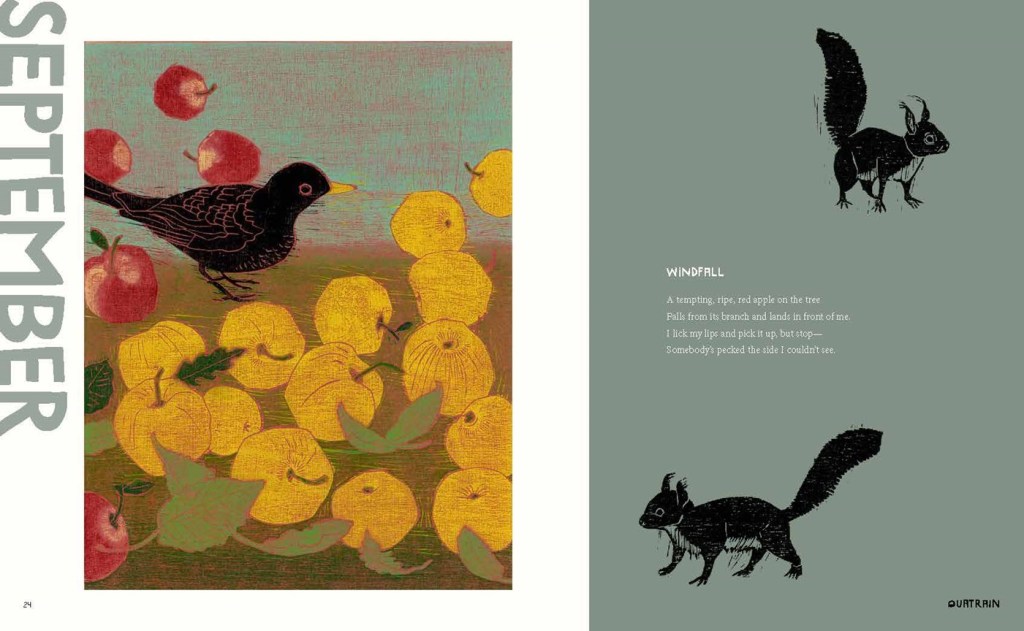
Each season begins with haiku. Every month has a poem in a different verse form. Following the twelve months and their poems, there is a section read by turning the book vertically. There are three columns of text and pictures, which are actually the same ones that appeared earlier, encouraging access to the description of the form that accompanies each poem here. Instructions for how to write in each form are not provided as a formula or a graphic, but they may certainly be used that way by aspiring poets.
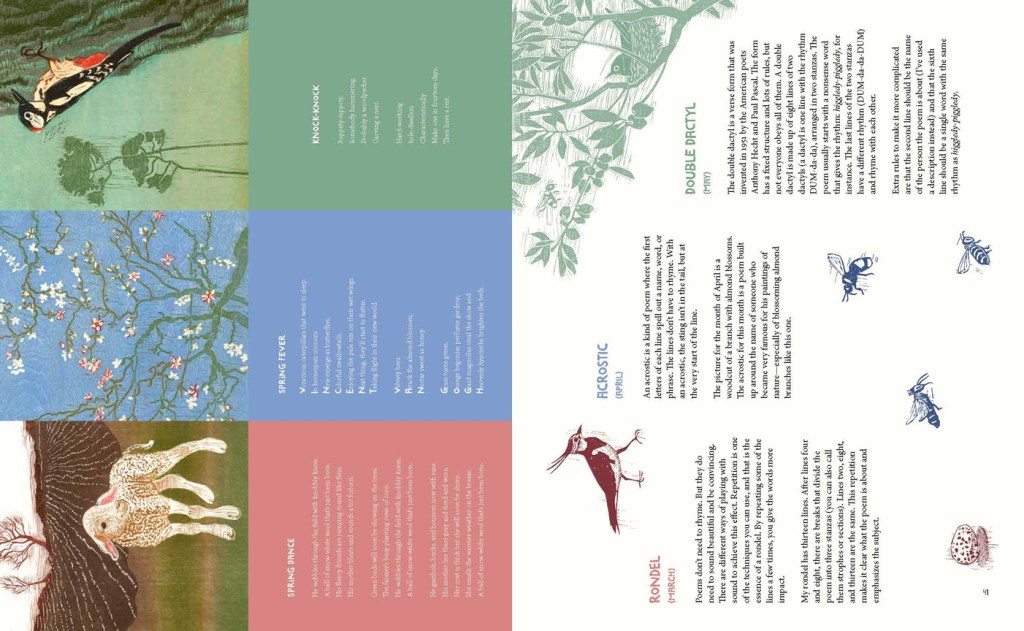
You may be thinking that this format alludes to the way that we read documents digitally, sometimes keeping different windows open. You would be right. The windows here, though, are different! They look outwards at the natural world, inwards at the imagination, and describe the technique of how poems function. Yes, there are similarities to text and hypertext. You have to read this book to believe the incredibly imaginative the synthesis that results.




 Imaginary Elevators