Today I Am a Hamantasch: A Poem for Purim – written and illustrated by Varda Livney
PJ Library, 2026
Purim Possibilities – written by Barbara Kimmel, illustrated by Irina Avgustinovich
PJ Library, 2026
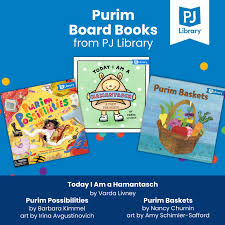
In addition to the Purim board book I reviewed last week, here are two more Purim board books, all from PJ Library; these emphasize the flexibility of who you are on the holiday of Purim. Today I Am a Hamantasch is small, square, scaled to young children’s hands. They may have different ideas for Purim costumes, changing their minds several times before their final decision.
The child in the book is actually a rotating cast of animals: bunny, mouse, cat. She begins as the iconic three-cornered pastry, and then becomes a tree. The sequence seems random. There are cut-out holes on several pages through which the reader can see the animals changing costumes. Queen Esther, of course, is lovely in her pink dress, crown, and proud six-pointed star scepter. There is an interlude, where the bunny decides to just be herself, wearing overalls. Then back to the costumes. The mermaid, again, is a not derived from the Purim story, but the grogger, a noisemaker activated every time the villain, Haman’s, name is mentioned, is key to the Megillat Esther. Back to a cupcake, and to a kitten happy to be herself. If you feel dizzy reading it, that’s to be expected. Purim as a day when norms are reversed, but, finally, the holiday ends and “we’ll all be back to normal.” That’s a relief, maybe.
Purim Possibilities also emphasizes the freedom of temporary change. It begins with a lively scene of the Megillat Esther reading, with the scroll unrolled and held at each end by a young girl. Then we experience the same series of choices, but this time the protagonist is identifiably human. She may impersonate a train engineer, a robot, a superhero, or a baker. Then again, Queen Esther is as heroic as may be imagined, fearless in her glittery outfit. Artistic creativity is part of the story, with colored pencils available to sketch the costumes. Finally, the young artist decides on an eclectic combination of elements. Sometimes you don’t have to make a choice. The book concludes with a selection of outfits as reusable stickers, to be removed from a closet and placed on the girl. Anything seems possible in these two books.
 Imaginary Elevators