Not a Hutch or Burrow

Welcome to the Rabbit Residence: A Seek-and-Find Story – written and illustrated by Haluka Nohana
Chronicle Books, 2026
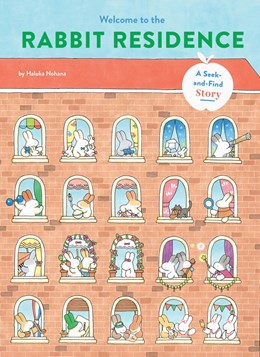
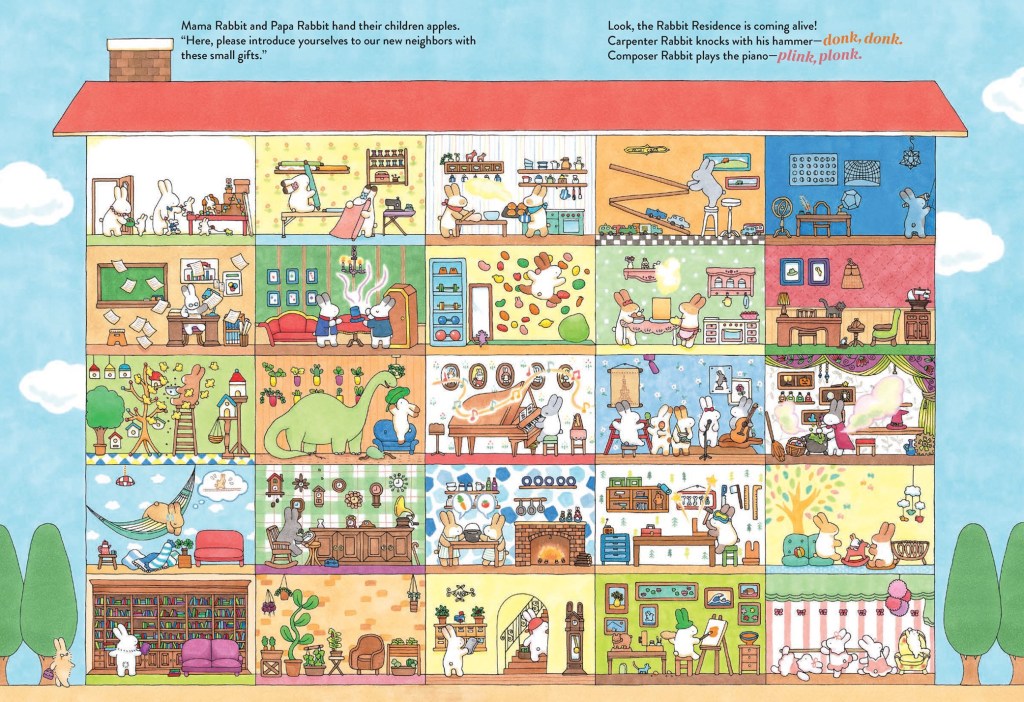
Following her earlier book about animals having fun while living in detailed habitats, author and artist Haluka Nohana has now invited readers to a rabbit residence full of activity. Even early in the morning, there’s a lot going on, even if not everyone is awake. Each room is a complete picture in itself, but the sum total of the cutaway house is a collective delight. The endpapers introduce the rabbits residing in the house. There are bakers, a wizard, a painter, a dinosaur keeper, a band, and many other essential professions. There are quintuplets, not so unusual for rabbits, a clockmaker for an old-fashioned touch, and a sleepy rabbit holding a blanket. He must be too young to have a job.  There is a four-page fold-out spread with text and a full view of the house, and subsequent pictures describe the action, and the text suggests indirectly that reader might want to look for a particular rabbit pastime. “Composer Rabbit plays the piano. – plink, plonk.” Some of the onomatopoeia seems as if it might be taken directly from the original text in Japanese, which adds an intriguing note: “Meanwhile, Painter Rabbit is painting, peta, peta.” The sounds connected to rabbit tailoring are “choki, choki.

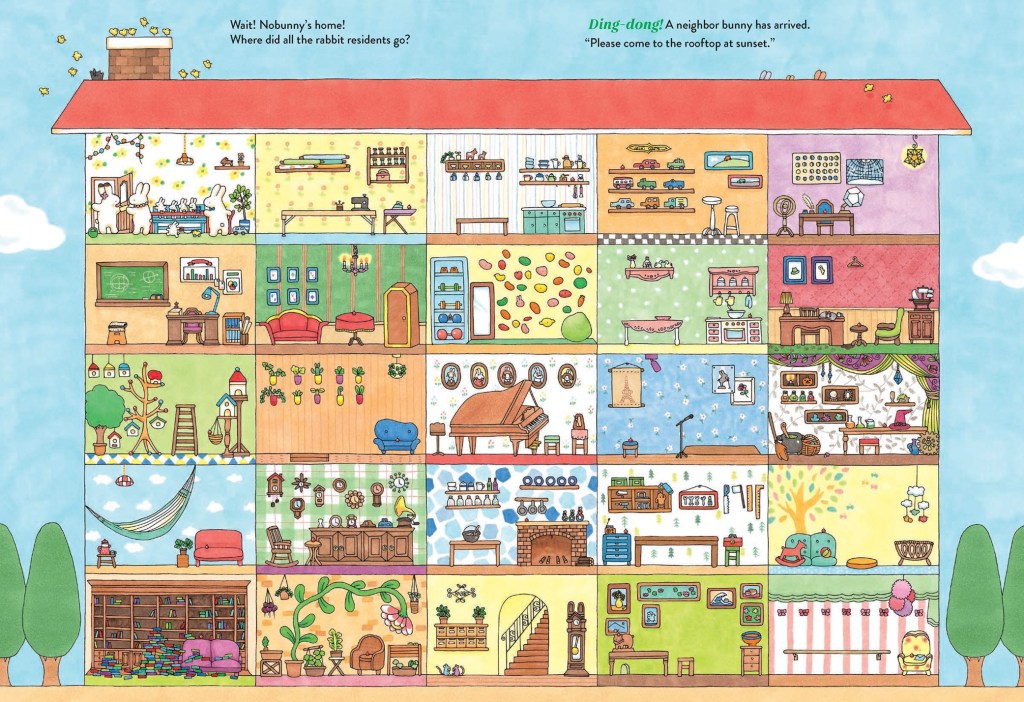
It’s easy to make rabbits appear cute, but these are quite distinctive, even within that category.  They are rounded and fluffy, a bit similar to Moomins. Lots of accessories, as well as brushstrokes denoting movement, add to their strangely realistic appeal. A rabbit exercising seems to have fallen and is seeing stars.  A dinosaur with a long neck, maybe an apatosaurus, leans down into the room below to offer a plant to a clockmaker. There is some ambiguity in these scenes, including magic involving a genie rabbit, whose swirling body may or may not be related to the waft of fragrant steam emanating from the kitchen. A mildly dissonant picture shows an almost empty house, framed by the question, “Wait! Nobunny’s home! Where did all the rabbit residents go?” The rooms appear different without all the busy rabbits.  Books are strewn about the library.  A lone telescope has no astronomer, and the magician’s studio shows an empty hat and a cauldron at mid-stir. It turns out that this swanky building has a rooftop open for a party, with all the familiar tenants as well as the light of shooting stars.
Tune In

And There Was Music – written and illustrated by Marta Pantaleo, translated from the Italian by Debbie Bibo
Eerdmans Books for Young Readers, 2025

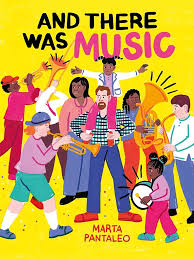
Sometimes children’s books address a question that may seem obvious. How can you explain the meaning of music, the way that people use it to communicate regardless of whether they share a language or a culture? Marta Pantaleo’s And There Was Music offers an answer through spare, poetic language, and bright imagery.  Her answer is non-academic, not definitional. Instead, she approaches the subject through examples that are diverse enough to constitute a whole. Music is shared by everyone, arises from our senses, memories, and emotions, and utilizes different instruments, as well as our voices and bodies, to make itself heard.

The book’s text is pitch perfect.  It alternates statements and questions: “When you listen to music, your heart changes rhythm. Can you hear it?  Some of the statements may seem self-evident: “If you are sad, it can make you feel better.” Still, they need to be said.  The feelings evoked by listening to, or making, music, are largely involuntary: “You don’t decide all this. It just happens.” Some statements are broader, with social and political implications: “Music is a bridge that unites us.”

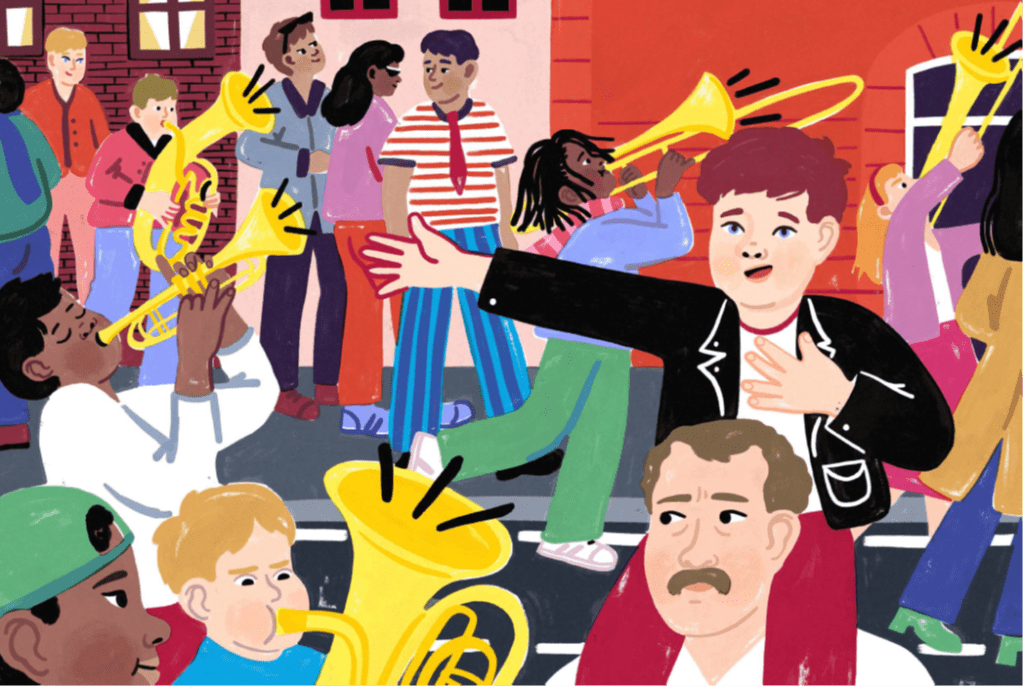
A book composed of generalities about music would be less useful than this one. Readers of. Pantaleo’s work will learn about several distinctive forms of music, which are briefly explained a section at the end of the book. There are bagpipes, acoustic guitars, drums, harmonicas, and brass band.  Musicians are from India, Bali, New Orleans, the American South, and Hawaii, and, of course, from your own community.  The illustrations are boldly colored, and influenced by traditional art.  (The also remind me of Maira Kalman’s work.) They also portray activity, but caught in a specific moment, as in a snapshot.  A girl moves her hands across a piano keyboard, her eyes closed in concentration. A gospel choir captures “hope,” with their voices and hands. A girl sings in the bathtub with a brush as her microphone.  Each image is its own performance.

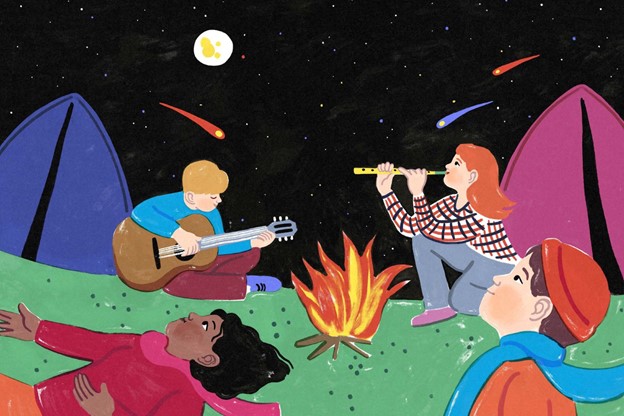
The design of the book and the composition of each page are also key notes to its success. Four young people surround a campfire. Each one has equal weight in contributing to the whole. A boy strums the guitar. A girl plays a flute. Two others do not play instruments, but they look up towards the sky at shooting stars and the moon.  “Music is connection,” yet, at the same, time each individual in the scene experiences it differently.

The melody of words, the harmony of voices, the choreography of figures, all make And There Was Music instrumental in helping children to understand this form of language. After you share it with them you will both continue to hear the echoes.

Music is connection.

You’ve Got Delicious Cuban Food

Guava and Grudges – by Alexis Castellanos
Bloomsbury, 2024

Sometimes it seems that there are an infinite number of possible homages to The Shop Around the Corner and You’ve Got Mail, specifically in young adult fictionGuava and Grudges, by Alexis Castellanos, more than justifies a new entry in this category, with strong characters, great description and dialogue, and affectionately accurate allusions to Cuban American culture.  The protagonists spar, but can’t deny their attachment to one another from their first encounter.  Family opposition is tough, if not on the Romeo and Juliet level.  Food obsession is far from essential to liking this novel, but dedication to one’s craft, in this case cuisine, is certainly central to the plot.

Ana María Ybarra and Miguel Fuentes are both Cuban American high school students whose families own popular bakeries in Seattle.  They meet in L.A. at a college tour, although Ana María has serious doubts about her future as a U.C.L.A. student.  Her dream is to become a pastry chef, unconstrained by the traditional expectations of her father, who has always been wary of innovations at Café y Más, their establishment.  (Ana María’s original ideas have been kept “a dark secret” from her family.) Miguel’s last name is Fuentes, but he is a member of the Morales family through his mother.  As Ana María painfully admits, “hating the Morales family was something I was born into and that I had accepted as a family tradition.” In case you needed a reminder that some family traditions can be ugly, here it is.

The plot contains elements of miscommunication, but the core of Ana María and Miguel’s affection is never seriously in doubt.  The looming specter of college applications only forces Ana María to a different commitment, and to hope that her entry in a culinary contest run by her favorite publication will lead to a scholarship. The outcome of the competition is handled well in the novel, as Castellanos carefully avoids pandering to the reader’s expectations.  Social media is also part of the story, because expertly produced food without a visual media presence is worthless, as everyone knows.  The author’s verbal flourishes create images that are just as powerful. Mishandled groceries lead to damaged goods: “‘Stupid milks,’ I mutter, dropping down to the floor with the desiccated croissants in my hands. They look so shriveled and sad. Is there a market for croissant raisins?”

The support of Ana María’s mother helps to offset her father’s often-oppressive parenting. A great best friend and a sister whose personality serves as a foil also enrich the cast.  Miguel isn’t perfect, but nor is he a self-centered male who must be redeemed by a girl’s love.  Guava and Grudges is rich is more ways than one, and includes a recipe for guava cream cheese thumbprint cookies.