
Journey of the Humpbacks – written by Juliana Muñoz Toro, illustrated by Dipacho, translated from the Spanish by Lawrence Schimel
Eerdmans Books for Young Readers, 2025

Although this fabulous informational book about humpback whales has not relation to Baudelaire’s poem, “L’invitation au voyage,” I could not help thinking of its title and famous refrain when I turned the first page. The author states her purpose: “This is an invitation for us to go on a journey. We don’t need a backpack or shoes. Just our eyes wide open.” Every book fits this description. By framing the experience of reading this way, Juliana Muñoz Toro raises expectations and meets them. Baudelaire invites readers to encounter a world where “Là, tout n’est qu’ordre et beauté,/Luxe, calme et volupté,” (“There, there is nothing but order and beauty,/Richness, calm and beauty.”) Instead of dream world, Muñoz Toro, and illustrator Dipacho, extend an invitation to the natural order and beauty of the environment. Science books for young readers need not omit a sense of wonder.
I won’t try to summarize the wealth of information in this book about the often misunderstood sea mammal, the humpback whale, otherwise known as Megaptera novaiangliae. Did you know that its Latin name means “giant-winged New Englanders?” Probably not, even though you may associate whales with New England, where this one was originally sighted by Europeans. To orient you on your journey, Dipacho’s elegant graphics, paired with captions, text boxes, and color judiciously added to black-and-white. Some of the questions even present the answer upside down, adding the sense of a game. To help you envision scale, a parade of Emperor Penguins sits atop the huge creature, whose principal features are carefully labeled.

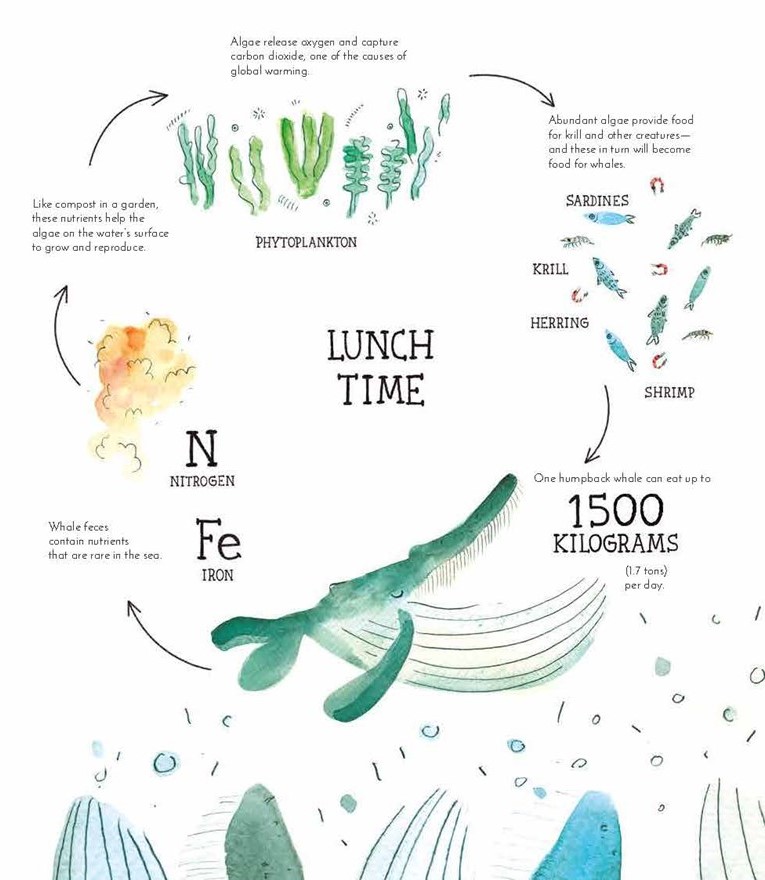
If you come to the book with some basic knowledge of humpback whales, you will still learn a great deal. Nothing is necessarily obvious, including the basic fact that every part of the environment is related to one another. “Nothing that happens in the water does so in isolation.” “Lunch time” involves a nutrients provided by algae, sardines, and krill.

The pictures are meticulously accurate, but also personify the whales a bit, with their balletic movements that seem almost joyful. Referring to the segments of their day as “nap time, “ “time for adventures,” and, of course, “time to breathe,” sets a tone of familiarity, but also awe: “The breathing of humpback whales is long and deliberate, as if they were meditating.” Note the phrase “as if.”

When people appear, they are comically observant, watching the whales and taking notes of what they see. Here Dipacho presents richer colors than in the extensive factual scenes, as he brings humans into the picture. They are important and provide perspective, but they don’t compromise the whales’ starring role. In fact, a wonderful two-page spread categorizing the baleen whale family (image) identifies the humpback, with a touch of humor, as “the protagonist of this book.” Another concise and complete section on the whale’s reproductive life is, again, accurate and also performative.
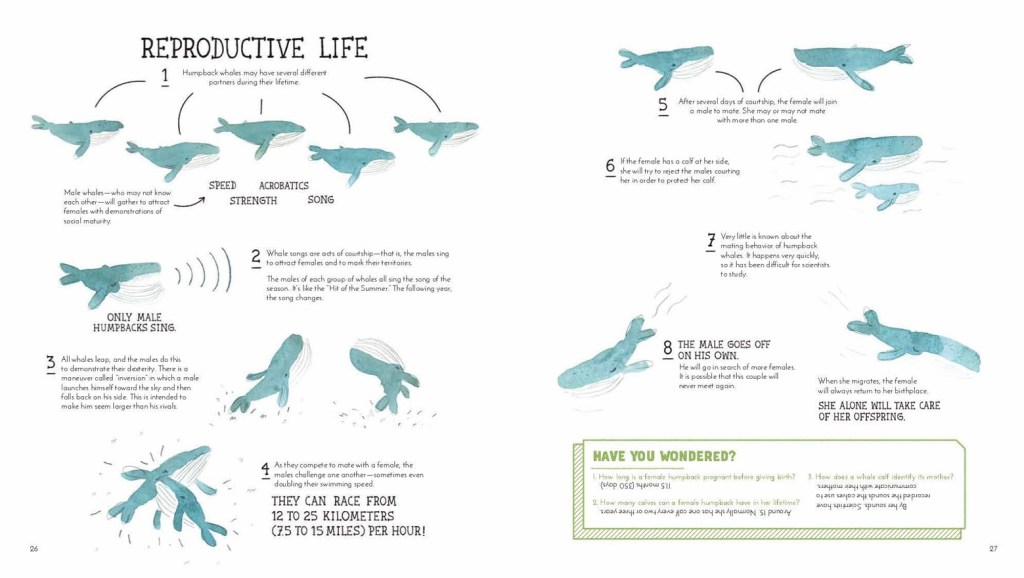
Steps numbered in sequence give the facts and also allow the reader to draw her own conclusions. “She alone will take care of her offspring.” The “Have You Wondered” section reveals how a calf learns to identify its mother. The book’s backmatter declares that it was created by “a team of people who love whales.” By this point, you will not have any doubt of that essential fact.

 Imaginary Elevators