
The Curious Life of Cecilia Payne – written by Laura Alary, illustrated by Yas Imamura
Eerdmans Books for Young Readers, 2026
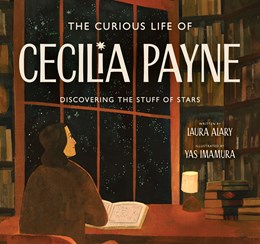
Cecilia Payne-Gaposchkin: her name has the ring of poetry. Before she married Russian scientist Sergei Gaposchkin, she was Cecilia Payne, a brilliant and curious young woman born in the U.K., who later emigrated to the U.S. to pursue studies at Harvard. In Laura Alary and Yas Imamura’s picture book biography (I previously reviewed an Imamura book here), Cecilia Payne’s intellectual gifts and incredible persistence pave the way to her unlikely success as an astrophysicist in an era when women confronted almost insurmountable obstacles. The adjective of the title refers both to Payne’s inquiring mind, and to the way that her distinguished career evolved.
The book begins with a significant statement: “When she was eight years old, Cecilia Payne discovered she was a scientist.” Alary asserts that Cecilia knew this essential fact, not merely an aspiration, about herself. Yet she begins at ground level, only later pursuing the stars. At first, Cecilia notices a bee orchid, a flower that, according to her mother, did not grow in England. The scientific method begins to form in her mind, like the bee enclosed in this flower. She continues to examine the flower, but also promises herself that she will not allow herself to become discouraged by resistance to her ideas.


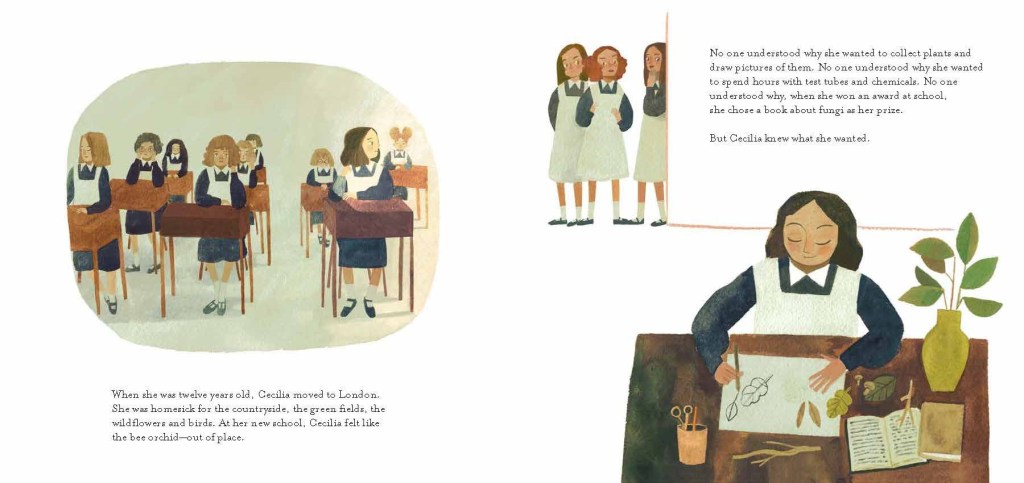
The qualities that drew Cecilia to the study of nature contrast with the social expectations surrounding her. When other children see “twinkling diamonds” in the heavens, she is compelled to determine the actual substance and origin of these beautiful visions.Fortunately, a teacher promotes Cecilia’s scientific literacy, but she encounters setbacks when her family moves to London, where, in a new school, she is isolated by her singular love of knowledge. Imamura’s picture captures both this potentially destructive social deficit, as well as Cecilia’s healthy response. Seated at her desk, she is the only girl looking, not distracted, but intently focused. A group of girls observe her drawing natural objects, but their apparent disapproval cannot dissuade Cecilia from her purpose.
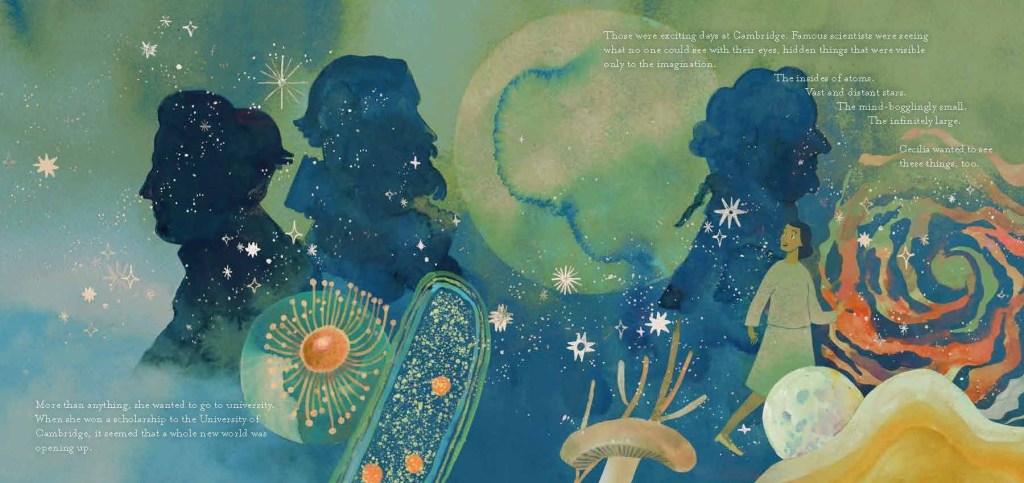
If childhood disdain is difficult, the adult version can be even worse. Arriving at Cambridge University, Payne is thrilled to be in the midst of possibilities. Knowledge is not limited to what is immediately visible. Against a background of male profiles, Imamura envisions a young woman who believes herself to be part of this world, but problems will emerge. Soon she be observing the skies with a telescope, but on the planet earth, men make the rules. Forced to sit by herself in a lecture hall filled with arrogant male scholars, Payne’s determination is forged even further by adversity. Imamura’s quiet depiction of this scene is free of overt drama, but clearly sends a message about the reality that Payne will repeatedly confront.
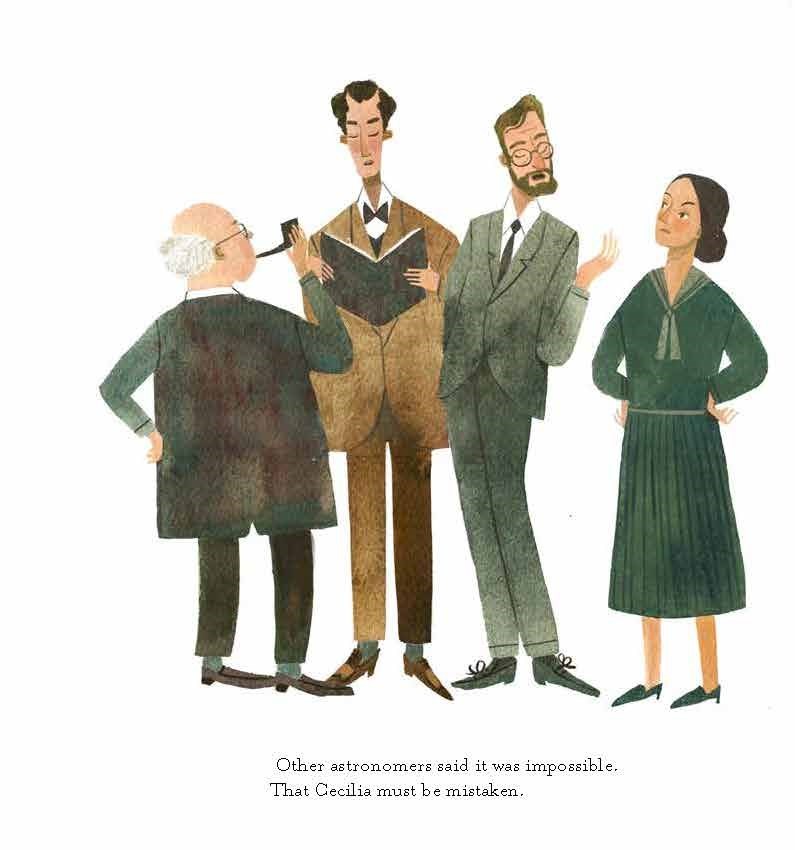
Arriving at Harvard, Payne finds both the proverbial room of one’s own, and the support of other women scientists, but also, a thick layer of disdain beneath the hypocritical veneer of hypocrisy. Imamura’s vision of this phenomenon is perfect. Attempting to explain to her male colleagues her revolutionary hypothesis about the true substance of stars, she is subjected to Harvard mansplaining. One distinguished perpetrator smokes his pipe and looks away, as if her ideas don’t even merit attention. Another stares into a book, while a third, gesturing with his hands for emphasis, informs her that she is wrong. In a later scene of understated triumph, Payne engages with her students, encouraging their questions and treating them with respect.
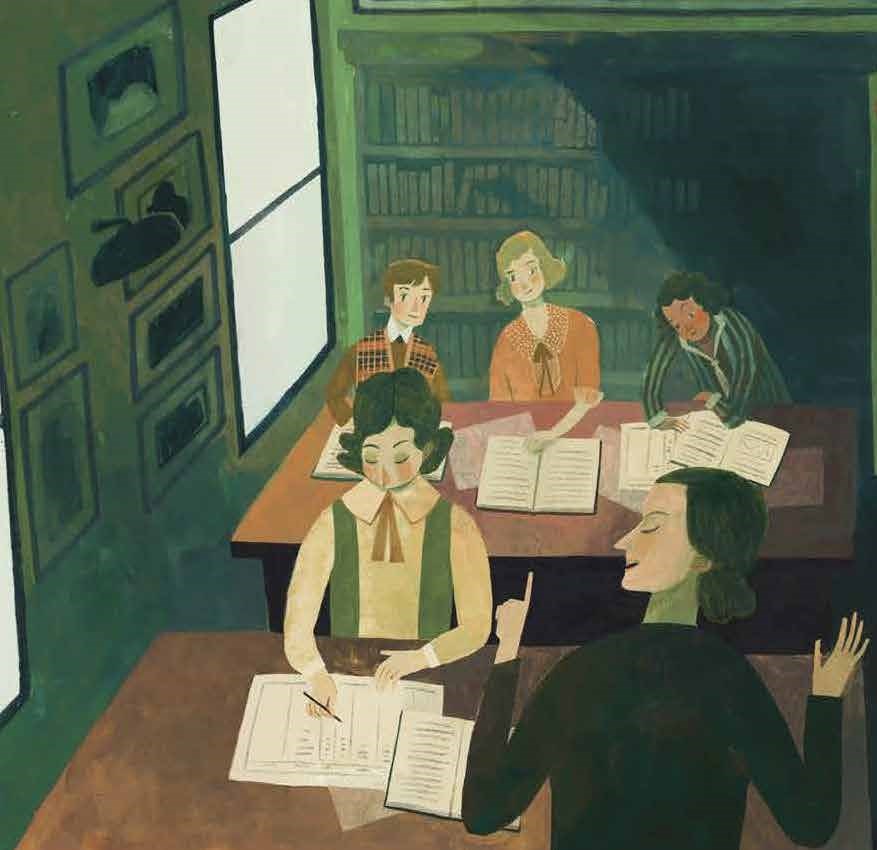
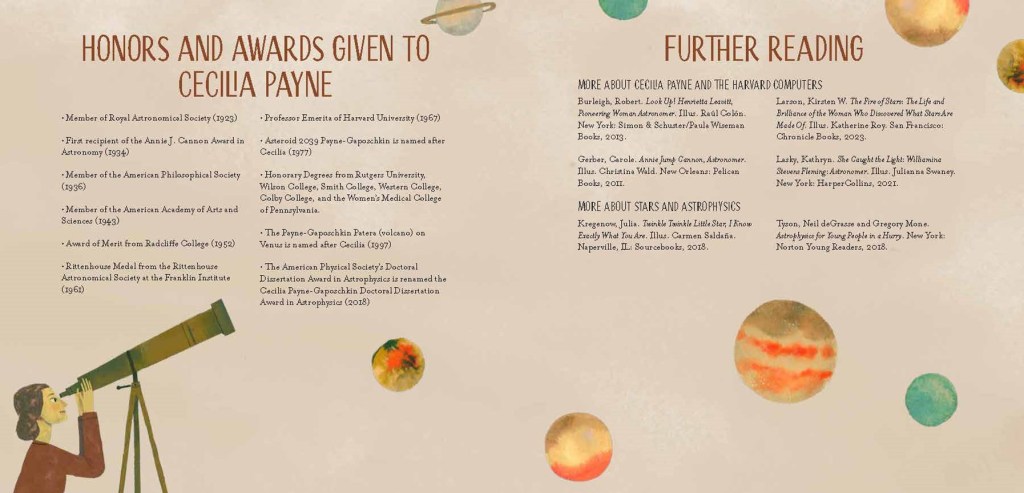
There are many excellent picture books about women in the sciences (for example, I have previously reviewed biographies of Emmy Noether, Lise Meitner, and Rosalind Franklin). Brilliance and determination are not always enough to assure fairness. The detailed backmatter of The Curious Life of Cecilia Payne offers clarification about her life, times, and successful career, with Imamura’s beautiful illustrations complementing the information, as it does everywhere in this outstanding and inspiring book.
 Imaginary Elevators