A Bridge to Somewhere

Late Today – written by Jungyoon Huh, illustrated by Myungae Lee, translated from the Korean by Aerin Park
Eerdmans Books for Young Readers, 2025

The opening endpapers of Late Today show an overcast sky. The following two pages feature the consequence, a bridge accompanied by the warning that “Morning rush hour traffic is congested all over Seoul,” with the report’s words alternating in word of the report alternating in level relative to the image.  The title page shows an adorable kitten with golden brown eyes that match the lid of the carton which has become her bed. Readers join the traffic jam and the rescue mission.

Jungyoon Huh’s minimalist text (ably translated by Aerin Park) conveys just exactly the amount of information needed.  Myungae Lee’s illustrations, rendered in colored pencils and oil pastels, combine black and white scenes, graphic novel panels, and earth and jewel tones against white background. They are beautiful in their simplicity, but also convey motion, sense impressions, and the imminent threat of losing a kitten on a traffic-clogged bridge.  The black font ranges in size, with some pages reminding me of the lettering used in Margaret Wise Brown and Leonard Weisgard’s The Noisy Book, and sequels. (The Winter Noisy Book is illustrated by Charles G. Shaw.)

Public transportation passengers, each in isolation, express their own thoughts about the danger, and their appropriate response to the kitten’s plight.  Parents and caregivers sharing the book with children will want to discuss all the implications of these natural, but possibly inadequate, emotions: “Why is no one helping out,” “Too heartbreaking to see. I’ll just look away,” and Oh no…what should I do?” One incredible two-page spread is a bird’s eye view of the vehicles, each one inadvertently threatening the tiny kitten weaving between them. The text is enclosed in a rectangle similar in size to the vehicles themselves, the words visualizing the ominous situation.

Cinematic techniques dedicate to full pages to a darkening storm, and another two to pelting raindrops.  Readers pause and take a deep breath. Then, a driver rescues the kitten, his or her hands cradling the animal in a gesture of human kindness. Someone has intervened at exactly the right moment. The cars and buses move. Everyone is relieved.  Being late is sometimes exactly right.

The Other Side of Trouble

Trouble Dog: From Shelter Dog to Conservation Hero – written by Carol A. Foote, illustrated by Larry Day
Eerdmans Books for Young Readers, 2025

There is a lot of action in Trouble Dog. There is also an abundance of information, a likeable main human character, and a surprising amount of humor.  Carol A. Foote has combined two real-life conservation dogs into one fictional hybrid named Tucker.  Caught in a cycle of adoption and rejection, he is always returned to the animal shelter that has given up on placing him. Then, along comes Laura, a classic heroine who refuses to give up on an unlikely pet who has driven everyone else to distraction. Larry Day’s pictures are full of action and color, setting a motion Laura and Tucker’s journey from trouble to success.

The opening end papers introduce Tucker in some typically frenetic canine activity. Then it escalates, as every home the shelter finds for him is subjected to chaos.  Tucker manages to overturn an aquarium and books in one place. He grabs a girl’s sweater and won’t let go. A man attempting to read his newspaper looks enraged as Tucker grabs it and leaves a litter of overturned items in his wake.  When we next see him, Tucker is a lonely prisoner in a cage, “watching everyone pass him by.”

Laura is a sturdy figure with a ponytail, flannel shirt, and jeans.  She is as no-nonsense as Mary Poppins, and she also intuits something about Tucker that everyone has missed. His energy can be put to good use.  Even though her home is quickly as disordered as every other place Tucker has been, she has a vision and the practical sense to implement it.  Dogs, as readers learn in Foote’s detailed backmatter, have a highly developed sense of smell.  Laura observes Tucker carefully and evaluates his routine and abilities.  She isn’t just kind and patient, but methodical, as well. 

Eventually Tucker gets a job, or a series of jobs. The details in the text are embedded in words as colorful as the pictures. “Tucker’s first job was to find rosy wolf snails in Hawaii.” (image). He travels the world, sniffing out “moon bears in China, mountain lions in Chile, and elephants in the jungles of Myanmar” in a narrative as exciting as one by Jules Verne, but rooted in the truth.  In a two-page spread, Tucker crosses the gutter between pages. An elephant marches ahead of him, dwarfing the dog in size, but not in energy.  Three researchers form a determined row in the background, to his left.  The image captures the cooperation necessary for Tucker to succeed in helping scientists to learn about species in need of protection.

Not every outing produces results easily. In Zambia, Laura’s optimism is tested, looking for cheetah scat and coming up short.  When Laura insists that “I trust Tucker,” who finally leads them to the right location, she is not relying only on her affection for the dog. Through hard work and astute decisions, she and Tucker have become a team.

Four pages of additional information and photographs are organized in a question-and-answer format, giving the bigger picture of how conservation animals, as well as other service animals, provide essential services.  A selected bibliography is accompanied by an oval portrait of Laura and Tucker relaxing at home. I hope that no one misses one title, by Alexandra Horowitz, Inside of a Dog: Young Readers Edition: What Dogs See, Smell, and Know. Just parenthetically, the title refers to the famous quip usually attributed to Groucho Marx: “Outside of a dog, a book is man’s best friend. Inside of a dog, it’s too dark to read.”  It’s definitely not too dark to read inside this book.

Imagining Who Wore Them

Little Shoes – written by David A. Robertson, illustrated by Maya McKibbin
Tundra Books, 2025

Many Indigenous children, in both Canada and the U.S., suffered the trauma of being removed from their families and placed in residential schools funded by the government and often controlled by different Christian denominations.  Deprived of their heritage, and often subject to physical and emotional abuse, these children would be lost to history if not for concerted efforts to publicize their experience and to demand restitution and atonement.  Little Shoes is a picture book by acclaimed author David A. Robertson (see my reviews here and here and here), a member of Norway House Cree Nation, illustrated by Maya McKibbin, of Ojibwe, Irish, and Yoeme heritage (Robertson and McKibbin have collaborated before). They have taken on the weighty task of presenting a catastrophic loss to young readers, but also offering hope and determination.  With poetic text and images of family life that are both familiar and mystical in tone, they have achieved this goal.

The endpapers feature constellations, introducing a central theme of each person’s place in the universe.  James, who understands the principles of astronomy from his science class, opens the curtains in his room to the moonlight. He asks his mother to clarify how and why his feet remain firmly on the ground if the Earth is spinning in space. The answer is only one of several which his mother will frame truthfully, and also use to elaborate on other questions which will naturally follow. She reassures him that his Kōkom’s, (grandmother’s) explanation about their origins is valid, but adds, “even though you’re from the stars, your home is right here with me.”

The love between a parent and child, and the enveloping warmth of his community, are anchors in James’s life.  His intense curiosity places demands on a parent who is obviously committed but exhausted, when he returns to her room with a request to hear about “every single constellation,” His own attempt to visualize and trace them in the night sky is insufficient.  The dialogues between children and their caregivers are open ended, and the book swerves from the dimensions of the cosmos to the specific history of injustice that remains unresolved.

James and his kōkom set out for one of their frequent walks, but his time it is transformed into a march.  A daily experience becomes a metamorphosis, and his grandmother takes on the role of teaching about a part of their lives that is far more difficult to internalize that the motions of the planets. The little shoes of the title are those of Indigenous children whose deaths are acknowledged by Kōkom with the haunting phrase that they “had gone to residential school but had not come home.”  Shoes as a metonym for children who have died seems to capture a sense of a life that is unnaturally cut short. Other articles of clothing are perhaps less universal, and small shoes also reflect the scale of the children relative to adults, both those who loved them and those who inflicted torture.  A similar allusion to this loss has been used in many memorials to child victims of the Holocaust. (Of course, while some of those children, like the Indigenous victims, died of abuse, neglect, and disease, many were murdered immediately upon arrival at a death camp.  Chronicling atrocities requires acknowledging both what they share and common and how they differ.)

Robertson and McKibben do not attempt a simplistic response to James’s fears. He interprets the frightening facts through the lens of loneliness, asking his mother how his own grandmother had coped with the deprivation of her isolation in the residential school.  His mother responds that her sister and she had “cuddled,” paralleled by McKibbin’s image of mother and son sharing the same physical contact. Their bond is unbreakable, even if mitigated by anguish.  The honesty of Little Shoes is an antidote to fear.

The Happiest Country, a Long Time Ago

Happy Times in Finland – written by Libushka Bartusek, illustrated by Warren Chappell
Alfred A. Knopf, 1941

Everyone knows that Finland is allegedly the happiest country in the world.  You certainly can’t take these simplistic measures too seriously, and comparing Finland to other countries with entirely different histories, economies, and demographics is useless.  I recently reread an unusual childhood favorite, which I had bought at a library used book sale. Its appeal to me at the time remains vague. I would read almost anything, and it had lovely pictures and promised to tell a story about a distant part of the world. Happy Times in Finland, by  Libushka Bartusek, was published in 1941. At that point, it was indisputably not happy at all.  Having been invaded by the Soviet Union, they eventually allied with Germany in that country’s war with its Russian enemy.  This was a bad choice, but it is not reflected in the book, which takes place in the idyllic time period before the war.

There is minimal plot and character development in the book, but a lot of folklore.  To summarize the improbable premise, Juhani Malmberg, a Chicago Boy Scout with Finnish immigrant parents, goes to visit his ancestral homeland.  He is able to take this expensive trip due to the generosity of his father’s employer at a furniture factory, Mr. Adams.  Finland is known for, besides an improbable level of happiness, abundant high-quality wood. A furniture manufacturer would be eager to see firsthand the source of his best supplies. Since Mr. Malmberg is such a loyal employee, his benevolent boss actually takes Juhani along, for free! He has the opportunity to see his beloved grandparents, as well as his aunt, uncle, and cousins.  In addition, Juhani becomes an ambassador from the American Scouts to their Finnish counterparts.  Aside from missing his parents, there’s a lot of happiness here.

Poetic language fulfills expectations about a land endowed with natural resources, and steeped in literature.  Approaching land, Juhani seems to be expecting a myth and he finds one: “Sure enough, there it was, just as his mother said it would be: an expanse of water, blue as sapphire, with green islands dotting it, as though some giant had scattered a mammoth handful of emeralds on a silver-streaked scarf.”  Not only the environment, but its people, are described with hyperbole. Oddly, almost everyone is blond.  Finland has a Swedish minority; the name “Malmberg” indicates that his father’s family is descended from this group. His cousins’ last name is Kallio, of Finnish origin.

Finnish is not a Scandinavian language, but is related most closely to Estonian and Hungarian. (A glossary of Finnish words is included at the end of the book.) Here is a description of Juhani’s aunt, a veritable Amazon of pale beauty: “She was tall and blond, so blond, in fact, that Juhani thought she was white-haired…she had great dignity…he felt as though he were at the feet of some exceedingly beautiful statue, all made of silver and bronze and pearl…her teeth gleamed like mother-of-pear.” There are even references to “Viking blood.”

The few realistic elements stand out because of their minimal role in the story.  Aunt Kallio, Aiti to her children, has favorites among her offspring.  Her older son, Jussi, will vicariously fulfill her own dream by becoming an architect, a career closed to women. Eero, the younger boy, is not academically oriented. Unlike his parents, he prefers manual labor. She keeps her disappointment to herself, only thinking how he lacks “initiative.” “Oh, me! she sighed, one could not be everything.”  This statuesque symbol of perfection is unable to tolerate individual differences.

Warren Chappell’s illustrations, some in color and others sepia, appear to be lithographs.  They are stylized images, whether portraying men in a sauna or women clothed in traditional costumes for festivals. There is a haunting image of a blind storyteller who recites Finnish epic poetry.  Mr. Adams recognizes that the Kalevala’s metrics had influenced Longfellow’s composition of Hiawatha. The Old World and the New touch one another in this tale of immigrant roots, written as the shadow of fascism descended on Europe. It’s blatantly out-of-date and also oddly appealing, just for that reason.

Tune In

And There Was Music – written and illustrated by Marta Pantaleo, translated from the Italian by Debbie Bibo
Eerdmans Books for Young Readers, 2025

Sometimes children’s books address a question that may seem obvious. How can you explain the meaning of music, the way that people use it to communicate regardless of whether they share a language or a culture? Marta Pantaleo’s And There Was Music offers an answer through spare, poetic language, and bright imagery.  Her answer is non-academic, not definitional. Instead, she approaches the subject through examples that are diverse enough to constitute a whole. Music is shared by everyone, arises from our senses, memories, and emotions, and utilizes different instruments, as well as our voices and bodies, to make itself heard.

The book’s text is pitch perfect.  It alternates statements and questions: “When you listen to music, your heart changes rhythm. Can you hear it?  Some of the statements may seem self-evident: “If you are sad, it can make you feel better.” Still, they need to be said.  The feelings evoked by listening to, or making, music, are largely involuntary: “You don’t decide all this. It just happens.” Some statements are broader, with social and political implications: “Music is a bridge that unites us.”

A book composed of generalities about music would be less useful than this one. Readers of. Pantaleo’s work will learn about several distinctive forms of music, which are briefly explained a section at the end of the book. There are bagpipes, acoustic guitars, drums, harmonicas, and brass band.  Musicians are from India, Bali, New Orleans, the American South, and Hawaii, and, of course, from your own community.  The illustrations are boldly colored, and influenced by traditional art.  (The also remind me of Maira Kalman’s work.) They also portray activity, but caught in a specific moment, as in a snapshot.  A girl moves her hands across a piano keyboard, her eyes closed in concentration. A gospel choir captures “hope,” with their voices and hands. A girl sings in the bathtub with a brush as her microphone.  Each image is its own performance.

The design of the book and the composition of each page are also key notes to its success. Four young people surround a campfire. Each one has equal weight in contributing to the whole. A boy strums the guitar. A girl plays a flute. Two others do not play instruments, but they look up towards the sky at shooting stars and the moon.  “Music is connection,” yet, at the same, time each individual in the scene experiences it differently.

The melody of words, the harmony of voices, the choreography of figures, all make And There Was Music instrumental in helping children to understand this form of language. After you share it with them you will both continue to hear the echoes.

Music is connection.

Hello, Baby

My Book of Firsts: Poems Celebrating a Baby’s Milestones – written by Lee Wardlaw, illustrated by Bruno Brogna
Red Comet Press, 2025

Opening Lee Wardlaw and Bruno Brogna’s endearing book about the milestones in a baby’s life is like taking a step, or rather two. The first is into the perspective of a baby or toddler, as well as her caretakers, as each one experiences a sense of accomplishment. The second step leads into classic mid-twentieth century illustration, with pictures that promote nostalgia, but not fantasy.  Babies have always been babies, but ways of visualizing our delight in them have taken different forms.

Wardlaw is a prolific poet, with most of her work aimed at older children. In My Book of Firsts she uses direct and off-rhyme, onomatopoeia, and other familiar forms from traditional poetry for the young.  In “First Word,” she charts the series of incomprehensible sounds that eventually become human speech: “Squeaked,/shrieked,/squawked,/and scowled,” “Babbled,/gabbled, jabbered, mooed…” resolves into the surprise of the child’s first word.  Brogna’s accompanying picture shows a mother fox in a smart yellow housedress with white collar, as well as a bushy red tail. She is holding up her kit and they are clearly communicating their mutual joy.

The same mom is at a first birthday party for a bear cub, with other species in attendance. (image).  The bear parents are much stockier than the fox mother, and they are wearing appropriately looser, but still attractive, clothing.  Wardlaw’s poem begins with rhyming couplets that build momentum: “Up early./Family flurry./Bake a cake./Decorate./Guests arrive./Come inside!”  In addition to the cake there is pizza, juice boxes (a more contemporary touch), and other delicately colored pastel items that may be vegetables, pastry, and candy.

Each poem refers to events that parents will recognize. “First Outing” catalogues the crucial items necessary for this milestone. These include the general categories of sunscreen, diapers, and tasty snack, but also the more specific “Flossy cap that Grandma knit.”  A raccoon mother holds her careful checklist and pushes the stroller as fast as she can as her child points to the “adoring fans” waiting to meet him.

Naturally, one poem is devoted to the accomplishment that any reader of this book would expect. In “First Book,” a rabbit reads to her kit. The book has a duck on its cover, because children’s interest is not limited to their own identity. The first stanza describes how a child first engages with this new object: “What is that?/Let me hold it!/I promise not to bend/or/fold it” She is excited to learn that mother and child can share the experience of this wonderful object. The book is “a perfect fit” for her hands, but “We both can sit/and look at pictures inside of it.” Of course, books end, but reading does not, and the kit demands a second reading, and inevitably many more.

My Book of Firsts includes spaces to record a child’s name, first birthday, first steps, and several more milestones, reinforcing the allusion to classic poetry and illustration. Childrearing methods change, but charting a baby’s progress, with patience and awe, does not.

Drawing Welcome Conclusions

Drawing Is…Your Guide to Scribbled Adventures – written and illustrated by Elizabeth Haidle
Tundra Books, 2025

The somewhat clichéd term “interactive” is only marginally useful for describing Elizabeth Haidle’s Drawing Is…Your Guide to Scribbled Adventures.  Reading, and using, this practical and philosophical guide does not involve lifting flaps or choosing endings, although it does encourage choosing paths. Instead, from the very first page, it challenges young (and older) readers to think about what it means to use your imagination in a visual form.  There are questions and suggested pathways, graphics, lists, numbers, black, white, and color.  Every sentence and image is related to all the others, becoming points of entry to the creative process.  All this happens without a touch of pretense!

First, you open the book to see the endpapers, a collection of photographed tools of the trade: pencils, erasers, pens, crayons, brushes.  Then, a black and white doodle with grey sketching presents a small man lifting a, proportionally, huge pencil, reflecting his effort. Haidle prepares you to steer the course with a definition that is simultaneously ambitious and reassuring: “Drawing is two-dimensional traveling. You can travel far away. You can drive inward.”  If you have ever felt discouraged trying to draw, her negative definitions will resonate. Drawing is definitely not a contest, an endeavor exclusively for the talented, nor a “waste of time.” Once you get that out of the way, you can move forward.  As Haidle’s checklist humorously points out, if you blink, inhale, exhale, read, or listen, you can draw.

The demonstrative drawings include lines, shading, color, scale, contrast, and texture, all presented with no assumptions about prior knowledge.  But those elements are not isolated from others: magic, wonder, feeling, and focus.  Haidle convinces the reader to be open to experience through her own example.  Along with guidance through concrete steps, she openly acknowledges the ineffable part of self-expression.  “Here are some places that I’ve visited in my sketchbook” lists, not the Eiffel Tower or the neighborhood park, but a “magical library,” a place where she “can feel safe,” and the state of feeling “calm,” pictured as a figure safely ensconced in a volume with smiling eyes and mouth. On the other hand, sometimes an attempt fails, otherwise known as “drawings that turn out awful.”  Don’t worry, but do “watch out for the part of your brain that wants to quit!”

The more mechanically oriented pages are just as filled with delight as the emotional ones. Using contrast to create a lovely owl out of lines, dots, dark, and light is a section you can immediately put to use, while still contemplating Haidle’s vision of art.  There is even a glorious two-age “Intermission” at the middle of the book, informing you that images of baby donkeys, or something the equivalent in cuteness, will help you to pause and recalibrate your gaze. If you are contemplating a self-portrait, (image) unexpected directions can lead to a surprising kind of accuracy. 

There are a number of wonderful books about drawing for children and adults to share, and I have used many of them. Ed Emberley is definitely the grandfather of simplicity in drawing. Contemporary authors such as Kamo, Sachicko Umoto, Annelore Parot, and Kimiko Sakimoto, among authors, have written lovely guides with beautiful graphics. Elizabeth Haidle has approached her subject from a completely different angle; this is one of the best, most complete, books on the subject I have seen, a truly essential work.

There are a number of inspiring people within the pages of this book: André Breton, an inventor of surrealism; the cartoonist Lynda Barry, poet Emily Dickinson, and the great Japanese master of print making, Hokusai. The humility interwoven with genius led him to state that his work before the age of 70 is unrealized, compared to what he hopes to produce when he reaches 90 or 100.  Even as metaphor, this endless faith in persistent creativity will motivate readers to return to Haidle’s book over and over, and to put her ideas into practice.

A Case of Mistaken Identity

Ramon Fellini the Dog Detective – written and illustrated by Guilherme Karsten
Eerdmans Books for Young Readers, 2025

Sometimes people believe what they want to believe, in spite of evidence to the contrary. Children have their own frame of reference for viewing the world. Whether you choose to call it innocence, or just a still untested belief that no one would lie to them, sometimes they interpret events differently than an adult would.  The endearing boy who narrates Ramon Fellini the Dog Detective needs to determine who overturned his fishbowl, leaving one fish missing and the remaining one “terrified.” When a self-proclaimed Dog Detective shows up at his door, offering to help, he is relieved, if momentarily confused. This dog looks just like a cat.

Guilherme Karsten has created a believable character. In his striped shirt, curly dark hair, and oversized glasses, the boy is an image of curiosity combined with trust.  The dog resembles a cat because his costume is “impeccable.” The questions posed by this detective are searching, and, if his methods seemed “strange,” the boy still has confidence that he will find the culprit.  One might think that a close up revealing the dog’s interrogation of the remaining fish would invite skepticism. The fish “looked like it had just seen a ghost,” and the detective extends his very feline tongue towards the fishbowl. But the boy has suspended his disbelief. (Suspension of belief is a theme in Karsten’s work.)

Every picture conveys character. The dog detective mirrors the black and white of the venetian blinds, as he lifts one of the slates to peer outside. One of his eyes half closes exactly like the aperture. But while the blinds are just an object, the dog looks notably sly.  Meanwhile, the boy looks on in appreciation of the detective’s skills.  Even after this supposedly canine Sherlock insists on taking a walk with the fish in its bowl to search for clues, the boy is only worried that his pet will be cold.

Will children think of the boy as foolish? No; just look at the abundant evidence and expertise the dog detective shows, even using a pointer to indicate his deduction about the fish’s escape. When Fellini hands him a post card from the fish’s destination, the boy has even more support for his faith in good deeds.  The dog detective is “AMAZING,” “a legend,” and even “a boy’s best friend.” (images).  The price of the boy’s happiness is not clear. After all, the fish is gone, and the boy is left with the deep satisfaction of having benefited by the detective’s incredible skills and dedication.  What has he really lost?

Poems That Take Flight

Words with Wings and Magic Things – written by Matthew Burgess, illustrated by Doug Salati
Tundra Books, 2025

Designing a book of poetry for children is not an easy task.  There are outstanding collections of classic poems accompanied by different artists’ interpretation. A Child’s Garden of Verse alone has been illustrated by, among others, Jessie Wilcox Smith, Gyo Fujikawa, Alice and Martin Provensen, and Eloise Wilkin.  Recently, Rosemary Wells had the courage to apply her own individual vision to a selection of A.A. Milne’s poems from When We Were Very Young, although they are inextricably linked to the artwork of Ernest H. Shepard.  There are modern classics by such disparate poets as Jack Prelutsky, Shel Silverstein, Bobbi Katz, and Julie FoglianoWords with Wings and Magic Things joins this distinguished company, while adding level of originality and beauty that stands on its own.

On the one hand, children are natural drawn to rhyme and rhythm. On the other, after a certain age they sometimes approach it with skepticism. Where is the plot? Maybe enough humor will compensate for that, and some poets try to hard by overloading their work with this feature.  Matthew Burgess seems to have chosen the subject and form of each poem with respect for children’s intelligence.  The book is organized into thematic sections, each introduced by a two-line poem. “Wild” summarizes excursions into that territory. “The animal inside of us who longs to wander free,/the sparkling specks of stardust that make up you and me.” The poems use different rhyme schemes, alliteration, and stanza lengths, and address subject matter ranging from whimsical to philosophical. There is not a pretentious note in the book.

Doug Salati’s pictures show a kind of exuberance, whatever the subject of the poem he is illustrating. There are two-page spreads with lavish colors and smaller image set against white space. Some pages feature cut-out windows to the following picture, allowing a moon, for example, to transform into a polar bear’s fur. His allusions to classic children’s books are not eye-winking secret messages to adults; they are wonderful homages that set his own work within a lasting tradition.  The lions in “Living with Lions” recall Sendak’s Pierre: they appear somewhat sly, as if unsure about whether to act as predators. “When they wake,/bake a cake,” the girl in the picture wisely decides.

The dog next to the slide in “Wild” is definitely related to Margaret Bloy Graham’s Harry the Dirty Dog. If children don’t recognize these forbears of Salati’s characters, it would be a great opportunity to introduce them. He also shows up accompanying the beginning of “Whoops and Whallops,” about life’s inevitably embarrassing and difficult moments, eating popcorn, and along with his human friend, enjoying a show.  The performing dog recalls the harlequin-costumed animals of The Color Kittens.

Maybe it seems obvious that yetis’ favorite food is spaghetti. Burgess twists the strands of language into invented words that make perfect sense in Salati’s scene of feasting monsters. Twist the fork into your noodles;/Meatball, meatball, and spagoodles.” By the end of the poem, the elongated pasta returns to normal: “Now eat it up, you hungry yet;. Meatball, meatball, and spaghetti.”  Poets and artists can accomplish magic.

Woman of Heart and Mind

Joni: The Lyrical Life of Joni Mitchell and illustrated by Selina Alko
HarperCollins, 2020

When Roberta Joan Anderson, eventually known to the world as Joni Mitchell, was in school, she had an inspiring English teacher. Mr. Kratzman advised her to approach her writing as she did her visual artworks: “If you can paint with a brush, you can paint with words.”  Selina Alko’s picture book biography of Mitchell embodies that principle in both its text and pictures, which are inextricably linked in this voyage through the singer and composer’s life and work. The author/illustrator and her subject are perfectly matched, making her book accurate, illuminating, and a stunning work of art in itself, as are her earlier books.
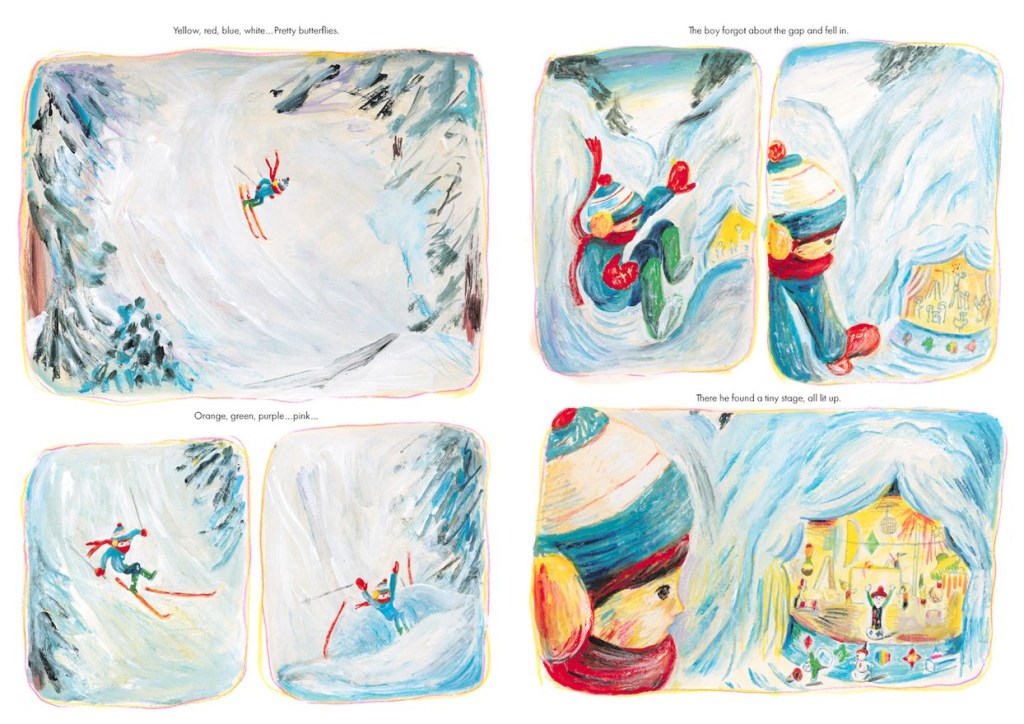
Combining acrylic paint and collage, including found objects, Alko creates a complete vision of Joni’s (as she refers to the singer), early life and subsequent development as an artist.  The young Joni is identifiable as the mature woman, and the elements of both “heart and mind,” as one of her memorable lyrics, are intertwined.  First we see Joni as a young girl on the prairie of western Canada, dancing to the sound of birds. Her parents stand in the background, and a train, composed of geometric shapes, collage elements and stamps, passes by.  Every page frames Joni’s life in this inventive format, each object attracting the reader’s eye with a specific relevance to the narrative. A bird’s-eye view of Joni playing the piano shows both her hands and the top of her head, which is crowned with a helix of words, notes, and ink-like spots.

Joni recovers from the childhood scourge of polio. She listens to Pete Seeger and Elvis Presley, attends art school in Calgary, and performs in coffeehouses.  Alko does not omit her failed marriage to folk singer Chuck Taylor, but she chooses not to discuss the painful decision Joni made to give up her daughter for adoption. Nevertheless, this trauma obliquely appears in a picture of Joni writing the lyrics to “Little Green” in dark, bold pencil. Alko could not have referred to every formative experience in her subject’s life, yet she is committed to acknowledge as many of them as possible.

The two pages that chronicle the genesis of Chelsea Morning are another example of this fidelity. Everything is there: the butterscotch curtains, the traffic, the bowl of oranges. You can practically smell the incense.  When Joni performs in Greenwich Village, there are cameos of Leonard Cohen, Judy Collins, Bob Dylan, and other engrossed listeners. Here is your chance to explain to children who these great innovators are.  It will not be difficult to convince kids that listening to Joni “helped people feel understood,” or that, when her fans demanded her older style rather than experiments in jazz, “Joni didn’t care.” 

Alko includes a discography, bibliography, and a thoughtful author’s note explaining why she was drawn to write and illustrate Joni. The result is an explosion of color and poetry, along with a meticulous record of Joni Mitchell’s legacy. This book is for children, teens, and adults.