A Case of Mistaken Identity

Ramon Fellini the Dog Detective – written and illustrated by Guilherme Karsten
Eerdmans Books for Young Readers, 2025
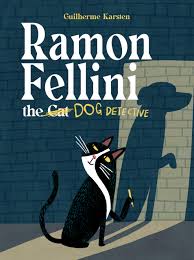
Sometimes people believe what they want to believe, in spite of evidence to the contrary. Children have their own frame of reference for viewing the world. Whether you choose to call it innocence, or just a still untested belief that no one would lie to them, sometimes they interpret events differently than an adult would.  The endearing boy who narrates Ramon Fellini the Dog Detective needs to determine who overturned his fishbowl, leaving one fish missing and the remaining one “terrified.” When a self-proclaimed Dog Detective shows up at his door, offering to help, he is relieved, if momentarily confused. This dog looks just like a cat.
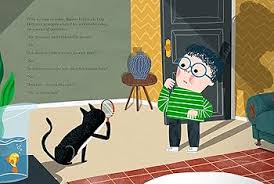
Guilherme Karsten has created a believable character. In his striped shirt, curly dark hair, and oversized glasses, the boy is an image of curiosity combined with trust.  The dog resembles a cat because his costume is “impeccable.” The questions posed by this detective are searching, and, if his methods seemed “strange,” the boy still has confidence that he will find the culprit.  One might think that a close up revealing the dog’s interrogation of the remaining fish would invite skepticism. The fish “looked like it had just seen a ghost,” and the detective extends his very feline tongue towards the fishbowl. But the boy has suspended his disbelief. (Suspension of belief is a theme in Karsten’s work.)

Every picture conveys character. The dog detective mirrors the black and white of the venetian blinds, as he lifts one of the slates to peer outside. One of his eyes half closes exactly like the aperture. But while the blinds are just an object, the dog looks notably sly.  Meanwhile, the boy looks on in appreciation of the detective’s skills.  Even after this supposedly canine Sherlock insists on taking a walk with the fish in its bowl to search for clues, the boy is only worried that his pet will be cold.

Will children think of the boy as foolish? No; just look at the abundant evidence and expertise the dog detective shows, even using a pointer to indicate his deduction about the fish’s escape. When Fellini hands him a post card from the fish’s destination, the boy has even more support for his faith in good deeds.  The dog detective is “AMAZING,” “a legend,” and even “a boy’s best friend.” (images).  The price of the boy’s happiness is not clear. After all, the fish is gone, and the boy is left with the deep satisfaction of having benefited by the detective’s incredible skills and dedication.  What has he really lost?

Poems That Take Flight

Words with Wings and Magic Things – written by Matthew Burgess, illustrated by Doug Salati
Tundra Books, 2025

Designing a book of poetry for children is not an easy task.  There are outstanding collections of classic poems accompanied by different artists’ interpretation. A Child’s Garden of Verse alone has been illustrated by, among others, Jessie Wilcox Smith, Gyo Fujikawa, Alice and Martin Provensen, and Eloise Wilkin.  Recently, Rosemary Wells had the courage to apply her own individual vision to a selection of A.A. Milne’s poems from When We Were Very Young, although they are inextricably linked to the artwork of Ernest H. Shepard.  There are modern classics by such disparate poets as Jack Prelutsky, Shel Silverstein, Bobbi Katz, and Julie FoglianoWords with Wings and Magic Things joins this distinguished company, while adding level of originality and beauty that stands on its own.

On the one hand, children are natural drawn to rhyme and rhythm. On the other, after a certain age they sometimes approach it with skepticism. Where is the plot? Maybe enough humor will compensate for that, and some poets try to hard by overloading their work with this feature.  Matthew Burgess seems to have chosen the subject and form of each poem with respect for children’s intelligence.  The book is organized into thematic sections, each introduced by a two-line poem. “Wild” summarizes excursions into that territory. “The animal inside of us who longs to wander free,/the sparkling specks of stardust that make up you and me.” The poems use different rhyme schemes, alliteration, and stanza lengths, and address subject matter ranging from whimsical to philosophical. There is not a pretentious note in the book.

Doug Salati’s pictures show a kind of exuberance, whatever the subject of the poem he is illustrating. There are two-page spreads with lavish colors and smaller image set against white space. Some pages feature cut-out windows to the following picture, allowing a moon, for example, to transform into a polar bear’s fur. His allusions to classic children’s books are not eye-winking secret messages to adults; they are wonderful homages that set his own work within a lasting tradition.  The lions in “Living with Lions” recall Sendak’s Pierre: they appear somewhat sly, as if unsure about whether to act as predators. “When they wake,/bake a cake,” the girl in the picture wisely decides.

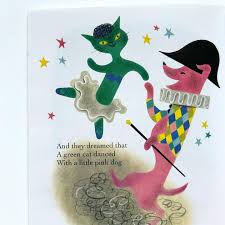
The dog next to the slide in “Wild” is definitely related to Margaret Bloy Graham’s Harry the Dirty Dog. If children don’t recognize these forbears of Salati’s characters, it would be a great opportunity to introduce them. He also shows up accompanying the beginning of “Whoops and Whallops,” about life’s inevitably embarrassing and difficult moments, eating popcorn, and along with his human friend, enjoying a show.  The performing dog recalls the harlequin-costumed animals of The Color Kittens.

Maybe it seems obvious that yetis’ favorite food is spaghetti. Burgess twists the strands of language into invented words that make perfect sense in Salati’s scene of feasting monsters. Twist the fork into your noodles;/Meatball, meatball, and spagoodles.” By the end of the poem, the elongated pasta returns to normal: “Now eat it up, you hungry yet;. Meatball, meatball, and spaghetti.”  Poets and artists can accomplish magic.

Woman of Heart and Mind

Joni: The Lyrical Life of Joni Mitchell and illustrated by Selina Alko
HarperCollins, 2020

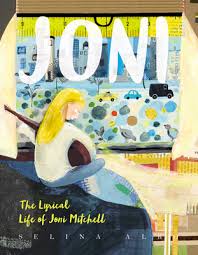
When Roberta Joan Anderson, eventually known to the world as Joni Mitchell, was in school, she had an inspiring English teacher. Mr. Kratzman advised her to approach her writing as she did her visual artworks: “If you can paint with a brush, you can paint with words.”  Selina Alko’s picture book biography of Mitchell embodies that principle in both its text and pictures, which are inextricably linked in this voyage through the singer and composer’s life and work. The author/illustrator and her subject are perfectly matched, making her book accurate, illuminating, and a stunning work of art in itself, as are her earlier books.

Combining acrylic paint and collage, including found objects, Alko creates a complete vision of Joni’s (as she refers to the singer), early life and subsequent development as an artist.  The young Joni is identifiable as the mature woman, and the elements of both “heart and mind,” as one of her memorable lyrics, are intertwined.  First we see Joni as a young girl on the prairie of western Canada, dancing to the sound of birds. Her parents stand in the background, and a train, composed of geometric shapes, collage elements and stamps, passes by.  Every page frames Joni’s life in this inventive format, each object attracting the reader’s eye with a specific relevance to the narrative. A bird’s-eye view of Joni playing the piano shows both her hands and the top of her head, which is crowned with a helix of words, notes, and ink-like spots.

Joni recovers from the childhood scourge of polio. She listens to Pete Seeger and Elvis Presley, attends art school in Calgary, and performs in coffeehouses.  Alko does not omit her failed marriage to folk singer Chuck Taylor, but she chooses not to discuss the painful decision Joni made to give up her daughter for adoption. Nevertheless, this trauma obliquely appears in a picture of Joni writing the lyrics to “Little Green” in dark, bold pencil. Alko could not have referred to every formative experience in her subject’s life, yet she is committed to acknowledge as many of them as possible.

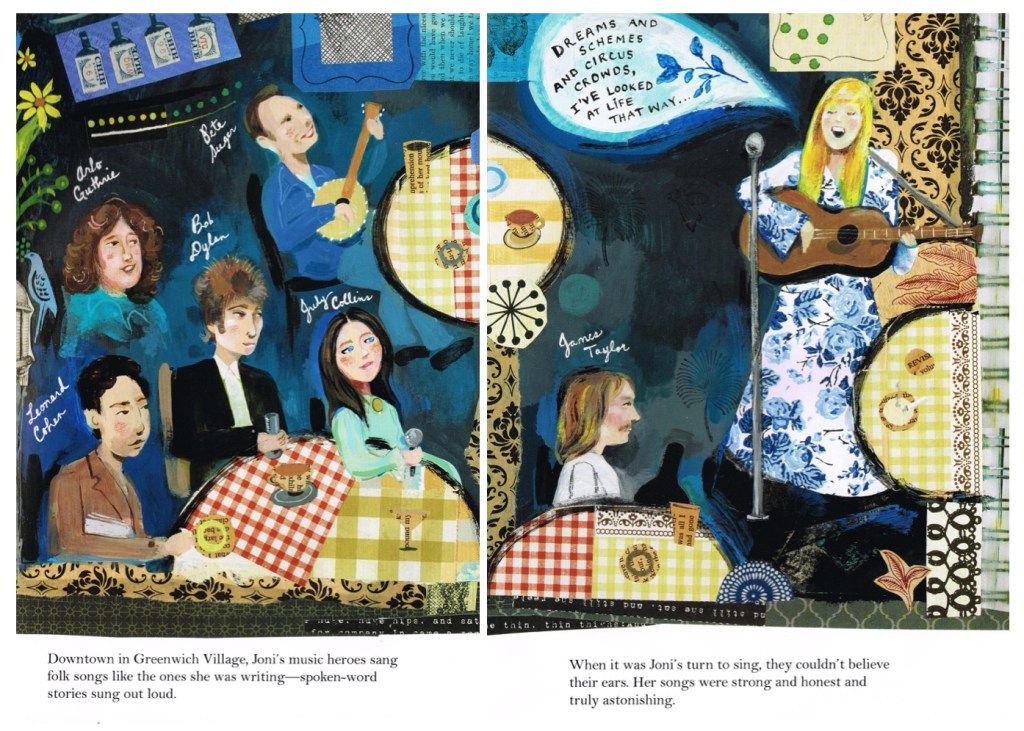
The two pages that chronicle the genesis of Chelsea Morning are another example of this fidelity. Everything is there: the butterscotch curtains, the traffic, the bowl of oranges. You can practically smell the incense.  When Joni performs in Greenwich Village, there are cameos of Leonard Cohen, Judy Collins, Bob Dylan, and other engrossed listeners. Here is your chance to explain to children who these great innovators are.  It will not be difficult to convince kids that listening to Joni “helped people feel understood,” or that, when her fans demanded her older style rather than experiments in jazz, “Joni didn’t care.” 

Alko includes a discography, bibliography, and a thoughtful author’s note explaining why she was drawn to write and illustrate Joni. The result is an explosion of color and poetry, along with a meticulous record of Joni Mitchell’s legacy. This book is for children, teens, and adults.