Family Is Everywhere

Some Places More Than Others – Renée Watson, Bloomsbury Children’s Books, 2019

otherscover

Amara Baker is an African-American middle school student growing up in Beaverton, Oregon, in a community unlike the one her father, Charles, knew at her age, when he lived in Harlem, New York City.  Amara’s parents are expecting a long-wanted second child, leading Amara to question if and how her role in the family will change.  But overall, her life is good. Her parents are protective and loving, even if her mother, a designer, seems disappointed sometimes that Amara feels more uncomfortable in her fashionable dresses than in her sneaker collection from Nike, where her father is an executive.

There is no crisis looming in her life, until her teacher, Mr. Rosen, assigns the Suitcase Project.  Asked to interview family members and to determine which special objects and experiences she will choose to represent in her suitcase, Amara needs to confront her father’s estrangement from his own father, Amara’s only living grandparent.  A trip to Harlem to spend time with him and with her extended family becomes an unanticipated opportunity to learn about her own past, as well as the past of her people.

Renée Watson’s narrative skills are expert and subtle.  Amara’s story could easily have become one of dramatic clashes between angry relatives, or singular moments of realization that African-American history is full of previously unknown riches.  Instead, the Harlem trip is full of illuminating moments, when Amara takes in the cultural landmarks which she has missed in Oregon, but which were always a part of her through her parents’ strength and pride.  Whether embarrassing her cousins by taking photos of the Apollo Theater or touring the Schomburg Center for Research in Black Culture with her enthusiastic Grandpa Earl, Amara is thoughtfully filling her mind and her heart, as well as her suitcase, with inspiration from the past.  Standing on the famed mosaic tribute to poet Langston Hughes, Amara notes that “I don’t take my phone out to capture this.  I just want to stand here, just want to be.”

branch_interior_2014_09_01_schomburg-2787

Not everything in the past is an unambiguous source of pride.  There is the bitterness and anger between Amara’s father and grandfather, and the tensions with her cousins, whose own father is absent but who share a deep bond with the grandfather which had been unavailable to Amara. During the trip, Amara tests some limits of independence, and her father reflects on his own authority as a parent.  In one scene at his mother’s grave, Amara’s father recites an original poem which is Watson’s implicit dialogue with Hughes’s “Mother to Son.”  In a book filled with profoundly moving moments of recognition about the ties between parents and children, this one stood out for its emotional impact.

Some Places More Than Others is an unusual chronicle of a child’s journey towards understanding of her family and her own place within it. Some books do this more than others; this is one you will want to put in your suitcase.

“I would like to be a bird looking down/ then everything would be so clear

The Collected Works of Gretchen Oyster – Cary Fagan, Tundra Books, 2019

cover

Art and poetry are potentially a lifeline to everyone, and certainly for an introspective and confused kid whose family is shaken by the worst kind of tragedy that could befall them.  In The Collected Works Gretchen Oyster, that kid is middle-school student Hartley Staples, and the tragedy is that his older brother Jackson has left home and may never return.  The lifeline which falls at his feet is a series of mysterious postcards, miniature works of art and poetry left around his small town by an unknown creator.

Award-winning author Cary Fagan (author of the picture book, What Are You Doing, Benny) has dropped his novel, like the powerful visual statements which Hartley finds, right into our paths, and his new book (due out September 17, 2019) demands the same kind of attention and offers the same rewards.

G.O. 1.png

Hartley is sad and sardonic, full of careful observations on life in his small town, where the tiny library is so inadequate that he terms it “The Place Where Books Go to Die.”  It is outside of this budget-less institution in a repurposed mobile home that Hartley finds the first in a series of small poetry and image collages which turn out to be a kind of message in a bottle from someone as committed to making sense of a senseless universe as is Hartley himself.  From that moment on, Hartley begins to carefully assemble a collection of these idiosyncratic cards.  Collecting them becomes both a purposeful mission and a distraction from the rest of his life, especially from a home where his loving parents are desperately trying to maintain their own sanity, and to offer Hartley and his younger brother some of the stability that has obviously disappeared from their lives.

G.O. 3.png

What is outstanding about this middle-grade novel, which will certainly be meaningful to teen readers and adults as well?  For one thing, Fagan completely avoids the kind of exaggerated misery which is central to so many books for and about teens.  Hartley himself alludes to these, as he searches in the library for “something that wasn’t about a kid whose mother was dying or father was dying or girlfriend was dying or whose mother, father, or girlfriend hadn’t been turned into a zombie” Yet the irony beyond Hartley’s dismissal of this genre is that his own parents have experienced a possible death and that they go about their ostensibly normal daily lives in a kind of zombie existence of barely suppressed grief. It’s not that kids’ lives can’t be terrible, Fagan is telling us, it’s the way that they translate that terror into meaning that matters, and which readers will recognize in his story.

G.O. 6.png

The artist who signs her work “G.O.” is also struggling with family issues, with bullying, and, like Hartley, with constructing her own narrative to make sense of her life.  Her work is not random; she explains her process in a way which is evidence of the refreshing way in which Fagan respects his readers’ intellectual curiosity.  Her work is “kind of like what the Dada artists did back in Europe after World War I…But she wasn’t trying to imitate the Dada artists or anyone else. She wanted to find her own way.”

Having read The Collected Works of Gretchen Oyster, I can only compare the connection which I experienced, and which I would have also experienced as a young person, with the one I feel reading the best classic novels for children or adults.  One need not have shared Hartley’s specific anxieties or Gretchen’s poetic vision in order to share their need to impose structure on an unsteady universe.  Everything will not be so clear, even for a bird looking down, but at least there will be a picture to construct and, at best, to share.

G.O. 7.png

A Family is Not DNA

Love, Penelope – Joanne Rocklin and Lucy Knisley, Amulet Books, 2018

penelopecover

Exploring one’s heritage has become something of a national pastime, simplified by the intriguing and expensive project of ordering DNA results from companies that promise to fill in the blanks about anyone’s hereditary background.  In Love, Penelope, Joanne Rocklin offers a much more nuanced and sensitive view of what constitutes family lineage through the moving and funny story of Penelope Bach, a ten-year-old girl in Oakland, California, struggling with the challenges of a school project. Asked by her teacher to research her family history, Penelope learns a great deal about her biological mom, Becky, and her mom’s domestic partner, Sammy, a woman who is as caring and strong a parent as Penelope’s original mother. Even more importantly, she learns lessons about honesty, commitment to family, and negotiating the hazards of friendship.

There are many qualities to love about this novel.  It is convincing.  Nobody is perfect.  Parents make mistakes.  Close friendships have painful moments.  Penelope is optimistic, but also introspective.  Since her deceased father was an orphan, she has no information about his family, and her knowledge of her mother’s family also turns out to be incomplete. However, she is extremely close to her adoptive mother, grandmother, and great-grandmother. Through them, she feels deeply connected to Sammy’s Ohlone Indian heritage. Is she lying to her teacher, Mr. Chen, as she plans to present the results of her in-depth research about the family ties which are not biological, but emotional ones?

 Love, Penelope is ambitious, as Rocklin expertly integrates several other threads into her narrative.  There is Penelope’s obsession with her favorite basketball team, the Golden State Warriors. There is her growing awareness of racism, and her strong conviction in marriage equality, which she hopes will become a reality for the wonderful parents currently joined in a “marriage of the heart.” Then there is the new baby which her family is expecting; throughout the book, Penelope addresses him/her as “You” in a series of journal entries.

ham

Lucy Knisley’s black and white drawings of this growing but still unknown being support the text, as do her sketches of other elements of the story, from Mr. Chen’s funny ties, to a ham bouncing like a basketball, to the Penelope’s image of herself as a spider, spinning a web of lies.  The book’s backmatter includes detailed lists of resources about Native American history, same-sex parenting, and, of course, basketball.

In writing this book, Rocklin was not dissuaded by suggestions that authors should choose only subjects that literally align with their own identities. Penelope and her family are complex human beings facing challenges and finding their own strengths.  Her story is a story for all of us.

Family, Art, and Chocolate

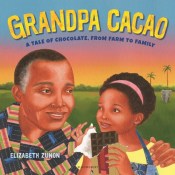
Grandpa Cacao – Elizabeth Zunon, Bloomsbury Children’s Books, 2019

cacao cover

The chocolate metaphor richness of Grandpa Cacao is so striking that it would be difficult to avoid in any description of Elizabeth Zunon’s new book.  The richness refers to the content and themes: family, heritage, culinary traditions, agriculture.  The artistic complexity of the book is also gorgeously rich.

In a detailed “Author’s Note,” Zunon explains how she has chosen to use oil paint, watercolor paper, and collage to create the main narrative background, combining these media with pale silk screen outlines in the images of her grandfather at work on his African farm.  The sophistication of this multidimensional technique is, again, extremely rich.  Grandpa Cacao is also an informational book about the cacao cultivation, and the book’s backmatter gives further information about the history, technology, and ethical issues of chocolate production, along with a recipe for Chocolate Celebration Cake.  There is so much here to capture young readers’ attention that the book will surely inspire many conversations each of its ingredients.

Grandpa Cacao inside

The core of the story is a conversation between a girl and her father about the grandfather she has never known.  Her father’s narration of his own father’s life as a cacao farmer is both dramatic and matter-of-fact, as he explains to this daughter the difficulties of planting and harvesting a successful crop.  He emphasizes the communal cooperation necessary to the process, and ties its outcome to crucial economic gains: “We used our money to buy food, school supplies, uniforms, books, and fabric to have our special occasion clothes made.”  As the girl listens, she draws parallels to her own life and feels connected to her grandfather, as she and her father carefully bake a chocolate cake together.  The silk-screen images of life in Africa form a visual sequence of her father’s story and her own involvement in listening to it.

The ending of the book has a mythic element of reunion. Readers who have grandparents from other parts of the world, whether or not they have never seen them or benefit by a close relationship, will empathize with the family strength of Zunon’s story.  Whether or not you love chocolate, Grandpa Cacao is a recipe for learning and empathy.

Juggling Demands on Your First Day of School

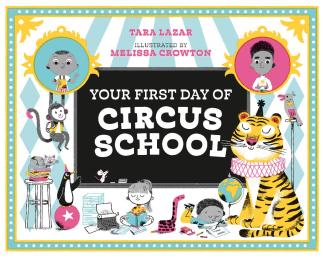
Your First Day of Circus School Tara Lazar and Melissa Crowton, Tundra Books, 2019

cover

Ladies and gentlemen, and children of all ages! Step right up to Your First Day of Circus School. This madcap map of a first day at school will reassure an apprehensive child, not through patient explanations that school will be great, but by offering an inventive metaphor for just how great it will be. In fact, it will be the greatest show on earth. Don’t worry; no animals were harmed in the making of this book!

megaphone

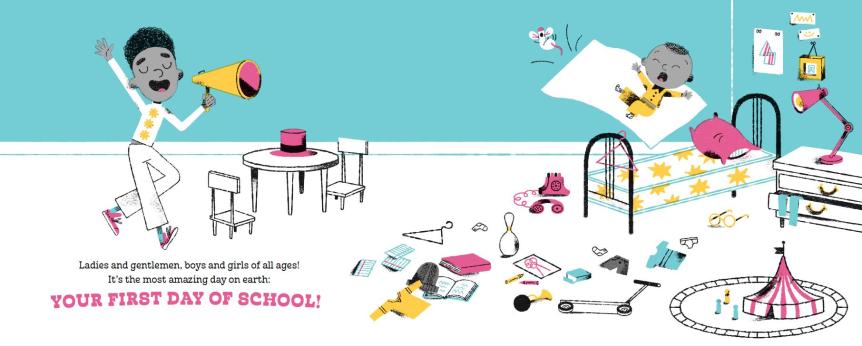
The little boy in the story is awoken by his older brother blaring into a megaphone, and he is propelled out of bed with a look of terror on his face. Why should he want to leave his room, an inviting setting for imaginative play, as proven by all the fun toys and scattered items surrounding him?  A circus playset in the lower right corner leads to the next page, where he begins to warm to the idea of school, even if he is still a bit confused about what it will entail.  That’s what controlling big brothers are for; his shows him that “you’ll/find your way/around,” and gives him practical advice: “Don’t let the kids in the/ HIGHER GRADES /run you over.” Many of the lines are combined with visual puns; the kids in the higher grades are elevated on stilts, and “The cafeteria/can be a real ZOO” is accompanied by an assortment of animals and children eating, socializing, and performing daredevil feats in the lunchroom.

clownsincar

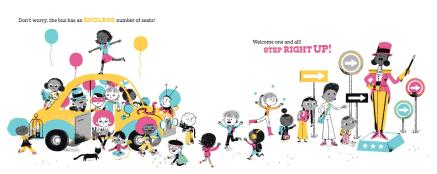
Some of the puns, as well as the clichés and aphorisms updated with visual interpretations, may be unfamiliar to kids.  Like many of the best children’s books, this one operates on more than one level.  Adults know that their kids will have “a lot to/JUGGLE/on your first day,” while young readers will instantly acquire that expression by seeing an image of their peers happily juggling small objects.  “HIGH EXPECTATIONS” can be attained by climbing a ladder.  Instead of a mundane school bus, the time worn joke about the endless number of clowns fitted into a tiny car, becomes a cheerful allusion to a community of excited kids ready for school.

canon

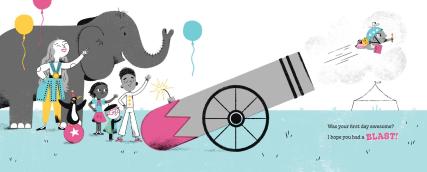
Does the book raise expectations that will be contradicted by real school, where you can’t actually sit backwards on your desk while wearing a cape, and where the tall kid in front of you isn’t an elephant? Only the most literal-minded child, or caregiver, will fail to recognize that imagination and reality can coexist in young minds, especially when thinking about and working through new situations.  Your teacher, even if she is not named “Miss Stupendous,” does want you to enjoy learning.  Your fellow students are also hesitant on the first day.  Your first day of school should indeed by “awesome,” even without the cannon blast conclusion pictured here.

Kids will love this book. Parents, look for the picture of the poodle writing on a typewriter.


Joe Krush is Extraordinary

Emily’s Runaway Imagination – Beverly Cleary and
Beth and Joe Krush, William Morrow and Company, 1961

Emily's_Runaway_Imagination_cover

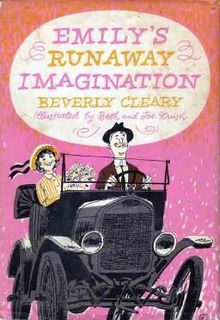
On Saturday, May 18, the inimitable children’s book illustrator, Joe Krush, will turn one-hundred-and-one-years-old. I have tried my best before in this blog (here and here and here and here), and on The Horn Book, to write the kinds of tributes to him that convey, at least a bit, the glorious detail and expressive beauty of his line drawings.  Since Beverly Cleary, with whom Mr. Krush collaborated on three teen novels, has just celebrated her one hundred and third birthday, I thought it would be a good opportunity to draw attention to a Cleary book for middle grade graders for which Joe and his wife Beth also drew wonderful pictures.  Emily’s Runaway Imagination is an unusual Cleary work, partly based on her own life growing up in the nineteen twenties in rural Oregon.  Not surprisingly, the Emily of the novel loves books, and the plot partly involves the efforts of her small town to establish its own library.

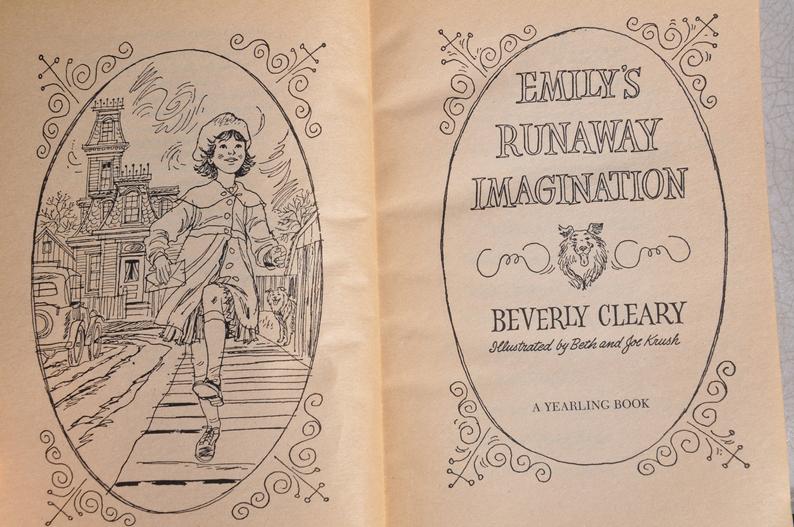
As always when the Krushes are part of a literary team, the illustrations are inseparable from the story; my childhood memories of first reading this book are illuminated, if that is an appropriate term for black and white images, by the scenes of Emily moving through her adventures and misadventures with cinematic swiftness.  There is Emily opening the door of her family’s wood burning stove, her hand raised in dismay to her face. What happened to the flaky pie crust she had hoped to create?  Her mother, in an elegant, if simple, shirtwaist dress and black t-strap pumps, the perfect attire for baking, looks on with patience and empathy.  From the coffee grinder sitting on top of the stove, to the curly arabesques decorating the hood, every touch of the drawings immerses the reader in the story with unpretentious, invisible, skill.

A kind Chinese immigrant, Mr. Quock, is clearly isolated, but Emily becomes his friend, not before Emily learns to discard some foolish prejudices of her own.  The picture of Emily leaving his house, presented as a smaller oval inset at the bottom of the page, shows the old man waving at Emily as she walks past his house, He is in the foreground, and a small Emily to the right of the picture raises a mittened hand, fully colored in black. In the background, a Victorian gingerbread-style house is filled with closely placed lines, with black areas within the windows matching Emily’s mittens and shoes.  Mr. Quock, a figure drawn mainly in white, aside from a few lines on his cardigan’s cuffs, looks quiet and vulnerable. When a scene calls for action, the Krushes are equally ready, as when Emily and her cousin June are terrified by a thunderstorm and the expectation of seeing a ghost.  Emily opens the door with determination and confronts the darkness with a flashlight, while June, her face turned towards us, looks completely disoriented as she clings to Emily’s nightgown.  The Krushes have shown us who is the brave one here. Even the dog is cowering under the table.

Joe Krush’s contribution to children’s book illustration is difficult to describe but impossible to miss.  I hope I have conveyed, on his birthday, some of the joy which his art has brought to readers.

emily frontspiece

Nobody’s Perfect

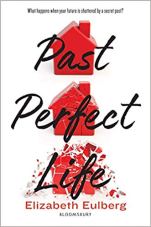
Past Perfect Life – Elizabeth Eulberg, Bloomsbury, 2019

ppl cover

Anyone following the news over the last several weeks has been observing the outcome of the college admissions scandal.  What price will wealthy and well-connected parents pay for having tried, often successfully, to buy their children places in universities, often by creating false identities for them—as high academic achievers or champions in sports in which they had never even participated?


The teens in Elizabeth Eulberg’s new novel, Past Perfect Life, are the children of hardworking parents, and the beneficiaries of a solid support system of their peers.  Allison Smith lives with her widowed father in a small Wisconsin town.  Her goal is to be accepted into the state university system, and she is actively engaged in trying to earn a scholarship based on academic merit.  The novel offers welcome insights into the lives of ordinary kids leading ordinary lives, although the pressures of senior year in high school seem extraordinary at the time.

Then a series of events change Allison’s life, forcing her to confront a new identity and to look at her past through a new lens, one that presents a dizzying and chaotic view of the present and future as well.  Elizabeth Eulberg’s narrative skills are apparent on every page, as she asks the reader to consider, reconsider, and consider again the relationships and dilemmas surrounding her characters.  The affection and sincerity of almost all of Allison’s friends and community members tests the skepticism of readers accustomed to dystopian visions of cruelty and division in young adult books.  Yet the picture which Eulberg paints is convincing, not merely an exercise in nostalgia for an idealized time and place where movie night with a parent or a first date with a boy are meaningful events. The boy is both physically attractive to Allison, and a compassionate listener throughout her ordeals. Really! Even the enthusiasm for football and for Wisconsin cuisine held my attention; I have to admit that this was a high bar for me, and Eulberg reached it successfully.

Without giving away any of the suspenseful plot, Allison learns to integrate her past and her present, and to balance flexibility towards change and faithfulness to her unchanging self.  There are no easy lessons or facile resolutions. Relationships of parents and children are always difficult to negotiate. At the same time that changes in Allison’s life convert everyday problems into shocking and painful ones, readers will still identify with the core experiences of young adulthood which she meets without flinching.  “Describe a significant event in your life and how it has influenced you,” Allison reads on a scholarship application.  By the end of Past Perfect Life, readers will appreciate the irony of that simple request, and the meaning of significant to Allison and to themselves.

Soaring with Alis

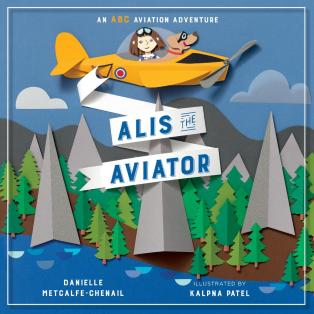
Alis the Aviator: an ABC Aviation Adventure – Danielle Metcalfe-Chenail and Kalpna Patel, Tundra Books, 2019

Alis cover

Alis the Aviator creates poetry out of flight.  Danielle Metcalf-Chenail, writing about the first Indigenous commercial pilot in Canada, is able to make words soar.  Along with Kalpna Patel’s bright paper cutouts of planes and people, including a young aviation-obsessed girl, this unusual book teaches, inspires, and entertains.  The ABCs of aviation, from Arrow to Zeppelins, take flight in this beautiful book.


Alis dog

Alis is ambitious and modest at the same time.  The assemblage of colored paper into meticulously detailed aircraft and scenes of joyous human creativity demands the reader’s attention.  Alis herself begins by constructing paper airplanes; what could be simpler?  Her dog is asleep on a fringed rug at her feet, not even awakened by curlicues of paper from her project drifting onto his head.


Alis chair

Soon, however, Alis moves beyond her initial experiments, and takes us on a tour of the real thing. Seated in a small RCAF Chipmunk or gazing up in wonder from a hiker’s trail at Norseman and Otter planes, Alis is aviation personified. Each image and each line of text is different; the reader lifts off at “A” and continues on through a wild and bumpy flight. Another incredible two page spread takes the reader back in time to World War II, with VICTORY spelled out, if not yet assured, and Rosie the Riveter smiling in the lower corner.  Workers on the Lancaster and Mosquito bombers are depicted as smaller and less defined, with tapering cones for bodies and small found faces without features, reminiscent of Japanese kokeshi dolls. The people in the scene subordinate themselves to the task.

Alis victory

In an entirely different scene, Patel juxtaposes old sepia-colored newspapers with dramatic headlines about feats from the past: “P is for parachute, a jump like no other./Q is for Queen, which crashed into the loam,” contrasting on the next page with “R is for Renegade/…a plane you build at home.” (image).  From wild adventure to the security of model building, Alis is enthusiastic about it all.

alis newspaper

The text is accessible, but also sophisticated and full of fun imagery and inventive rhymes: “D is for Dakota a northern weather vane/E is for Electra, a shiny metal steed./F is for Fairey Swordfish, not known for its speed.”  It’s easy to string to together related items beginning with each of twenty-six letters, and many alphabet books do just that.  In Alis the Aviator, the letters are a pretext for a journey through the imagination of a plane enthusiast.  The book includes a biography with photos of the real Dr. Alis Kennedy, and an illustrated glossary rich with information and miniature images of all the planes in the book.  If a child is already in love with the world of flight, she will be thrilled with this book. If she is not, the fantastic artwork and compelling poetry will encourage her to board the flight.

The Truth, the Whole Truth, and No Subpoena Needed

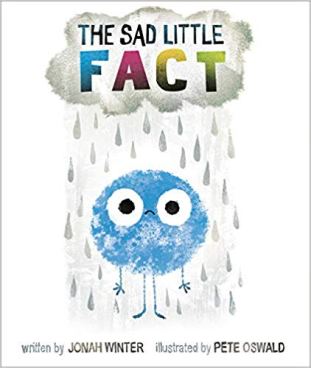
The Sad Little Fact – Jonah Winter and Pete Oswald, Schwartz & Wade Books, 2019

seedcover

It’s a sad, and not so little, fact that today facts are in retreat. The amount of taxes paid by the current occupant of the White House, the size of his inaugural crowd, the reliability of security clearances, the reality of human-made climate change, the validity of our Constitution itself, are all under attack.  Do children of an age to enjoy picture books care about these threatened notions?  Even a kid knows the approximate difference between a lie and the truth. Here is a new book to help anxious parents encourage their children in their life-long pursuit of reality.

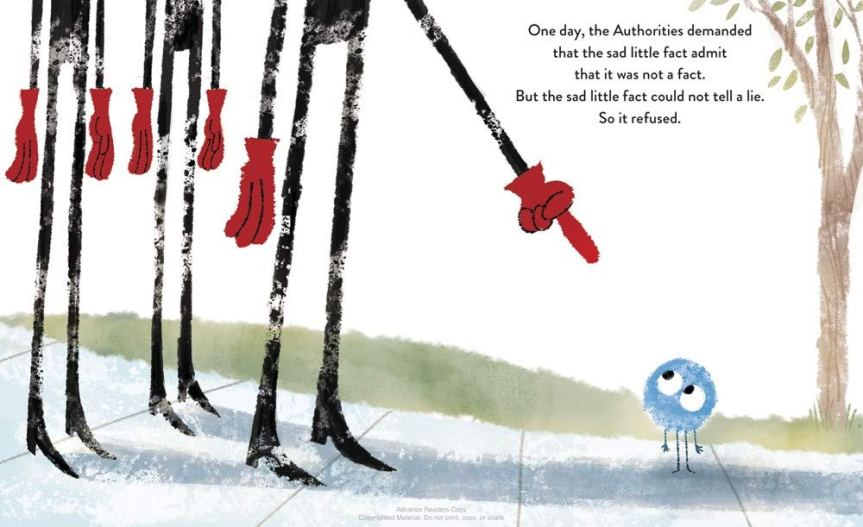
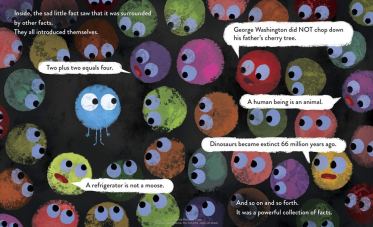
The combination of Jonah Winter’s direct and simple text, leavened with quite a bit of humor, and Pete Oswald’s signature colorful geometric forms (as seen recently in The Good Egg and The Bad Seed), here lost in a sea of falsehoods, forms the perfect vehicle for a ride towards the truth.  The first lesson kids will learn here is that facts are vulnerable. They can be ignored, bullied, even buried in a treasure chest so deep in the ground that no one may hear their cries.  Children will identify with the small blue wide-eyed dot as it is menaced by long shadowy figures, or pointed at with red-gloved hands.  Winter puts into words the message which we all hope to give to our children, even when it seems countercultural to do so:

pointing

It’s easy enough to explain who “authorities” are to kids: people who should be responsible for taking care of us, but sometimes don’t act as they should. Winter adds impact to his familiar and kid-friendly vocabulary: tools, dark, angry, big box, bunch of lies, with a limited number of concepts requiring explanation.  That is what sets his story apart and makes it a cross-generational experience to read together.

facts in box

No one likes to be isolated, and the sad little fact is rendered less sad by the fact that he is surrounded by other incontrovertible truths.  Kids love jokes, so they will appreciate that ‘A refrigerator is not a moose,” and no one can claim that it is.  If they don’t already know that “Christopher Columbus did not discover America,” they should, and what young dinosaur fan doesn’t appreciate the fact that his favorite animals “became extinct 66 million years ago.”

Winter’s lesson is not abstract, and Oswald’s embattled little creatures make them even more concrete.  Deceptive imposter facts are ejected from a scary contraption into a gumball machine of lies and released into a panicked world, but they will not succeed.  Solidarity and determination save the day:

“And so the fact finders started digging.
Equipped with only shovels, flashlights,
and a need to know the truth,
they dug a tunnel deep, deep underground.”

The best part of the book is its triumphant happy ending.  The lie machine is removed like a statue of Stalin and hauled off in a recycling truck.  The facts line up in a joyous chorus, standing atop the truth in giant font.  A fact is indeed a fact, and the sooner we can succeed in teaching that to our kids, and reminding ourselves of its power, the better the story will end for all of us.

Curious George, Toddler

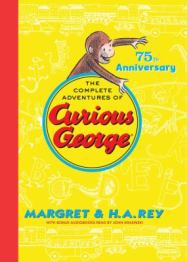
The Complete Adventures of Curious George: 75th Anniversary Edition – H.A. and Margret Rey, Houghton Mifflin Harcourt, 2016

The ABC of It: Why Children’s Books Matter – Leonard S. Marcus, Foreword by Lisa Von Drasek, Kerlan Collection at the University of Minnesota, 2019

The Journey That Saved Curious George: The True Wartime Escape of Margret and H.A. Rey – Louise Borden and Allan Drummond, HMH Books for Young Readers, 2005

The Journey That Saved Curious George Young Readers Edition: The True Wartime Escape of Margret and H.A. Rey – Louise Borden and Allan Drummond, HMH Books for Young Readers, 2016

Monkey Business: The Adventures of Curious George’s Creators – film directed by Ema Ryan Yamazaki, The Orchard Studio, 2017
CG cover404 screen

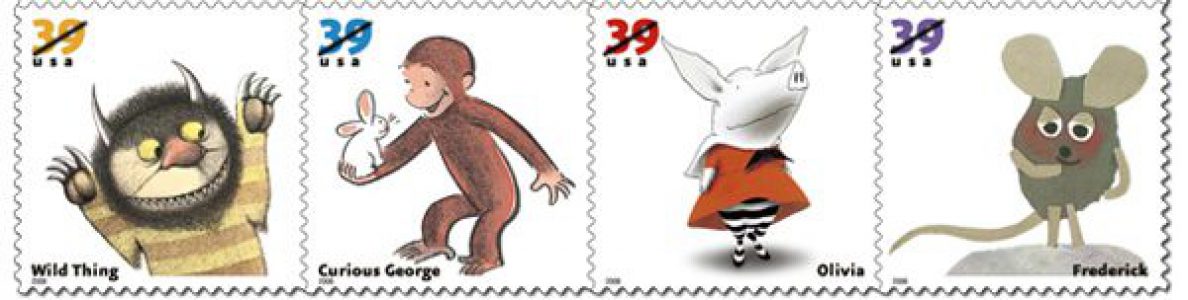
In 1940, a German Jewish couple fled occupied France in danger of their lives.  Traveling first to Brazil and then to the United States, they brought with them the manuscript for what would become the first in a series of one of the most enduring and popular children’s books, Curious George.  Author H.A. Rey and his wife, illustrator Margret Rey, brought to life the little risk-taking monkey who was frequently rescued from near disaster by his patient and benevolent friend, the man with the yellow hat.  Unlike a toddler, George cannot speak.  Like a toddler, he is often misunderstood.  Impulsive, highly physical, affectionate, and essentially kind, George became a character with whom children could easily identify. He represents both their best and their most difficult characteristics, but his adventures are always resolved without serious harm to anyone.  Most significantly, George represents parental compassion and unconditional acceptance. Note his introduction to the world: “He was a good little monkey/and always very curious.” That “and,” not “but,” promises that even George’s most problematic behaviors are routed in a healthy embrace of the world.

There is currently an acclaimed exhibit at the University of Minnesota’s renowned Kerlan Collection of children’s literature. (The amazing story of Dr. Irvin Kerlan, and how he came to create his collection and leave it to the University of Minnesota, would itself be worth of its own blog post.)  The exhibit is co-curated by Lisa Von Drasek, Curator of the Children’s Literature Research Collections that includes the Kerlan Collection, and Leonard Marcus.  The exhibit is a revised version of the one originally curated at the New York Public Library from 2013-2014 by Marcus, a well-known and distinguished scholar of children’s literature.   (I saw the original exhibit; I thought it was one of the most comprehensive and exciting approaches to children’s literature that I could imagine.)

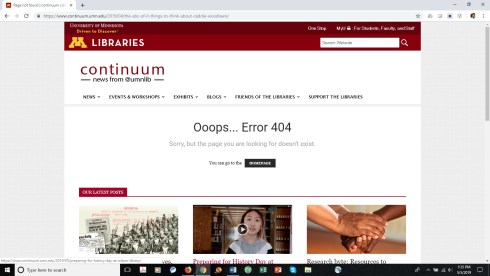
Not surprisingly, the Minnesota exhibit has received some criticism, which is healthy.  Viewers should always feel free to analyze and respond to perceived shortcomings in a public exhibition, even more so when the subject is as central to our daily lives as the role of books in the daily lives of our children. In the years since the New York exhibit opened, parents, educators, and scholars have expressed concerns about the need for diversity in books for children, with a greater confidence that their ideas would be listened to seriously than had been the case in the past.  One of the issues raised has been the difference between celebration and documentation.  If a book from an earlier era reflected the racism or sexism of that time, how should be approach it today? In my opinion, the worst response is censorship.  No, censorship is not strictly the government-controlled decision to legally outlaw certain books.  We don’t have that in the United States, although we can no longer take for granted that it does not loom on the horizon.  Censorship is also commonly understood to mean deliberately making access to books or other works difficult, discouraging or threatening publishers, libraries, or bookstores, and impugning the motives of any author who fails to agree with the critics’ perspectives or cede to their demands.  Wrapping a book in yellow caution tape in a public exhibition, as opposed to criticizing it and publicizing alternative perspectives, is wrong, and reminiscent of terrible times in history when books were physically destroyed.  (Here is a link to a post at the University of Minnesota’s Library blog that had originally depicted this act; that since has been removed; my description comes from memory:  https://www.continuum.umn.edu/2019/04/the-abc-of-it-things-to-think-about-caddie-woodlawn/.)

Back to Curious George.  The section in the exhibit on George now links him to other depictions of monkeys in literature, some of which are examples of crude and ugly racism, and makes the claim that therefore all depictions of monkeys in children’s literature, including George, are inherently racist.
curious-george-myh1

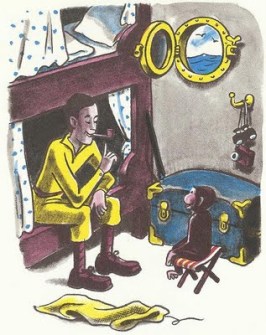
Yes, the man with the yellow hat does “rescue” him from Africa. The Reys were European, a continent with virtually no native species of monkey.  Originally, he is also put in a zoo, where he is very happy, but in subsequent books in the series he is living comfortably in a human home and enjoying a great deal of freedom. Oh, and the man with the yellow hat smokes like a chimney.  I have posted on Curious George numerous times (here and here and here), including on this problematic habit.


Viewers, and readers, can reach their own conclusion about the accuracy or justice of this comparison.  Look at George’s grief when he realizes, as toddlers inevitably do, that his actions have consequences, as when he inadvertently lets all the bunnies out of their hutch in Curious George Flies a Kite (“George sat down.  He had been a bad little monkey. Why was he so curious? Why did he let the bunny go?”), or when he just has to taste the puzzle piece and winds up in the hospital, where he cheers up the other kids by crashing the food cart.  If only life were like this!  In the Curious George books, the daily hazards of life are never catastrophic and bad decisions never have permanent consequences.  The Reys offered readers a safe introduction to negotiating the real world, one where adults will always care for you. Critics intent on placing George in a historical context of racism might also wish to learn more about the harrowing circumstances in which the Reys, themselves the victims of racism of the most murderous sort, managed to create this reassuring and endearing character for all children to enjoy.