Anti-Boredom for Girls

A Girl’s Treasury of Things-to-do – written by Caroline Horowitz, illustrations not credited
Hart Publishing Company, 1946

Who was Caroline Horowitz? It’s difficult to find any information about her online, aside from links to booksellers offering used copies of her works.  She specialized in collections of recommended activities for different categories of children; boys, girls, “tiny tots,” little girls, young boys. Some of the collections are described as “swell,” “jumbo,” or other attractive adjectives. One is entitled, The Great Big Happy Book.  I’ve acquired some of these, and I look at them affectionately, in spite of the radical gender division and the fact that some of the suggested activities might cause physical harm.

Horowitz might be the illustrator, as well, of this volume, since no other illustrator is listed.  The publication date, immediately after World War II, is significant.  Since children would no longer be involved in growing victory gardens or in collecting scrap metal or rubber for the war effort, they presumably needed other activities.  In addition, the temporarily expanded opportunities for women on the home front had been abruptly closed off, and it was time to train girls for their future roles as homemakers.  The acknowledgements of support at the beginning of the book are also interesting. One is to Josette Frank of the Child Study Association of America. Frank was quite well known as an advocate for children’s literacy and several progressive causes, and as a voice of sanity in the attacks on comic books. Evidently, although Horowitz is little-known today, she interacted with key players in the world of children’s literature. 

So what, according to Horowitz, should girls be doing with their free time, in an era when structured and highly specialized after-school activities were less common than today? Here are a few suggestions.  They might create a “sweet-spice sachet” out of apple, cloves, and ribbon.  That might now show up on Etsy. A somewhat more ambitious project, but still very feasible, involves making a picture frame. Perhaps “ambitious” is less precise than “dangerous.”  This project requires cardboard, tape, and ribbon, but also a razor blade.  I can’t help but notice that the drawing of a girl inside the complete framed bears a marked resemblance to Barbie, the revolutionary new doll who would not appear until thirteen years later. Speaking of dolls, girls can learn to craft a simple yarn doll, designed with many emblems of femininity. “Susie Shy Lapel Doll” doesn’t actually list any way to attach her to the crafter’s lapel, but she is truly decorative, with a skirt, a pink face, red lips and “downcast eyes,” and a ruffle.
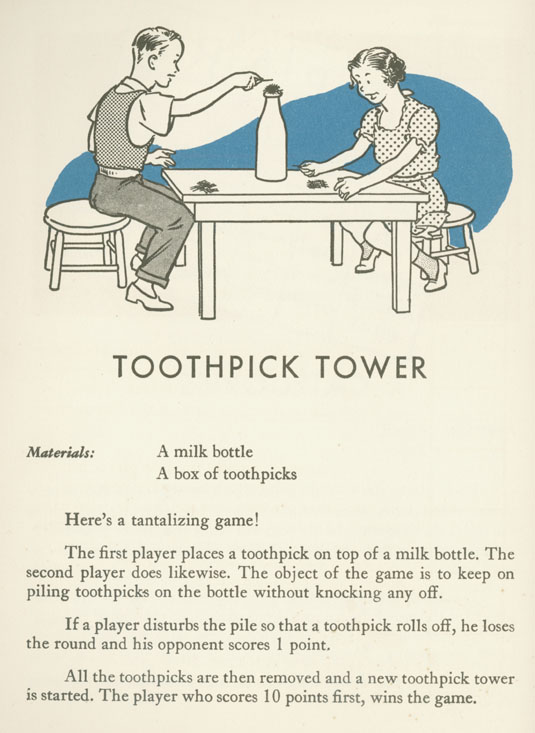
Girls need no restrict themselves to making dolls. For future journalists there is a family newspaper. Granted that it is restricted to domestic news: “…a visit from a relative, someone’s graduation from school, a new business venture by some member of the family, a furlough visit of your older brother.” Many men were still completing their military duty in 1946, although Horowitz may well have written the book before the war ended.  For a different form of communication, readers could simulate a telegram by pasting words from newspapers or magazines onto a sheet of paper.  One of the most refreshing elements of the projects, razor blades aside, is the simplicity of the materials. Most require only paper, pencils, ribbons, glue, and one’s mental faculties, such as “Toothpick Tower.. 

“Mixed Answers” is billed as “hilarious…a sure-fire hit at any party.”  It’s somewhat related to Mad Libs, mixing questions and answers in an improbable way.  Some of the questions are: “What will you serve at your wedding,” “Where will you meet your husband or wife,” and “What business will you be in then?” This is apparently a coed game; maybe the girls will work in businesses someday, and the boys might concern themselves with the food at their future weddings. 

I don’t mean in any way to mock this sweetly nostalgic exercise. Projects and memory games are great.  The “Gallery of Movie Stars” is basically a scrapbook of celebrities. If “Schnozzola,” a game involving transferring a matchbox from your nose onto someone else’s nose in a relay, seems problematic, you might try one with less contact, “Who Am I?” Children with the names of famous people taped to their backs need to ask one another yes or no questions about their identity: “Am I an American?” “Am I a man?” “Am I alive?” If the possible famous people list of Franklin Delano Roosevelt, Cleopatra, or George Washington, seems limited, feel free to add your own choices. The best part of this and all the activities in the book, according to the author, is that “It won’t be necessary for an adult to give directions or supervise your play. What’s more, you’ll be so interested you’ll want to do everything yourself.”  That’s an idea which isn’t dated at all.
Hats Off to Carol

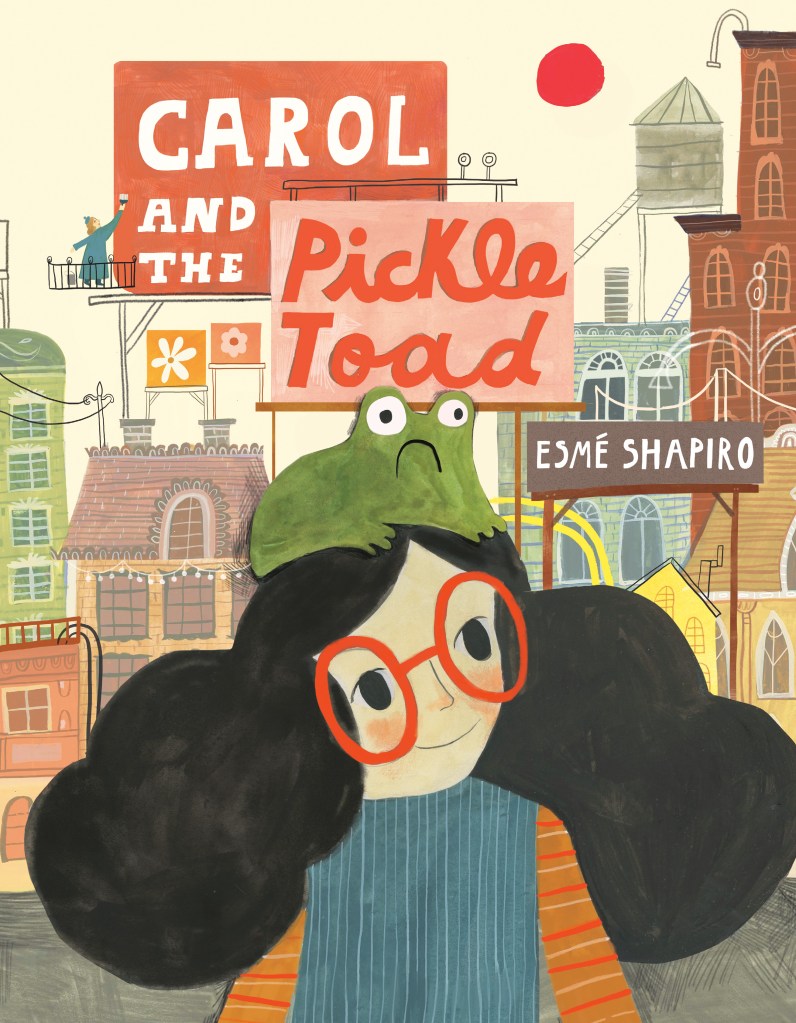
Carol and the Pickle Toad – written and illustrated by Esmé Shapiro
Tundra Books, 2021

Esmé Shapiro opens her latest picture book with a statement and a question about an oddly endearing girl, Carol. She wears a toad as a hat.  “Did you know,” Shapiro asks the reader, “that some people wear toads as hats?” Since the answer to that question is probably “no,” she assures you that “some do.”  To fully enjoy Shapiro’s mildly iconoclastic books, including this one, begin by accepting her premise and then enjoy the way her words and images expand the world a little bit. Carol’s physical proportions emphasize that she is a child, but also a creature of Shapiro’s rich imagination. We meet her riding a bicycle, her dark hair and big glasses almost overwhelming her face.  She is turning her head around completely so that she can see behind her, an implausible action which many kids would love to be able to perform. There is a toad sitting atop her head.

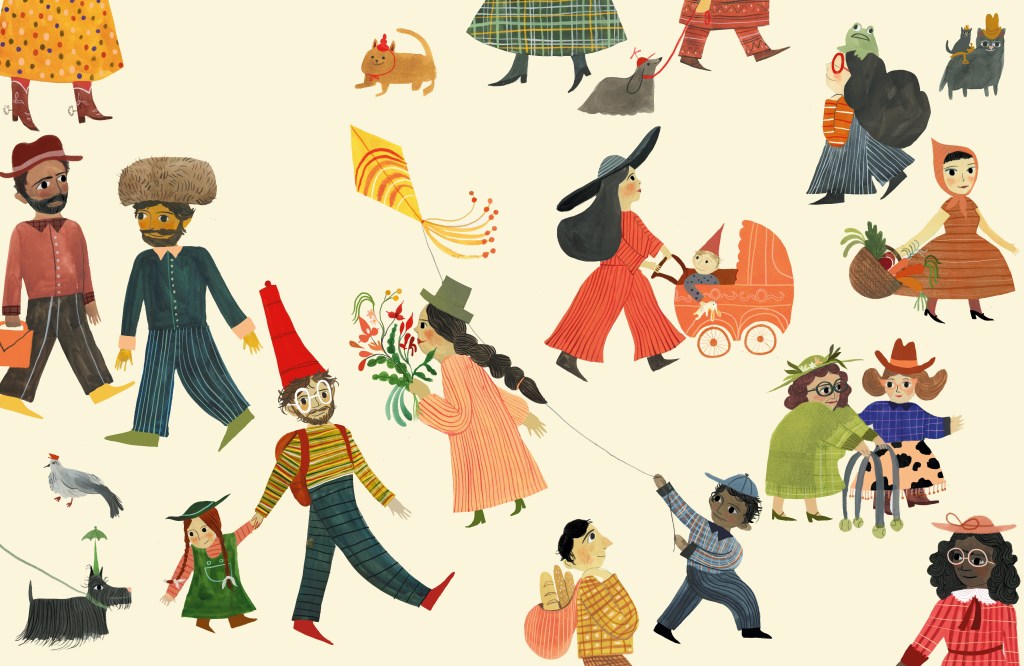
Turning the page, we observe that hats are so much a part of the city’s diversity that a toad is just one more means of self-expression. After all, people were wide-brimmed hats, Little Red Riding Hood-like pointed ones, and “big and furry” Hasidic shtreimels. A dog even wears an umbrella hat.  So Carol’s hat is only slightly off-kilter, if at all.

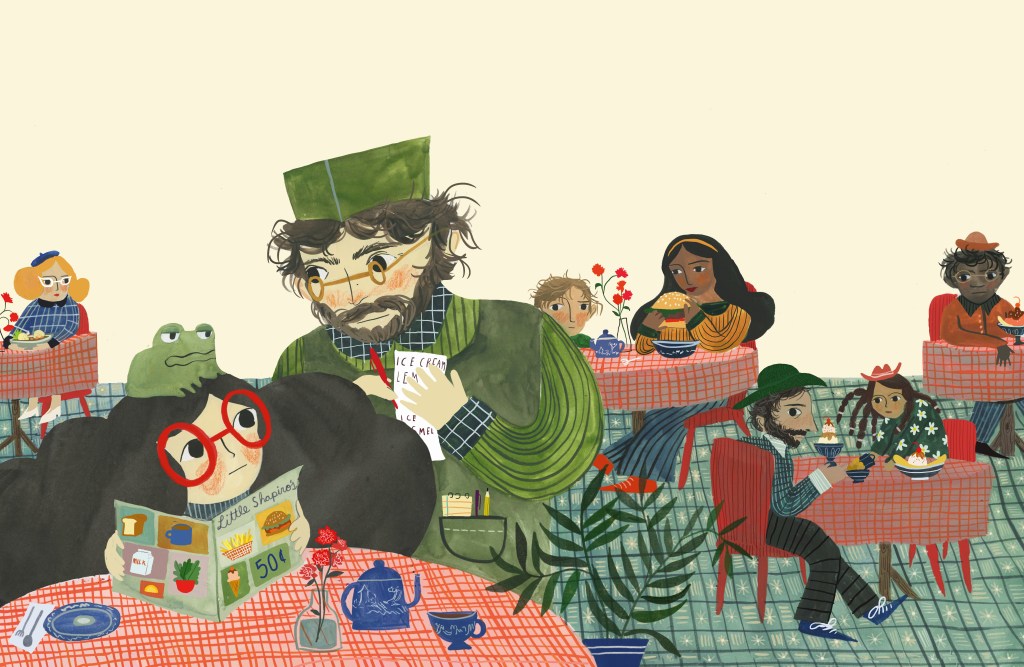
Readers can easily identify with her creativity, which brings along a dilemma. Carol’s hat, like a Freudian superego, tells her what to do.  (If at this point you think of Disney’s Ratatouille, where Rémy sits under Chef Linguini’s toque and directs him how to prepare the best dishes, the young chef is appreciative of the help, not frustrated by bossiness.) Carol can’t so much as ride her bicycle, let alone paint a picture her own way, without the toad’s obnoxious interference. Worse, she can’t even select delicious food at her favorite deli. 

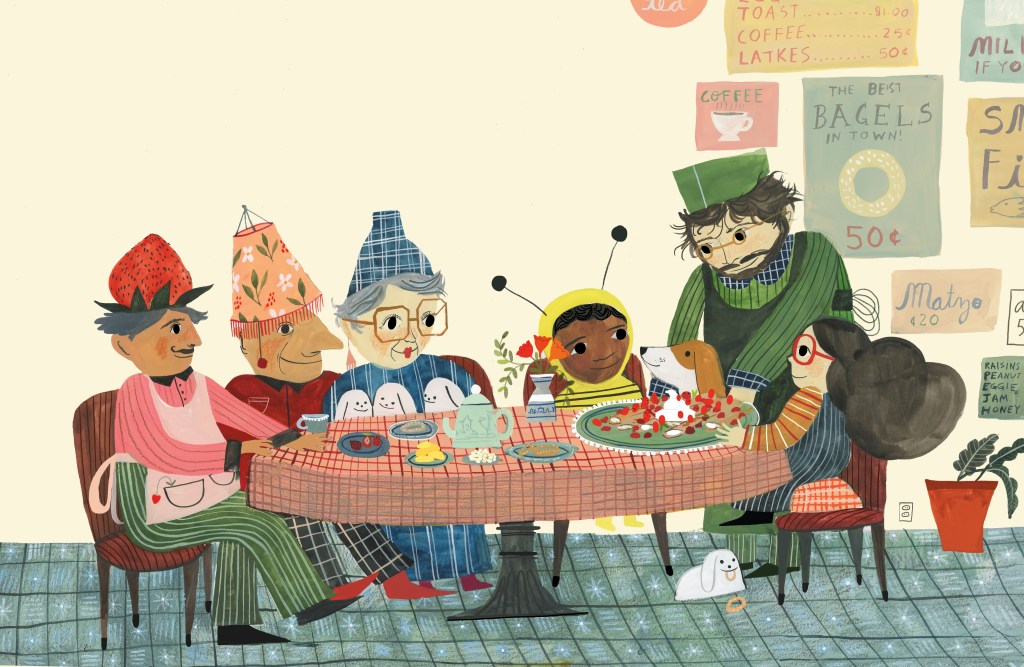
One of Shapiro’s most playful and appealing qualities as an author and artist is her combination of themes and images in a quirky way.  This book is about children’s desire to be independent. It’s also about creativity, and about friendship. The food element emphasizes comfort.  Who wouldn’t want to order the great items on offer at Little Shapiro’s: blintzes, bagels, potato latkes, matzo ball soup, strawberry shortcake, and lettuce leaves?  (The wonderfully diverse clientele, harmonious décor, and friendly service are perfect. If only a toad on Carol’s head did not insist on ordering “a side of flies.”  Shapiro understands perfectly how to include humor for both children and adults in her stories.

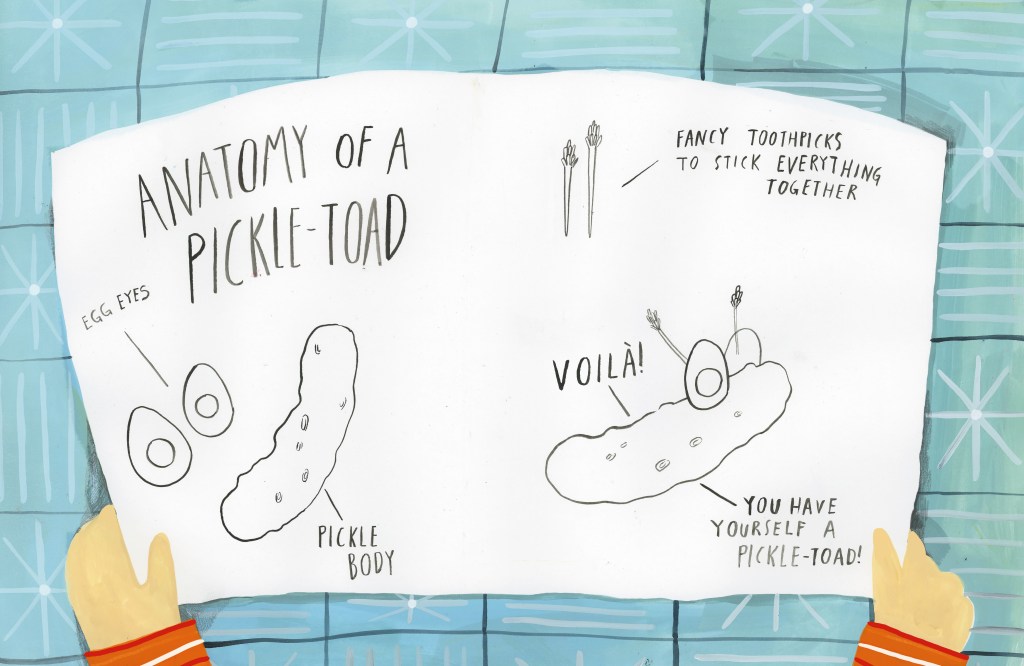
But wait, this book doesn’t stay in the deli. Shapiro’s change of scenes calls to mind the way children think about experience. Carol visits a hat shop, eager to find a more liberating kind of headgear.  A lovely older woman is sewing her creation, while Carol, in wizard hat, ascends a ladder to find what she is seeking. “She was so used to being bossed about that she knew what SHE wanted.”  Once again, Shapiro’s words get to the heart of what children feel. Carol’s solution to her problem involves thinking outside of the box, and her diagram of the perfect hat gets right to the point. (image).

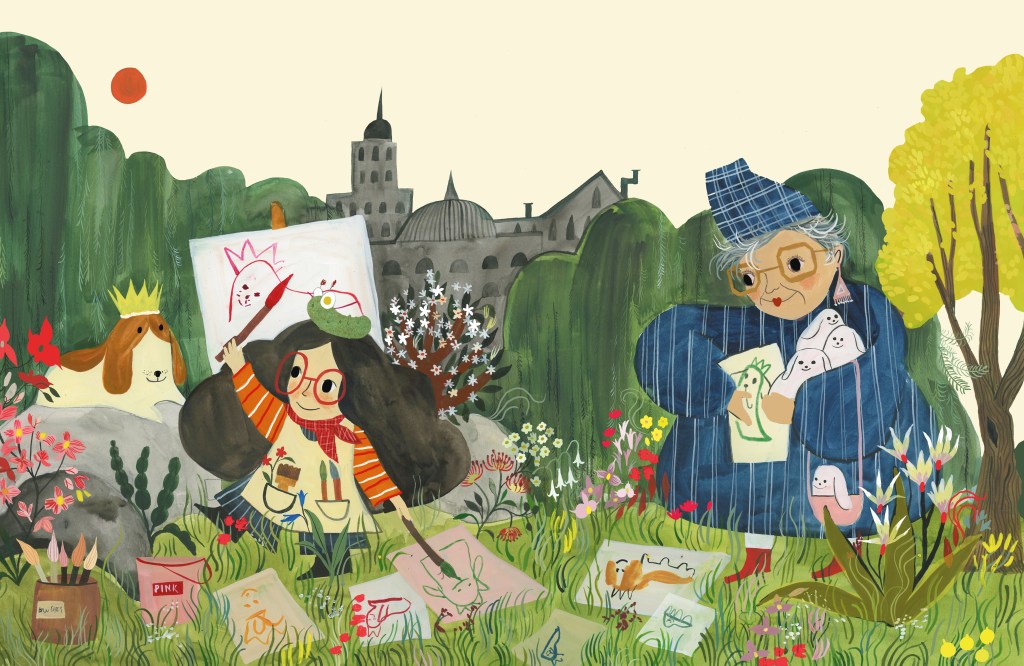
Cities and the outdoors also coexist in Shapiro’s imagination and in the book.  With gray city buildings in the background, Carol paints outdoors, “…all kinds of things, not just toads.” Another, presumably, wise and sympathetic old woman, with funky glasses and earrings, encourages Carol.  Who is this maternal figure? She is dressed in blue stripes which approximately match those of Carol’s outfit 7under her smock. Perhaps she is older version of Carol, as she embraces some adorable animals as well as one of Carol’s original artworks.  Shapiro depicts closeness between different kinds of people in Carol’s life, at the same time that she highlights Carol’s independence.

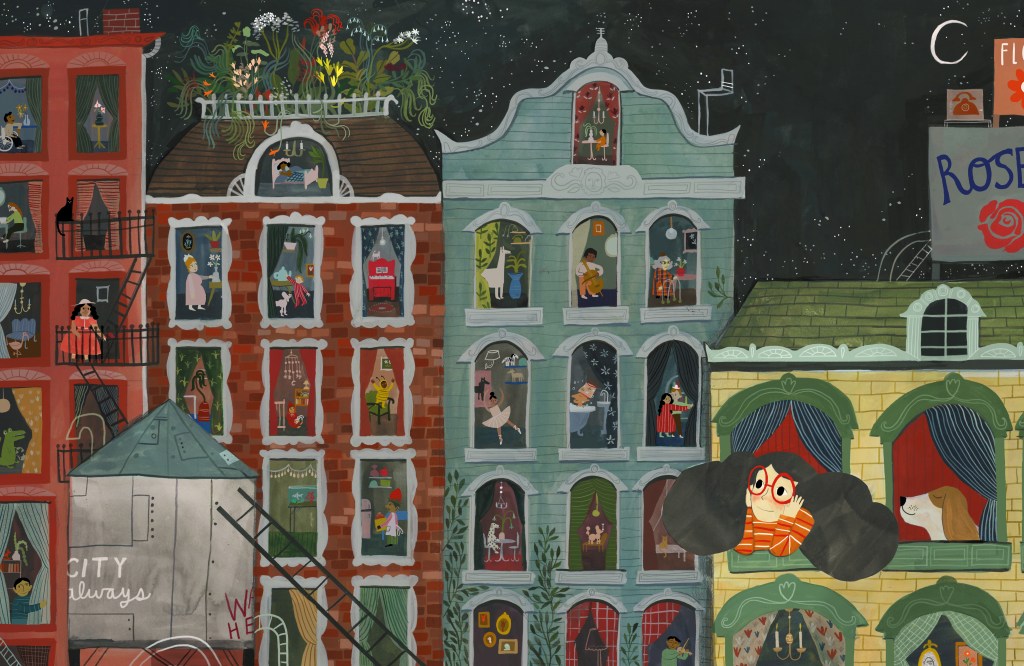
After further adventures and trials, Carol learns to listen to her own voice, and it’s a loud one: “With her big loud voice everything felt completely brand-new. She biked freely all about town.” Finally, she rewards herself with a trip to the deli and a wonderful feast with friends, including a man wearing a lampshade hat, a child in a bee costume, and the wonderful blue-robed lady and her pink puppies. They, as well as well as her friend the waiter, all have something in common: kindness. If fact, kindness is “fabulous,” and so is the city where Carol lives. The final two-page spread has a touch of Maira Kalman’s love of humanity and the urban world.  Even in the darkness of night, there are friends in every window, each one of them guides on Carol’s journey away from the pickle toad’s voice and towards her own.

Happy Birthday to the Wonderful, Inimitable Joe Krush

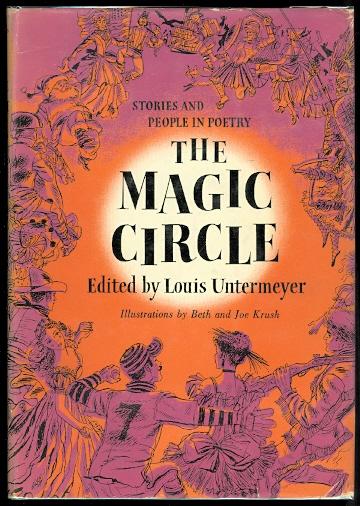
The Magic Circle: Stories and People in Poetry – edited by Louis Untermeyer, illustrated by Beth and Joe Krush
Harcourt, Brace and Company, 1952

Readers of my blog know that Joe Krush, and his late wife Beth (1918-2009) are among my most favorite illustrators in the world of children’s books. (Here is my Horn Book article published on the occasion of Joe’s centenary three years ago, and some of my posts about the couple’s work from this blog can be found here and here and here and here and here and here). Their style incorporates so many artistic styles and historical allusions, but it can never be imitated.  In addition to the many novels which their pictures brought to life, transforming them in a way which no other artists’ work would have matched, they illustrated a classic collection of poetry for young people, The Magic Circle. The book is organized into sections, each one with a title which represented the value of its era, even if they now seem dated. There are “Strange Tales,” “Gallant Deeds,” “All in Fun,” and yes, “Our American Heritage.” But this post is not about the changing perspective on what constitutes “American,” “gallant,” or “fun.” The point here is the pictures.

An excerpt from Chaucer’s Canterbury Tales, “A Knight,” portrays a knight, a squire, and a prioress, as envisioned by the Krushes.  The one woman in the trio is seated side saddle on a horse, her partly veiled face looking out at the reader.  Her sleeves are covered in arabesque patterns in the elaborate filling of space in black and white lines so typical of Beth and Joe. While the knight looks preoccupied with his latest deeds, she is positively serene. As Untermeyer’s adaptation asserts, “She was all goodness and a tender heart.”  The Krushes excelled at depicting goodness, although they drew quite a few villains, too.  The prioress’s wimple has cross-hatched lines, matched by those on her fine cheekbones. One shoe protrudes from the bottom of her gown. Here we are in the Middle Ages, courtesy of Beth and Joe Krush’s deep feeling for beauty.

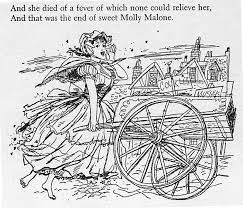
We meet another woman from a different social class in “Molly Malone,” the folk poem about a poor Dublin fishmonger and her tragic end. Molly is no high-class prioress, but she is every bit as lovely if much less constrained as Chaucer’s character.  Instead of wearing elaborate footwear, she is barefoot, pushing her cart as she loudly hawks “Cockles and mussels, alive, alive, oh!” The many tiers of her skirt seem to emit tiny stars. Her two braids fly in the wind, and she is strong enough to push the heavy cart with one hand while using the other to project her voice. She does look extremely happy for someone who, as we all know “died of a fever of which none could relive her.” But that was later. In the picture, Beth and Joe Krush pay homage to her tough and wild heart.

Happy 103rd birthday to Joe Krush, a national treasure!

Soup of Life and Luck

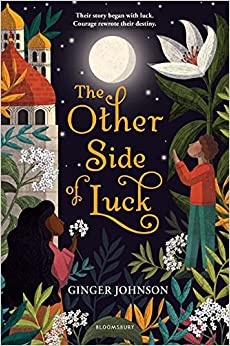
The Other Side of Luck – by Ginger Johnson
Bloomsbury Children’s Books, 2021

The title of this new middle-grade and older novel by Ginger Johnson is the first indication of its unusual focus.  There are many books about pre-teens and teenagers struggling with the inherent unfairness of life and how to cope with it.  There are other novels set in fantastic or semi-fictional historical worlds, not governed by the norms of realistic fiction.  The Other Side of Luck falls into neither category, although its title might lead readers to believe that it is one more contemporary examination of young lives. Instead, we meet Una and Julien, a girl from the ruling class and a boy whose job is to help his father locate valuable plants and herbs for sale by potion makers in the local market.  They do have family problems. Each has lost a mother.  They both confront injustice.  Yet Una and Julien’s life circumstances would seem to dictate very different outcomes.  Subtlety, humor, and empathy give this novel, set in a fictional past world but full of identifiable problems, a rich and compelling dimension.

Una is the First Daughter of the Magister Populi (master, or teacher, of the people in Latin, which is not required for reading this book)! The privilege which defines her life does not extend to gender; her younger brother will inherit their father’s power.  Julien, also motherless, has a tough job, helping his Baba (father) to locate valuable pharmaceuticals in the natural world.  Since he has no sense of smell, this task is particularly challenging.  There are lots of olfactory images and descriptions, some quite stunning, as when the author contrasts two different relationships of people to the environment:

          …the marauders rode straight into a meadow of wildflowers…their horses’ hooves
          trampling the delicate leaves and petals, crushing them, much the way an
          apothecary grinds leaves and petals in a mortar with a pestle.  The difference was
          that the apothecary turns his destruction into something beautiful, whereas the
          horsemen only left a path of wreckage.

Different themes weave together throughout the novel: feminism, parenting, coping with loss, finding one’s own path in life, fighting injustice.  There is a marked absence of ideological statements, as the characters’ speech and internal monologues ring true to the way in which intelligent and insightful young adults might articulate their feelings.  The colorful details of dress, language, food, and customs in this imaginary world are both specific and universal, allowing a great deal of room for the reader’s imagination. While character names such as Cassius, Brutus, and Ovid seem to be an homage to classic works of western literature, they enter the novel with a light touch, with multiple allusive possibilities.  Even if the reader is completely unfamiliar with the sources, their compelling stories move forward.

There is also soup, in the hands of wise older woman named Vita (life), whose concoctions play an important role.  “Soup of life has spice and lime, chiles, garlic, luck, and time.” You can’t argue with that recipe, only one of many essential ingredients in this beautiful and memorable book.

Milk in the Stars and on the Ground

Ernestine’s Milky Way – written by Kerry Madden-Lunsford, illustrated by Emily Sutton
Schwartz & Wade Books, 2019

I first encountered Emily Sutton’s work at the Society of Illustrator’s annual show of original picture book art, which I used to attend in person, before the pandemic temporarily converted it to an online event.  The book exhibited was One Christmas Wish and I fell in love with her pictures—beautiful, evocative, resonating with classical illustration styles, but not imitative.  When I found Ernestine’s Milky Way, I was not disappointed. Kerry Madden-Lunsford’s story, set in a poor community in the Great Smoky Mountains during World War II, is an absolutely perfect match for Sutton’s art.  Everything about this book deserves attention.  The story is nostalgic, but does not romanticize the past.  The little girl at the center, Ernestine, is brave, persistent, and good at conquering her fears, but not unrealistically so.  The composition and use of color is gorgeous and the text matches the pictures with appealing symmetry.  In fact, symmetry is the core metaphor, since the celestial Milky Way has an earthly counterpart in the scarce and precious milk available on Ernestine’s farm.  Her mother is even expecting twins, keeping the metaphor operating on every level.

Life is not easy for Ernestine and her mother. Ernestine’s father is “off in the war,” and she and her mom are responsible for keeping the farm running.  (The “Author’s Note” explains that the story takes place in 1942.) Ernestine’s lovely, strong mother assures her that they are a team: “I’m the Big Dipper and you’re the Little Dipper, and way over in Germany, Daddy sees the same stars we do up there in the Milky Way.” This. matter-of-fact poetry characterizes their closeness and warmth, as do the pictures of mother and daughter under a quilt with star motifs, and the two embracing after Ernestine has completed her special mission.  A neighboring family with many children needs milk as much as they do, and Ernestine is given the challenging task of delivering two mason jars full of the liquid to their friends.

Her odyssey is truly daunting, with obstacles both real and imagined.  Ernestine fortifies herself by repeating “I’m five years old and a big girl.” Children will easily relate to her tenuous feeling of confidence, as well as to the rhythmic descriptions of nature: “Soon Ernestine found herself in the valley of green doghobble and devil’s walking stick, where she heard a mighty big something scratcha-scratcha-scratchin’ up a tree.”  Madden-Lunsford’s combination of fairy tale repetition and realistic plot works flawlessly. Ernestine’s trip down the slippery path is tenuous. When one “runaway jar of milk” escapes her grasp, she tries to recover it, to no avail: “But it vanished without a trace.”  Each segment of the mishap is accompanied by Sutton’s picture of Ernestine in motion, as she walks, trips, and tries to regain her balance.  When she arrives at the home of Mrs. Mattie Ramsey and her family, their Aunt Birdy pours the one jug of milk over each one of twelve bowls of oatmeal carefully set out on the table. Again, the characters, from strong matriarchs to needy children, are both real-life people and archetypes.

Sutton’s ink and watercolor drawings are glorious.  She uses earth colors and jewel tones, includes many homely details of rural life, and allows even minor characters to claim their own personalities. One two-page spread of the Ramsey family enjoying their meal of both oatmeal with milk and cornbread with butter features each person responding somewhat differently to the fortunate occasion. The mother feeds the baby in her lap, one boy reaches for seconds while another closes his eyes as he bites into the bread.  Colorful flowers decorate the table, while pots and pans on hooks and wooden shelves signal the everyday work involved in sustaining a family.  The book ends with a lovely “Author’s Note” about the story’s origin, and a recipe for traditional corn bread.  Ernestine is five years old and a big girl, but her adventure resonates with anyone faced with a task, motivation, and the support of a loving community.

A Line of Generations

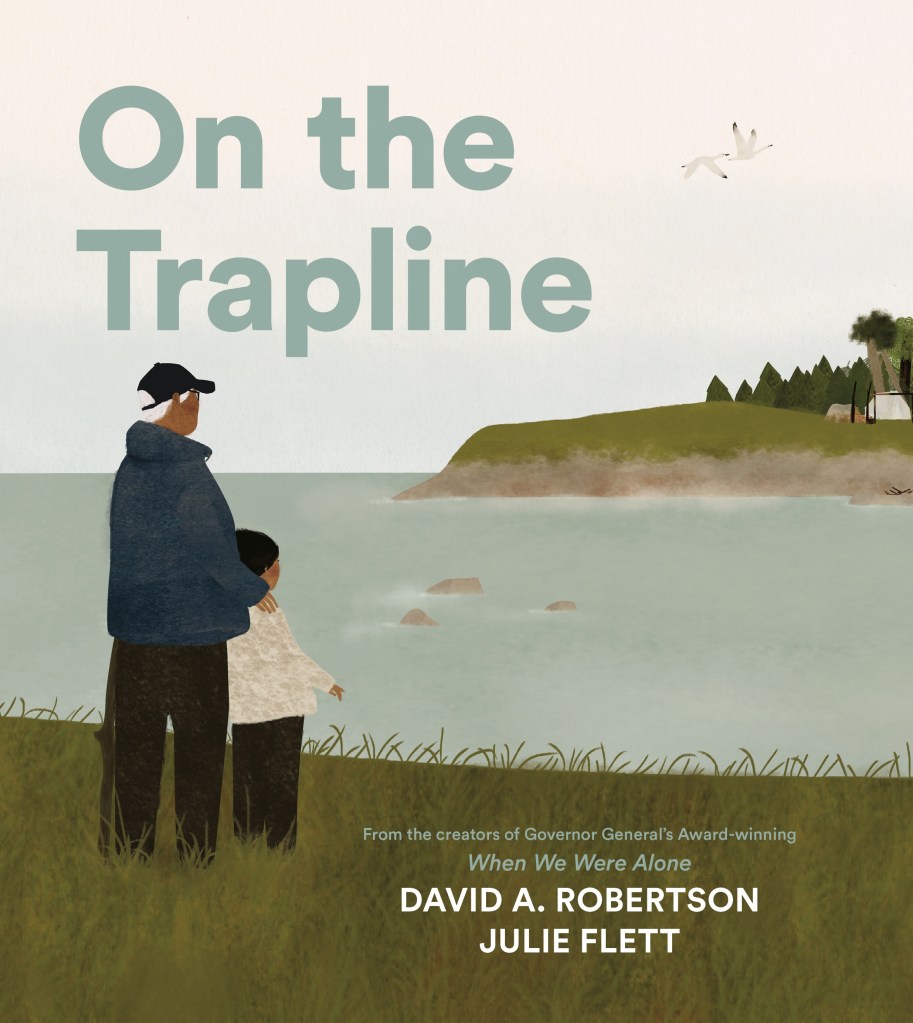
On the Trapline – written by David A. Robertson, illustrated by Julie Flett
Tundra Books, 2021

In David A. Robertson and Julie Flett’s hauntingly beautiful new book, a boy and his grandfather renew their connection to one another and to the past which they share. Robertson, prolific author and member of the Norway House Cree Nation, and accomplished artist Flett, of the Swampy Cree and Red River Métis, have created a dialogue between generations. The reader is invited to join in, as author and illustrator offer insights into the specific values of the Cree as well as the universal bond between grandparents and grandchildren (see examples from children’s literature here and here and here and here and here and here and here and here).

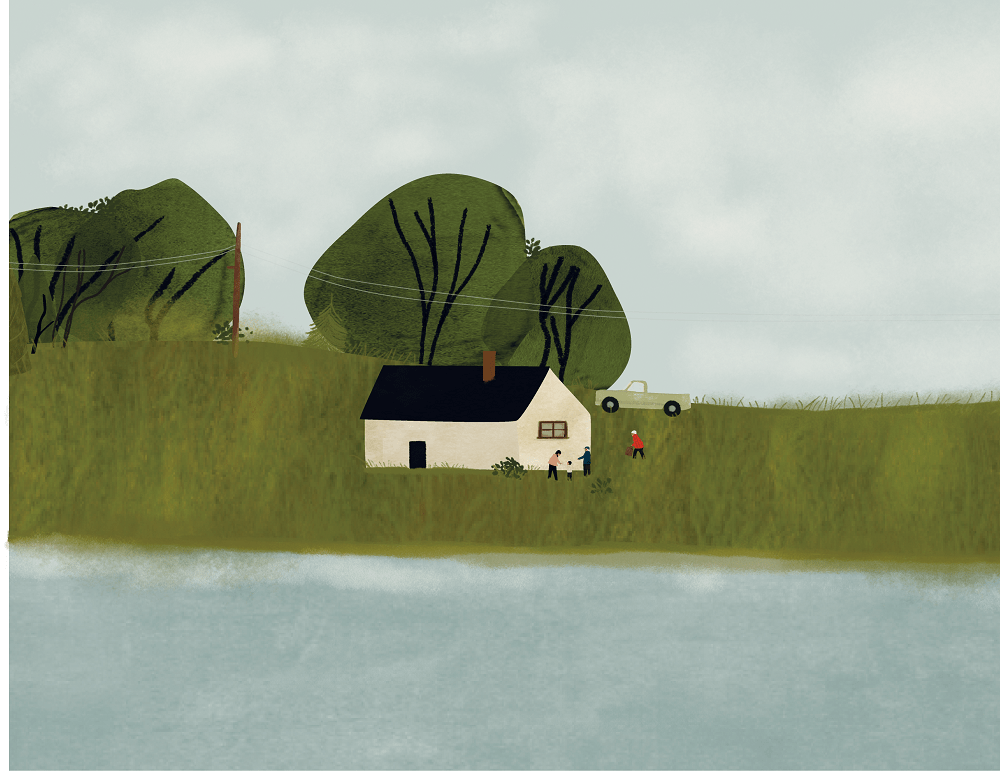
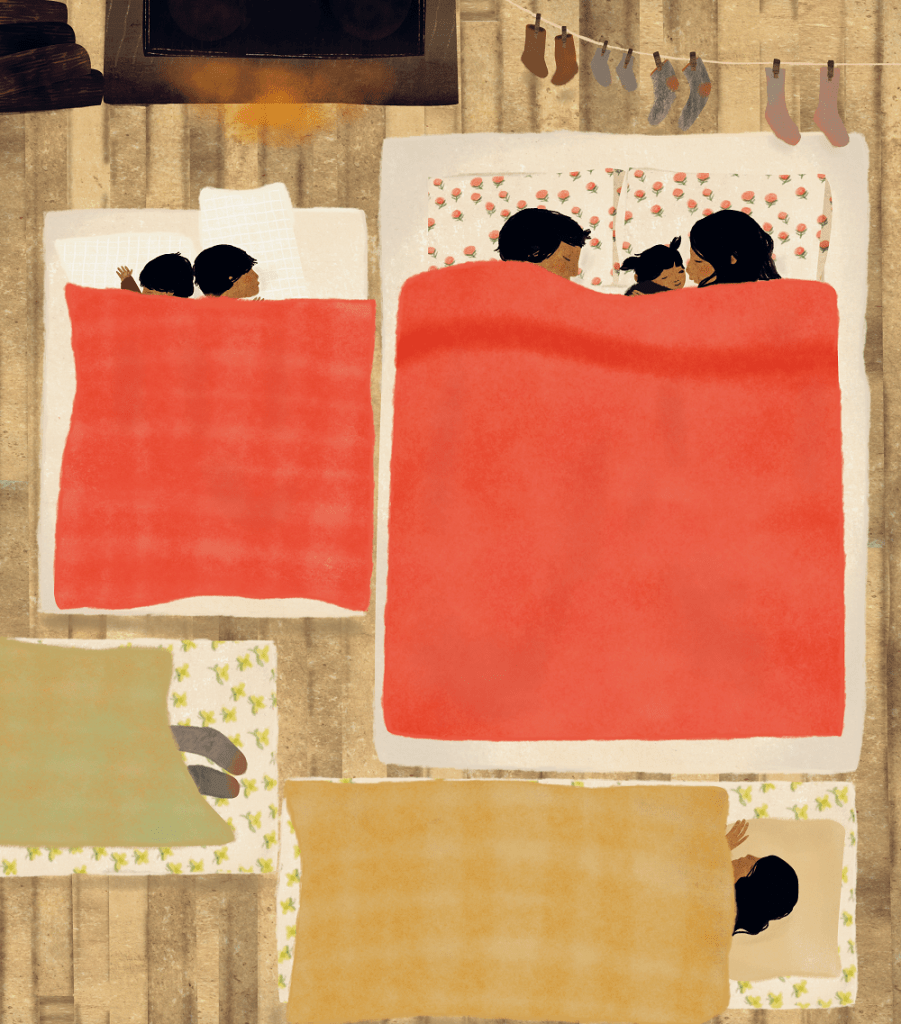
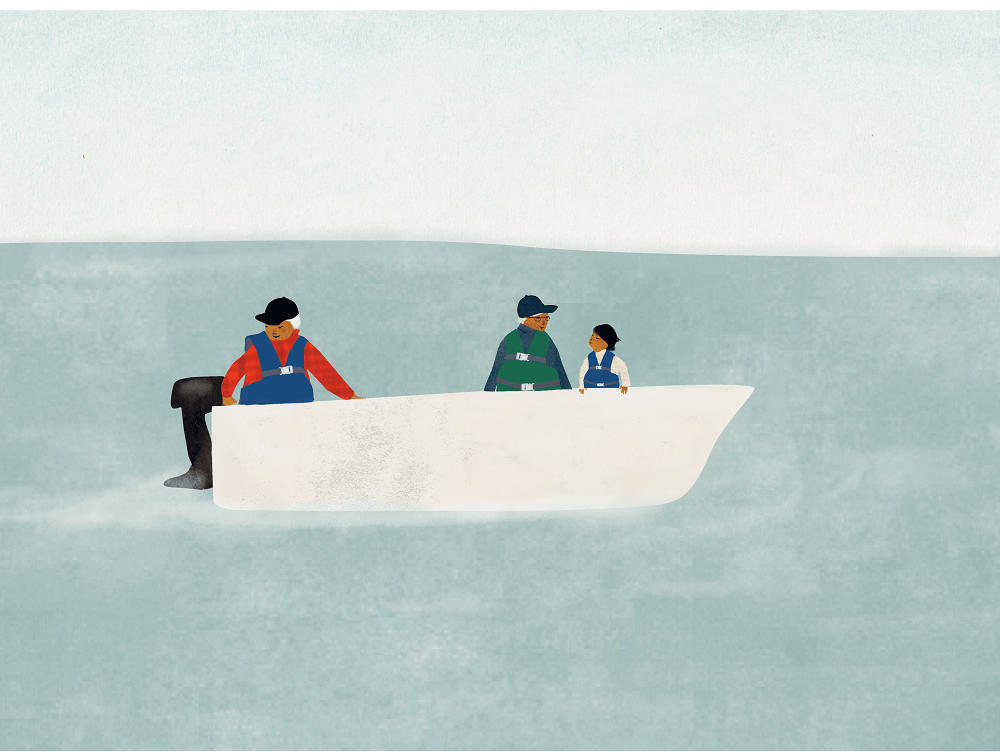
Everything about the book demands a careful and attentive pace of reading.  From the dominant colors of blue and grey accented by brighter red, to the boy’s faithful rendition of his conversations with Moshom (grandfather), a picture unfolds of two contrasting ways of life. But the boy does not only observe the differences, he analyzes them, noting surprising similarities as well as clear divergences between the city where he lives and his grandfather’s life “in the north…Kīwētinohk.”  While the space between houses seems vast, the space between family members sharing a room (image) is smaller than he could have imagined: “I guess some things are bunched up in the north.”

Moshom defines the trapline of the book’s title as a place “…where people hunt animals and live off the land.” Although central to the community’s life, it is an entry point to other truths that he shares with his grandson about the history of their people.  Talking about the school he attended as a child, Moshom reveals that, although he has his friends spoke Cree, they were forced to communicate exclusively in English while in school.  When his grandson asks with evident concern if they still were able to speak Cree, Moshom answers that “My friends and I snuck into the bush so we could speak our language.” Even without any explicit elaboration of this injustice or the pain it must have caused, the boy understands what happened, using both his grandfather’s words and geographic setting to recreate the past: “We look at the birch trees and pine trees and all the long grass.  I imagine Moshom and his friends speaking Cree in there.”

It is difficult to capture the totality of this book in a brief review, because the sequence of understated words and almost dream-like pictures operate as a seamless whole.  Out in a motorboat together, the boy and his grandfather continue to become closer. Moshom emphasizes the slow tempo and natural beauty of his life in the past. As on every page of the book, his meditative comments end with the boy noting the meaning of key words in his grandfather’s Cree language.  Robertson leaves some ambiguity about the speaker, or thinker, of these words.  They may be new to the boy, or they may have been familiar before they were reinforced on this visit to his grandfather. Unless the reader is a native speaker of Swampy Cree languages, they are likely new to her.  The exquisite subtlety of their impact, reinforcing what the boy is learning and the deep love of grandfather and grandson for one another, is at the core of this wonderful story. Moving notes from the author and illustrator, and a list of Swampy Cree words, conclude the book.


Small Girl, Big Dreams

This Is Ruby – written by Sara O’Leary, illustrated by Alea Marley
Tundra Books, 2021

The fact that girls can do anything used to be rarely acknowledged in children’s books, but now multitalented girls with big dreams are often at the center of their storiesThis Is Ruby stands out in the super girls genre because it speaks to children rather than to adults who have high aspirations for their daughters.  (link to other books by Sara O’Leary if I have blogs on them, and maybe to I Will Be Fierce.). Ruby is confident, lovable, and still too young to specialize. She might become an astronaut, an engineer, or a doctor, but she has dreams outside of STEM fields, too.  Like all children, she’s on a voyage to an unknown destination.

Ruby’s unaffected greeting from behind a red door introduces her to young readers as a peer.  She’s imaginative and kinetic, and she has a big, friendly dog who helps her by being a patient when she explores medicine as a career. Knowing how things work is key to success in any chosen field; Ruby shows initiative and a valuable sense of perspective in examining the nuts and bolts, as well as gears and faces, of important objects. One key line of Sara O’Leary’s accessible text summarizes Ruby’s approach to life: “Ruby knows that there is always another way to see the world.” Fantasy and imagination are also central to Ruby’s experiments. After all, reading books about dinosaurs is essential to becoming a paleontologist, but make-believe time travel is another avenue of research for a young child. (image).  As O’Leary helpfully points out, “Ruby decides to go back to see what the dinosaurs really looked like.” The use of “decide” captures the. purposeful nature of this little girl’s pursuits.

Visually, Ruby is totally delightful. With her beautiful dark curls almost overwhelming her petite frame, and her practical fashion choice of striped sailor shirt and comfortable pants, she always looks ready for fun.  Cooking up “a potion that tastes like clouds,” is a mix of culinary and supernatural arts. Her star earrings and round-as-planet glasses ensure that she is geared up for any possibility. If parents are looking for a book that emphasizes only academic readiness to ensure a successful future, this is not it. Instead, O’Leary and Alea Marley convey on every page that learning for young children cannot be neatly separated from flights of imaginative fancy.

Marley’s use of color in This is Ruby is attuned to the way in which children view the world.  Whether building herself a town made of brown boxes, green trees, and dinosaurs of different hues, or playing under a rainbow-colored sky at the beach,  Ruby is immersed light and bright shades, sometimes arranged in kaleidoscopic sequences.  The pages of this book are so inviting, and children will respond to Ruby’s acknowledgement that “…she will always find something new to make, and that she can be whatever she wants to be.” 

More About New Little Women

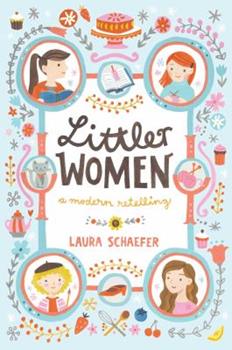
Littler Women: A Modern Retelling – by Laura Schaefer
Simon & Schuster Books for Young Readers, 2017

I’m continuing my series of Little Women retellings, re-imaginings, and fan fictions, with a book which initially raised doubts in my mind, but which completely won me over.  Laura Schaefer’s modest premise is an updated version of Louisa May Alcott’s novel, with younger main characters.  Like the original book, Littler Women tales place in a town outside of Boston, and the March sisters’ father is serving in the military.  It is not the era of the Civil War, but an unspecified contemporary setting.  Kirkus Reviews was largely positive, but posed the question of the book’s purpose: why should readers need this book when they can read the Alcott classic? For some reason Kirkus did not raise the same question about Meg, Jo, Beth, and Amy: A Graphic Novel by Rey Terciero and Bre Indigo but, in any event,  Schaefer’s book is aimed at younger readers than Little Women.  One hopes they will go on to read the original, but that book is sadly more read about than read. Its length, vocabulary, and antique cultural references make it seem obsolete to many less motivated readers, especially if they are not actively encouraged by parents and educators. 

In Schaefer’s book, the sisters range in age from nine to thirteen.  Their personalities are quite similar to Alcott’s heroines, and the situations which they confront are also rooted in the original novel.  Schaefer has not merely imitated, however, but rather transposed the girls from an earlier time, allowing their qualities and their life circumstances to develop naturally in the twenty-first century.  Readers will find it easy to empathize with them, and will wonder about a potential romance between Laurie and Jo just as Alcott’s original readers did. Each girl is uniquely gifted, and sometimes their priorities clash.  Their mother is a center of strength, just like Marmee, but far less acquiescent to the gender roles that ruled in the nineteenth century.  Yet she is still the same role model,  teaching the girls how to manage their anger, avoid pointless envy of those with more material goods, and cultivate patience.

A truly inventive part of the book is Schaefer’s inclusion of recipes, craft projects, and selections from the letters and March family publications.  Each chapter begins with a quote from a beloved author, and the book ends with “Jo’s Book List” and an author’s note.  The details in these extra features are quite impressive, indicating that the author expects readers to slow their pace and pay close attention, whether to a recipe for “Potato Salad Even Jo Could Love,” or “Mr. Lawrence’s Scarf Pattern.”  There’s a sense of dignity and compassion underlying this story of the March girls, made accessible for younger readers without talking down to them.  I hope that Laura Schaefer will consider writing more about Meg, Jo, Beth, and Amy.

Turning No to Yes

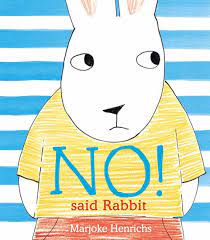
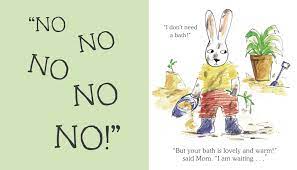
No! Said Rabbit – written and illustrated by Marjoke Henrichs
Peachtree Publishing, 2021

This is a lovely and unpretentious book about the reflexive response of toddlers, “No,” when asked to do almost anything.  There is no irony or sly humor; instead, Marjoke Henrichs succeeds in conveying the emotions of the young rabbit and the patience of his mother at the same time. The pictures, “created with wooden stick, ink, gouache, and colored pencil,” are perfect for expressing the rabbit’s world and his world view.  The design of each page reflects careful attention to a young child’s attention span and to the types of objects and their placement which she would find appealing.  Even the pictures themselves are closely enough related to a child’s artwork that their deceptive simplicity goes almost unnoticed.  From beginning to end, No! Said Rabbit performs beautifully.

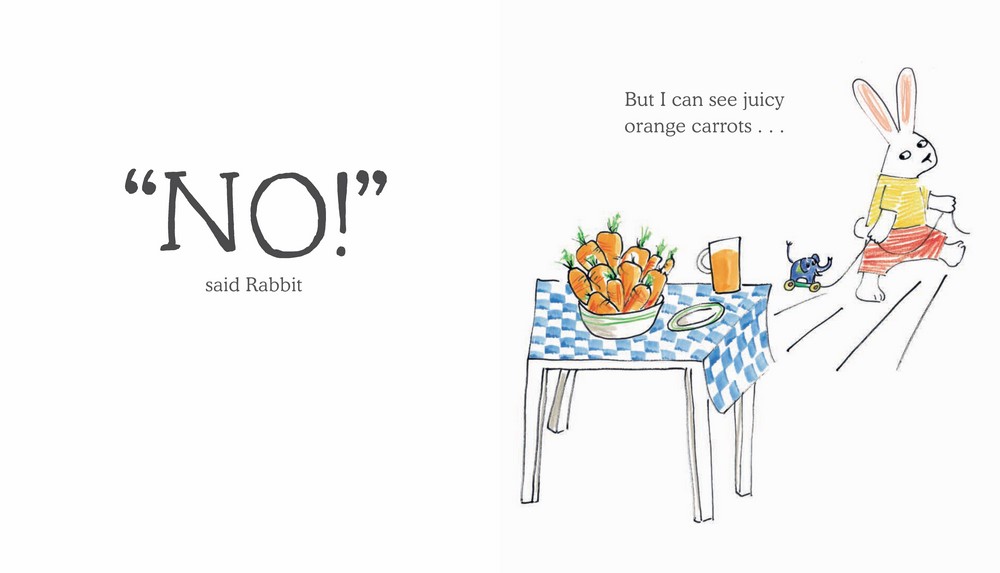
Rabbit’s room has all the basic necessities of toddler life: blocks, pull-toys, a ball, a clothes rack with striped tee shirts, and a blanket large enough to trail off the bed and onto the floor. His mother’s cheerful reminder that it is time to get dressed earns a “NO!” in large font.  Rabbit’s thoughts are in a different font, in lighter gray and with almost-cursive elements. He walks past his tempting breakfast, although he is clearly interested: “But I can see juicy orange carrots…” Every action meets a reaction, and every one of his mother’s statements meets a compromise between outright defiance and half-compliance.  Why would he want to go outside when so many toys tumble out of a box, but, then again, there would be advantages to an outdoor trip: “But those are lovely rain boots.”

Children will be eager to hear the next page, and excited by a full-page list of text bubbles, each containing another suggestion and another refusal.  Here Rabbit’s face is smudged with swatches of dark crayon, as if an angry toddler had actually drawn across it. When he finally gets into his bath, this issue is resolved, and the book’s dénouement begins. He will definitely not say “no” to a hug from his mother.  Bedtime is another story…Reading and rereading this book with children could become a cyclical event and a satisfying one. The little rabbit gets to negate every rule while finding convenient reasons to do what is actually best for him. The mother doesn’t get angry. Each compromise activity is a lot of fun.  Finally, in a moment which as most caregivers will recognize, he is just too tired to resist sleep.  Time to start the book again.

Being a Twin and Dealing with a Bully

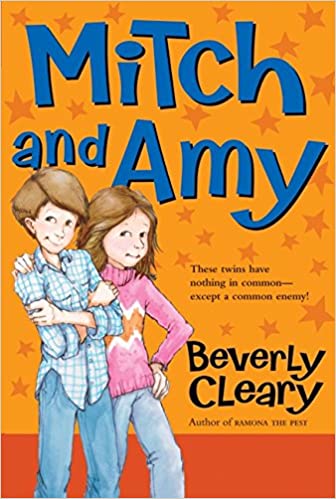
Mitch and Amy – written by Beverly Cleary, illustrated by Tracy Dockray
HarperCollins, 2000, reprint of original edition, 1972

Beverly Cleary (1916-2021), was the mother of boy and girl twins. How much of that experience is reflected in her novel Mitch and Amy, about twins who are very different in spite of the strong bond they share, is hard to know.  However, the book radiates empathy for the experience of having one sibling of the same age.  Mitch and Amy Huff fight over many typical sources of conflict. Mitch bothers Amy and her friends, they playfully belittle each other in ways that can cross the line from funny to hurtful, and their strengths and weaknesses are complementary.  Mitch struggles with reading, while Amy finds learning arithmetic to be a torment. The intervening years between the novel’s first appearance and now have done little to date these problems. 

The twins also need to support one another through attacks by a classic bully. Alan Hibbler is cruel and aggressive. He destroys the skateboard which Mitch built for himself, and steals cupcakes meant for Amy’s Girl Scout troop.  A key part of Alan’s identity is that is father is a world-famous professor at the University. (The book takes place in the San Francisco Bay Area.) Most of the other kids in the book, including Mitch and Amy Huff, have less illustrious parents.  Only at the end are readers asked to connect the dots, when Mitch and Amy realize that constant comparisons to his intellectually gifted father, especially for a boy who finds reading difficult, may have influenced the development of his personality.

There are numerous references to the distractions of television.  Far from being irrelevant, they could easily be compared today to the much more pervasive effect of other media.  Cleary is never heavy-handed, and she is often funny, as in this wry description of mid-century TV programming:

          …he watched a nursery-school program, which was followed by an exercise program,
          a man interviewing some famous but boring people, and several old comedies.  Amy
          perched on the foot of his bed to watch the comedies, and just at a funny part, where
          a curly-haired woman was trying on a pair of skis in her living room and was knocking
          over all the lamps, Mr. Huff walked into the bedroom with the three library books…

There is a delightful subplot about one of Amy’s friends, Bernadette, whose family life is utterly unlike Mitch and Amy’s.  Bernadette has many brothers and lives in a gloriously messy and chaotic home.  Her mother is attending classes at the university, because she had not finished her degree before marrying and raising a large family. Her stated goal is to find an interesting job when she graduates.  As in the Ramona series, the author quietly supports the idea that mothers have a right to both contribute to the family income and find jobs as satisfying as those of their husbands. 

As for Alan the bully, Mitch and Amy try to avoid him, outwit him, and, in Mitch’s case, fight him. Finally, Bernadette is ready to deliver the ultimate humiliation to Alan of also engaging him in a physical fight.  When Mitch and Amy realize how pathetic Alan’s aggressiveness actually is, there is not facile transformation of this obnoxious child into their friend. Instead, the novel concludes with the twins recognizing that Alan’s glory days of bullying are probably behind him, and that they are glad to have one another.  Adults who read this book as children should return to it, and share it with kids.  There’s so much to appreciate and discuss in this one example of Beverly Cleary’s legacy.