Not Redemption, But Consolation

Book Reviewed:  Elisabeth – Claire A. Nivola, Farrar, Straus & Giroux, 1997

I am writing today about one of my favorite books.  By saying that, I am giving it an award in a category too broad to exist.  It is at the top of my list in several categories: children’s books, illustrated books, Jewish children’s books, doll books, books with girls and women as central characters. It is based on a true story, adding a category of historically themed illustrated books.  Both the text and pictures are by acclaimed artist and writer Claire A. Nivola, author and illustrator of Orani: My Father’s Village, and illustrator of Emma’s Poem and the soon to be published The Secret Kingdom: Nek Chand, a Changing India, and a Hidden World of Art.

elisabeth cover

Elisabeth is the story of a Jewish child, based on the author’s mother Ruth, growing up in Germany as the country succumbs to the murderous rule of the Nazis.  Elisabeth is the name of her doll, portrayed as incredibly life-like—almost uncannily so.  They share everything together in a comfortable home full of the details of their particular life: Persian carpets, a giant turtle brought from Africa, a carved wooden chair on which they sit together as the book opens.  The inner life of her childhood is radically disrupted as the Nazis, along with the German people, distort who she is: “Then everything changed.  In school, the teacher no longer saw my hand when I raised it in class. ‘Jew,’ I was called.”
Continue reading “Not Redemption, But Consolation”

Grandpa Explains the City of Light

Book reviewed:  A Walk in Paris – Salvatore Rubbino, Candlewick Press, 2014

Author and illustrator Salvatore Rubbino has been introducing great cities of the world to your children since A Walk in New York, 2009.   Two years later, he went to a pre-Brexit Britain in A Walk in London. (Look for future posts on both books.)  His most recent, but I hope not his last, is A Walk in Paris. In each of his previous tours, a parent accompanied a child. Here it is a grandfather who enlightens a young girl about the history, architecture, and je ne sais quois of France’s capital city.

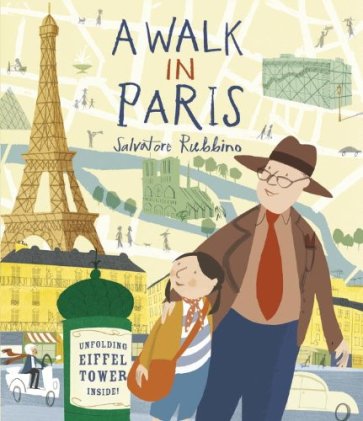
Paris-cover

The cover of the book promises that you will find an “Unfolding Eiffel Tower Inside!” so you know that Rubbino’s  audience includes the kind of parent or caregiver excited by teaching children about  world cultures.  An obvious inspiration for this type of picture book is Miroslav Sasek’s This Is series portraying different countries and cities and the people who live there.  Originally published between 1959 and 1974, many of these have been recently reissued, including This is Paris, This is London, and This is Israel.


Continue reading “Grandpa Explains the City of Light”

A Crush on Beth and Joe Krush Starting Out Small:

Arietty’s Bedroom

Book Reviewed:  The Borrowers – Mary Norton and Beth and Joe Krush, Houghton Mifflin Harcourt, 2016 (reprint edition of complete series, 1953, 1955, 1959, 1982)

crushes

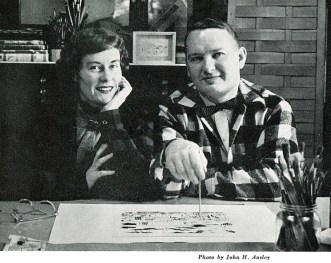
Beth and Joe Krush were a frequent presence in American illustration from the 1940s to the 1980s. They were both born in 1918; Beth died in 2009 and, if the most current information is correct, Joe is still living in the Philadelphia suburbs.  There is a moving film about him by director John Thornton, Joe Krush, An Illustrated LifeJoe actually produced courtroom sketches at the Nuremberg Trials. He and his wife Beth are responsible for creating some of the most lasting images in mid-twentieth century children’s literature, for The Borrowers, as well as Sydney Taylor’s All-of-a-Kind Family Downtown, Elizabeth Enright’s Gone-Away Lake, Virginia Sorenson’s Newbery winner Miracle on Maple Hill, and many more (be warned that even when classics are re-issued with the original illustrations, publishers tend to commission another artist to do a new cover).  It would be impossible to do justice to the Krushes’ body of work in one post, so I am starting out “small,” with The Borrowers, and really small, with Arietty’s room.

Continue reading “A Crush on Beth and Joe Krush Starting Out Small:”

An Elephant and a Mouse Walk into a Bakery…

Books Reviewed:
Little Elliot Big City – Mike Curato, Henry Holt and Company, 2014
Little Elliot Big Family – Mike Curato, Henry Holt and Company, 2015
Little Elliot Big Fun – Mike Curato, Henry Holt and Company, 2016
Little Elliot Fall Friends – Mike Curato, Henry Holt and Company, 2017

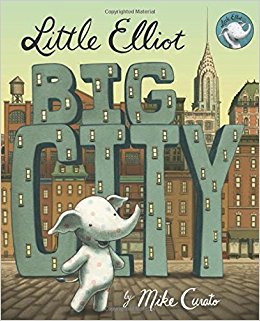
Mike Curato is a relatively new but rising star author and illustrator and Little Elliot is a sweet and vulnerable elephant of small stature who successfully negotiates many difficulties with the help of his friend, Mouse.  They live in a time and place unnamed in the books, but which is clearly 1940s New York City and environs.  Elliot, white with pastel colored polka dots, is acutely conscious of being different. He also suffers anxiety over a number of problems, such as not being able to reach the counter in his favorite Italian-American Speranza bakery, or confronting the terrors of a big amusement park (Coney Island).  The books are saved from being formulaic or saccharine through Curato’s understated text and his brilliantly executed pictures, which manage to evoke both a specific and nostalgic era and the timeless universe of young children. While Elliot follows in the grand tradition of de Brunhoff’s anthropomorphized Babar, he is a younger and more innocent character in a less complex universe.

bigcitycover

The cover of the first book introduces Elliot standing in front of a row of urban apartment buildings with the Chrysler Building in the background.  The letters “Big City” are the size of tall buildings and they are dotted with windows like the structures behind them.  We enter Elliot’s world to learn how difficult it is for him to huddle on a crowded train track, hail a cab, or reach the ice cream in his freezer. He seems to live a lonely but independent life in his pre-war apartment, until he meets an even smaller but perhaps more resourceful Mouse, who is fishing for half-eaten pizza in a Central Park garbage can.  Elliot helps him; this is the beginning of beautiful friendship.

By the second book, Elliot and Mouse apparently live together, but Mouse needs to visit his extended family and Elliot is temporarily devastated.

Continue reading “An Elephant and a Mouse Walk into a Bakery…”

It Takes a Village…and a Woman

Books reviewed:

It Takes a Village – Hillary Rodman Clinton and Marla Frazee, Simon and Schuster Books for Young Readers, 2017
Hillary Rodman Clinton: Some Girls Are Born to Lead – Michelle Markel and LeUyen Pham, Balzer + Bray of HarperCollins, 2016

A year ago last November, it appeared that it would take a woman, a brilliant, committed one, to continue to elevate our country, following  President Obama’s progress in eight years in office. Now it seems that way more than ever.  Instead of progress, we now have destructive and reactionary moves backward, towards the worst elements of America’s past. Racism, misogyny, xenophobia, contempt for the poor and attacks on labor, science, and education.  On one level, I find it sad even to look at these two wonderful books, but on another, it gives me hope for the future, as they showcase the accomplishments and dreams of four talented women: authors and illustrators, and almost-President Clinton herself.

villagehillary

It Takes a Village is an expression of Hillary Clinton’s philosophy, based on her previous manifesto of the same name, but distilled for children. The pictures are by Caldecott Honor winner Marla Frazee in her inimitable style, perfect for capturing a multicultural present rooted in the finest values of America’s past.

Continue reading “It Takes a Village…and a Woman”

What Makes a Family?

Book reviewed:  One Family – George Shannon and Blanca Gómez, Farrar Straus & Giroux, 2015

In One Family, George Shannon and Blanca Gómez together answer the question of how to depict a twenty-first century family in a natural and inclusive way.  The success of their book lies in its complete accessibility to children, with both words and pictures constructing a world where members of families and the objects they encounter “match.”  You can count them, and count on them, to be there, in predictable settings.  In the past, the families shown here might have been on the margins, but now they are part of children’s daily world. The author and illustrator accomplish this normalized view of diversity in a completely unobtrusive way by creating people who are both archetypal and real at the same time.

one familycover

The book is structured around family members, at first single and then in groups of up to ten.  There are parents, siblings, grandparents, and pets in indoor and outdoor settings.  Shannon’s text acknowledges the way children notice their environment, beginning with the words “One is one/One lamp.  One clock.  One book to share,” describing a grandmotherly figure sitting in a living room, reading.  She has lovely grey curls, oversized in relation to the rest of her.  Maybe this is the first quality that a child might identify with his or her grandmother.

Continue reading “What Makes a Family?”

“There Were Two Little Bears…”

Book reviewed:  Snow Sisters! – Kerri Kokias and Teagan White, Alfred A. Knopf, 2018

Actually, this is not about two little bears, but two sisters. They don’t actually live in the woods, either, but the theme of the book reminded me of an A.A. Milne poem, “Twice Times,” which makes me think about parenting and siblings:

“There were Two Little Bears who lived in a Wood,
And one of them was Bad and the other was Good.”

The two bears in the poem initially embody opposite qualities, such as the ability to learn multiplication tables vs. the inability to keep one’s clothes and personal articles neat and tidy.  At the end, they switch roles, with the fastidious fan of arithmetic forgetting all the numbers he had learned while his messy brother learns to use a handkerchief.

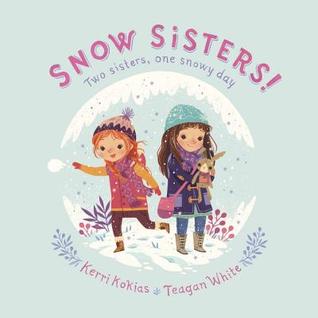
In Snow Sisters, by Kerri Kokias and Teagan White, the two sisters, unnamed like the bears, have very different attitudes towards winter weather and towards the outdoors in general. Kokias’ brief phrases serve as captions:

snowsisters

“Coat. Scarf. Hat.
Mittens. Boots.
Cocoa. Blankets. Books.

Throwing. Building.
Baking. Making.”

White’s pictures advance the story, and the words are repeated in a slightly different order, as each sister comes to appropriate the other’s responses.  The images have the look of mid-century children’s illustration and a touch of animation, with a color palette based on reds, purples, and mauve.

Continue reading ““There Were Two Little Bears…””

So They May Not Really Be Books…

Books reviewed:  Tiny Farm – Suzy Ultman, Chronicle Books, 2017
Tiny Town – Suzy Ultman, Chronicle Books, 2017
Masha and Her Sisters – Suzy Ultman, Chronicle Books, 2017

Suzy Ultman is a designer whose creations include books, but also pillows, enamel pins, and stationary items.  She sells her work through bookstores, but also through Etsy, Crate and Barrel, and other retailers.  Recently Chronicle Books, known both for literary excellence and design ingenuity, has published three of her latest items.  Are they books? Yes.  Might critics legitimately question their status as principally books, as opposed to pretty objects or toys? Also, yes. I would like to defend them, if they need a defense, as picture books, to be read, looked at, and admired.

Suzy Ultman Tiny Farm Book 2Suzy Ultman Tiny Town Book 2

Both Tiny Town and Tiny Farm are small, chunky board books with sturdy, thick “pages.”  The visitor to Tiny Town enters a tiny bakery, tiny toy, pet, and book stores, and ends in a tiny home.

Continue reading “So They May Not Really Be Books…”

Good Mouse, Bad Mouse

Books referenced:
Mice Skating – Annie Silvestro and Teagan White, Sterling Children’s Books, 2017
The Tale of Two Bad Mice – Beatrix Potter, Warne, 2002 (100th  anniversary edition)

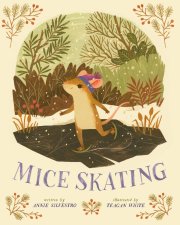
There was a snowstorm here today, and while Peter, of Ezra Jack Keats’ The Snowy Day, seems the best representation of a child’s elated experience of the snow (recently featured in stamps from the U.S. Post Office), I decided instead to write about mice.  Mice Skating is an optimistic poetic journey with Lucy, a brave and persistent girl mouse who is undaunted by rough weather or practically anything else.  Her wool hat gives her the courage to face winter while her friends huddle inside like, well, scared little mice.

micecover     “It made her brave.
      It made her bold.
     It made her bloom!”

Not content with enjoying the snow alone, she tries to convince Marcello, even though he replies that he won’t leave their dwelling: “Not unless that snow/is made of mozzarella.”  Lucy is not dissuaded by this lack of enthusiasm: “She fashioned skates out of pine needles/and scurried to the pond.Mice Skating writer Annie Silvestro’s Bunny’s Book Club offers a complementary indoor view of bravery, with a brave bunny who loves to read seeking entrance to a library at night.

Continue reading “Good Mouse, Bad Mouse”

How to…Be a Child

Book reviewed:  how to – Julie Morstad, Simply Read Books, 2013

In case you have forgotten how to be a child, Julie Morstad can reacquaint you with the “idiomatic logic,” of this stage of life, immortalized by Annie Ross in the lyrics to the vocalese number, “Twisted,” covered by Joni Mitchell on her “Court and Spark” album

how to cover

The children in Morstad’s loosely connected series of instructions know “how to watch/where you’re going” by observing your shadow, “how to wash your face” by standing in the rain, and “how to make new friends” by drawing pictures of them with sidewalk chalk.  While adults may forget that a child taking a bath is a mermaid and an alternating stack of children and cushions is a sandwich, younger people know that their parents’ inability to distinguish literal from figurative in just the right way can be frustrating.


Continue reading “How to…Be a Child”