Stitching a Home

Thread by Thread– written by Alice Brière-Haquet, illustrated by Michela Eccli, translated from the French by Sarah Ardizzone
Eerdmans Books for Young Readers, 2025
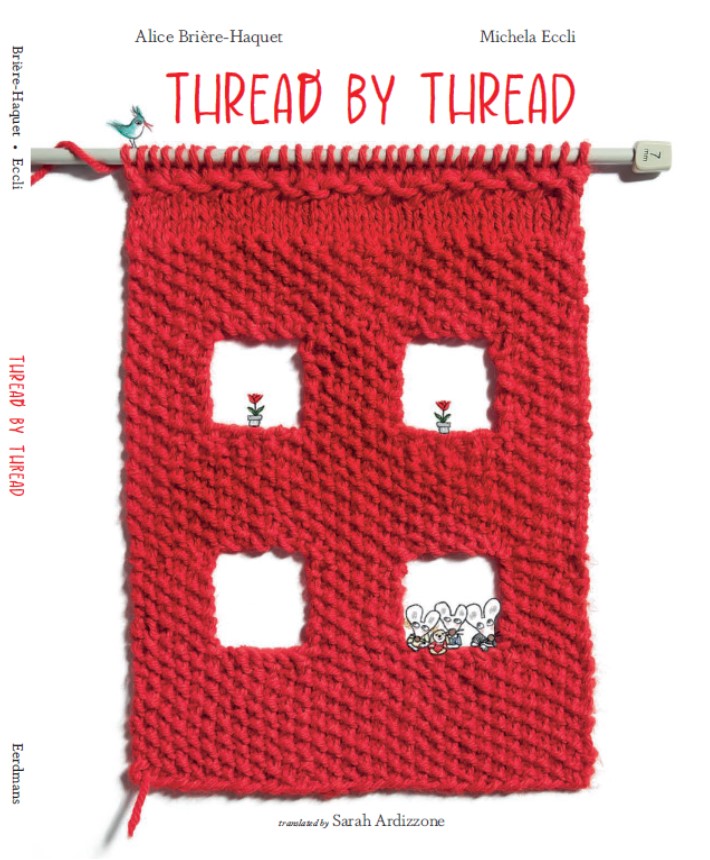
“Knit one, purl one,” this book begins.  Everyone who knits knows the phrase. Sometimes you drop a stitch, which is frustrating.  Other things can go wrong. You may run out of the color yarn that you need, thinking that you had enough.  In Thread by Thread, Alice Brière-Haquet and Michela Eccli have created several projects.  The picture book is an homage to artisans, an ode to needlework, and a compassionate look at the need for everyone to find a home.

To call the illustrations inventive is an understatement. Delicate drawings of a mouse family intersect with photographs of yarn and knit items.  The central item is a home, a red rectangle suspended from a knitting needle.  Four square windows enclose two mice each, a flower, and a blank space.  The demands on readers’ attention seem calm in this minimalist setting, but the book progresses to a warning, ending in reassurance.

As any knitter knows, “sometimes things can begin to unravel.” The mice have to hastily descend the stairs, which are a loose thread arranged in a zigzag. Frightening creatures emerge, including a dragon with orange fire emerging from his mouth. Brière-Haquet begins to describe the underlying resistance of this family: “We leave without making a fuss, but we dream of staying put.” The phrase could be a summary of some refugees’ experience. 

While the dragon seemed menacing, other creatures are helpful. The rhino helping to hold thread called to mind Albrecht Dürer’s famous animal, which he had never actually seen, but whose combination of fantasy and accuracy amazed viewers.  A turtle slowly rolls a ball of green yarn, and tiny crabs support a knitting needle. Again, the author introduces a quietly dissident note, admitting that the wool and silk are “spools of worry.”

Eventually, the mice create a new home. One window is still empty. The mice are proud and relieved.  A seesaw works by balancing a group of small animals with a large one.  Without a didactic trace, author and illustrator have presented several messages within one structure. This house holds anxiety, a cooperative spirit hope, and accomplishment.  Thread by Thread is one of the most profound and beautiful picture books I have recently read.  The elements of text and picture are interwoven in a way that will never unravel.

80th Anniversary of Liberation of Auschwitz

Today, the New York Times published an important opinion piece by Ruth Franklin about Anne Frank. The singular tragedy referred to in her title is both her death, and the erasure of her Jewish identity in popular culture.  Francine Prose’s book, Anne Frank: The Book, the Life, the Afterlife (2009) and Dara Horn’s chapter on Frank, “Everyone’s (Second) Favorite Dead Jew,” in her essay collection People Love Dead Jews: Report from a Haunted Present (2021) are both illuminating on the same subject. Adults sharing books about Anne Frank, and others on related people and themes, might wish to read Franklin’s piece, as well as the books mentioned above, as an appropriate and realistic memorial and a step towards some understanding of the Shoah.  I have written about this topic before, and here, in recognition of International Holocaust Remembrance Day and the 80th anniversary of the liberation of Auschwitz, are some other relevant reviews and an interview:

Nev­er Again Will I Vis­it Auschwitz: A Graph­ic Fam­i­ly Mem­oir of Trau­ma & Inheritance

The Librar­i­an of Auschwitz: The Graph­ic Novel

A Delayed Life: The True Sto­ry of the Librar­i­an of Auschwitz

The Boy Who Drew Auschwitz: A Pow­er­ful True Sto­ry of Hope and Survival

Behind the Book­case: Miep Gies, Anne Frank, and the Hid­ing Place

Impos­si­ble Escape: A True Sto­ry of Sur­vival and Hero­ism in Nazi Europe

Interview with Steve Sheinkin, author of Impossible Escape

When I Grow Up: The Lost Auto­bi­ogra­phies of Six Yid­dish Teenagers

Tove Jansson and the Gold Spine

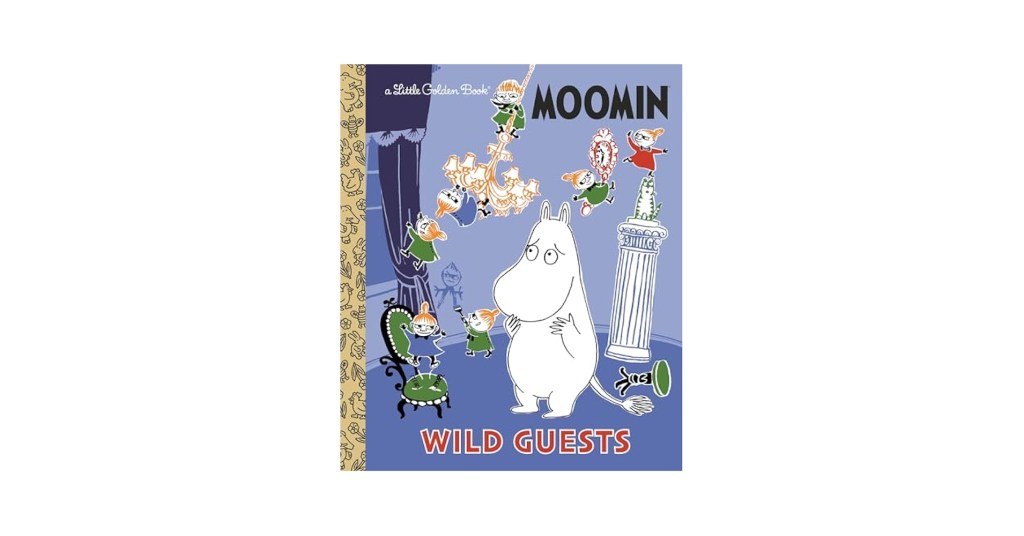
Wild Guests (Moomin) – written and illustrated by Riina and Sami Kaarla, based on characters created by Tove Jansson
Golden Books, 2025

Golden Books have become a big tent, in both the range of their subjects and artistic quality. When I learned that a Little Golden Book based on Tove Jansson’s beloved Moomin characters would be released, I was worried.  Recent releases, particularly those on celebrities of more interest to parents than children, have pictures of dubious quality. On the other hand, some of them are quite good, with substantial information appropriately presented and attractive artwork. (for example, biographies of Queen Elizabeth II, Audrey Hepburn and Ruth Bader Ginsburg) As it turns out, the price of joining the distinguished club of Golden Book classic authors and illustrators was not to compromise the style of Tove Jansson, the creator of the Moomins.

Although the pictures are not her original ones, Riina and Sami Kaarla have produced their own interpretation, which is respectful of Jansson’s inimitable style.

There are many characters in the Moomin universe. In Wild Guests, the title refers to some unexpected visitors, who are the mother and siblings of Mymble, who is herself a guest in the Moomin family home.  When they arrive, Moomintroll and Moominpapa are filled with excitement, while Moominmama somewhat unrealistically expects a docile crew who will happily consume strawberry juice and rhubarb pie. Instead, the Mymbles go wild.  They treat the lovely, Victorian furnished home much as the Cat in the Hat did to Sally and her brother’s parent-free zone.  While their destruction is innocent in its intention, they succeed in wrecking Snorkmaiden’s dressing table, defacing Moominpapa’s globe, and converting the kitchen into their playground.

There is a definite mid-twentieth century look to the pictures. The colors range from pastel to jewel tones, and the graphics recall paper cut-outs superimposed on a background of drawing. The wild guests are mischievous, but unmotivated by any conscious plan. (“I am Little My, and I bite because I like it.”) Their adult-like facial expressions may seem to cast some doubt on that, yet the Moomin’s home remains preserved from any serious damage. In fact, there is even helpful Elves and the Shoemaker results: a tower of carefully stacked jars and crockery, and a kettle boiling for breakfast.

It would be wonderful to use this lovely book as a gateway to Tove Jansson’s work.  However, it stands all on its own as an immersion into Moominland.

Poems That Take Flight

Words with Wings and Magic Things – written by Matthew Burgess, illustrated by Doug Salati
Tundra Books, 2025

Designing a book of poetry for children is not an easy task.  There are outstanding collections of classic poems accompanied by different artists’ interpretation. A Child’s Garden of Verse alone has been illustrated by, among others, Jessie Wilcox Smith, Gyo Fujikawa, Alice and Martin Provensen, and Eloise Wilkin.  Recently, Rosemary Wells had the courage to apply her own individual vision to a selection of A.A. Milne’s poems from When We Were Very Young, although they are inextricably linked to the artwork of Ernest H. Shepard.  There are modern classics by such disparate poets as Jack Prelutsky, Shel Silverstein, Bobbi Katz, and Julie FoglianoWords with Wings and Magic Things joins this distinguished company, while adding level of originality and beauty that stands on its own.

On the one hand, children are natural drawn to rhyme and rhythm. On the other, after a certain age they sometimes approach it with skepticism. Where is the plot? Maybe enough humor will compensate for that, and some poets try to hard by overloading their work with this feature.  Matthew Burgess seems to have chosen the subject and form of each poem with respect for children’s intelligence.  The book is organized into thematic sections, each introduced by a two-line poem. “Wild” summarizes excursions into that territory. “The animal inside of us who longs to wander free,/the sparkling specks of stardust that make up you and me.” The poems use different rhyme schemes, alliteration, and stanza lengths, and address subject matter ranging from whimsical to philosophical. There is not a pretentious note in the book.

Doug Salati’s pictures show a kind of exuberance, whatever the subject of the poem he is illustrating. There are two-page spreads with lavish colors and smaller image set against white space. Some pages feature cut-out windows to the following picture, allowing a moon, for example, to transform into a polar bear’s fur. His allusions to classic children’s books are not eye-winking secret messages to adults; they are wonderful homages that set his own work within a lasting tradition.  The lions in “Living with Lions” recall Sendak’s Pierre: they appear somewhat sly, as if unsure about whether to act as predators. “When they wake,/bake a cake,” the girl in the picture wisely decides.

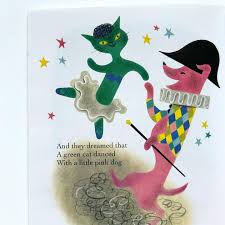
The dog next to the slide in “Wild” is definitely related to Margaret Bloy Graham’s Harry the Dirty Dog. If children don’t recognize these forbears of Salati’s characters, it would be a great opportunity to introduce them. He also shows up accompanying the beginning of “Whoops and Whallops,” about life’s inevitably embarrassing and difficult moments, eating popcorn, and along with his human friend, enjoying a show.  The performing dog recalls the harlequin-costumed animals of The Color Kittens.

Maybe it seems obvious that yetis’ favorite food is spaghetti. Burgess twists the strands of language into invented words that make perfect sense in Salati’s scene of feasting monsters. Twist the fork into your noodles;/Meatball, meatball, and spagoodles.” By the end of the poem, the elongated pasta returns to normal: “Now eat it up, you hungry yet;. Meatball, meatball, and spaghetti.”  Poets and artists can accomplish magic.

Miigiwe – Giving Away is Good

An Anishinaabe Christmas – written by Wab Kinew, illustrated by Erin Hill
Tundra Books, 2024

Finding a children’s book that may be identified as an instant classic is not to be taken for granted. One book that fits that category is An Anishinaabe Christmas. It brings to mind Dylan Thomas’s A Child’s Christmas in Wales, the versions illustrated by both Edward Ardizzone and Chris Raschka, not because of any direct similarity, because the books are very different. Both classics evoke a particular, but also universal, immersion in childhood. You leave the book, and return to it, with a feeling of peacefulness without sentimentality.

A young child from an Indigenous community is going with his parents to visit their extended family on the reservation.  It is winter solstice, an inseparable element of their culture’s celebration of Christmas. Baby, as he is called in the book, looks serious, even puzzled, as his mother and father bundle him up and get ready for their car trip. Their evident excitement is in contrast to his hesitation; this experience is typical of childhood. He is concerned that Santa will not find him away from their home. The cultural signifier of this gift-giving figure so common in the West then transitions to the specific deep roots on the Anishinaabe people.

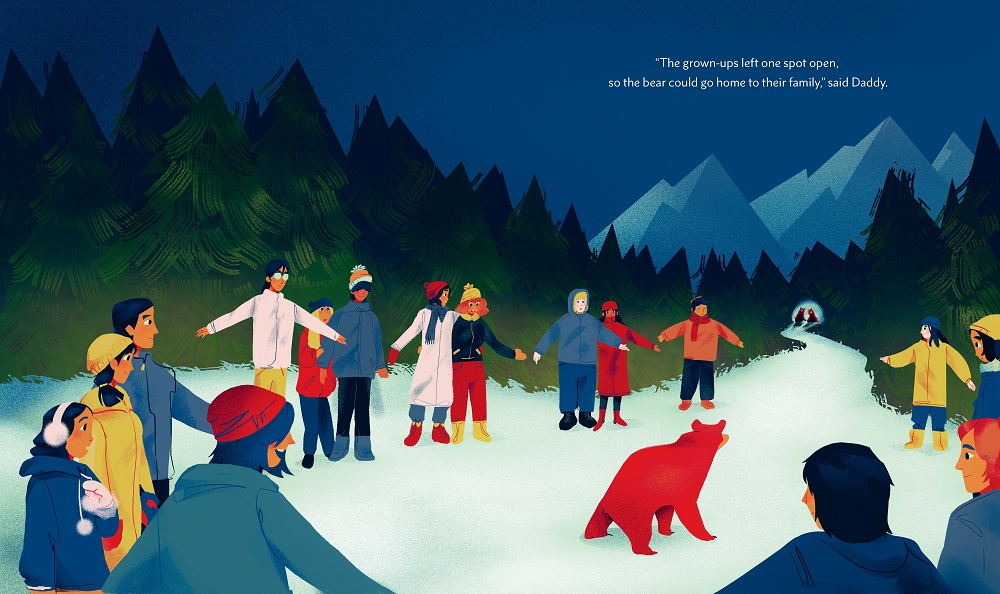
As they drive from the city to the country, the family passes a sign warning not to feed the bears. This prompts a memory that connects Baby to her heritage, and to the natural world that is part of it. Her father repeats the story of how he and other adults had formed a protective circle so that a lost bear cub could find its home. The idea of communalities between humans and animals is organic to the picture, without any ideological explanations. “The bear has a family?” Baby asks. Of course it does, and the father not only answers, but uses the opportunity to introduce words in their native language. (Wab Kinew includes these terms in a glossary at the end of the book, along with an explanation of the cultural syncretism combining Christmas with Indigenous traditions.) The bear also has makwa, family, although it is distinct from the human one.  The bears’ makwa  will “snuggle up in their dens with their babies for Christmas.”

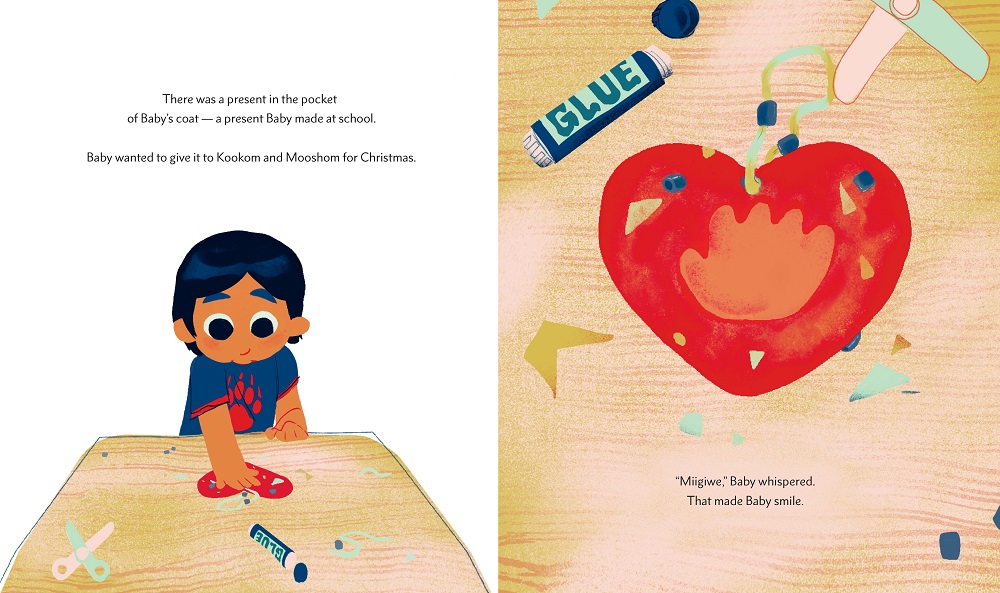
One thing the bear cub will not do is craft a gift for his grandparents, Kookom and Mooshom. The picture of this project is composed of carefully spaced elements, each one of which represents something important: creativity, love, simplicity, focus. Glue, scissors, a red paper heart, become a concrete expression of miigiwe, that Baby’s father has explained: “That means ‘giving away.’ And it’s good.”

The pictures by Erin Hill alternate outdoor panoramas, domestic interiors, and framed scenes of specific activities. A view of the family seated around a wood stove is set an angle and viewed from a slight elevation. Relatives embrace, but there is empty space between different sections of the picture.  Kookom and Mooshom are thrilled to see their grandchild, but they listen carefully to his narration of the car trip. He has processed the truths his father communicated and his repeats them, with understanding, to the older generation. Do you have grandparents? Are you a grandparent? Do you remember your grandparents? You will never forget these scenes.  The family goes outdoors, where they sing about the poetry of winter while playing drums. Whatever winter holiday you celebrate, An Anishinaabe Christmas will resonate as strongly as that chorus.

A Sesame Street Hanukkah Classic

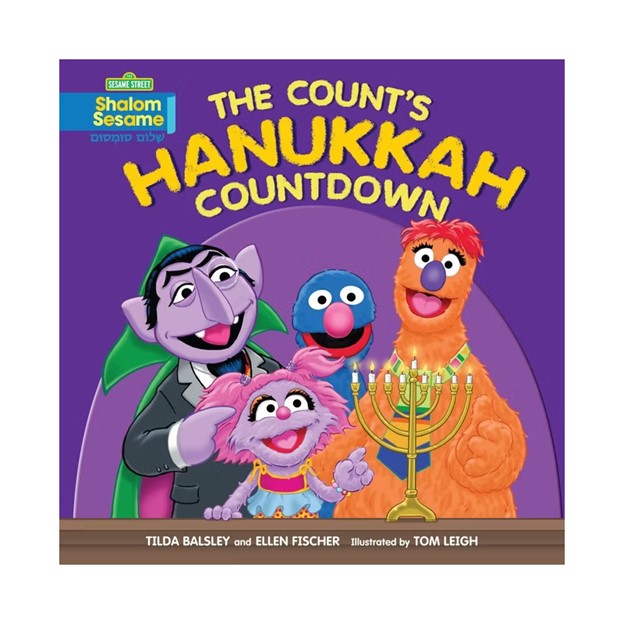
The Count’s Hanukkah Countdown (Shalom Sesame) – written by Tilda Balsley and Ellen Fischer, illustrated by Tom Leigh
Kar-Ben Publishing, 2012

Sesame Street Hanukkah classic books are, admittedly, a somewhat narrow category.  If you know Count Count, you probably realize that Hanukkah is a terrific holiday for him, since it allows him to obsessively enumerate the festival’s eight days and everything associated with them. 

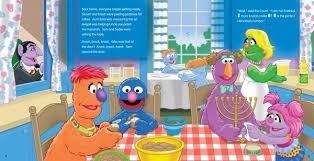
The book opens with Grover grasping a chanukiah (Hanukkah menorah) clutching a dreidel, and welcoming you to the celebration of the Festival of Lights.  Numerals in the text are in bold, making it fun for young children learning to count, but there is also an extended narrative. Grover begins by presenting a shopping list of ingredients to the Count, and modestly asks if that expert at counting had not realized that “furry blue monsters are excellent shoppers.”  The list comprises all the ingredients to make potato latkes (pancakes).

The scene moves to the kitchen of their Israeli friends and extended family.  Sesame Street monsters all have different color skin. Uncle Joe is purple and Aunt Sara is green.  The whole mishpacha (family) are busily engaged peeling potatoes and measuring oil. The Count enters. He is thrilled to see the multi-branch chanukiah, but confused that, on the first night, only one candle plus the shamash (helper candle) is lit. Even though he is the title character, everyone plays an important role in this family-centered holiday. Uncle Joe, seated in his easy chair, relates the historical events commemorated by Hanukkah. His language is so vivid that the children imagine the Greek soldiers riding on their elephants, depicted in a word-bubble-like cloud. They desecrate the Temple, but Uncle Joe quickly advances to the counting element, fortified by heroism. There was only enough oil for 1 night, but it miraculously lasted for 8.

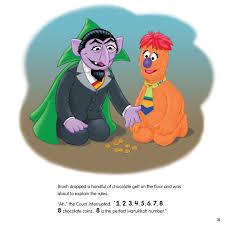
Then comes the consumption of latkes. Count Count evens out the number by eating one, and everyone follows his zany example by taking 8 bites of every food item. These include not only latkes, but the equally traditional sufganiyot (jelly doughnuts).  The game of dreidel, fortunately, also involves the counting of chocolate gelt (coins). The dreidel game scene shows everyone seated in a circle on the floor. The Count is viewed from the back, with his triangular green cape pointing upward.  Even among Muppets, he looks distinctive. Presents also lend themselves to counting. We see only their colorful gift bags, so we can use our imagination about what the bags may contain.

Readers will agree with Grover that Hanukkah, to use his favorite adjective, is “totally awesome,” and to the Count, the “8 is the perfect Hanukkah number.” It’s hard to disagree with him.

You’ve Got Delicious Cuban Food

Guava and Grudges – by Alexis Castellanos
Bloomsbury, 2024

Sometimes it seems that there are an infinite number of possible homages to The Shop Around the Corner and You’ve Got Mail, specifically in young adult fictionGuava and Grudges, by Alexis Castellanos, more than justifies a new entry in this category, with strong characters, great description and dialogue, and affectionately accurate allusions to Cuban American culture.  The protagonists spar, but can’t deny their attachment to one another from their first encounter.  Family opposition is tough, if not on the Romeo and Juliet level.  Food obsession is far from essential to liking this novel, but dedication to one’s craft, in this case cuisine, is certainly central to the plot.

Ana María Ybarra and Miguel Fuentes are both Cuban American high school students whose families own popular bakeries in Seattle.  They meet in L.A. at a college tour, although Ana María has serious doubts about her future as a U.C.L.A. student.  Her dream is to become a pastry chef, unconstrained by the traditional expectations of her father, who has always been wary of innovations at Café y Más, their establishment.  (Ana María’s original ideas have been kept “a dark secret” from her family.) Miguel’s last name is Fuentes, but he is a member of the Morales family through his mother.  As Ana María painfully admits, “hating the Morales family was something I was born into and that I had accepted as a family tradition.” In case you needed a reminder that some family traditions can be ugly, here it is.

The plot contains elements of miscommunication, but the core of Ana María and Miguel’s affection is never seriously in doubt.  The looming specter of college applications only forces Ana María to a different commitment, and to hope that her entry in a culinary contest run by her favorite publication will lead to a scholarship. The outcome of the competition is handled well in the novel, as Castellanos carefully avoids pandering to the reader’s expectations.  Social media is also part of the story, because expertly produced food without a visual media presence is worthless, as everyone knows.  The author’s verbal flourishes create images that are just as powerful. Mishandled groceries lead to damaged goods: “‘Stupid milks,’ I mutter, dropping down to the floor with the desiccated croissants in my hands. They look so shriveled and sad. Is there a market for croissant raisins?”

The support of Ana María’s mother helps to offset her father’s often-oppressive parenting. A great best friend and a sister whose personality serves as a foil also enrich the cast.  Miguel isn’t perfect, but nor is he a self-centered male who must be redeemed by a girl’s love.  Guava and Grudges is rich is more ways than one, and includes a recipe for guava cream cheese thumbprint cookies.

Family Stories and Food

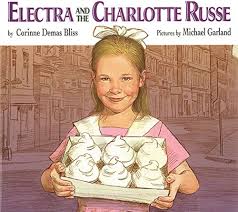
Electra and the Charlotte Russe – written by Corinne Demas Bliss, illustrated by Michael Garland
Boyds Mills Press, 1997

When I was growing up in New York, the charlotte russe was a popular pastry, though the peak of its popularity was already gone by the post-World War II era. At the time, I wasn’t aware that I was enjoying a part of New York food lore in its decline, but that still had meaning for my parents’ generation.  In Electra and the Charlotte Russe, a Greek-American family, living in an ethnically mixed Bronx neighborhood, is the center of the nostalgic story.  In her author’s note, Corinne Demas Bliss writes that the book is based a story which her mother, Electra, had related about her own Bronx childhood in the 1920s.  Whatever your background, and whether or not you have ever eaten the delicate pastry enclosed in a paper sleeve, you will probably respond to the essence of Demas’s tale and Michael Garland’s almost photorealist pictures.

Once upon a time, there were many children’s picture books with extensive text. Electra opens with a portrait of the little girl and her mother. Electra is entrusted with an important errand. She will go to the local bakery to purchase six charlotte russes for her mother’s guests. These are Mrs. Papadapoulos, Mrs. Marcopoulos and her daughter, Athena. The guest without a melodic Greek last name is Miss Smith, who is learning Greek from Electra’s mother, in preparation for her upcoming marriage to Mr. Demetropoulis.  If you think this is an overly idealized portrait of immigrant communities, the motive behind the Greek language lessons is for the future Mrs. Demetropoulis “to understand what his relatives said behind her back.”

On the way Electra meets her friend, Murray Schwartz, whose tongue has turned green from eating a gumball.  A much older neighbor, Mr. Melnikoff, waxes nostalgic about the charlotte russes of his own past, calling them “a dessert fit for a princess.” The extended text occupies some pages, while others have only one or two sentences. A typical New York City apartment building, as rendered by Michael Garland, seems shaded in ombre light and colors, accompanied by the brief instructions to Electra not to run even though she is in a hurry.  Mrs. Zimmerman at the bakery repeats that prophetic warning to her young customer.

When Electra trips, damaging the exquisite works of art in her bakery carton, she tries to fix them. This leads, of course, to eating some of the whipped cream. A two-page spread shows four scenes of Electra’s face and hands as she attempts to even out the cream.  Every step of the process is detailed in sequence, from Electra’s entrance into her apartment building, to her settling on several landings with the pastries, and finally reaching her home. “They didn’t look quite like charlotte russes anymore, but at least they did look all the same.”

Fortunately, Electra’s mother had prepared other delicacies: baklava, diples, loukoumades and kourabedes. The guests enjoy the now transformed and unidentifiable charlottes russes. After they leave, Electra’s mother explains to her the concept of remorse. “Remorse is when you wish you hadn’t done something that you did.” But she isn’t angry with her daughter, and the book closes with Electra sitting on her mother’s lap.  Perhaps she would have been less forgiving if her guests had not enjoyed the gathering, or the pastries denuded of whipped cream. But I doubt that would have made a difference.

Miniature Medicine

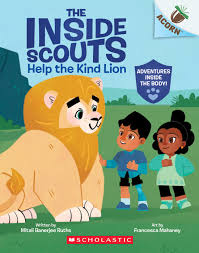
The Inside Scouts Help the Strong Cheetah – written by Mitali Banerjee Ruths, illustrated by Francesca Mahaney
Scholastic, 2024

The format of this early readers graphic novel matches the content.  A compact 7×5 1/2 inches, it easily fits the hands of a young child.  The Inside Scouts series, by Mitali Banerjee Ruths and Francesca Mahaney, features the veterinary adventures of Sanjay and Viv, who shrink to fit the inside of animal in need of medical attention. (It may make you think of The Magic School Bus Inside the Human Body by Joanna Cole and Bruce Degen.) The title is intriguing. If the cheetah is strong, why does he need help?  With minimal text and bright graphics, young readers learn about the causes of muscle cramps and how much they can hurt.  Don’t worry; Sanjay and Viv are on the job.

The heroes of the story exchange their everyday clothes for uniforms with robotic arms and legs, tool packs, and shrink suits.  When Zora the cheetah pops up on their computer screen, they locate her and spring into action. Even with their high level of motivation, they are still kids. Sanjay briefly complains about the heaviness of this tool pack, but Viv reminds him that the cheetah needs help. There’s a Doctor Doolittle element to the story; the cheetah talks to them and explains his problem. They take him to the care lab, a doctor’s office with reassuring pictures of animals on the walls.

Fact and fantasy combine in the story. Navigating inside the cheetah’s body in their jump rocket, Sanjay and Viv use power tools to access the animal’s muscle, described as “bunched up ropes” that “look stuck.”  At the end of the book, “Fun Facts About Muscles” provides some more specific information about the musculoskeletal system.  (The author is a pediatrician.) The book’s best feature is its matter-of-fact approach to learning about science. The superhero approach is minimally elaborated. There is no back story about how Sanjay and Viv met or when they discovered their power to help animals.  Instead, their special identity is presented as a given, as is the underlying message about using one’s abilities to help others (even when a heavy backpack seems a burden). Educators and caregivers can certainly use the book as a starting point for learning more about the topic, but it also stands alone as an attractive and engaging story that blends fact and fiction.  On the penultimate page, Sanjay and Viv plan to rest, in anticipation of their next adventure.  Zora will not be the last animal who needs their help.

Anne’s Aspirations

Anne Dreams – written by Kallie George (adapted from L.M. Montgomery), illustrated by Abigail Halpin
Tundra Books, 2024

Once again, Kallie George and Abigail Halpin have succeeded in creating a book for young readers based on L.M. Montgomery’s classic, Anne of Green Gables (I’ve reviewed their earlier efforts here and here and here and here, and some of their efforts with other creators here and here and here and here). Of course, their works are invitations to read the original series, but they stand on their own as modern classics.  Each volume selects specific incidents from Anne, and develops them as the focus of independent interest. At the same time, they cumulatively evoke the full character of Anne and her world.

Anne’s beautiful red hair is a source of anguish to her. How could that be? Her distinctive beauty made her uncomfortable, and when her future love, but present nemesis, Gilbert Blythe taunts her as “Carrots,” she feels even more insecure. Anne is reduced to buy hair dye from a peddler, expecting her stunning red to be transformed to “raven black.” Halpin captures Anne’s desolation and her guardian, Marilla’s, shock, at the resulting green color. No, girls and women should not waste even a moment concerned about male beauty standards, but Anne actually was trying to emulate her “best friend and kindred spirit, Diana.”

A haircut and the passage of time fixes this problem. Then Anne must think about her future. Her love her learning inspires a dream of attending Queen’s College in Charlottetown, training to become a teacher.  Anne is both intensely loyal to friends and family, and also changeable. When Marilla asks if she wants to become a teacher, she answers, “Oh, yes! It has been my lifelong dream!…Well, at least it has been for the last few months.”  But once she arrives at that decision, she is determined to avoid distractions, including Gilbert Blythe.

Some of the pictures extend to two pages, including a nervous but enthusiastic Anne arriving in Charlottetown for her entrance exam. Her guardian, Matthew, waves quietly from the carriage before leaving Anne in a place that resembles a metropolis, compared to her home. She waves back, clutching a book. This scene signals a coming transformation in her life. 

But Anne is still Anne, as another two-page spread reminds us.  Halpin juxtaposes Anne arriving at Avonlea, Anne opening a lovely new dress, Anne holding to ill-fated bottle of raspberry cordial before serving it to Diana.  Every visual incarnation of her personality shows one dimension of a character we will never forget, whether we have encountered her first in the work of L.M. Montgomery, or in this outstanding series.