Anne Frank and Authenticity

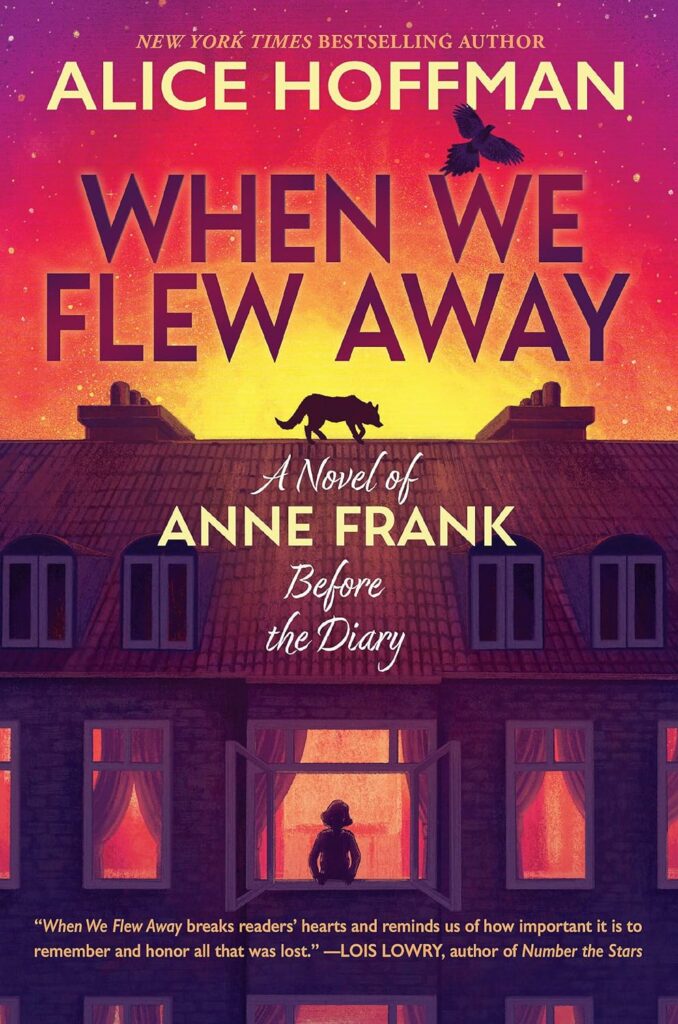
When We Flew Away: A Novel of Anne Frank Before the Diary – by Alice Hoffman
Scholastic Press, 2024

When I first learned about When We Flew Away, I was slightly skeptical, even though Alice Hoffman is a very fine author.  There are so many attempts to simplify or universalize the experience of Anne Frank, as well as honest misunderstandings of her life and legacy.  Before reading this middle-grade and young adult novel, I recommend two adult books that do an excellent job explaining and contextualizing Anne Frank and her diary. These are Ruth Franklin’s The Many Lives of Anne Frank (2025), and Francine Prose’s Anne Frank: The Book, The Life, The Afterlife (2009). Cynthia Ozick wrote a powerful article in The New Yorker in 1997 on the same theme, called “Who Owns Anne Frank?”

As the above-mentioned authors have both clarified and deplored, Frank’s message has been distorted in order to convert her into a bland symbol of universal forgiveness. The history of the Holocaust, as well as her own understanding of Jewish culture, religion, and identity, were lost in the process. More accurately, they have been deliberately erased. Alice Hoffman does not attempt to document Frank’s experience in hiding. Instead, she imagines, based on the record and her own interpretations, what the young Anne was like before her family was forced into their desperate choice.  This novel is about a young girl’s family, her emotions, and her response to the development of violent antisemitism in the Netherlands, the country that was supposed to have been a refuge for her German Jewish family. (To correct misconceptions about the alleged heroism of most non-Jewish Dutch citizens, read Nina Siegel’s thorough account in the anthology The Diary Keepers: World War II in the Netherlands, as Written by the People Who Lived Through It.)

Anne’s close relationship with her father is central to the story, but Hoffman also offers a much more nuanced view of Anne’s mother than the limited perception of their tensions.  The diary does record conflict, but Hoffman includes the plausible view that Edith Frank had a deep love for her daughter, although her personality caused her to express this in a less direct way. Ruth Franklin corroborates this idea in her work. 

The move to the Secret Annex is preceded by increasing levels of oppression.  “Life became smaller.  People stopped talking about the future.” Without imitating Anne’s own future writings, Hoffman captures the sense of confinement, which would gradually worsen.  The metaphor of flight, which will never become literally possible, is woven throughout the narrative. Looking at a Jewish boy who has been tormented by children in the street, Anne perceives the truth about their present lives: “Anne looked at the boy and he stared back across the distance between them. They lived in a land without birds, a country in which there were no laws that would protect them, a place where it wasn’t possible to be a child anymore.”

When We Flew Away is understated in its ambitions, but it does succeed in restoring a measure of realism and humanity to Anne Frank in the form of a compelling and believable story.

Subject to Change

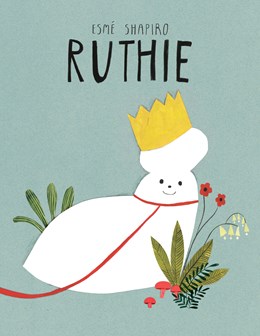
Ruthie – written and illustrated by Esmé Shapiro
Tundra Books, 2026

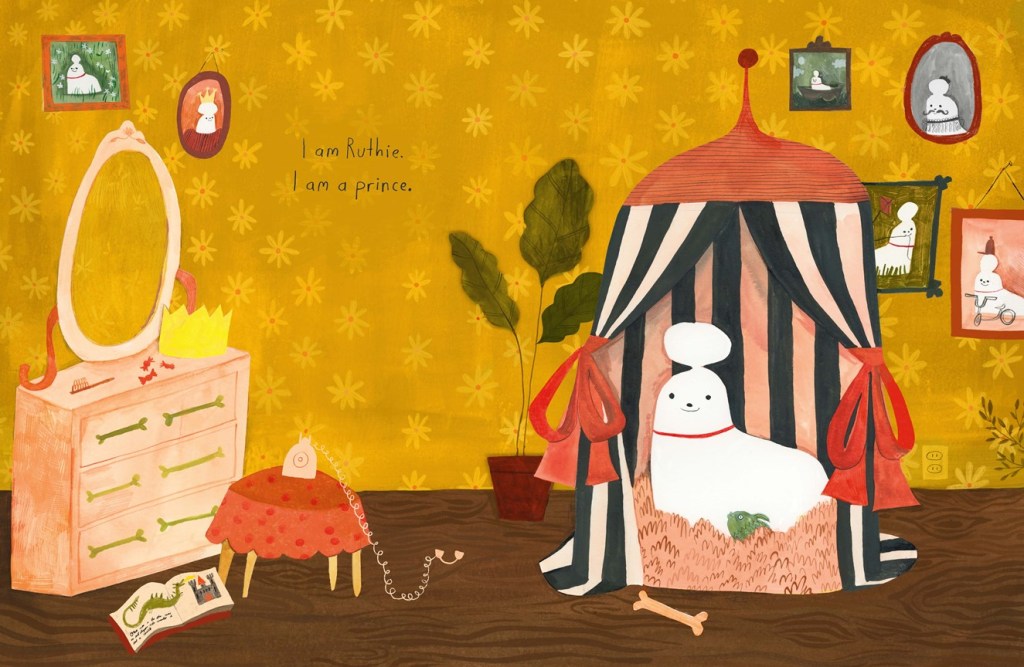
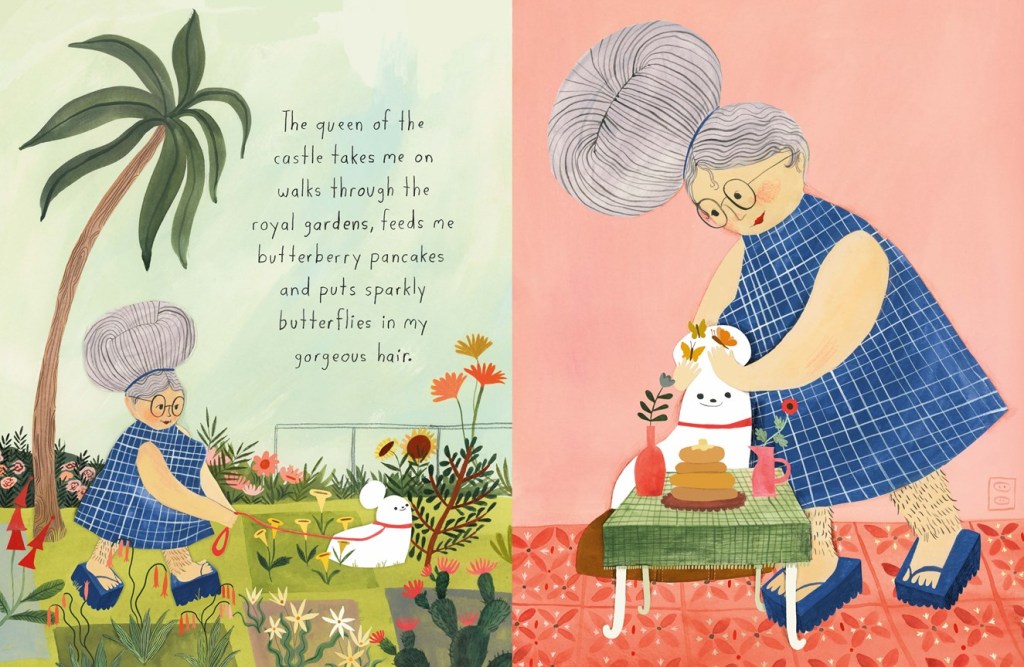
It’s impossible to mistake a book by Esmé Shapiro with the work of any other artist (I’ve reviewed her work here and here and here). Her odd, rounded, comically proportioned figures, their quirky thoughts put into the perfect words, as well as the underlying premise of Shapiro’s universe, are all there. (Her pictures in this book are rendered in gouache, watercolor, colored pencils, and collage.) Life is strange, funny, poignant, and always suitable to be made into art.  In Ruthie, a haughty dog believes that he is a prince. Just look at this pet’s bedroom, with its pink-ribboned canopy and fancy vanity.  Royal pictures adorn the walls and a crown, perhaps paper, sits next to brush and hair ornaments. A picture book, left carelessly open, on the floor, features a castle and dragon. Someone must be in charge of picking up this mess, but it’s not the monarch himself.

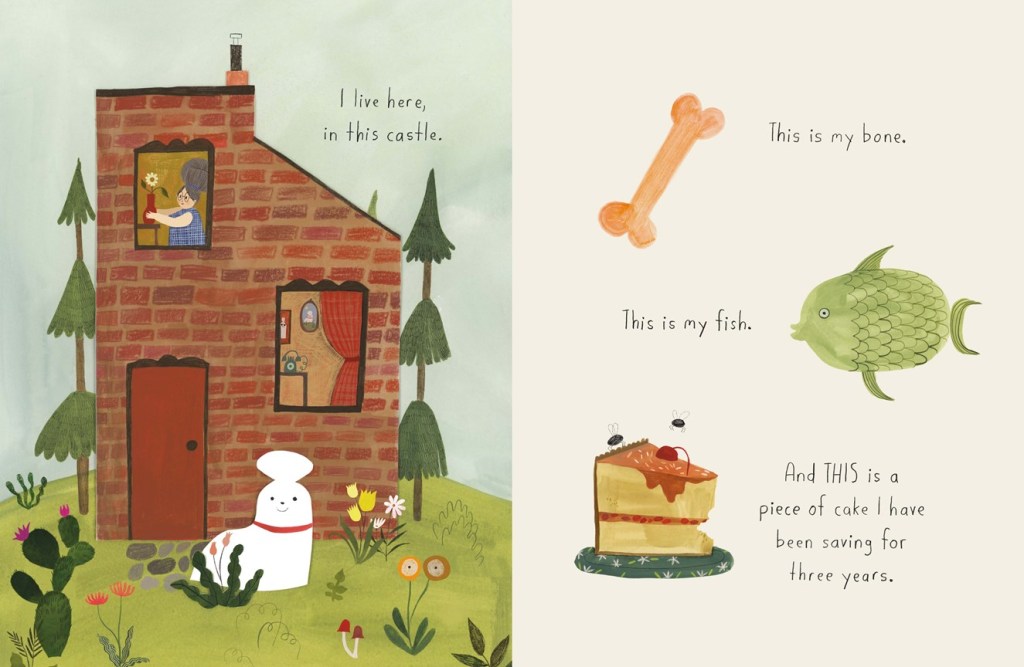
Ruthie lives in a smallish castle, resembling a brick house. Through the window we can see Ruthie’s human queen, the same one who feeds and grooms him, taking care of his every need. Ruth imperiously identifies some of his favorite objects: bone, fish, and three-year old piece of cake.  This is the only tone he knows how to adopt when communicating his needs. 

There are some disadvantages to her living arrangement. The responsive and super-competent queen sometimes keeps Ruthie on a short leash. The dog-prince suspects that there may be experiences which he is missing, such as a parade given in her honor, but freedom is inconsistent with instantly available blueberry pancakes and a relaxing bath.

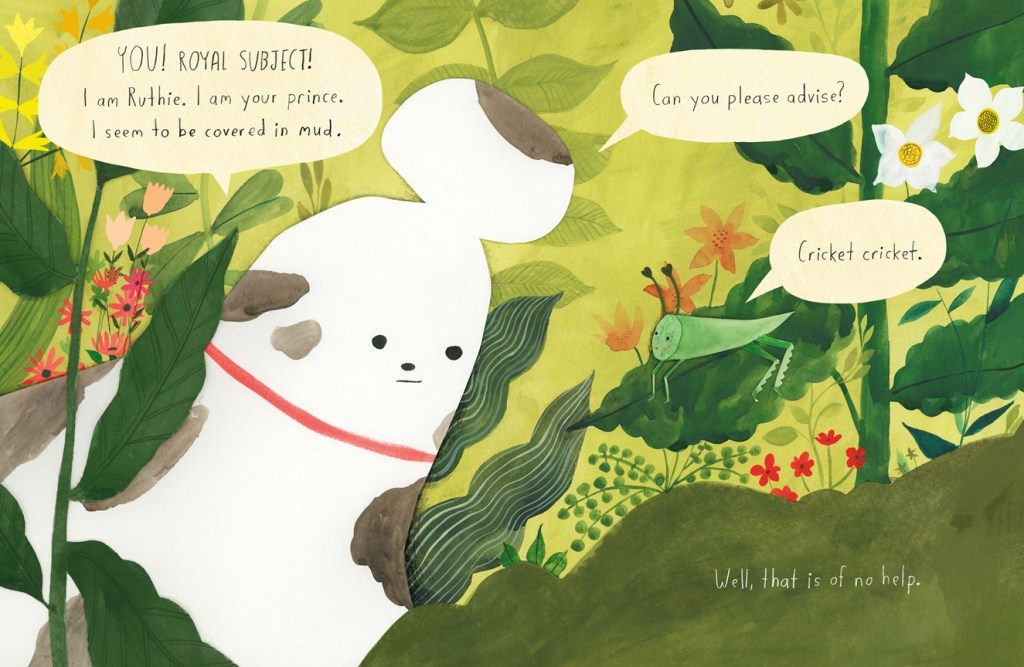
Preaching is not part of Shapiro’s vocabulary. When Ruthie breaks loose, he is initially thrilled with the possibilities, but soon he is covered with mud. Strangely, the animals he meets don’t recognize his authority. But explaining his predicament to a, naturally, wise owl, Ruthie finally has the means to return from his Oz-like journey, back to the safety of the person who loves him unconditionally. He even recognizes that, in his quest to get rid of the mud, he has  made “a new friend or two.”

Starring Cecilia

The Curious Life of Cecilia Payne – written by Laura Alary, illustrated by Yas Imamura
Eerdmans Books for Young Readers, 2026
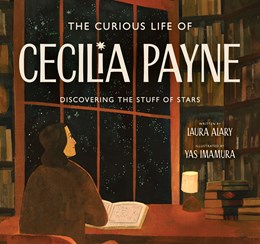
Cecilia Payne-Gaposchkin: her name has the ring of poetry.  Before she married Russian scientist Sergei Gaposchkin, she was Cecilia Payne, a brilliant and curious young woman born in the U.K., who later emigrated to the U.S. to pursue studies at Harvard.  In Laura Alary and Yas Imamura’s picture book biography (I previously reviewed an Imamura book here), Cecilia Payne’s intellectual gifts and incredible persistence pave the way to her unlikely success as an astrophysicist in an era when women confronted almost insurmountable obstacles.  The adjective of the title refers both to Payne’s inquiring mind, and to the way that her distinguished career evolved.
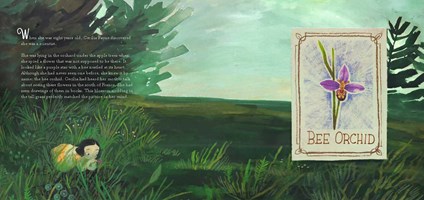
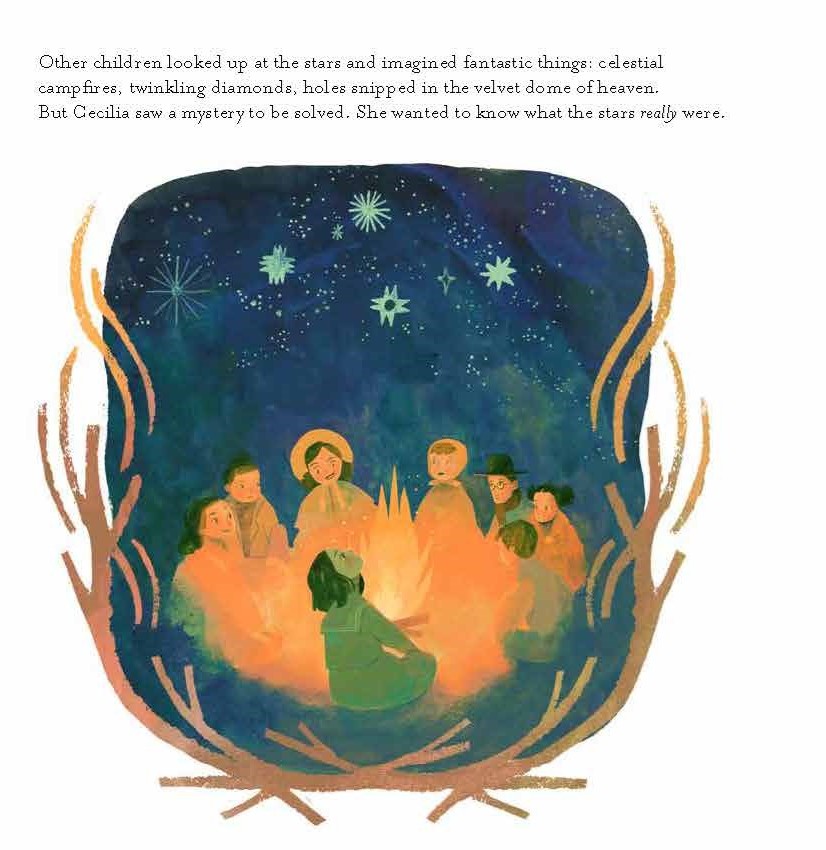
The book begins with a significant statement: “When she was eight years old, Cecilia Payne discovered she was a scientist.” Alary asserts that Cecilia knew this essential fact, not merely an aspiration, about herself.  Yet she begins at ground level, only later pursuing the stars. At first, Cecilia notices a bee orchid, a flower that, according to her mother, did not grow in England.  The scientific method begins to form in her mind, like the bee enclosed in this flower.  She continues to examine the flower, but also promises herself that she will not allow herself to become discouraged by resistance to her ideas.
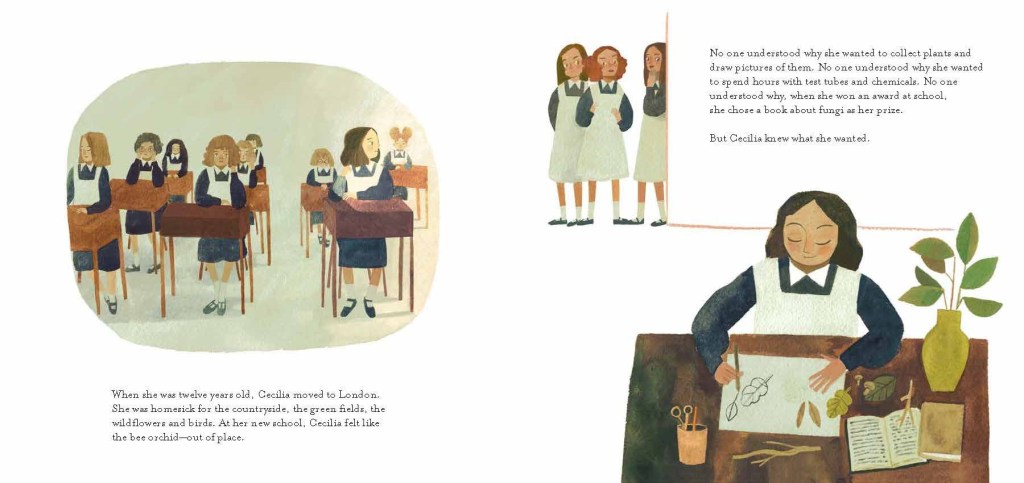
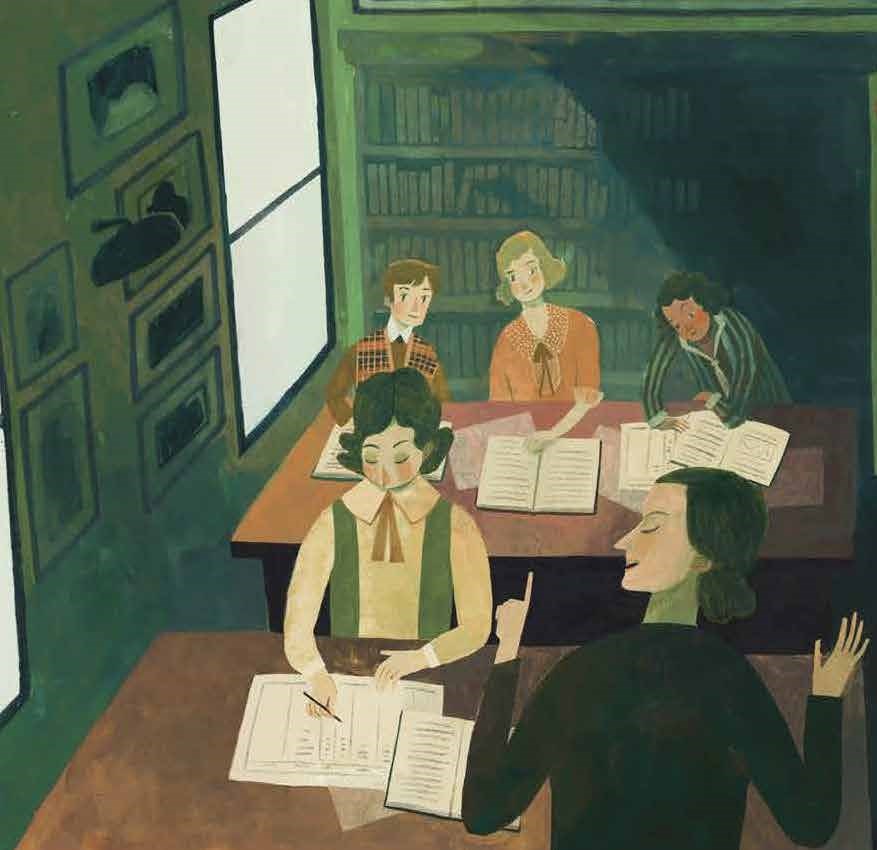
The qualities that drew Cecilia to the study of nature contrast with the social expectations surrounding her.  When other children see “twinkling diamonds” in the heavens, she is compelled to determine the actual substance and origin of these beautiful visions.Fortunately, a teacher promotes Cecilia’s scientific literacy, but she encounters setbacks when her family moves to London, where, in a new school,  she is isolated by her singular love of knowledge. Imamura’s picture captures both this potentially destructive social deficit, as well as Cecilia’s healthy response. Seated at her desk, she is the only girl looking, not distracted, but intently focused. A group of girls observe her drawing natural objects, but their apparent disapproval cannot dissuade Cecilia from her purpose.

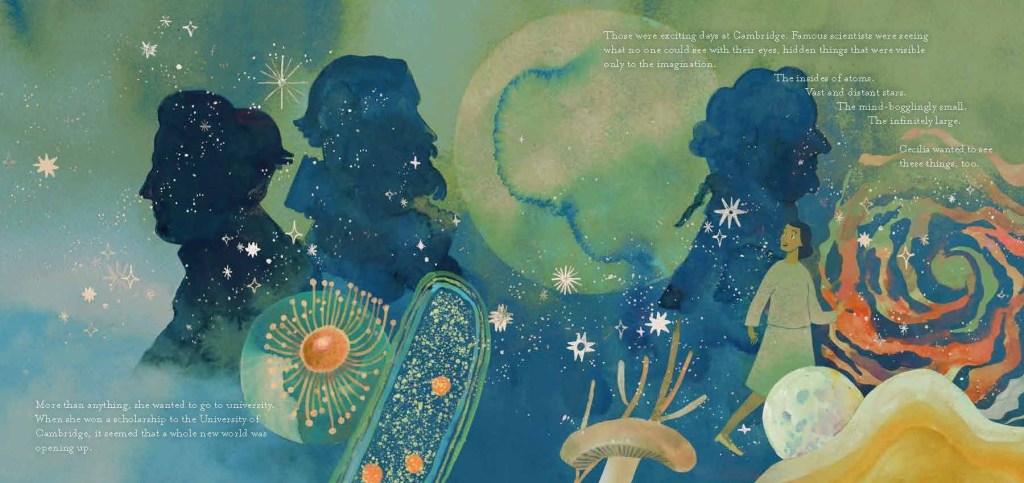
If childhood disdain is difficult, the adult version can be even worse. Arriving at Cambridge University, Payne is thrilled to be in the midst of possibilities.  Knowledge is not limited to what is immediately visible.  Against a background of male profiles, Imamura envisions a young woman who believes herself to be part of this world, but problems will emerge. Soon she be observing the skies with a telescope, but on the planet earth, men make the rules.  Forced to sit by herself in a lecture hall filled with arrogant male scholars, Payne’s determination is forged even further by adversity. Imamura’s quiet depiction of this scene is free of overt drama, but clearly sends a message about the reality that Payne will repeatedly confront.

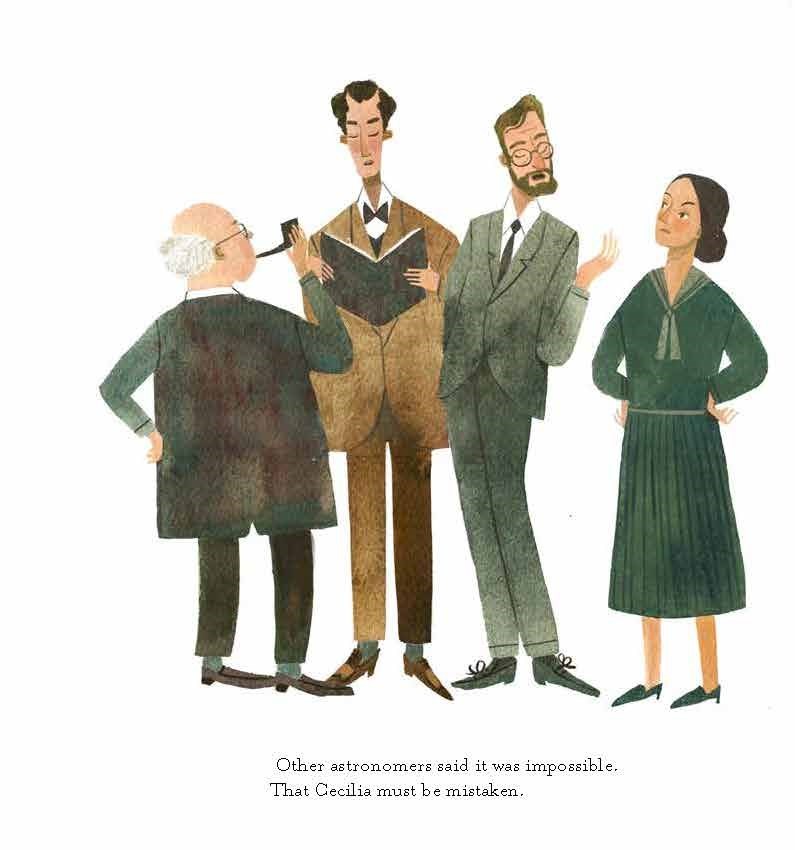
Arriving at Harvard, Payne finds both the proverbial room of one’s own, and the support of other women scientists, but also, a thick layer of disdain beneath the hypocritical veneer of hypocrisy.  Imamura’s vision of this phenomenon is perfect. Attempting to explain to her male colleagues her revolutionary hypothesis about the true substance of stars, she is subjected to Harvard mansplaining. One distinguished perpetrator smokes his pipe and looks away, as if her ideas don’t even merit attention. Another stares into a book, while a third, gesturing with his hands for emphasis, informs her that she is wrong. In a later scene of understated triumph, Payne engages with her students, encouraging their questions and treating them with respect.

There are many excellent picture books about women in the sciences (for example, I have previously reviewed biographies of Emmy Noether, Lise Meitner, and Rosalind Franklin).  Brilliance and determination are not always enough to assure fairness.  The detailed backmatter of The Curious Life of Cecilia Payne  offers clarification about her life, times, and successful career, with Imamura’s beautiful illustrations complementing the information, as it does everywhere in this outstanding and inspiring book. 

More Books for Purim

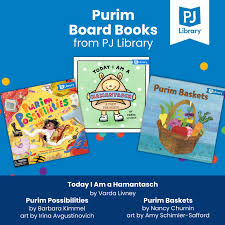
Today I Am a Hamantasch: A Poem for Purim – written and illustrated by Varda Livney
PJ Library, 2026

Purim Possibilities – written by Barbara Kimmel, illustrated by Irina Avgustinovich
PJ Library, 2026

In addition to the Purim board book I reviewed last week, here are two more Purim board books, all from PJ Library; these emphasize the flexibility of who you are on the holiday of Purim. Today I Am a Hamantasch is small, square, scaled to young children’s hands. They may have different ideas for Purim costumes, changing their minds several times before their final decision.

The child in the book is actually a rotating cast of animals: bunny, mouse, cat. She begins as the iconic three-cornered pastry, and then becomes a tree. The sequence seems random. There are cut-out holes on several pages through which the reader can see the animals changing costumes. Queen Esther, of course, is lovely in her pink dress, crown, and proud six-pointed star scepter. There is an interlude, where the bunny decides to just be herself, wearing overalls. Then back to the costumes. The mermaid, again, is a not derived from the Purim story, but the grogger, a noisemaker activated every time the villain, Haman’s, name is mentioned, is key to the Megillat Esther. Back to a cupcake, and to a kitten happy to be herself. If you feel dizzy reading it, that’s to be expected. Purim as a day when norms are reversed, but, finally, the holiday ends and “we’ll all be back to normal.” That’s a relief, maybe.

Purim Possibilities also emphasizes the freedom of temporary change. It begins with a lively scene of the Megillat Esther reading, with the scroll unrolled and held at each end by a young girl. Then we experience the same series of choices, but this time the protagonist is identifiably human. She may impersonate a train engineer, a robot, a superhero, or a baker. Then again, Queen Esther is as heroic as may be imagined, fearless in her glittery outfit. Artistic creativity is part of the story, with colored pencils available to sketch the costumes. Finally, the young artist decides on an eclectic combination of elements. Sometimes you don’t have to make a choice. The book concludes with a selection of outfits as reusable stickers, to be removed from a closet and placed on the girl. Anything seems possible in these two books.

Cloudy with a Chance of Beauty

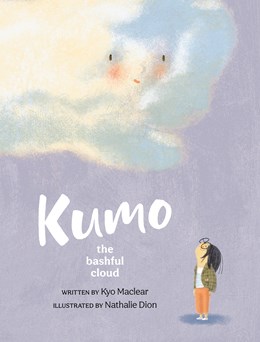
Kumo the Bashful Cloud – written by Kyo Maclear, illustrated by Nathalie Dion
Tundra Books, 2022

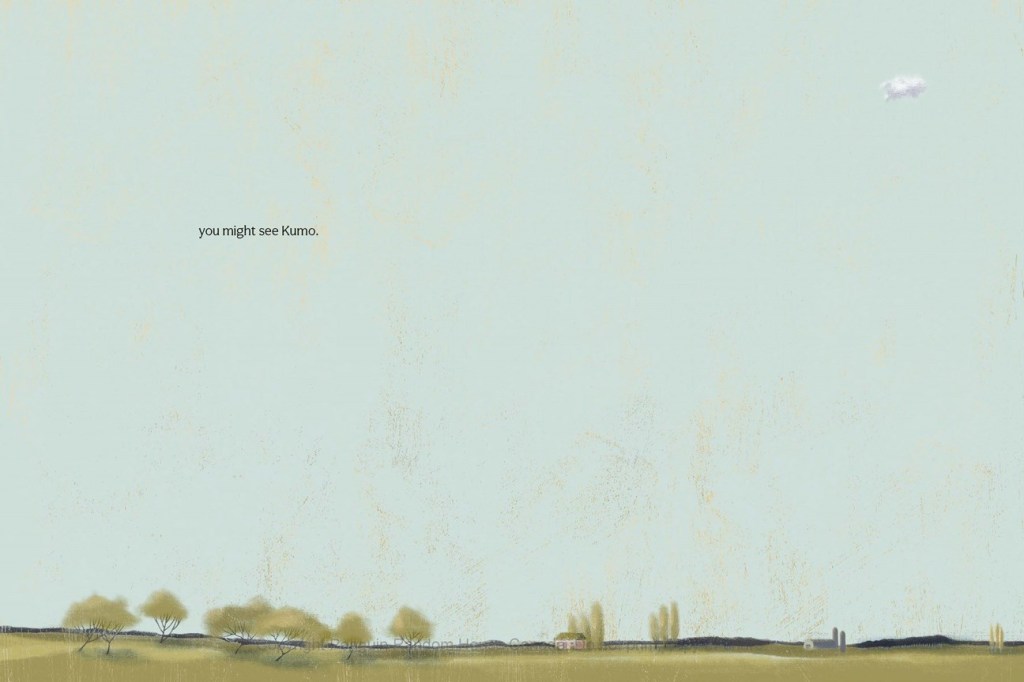
Children sometimes personify clouds, and so do adults. While the actual scientific facts about their existence is also enthralling, spinning stories about their evanescent shapes is an important pastime. Kumo is bashful, insecure, but also socially enough inclined to welcome the friendship of Cumulus and Cirrus.

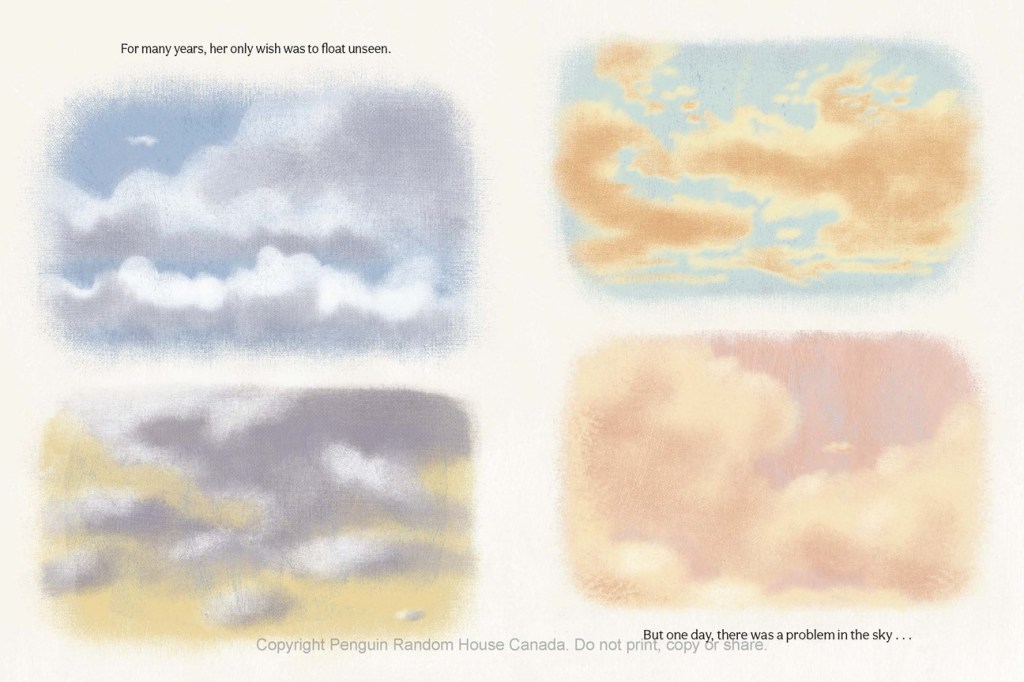
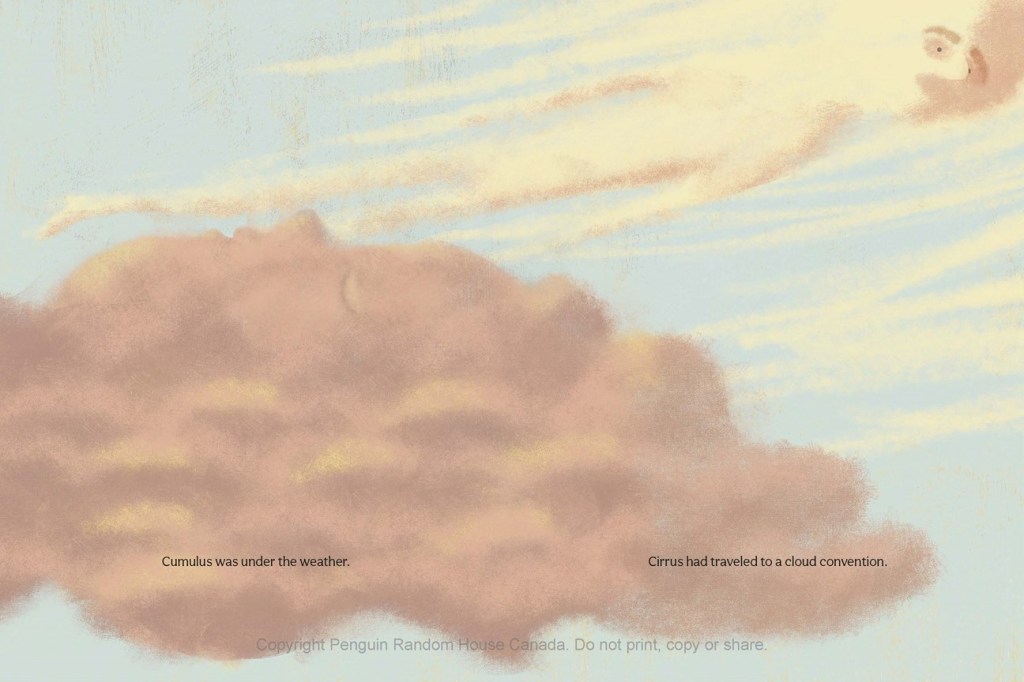
When the book opens, Kumo is so pale as to be almost invisible. As Kyo Maclear narrates (I’ve reviewed her other works here and here and here and here and here), “for many years, her only wish was to float unseen.” Yet circumstances change and she adapts, if, at first, reluctantly. “Her mind was heavy with doubt” may seem an intense statement of consciousness to a child, but it makes sense. She is frightened, then trapped in a tree. A friendly kite, not a cloud by cloud-adjacent, helps her out. So does the wind, and a lake, fields, and “singing glaciers.” The natural world is her ally. But When Cumulus feels “under the weather” and Cirrus departs for a cloud convention, she is worried.

Nathalie Dion’s pastel images with touches of brighter color perfectly match the poetry of the text. Eventually, Kumo begins to interact more with the human world, helping a man to plant petunias, and even enjoying an urban scene full of lively families. One child holds a red balloon, while another, with oversized black glasses and dark hair, wears matching red pants. That child is revealed to be somewhat like Kumo. With his head in the proverbial clouds, he loves to dream. Soon he transforms Kumo into a bunny, a car, and a flying horse.

With the boy’s help, Kumo ascends to “the top of the world,” and even reaches out to new friends. With the lovely Japanese names of Fuwa-chan, Miruku, and Mochi, helpfully explained in a short glossary, they support one another, both literally and figuratively. Being alone and having friends, both meteorological and human, both turn out to be within Kumo’s flexible reach. Kumo the Bashful Cloud reveals wisdom with a light touch.

Four Seasons: A Complete View

Now I See Winter
Now I See Spring
Now I See Summer
Now I See Summer
Written by Mac Barnett, illustrated by Jon Klassen
Tundra Books, 2026

There are board book editions of children’s classics, others that are original stories, and many that have tactile elements or photographs of familiar objects. All those categories are wonderful for introducing literacy to babies, toddlers, and young children. (Older children, and adults, also appreciate the sturdiness, portability, and other features of this format.)  Mac Barnett and Jon Klassen have written and illustrated a systematic view of the four seasons based on two different premises, continuity and change.  The four books are inventive and appealing, and surprising, as well. Even if you own many seasonal books for young readers and listeners, these are different.

Each of these small, square, books has identical text, and pictures of the same location or object, varied according to the time of year when it is experienced. Each has a similar cover, featuring a pair of eyes ready to focus, and a color and pattern specific to winter, spring, summer, or fall. The tree is covered in snow in winter, accented with green leaves and grass in summer.

The garden, encased in a small box, is beginning to sprout in spring, and in transition between growth in the fall and emptiness in the fall. The page dedicated to “me” shows a child’s shadow observing the changed scenes. The simplicity of the text is a sign of its depth, a kind of Zen-like approach to the changing environment in the perception of a child.  There is nothing inevitable about Barnett’s choice of few words. One page in each book is dedicated to “something red;” the fall image of a lone red wagon calls to mind William Carlos Williams’s famous red wheelbarrow. “The perfect hat,” of course, Jon Klassen’s hat trilogy.  The hat changes for each season, but the child’s intent stare through the window is constant, a reminder that the book is about observation.  Children do not miss some details that adults might, and they may attach different significance to them. 

The series celebrates the acute perceptions of childhood, both for children themselves and the adults who recollect the time when a house, tree, or the expanse of sky were both predictable and strange, depending on time.

Treehouse Inhabitants

The Tree That Was a World – written by Yorick Goldewijk, illustrated by Jeska Verstegen, translated from the Dutch by Laura Watkinson
Eerdmans Books for Young Readers, 2025

The Tree That Was a World is unexpected.  The central premise of a multitude of creatures who all inhabit, or interact with, the tree, and the dream-like mixed media illustrations, predict a kind of eco-fable. While the natural environment is the scenery to the story, its idiosyncratic characters form a unique cast that defies any didactic message. Readers will meet two pikes, one of whom finds the other to be “arrogant and self-important.”  There is a big brown bear having an existential crisis, and an owl who doubts his own identity. These are animals who argue, become discouraged, and pronounce, “Fuhgeddaboudit” when they reach their wits’ end.

The tree is majestic, a metaphor for age and stability. It’s also a place where everyone has a distinct niche and harmony is not always the order of the day.  A moon moth caterpillar contemplates the meaning of freedom. Her friends boast and obsess with their beauty, while she finds herself unwilling to play their game.  All the characters are similarly endowed with an independent spirit, which is far from idealized. They can be cranky and irritating, even while their refusal to conform is admirable. No, this is not George Orwell’s Animal Farm. Yorick Goldewijk’s carefully expressed irony sets them all, from spider to barn swallow, apart from allegory.

Jeska Verstegen’s pictures are dark, with dashes of illumination (I’ve reviewed her work here and here).  A sloth determines to defy expectations, swinging gently from the tree. He projects his thoughts onto everyone who assumes they know him, even when they don’t, declaring that “he’s going to do some running, jumping, and somersaulting. And screaming. Lots of lovely screaming.” The angry pike swims by his nemesis, insistent that his distress is all the fault of the other fish.  Oddly, the glassy green of this image reminds me of Martin and Alice Provensen’s illustrations for Margaret Wise Brown’s The Color Kittens. Yet for all the innocence of the lovely Golden Book classic, there is a mysterious depth the images, along with Brown’s poetry, share.  The characters are anthropomorphic, but retain their identity as animals.

Other classic works of children’s literature will come to mind, including The Wind in the Willows, Winnie-the-Pooh, and even Frog and Toad (not to mention George and Martha.) A red squirrel gets into a heated argument with a toad, which includes a debate about the existence of gnomes, and the danger of socializing with humans. “If you’re not careful,” the toad warns, “you’re going to turn into one of them.” Children and adults will both take to heart those words to live by in this bold story, as non-compliant as the tree’s peculiar, yet also familiar, residents.

Let It Snow

The Snow Theater – written and illustrated by Ryoji Arai, translated from the Japanese by David Boyd
Enchanted Lion Books, 2025

The art of Ryoji Arai’s The Snow Theater demands strong adjectives: intense, stunning, original, but also: unpretentious, dream-like, and accessible. The reason for this contrast, aside from the artist’s incredible gifts, is the imagery’s blend of naiveté and sophistication, with splashes of color as well as carefully delineated figures. Arai’s pictures capture what it feels like to be a child, and specifically to be captivated by the experience of snow. Snow as theater is not at all artificial, from a child’s point of view. It is a gift, perhaps unanticipated, that then takes on different qualities, including joy. It is familiar, but can also be strange.

There are innumerable children’s picture books about snow, and many are excellent, beginning with the Ezra Jack Keats classic The Snowy Day (see some other examples here and here and here and here and here and here and here). The Snow Theater is not unique, but both its design and philosophy and language are distinctive enough to merit acclaim (it is translated by David Boyd, who has translated some of the Chirri and Chirra books, also published in English by Enchanted Lion). It opens indoors, where two boys are “keeping warm” and “looking at a book.” The first picture has the reader looking towards them from outside, where they are framed in the window, almost like residents of a dollhouse. Then, a two-page spread is divided into several more specific descriptions of their activity, and one larger scene of it result. At first they are sharing a picture book about butterflies in a cooperative spirit. Then, the friend of the boy who lives in the house “badly wants to borrow the book,” and the idyll is ruined. That adjective, “badly,” prepares you for the act of, perhaps accidental, aggression that results when the book is damaged.

Now the boy is devastated. Worse, the book is actually one of his father’s favorites, adding a dimension of anxiety to an already tense situation. Arai traces the arc of the boy’s feelings. They boy had wanted to share the book with his friend, not only because they both liked butterflies, but in order to communicate its special status in his family. Worried, he leaves the house and begins to ski through the snow. Suddenly, he finds himself looking into a miniature theatrical production. There are “snow people,” including ballerinas. They surround him physically, occupying his senses. Then the scale seems to change, as he sees “a large theater in front of him.” Yet the performers, who include singers, still appear to be tiny. “Everybody floated quietly to their places, like freshly fallen snow.” There are echoes of Tchaikovsky’s Nutcracker, with impressionistic colors. Snow people reflect the color of rainbows. Icicles are suspended from their limbs and odd pieces of scenery, like an Easter Island head, occupy the elaborate background.

Then the show ends. As in The Nutcracker, viewers wonder if the performance was a dream, or if the protagonist had really undertaken a mysterious journey. The kinetic, and ephemeral, experience of a snowstorm seems to have been the boy’s escape from emotional difficulty. He reaches across the snow to find his friend against a field of butterflies, only some of which are enclosed within a book. The boy’s father appears with the awaited resolution: “Let’s get you home.” A cup of hot cocoa by a warm stove brings back domestic security, but the song of the snow people is reprised in the boy’s memory.

Freedom from Hunger

Maddi’s Fridge – written by Lois Brandt, illustrated by Vin Vogel
Flashlight Press, 2014 (paperback edition, 2022. Reading app available:
https://apps.apple.com/us/app/maddis-fridge/id6748969593)

Thanksgiving is associated with families sharing a plentiful amount of food, but not all Americans have access to this custom.  Freedom from hunger is a human right. Historically, it has been an American right, even if this ideal has not always been realized.  Norman Rockwell’s iconic paintings depict the Four Freedoms that President Roosevelt had a promoted during World War II as a reminder of the war’s purpose.  Maddi’s Fridge is a non-ideological picture book for children.

It does not discuss the social and economic programs needed to combat income inequality; that is not its purpose. Lois Brandt and Vin Vogel present the problem of hunger through the friendship of two girls, Sofia and Maddi. Sofia has always assumed that her well-stocked refrigerator is the norm. When she learns that her friend’s is virtually empty, Sofia needs to help her friend without betraying a secret.

Vogel’s illustrations are understated and appealing.  They convey a sense of community, even a modern version of Rockwell’s, as well as a touch of mid-twentieth century animation.

Sofia’s family is well-fed, with the inventory of her refrigerator even including dog food. Brandt enumerates each item for human consumption: chicken, yogurt, cheese, carrots, bread. In contrast, her friend Maddi’s refrigerator has barely enough to sustain her and her younger brother.  Brandt and Vogel show, in words and images, the asymmetry of the situation without elaborating on its cause.  Instead, Sofia’s dilemma is central to the story.  How can she help Maddi? Bringing foods for the two friends to share as they play outside will not address the problem.

Adults reading with their children may anticipate Sofia’s decision, but children will not necessarily predict the outcome.  Maddi’s Fridge presents an opportunity to discuss why breaking a promise of secrecy may be not only permissible, but crucial.  The book’s afterword provides further suggestions for filling empty fridges, on an individual and communal level.  The book’s relevance today is a sad statement about the refusal to ensure that all children are cared for, but it at least represents an intelligent and sensitive way to shed light on the problem.

Ready, Set, Anne

Anne: The Chapter Book Collection – adapted by Kallie George, illustrated by Abigail Halpin
Tundra Books, 2025

Anne Dares – adapted by Kallie George, illustrated by Abigail Halpin
Tundra Books, 2023

For fans of Kallie George and Abigail Halpin’s wonderful collaboration in bringing the work of Lucy Maud Montgomery to chapter book readers, Tundra has issued a boxed set of paperback editions.  As you will read on my earlier posts (see here and here and here and here), this series is both an accessible introduction to the original Anne of Green Gables, and each volume a  wonderful illustrated novel that stands on its own merits.  Abigail Halpin’s pictures offer her own perspective on the characters and setting, and Kallie George has succeeded in writing an homage to Montgomery’s vision, not a bland imitation.

In Anne Dares, the bold aspect of Anne Shirley’s personality propels her to take some risks.  These include the physically daring walking on the edge of a fence, as well as the courage to perform in her school’s recital. The fence-walking stunt even requires her to ignore the advice of kindred spirit Diana. Ever conscious of a dramatic situation, Anne assures her friend, “And if I do perish,…you can have my pearl-bead ring.

Her performance involves facing her apparent nemesis, Josie Pye, as well as Gilbert Blythe, the boy whose thoughtless teasing will prove to be a mere mask over his true feelings. Her new puff sleeved dress, a gift from her beloved father figure, Matthew, gives her some of the strength she needs in front of an audience.  The dress is both a cherished article of clothing, as well as a tangible proof of the love that now characterizes her home life, although her initial arrival had provoked skepticism.  On stage, at first “she thought she might faint.” Daring or not, she is still afraid. Fortunately, “she knew she must live up to those puffed sleeves.”  Montgomery’s heroine, re-imagined by Kallie George and Abigail Halpin, lives in two worlds, where undeniable difficulties and dreams of beauty are intertwined.