Imagining Who Wore Them

Little Shoes – written by David A. Robertson, illustrated by Maya McKibbin
Tundra Books, 2025

Many Indigenous children, in both Canada and the U.S., suffered the trauma of being removed from their families and placed in residential schools funded by the government and often controlled by different Christian denominations.  Deprived of their heritage, and often subject to physical and emotional abuse, these children would be lost to history if not for concerted efforts to publicize their experience and to demand restitution and atonement.  Little Shoes is a picture book by acclaimed author David A. Robertson (see my reviews here and here and here), a member of Norway House Cree Nation, illustrated by Maya McKibbin, of Ojibwe, Irish, and Yoeme heritage (Robertson and McKibbin have collaborated before). They have taken on the weighty task of presenting a catastrophic loss to young readers, but also offering hope and determination.  With poetic text and images of family life that are both familiar and mystical in tone, they have achieved this goal.
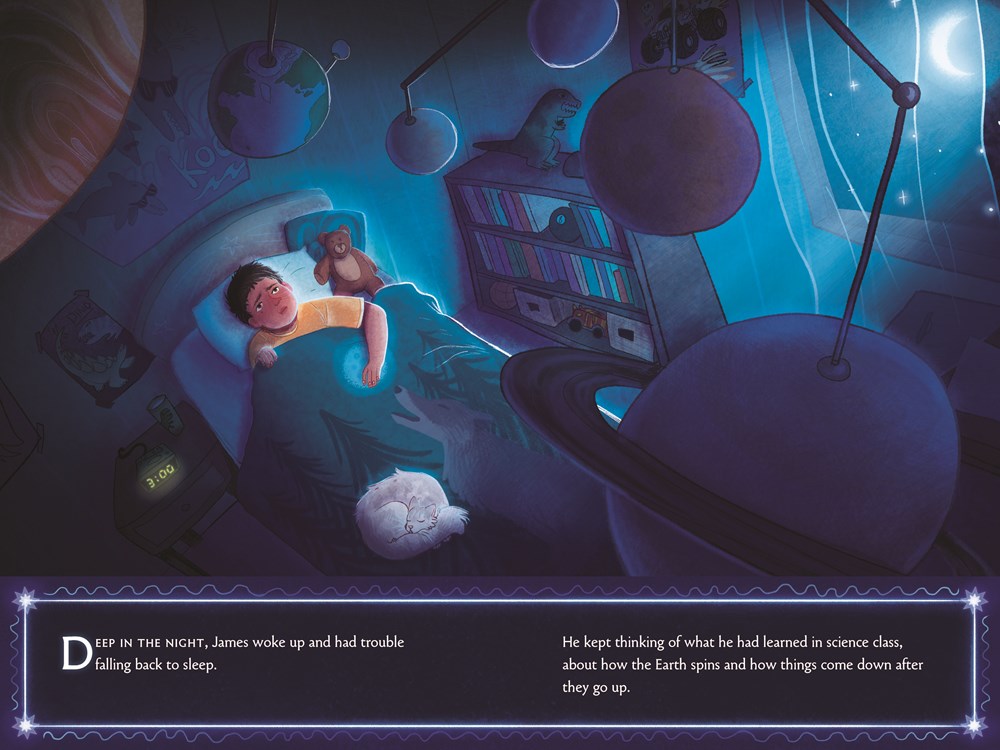
The endpapers feature constellations, introducing a central theme of each person’s place in the universe.  James, who understands the principles of astronomy from his science class, opens the curtains in his room to the moonlight. He asks his mother to clarify how and why his feet remain firmly on the ground if the Earth is spinning in space. The answer is only one of several which his mother will frame truthfully, and also use to elaborate on other questions which will naturally follow. She reassures him that his Kōkom’s, (grandmother’s) explanation about their origins is valid, but adds, “even though you’re from the stars, your home is right here with me.”

The love between a parent and child, and the enveloping warmth of his community, are anchors in James’s life.  His intense curiosity places demands on a parent who is obviously committed but exhausted, when he returns to her room with a request to hear about “every single constellation,” His own attempt to visualize and trace them in the night sky is insufficient.  The dialogues between children and their caregivers are open ended, and the book swerves from the dimensions of the cosmos to the specific history of injustice that remains unresolved.

James and his kōkom set out for one of their frequent walks, but his time it is transformed into a march.  A daily experience becomes a metamorphosis, and his grandmother takes on the role of teaching about a part of their lives that is far more difficult to internalize that the motions of the planets. The little shoes of the title are those of Indigenous children whose deaths are acknowledged by Kōkom with the haunting phrase that they “had gone to residential school but had not come home.”  Shoes as a metonym for children who have died seems to capture a sense of a life that is unnaturally cut short. Other articles of clothing are perhaps less universal, and small shoes also reflect the scale of the children relative to adults, both those who loved them and those who inflicted torture.  A similar allusion to this loss has been used in many memorials to child victims of the Holocaust. (Of course, while some of those children, like the Indigenous victims, died of abuse, neglect, and disease, many were murdered immediately upon arrival at a death camp.  Chronicling atrocities requires acknowledging both what they share and common and how they differ.)
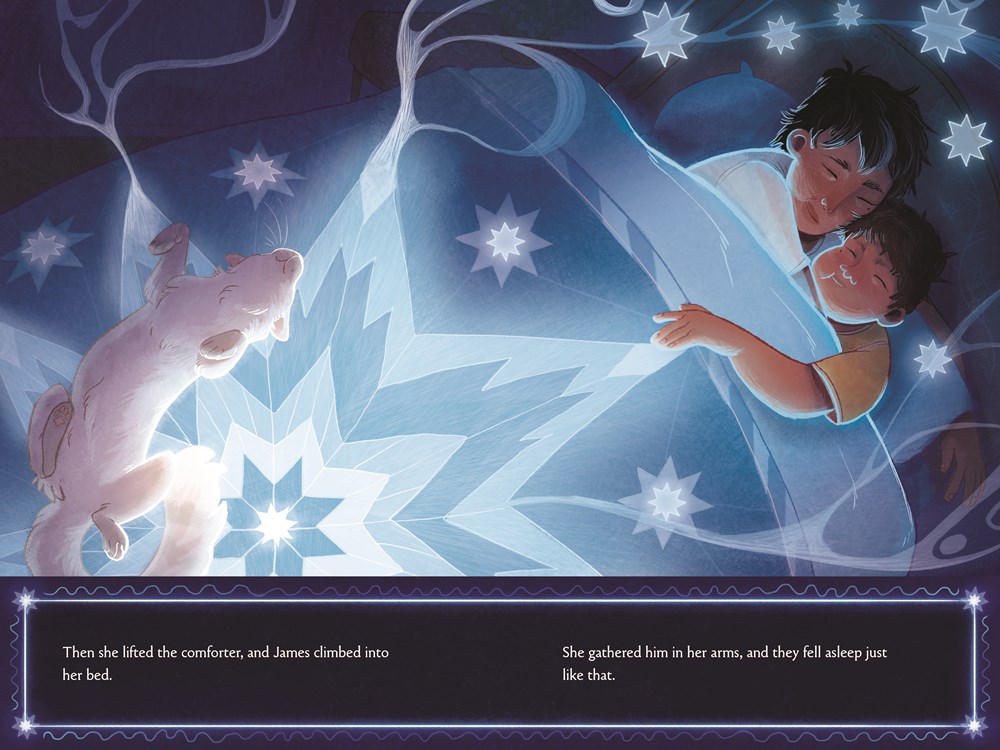
Robertson and McKibben do not attempt a simplistic response to James’s fears. He interprets the frightening facts through the lens of loneliness, asking his mother how his own grandmother had coped with the deprivation of her isolation in the residential school.  His mother responds that her sister and she had “cuddled,” paralleled by McKibbin’s image of mother and son sharing the same physical contact. Their bond is unbreakable, even if mitigated by anguish.  The honesty of Little Shoes is an antidote to fear.
What Makes Us Happy

I Would Give You My Tail – written by Tanya Tagaq, illustrated by Qavavau Manumie
Tundra Books, 2025

This tender, subtle, book, about a boy awaiting the birth of a sibling, is set among the Indigenous people of Nunavut, northern Canada. It is both unique to their culture and universal in its expression of gratitude, both to people and the environment in which they live. The title refers to a conversation between two hares, echoed by other animals, and finally by the brother welcoming his new sister to the world they will share. The language seamlessly weaves together the language of the physical world and metaphor. The pictures, created in colored pencil, draw from Inuit folklore, as well as the specific qualities of the characters.  Sharing is a concept central to the book, part of the overall vision of happiness passed from one generation to the next.

Assuming a child’s perspective in a book for children may seem natural, but it’s not so easily accomplished. Here, from the first page, readers will empathize with the boy, Kalluk’s, feelings of expectation and some anxiety, as he awaits a profound event in his life.  Tanya Tagaq is straightforward in presenting the situation: “Kalluk’s mother is in labor and about to have a baby.” Even the repetition of seemingly redundant terms, “labor,” and “about to have a baby,” reflects the way that children incorporate reality. Qavavau Manumie’s illustration shows the pregnant mother touching her kneeling son in a gesture of reassurance, before he sets out to bring his grandmother to help.

Unhappiness is, realistically, part of Kalluk’s range of feelings at this moment. He asks two hares why they are happy, and learns how the qualities that they need to survive, speed and cleverness, are fulfilling ones. A brook is happy because of the fish who inhabit it. Mothers, animals or human, are happy with the offspring to their care. Explanations are kept to a minimum. Kalluk can sense the sincerity of all the responses.

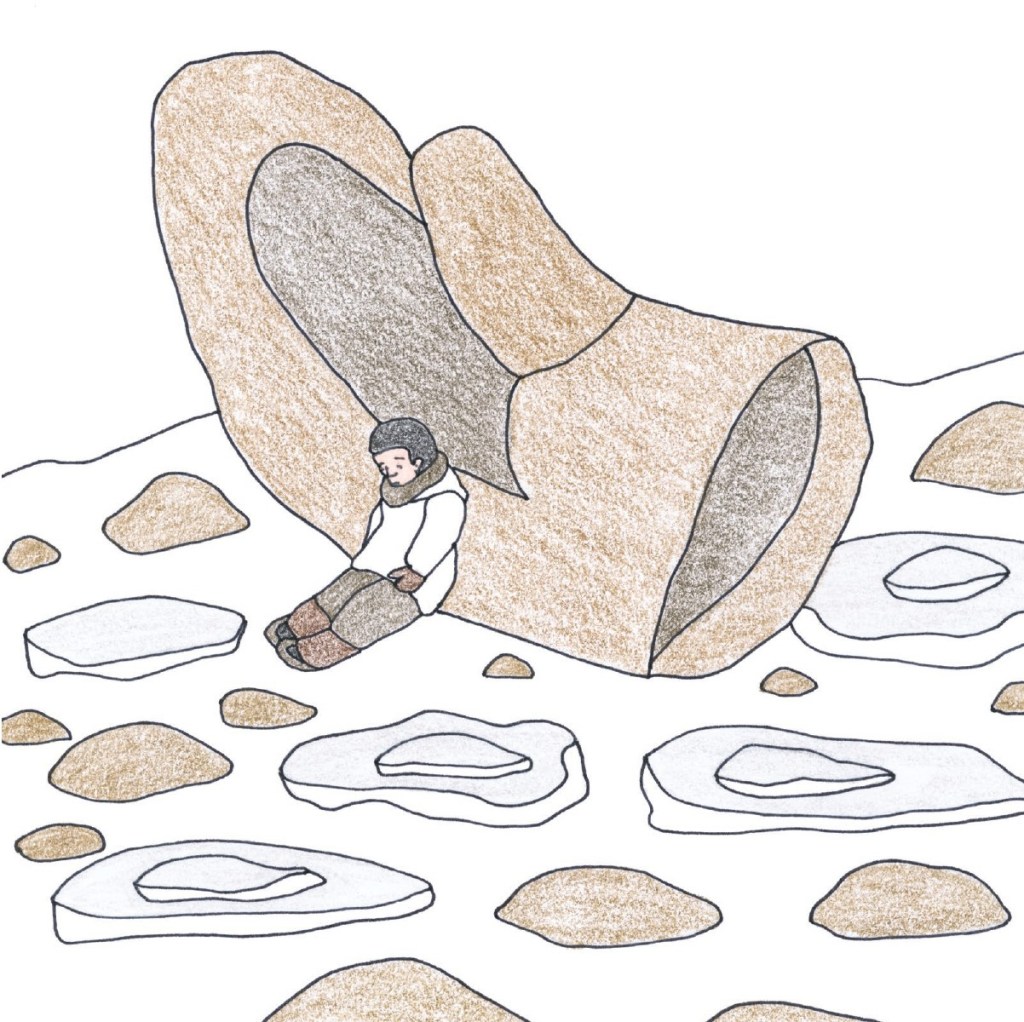
A picture of Kalluk seated with his back against a giant mitten embodies his feelings of gratitude tinged with sadness. He clearly misses his mother, thinks of the warm mittens she has created for him, and sends her “all the love in his heart.” The way in which that message is convened does not need to be articulated.

Meeting his grandparents, Kalluk has reached the confirmation of all the previous lessons about gratitude and love. His grandmother, Anaanattiaq in their North Qikiqtaaluk dialect, is unapologetically depicted as old; she “stands up slowly, bones creaking and cane shaking.”  Any diminished physical strength is no obstacle, as she states purposefully, “Let’s go greet the new one.” Walking home, the boy asks her about her source of happiness. When she answers “peace,” he requests an elaboration. This dialogue is different from those with the animals. She tells him in the most direct language that peace grows inside each person, as he or she makes a series of choices in life. The right choices will make you proud, and grant “lots of peace,” the kind that is meant to be shared.

When Kalluk and Anaanattiaq come upon “a conspiracy of ravens,” the squawking, lively birds are friendly towards them.  Their requirement for happiness is “knowledge,” a slight variation of the other animals’ answers. Their grandmother, the ravens assure Kalluk, is full of knowledge. That knowledge is put to the most important use when she arrives at Kalluk’s home, where his mother has already given birth and his breastfeeding the baby whom he is now prepared to teach everything he has learned.  Gratitude for food, water, family, and the ability to choose well, are the gifts he brings to her, as well along with a declaration of love.  I Would Give You My Tail is like a perfect circle, enclosing the reader in the complete circle of Kalluk’s journey.

Miigiwe – Giving Away is Good

An Anishinaabe Christmas – written by Wab Kinew, illustrated by Erin Hill
Tundra Books, 2024

Finding a children’s book that may be identified as an instant classic is not to be taken for granted. One book that fits that category is An Anishinaabe Christmas. It brings to mind Dylan Thomas’s A Child’s Christmas in Wales, the versions illustrated by both Edward Ardizzone and Chris Raschka, not because of any direct similarity, because the books are very different. Both classics evoke a particular, but also universal, immersion in childhood. You leave the book, and return to it, with a feeling of peacefulness without sentimentality.

A young child from an Indigenous community is going with his parents to visit their extended family on the reservation.  It is winter solstice, an inseparable element of their culture’s celebration of Christmas. Baby, as he is called in the book, looks serious, even puzzled, as his mother and father bundle him up and get ready for their car trip. Their evident excitement is in contrast to his hesitation; this experience is typical of childhood. He is concerned that Santa will not find him away from their home. The cultural signifier of this gift-giving figure so common in the West then transitions to the specific deep roots on the Anishinaabe people.

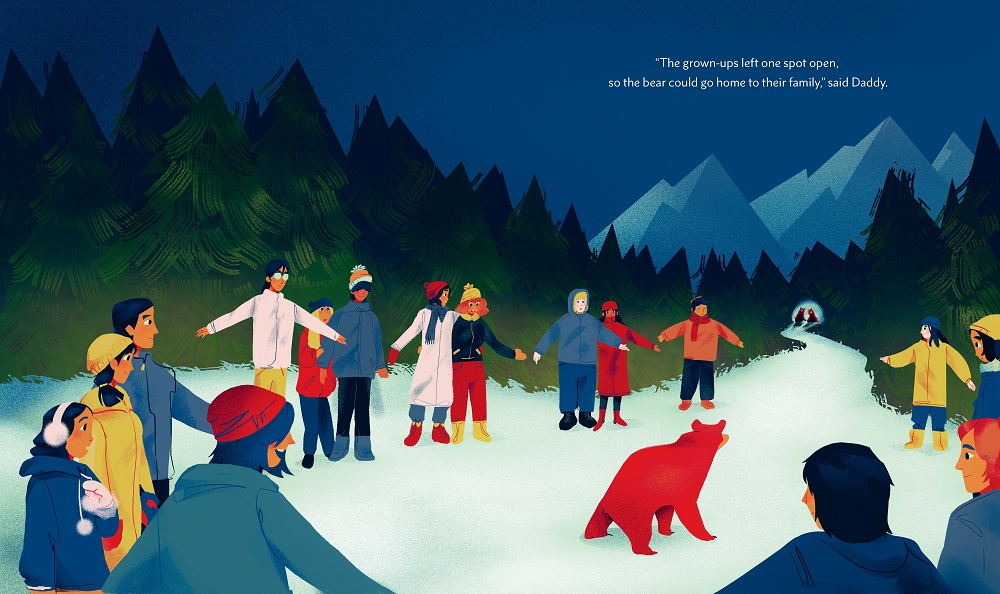
As they drive from the city to the country, the family passes a sign warning not to feed the bears. This prompts a memory that connects Baby to her heritage, and to the natural world that is part of it. Her father repeats the story of how he and other adults had formed a protective circle so that a lost bear cub could find its home. The idea of communalities between humans and animals is organic to the picture, without any ideological explanations. “The bear has a family?” Baby asks. Of course it does, and the father not only answers, but uses the opportunity to introduce words in their native language. (Wab Kinew includes these terms in a glossary at the end of the book, along with an explanation of the cultural syncretism combining Christmas with Indigenous traditions.) The bear also has makwa, family, although it is distinct from the human one.  The bears’ makwa  will “snuggle up in their dens with their babies for Christmas.”

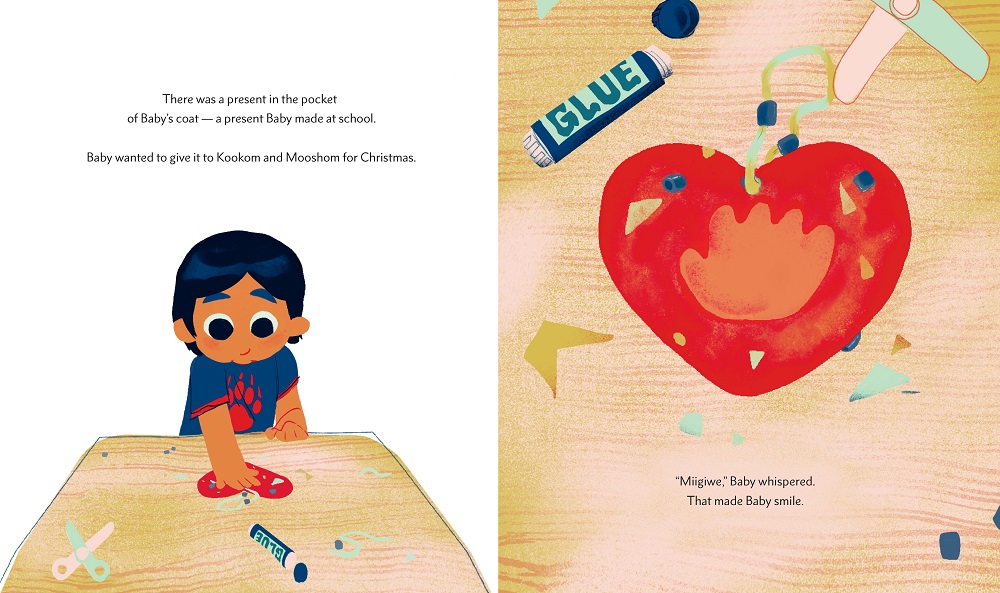
One thing the bear cub will not do is craft a gift for his grandparents, Kookom and Mooshom. The picture of this project is composed of carefully spaced elements, each one of which represents something important: creativity, love, simplicity, focus. Glue, scissors, a red paper heart, become a concrete expression of miigiwe, that Baby’s father has explained: “That means ‘giving away.’ And it’s good.”

The pictures by Erin Hill alternate outdoor panoramas, domestic interiors, and framed scenes of specific activities. A view of the family seated around a wood stove is set an angle and viewed from a slight elevation. Relatives embrace, but there is empty space between different sections of the picture.  Kookom and Mooshom are thrilled to see their grandchild, but they listen carefully to his narration of the car trip. He has processed the truths his father communicated and his repeats them, with understanding, to the older generation. Do you have grandparents? Are you a grandparent? Do you remember your grandparents? You will never forget these scenes.  The family goes outdoors, where they sing about the poetry of winter while playing drums. Whatever winter holiday you celebrate, An Anishinaabe Christmas will resonate as strongly as that chorus.

Anne’s Aspirations

Anne Dreams – written by Kallie George (adapted from L.M. Montgomery), illustrated by Abigail Halpin
Tundra Books, 2024

Once again, Kallie George and Abigail Halpin have succeeded in creating a book for young readers based on L.M. Montgomery’s classic, Anne of Green Gables (I’ve reviewed their earlier efforts here and here and here and here, and some of their efforts with other creators here and here and here and here). Of course, their works are invitations to read the original series, but they stand on their own as modern classics.  Each volume selects specific incidents from Anne, and develops them as the focus of independent interest. At the same time, they cumulatively evoke the full character of Anne and her world.

Anne’s beautiful red hair is a source of anguish to her. How could that be? Her distinctive beauty made her uncomfortable, and when her future love, but present nemesis, Gilbert Blythe taunts her as “Carrots,” she feels even more insecure. Anne is reduced to buy hair dye from a peddler, expecting her stunning red to be transformed to “raven black.” Halpin captures Anne’s desolation and her guardian, Marilla’s, shock, at the resulting green color. No, girls and women should not waste even a moment concerned about male beauty standards, but Anne actually was trying to emulate her “best friend and kindred spirit, Diana.”

A haircut and the passage of time fixes this problem. Then Anne must think about her future. Her love her learning inspires a dream of attending Queen’s College in Charlottetown, training to become a teacher.  Anne is both intensely loyal to friends and family, and also changeable. When Marilla asks if she wants to become a teacher, she answers, “Oh, yes! It has been my lifelong dream!…Well, at least it has been for the last few months.”  But once she arrives at that decision, she is determined to avoid distractions, including Gilbert Blythe.

Some of the pictures extend to two pages, including a nervous but enthusiastic Anne arriving in Charlottetown for her entrance exam. Her guardian, Matthew, waves quietly from the carriage before leaving Anne in a place that resembles a metropolis, compared to her home. She waves back, clutching a book. This scene signals a coming transformation in her life. 

But Anne is still Anne, as another two-page spread reminds us.  Halpin juxtaposes Anne arriving at Avonlea, Anne opening a lovely new dress, Anne holding to ill-fated bottle of raspberry cordial before serving it to Diana.  Every visual incarnation of her personality shows one dimension of a character we will never forget, whether we have encountered her first in the work of L.M. Montgomery, or in this outstanding series.