Tiny Jenny: Little Fairy, Big Trouble – written and illustrated by Briony May Smith
Anne Schwartz Books, 2024
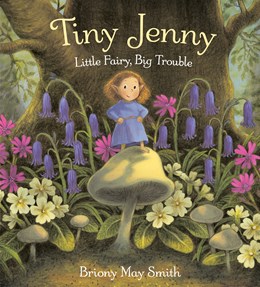
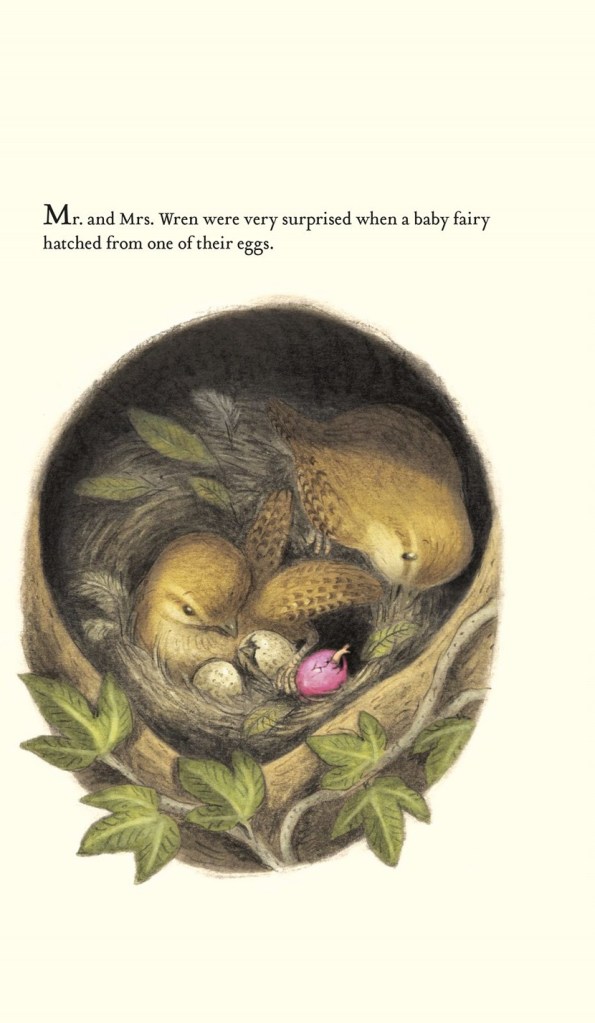
Briony May Smith‘s Jenny is a changeling, a fairy hatched from a wren’s egg, much to the family’s surprise. She has no wings, sort of like the reverse of Horton’s long-anticipated newborn in Horton Hatches the Egg. Like Hans Christian Andersen’s Thumbelina, she has to navigate her way through a dangerous world. There are many lovely books about fairies who have a range of origins and play a variety of roles (see my reviews here and here and here). The wrens name her Tiny Jenny and dedicate themselves to raising her, but perhaps not thinking through all the potential problems.
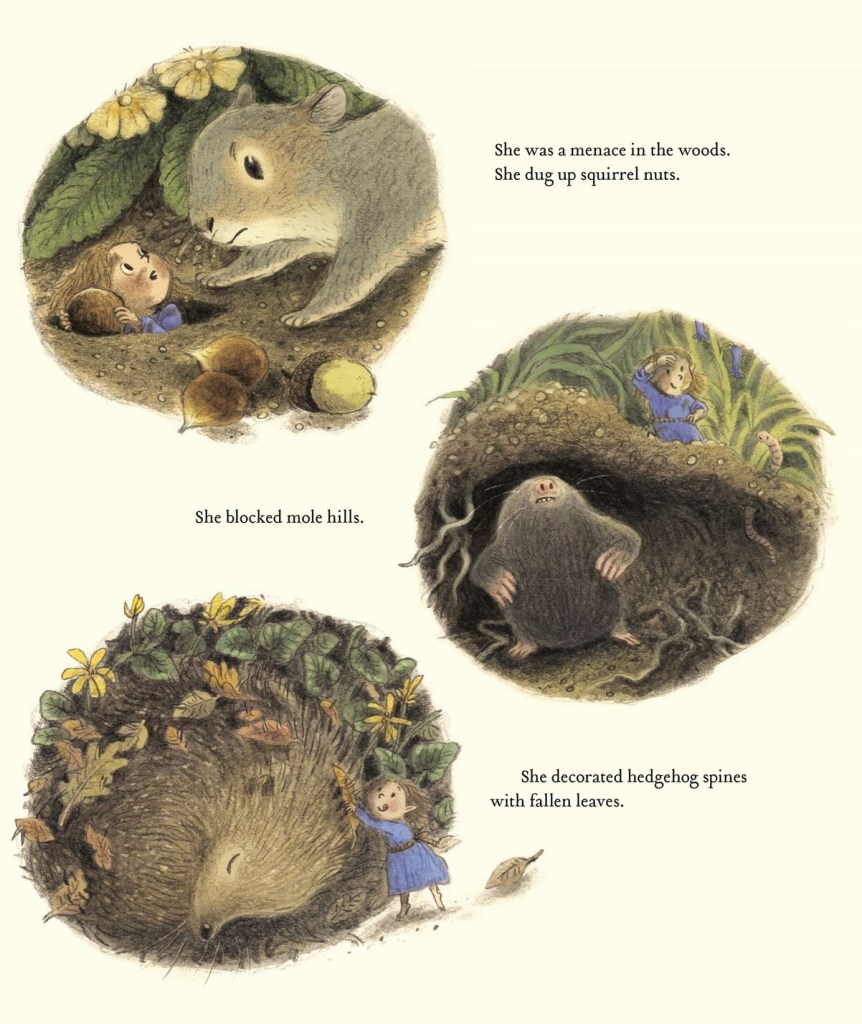
Wrens can fly, but wingless Jenny cannot. She manages pretty well, finding stems and brambles to eat, and even decorating her friend the hedgehog with leaves. Not every part of her day concerns survival. One day, Jenny overhears some of her woodland friends, or least creatures she had thought were her friends, talking about her. It isn’t pretty. They find her most endearing traits to be annoying. When a wise owl uses his renowned quality to point out that she is not a wren, but a fairy, he also encourages her to go out and find some of her own kind to prove her true identity. She stumbles into a fairy ring, an action generally associated with bad results, at least for non-fairies. She is pictured among a circle of oversized, from her point of view, mushrooms, as she looks up quizzically. All of a sudden Tiny Jenny finds herself surrounded by fairies. There are boy and girl fairies, ones in flowing dresses and others in trousers. They move effortlessly because, unlike Jenny, they have wings. These fairies are not so nice. They prod her skeptically. Merletta, their queen, extends her hand to Jenny for the required kiss. Naturally, “Tiny Jenny stared at her blankly.” One fairy actually smirks at Jenny’s confusion, and her lack of wings.
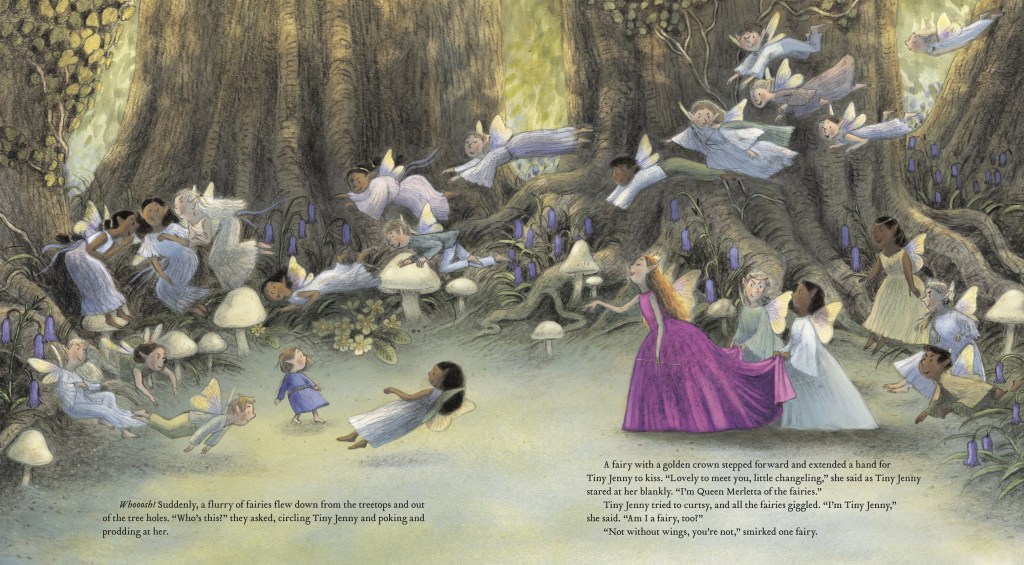
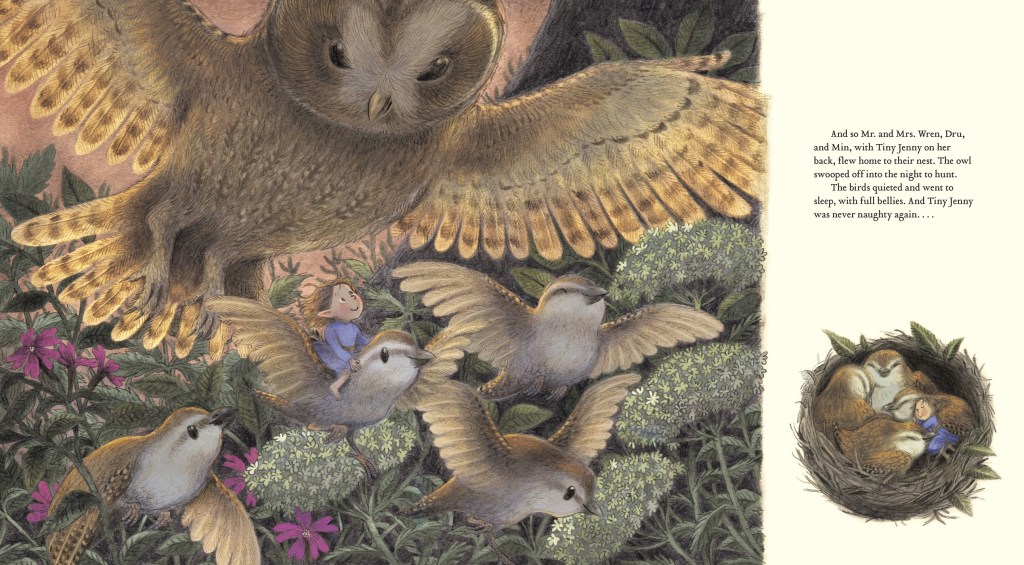
The solution to her problem seems imminent, as Queen Merlette assures Jenny that she only needs wings in order to complete her fairy transformation. Then come those ominous fairy tale words: “But first you must prove yourself worthy.” What follows is a kind of mild fairy hazing. Jenny is relegated to the back of the line of fairies wielding wild garlic and bluebells. Disillusionment follows, as Jenny learns that fairies are not nearly as nice as wrens. Instead of foraging for food, they steal. Queen Merletta is a proto-dictator, calling out commands to “ATTACK.” When they inform Jenny that she has passed their test, she responds with the self-assurance rooted in the unconditional love of her wren parents. “No, I don’t want to be a fairy,…You’re mean, you’re bullies.” Jenny doesn’t care about getting wings anymore. Soon she is home, eating mushrooms, and sleeping in her nest, while reserving the right to occasionally be restive and annoying. There’s no place like home.


 Imaginary Elevators