
The Witching Hour – written by Jennifer Harris, illustrated by Adelina Lirius
Tundra Books, 2025

My mother used to refer to “the witching hour,” that time late in the day when babies, toddlers, and young children seem to act a bit possessed. Whether because they have managed their impulses as best as they can for many hours, or need limits and reassurance, or are just exhausted, this can be a difficult moment for parents. The “hour” may seem like multiple hours. Jennifer Harris and Adelina Lirius (I reviewed another of her works here) have captured the phenomenon so perfectly in their new picture book that you and your children will be under their spell. Indeed, as Harris solemnly states, “Anything can happen in the witching hour.”

The two mothers in the book are paragons of patience, trying every inventive solution you might imagine, and then some. First, the acknowledge that anything, “or even nothing at all,” can set the chaos in motion. A baby overturns a cup of liquid on a table enclosed in a lovely tree trunk. Yes, we all recognize that scene. An older child wearing an acorn cap looks on, clearly worried about the next phase. The author is honest in calling it “chaos.” It takes both moms to extricate the screaming toddler from her highchair. An adult chair is overturned, a black cat arches its back, and the sibling covers her ears in terror.
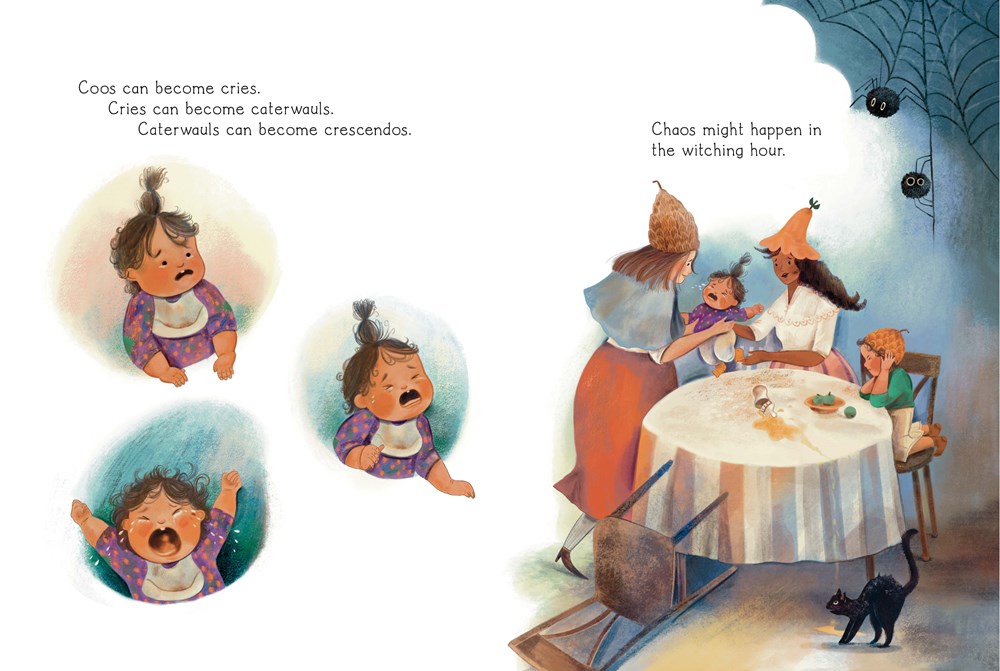
One of the most frustrating features of the witching hour, when it happens, is escalation. “Coos can become cries. Cries can become caterwauls. Caterwauls can become crescendos.” Harris uses every figure of speech at her disposal: alliteration, onomatopoeia, literary allusions, rhythm. Perhaps your child can be calmed by a favorite stuffed animal. The moms try a variety of real wildlife, finally settling on the owl. You know the feeling of relief: “Definitely the owl. Thank goodness for the owl.”

If you were hoping for fairies, you won’t be disappointed. They arrive and join in the music and dancing, in a kinetic scene of joy mixed with desperation. Lirius’s fabulous pictures evoke an entire universe where the fantastic and the familiar are effortlessly blended. Earth colors predominate and the domestic interiors are as welcoming as those in Dutch still paintings. One mom holds the baby, who looks momentarily transfixed. The other mom is dancing upside down, her feet fixed to a magical broom. Fairies usually command attention, but here they are a great audience. When the show ends (who could sustain that level of energy), the moms come down to earth.

There are still many comforting possibilities to try: “this bottle, this banana, this bat.” The moms are creative and full of hope, waiting for the moon to signal that at least for today, it’s time to sleep. Suspension of disbelief sets in for this lovely family of nurturing witches. Tomorrow they we ready to start again, with all the resources at their disposal. For readers, this home of friendly spider webs, baskets of knitting yarn, and a quaint wood stove, seems uncannily real. For the duration of the story, you will be living among friends, and the supernatural is just, natural.














 Imaginary Elevators