The Happiest Country, a Long Time Ago

Happy Times in Finland – written by Libushka Bartusek, illustrated by Warren Chappell
Alfred A. Knopf, 1941
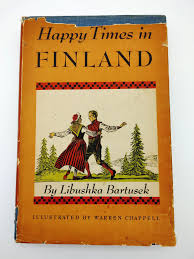
Everyone knows that Finland is allegedly the happiest country in the world.  You certainly can’t take these simplistic measures too seriously, and comparing Finland to other countries with entirely different histories, economies, and demographics is useless.  I recently reread an unusual childhood favorite, which I had bought at a library used book sale. Its appeal to me at the time remains vague. I would read almost anything, and it had lovely pictures and promised to tell a story about a distant part of the world. Happy Times in Finland, by  Libushka Bartusek, was published in 1941. At that point, it was indisputably not happy at all.  Having been invaded by the Soviet Union, they eventually allied with Germany in that country’s war with its Russian enemy.  This was a bad choice, but it is not reflected in the book, which takes place in the idyllic time period before the war.

There is minimal plot and character development in the book, but a lot of folklore.  To summarize the improbable premise, Juhani Malmberg, a Chicago Boy Scout with Finnish immigrant parents, goes to visit his ancestral homeland.  He is able to take this expensive trip due to the generosity of his father’s employer at a furniture factory, Mr. Adams.  Finland is known for, besides an improbable level of happiness, abundant high-quality wood. A furniture manufacturer would be eager to see firsthand the source of his best supplies. Since Mr. Malmberg is such a loyal employee, his benevolent boss actually takes Juhani along, for free! He has the opportunity to see his beloved grandparents, as well as his aunt, uncle, and cousins.  In addition, Juhani becomes an ambassador from the American Scouts to their Finnish counterparts.  Aside from missing his parents, there’s a lot of happiness here.
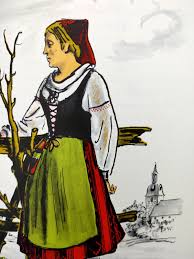
Poetic language fulfills expectations about a land endowed with natural resources, and steeped in literature.  Approaching land, Juhani seems to be expecting a myth and he finds one: “Sure enough, there it was, just as his mother said it would be: an expanse of water, blue as sapphire, with green islands dotting it, as though some giant had scattered a mammoth handful of emeralds on a silver-streaked scarf.”  Not only the environment, but its people, are described with hyperbole. Oddly, almost everyone is blond.  Finland has a Swedish minority; the name “Malmberg” indicates that his father’s family is descended from this group. His cousins’ last name is Kallio, of Finnish origin.

Finnish is not a Scandinavian language, but is related most closely to Estonian and Hungarian. (A glossary of Finnish words is included at the end of the book.) Here is a description of Juhani’s aunt, a veritable Amazon of pale beauty: “She was tall and blond, so blond, in fact, that Juhani thought she was white-haired…she had great dignity…he felt as though he were at the feet of some exceedingly beautiful statue, all made of silver and bronze and pearl…her teeth gleamed like mother-of-pear.” There are even references to “Viking blood.”

The few realistic elements stand out because of their minimal role in the story.  Aunt Kallio, Aiti to her children, has favorites among her offspring.  Her older son, Jussi, will vicariously fulfill her own dream by becoming an architect, a career closed to women. Eero, the younger boy, is not academically oriented. Unlike his parents, he prefers manual labor. She keeps her disappointment to herself, only thinking how he lacks “initiative.” “Oh, me! she sighed, one could not be everything.”  This statuesque symbol of perfection is unable to tolerate individual differences.

Warren Chappell’s illustrations, some in color and others sepia, appear to be lithographs.  They are stylized images, whether portraying men in a sauna or women clothed in traditional costumes for festivals. There is a haunting image of a blind storyteller who recites Finnish epic poetry.  Mr. Adams recognizes that the Kalevala’s metrics had influenced Longfellow’s composition of Hiawatha. The Old World and the New touch one another in this tale of immigrant roots, written as the shadow of fascism descended on Europe. It’s blatantly out-of-date and also oddly appealing, just for that reason.
Tove Jansson and the Gold Spine

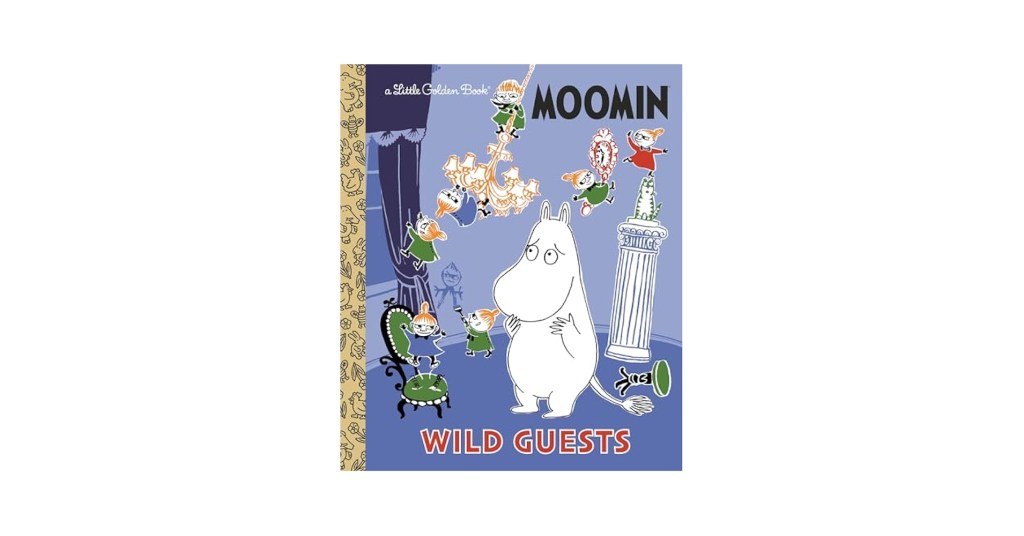
Wild Guests (Moomin) – written and illustrated by Riina and Sami Kaarla, based on characters created by Tove Jansson
Golden Books, 2025

Golden Books have become a big tent, in both the range of their subjects and artistic quality. When I learned that a Little Golden Book based on Tove Jansson’s beloved Moomin characters would be released, I was worried.  Recent releases, particularly those on celebrities of more interest to parents than children, have pictures of dubious quality. On the other hand, some of them are quite good, with substantial information appropriately presented and attractive artwork. (for example, biographies of Queen Elizabeth II, Audrey Hepburn and Ruth Bader Ginsburg) As it turns out, the price of joining the distinguished club of Golden Book classic authors and illustrators was not to compromise the style of Tove Jansson, the creator of the Moomins.

Although the pictures are not her original ones, Riina and Sami Kaarla have produced their own interpretation, which is respectful of Jansson’s inimitable style.

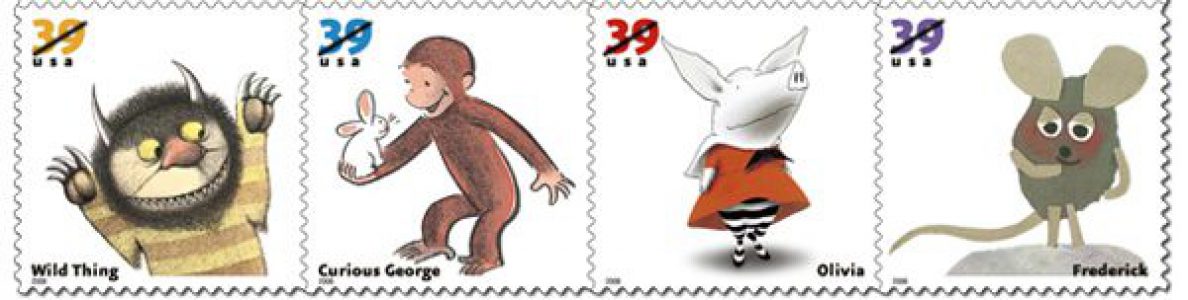
There are many characters in the Moomin universe. In Wild Guests, the title refers to some unexpected visitors, who are the mother and siblings of Mymble, who is herself a guest in the Moomin family home.  When they arrive, Moomintroll and Moominpapa are filled with excitement, while Moominmama somewhat unrealistically expects a docile crew who will happily consume strawberry juice and rhubarb pie. Instead, the Mymbles go wild.  They treat the lovely, Victorian furnished home much as the Cat in the Hat did to Sally and her brother’s parent-free zone.  While their destruction is innocent in its intention, they succeed in wrecking Snorkmaiden’s dressing table, defacing Moominpapa’s globe, and converting the kitchen into their playground.

There is a definite mid-twentieth century look to the pictures. The colors range from pastel to jewel tones, and the graphics recall paper cut-outs superimposed on a background of drawing. The wild guests are mischievous, but unmotivated by any conscious plan. (“I am Little My, and I bite because I like it.”) Their adult-like facial expressions may seem to cast some doubt on that, yet the Moomin’s home remains preserved from any serious damage. In fact, there is even helpful Elves and the Shoemaker results: a tower of carefully stacked jars and crockery, and a kettle boiling for breakfast.

It would be wonderful to use this lovely book as a gateway to Tove Jansson’s work.  However, it stands all on its own as an immersion into Moominland.

No Creator of Moomins is an Island

Tove and the Island with No Address – written and illustrated by Lauren Soloy
Tundra Books, 2024

First, if a devoted reader of Tove Jansson were to imagine the ideal author and illustrator of a book about Jansson’s childhood, Lauren Soloy would be a likely choice. (see my earlier reviews here and here and here). Tove and the Island with No Address is not a picture book biography. Rather, it is an evocative portrait of one aspect of Jansson’s life, her childhood summers in a small cottage on a remote island. Soloy does not draw explicit conclusions about creativity and nature, or even attempt to connect all the dots between a child’s imagination and the real world surrounding her.  Readers will infer those connections from the comforting text and distinctive illustrations, which could only be from the pen (and accomplished skill with Procreate software) of Lauren Soloy.

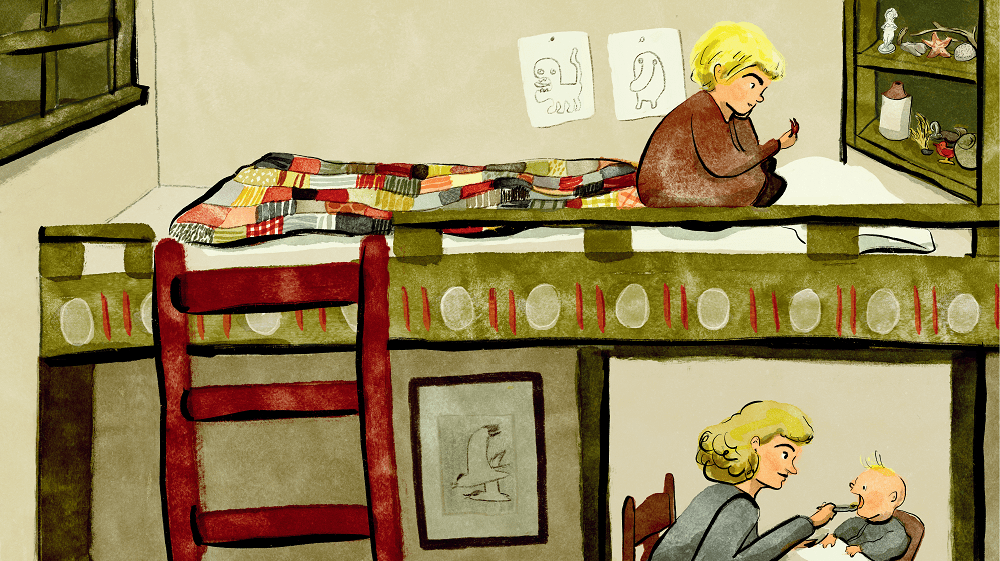
Tove loves the sea, and the assortment of objects washed ashore.  With a kind of Zen wisdom, she understands that “salvage is the fit the sea gives you and can be any number of wonderful things.” The domestic interiors are as much an ingredient in Tove’s vision as the outdoors. If salvage is somewhat unpredictable, her summer residence is a place of stability. Tove inspects her loft bed to ensure that “everything was just as she had left it.” Children instinctively know that change and continuity need to be in balance. Below her bed, Tove’s mother feeds her baby sibling. Maternal nourishment will demonstrate itself later in the book, as well.

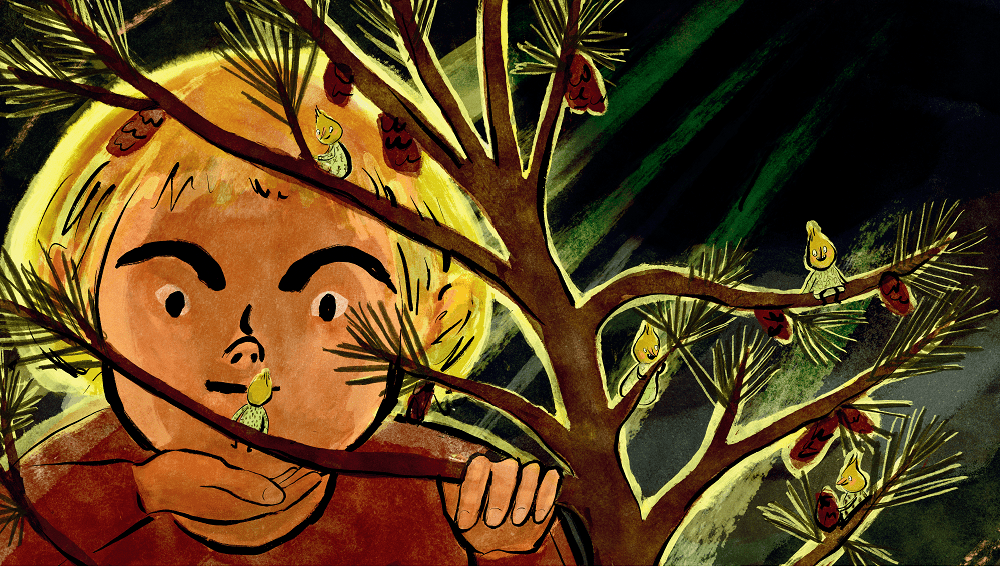
Where are the Moomins? They have not been invented yet, but young Tove encounters a secret friend who live in a grotto.  This creature has five children, miniature in size but unruly in nature.  The larger creature cannot control them. Tove expands upon her older sister role, placing them in her coat pocket and taking them for a walk. A storm threatens, but the inventive little girls hide on a tree among the pinecones. Like most parents, Tove tries to influence them through both “coaxing” and “scolding,” but they only accept the compromise of a boat made from bark with teaspoon oars.  Tove is tolerant, and introspective. She admits to herself that the little girls’ rebelliousness actually inspires pride in her caregiver.

Soloy’s wild nature has the force of a painting by J.M.W. Turner.  Bodies and faces are bulky and squared, but with only a few strokes of color she turns limbs, eyes, and mouth into specific expressions of character. When Tove returns from her adventure, cold and wet, her mother embraces her, using her larger sweater to enclose her daughter’s small body.  Naturally, Tove observes that his enclosure is “better than any blanket.”  When the Moomins arrive, in Tove Jansson’s adulthood, parental protectiveness, and sometimes inadequacy, will make them more complex than the small inhabitants of the island. Nevertheless, those girls carried in Tove’s pocket will become part of the Moomintrolls’ world.  An afterword fills in more information about Jansson’s life and career.