What If I Never Fly?

Fly Like a Bird – written and illustrated by Olga Ptashnik
Eerdmans Books for Young Readers, 2025
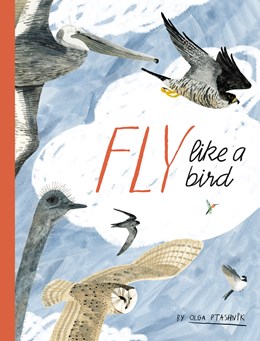
Breaking the mold may be a harsh-sounding metaphor for a children’s book about birds, which contains within itself a story of natural insecurity and a parent’s reassurance. Fly Like a Bird does actually break a mold in the “STEAM” books genre.  The text and the artwork, by Olga Ptashnik, are both wonderful.  Children, and adults, will also learn a lot about a wide range of birds.

A young chickadee expresses concern about the possibility that she will never accomplish the daunting task of learning to fly. Ptashnik captures the inner life a child with her words: “I can flap my wings, but I can’t fly. I’m just a tiny little bird…What if I never learn to fly?”
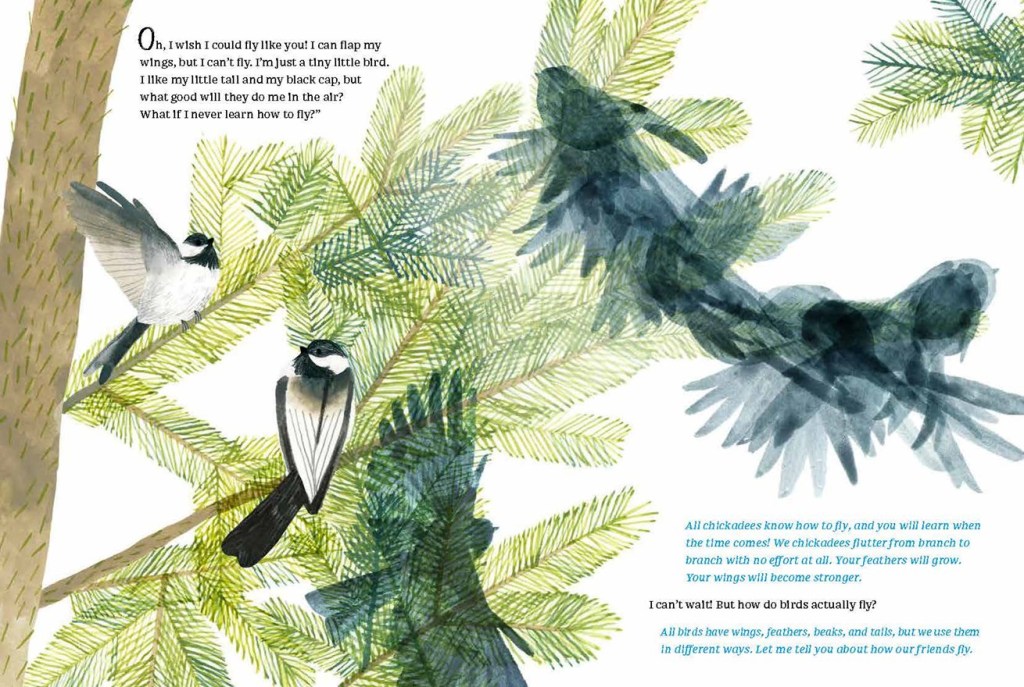
Right away, children will be drawn to the book’s tone and central idea. The question-and-answer format alternates black and blue font, as the parent answers with accessible information about different birds and their unique qualities. Digital artwork produces the colors of nature: green, gray, blue, black, red, in different shades.

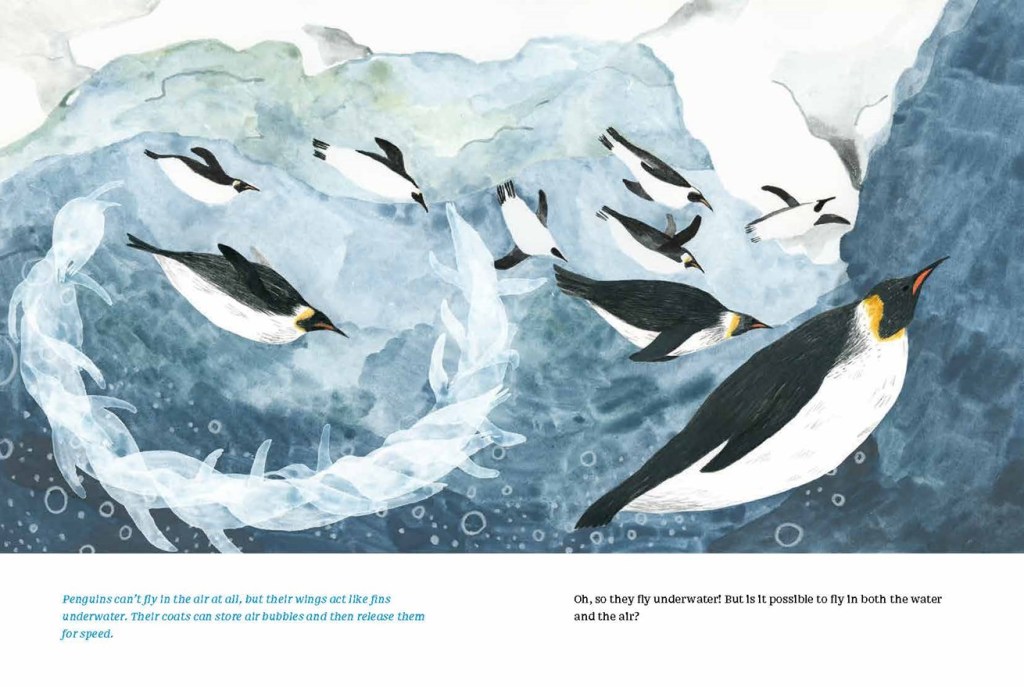
Hummingbirds are tiny; how do they produce the intense vibrations that give them their names, and also find nectar to drink? Penguins can’t fly, but their speedy swimming more than compensates for this unusual difference. The young bird processes the information: “Oh, so they fly underwater! But is it possible to fly in both the water and air?”
The peregrine falcon images bring the reader to a more human-populated location, as they fly high above elegant buildings and swoop down with incredible speed.

Each picture is composed to invite focus on different aspects of the scene. A large falcon appears commanding, hovering over the rooftops.  A chain of apparently connected birds descends, and more distant birds appear smaller as they alight on structures and rise up further into the sky.  Ptashnik anthropomorphizes a bit more here, breaking the fourth wall. The young bird expresses feelings of vulnerability associated with humans: “…but I don’t want to hurt other birds! How can tiny birds like us protect ourselves from predators?”
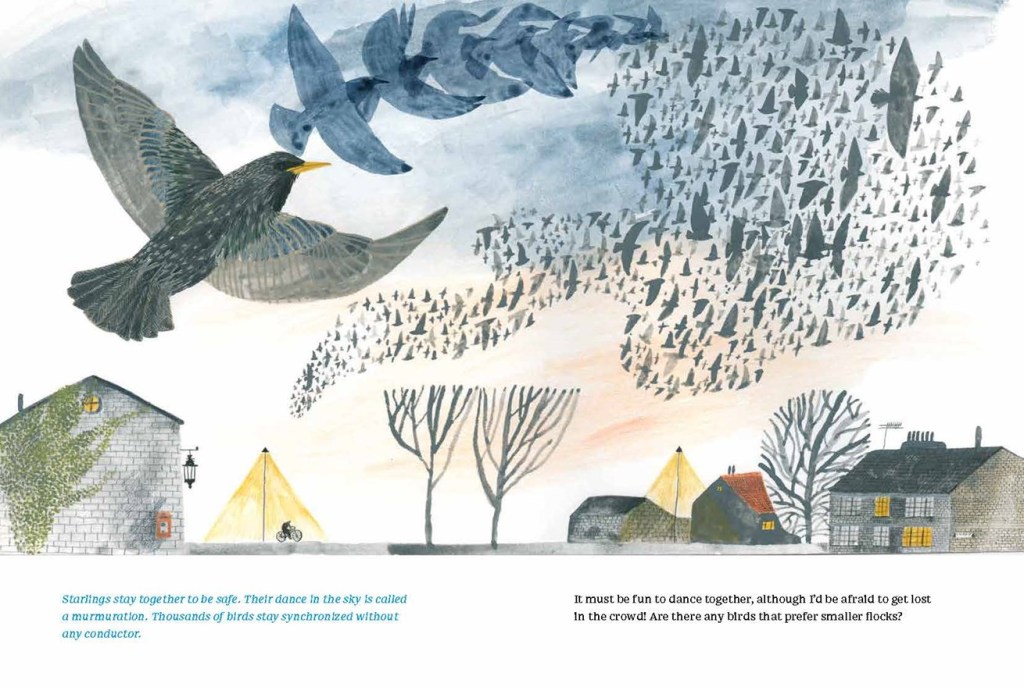
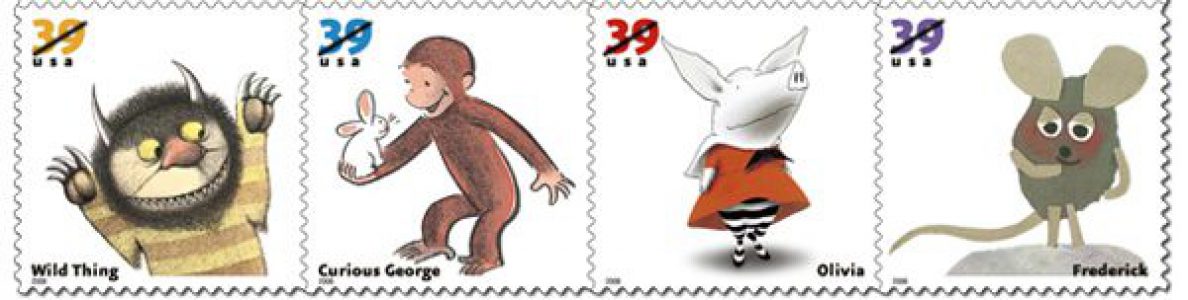
A flock of starlings forms a “murmuration,” as “Thousands of birds stay synchronized without any conductor.” Again, the varying scale of the scene elements are a quiet drama.  On the ground, a person riding a bicycle appears very small. Above, the murmuration is a symphony in motion. I was reminded of the fish learning about solidarity in Leo Lionni’s Swimmy.

The book concludes with two pages summarizing the star players, from hummingbirds to black-capped chickadees.  Everyone eventually learns to fly, swim, swoop, and find nectar, when the time is right.

Invitation to a Voyage

Journey of the Humpbacks – written by Juliana Muñoz Toro, illustrated by Dipacho, translated from the Spanish by Lawrence Schimel
Eerdmans Books for Young Readers, 2025

Although this fabulous informational book about humpback whales has not relation to Baudelaire’s poem, “L’invitation au voyage,” I could not help thinking of its title and famous refrain when I turned the first page.  The author states her purpose: “This is an invitation for us to go on a journey. We don’t need a backpack or shoes. Just our eyes wide open.” Every book fits this description. By framing the experience of reading this way, Juliana Muñoz Toro raises expectations and meets them. Baudelaire invites readers to encounter a world where “Là, tout n’est qu’ordre et beauté,/Luxe, calme et volupté,” (“There, there is nothing but order and beauty,/Richness, calm and beauty.”) Instead of dream world, Muñoz Toro, and illustrator Dipacho, extend an invitation to the natural order and beauty of the environment.  Science books for young readers need not omit a sense of wonder.

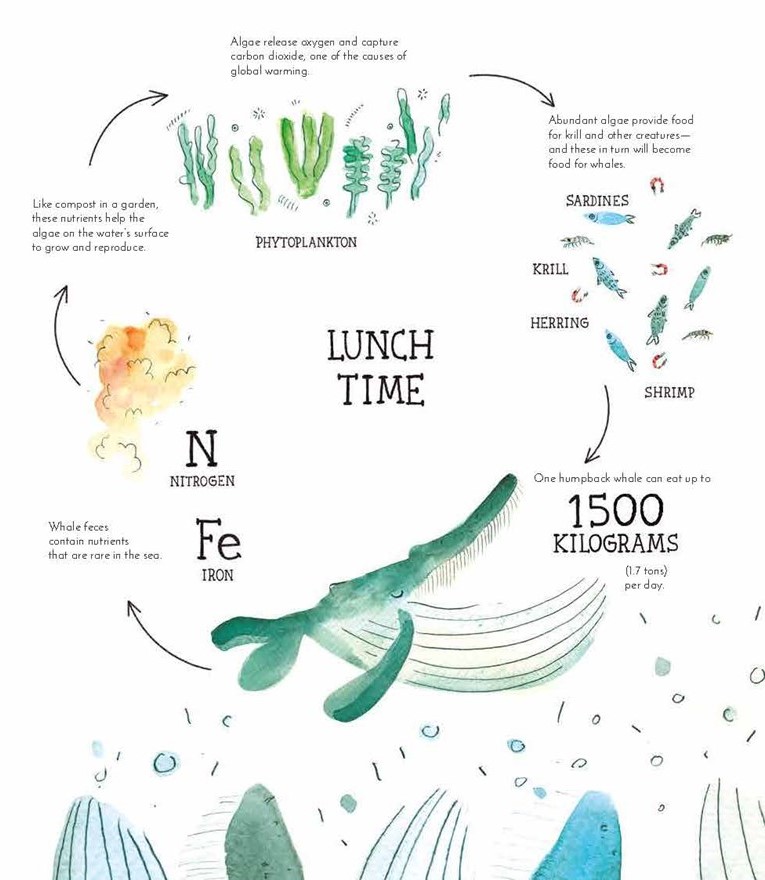
I won’t try to summarize the wealth of information in this book about the often misunderstood sea mammal, the humpback whale, otherwise known as Megaptera novaiangliae. Did you know that its Latin name means “giant-winged New Englanders?” Probably not, even though you may associate whales with New England, where this one was originally sighted by Europeans.  To orient you on your journey, Dipacho’s elegant graphics, paired with captions, text boxes, and color judiciously added to black-and-white.  Some of the questions even present the answer upside down, adding the sense of a game.  To help you envision scale, a parade of Emperor Penguins sits atop the huge creature, whose principal features are carefully labeled.

If you come to the book with some basic knowledge of humpback whales, you will still learn a great deal. Nothing is necessarily obvious, including the basic fact that every part of the environment is related to one another. “Nothing that happens in the water does so in isolation.”  “Lunch time” involves a nutrients provided by algae, sardines, and krill.

The pictures are meticulously accurate, but also personify the whales a bit, with their balletic movements that seem almost joyful.  Referring to the segments of their day as “nap time, “ “time for adventures,” and, of course, “time to breathe,” sets a tone of familiarity, but also awe: “The breathing of humpback whales is long and deliberate, as if they were meditating.” Note the phrase “as if.” 

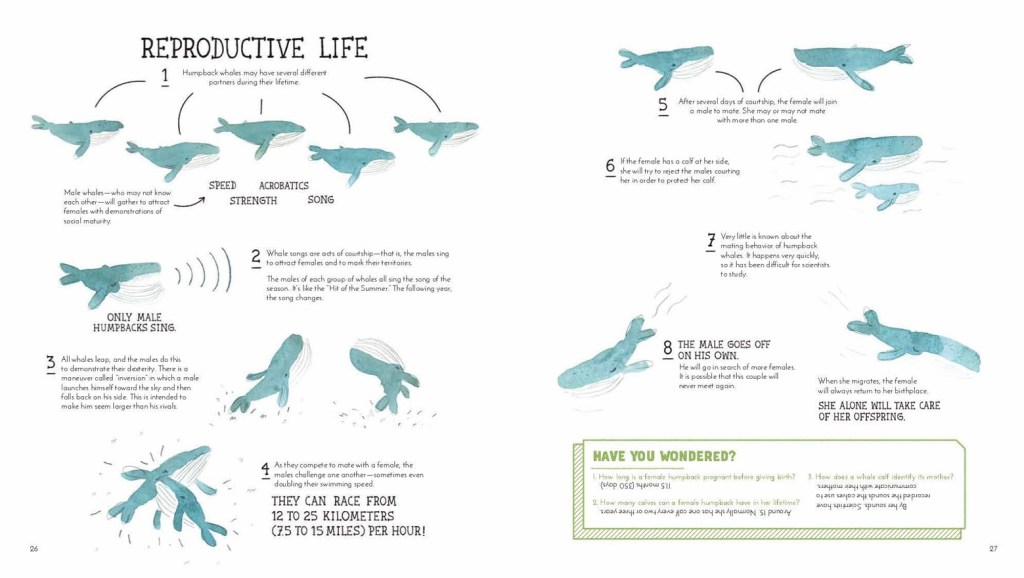
When people appear, they are comically observant, watching the whales and taking notes of what they see. Here Dipacho presents richer colors than in the extensive factual scenes, as he brings humans into the picture.  They are important and provide perspective, but they don’t compromise the whales’ starring role. In fact, a wonderful two-page spread categorizing the baleen whale family (image) identifies the humpback, with a touch of humor, as “the protagonist of this book.”  Another concise and complete section on the whale’s reproductive life is, again, accurate and also performative.

Steps numbered in sequence give the facts and also allow the reader to draw her own conclusions. “She alone will take care of her offspring.” The “Have You Wondered” section reveals how a calf learns to identify its mother.  The book’s backmatter declares that it was created by “a team of people who love whales.” By this point, you will not have any doubt of that essential fact.

The Year Is a Circle

Lights at Night – written by Tasha Hilderman, illustrated by Maggie Zeng
Tundra Books 2025

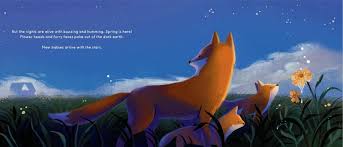
There are two families observing the rhythms of the year in Lights at Night. One is human and the other canine, specifically foxes.  Dream-like images with changing shades of color include realistic details, both natural and cultural.  Children experience the wonder, but also the reassurance, of the four seasons and their special features, from football in autumn to storms in spring. While the fox family does not kindle holiday lights around the time of the winter solstice, they also appear to respond to the changes.  Tasha Hilderman’s soothing poetic text complements Maggie Zeng’s visual immersion in the excitement of one year. Children find joy, not boredom, in the repetition of familiar events.

A powerful storm is just unsettling enough to make the shelter of home more of a comfort.  Crayon drawn strikes of lightening emanate from a house, enclosed in a photograph, and also cross its border.  Inside, a strong of lights and beds configured as tents add the sense of drama that children like. Note the plush fox in a small sleeping bag. The fox family lacks the domestic props, but is just as attuned to the environmental changes. Of course, animals’ lives are more closely defined by the seasons. In spring, “new babies arrive with the stars.”

Campfires come in summer; riding the bus to school and harvesting wheat are tied to autumn. One of my favorite images in the book is a natural and unobtrusive celebration of multicultural holidays.  Christmas trees, Diwali lights, a Muslim family welcoming visitors, and a Kwanzaa lamp grace the neighborhood, along with a Jewish family’s observance of Chanukah. If you look closely, you will see that the correctly depicted nine branch chanukiyah (menorah) has its candle farthest to the left partly obscured by the window frame.  This is not an error, just a small visual element lending authenticity to the way in which someone placed the lights, which must be visible from the outside.

At the end of the book, the two children share an album and a box of crayons. The volume is open to the photo with lightning, enhanced by the children’s artwork. The actual fox looks up the moon.

The Other Side of Trouble

Trouble Dog: From Shelter Dog to Conservation Hero – written by Carol A. Foote, illustrated by Larry Day
Eerdmans Books for Young Readers, 2025

There is a lot of action in Trouble Dog. There is also an abundance of information, a likeable main human character, and a surprising amount of humor.  Carol A. Foote has combined two real-life conservation dogs into one fictional hybrid named Tucker.  Caught in a cycle of adoption and rejection, he is always returned to the animal shelter that has given up on placing him. Then, along comes Laura, a classic heroine who refuses to give up on an unlikely pet who has driven everyone else to distraction. Larry Day’s pictures are full of action and color, setting a motion Laura and Tucker’s journey from trouble to success.

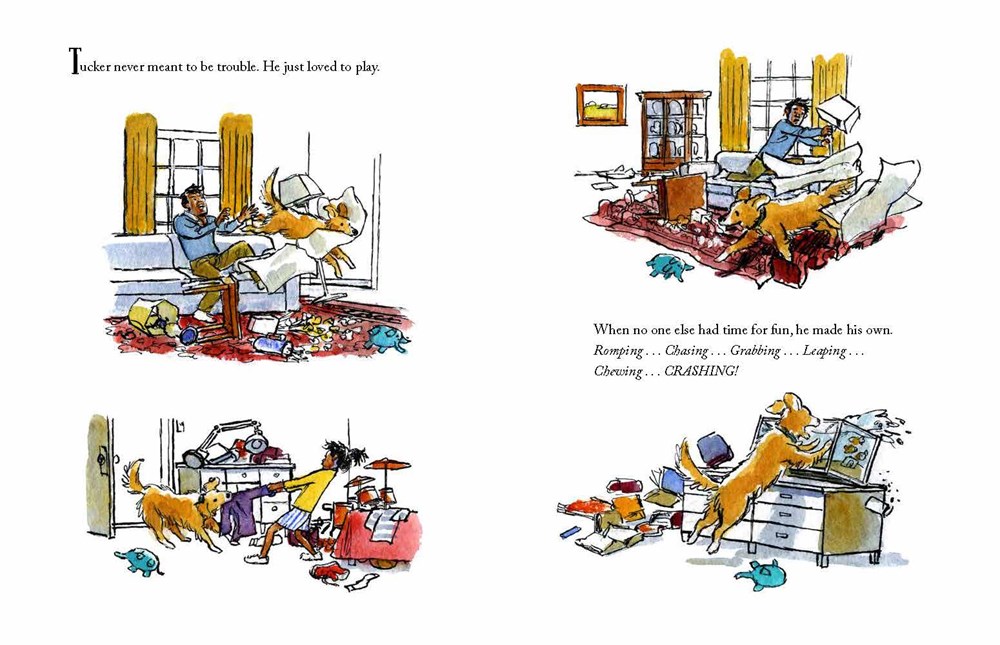
The opening end papers introduce Tucker in some typically frenetic canine activity. Then it escalates, as every home the shelter finds for him is subjected to chaos.  Tucker manages to overturn an aquarium and books in one place. He grabs a girl’s sweater and won’t let go. A man attempting to read his newspaper looks enraged as Tucker grabs it and leaves a litter of overturned items in his wake.  When we next see him, Tucker is a lonely prisoner in a cage, “watching everyone pass him by.”

Laura is a sturdy figure with a ponytail, flannel shirt, and jeans.  She is as no-nonsense as Mary Poppins, and she also intuits something about Tucker that everyone has missed. His energy can be put to good use.  Even though her home is quickly as disordered as every other place Tucker has been, she has a vision and the practical sense to implement it.  Dogs, as readers learn in Foote’s detailed backmatter, have a highly developed sense of smell.  Laura observes Tucker carefully and evaluates his routine and abilities.  She isn’t just kind and patient, but methodical, as well. 

Eventually Tucker gets a job, or a series of jobs. The details in the text are embedded in words as colorful as the pictures. “Tucker’s first job was to find rosy wolf snails in Hawaii.” (image). He travels the world, sniffing out “moon bears in China, mountain lions in Chile, and elephants in the jungles of Myanmar” in a narrative as exciting as one by Jules Verne, but rooted in the truth.  In a two-page spread, Tucker crosses the gutter between pages. An elephant marches ahead of him, dwarfing the dog in size, but not in energy.  Three researchers form a determined row in the background, to his left.  The image captures the cooperation necessary for Tucker to succeed in helping scientists to learn about species in need of protection.

Not every outing produces results easily. In Zambia, Laura’s optimism is tested, looking for cheetah scat and coming up short.  When Laura insists that “I trust Tucker,” who finally leads them to the right location, she is not relying only on her affection for the dog. Through hard work and astute decisions, she and Tucker have become a team.

Four pages of additional information and photographs are organized in a question-and-answer format, giving the bigger picture of how conservation animals, as well as other service animals, provide essential services.  A selected bibliography is accompanied by an oval portrait of Laura and Tucker relaxing at home. I hope that no one misses one title, by Alexandra Horowitz, Inside of a Dog: Young Readers Edition: What Dogs See, Smell, and Know. Just parenthetically, the title refers to the famous quip usually attributed to Groucho Marx: “Outside of a dog, a book is man’s best friend. Inside of a dog, it’s too dark to read.”  It’s definitely not too dark to read inside this book.

Learning from Color

A Universe of Rainbows – poems selected by Matt Forrest Esenwine, illustrated by Jamey Christoph
Eerdmans Books for Young Readers, 2025

To paraphrase Mark Twain oft quoted remark about the weather, everybody talks about STEAM (science, technology, engineering, arts, and mathematics), but nobody does anything about it.  A Universe of Rainbows is a picture book that fulfills the ideal of combining education about these seemingly disparate fields.  An anthology of poems rooted in rainbows and color, it includes works by well-known authors and others whose work may be less familiar.  Each poem is accompanied by a boldly colored illustrated, and by a column of informational text. The breadth and range of the content and styles is amazing.

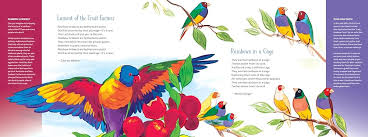
Virtually any selection gives a sense of the book’s approach. A poem by prolific author Marilyn Singer, “Rainbows in a Cage,” warns of the dangers of extinction caused by the voracious pursuit of rainbow finches: “They wanted rainbows in a cage:/finches stolen from the wild./A different time, a different age.” Singer uses the poetic form of the triolet, while other poems in the collection are composed in free verse.  This compact form, using only two different rhymes, is perfect for conveying her message.  The birds’ beauty does not excuse their exhaustion by selfish collectors. At the same time, she contextualizes the events by noting that different standards have applied in the past.  Jamey Christoph’s picture of the sought-after birds sitting on branches shows the bright and pastel colors that attracted collectors.  The explanatory text gives historical background and summarizes the results of the birds’ popularity: “the demand for Gouldian flinches became so great they were nearly trapped and caged out of existence.”

Lee Wardlaw points out the unfairness of judging a species only by its obvious beauty in “The Fruit Fly’s Secret.”  Yes, butterflies are lovely, but “just because/they flit and flirt/on wings of rainbow hues” they have deflected attention from the equally significant fruit fly.  Viewed under a microscope, the colors of these insects are revealed, elevating them from their lowly habitats in “drains and sinks and mops” or rotting fruit.  The text box describes how photomicroscopy documents how they refract light, and also interacts with the poem itself.  Wardlaw includes quotes from different authors extolling the beauty of butterflies; the text refers back to the poem by attributing each quote (Victor Hugo, Oscar Wilde, Bashō, and more).

Editor Matt Forrest Esenwine’s own poetry is also part of the book. “Alien Fountain” responds with awe to the unexpected phenomenon of the Fly Geyser, a “peculiar/accident/that could/only have/been created/by human ignorance/and Nature’s/resilient/soul.”  This result of an energy company’s drilling for geothermal water in the 1960s produced a strangely stunning appearance, captured in Christoph’s illustration.  The algae growing on mounds of limestone caused an explosion of color, “giving the geyser its otherworldly appearance.” As in all the explanations, concise presentation of facts works in parallel with literary language.

I cannot recommend this book highly enough.  It sets a high bar for authors and artists aspiring to link science and the arts without sacrificing aesthetic and linguistic distinction.