
The Many Problems of Rochel-Leah – written by Jane Yolen, illustrated by Felishia Henditirto
PJ Library, 2024
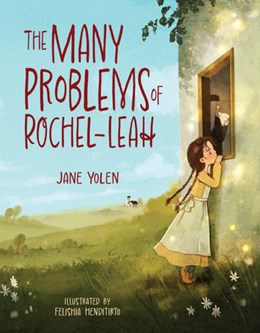
In this truthful fable by Jane Yolen, who explains in the afterword that the story is based on one passed down in her family, Rochel-Leah does not fight the patriarchy. (I’ve reviewed other books by the inimitable and prolific Jane Yolen here and here and here and here and here and here and here and here.) Instead, as girls and women have done through the ages, she subverts it. Rochel-Leah is a Jewish girl growing up in Eastern Europe in the 1830s. She works hard, as her family struggles with poverty. Her father is a bottler, and her mother takes on traditional tasks in the home. But Rochel-Leah wants to read. (images) She will not give up her dream, even when confronted with resistance from family, community, and even the town rabbi. This man, who has dedicated himself to learning, cannot bring himself to permit extending that essential part of his culture to a girl. (I’ve written elsewhere about the gender roles in the Old Country when these shtetl dwellers move to the New World, and I’ve reviewed books about Jewish children’s literature that take on the topic here and here and here.)
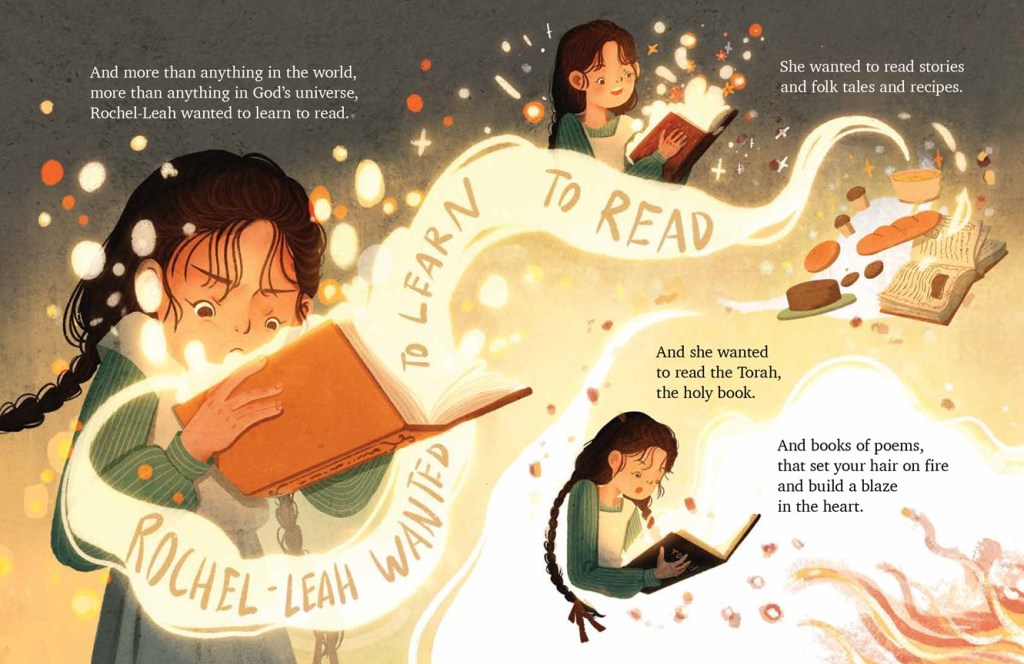
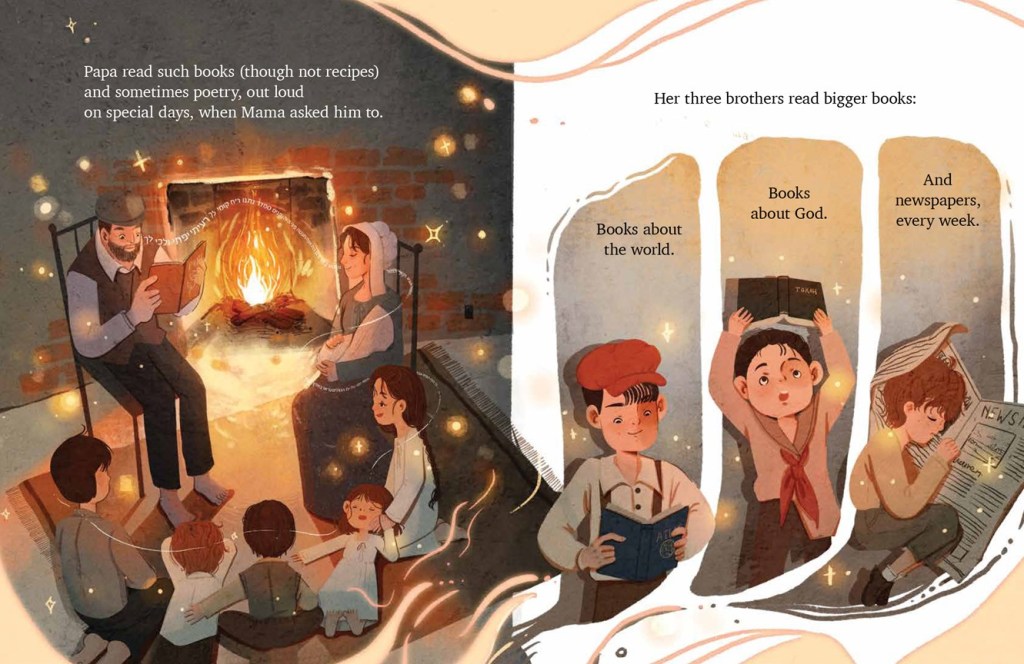
Rochel-Leah’s desire to read is all-encompassing. She longs to read recipes, folk tales, and poetry, but she also wants to read the word of God in the Torah. In Felishia Henditirto’s picture, Rochel-Leah is consumed by this passion, stated on a wave of fragrant steam coming from the cooking pot that defines a woman’s role. In her home, literacy is respected and embraced. Her father reads aloud to the family, and her brothers have the privilege of reading books and newspapers. They learn Hebrew in their cheder, and also Yiddish and Russian. Pictures of them sitting attentively in a primitive schoolroom are a stark contrast to Rochel-Leah’s exclusion from this setting.
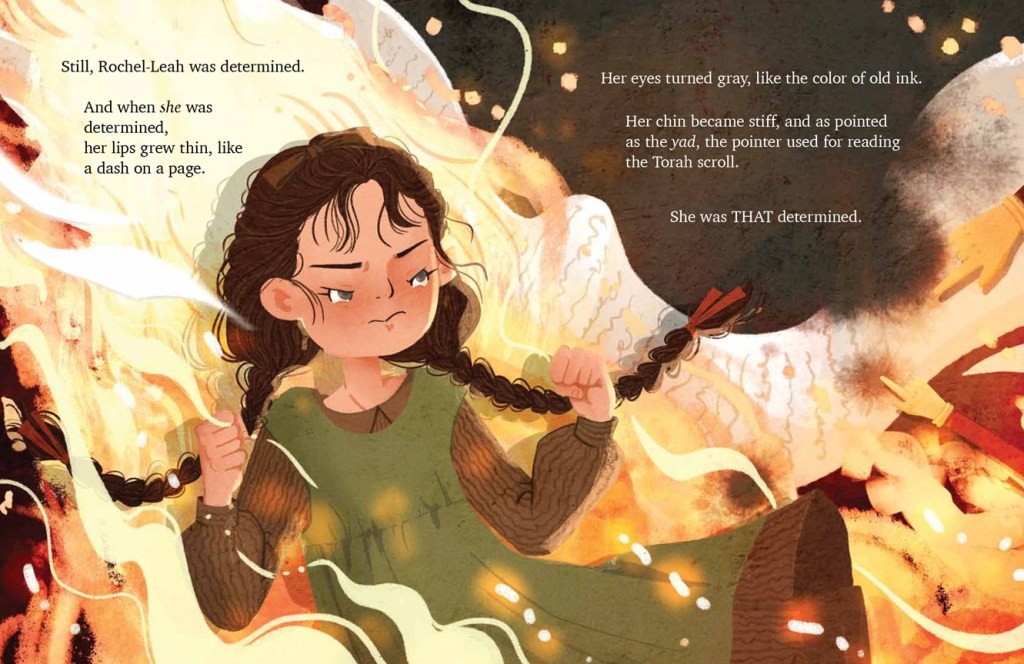
Instead, she is angry, but also “determined.” In Yolen’s metaphor, Rochel-Leah’s “lips grew think, like a dash on a page,” and ‘her eyes turned gray, like the color of old ink.” So consumed is she with the desire to learn that her chin becomes as pointed as a yad, used for pointing to the letters of a Torah scroll.
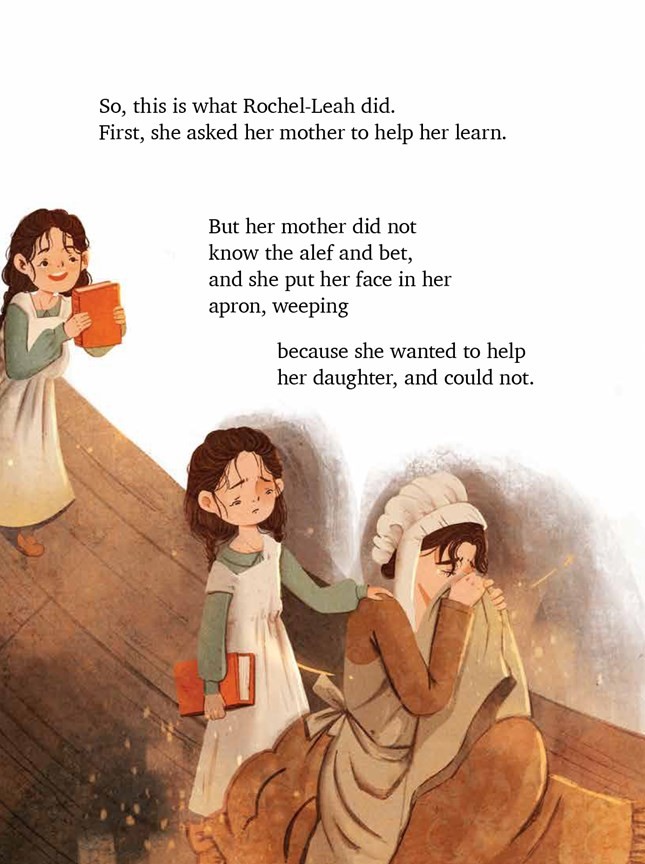
The rejection of women is painful for a girl who needs support. Her mother actually weeps because she cannot help her. (image) Her father counters reality by denying that she has any cause for complaint, and her brothers laugh at her. (images). Most people would give up, but Rochel-Leah has a strength of unknown origin. She will confront the rabbi.
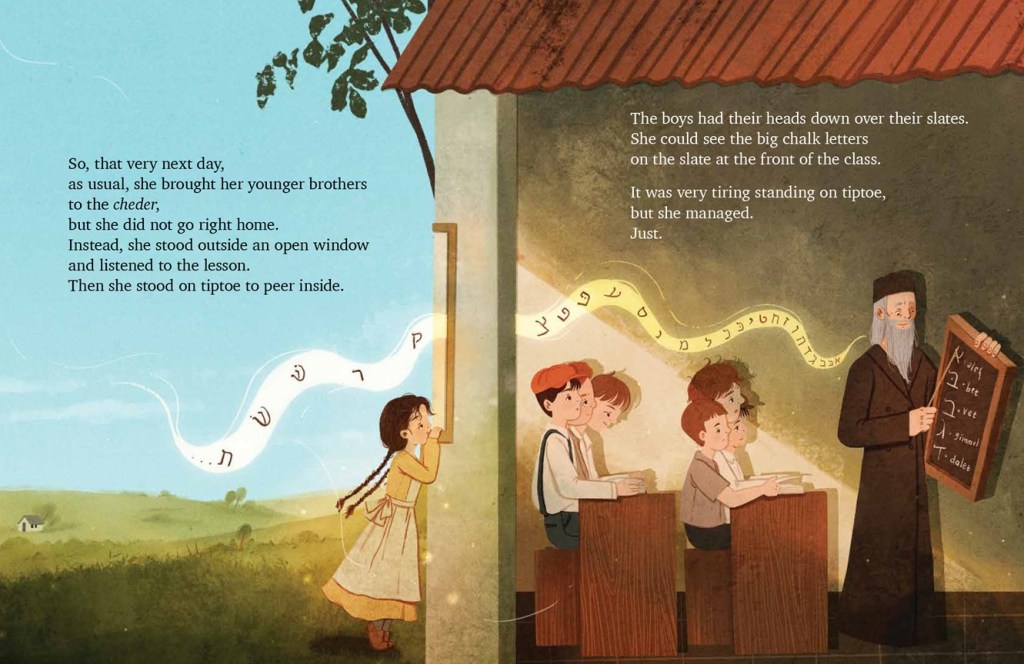
This devoted scholar is walking through the woods “reading poetry to the birds.” Is he so unworldly that this humble activity is important to him, or is his choice of audience one more example of his complete lack of awareness of women’s humanity? The rabbi informs her that rules cannot be broken. How much wisdom does that answer denote? Rochel-Leah’s inventive solution is to stand outside her brothers’ school and listen to the lessons taking place. A picture of this stark division shows the letters of the Hebrew alphabet flowing through the wall, defying the restrictions against who can learn them. Then, she physically elevates herself on a ladder. She has forced the rabbi to take notice, and he concedes that rules cannot be broken, but they may be bent. He finally understands the depth of Rochel-Leah’s commitment, although he can only accept it as, to some extent, an exception. She is invited in to learn, but will have to hide in a closet if an inspector comes in. This closet is literal, as well as figurative.
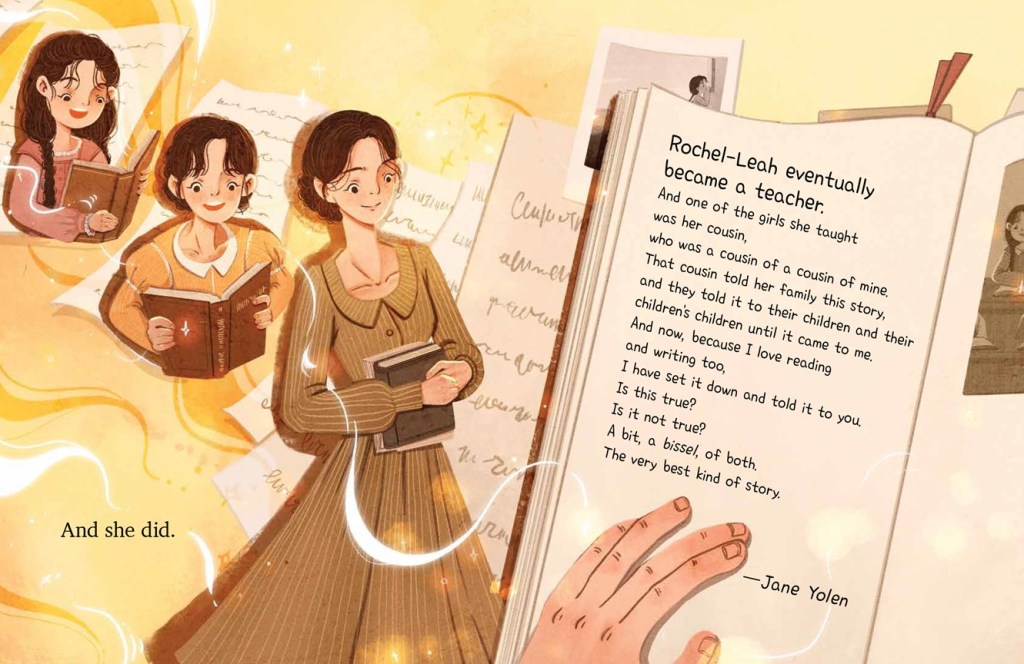
Rochel-Leah grows up to become a teacher. Change eventually arrives, with many Jewish women now fully participating in the life of the mind that was denied them in the past.











 Imaginary Elevators