
Book Reviewed: The Year of Goodbyes – Debbie Levy, Disney Hyperion Books, 2010
The assumption that children and young adults will want to read poetry is reflected in the many recent books that present history and personal experience through verse to young readers. Some of these, such as Jacqueline Woodson’s Brown Girl Dreaming and Marilyn Nelson’s American Ace, successfully experiment with the boundaries between lyric and narrative, offering the reader a new way to enter the past. Debbie Levy’s The Year of Goodbyes is also an experiment, a profoundly moving one, in combining documents, conversations, and original poems to make the sorrows of the Holocaust individual and real.

In the book’s introduction, Levy (also the author of a children’s biography of Ruth Bader Ginsburg) explains the structure of the book through the custom of the poesiealbum, a volume something like autograph books, “but…much more serious enterprises,” which students collected, inscribed, and exchanged with their friends in the Germany of the 1930s, from which her mother became a refugee. Reproducing translations of actual entries from these books, images, and interweaving her own poems, Levy has attempted to capture the fear and confusion of a young girl about to be uprooted from the only world that she knew. Levy creates a complete world, bookended between her introduction and a detailed afterward, along with a time line, photos, and bibliography. The Year of Goodbyes needs to be experienced in this context in order to appreciate the depth of what Levy has accomplished.
“It is January 1938.
I am Jutta Salzberg,
a Jewish girl
in the city of Hamburg,
between the Elbe and Auster rivers,
in the north of Germany.”


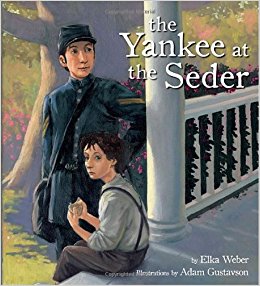


 Here are some challenges to male authority to share with our children. The women included are all profiled in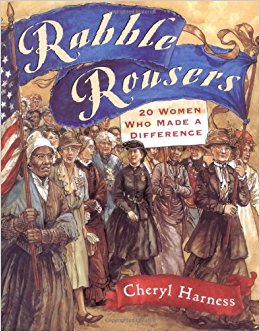
 Imaginary Elevators