
How to Talk to Your Succulent – written and illustrated by Zoe Persico
Tundra Books, 2025
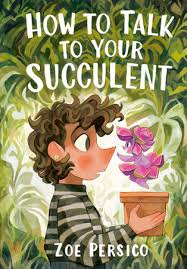
In Zoe Persico’s incredibly inventive graphic novel, Adara’s mother has recently died. She and her father leave California to move in with her grandmother in Michigan. The potential subjects of graphic novels are unlimited, and How to Talk to Your Succulent is not the first one to deal with grief, or strained relationships of parents and children. It is, however, outstanding in its sensitivity, bold graphics, and experimentation with fantasy and reality as equal components of a young girl’s search for the truth. Persico quietly presents a scenario that defies reality, and then proceeds to immerse the reader in a world where it is utterly plausible.
If you are skeptical about human communication with plants, this book will demonstrate the irrelevance of that reservation. Adara is sad and uprooted, even though her grandmother is a pillar of flexible strength. Her father is trying, somewhat helplessly, to cope with his own desolation and anger, which he approaches by inadvertently discouraging his daughter from expressing her feelings. What could be worse than this agonizing moment in all their lives? As it turns out, Adara’s mother had quietly used a special power. Not only did she have the proverbial green thumb at growing plants, she could actually communicate with them: “Like, you know, actual conversations.”
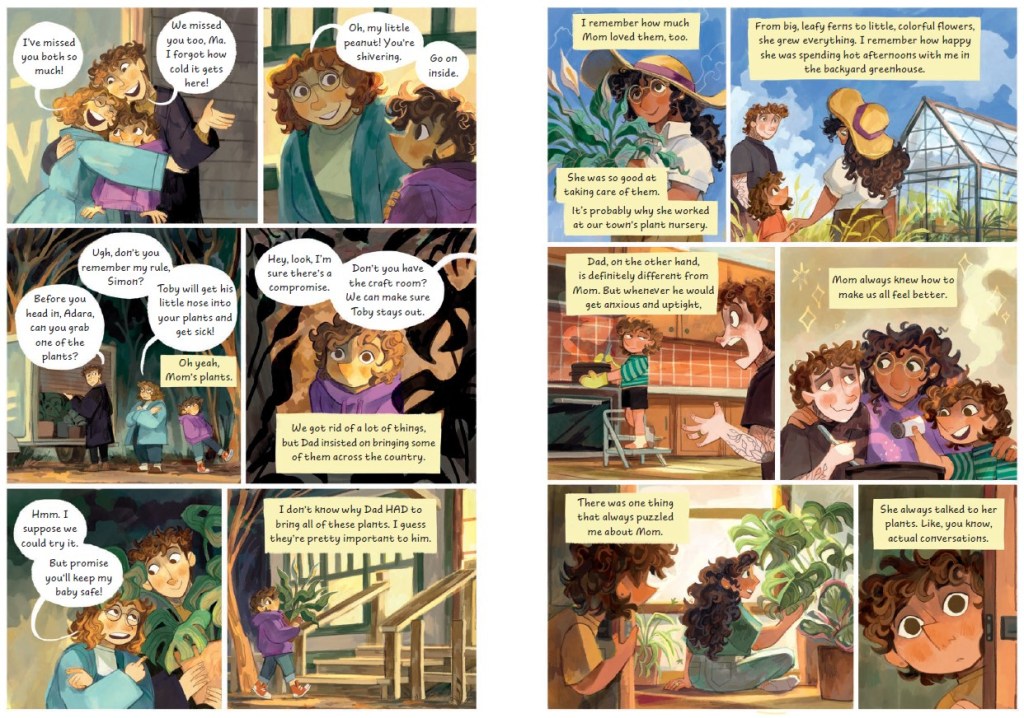
Adara’s grandmother, who resembles a child’s ideal image of a non-judgmental old person as both youthful and wise, also keeps a garden and greenhouse. When Adara’s father realizes that she has taken to wearing her mother’s earrings, which resemble tiny plants, he takes her to visit a nursery where she can select an actual plant of her own. This gesture is the closest he can come to acknowledging her feelings of isolation. At the greenhouse she meets Perle, short for Perle von Nurnberg, a delicately beautiful succulent who, for a devastatingly brief second Adara believes to be speaking in her mother’s voice. Then comes the epiphany: “I can talk to plants just like Mom! I knew it! I knew it!”

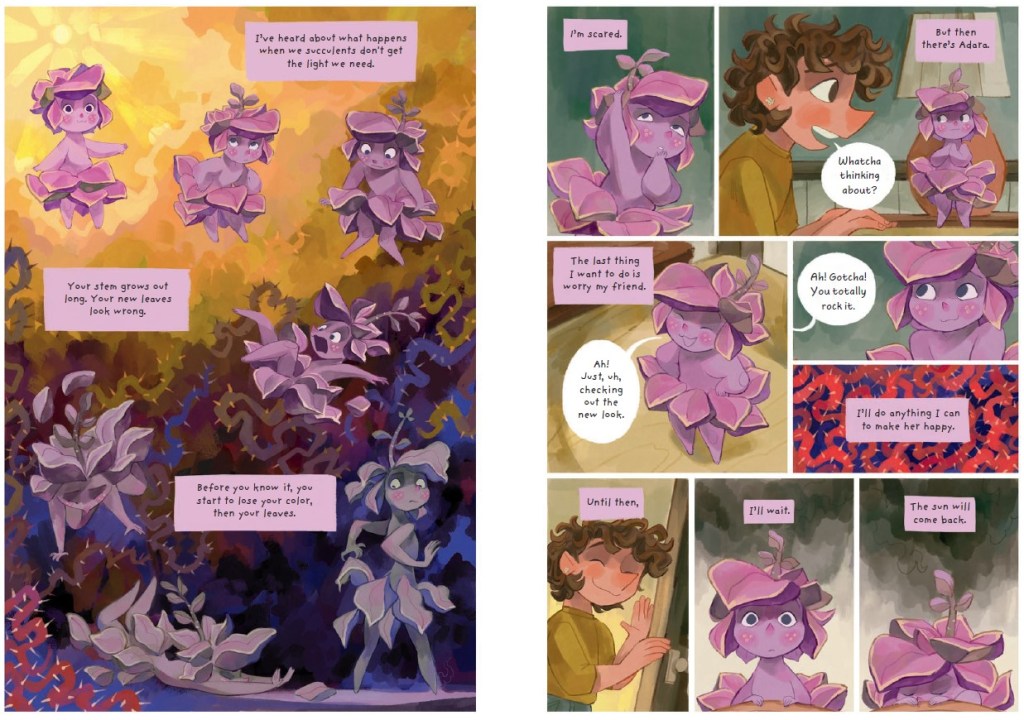
There is nothing affected about this unusual series of circumstances. Readers are not asked to suspend disbelief, but to enter Adara’s emotional state without preconceptions. Broadening her narrow circle of relatives, she also meets a new best friend, Winnie, a frustrated artist whose own mother is demanding and unappreciative of her daughter’s talents. Still, she has a living mother and Adara does not. But other people, as Adara learns, have their own problems and also need to be protected in order to thrive. Perle, the plant who demonstrates Adara’s maternal inheritance, is threatened with extinction if Adara cannot learn that same lesson as it applies to her.

The artwork of How to Talk to Your Succulent is inseparable from the text. Persico uses earth colors, jewel tones, and gradations of light in a setting that combines the spaciousness of nature with the enclosed scale of a greenhouse. People’s emotions register with expressive brush strokes, as do the fantastic plants who interact with each other and intersect with humans. The author’s note reaffirms her commitment, both artistic and emotional, to connecting with the reader. She includes mixed media photographic images, a visual and textual demonstration of her method, and even a guide to the plants at the root of her story. Equally innovative for its graphics and its exploration of emotional vulnerability, this book will bloom with every re-reading.













 Imaginary Elevators