Imagining Who Wore Them

Little Shoes – written by David A. Robertson, illustrated by Maya McKibbin
Tundra Books, 2025

Many Indigenous children, in both Canada and the U.S., suffered the trauma of being removed from their families and placed in residential schools funded by the government and often controlled by different Christian denominations.  Deprived of their heritage, and often subject to physical and emotional abuse, these children would be lost to history if not for concerted efforts to publicize their experience and to demand restitution and atonement.  Little Shoes is a picture book by acclaimed author David A. Robertson (see my reviews here and here and here), a member of Norway House Cree Nation, illustrated by Maya McKibbin, of Ojibwe, Irish, and Yoeme heritage (Robertson and McKibbin have collaborated before). They have taken on the weighty task of presenting a catastrophic loss to young readers, but also offering hope and determination.  With poetic text and images of family life that are both familiar and mystical in tone, they have achieved this goal.

The endpapers feature constellations, introducing a central theme of each person’s place in the universe.  James, who understands the principles of astronomy from his science class, opens the curtains in his room to the moonlight. He asks his mother to clarify how and why his feet remain firmly on the ground if the Earth is spinning in space. The answer is only one of several which his mother will frame truthfully, and also use to elaborate on other questions which will naturally follow. She reassures him that his Kōkom’s, (grandmother’s) explanation about their origins is valid, but adds, “even though you’re from the stars, your home is right here with me.”

The love between a parent and child, and the enveloping warmth of his community, are anchors in James’s life.  His intense curiosity places demands on a parent who is obviously committed but exhausted, when he returns to her room with a request to hear about “every single constellation,” His own attempt to visualize and trace them in the night sky is insufficient.  The dialogues between children and their caregivers are open ended, and the book swerves from the dimensions of the cosmos to the specific history of injustice that remains unresolved.

James and his kōkom set out for one of their frequent walks, but his time it is transformed into a march.  A daily experience becomes a metamorphosis, and his grandmother takes on the role of teaching about a part of their lives that is far more difficult to internalize that the motions of the planets. The little shoes of the title are those of Indigenous children whose deaths are acknowledged by Kōkom with the haunting phrase that they “had gone to residential school but had not come home.”  Shoes as a metonym for children who have died seems to capture a sense of a life that is unnaturally cut short. Other articles of clothing are perhaps less universal, and small shoes also reflect the scale of the children relative to adults, both those who loved them and those who inflicted torture.  A similar allusion to this loss has been used in many memorials to child victims of the Holocaust. (Of course, while some of those children, like the Indigenous victims, died of abuse, neglect, and disease, many were murdered immediately upon arrival at a death camp.  Chronicling atrocities requires acknowledging both what they share and common and how they differ.)

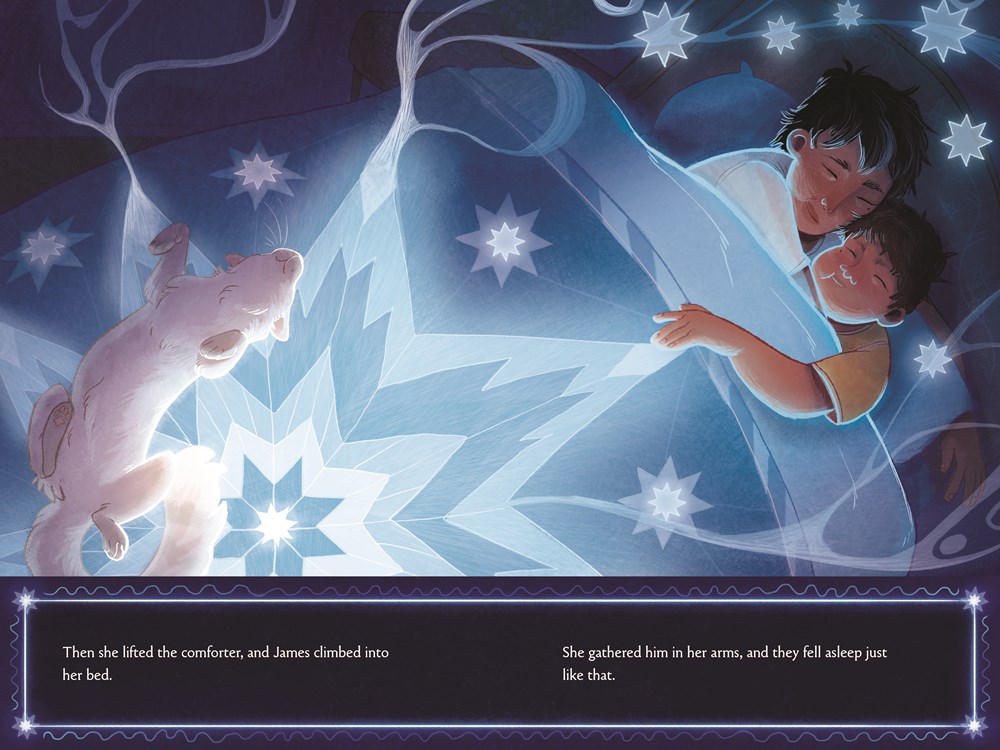
Robertson and McKibben do not attempt a simplistic response to James’s fears. He interprets the frightening facts through the lens of loneliness, asking his mother how his own grandmother had coped with the deprivation of her isolation in the residential school.  His mother responds that her sister and she had “cuddled,” paralleled by McKibbin’s image of mother and son sharing the same physical contact. Their bond is unbreakable, even if mitigated by anguish.  The honesty of Little Shoes is an antidote to fear.

Stage Door

The Rehearsal Club – Kate Fodor and Laurie Petrou
Groundwood Books, 2025

Kate Fodor and Laurie Petrou’s new middle-grade novel, about aspiring actresses and quirky kids, is quite a production.  Alternating between two eras, it does not involve time travel, but rather involves a mystery in the past which contemporary characters have committed to solve.  If this description sounds somewhat formulaic, the novel transcends the very formula that frames its story.  While several familiar elements are there; the magic of theater, coming of age narratives, sibling and friendship rivalries, and intergenerational tensions, they avoid all the clichés associated with this popular literary and cinematic tradition.

The Rehearsal Club is a wonderful book.

Paloma “Pal” Gallagher is a twelve-year old girl who has just moved from Arizona to New York City, where her older sister, Naomi, is pursuing a career in theatre.  Pal’s parents are both librarians, and her mother has a new job in the New York Public Library system. Pal is outgoing and socially awkward at the same time, but she finds a crew of similarly category-resisting friends who provide one another with mutual support. The women’s residence where Naomi lives has a long history, but is now facing financial extinctions. Chapters set in 1954 follow two young mid-century characters, Olive and Posy, with contrasting personalities and different approaches to finding success on Broadway.  Meanwhile, in the present, Pal’s parents take off for a librarians’ conference and Pal, temporarily and surreptitiously, moves in with Naomi, and becomes part of her distinctive milieu.

The authors capture perfectly the competitiveness and camaraderie of theater life, in both the past and present. If it seems idealized to have such striking differences between Olive and Posy, the resolution of their dreams as parallel, more than intersecting, actually works.  At every point when the reader is asked to suspend disbelief just a bit, a surprise intervenes.  There are so many antecedents for the idea of conflict mixed with solidarity in this setting, that adding a new element seems improbable.  Melanie Crowder’s Mazie, for a young adult audience, is also inventive in simultaneously paying homage to clichés while dismantling them, and Shira and Esther’s Double Dream Debut by Anna E. Jordan plays with mistaken identity and explores Yiddish theater.

Characters age in The Rehearsal Club. The young and insecure Olive becomes an ageing grande dame with some decidedly unattractive qualities, but also a core of honesty and toughness. In fact, she reminded me a little of Mrs. Basil E. Frankweiler, for those qualities as well as for her impatience with the idea of patronizing children.  Young people need to learn from older ones, and, fortunately, the advice offered by people with more experience actually has value. 

As the authors explain in their afterword, there was a rehearsal club in New York. That reality was an inspiration for the story of Pal, Olive, Posy, and all the others determined to break a leg and perform to great acclaim.  But only the imaginative and skilled approach of Fodor and Petrou allowed brought the script to life.

Keep Moving

Taro Gomi’s Big Book of Verbs – written and illustrated by Taro Gomi
Chronicle Books, 2025 (Original Japanese edition, 2020)

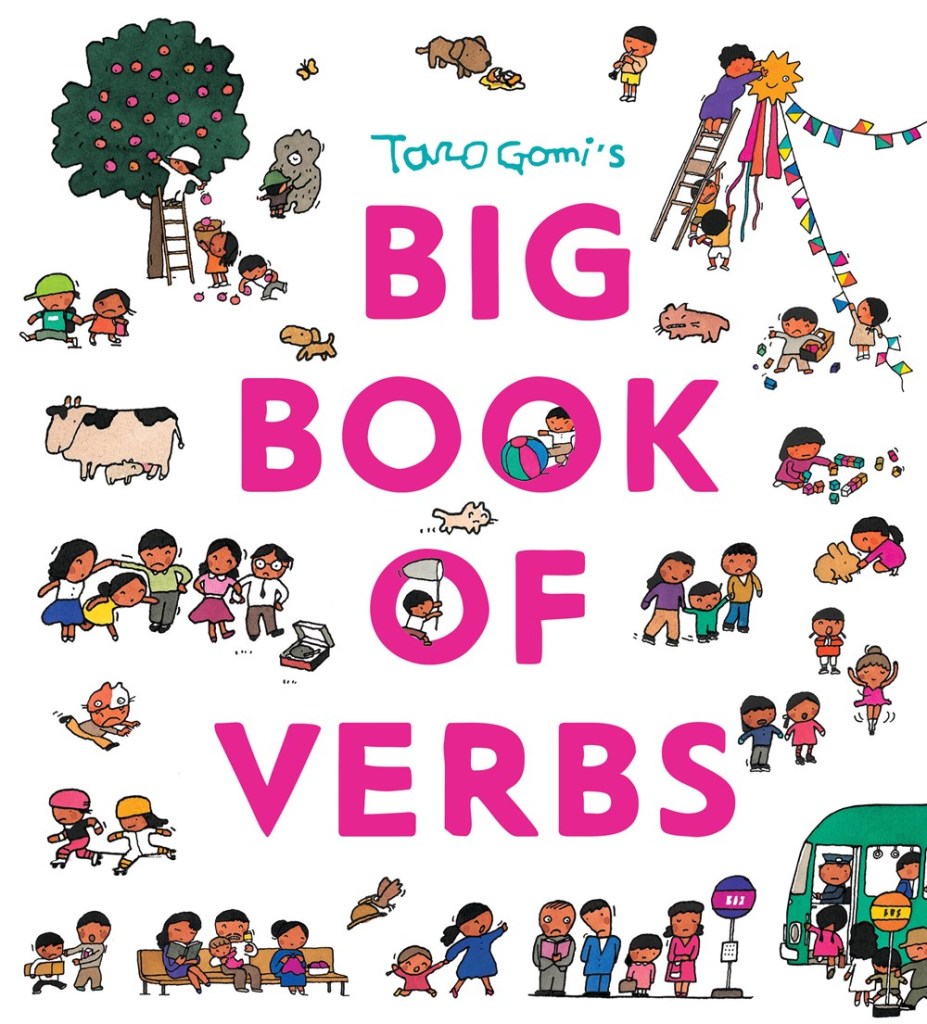
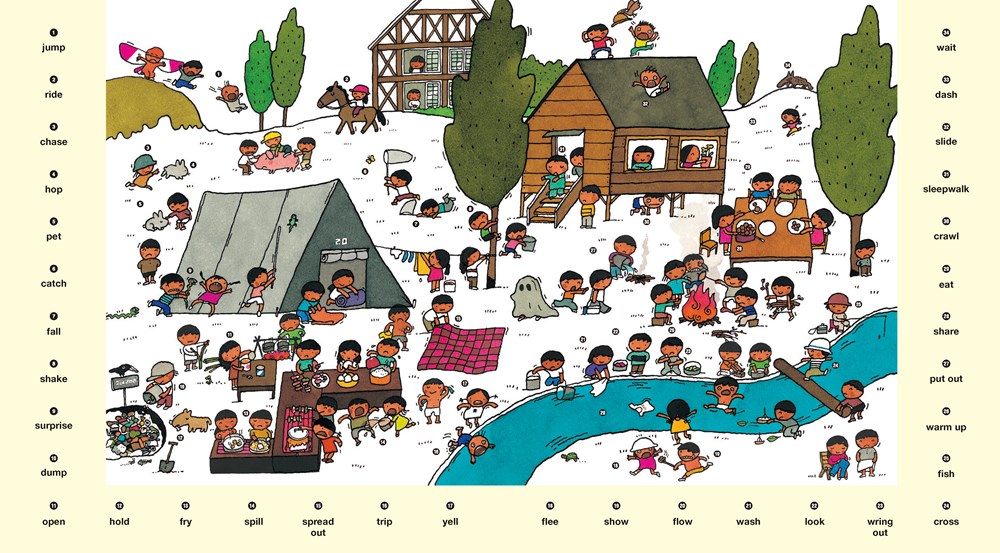
Children like to move, whether they are playing, responding to instructions, or participating in daily routines. Unlike for many adults, those routines do not yet seem perfunctory or automatic. In Taro Gomi’s Big Book of Verbs, the artist breaks down those actions, labels them, and imbues them with individualized characters.

Why dedicate this type of children’s dictionary exclusively to verbs? Taro Gomi’s Big Book of Verbs is more inclusive in its parts of speech.  As Gomi points out in his brief introduction, “There are so many things to do and explore! Have you done some of these things?” Of course, you have, and Gomi encourages readers to think carefully about each action’s meanings, whether rejecting a breakfast food, fighting with classmates, or boarding a bus.  

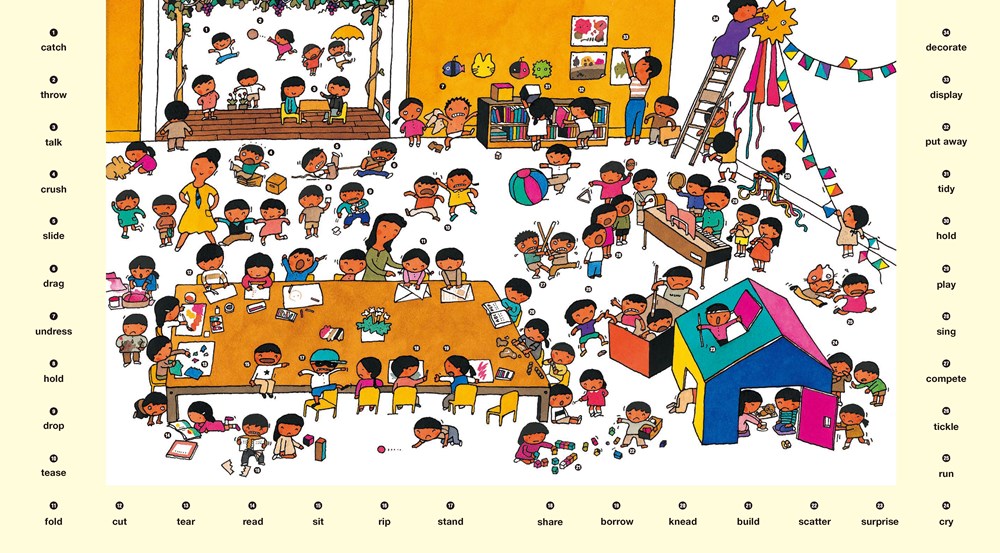
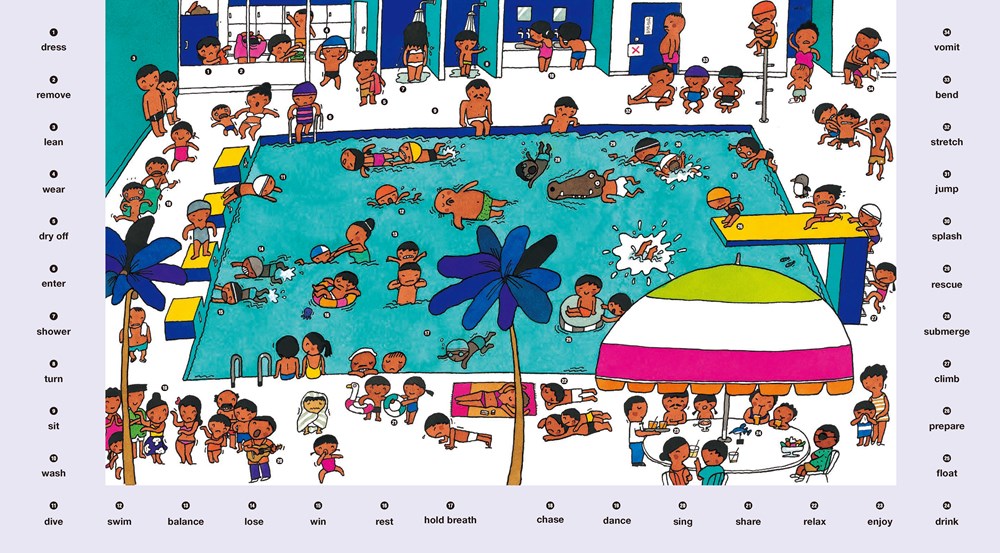
Gomi’s signature style features people with simple features that express a lot.  Each word is numbered and corresponds to a picture.  “Harvest” demonstrates the effort involved in pulling a plant from the ground. A day at the swimming pool encompasses a range of emotions, from fear to happiness. Sometimes feelings are more subtle. While the child about to leap from the diving board may be a bit frightened, she is also simply ready to “prepare” for her leap.  Gomi never romanticizes childhood; both adults and children will appreciate the way that he portrays reality.  Conflict, discomfort, and frustration are tied to actions, but so are joy, silliness, and determination.

There are a number of humorous surprises tucked into the book. At the zoo, there are some lions who are as selfish and angry as the human visitors. (There’s also a calm elephant family, and monkeys having a great time.) An indoor arena features people skating, playing soccer, dancing ballet (“twirl”), and, as part of these interactions, defining both “apologize” and “forgive.” Yes, those are action words, too.  The camping scene includes someone sleepwalking.

As in many books of this genre, including Richard Scarry’s classics, the possibilities of finding new elements of interest seem infinite.  Why is that boy breaking a fence in the farm scene? Is the child drawing in his classroom tired or triumphant when he holds up his crayon? Two apes are relaxing near a t.v.; the one reclining defines the word “chill.”  As Winnie-the-Pooh famously stated about bees, you never can tell with verbs.

Giving a Young Woman Her Voice

Adi of Boutanga: A Story from Cameroon – written by Alain Serge Dzotop, illustrated by Marc Daniau
Eerdmans Books for Young Readers, 2025 (originally published in French, 2019, Translated by the author)

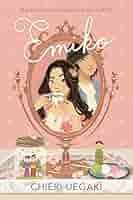
Adi of Boutanga is an important book. That quality would not necessarily make it appealing, let alone essential, to read, but there are many other reasons why it is just that. A voice that resonates with the truth, beautiful illustrations and innovative graphics, a compelling story, and a deep sense of conviction will all enfold the reader in its narrative fabric.

Adi is fourth grader living in a nomadic community, the Mbororos, in Cameroon. Although they are traditionally herders, their economy has changed; Adi’s father transports passengers on his motorcycle and her mother sells Makala (doughnuts) in the marketplace. Adi’s identity is defined by family relationships: “I prefer to stay the big sister of Fadimatou, Zénabou, Youssoufa, Daïro, Souaïbou, and baby Mohamadou.”

Children cannot control their own lives, even to the limited extent that adults are able to do so. Adi loves attending her school, which she describes as a “gift” to the village by Mama Ly and Monsieur, generous benefactors. The process of learning to read may seem inherently magical to many children, but Dzotop captures the poetry of this experience and gives Adi a voice:

      Before the school was given to our village, words were invisible to us. We
      could hear them, but we couldn’t see or touch them. I even thought a
      a strong wind might steal them as soon as they left our mouths. But that
      wasn’t true.

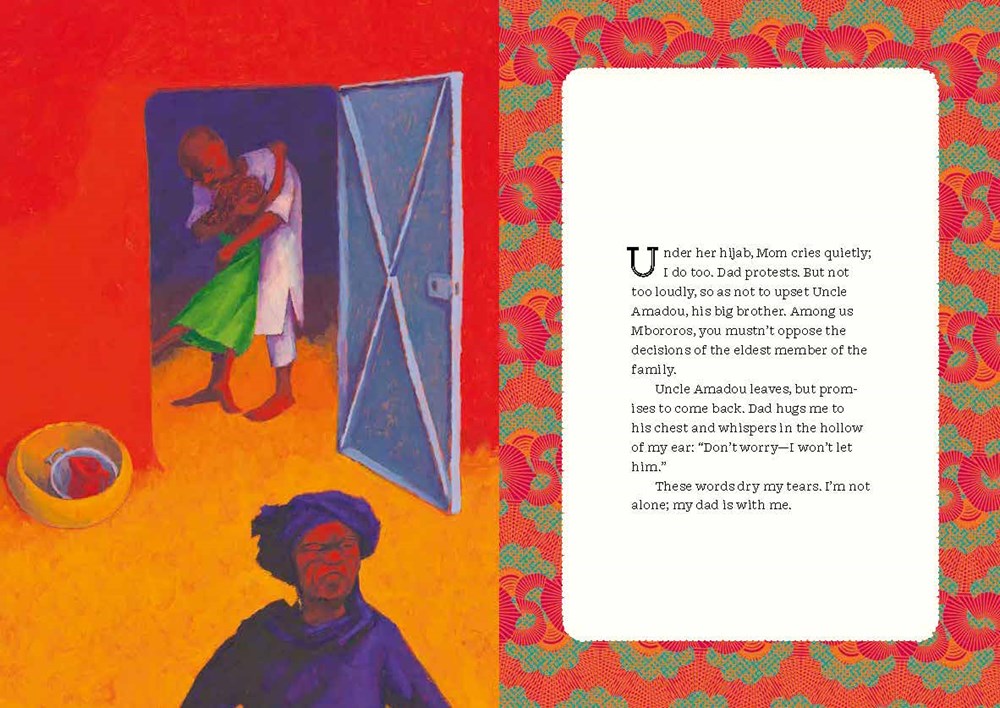
Although there may seem to be a fable-like quality to the book, the characters are not generic. Adi’s mother embraces her daughter’s individuality, responding to Adi’s frequent laughter with the suggestion that her daughter has “swallowed a thousand weaverbirds.” But the warmth and protectiveness of Adi’s life is shattered when her uncle arrives to inform the family that, although still a child, she must marry. Her father and uncle assume opposite patriarchal roles, one caring and the other transactional. “They throw words at each other. Words that hit like stones.”

Saving their daughter means that Adi’s parents must send her away. She goes to Boutanga, where her benefactors have established a school for girls that fosters creativity and dignity. Even if this solution is not a global one, it is enough for Adi and an example for all. Eventually, when she has arrived at the point in her young adult life when she is able to choose, Adi finds love with a man who respects and understands her. Mastering language has been a key to her growth, “catching words… putting them in the right order and making sure they say the right thing.”

The book is not composed only of words, but of images that organically emerge from the culture which they represent. Pages with illustrations alternate with blocks of text set against traditional fabric patterns. Human figures allude to sculpture but have kinetic movement. Earth tones are the setting for the book’s quiet drama, with deep blue sea and red skies framing Adi’s journey. Adi of Boutanga is not a moral lesson, but a work of art that interweaves modern aspirations of freedom for women with the unique threads of a specific culture. It is a book to read, share with children, and read again.

The Happiest Country, a Long Time Ago

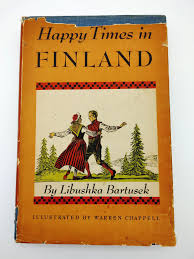
Happy Times in Finland – written by Libushka Bartusek, illustrated by Warren Chappell
Alfred A. Knopf, 1941

Everyone knows that Finland is allegedly the happiest country in the world.  You certainly can’t take these simplistic measures too seriously, and comparing Finland to other countries with entirely different histories, economies, and demographics is useless.  I recently reread an unusual childhood favorite, which I had bought at a library used book sale. Its appeal to me at the time remains vague. I would read almost anything, and it had lovely pictures and promised to tell a story about a distant part of the world. Happy Times in Finland, by  Libushka Bartusek, was published in 1941. At that point, it was indisputably not happy at all.  Having been invaded by the Soviet Union, they eventually allied with Germany in that country’s war with its Russian enemy.  This was a bad choice, but it is not reflected in the book, which takes place in the idyllic time period before the war.

There is minimal plot and character development in the book, but a lot of folklore.  To summarize the improbable premise, Juhani Malmberg, a Chicago Boy Scout with Finnish immigrant parents, goes to visit his ancestral homeland.  He is able to take this expensive trip due to the generosity of his father’s employer at a furniture factory, Mr. Adams.  Finland is known for, besides an improbable level of happiness, abundant high-quality wood. A furniture manufacturer would be eager to see firsthand the source of his best supplies. Since Mr. Malmberg is such a loyal employee, his benevolent boss actually takes Juhani along, for free! He has the opportunity to see his beloved grandparents, as well as his aunt, uncle, and cousins.  In addition, Juhani becomes an ambassador from the American Scouts to their Finnish counterparts.  Aside from missing his parents, there’s a lot of happiness here.

Poetic language fulfills expectations about a land endowed with natural resources, and steeped in literature.  Approaching land, Juhani seems to be expecting a myth and he finds one: “Sure enough, there it was, just as his mother said it would be: an expanse of water, blue as sapphire, with green islands dotting it, as though some giant had scattered a mammoth handful of emeralds on a silver-streaked scarf.”  Not only the environment, but its people, are described with hyperbole. Oddly, almost everyone is blond.  Finland has a Swedish minority; the name “Malmberg” indicates that his father’s family is descended from this group. His cousins’ last name is Kallio, of Finnish origin.

Finnish is not a Scandinavian language, but is related most closely to Estonian and Hungarian. (A glossary of Finnish words is included at the end of the book.) Here is a description of Juhani’s aunt, a veritable Amazon of pale beauty: “She was tall and blond, so blond, in fact, that Juhani thought she was white-haired…she had great dignity…he felt as though he were at the feet of some exceedingly beautiful statue, all made of silver and bronze and pearl…her teeth gleamed like mother-of-pear.” There are even references to “Viking blood.”

The few realistic elements stand out because of their minimal role in the story.  Aunt Kallio, Aiti to her children, has favorites among her offspring.  Her older son, Jussi, will vicariously fulfill her own dream by becoming an architect, a career closed to women. Eero, the younger boy, is not academically oriented. Unlike his parents, he prefers manual labor. She keeps her disappointment to herself, only thinking how he lacks “initiative.” “Oh, me! she sighed, one could not be everything.”  This statuesque symbol of perfection is unable to tolerate individual differences.

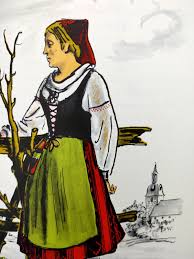
Warren Chappell’s illustrations, some in color and others sepia, appear to be lithographs.  They are stylized images, whether portraying men in a sauna or women clothed in traditional costumes for festivals. There is a haunting image of a blind storyteller who recites Finnish epic poetry.  Mr. Adams recognizes that the Kalevala’s metrics had influenced Longfellow’s composition of Hiawatha. The Old World and the New touch one another in this tale of immigrant roots, written as the shadow of fascism descended on Europe. It’s blatantly out-of-date and also oddly appealing, just for that reason.

Bewitched, Bothered, and Bewildered

The Witching Hour – written by Jennifer Harris, illustrated by Adelina Lirius
Tundra Books, 2025

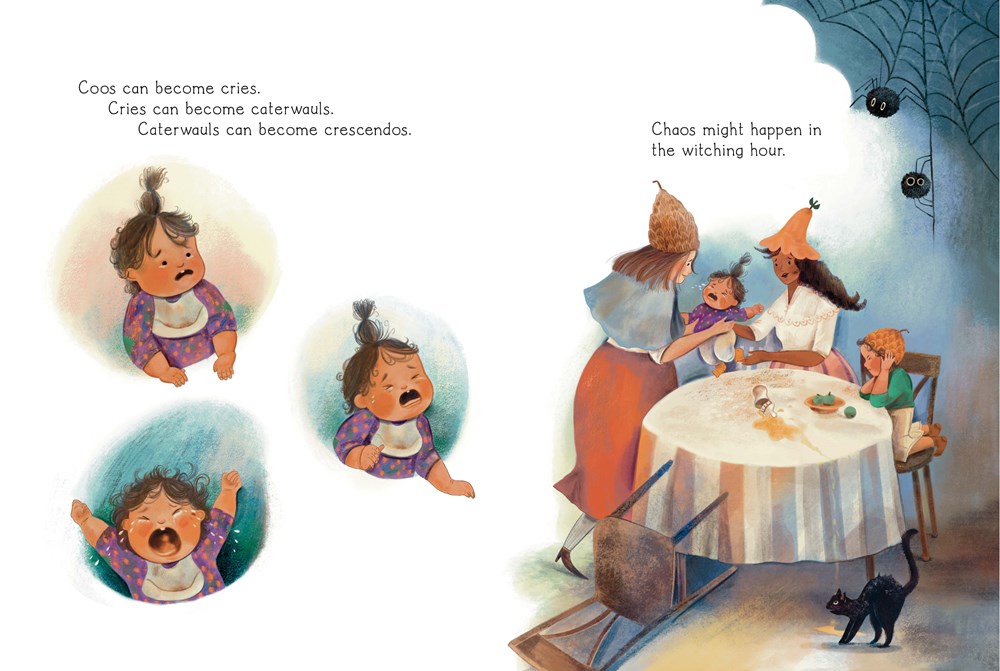
My mother used to refer to “the witching hour,” that time late in the day when babies, toddlers, and young children seem to act a bit possessed. Whether because they have managed their impulses as best as they can for many hours, or need limits and reassurance, or are just exhausted, this can be a difficult moment for parents. The “hour” may seem like multiple hours.  Jennifer Harris and Adelina Lirius (I reviewed another of her works here) have captured the phenomenon so perfectly in their new picture book that you and your children will be under their spell. Indeed, as Harris solemnly states, “Anything can happen in the witching hour.”

The two mothers in the book are paragons of patience, trying every inventive solution you might imagine, and then some.  First, the acknowledge that anything, “or even nothing at all,” can set the chaos in motion.  A baby overturns a cup of liquid on a table enclosed in a lovely tree trunk. Yes, we all recognize that scene.  An older child wearing an acorn cap looks on, clearly worried about the next phase.  The author is honest in calling it “chaos.” It takes both moms to extricate the screaming toddler from her highchair. An adult chair is overturned, a black cat arches its back, and the sibling covers her ears in terror.

One of the most frustrating features of the witching hour, when it happens, is escalation. “Coos can become cries.  Cries can become caterwauls. Caterwauls can become crescendos.”  Harris uses every figure of speech at her disposal: alliteration, onomatopoeia, literary allusions, rhythm.  Perhaps your child can be calmed by a favorite stuffed animal. The moms try a variety of real wildlife, finally settling on the owl. You know the feeling of relief: “Definitely the owl. Thank goodness for the owl.”

If you were hoping for fairies, you won’t be disappointed.  They arrive and join in the music and dancing, in a kinetic scene of joy mixed with desperation. Lirius’s fabulous pictures evoke an entire universe where the fantastic and the familiar are effortlessly blended. Earth colors predominate and the domestic interiors are as welcoming as those in Dutch still paintings. One mom holds the baby, who looks momentarily transfixed. The other mom is dancing upside down, her feet fixed to a magical broom.  Fairies usually command attention, but here they are a great audience. When the show ends (who could sustain that level of energy), the moms come down to earth. 

There are still many comforting possibilities to try: “this bottle, this banana, this bat.” The moms are creative and full of hope, waiting for the moon to signal that at least for today, it’s time to sleep. Suspension of disbelief sets in for this lovely family of nurturing witches. Tomorrow they we ready to start again, with all the resources at their disposal. For readers, this home of friendly spider webs, baskets of knitting yarn, and a quaint wood stove, seems uncannily real. For the duration of the story, you will be living among friends, and the supernatural is just, natural.

Lives Scaled Down

The Indian in the Cupboard – written by Lynn Reid Banks, illustrated by Brock Cole
Doubleday, 1980

Re-reading the classic The Indian in the Cupboard by Lynne Reid Banks today involves a trip back in time. This is not to suggest that the starkly obvious prejudice embedded in the story of Omri, and his miniature plastic friend come to life, has disappeared, but its blatant presentation in a widely acclaimed middle grade novel would be far less likely. I interpreted it along two parallel tracks. One is as a simplistic story about civilization and barbarism, in which a British boy and his friend become enmeshed in managing a stubbornly independent American Indian. The other is as the fantasy of a boy trying to have control in his life, never possible in childhood, through the transparent vehicle of a miniature figurine. That is part of the obvious appeal in children’s books of dollhouses and toy soldiers, in children’s books like The Borrowers, The Doll People, Gemma and the Giant Girl, and so many others.

By 1980, when the book was published, the United States already had a well-organized and prominent American Indian Movement, and, among other landmarks, the searing revision of American history, Bury My Heart at Wounded Knee had been available for ten years.  In Britain, although changing perceptions of Indigenous peoples in the Americas were discussed, they would not have attracted the same level of attention.   Nonetheless, Banks does show awareness of stereotypical misconceptions. When Omri meticulously creates a teepee for Little Bear, the Indian who is transformed by the turn of an old key in the door of a magical cupboard, he is deflated by Little Bear’s correction. As a member of the Iroquois, he lived in a longhouse.  There are intermittent references to other offensive caricatures, including the viewpoint of the standard Western television show which Omri and his friend, Patrick, have Little Bear watch.

Little Bear, by that point, is accompanied by another plastic figure, his apparent nemesis, Boone. This gun-toting cowboy is as crudely depicted as Little Bear. For that matter, the World War I medic figure who is briefly made real spouts phrases just as cinematic and silly as those of Boone and Little Bear. Still, Little Bear is at the center of the picture and his propensity to violence when he is contradicted perpetuates the worst and most malicious quality, one which allegedly justified European control of the first Americans.

There is quite a bit of violence in the novel. Even though the weapons are tiny in scale, they manage to hurt people, draw blood, and nearly kill Boone. As if trying to convey that stereotypes are not only hurtful, but misleading, the cowboy turns out to be a gifted artist. There is no such mitigating surprise in Little Bear’s character.

When “his” Indian, (Omri also uses the possessive in identifying the cowboy), requests a spouse, there is subplot involving a visit to the local shop where Little Bear will choose a woman from among the miniatures Indians.  The description of how Omri will place Little Bear and Bright Stars in the cupboard together is disturbingly adult, not to mention grossly sexist.  The female toy is, if possible, subjected to even greater objectification than her male counterpart.

Having catalogued all those demeaning features of the book, the parallel interpretation would see it as a typical metaphor for childhood. Omri fights with his two brothers, is disappointed in his best friend, and has the ill fortune of a school headmaster who, confronted with living, breathing, toys, suffers an emotional collapse.  There are no adults to help here, only childhood dreams and magic.

Color of Grief

All the Blues in the Sky – by Renée Watson
Bloomsbury Children’s Books, 2024

Sage is a thirteen-year-old girl whose best friend is killed by a reckless driver. This terrible event happens on Sage’s birthday. The terms “losing” someone, or “passing away,” would be completely inadequate to describe the shock, numbness, and internalized rage that follow the accident.  Renée Watson’s verse novel gives Sage a voice in each chapter, narrated from the unaffected perspective of a person confronting emotions that would level a strong adult. With the same sensitivity to the process of growing up shown in her other works (which I have reviewed here and here and here), Watson creates characters who are vulnerable, but also strong.

In All the Blues in the Sky the experiences that test Sage are not the ordinary, but still difficult ones, of every adolescence, although those experiences, such as having divorced parents, are the framework for her growth.  Her parents are supportive, as is Aunt Ini, her surrogate grandmother.  She even has the benefit of a grief counseling group facilitated by Ms. Carver, who is nothing if not patient and professional. Mr. Dixon, Sage’s dedicated math teacher, offers slightly irritating, but totally sincere, life lessons: “Understanding angle relationships in math will help you understand your personal, real-life relationships…There are people –like transversal lines – that cross paths with you, only for a moment.”

There are other people in her life who are grieving.  Zay’s grandmother has died, and she admits relief at the end of her suffering. DD’s brother was killed by the police.  Ebony’s father had a heart attack. Sage is forced to constantly evaluate which types of death are hardest for survivors. No one has been able to answer this question.  Her friend’s death was abrupt and senseless. Sage never had a chance to say good-bye. Other survivors had to helplessly watch a long period of illness preceding a death.  Another troubling part of Sage’s role, which is only implicit in the novel, is her specific relationship to the person who died. She is not a sister, mother, or child, but a friend.  When a relationship is not formally recognized, the most profound sadness can seem somehow less important, although her friend’s family certainly honors Sage’s role in their loved one’s life.

For almost the entire book, Sage’s friend remains unnamed.  There could be many narrative, and psychological, reasons for this choice.  Articulating her name is too difficult, too final.  Nameless, she is both a real person and a tangible symbol for anyone who has grieved.  Words cannot capture the friend’s unique qualities, although Sage gives many examples of their closeness, and even of the tensions that leave her with unresolved guilt.  But specific, mundane, questions are more important than generalities: “What will her parents do with the posters on the wall?” Sage asks, “What will they do with her jean and T-shirts and sweaters/ and sneakers and sandals and socks and leggings and bracelets/ and earrings…”

Sage grieves, but she also falls in love, and begins to fulfill her dream of learning to fly.  More losses are in store, and Watson never minimizes their depth with platitudes. “If I live long enough to be an adult/and if I have children when I am an adult/I will tell them as much as I can about all the loss…” The phrase. “If I live long enough” from a girl of thirteen is terrible, but Sage’s resolve to tell her children the truth is something of a triumph.

Not Scary, Really

This Book is Dangerous! (A Narwhal and Jelly Picture Book #1) – written and illustrated by Ben Clanton
Tundra Books, 2025

What is the difference between Narwhal and Jelly, the sea creature duo from Ben Clanton, when they appear in a picture book or in their previous format, graphic novels (see here and here and here)? This is not a rhetorical question. While in This Book is Dangerous! they inhabit a larger format with a somewhat more intense narrative pace, they still have the same lovably sincere personalities.  There is a narrower range of characters and fewer digressions. Jelly is focused on his fears, given the title of his picture book debut.

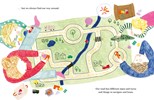
Jelly is rendered in Clanton’ inimitable style, with a touch of Ed Emberley simplicity. His inverted eyebrows and down-turned mouth ask the reader what on earth, or in the sea, is going on: “UH…DID YOU READ THE TITLE OF THIS BOOK?!” The redundant punctuation tells you just how terrified he is.  Soon he is caught in a maze of signs urging caution, peril, and the need to stop. Jelly believes that the reader can help him to decode them and offer advice.

There are sea serpents with sharp teeth and a cannon which may or may not be non-functional. Jelly is actually transformed into a dark red cannonball, as Clanton extends the character’s legs, opens his eyes wide, and reverse the direction of the eyebrows.  Children relate to artwork that seems to contain elements of their own.

The drama settles down, and the book briefly returns to the idiosyncrasies of the graphic novels.  A page entitled “SOME NEARBY ITEMS” also reminded me The Everything in the Whole Wide World Museum: With Lovable Furry Old Grover, although the stakes are higher. Jelly needs support, but he may have some problems depending on “PRICKLY UNDERSEA PINEAPPLE,” or “RANDOM CACTUS.”

Jelly becomes angry, disappointed with the reader who, as in The Monster at the End of This Book, does not seem to understand the gravity of his problem. After all, someone who cannot help him extricate himself from danger is as dangerous as the book itself and all the horrors it contains. When Jelly finds some courage, along with ingenuity, and a bit of luck, he feels calmer, safer, and happy to meet his old friend Narwhal for a nostalgic ending.  His warning not to read the book over again is not to be taken literally.

The Olive Tree’s Story

The History of Jerusalem: An Illustrated Story of 4,000 Years – written by Vincent Lemire, illustrated by Christophe Gaultier, coloring by Marie Galopin, translated from the French by Amanda Axsom
Abrams ComicArts, 2024 (originally published in French, Les Arènes, 2022)

The narrative premise of this graphic history is that a 4,000 year-old olive tree is uniquely placed to teach readers about Jerusalem’s contested past. If that seems an unlikely approach, its success is only one of the many surprises in this unusual book.  Dense with facts, yet a at the same time utterly absorbing and swiftly paced, The History of Jerusalem is also both provocative and balanced.  The illustrations allude to classic comics, while subverting the idea that anyone involved has superpowers. Even great historical figures, and mythical ones, are viewed realistically, from different angles.  It would be impossible to interpret the history of this city without controversy; Lemire and Gaultier do not avoid that essential truth.  Instead, they maintain an appropriate level of respect and skepticism about both the past and the future. The book may be intended for adults, but it is equally appropriate for young adult readers, and would be an excellent complement to other, more ideological, resources.

The opening image of the tree, Zeitoun or Olivia, promises some divisiveness, or perhaps coexistence.  After all, the word bubbles proclaim “Hello!” “Shalom” and “Salam!” She lays out the vast panorama of the city, echoing the biblical tale of creation: “In the beginning, when this story started, there was nothing…” Then the nothingness fills with geography, history, religion, ethnic groups, famous and influential people who impacted Jerusalem’s move towards centrality. Vincent Lemire chooses each event with great care, allowing different perspectives to emerge. There are events so loaded with meaning that their inclusion may seem unnecessary.  The near sacrifice of Isaac, or Jesus at the Last Supper, command an immediate, probably pre-determined response. Yet they are equally weighted with panels dedicated to other hinge moments. The correspondence between former Arab mayor of Jerusalem, Yousef al-Khalidi and Zionist leader Theodore Herzl also reveals world-changing consequences.  Christophe Gaultier depicts the serious and careful intent of Khalidi, seated at his desk with inkwell and steaming cup of coffee. When he writes to Herzl, “The concept of Zionism in itself is beautiful…My God, historically it is indeed your land,” the future appears in one way. When he follows those words with “We Arabs and Turks view ourselves as guardians of Jerusalem’s holy places…in the name of God…leave Palestine alone!” that future veers in a different direction.

The presence of each group taking root is documented. Lemire emphasizes both biblical accounts whose literal veracity can be disputed, and abundant archeological evidence of an ongoing Jewish presence, including autonomous kingdoms.  Hellenistic, Roman, and Persian domination never erased a Jewish presence, nor did the western Christian Crusades, dedicated to brutally removing the Islamic control of the Holy Land. The rich Islamic civilization that developed from the mid 7th century C.E. eventually regained power and flourished under the Ottomans, until British victory in World War I brought it to an end. While there were continuing struggles for power throughout the centuries, Lemire seems to suggest a relatively equitable sharing of space by Jews, Christians, and Muslims, until the British Balfour Declaration promoted the idea of a Jewish homeland in Palestine. This assertion does not seem to be based as much in contempt for Jewish aspirations, as in an overly idyllic view of the region prior to the British mandate.

It is impossible to summarize the book’s depth, and sensitivity to the competing claims that inevitably threatened any permanent harmony. But at every point when I began to sense bias, the author provided counter examples.  The exclusion of refugees from the Holocaust, the refusal to accept partition by the U.N., and other obstructions to a successful resolution are mentioned; blame is apportioned among the British, the Hashemite Kingdom of Jordan, and extremist elements on all sides.  I felt uneasy at the faint implication that “Ashkenazi” Jews were somehow less indigenous to Jerusalem than Sephardim. The reference to Yasser Arafat’s “moving speech” at the U.N., in light of his extreme corruption, is, at best, ingenuous. Yet these are relatively minor exceptions to the tone of generosity and hope. A book with this range could not avoid controversy and still attempt complexity. Lemire and Gaultier construct a solid edifice built on fact, myths, and deeply held beliefs. They refrain from assigning unique blame to anyone, and also avoid judging the validity of Jewish conviction that the modern state of Israel represents self-determination.  The lonely olive tree holds out hopes for a reasonable solution, of “two independent but allied states” built on mutual respect.