Sisters You Won’t Forget

Stella & Marigold: Mermaids and Mix-Ups – written by. Annie Barrows, illustrated by Sophie Blackall
Chronicle Books, 2025

The second volume in Annie Barrows and Sophie Blackall’s series about an unforgettable pair of sisters continues their adventures, and the development of their relationship. Stella & Marigold established that their closeness, characterized by both unrelenting love and occasional friction, was as believably narrated as Beverly Cleary’s Ramona books (astute readers of my blog will recognize that its title derives from a quote in Ramona the Brave.) The outward similarities between the two series are not superficial, but rather are based on the way which both sets of books communicate how it feels to be a child, without a touch of condescension. Both also invite adults to identify with characters, whether by remembering their childhood or following along as Stella and Marigold’s parents, teachers, and grownup friends, who also propel the plot. (I reviewed the first Stella & Marigold book here.)
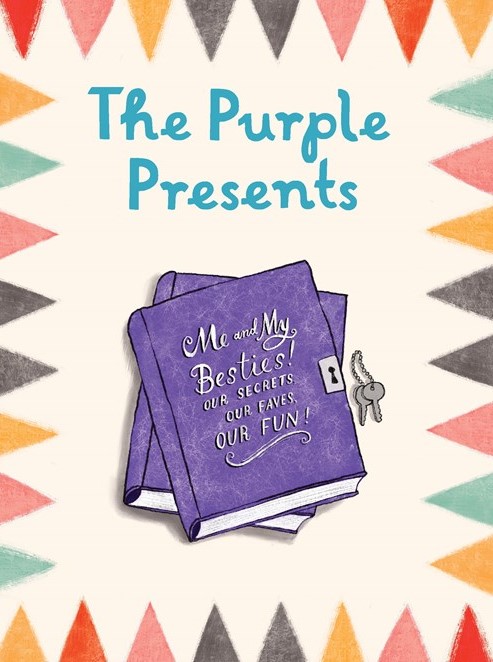
Each chapter may be read independently, but are interconnected. The book begins with a gift which the sisters receive from their Aunt Judy. Like many of her gifts, this one turns out to be a Trojan horse. A sparkly purple covered diary with high-pressure demand to record “Me and My Besties! Our Secrets, Our Faves, Our Fun!” sets Stella and Marigold on a series of attempts to find friends worthy to fill in the blanks. Even though this involves some distress, it eventually leads to an understanding of friendship and empathy, minus the high-stakes categories.

In “Snow, Snow, Snow!” Stella tries to win the friendship of a classmate by using mind control to ensure a snowstorm. When their teacher, Mr. Banagal, intends to dissuade the children by calling this “magical thinking,” Barrows reveals how differently adults and children sometimes interpret reality. His phrase has the opposite result. After all, what else could magical thinking be but “encouraging?” Adults will read this passage with recognition, but not a sense of superiority unless they don’t remember what it felt like to fruitfully “misinterpret” adult’s language. Barrows does employ a little bit of gentle humor at adults’ expense when Teacher Kaitlin carefully avoids direct praise of Marigold’s artwork, instead focusing on one quality:

“Wow, your picture is so detailed”…She always said things like that. Never, “Your picture is great…the best I ever saw.”
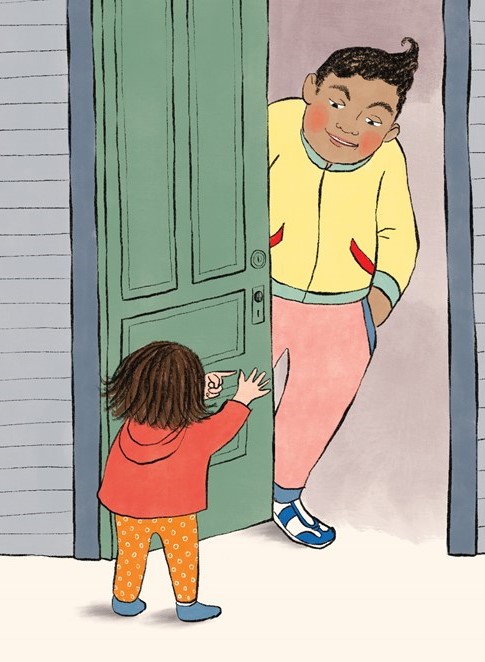
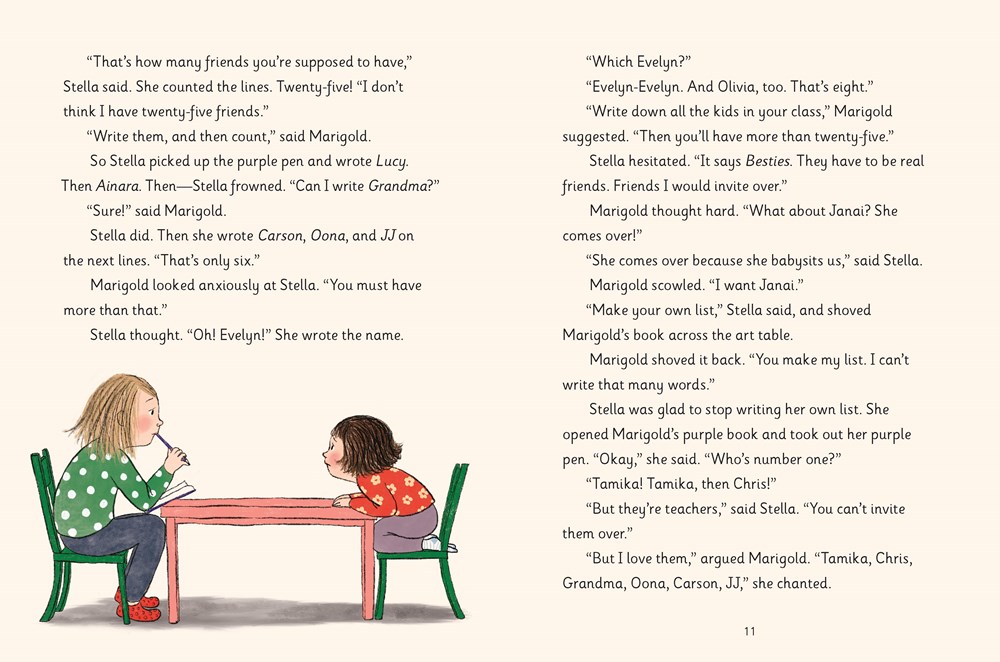
Blackall’s pictures feature her ability to convey a character’s feelings with slight alterations of their features. (I reviewed another of her books here.) A range of crayon-box colors, and careful composition of images against white background, give every page of the book its own impact. Stella and Marigold sit across from one another at a table, as they collaborate on coping with the diary. Marigold desperately tries to get her father’s attention when he is absorbed in his work; his temporary rejection leaves her curled into a question mark, embodying her feelings about why his priorities would be so misplaced.
There are so many series about girls and their friendships; many of these are terrific. Stella & Marigold fits securely into the category of classic.

A Bridge to Somewhere

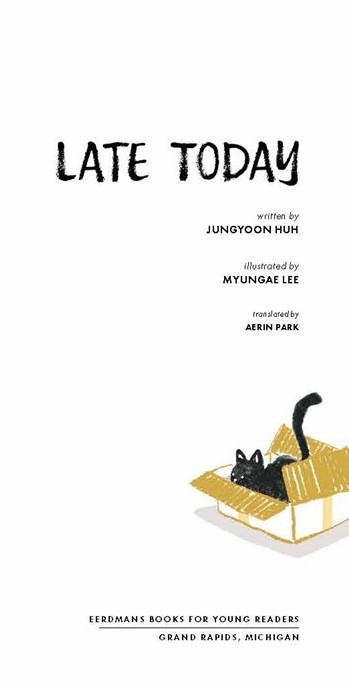
Late Today – written by Jungyoon Huh, illustrated by Myungae Lee, translated from the Korean by Aerin Park
Eerdmans Books for Young Readers, 2025

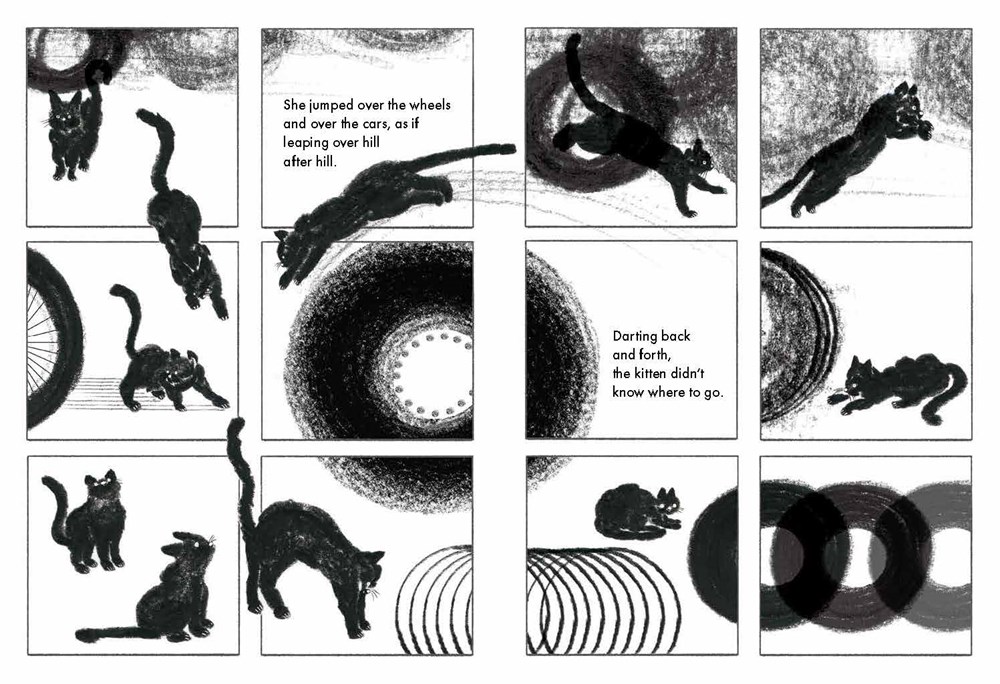
The opening endpapers of Late Today show an overcast sky. The following two pages feature the consequence, a bridge accompanied by the warning that “Morning rush hour traffic is congested all over Seoul,” with the report’s words alternating in word of the report alternating in level relative to the image.  The title page shows an adorable kitten with golden brown eyes that match the lid of the carton which has become her bed. Readers join the traffic jam and the rescue mission.

Jungyoon Huh’s minimalist text (ably translated by Aerin Park) conveys just exactly the amount of information needed.  Myungae Lee’s illustrations, rendered in colored pencils and oil pastels, combine black and white scenes, graphic novel panels, and earth and jewel tones against white background. They are beautiful in their simplicity, but also convey motion, sense impressions, and the imminent threat of losing a kitten on a traffic-clogged bridge.  The black font ranges in size, with some pages reminding me of the lettering used in Margaret Wise Brown and Leonard Weisgard’s The Noisy Book, and sequels. (The Winter Noisy Book is illustrated by Charles G. Shaw.)

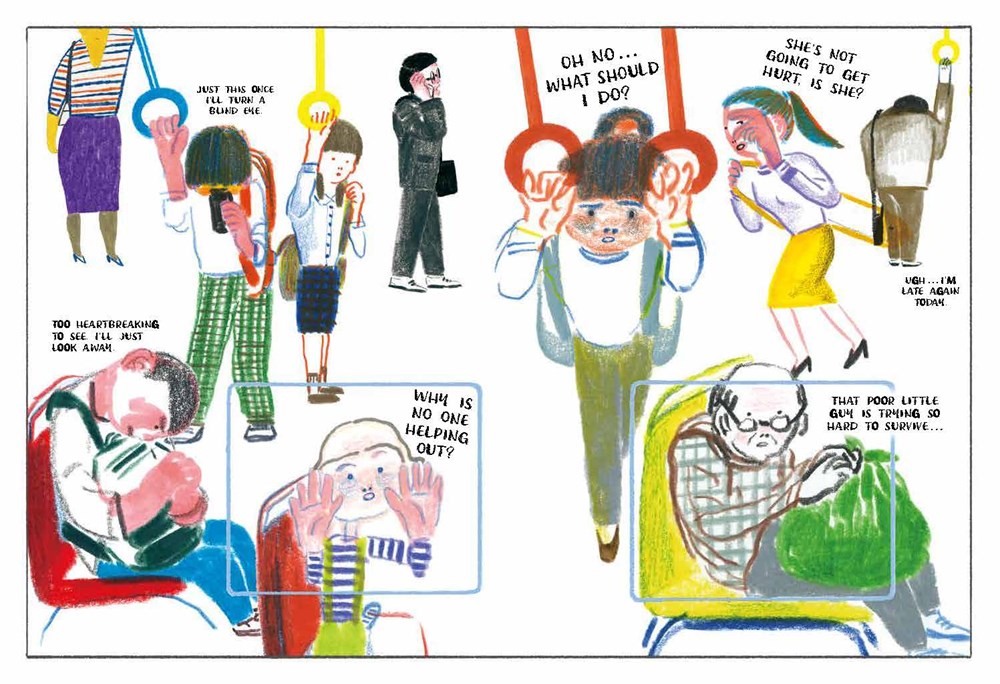
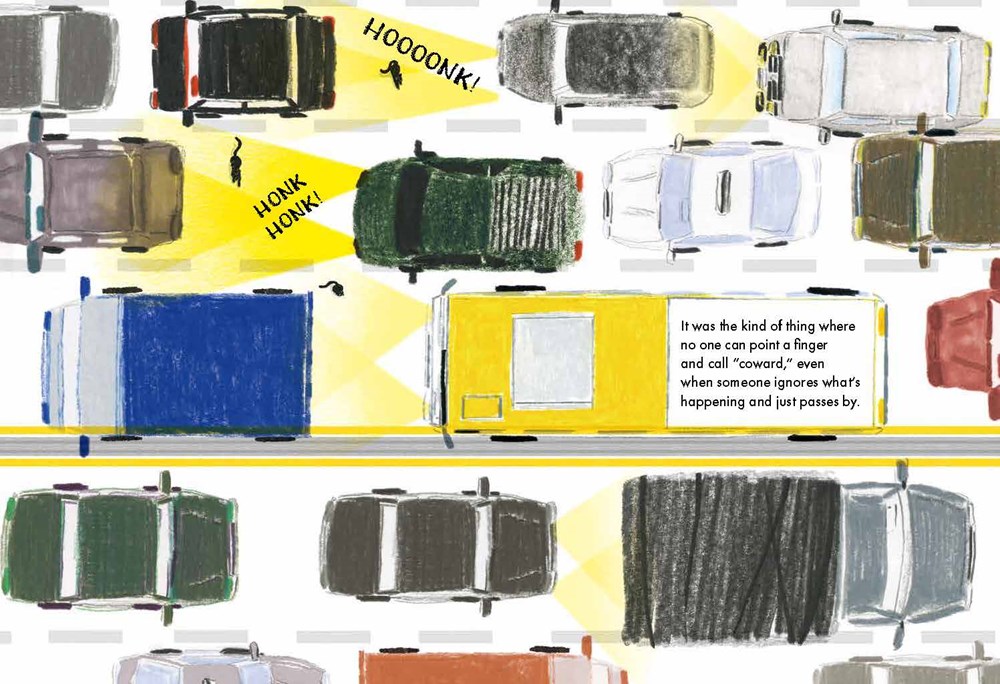
Public transportation passengers, each in isolation, express their own thoughts about the danger, and their appropriate response to the kitten’s plight.  Parents and caregivers sharing the book with children will want to discuss all the implications of these natural, but possibly inadequate, emotions: “Why is no one helping out,” “Too heartbreaking to see. I’ll just look away,” and Oh no…what should I do?” One incredible two-page spread is a bird’s eye view of the vehicles, each one inadvertently threatening the tiny kitten weaving between them. The text is enclosed in a rectangle similar in size to the vehicles themselves, the words visualizing the ominous situation.

Cinematic techniques dedicate to full pages to a darkening storm, and another two to pelting raindrops.  Readers pause and take a deep breath. Then, a driver rescues the kitten, his or her hands cradling the animal in a gesture of human kindness. Someone has intervened at exactly the right moment. The cars and buses move. Everyone is relieved.  Being late is sometimes exactly right.

The Year Is a Circle

Lights at Night – written by Tasha Hilderman, illustrated by Maggie Zeng
Tundra Books 2025

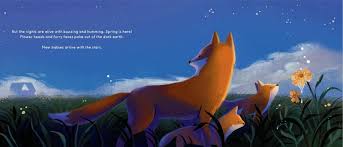
There are two families observing the rhythms of the year in Lights at Night. One is human and the other canine, specifically foxes.  Dream-like images with changing shades of color include realistic details, both natural and cultural.  Children experience the wonder, but also the reassurance, of the four seasons and their special features, from football in autumn to storms in spring. While the fox family does not kindle holiday lights around the time of the winter solstice, they also appear to respond to the changes.  Tasha Hilderman’s soothing poetic text complements Maggie Zeng’s visual immersion in the excitement of one year. Children find joy, not boredom, in the repetition of familiar events.

A powerful storm is just unsettling enough to make the shelter of home more of a comfort.  Crayon drawn strikes of lightening emanate from a house, enclosed in a photograph, and also cross its border.  Inside, a strong of lights and beds configured as tents add the sense of drama that children like. Note the plush fox in a small sleeping bag. The fox family lacks the domestic props, but is just as attuned to the environmental changes. Of course, animals’ lives are more closely defined by the seasons. In spring, “new babies arrive with the stars.”

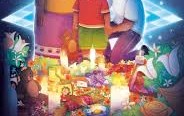
Campfires come in summer; riding the bus to school and harvesting wheat are tied to autumn. One of my favorite images in the book is a natural and unobtrusive celebration of multicultural holidays.  Christmas trees, Diwali lights, a Muslim family welcoming visitors, and a Kwanzaa lamp grace the neighborhood, along with a Jewish family’s observance of Chanukah. If you look closely, you will see that the correctly depicted nine branch chanukiyah (menorah) has its candle farthest to the left partly obscured by the window frame.  This is not an error, just a small visual element lending authenticity to the way in which someone placed the lights, which must be visible from the outside.

At the end of the book, the two children share an album and a box of crayons. The volume is open to the photo with lightning, enhanced by the children’s artwork. The actual fox looks up the moon.

The Other Side of Trouble

Trouble Dog: From Shelter Dog to Conservation Hero – written by Carol A. Foote, illustrated by Larry Day
Eerdmans Books for Young Readers, 2025

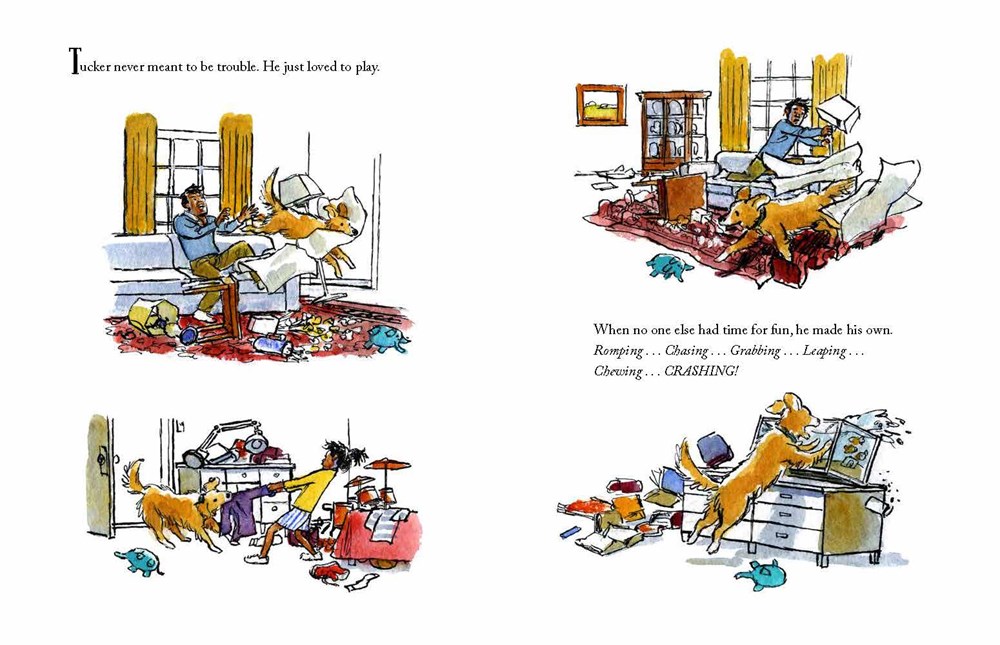
There is a lot of action in Trouble Dog. There is also an abundance of information, a likeable main human character, and a surprising amount of humor.  Carol A. Foote has combined two real-life conservation dogs into one fictional hybrid named Tucker.  Caught in a cycle of adoption and rejection, he is always returned to the animal shelter that has given up on placing him. Then, along comes Laura, a classic heroine who refuses to give up on an unlikely pet who has driven everyone else to distraction. Larry Day’s pictures are full of action and color, setting a motion Laura and Tucker’s journey from trouble to success.

The opening end papers introduce Tucker in some typically frenetic canine activity. Then it escalates, as every home the shelter finds for him is subjected to chaos.  Tucker manages to overturn an aquarium and books in one place. He grabs a girl’s sweater and won’t let go. A man attempting to read his newspaper looks enraged as Tucker grabs it and leaves a litter of overturned items in his wake.  When we next see him, Tucker is a lonely prisoner in a cage, “watching everyone pass him by.”

Laura is a sturdy figure with a ponytail, flannel shirt, and jeans.  She is as no-nonsense as Mary Poppins, and she also intuits something about Tucker that everyone has missed. His energy can be put to good use.  Even though her home is quickly as disordered as every other place Tucker has been, she has a vision and the practical sense to implement it.  Dogs, as readers learn in Foote’s detailed backmatter, have a highly developed sense of smell.  Laura observes Tucker carefully and evaluates his routine and abilities.  She isn’t just kind and patient, but methodical, as well. 

Eventually Tucker gets a job, or a series of jobs. The details in the text are embedded in words as colorful as the pictures. “Tucker’s first job was to find rosy wolf snails in Hawaii.” (image). He travels the world, sniffing out “moon bears in China, mountain lions in Chile, and elephants in the jungles of Myanmar” in a narrative as exciting as one by Jules Verne, but rooted in the truth.  In a two-page spread, Tucker crosses the gutter between pages. An elephant marches ahead of him, dwarfing the dog in size, but not in energy.  Three researchers form a determined row in the background, to his left.  The image captures the cooperation necessary for Tucker to succeed in helping scientists to learn about species in need of protection.

Not every outing produces results easily. In Zambia, Laura’s optimism is tested, looking for cheetah scat and coming up short.  When Laura insists that “I trust Tucker,” who finally leads them to the right location, she is not relying only on her affection for the dog. Through hard work and astute decisions, she and Tucker have become a team.

Four pages of additional information and photographs are organized in a question-and-answer format, giving the bigger picture of how conservation animals, as well as other service animals, provide essential services.  A selected bibliography is accompanied by an oval portrait of Laura and Tucker relaxing at home. I hope that no one misses one title, by Alexandra Horowitz, Inside of a Dog: Young Readers Edition: What Dogs See, Smell, and Know. Just parenthetically, the title refers to the famous quip usually attributed to Groucho Marx: “Outside of a dog, a book is man’s best friend. Inside of a dog, it’s too dark to read.”  It’s definitely not too dark to read inside this book.

A True Heir to Jane

Emiko – by Chieri Uegaki
Tundra Books, 2025

It’s hard to keep track of all the novels, movies, and other varieties of allegedly Jane Austen-inspired works (there are children’s biographies of her as well, such as this and this).  Some of quite good, a few excellent, and others teeter on the border between obtuse and exploitative.  Chieri Uegaki’s Kimiko is an outstanding young adult novel that adults will enjoy, as well. (I also reviewed an earlier picture book by her.) She is a true heir to Jane Austen, not in the sense of attempting to replicate the novelist’s Emma, but in offering how own distinct version in conversation with the 19th century masterpiece.

Emiko Kimori is a Japanese Canadian high school student living in a spacious and idyllic home on the Pacific coast.  Her parents died when she was very young, but the memories she is too young to have retained have been transformed into an almost spiritual presence in her consciousness. She lives with Ojiichan, her grandfather, a character endowed by Chieri Uegaki with a level of wisdom and patience that, in the hands of another author, might lack credibility. Yet, like every person in Emiko’s life, from the closest to the most tangential, he is utterly believable. 

If you remember your Jane Austen, Emma Woodhouse is engaged in well intentioned matchmaking, motivated by genuine concern for others, but also

unacknowledged arrogance.  Uegaki’s Emiko is also consumed with helping her friends find the partner who will complete their happiness, and a controlling element definitely plays a role in her machinations.  She is also kind, sensitive, and sometimes able to examine her actions with some critical distance.  She has been friends with Kenzo Sanada since they were children, enjoying the embrace of his family and the peace that being with them confers.  “Kimochi ii,” as Emiko explains this warmth, “floats through my mind…The closest I can come to explain what I mean…is that…it makes my spirit feel at ease.”

All novelistic characters have an ethnic identity, whether as an integral part of the narrative or a kind of default, of less significance.  Uegaki weaves Japanese culture throughout the book, with a graceful conviction of its importance.  She is not taking readers on a tour, but inculcating a feeling of interest and empathy.  Whether describing foods in detail or naturally choosing phrases that are the best way to convey the events and her responses to them, Emiko is at ease in two intersecting worlds. She shares with Ojiichan the ritual of offering incense at the butsudan (altar) to honor deceased family members, closing her eyes in front of their photos and requesting guidance.  She and Ojiichan also bond watching Audrey Hepburn in Sabrina.

There are several surprises for readers. Like Austen’s characters, Uegaki’s are three dimensional.  A friend, like Harumi, may be oblivious to her own needs. Jun, the stepson of Emiko’s aunt, Mitsuko, is brimming with both pride and prejudice that place him on a dangerous course.  Kenzo’s basic decent strength is never in doubt, but, like everyone, he needs to find a counterpart. 

There is a scene that epitomizes the way that Uegaki translates Austen into Emiko’s movement towards growth.  Mitsuko prepares to help Emiko transform one of her mother’s kimonos into a prom dress. First, she dresses in the kimono and traditional accessories, then poses for a picture. Finally, Ojiichan blesses the project: “I am happy for you to do as you wish, Emiko. I think your mother would be as well, knowing you are taking something of hers and making it your own.” Then it’s time to “deconstruct” the kimono and recreate it into something new. Emiko eventually learns both how to scrutinize the past and present, and how to start from scratch.

Navigating Together

Together We Are Family – written and illustrated by Emily Hamilton
Bloomsbury Children’s Books, 2025

Wonderful children’s books each have their own outstanding qualities.  There is no one formula for producing the authenticity and beauty inherent in a distinctive picture book.  Emily Hamilton’s Together We Are Family features a tone of empathy with kids, simplicity that is not patronizing, and pictures that are reminiscent of children’s artwork without mere imitation. 

In the opening picture, the mother lowers her body slightly to speak with her daughter, a young girl using a walker.  The mother’s words are enclosed in a speech bubble bordered by unconnected dashes rather than a continuous curved line.  “You are you and I am me. Together, we are family.”  There is nothing trite about those words to a child.  The facing page shows family portraits framed and posted in their home. Each scene captures a moment: a bird carrying off part of a girl’s ice cream cone, a father holding one daughter and an older daughter’s face peering over the bottom of the photo, sisters on the beach with their back to the viewer.

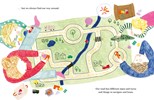
Hamilton’s illustrations are rendered in watercolor and pencil, along with Photoshop.  Simply using media that children might also prefer, including colored pencils and paint, does not necessarily convince readers that the illustrator identifies with their point of view.  The primary colors and naïve brushstrokes need to be accompanied by a sense of identification. In a terrific two-page spread, Hamilton presents a bird’s eye view of a family that embodies the metaphor of finding their way together.  Sitting around a floor mat designed as a town with roads connecting the community, each family member chooses a different activity, but they are working in harmony. The father “drives” a red car in a traffic circle, while one child drives a similar vehicle on her mother’s pants leg. The mother builds a structure with blocks. The younger girl, who is moving a toy alligator, which seems more fanciful and less related to the overall purpose of the game, is just as integrated into the scene.

Frustration is also part of a child’s life, as Hamilton visualizes without judgment.  Putting on her shoes is a challenge for the young girl, as is climbing stairs without the aid of her walker.  As with all children, whether or not they have special needs, anger can erupt unpredictably, as “the moods that catch you unawares.”  While her older sister calmly picks up a piece of fruit at their picnic, the younger girl, frowning, tosses a sandwich into the air. The chaotic merriment of a party is off putting to the child, who stays close to her mother watching the scene with some discomfort. Anyone, young or old, who has ever experienced frenetic social activity as less than an unalloyed joy will relate to this scene.

In a sensitive author’s note, Hamilton explains how her daughter’s disability has influenced their life as a family in specific ways, but she emphasizes how all families inevitably cope with difficulties through support and love.  Together We Are Family resonates with that truth for all readers.

Imagining Who Wore Them

Little Shoes – written by David A. Robertson, illustrated by Maya McKibbin
Tundra Books, 2025

Many Indigenous children, in both Canada and the U.S., suffered the trauma of being removed from their families and placed in residential schools funded by the government and often controlled by different Christian denominations.  Deprived of their heritage, and often subject to physical and emotional abuse, these children would be lost to history if not for concerted efforts to publicize their experience and to demand restitution and atonement.  Little Shoes is a picture book by acclaimed author David A. Robertson (see my reviews here and here and here), a member of Norway House Cree Nation, illustrated by Maya McKibbin, of Ojibwe, Irish, and Yoeme heritage (Robertson and McKibbin have collaborated before). They have taken on the weighty task of presenting a catastrophic loss to young readers, but also offering hope and determination.  With poetic text and images of family life that are both familiar and mystical in tone, they have achieved this goal.

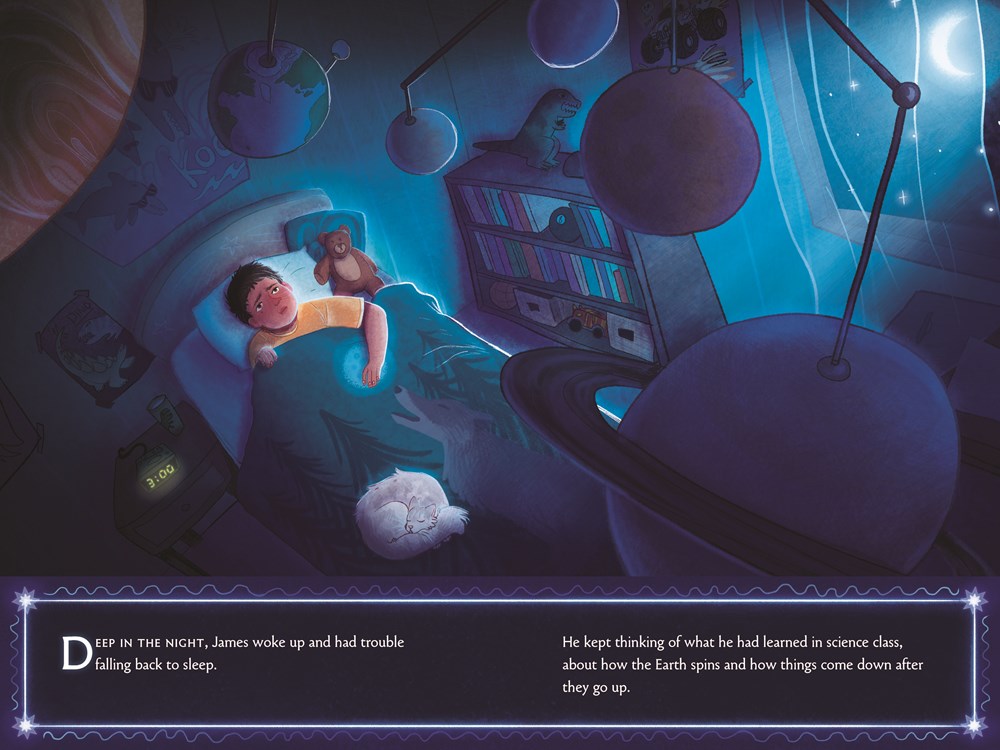
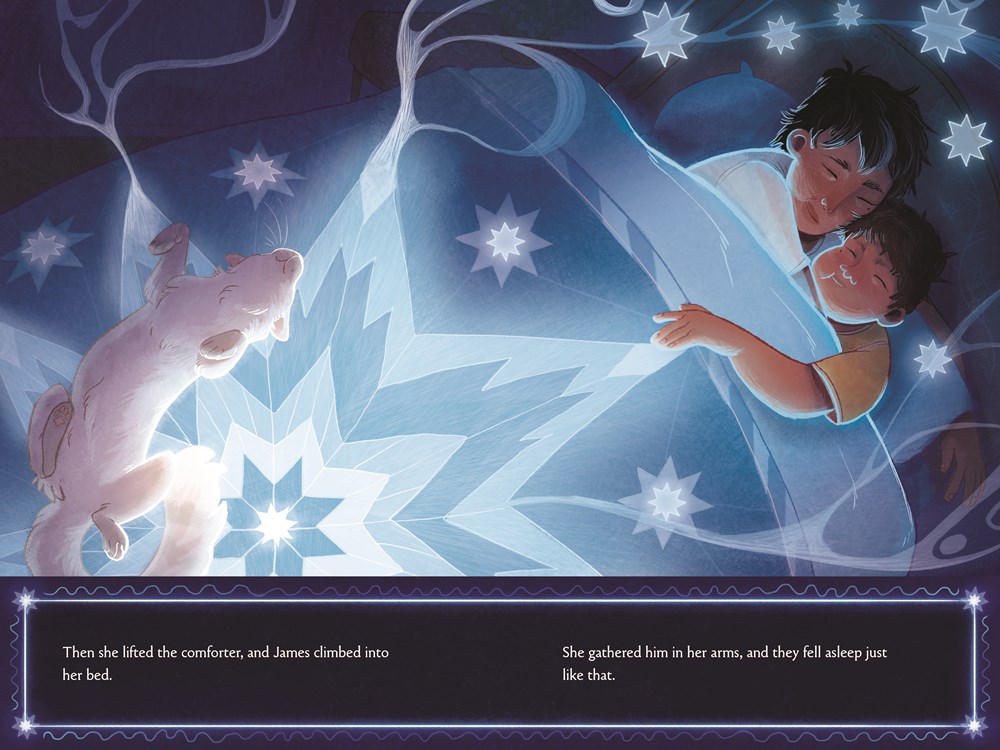
The endpapers feature constellations, introducing a central theme of each person’s place in the universe.  James, who understands the principles of astronomy from his science class, opens the curtains in his room to the moonlight. He asks his mother to clarify how and why his feet remain firmly on the ground if the Earth is spinning in space. The answer is only one of several which his mother will frame truthfully, and also use to elaborate on other questions which will naturally follow. She reassures him that his Kōkom’s, (grandmother’s) explanation about their origins is valid, but adds, “even though you’re from the stars, your home is right here with me.”

The love between a parent and child, and the enveloping warmth of his community, are anchors in James’s life.  His intense curiosity places demands on a parent who is obviously committed but exhausted, when he returns to her room with a request to hear about “every single constellation,” His own attempt to visualize and trace them in the night sky is insufficient.  The dialogues between children and their caregivers are open ended, and the book swerves from the dimensions of the cosmos to the specific history of injustice that remains unresolved.

James and his kōkom set out for one of their frequent walks, but his time it is transformed into a march.  A daily experience becomes a metamorphosis, and his grandmother takes on the role of teaching about a part of their lives that is far more difficult to internalize that the motions of the planets. The little shoes of the title are those of Indigenous children whose deaths are acknowledged by Kōkom with the haunting phrase that they “had gone to residential school but had not come home.”  Shoes as a metonym for children who have died seems to capture a sense of a life that is unnaturally cut short. Other articles of clothing are perhaps less universal, and small shoes also reflect the scale of the children relative to adults, both those who loved them and those who inflicted torture.  A similar allusion to this loss has been used in many memorials to child victims of the Holocaust. (Of course, while some of those children, like the Indigenous victims, died of abuse, neglect, and disease, many were murdered immediately upon arrival at a death camp.  Chronicling atrocities requires acknowledging both what they share and common and how they differ.)

Robertson and McKibben do not attempt a simplistic response to James’s fears. He interprets the frightening facts through the lens of loneliness, asking his mother how his own grandmother had coped with the deprivation of her isolation in the residential school.  His mother responds that her sister and she had “cuddled,” paralleled by McKibbin’s image of mother and son sharing the same physical contact. Their bond is unbreakable, even if mitigated by anguish.  The honesty of Little Shoes is an antidote to fear.

Giving a Young Woman Her Voice

Adi of Boutanga: A Story from Cameroon – written by Alain Serge Dzotop, illustrated by Marc Daniau
Eerdmans Books for Young Readers, 2025 (originally published in French, 2019, Translated by the author)

Adi of Boutanga is an important book. That quality would not necessarily make it appealing, let alone essential, to read, but there are many other reasons why it is just that. A voice that resonates with the truth, beautiful illustrations and innovative graphics, a compelling story, and a deep sense of conviction will all enfold the reader in its narrative fabric.
Adi is fourth grader living in a nomadic community, the Mbororos, in Cameroon. Although they are traditionally herders, their economy has changed; Adi’s father transports passengers on his motorcycle and her mother sells Makala (doughnuts) in the marketplace. Adi’s identity is defined by family relationships: “I prefer to stay the big sister of Fadimatou, Zénabou, Youssoufa, Daïro, Souaïbou, and baby Mohamadou.”

Children cannot control their own lives, even to the limited extent that adults are able to do so. Adi loves attending her school, which she describes as a “gift” to the village by Mama Ly and Monsieur, generous benefactors. The process of learning to read may seem inherently magical to many children, but Dzotop captures the poetry of this experience and gives Adi a voice:

      Before the school was given to our village, words were invisible to us. We
      could hear them, but we couldn’t see or touch them. I even thought a
      a strong wind might steal them as soon as they left our mouths. But that
      wasn’t true.

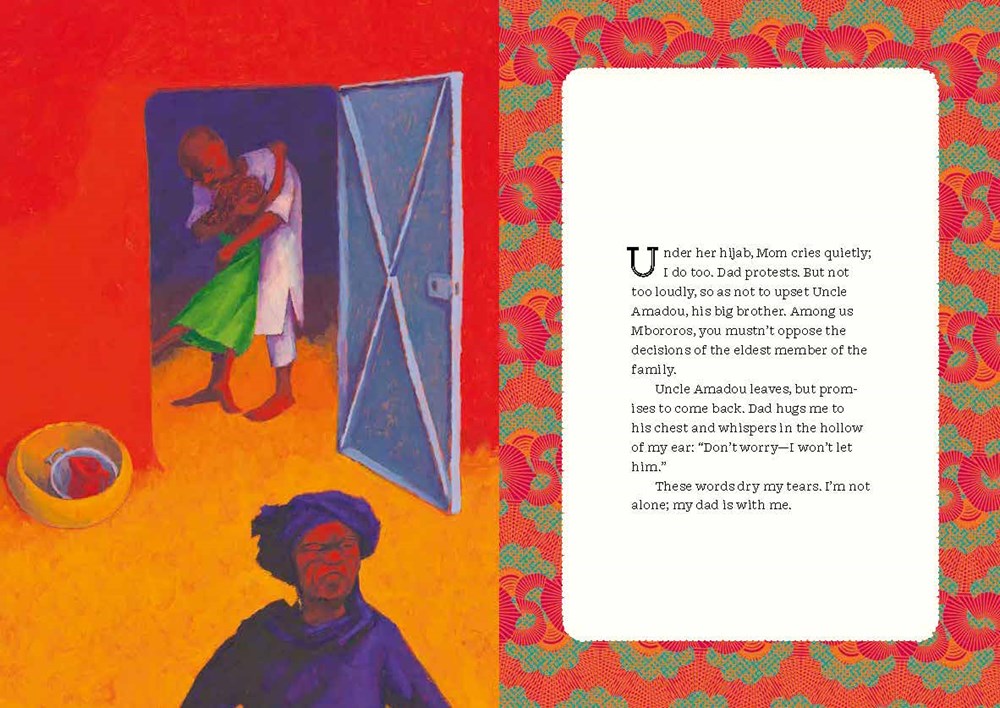
Although there may seem to be a fable-like quality to the book, the characters are not generic. Adi’s mother embraces her daughter’s individuality, responding to Adi’s frequent laughter with the suggestion that her daughter has “swallowed a thousand weaverbirds.” But the warmth and protectiveness of Adi’s life is shattered when her uncle arrives to inform the family that, although still a child, she must marry. Her father and uncle assume opposite patriarchal roles, one caring and the other transactional. “They throw words at each other. Words that hit like stones.”

Saving their daughter means that Adi’s parents must send her away. She goes to Boutanga, where her benefactors have established a school for girls that fosters creativity and dignity. Even if this solution is not a global one, it is enough for Adi and an example for all. Eventually, when she has arrived at the point in her young adult life when she is able to choose, Adi finds love with a man who respects and understands her. Mastering language has been a key to her growth, “catching words… putting them in the right order and making sure they say the right thing.”

The book is not composed only of words, but of images that organically emerge from the culture which they represent. Pages with illustrations alternate with blocks of text set against traditional fabric patterns. Human figures allude to sculpture but have kinetic movement. Earth tones are the setting for the book’s quiet drama, with deep blue sea and red skies framing Adi’s journey. Adi of Boutanga is not a moral lesson, but a work of art that interweaves modern aspirations of freedom for women with the unique threads of a specific culture. It is a book to read, share with children, and read again.

The Happiest Country, a Long Time Ago

Happy Times in Finland – written by Libushka Bartusek, illustrated by Warren Chappell
Alfred A. Knopf, 1941

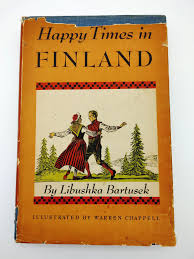
Everyone knows that Finland is allegedly the happiest country in the world.  You certainly can’t take these simplistic measures too seriously, and comparing Finland to other countries with entirely different histories, economies, and demographics is useless.  I recently reread an unusual childhood favorite, which I had bought at a library used book sale. Its appeal to me at the time remains vague. I would read almost anything, and it had lovely pictures and promised to tell a story about a distant part of the world. Happy Times in Finland, by  Libushka Bartusek, was published in 1941. At that point, it was indisputably not happy at all.  Having been invaded by the Soviet Union, they eventually allied with Germany in that country’s war with its Russian enemy.  This was a bad choice, but it is not reflected in the book, which takes place in the idyllic time period before the war.

There is minimal plot and character development in the book, but a lot of folklore.  To summarize the improbable premise, Juhani Malmberg, a Chicago Boy Scout with Finnish immigrant parents, goes to visit his ancestral homeland.  He is able to take this expensive trip due to the generosity of his father’s employer at a furniture factory, Mr. Adams.  Finland is known for, besides an improbable level of happiness, abundant high-quality wood. A furniture manufacturer would be eager to see firsthand the source of his best supplies. Since Mr. Malmberg is such a loyal employee, his benevolent boss actually takes Juhani along, for free! He has the opportunity to see his beloved grandparents, as well as his aunt, uncle, and cousins.  In addition, Juhani becomes an ambassador from the American Scouts to their Finnish counterparts.  Aside from missing his parents, there’s a lot of happiness here.

Poetic language fulfills expectations about a land endowed with natural resources, and steeped in literature.  Approaching land, Juhani seems to be expecting a myth and he finds one: “Sure enough, there it was, just as his mother said it would be: an expanse of water, blue as sapphire, with green islands dotting it, as though some giant had scattered a mammoth handful of emeralds on a silver-streaked scarf.”  Not only the environment, but its people, are described with hyperbole. Oddly, almost everyone is blond.  Finland has a Swedish minority; the name “Malmberg” indicates that his father’s family is descended from this group. His cousins’ last name is Kallio, of Finnish origin.

Finnish is not a Scandinavian language, but is related most closely to Estonian and Hungarian. (A glossary of Finnish words is included at the end of the book.) Here is a description of Juhani’s aunt, a veritable Amazon of pale beauty: “She was tall and blond, so blond, in fact, that Juhani thought she was white-haired…she had great dignity…he felt as though he were at the feet of some exceedingly beautiful statue, all made of silver and bronze and pearl…her teeth gleamed like mother-of-pear.” There are even references to “Viking blood.”

The few realistic elements stand out because of their minimal role in the story.  Aunt Kallio, Aiti to her children, has favorites among her offspring.  Her older son, Jussi, will vicariously fulfill her own dream by becoming an architect, a career closed to women. Eero, the younger boy, is not academically oriented. Unlike his parents, he prefers manual labor. She keeps her disappointment to herself, only thinking how he lacks “initiative.” “Oh, me! she sighed, one could not be everything.”  This statuesque symbol of perfection is unable to tolerate individual differences.

Warren Chappell’s illustrations, some in color and others sepia, appear to be lithographs.  They are stylized images, whether portraying men in a sauna or women clothed in traditional costumes for festivals. There is a haunting image of a blind storyteller who recites Finnish epic poetry.  Mr. Adams recognizes that the Kalevala’s metrics had influenced Longfellow’s composition of Hiawatha. The Old World and the New touch one another in this tale of immigrant roots, written as the shadow of fascism descended on Europe. It’s blatantly out-of-date and also oddly appealing, just for that reason.

Color of Grief

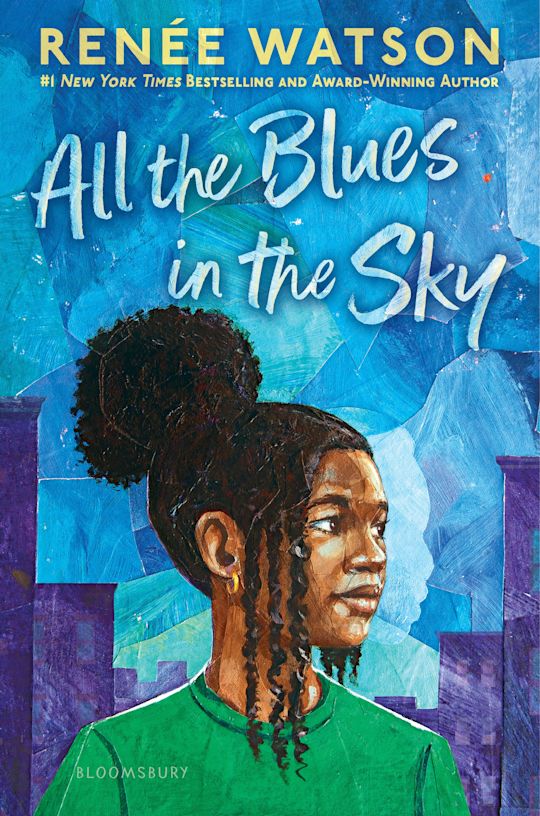
All the Blues in the Sky – by Renée Watson
Bloomsbury Children’s Books, 2024

Sage is a thirteen-year-old girl whose best friend is killed by a reckless driver. This terrible event happens on Sage’s birthday. The terms “losing” someone, or “passing away,” would be completely inadequate to describe the shock, numbness, and internalized rage that follow the accident.  Renée Watson’s verse novel gives Sage a voice in each chapter, narrated from the unaffected perspective of a person confronting emotions that would level a strong adult. With the same sensitivity to the process of growing up shown in her other works (which I have reviewed here and here and here), Watson creates characters who are vulnerable, but also strong.

In All the Blues in the Sky the experiences that test Sage are not the ordinary, but still difficult ones, of every adolescence, although those experiences, such as having divorced parents, are the framework for her growth.  Her parents are supportive, as is Aunt Ini, her surrogate grandmother.  She even has the benefit of a grief counseling group facilitated by Ms. Carver, who is nothing if not patient and professional. Mr. Dixon, Sage’s dedicated math teacher, offers slightly irritating, but totally sincere, life lessons: “Understanding angle relationships in math will help you understand your personal, real-life relationships…There are people –like transversal lines – that cross paths with you, only for a moment.”

There are other people in her life who are grieving.  Zay’s grandmother has died, and she admits relief at the end of her suffering. DD’s brother was killed by the police.  Ebony’s father had a heart attack. Sage is forced to constantly evaluate which types of death are hardest for survivors. No one has been able to answer this question.  Her friend’s death was abrupt and senseless. Sage never had a chance to say good-bye. Other survivors had to helplessly watch a long period of illness preceding a death.  Another troubling part of Sage’s role, which is only implicit in the novel, is her specific relationship to the person who died. She is not a sister, mother, or child, but a friend.  When a relationship is not formally recognized, the most profound sadness can seem somehow less important, although her friend’s family certainly honors Sage’s role in their loved one’s life.

For almost the entire book, Sage’s friend remains unnamed.  There could be many narrative, and psychological, reasons for this choice.  Articulating her name is too difficult, too final.  Nameless, she is both a real person and a tangible symbol for anyone who has grieved.  Words cannot capture the friend’s unique qualities, although Sage gives many examples of their closeness, and even of the tensions that leave her with unresolved guilt.  But specific, mundane, questions are more important than generalities: “What will her parents do with the posters on the wall?” Sage asks, “What will they do with her jean and T-shirts and sweaters/ and sneakers and sandals and socks and leggings and bracelets/ and earrings…”

Sage grieves, but she also falls in love, and begins to fulfill her dream of learning to fly.  More losses are in store, and Watson never minimizes their depth with platitudes. “If I live long enough to be an adult/and if I have children when I am an adult/I will tell them as much as I can about all the loss…” The phrase. “If I live long enough” from a girl of thirteen is terrible, but Sage’s resolve to tell her children the truth is something of a triumph.