Today, the New York Times published an important opinion piece by Ruth Franklin about Anne Frank. The singular tragedy referred to in her title is both her death, and the erasure of her Jewish identity in popular culture. Francine Prose’s book, Anne Frank: The Book, the Life, the Afterlife (2009) and Dara Horn’s chapter on Frank, “Everyone’s (Second) Favorite Dead Jew,” in her essay collection People Love Dead Jews: Report from a Haunted Present (2021) are both illuminating on the same subject. Adults sharing books about Anne Frank, and others on related people and themes, might wish to read Franklin’s piece, as well as the books mentioned above, as an appropriate and realistic memorial and a step towards some understanding of the Shoah. I have written about this topic before, and here, in recognition of International Holocaust Remembrance Day and the 80th anniversary of the liberation of Auschwitz, are some other relevant reviews and an interview:
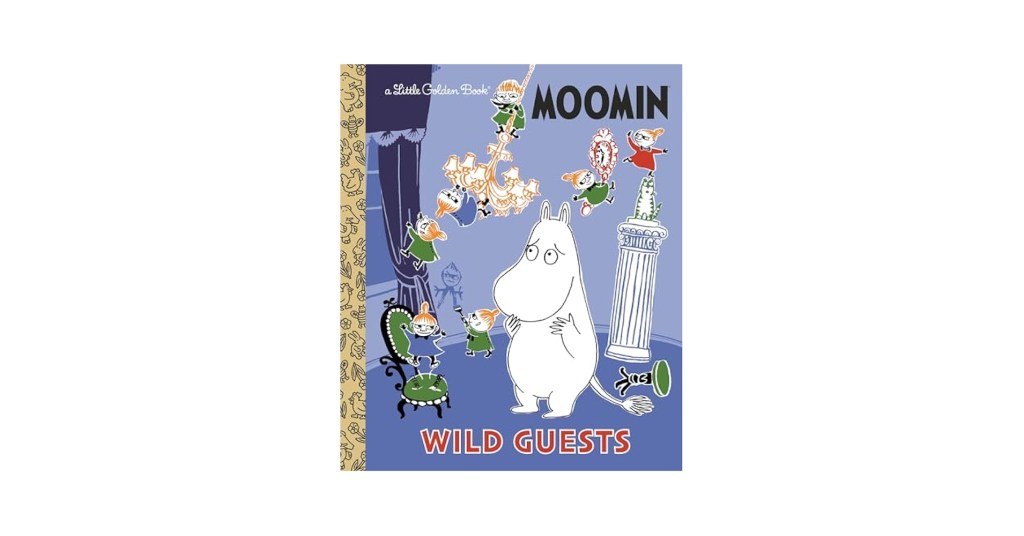
Wild Guests (Moomin) – written and illustrated by Riina and Sami Kaarla, based on characters created by Tove Jansson Golden Books, 2025
Golden Books have become a big tent, in both the range of their subjects and artistic quality. When I learned that a Little Golden Book based on Tove Jansson’s beloved Moomin characters would be released, I was worried. Recent releases, particularly those on celebrities of more interest to parents than children, have pictures of dubious quality. On the other hand, some of them are quite good, with substantial information appropriately presented and attractive artwork. (for example, biographies of Queen Elizabeth II, Audrey Hepburn and Ruth Bader Ginsburg) As it turns out, the price of joining the distinguished club of Golden Book classic authors and illustrators was not to compromise the style of Tove Jansson, the creator of the Moomins.
Although the pictures are not her original ones, Riina and Sami Kaarla have produced their own interpretation, which is respectful of Jansson’s inimitable style.
There are many characters in the Moomin universe. In Wild Guests, the title refers to some unexpected visitors, who are the mother and siblings of Mymble, who is herself a guest in the Moomin family home. When they arrive, Moomintroll and Moominpapa are filled with excitement, while Moominmama somewhat unrealistically expects a docile crew who will happily consume strawberry juice and rhubarb pie. Instead, the Mymbles go wild. They treat the lovely, Victorian furnished home much as the Cat in the Hat did to Sally and her brother’s parent-free zone. While their destruction is innocent in its intention, they succeed in wrecking Snorkmaiden’s dressing table, defacing Moominpapa’s globe, and converting the kitchen into their playground.
There is a definite mid-twentieth century look to the pictures. The colors range from pastel to jewel tones, and the graphics recall paper cut-outs superimposed on a background of drawing. The wild guests are mischievous, but unmotivated by any conscious plan. (“I am Little My, and I bite because I like it.”) Their adult-like facial expressions may seem to cast some doubt on that, yet the Moomin’s home remains preserved from any serious damage. In fact, there is even helpful Elves and the Shoemaker results: a tower of carefully stacked jars and crockery, and a kettle boiling for breakfast.
It would be wonderful to use this lovely book as a gateway to Tove Jansson’s work. However, it stands all on its own as an immersion into Moominland.
An Anishinaabe Christmas – written by Wab Kinew, illustrated by Erin Hill Tundra Books, 2024
Finding a children’s book that may be identified as an instant classic is not to be taken for granted. One book that fits that category is An Anishinaabe Christmas. It brings to mind Dylan Thomas’s A Child’s Christmas in Wales, the versions illustrated by both Edward Ardizzone and Chris Raschka, not because of any direct similarity, because the books are very different. Both classics evoke a particular, but also universal, immersion in childhood. You leave the book, and return to it, with a feeling of peacefulness without sentimentality.
A young child from an Indigenous community is going with his parents to visit their extended family on the reservation. It is winter solstice, an inseparable element of their culture’s celebration of Christmas. Baby, as he is called in the book, looks serious, even puzzled, as his mother and father bundle him up and get ready for their car trip. Their evident excitement is in contrast to his hesitation; this experience is typical of childhood. He is concerned that Santa will not find him away from their home. The cultural signifier of this gift-giving figure so common in the West then transitions to the specific deep roots on the Anishinaabe people.
As they drive from the city to the country, the family passes a sign warning not to feed the bears. This prompts a memory that connects Baby to her heritage, and to the natural world that is part of it. Her father repeats the story of how he and other adults had formed a protective circle so that a lost bear cub could find its home. The idea of communalities between humans and animals is organic to the picture, without any ideological explanations. “The bear has a family?” Baby asks. Of course it does, and the father not only answers, but uses the opportunity to introduce words in their native language. (Wab Kinew includes these terms in a glossary at the end of the book, along with an explanation of the cultural syncretism combining Christmas with Indigenous traditions.) The bear also has makwa, family, although it is distinct from the human one. The bears’ makwa will “snuggle up in their dens with their babies for Christmas.”
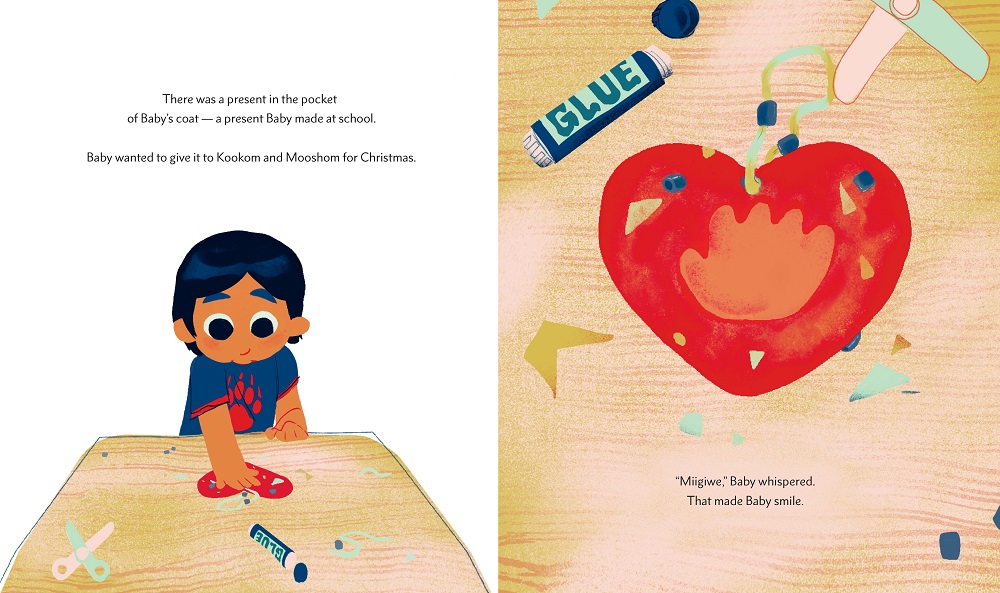
One thing the bear cub will not do is craft a gift for his grandparents, Kookom and Mooshom. The picture of this project is composed of carefully spaced elements, each one of which represents something important: creativity, love, simplicity, focus. Glue, scissors, a red paper heart, become a concrete expression of miigiwe, that Baby’s father has explained: “That means ‘giving away.’ And it’s good.”
The pictures by Erin Hill alternate outdoor panoramas, domestic interiors, and framed scenes of specific activities. A view of the family seated around a wood stove is set an angle and viewed from a slight elevation. Relatives embrace, but there is empty space between different sections of the picture. Kookom and Mooshom are thrilled to see their grandchild, but they listen carefully to his narration of the car trip. He has processed the truths his father communicated and his repeats them, with understanding, to the older generation. Do you have grandparents? Are you a grandparent? Do you remember your grandparents? You will never forget these scenes. The family goes outdoors, where they sing about the poetry of winter while playing drums. Whatever winter holiday you celebrate, An Anishinaabe Christmas will resonate as strongly as that chorus.
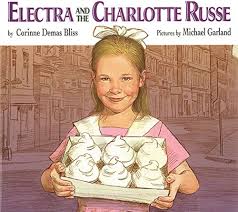
Electra and the Charlotte Russe – written by Corinne Demas Bliss, illustrated by Michael Garland Boyds Mills Press, 1997
When I was growing up in New York, the charlotte russe was a popular pastry, though the peak of its popularity was already gone by the post-World War II era. At the time, I wasn’t aware that I was enjoying a part of New York food lore in its decline, but that still had meaning for my parents’ generation. In Electra and the Charlotte Russe, a Greek-American family, living in an ethnically mixed Bronx neighborhood, is the center of the nostalgic story. In her author’s note, Corinne Demas Bliss writes that the book is based a story which her mother, Electra, had related about her own Bronx childhood in the 1920s. Whatever your background, and whether or not you have ever eaten the delicate pastry enclosed in a paper sleeve, you will probably respond to the essence of Demas’s tale and Michael Garland’s almost photorealist pictures.
Once upon a time, there were many children’s picture books with extensive text. Electra opens with a portrait of the little girl and her mother. Electra is entrusted with an important errand. She will go to the local bakery to purchase six charlotte russes for her mother’s guests. These are Mrs. Papadapoulos, Mrs. Marcopoulos and her daughter, Athena. The guest without a melodic Greek last name is Miss Smith, who is learning Greek from Electra’s mother, in preparation for her upcoming marriage to Mr. Demetropoulis. If you think this is an overly idealized portrait of immigrant communities, the motive behind the Greek language lessons is for the future Mrs. Demetropoulis “to understand what his relatives said behind her back.”
On the way Electra meets her friend, Murray Schwartz, whose tongue has turned green from eating a gumball. A much older neighbor, Mr. Melnikoff, waxes nostalgic about the charlotte russes of his own past, calling them “a dessert fit for a princess.” The extended text occupies some pages, while others have only one or two sentences. A typical New York City apartment building, as rendered by Michael Garland, seems shaded in ombre light and colors, accompanied by the brief instructions to Electra not to run even though she is in a hurry. Mrs. Zimmerman at the bakery repeats that prophetic warning to her young customer.
When Electra trips, damaging the exquisite works of art in her bakery carton, she tries to fix them. This leads, of course, to eating some of the whipped cream. A two-page spread shows four scenes of Electra’s face and hands as she attempts to even out the cream. Every step of the process is detailed in sequence, from Electra’s entrance into her apartment building, to her settling on several landings with the pastries, and finally reaching her home. “They didn’t look quite like charlotte russes anymore, but at least they did look all the same.”
Fortunately, Electra’s mother had prepared other delicacies: baklava, diples, loukoumades and kourabedes. The guests enjoy the now transformed and unidentifiable charlottes russes. After they leave, Electra’s mother explains to her the concept of remorse. “Remorse is when you wish you hadn’t done something that you did.” But she isn’t angry with her daughter, and the book closes with Electra sitting on her mother’s lap. Perhaps she would have been less forgiving if her guests had not enjoyed the gathering, or the pastries denuded of whipped cream. But I doubt that would have made a difference.
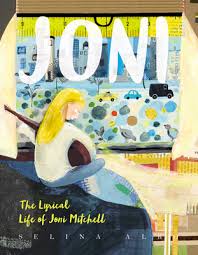
Joni: The Lyrical Life of Joni Mitchell– and illustrated by Selina Alko HarperCollins, 2020
When Roberta Joan Anderson, eventually known to the world as Joni Mitchell, was in school, she had an inspiring English teacher. Mr. Kratzman advised her to approach her writing as she did her visual artworks: “If you can paint with a brush, you can paint with words.” Selina Alko’s picture book biography of Mitchell embodies that principle in both its text and pictures, which are inextricably linked in this voyage through the singer and composer’s life and work. The author/illustrator and her subject are perfectly matched, making her book accurate, illuminating, and a stunning work of art in itself, as are her earlier books.
Combining acrylic paint and collage, including found objects, Alko creates a complete vision of Joni’s (as she refers to the singer), early life and subsequent development as an artist. The young Joni is identifiable as the mature woman, and the elements of both “heart and mind,” as one of her memorable lyrics, are intertwined. First we see Joni as a young girl on the prairie of western Canada, dancing to the sound of birds. Her parents stand in the background, and a train, composed of geometric shapes, collage elements and stamps, passes by. Every page frames Joni’s life in this inventive format, each object attracting the reader’s eye with a specific relevance to the narrative. A bird’s-eye view of Joni playing the piano shows both her hands and the top of her head, which is crowned with a helix of words, notes, and ink-like spots.
Joni recovers from the childhood scourge of polio. She listens to Pete Seeger and Elvis Presley, attends art school in Calgary, and performs in coffeehouses. Alko does not omit her failed marriage to folk singer Chuck Taylor, but she chooses not to discuss the painful decision Joni made to give up her daughter for adoption. Nevertheless, this trauma obliquely appears in a picture of Joni writing the lyrics to “Little Green” in dark, bold pencil. Alko could not have referred to every formative experience in her subject’s life, yet she is committed to acknowledge as many of them as possible.
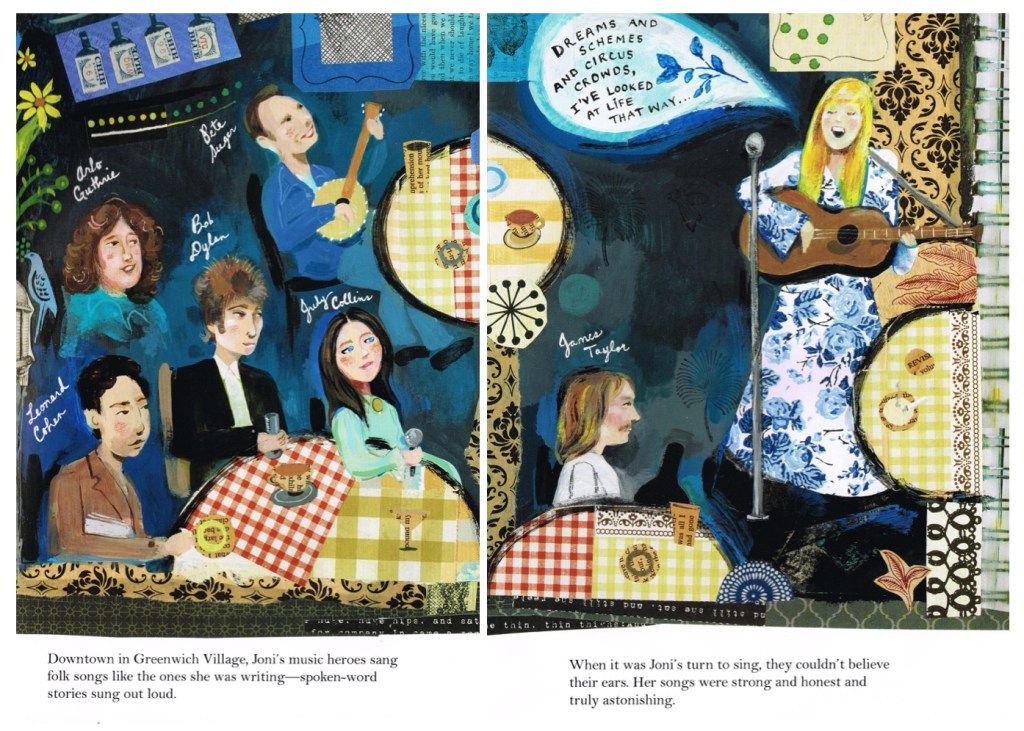
The two pages that chronicle the genesis of Chelsea Morning are another example of this fidelity. Everything is there: the butterscotch curtains, the traffic, the bowl of oranges. You can practically smell the incense. When Joni performs in Greenwich Village, there are cameos of Leonard Cohen, Judy Collins, Bob Dylan, and other engrossed listeners. Here is your chance to explain to children who these great innovators are. It will not be difficult to convince kids that listening to Joni “helped people feel understood,” or that, when her fans demanded her older style rather than experiments in jazz, “Joni didn’t care.”
Alko includes a discography, bibliography, and a thoughtful author’s note explaining why she was drawn to write and illustrate Joni. The result is an explosion of color and poetry, along with a meticulous record of Joni Mitchell’s legacy. This book is for children, teens, and adults.









 Imaginary Elevators