Ready, Set, Anne

Anne: The Chapter Book Collection – adapted by Kallie George, illustrated by Abigail Halpin
Tundra Books, 2025

Anne Dares – adapted by Kallie George, illustrated by Abigail Halpin
Tundra Books, 2023
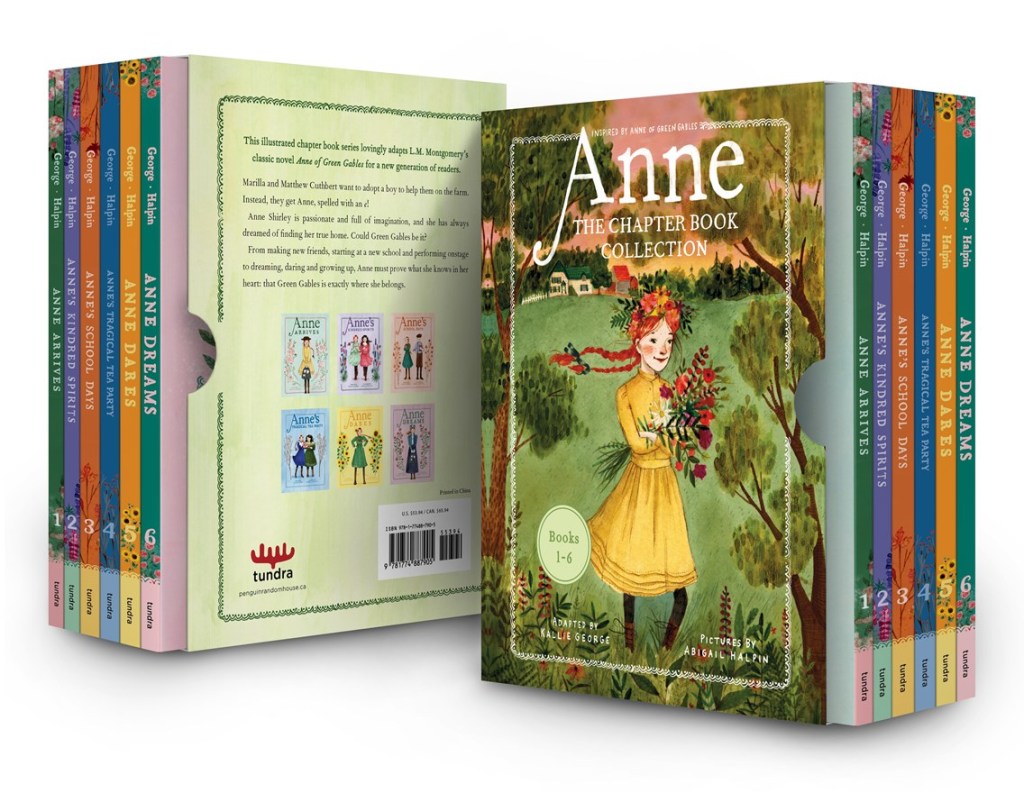
For fans of Kallie George and Abigail Halpin’s wonderful collaboration in bringing the work of Lucy Maud Montgomery to chapter book readers, Tundra has issued a boxed set of paperback editions.  As you will read on my earlier posts (see here and here and here and here), this series is both an accessible introduction to the original Anne of Green Gables, and each volume a  wonderful illustrated novel that stands on its own merits.  Abigail Halpin’s pictures offer her own perspective on the characters and setting, and Kallie George has succeeded in writing an homage to Montgomery’s vision, not a bland imitation.

In Anne Dares, the bold aspect of Anne Shirley’s personality propels her to take some risks.  These include the physically daring walking on the edge of a fence, as well as the courage to perform in her school’s recital. The fence-walking stunt even requires her to ignore the advice of kindred spirit Diana. Ever conscious of a dramatic situation, Anne assures her friend, “And if I do perish,…you can have my pearl-bead ring.

Her performance involves facing her apparent nemesis, Josie Pye, as well as Gilbert Blythe, the boy whose thoughtless teasing will prove to be a mere mask over his true feelings. Her new puff sleeved dress, a gift from her beloved father figure, Matthew, gives her some of the strength she needs in front of an audience.  The dress is both a cherished article of clothing, as well as a tangible proof of the love that now characterizes her home life, although her initial arrival had provoked skepticism.  On stage, at first “she thought she might faint.” Daring or not, she is still afraid. Fortunately, “she knew she must live up to those puffed sleeves.”  Montgomery’s heroine, re-imagined by Kallie George and Abigail Halpin, lives in two worlds, where undeniable difficulties and dreams of beauty are intertwined.

Navigating Together

Together We Are Family – written and illustrated by Emily Hamilton
Bloomsbury Children’s Books, 2025

Wonderful children’s books each have their own outstanding qualities.  There is no one formula for producing the authenticity and beauty inherent in a distinctive picture book.  Emily Hamilton’s Together We Are Family features a tone of empathy with kids, simplicity that is not patronizing, and pictures that are reminiscent of children’s artwork without mere imitation. 

In the opening picture, the mother lowers her body slightly to speak with her daughter, a young girl using a walker.  The mother’s words are enclosed in a speech bubble bordered by unconnected dashes rather than a continuous curved line.  “You are you and I am me. Together, we are family.”  There is nothing trite about those words to a child.  The facing page shows family portraits framed and posted in their home. Each scene captures a moment: a bird carrying off part of a girl’s ice cream cone, a father holding one daughter and an older daughter’s face peering over the bottom of the photo, sisters on the beach with their back to the viewer.

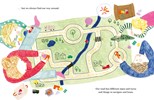
Hamilton’s illustrations are rendered in watercolor and pencil, along with Photoshop.  Simply using media that children might also prefer, including colored pencils and paint, does not necessarily convince readers that the illustrator identifies with their point of view.  The primary colors and naïve brushstrokes need to be accompanied by a sense of identification. In a terrific two-page spread, Hamilton presents a bird’s eye view of a family that embodies the metaphor of finding their way together.  Sitting around a floor mat designed as a town with roads connecting the community, each family member chooses a different activity, but they are working in harmony. The father “drives” a red car in a traffic circle, while one child drives a similar vehicle on her mother’s pants leg. The mother builds a structure with blocks. The younger girl, who is moving a toy alligator, which seems more fanciful and less related to the overall purpose of the game, is just as integrated into the scene.

Frustration is also part of a child’s life, as Hamilton visualizes without judgment.  Putting on her shoes is a challenge for the young girl, as is climbing stairs without the aid of her walker.  As with all children, whether or not they have special needs, anger can erupt unpredictably, as “the moods that catch you unawares.”  While her older sister calmly picks up a piece of fruit at their picnic, the younger girl, frowning, tosses a sandwich into the air. The chaotic merriment of a party is off putting to the child, who stays close to her mother watching the scene with some discomfort. Anyone, young or old, who has ever experienced frenetic social activity as less than an unalloyed joy will relate to this scene.

In a sensitive author’s note, Hamilton explains how her daughter’s disability has influenced their life as a family in specific ways, but she emphasizes how all families inevitably cope with difficulties through support and love.  Together We Are Family resonates with that truth for all readers.

Stage Door

The Rehearsal Club – Kate Fodor and Laurie Petrou
Groundwood Books, 2025

Kate Fodor and Laurie Petrou’s new middle-grade novel, about aspiring actresses and quirky kids, is quite a production.  Alternating between two eras, it does not involve time travel, but rather involves a mystery in the past which contemporary characters have committed to solve.  If this description sounds somewhat formulaic, the novel transcends the very formula that frames its story.  While several familiar elements are there; the magic of theater, coming of age narratives, sibling and friendship rivalries, and intergenerational tensions, they avoid all the clichés associated with this popular literary and cinematic tradition.

The Rehearsal Club is a wonderful book.

Paloma “Pal” Gallagher is a twelve-year old girl who has just moved from Arizona to New York City, where her older sister, Naomi, is pursuing a career in theatre.  Pal’s parents are both librarians, and her mother has a new job in the New York Public Library system. Pal is outgoing and socially awkward at the same time, but she finds a crew of similarly category-resisting friends who provide one another with mutual support. The women’s residence where Naomi lives has a long history, but is now facing financial extinctions. Chapters set in 1954 follow two young mid-century characters, Olive and Posy, with contrasting personalities and different approaches to finding success on Broadway.  Meanwhile, in the present, Pal’s parents take off for a librarians’ conference and Pal, temporarily and surreptitiously, moves in with Naomi, and becomes part of her distinctive milieu.

The authors capture perfectly the competitiveness and camaraderie of theater life, in both the past and present. If it seems idealized to have such striking differences between Olive and Posy, the resolution of their dreams as parallel, more than intersecting, actually works.  At every point when the reader is asked to suspend disbelief just a bit, a surprise intervenes.  There are so many antecedents for the idea of conflict mixed with solidarity in this setting, that adding a new element seems improbable.  Melanie Crowder’s Mazie, for a young adult audience, is also inventive in simultaneously paying homage to clichés while dismantling them, and Shira and Esther’s Double Dream Debut by Anna E. Jordan plays with mistaken identity and explores Yiddish theater.

Characters age in The Rehearsal Club. The young and insecure Olive becomes an ageing grande dame with some decidedly unattractive qualities, but also a core of honesty and toughness. In fact, she reminded me a little of Mrs. Basil E. Frankweiler, for those qualities as well as for her impatience with the idea of patronizing children.  Young people need to learn from older ones, and, fortunately, the advice offered by people with more experience actually has value. 

As the authors explain in their afterword, there was a rehearsal club in New York. That reality was an inspiration for the story of Pal, Olive, Posy, and all the others determined to break a leg and perform to great acclaim.  But only the imaginative and skilled approach of Fodor and Petrou allowed brought the script to life.

Giving a Young Woman Her Voice

Adi of Boutanga: A Story from Cameroon – written by Alain Serge Dzotop, illustrated by Marc Daniau
Eerdmans Books for Young Readers, 2025 (originally published in French, 2019, Translated by the author)

Adi of Boutanga is an important book. That quality would not necessarily make it appealing, let alone essential, to read, but there are many other reasons why it is just that. A voice that resonates with the truth, beautiful illustrations and innovative graphics, a compelling story, and a deep sense of conviction will all enfold the reader in its narrative fabric.

Adi is fourth grader living in a nomadic community, the Mbororos, in Cameroon. Although they are traditionally herders, their economy has changed; Adi’s father transports passengers on his motorcycle and her mother sells Makala (doughnuts) in the marketplace. Adi’s identity is defined by family relationships: “I prefer to stay the big sister of Fadimatou, Zénabou, Youssoufa, Daïro, Souaïbou, and baby Mohamadou.”

Children cannot control their own lives, even to the limited extent that adults are able to do so. Adi loves attending her school, which she describes as a “gift” to the village by Mama Ly and Monsieur, generous benefactors. The process of learning to read may seem inherently magical to many children, but Dzotop captures the poetry of this experience and gives Adi a voice:

      Before the school was given to our village, words were invisible to us. We
      could hear them, but we couldn’t see or touch them. I even thought a
      a strong wind might steal them as soon as they left our mouths. But that
      wasn’t true.

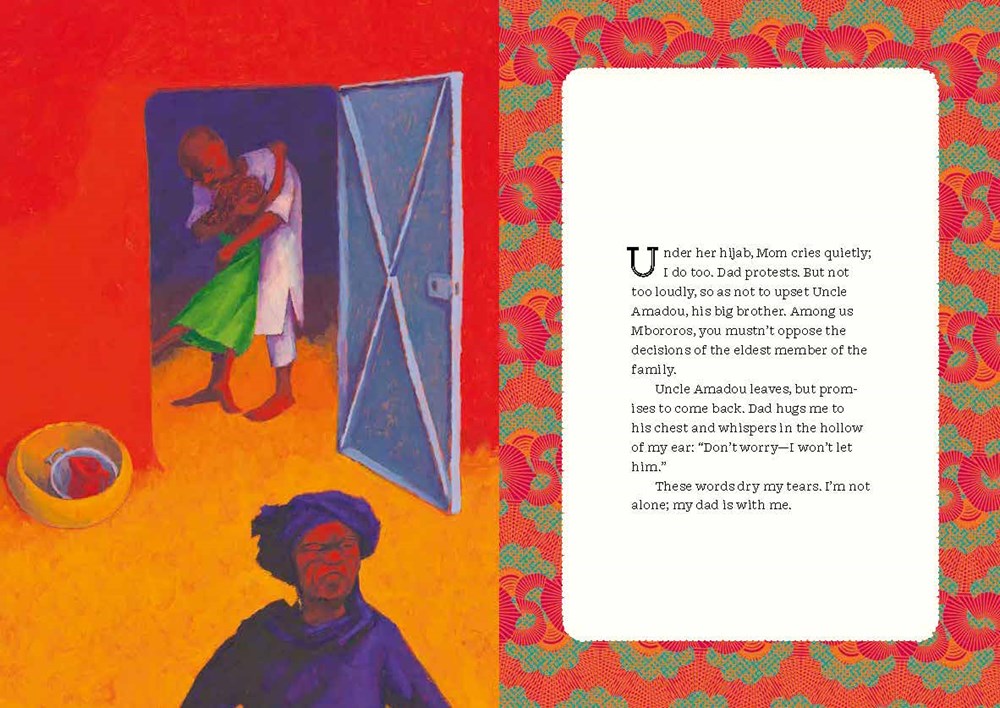
Although there may seem to be a fable-like quality to the book, the characters are not generic. Adi’s mother embraces her daughter’s individuality, responding to Adi’s frequent laughter with the suggestion that her daughter has “swallowed a thousand weaverbirds.” But the warmth and protectiveness of Adi’s life is shattered when her uncle arrives to inform the family that, although still a child, she must marry. Her father and uncle assume opposite patriarchal roles, one caring and the other transactional. “They throw words at each other. Words that hit like stones.”

Saving their daughter means that Adi’s parents must send her away. She goes to Boutanga, where her benefactors have established a school for girls that fosters creativity and dignity. Even if this solution is not a global one, it is enough for Adi and an example for all. Eventually, when she has arrived at the point in her young adult life when she is able to choose, Adi finds love with a man who respects and understands her. Mastering language has been a key to her growth, “catching words… putting them in the right order and making sure they say the right thing.”

The book is not composed only of words, but of images that organically emerge from the culture which they represent. Pages with illustrations alternate with blocks of text set against traditional fabric patterns. Human figures allude to sculpture but have kinetic movement. Earth tones are the setting for the book’s quiet drama, with deep blue sea and red skies framing Adi’s journey. Adi of Boutanga is not a moral lesson, but a work of art that interweaves modern aspirations of freedom for women with the unique threads of a specific culture. It is a book to read, share with children, and read again.

Not Scary, Really

This Book is Dangerous! (A Narwhal and Jelly Picture Book #1) – written and illustrated by Ben Clanton
Tundra Books, 2025

What is the difference between Narwhal and Jelly, the sea creature duo from Ben Clanton, when they appear in a picture book or in their previous format, graphic novels (see here and here and here)? This is not a rhetorical question. While in This Book is Dangerous! they inhabit a larger format with a somewhat more intense narrative pace, they still have the same lovably sincere personalities.  There is a narrower range of characters and fewer digressions. Jelly is focused on his fears, given the title of his picture book debut.

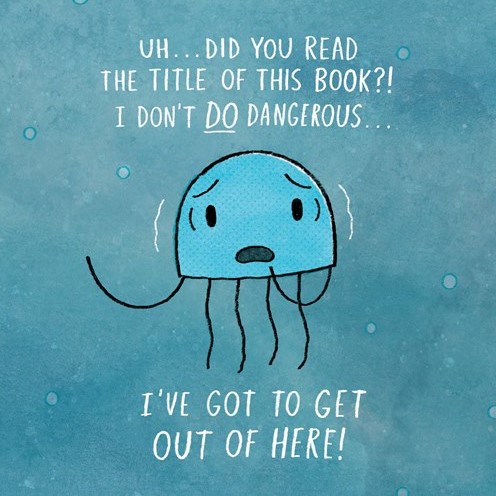
Jelly is rendered in Clanton’ inimitable style, with a touch of Ed Emberley simplicity. His inverted eyebrows and down-turned mouth ask the reader what on earth, or in the sea, is going on: “UH…DID YOU READ THE TITLE OF THIS BOOK?!” The redundant punctuation tells you just how terrified he is.  Soon he is caught in a maze of signs urging caution, peril, and the need to stop. Jelly believes that the reader can help him to decode them and offer advice.

There are sea serpents with sharp teeth and a cannon which may or may not be non-functional. Jelly is actually transformed into a dark red cannonball, as Clanton extends the character’s legs, opens his eyes wide, and reverse the direction of the eyebrows.  Children relate to artwork that seems to contain elements of their own.

The drama settles down, and the book briefly returns to the idiosyncrasies of the graphic novels.  A page entitled “SOME NEARBY ITEMS” also reminded me The Everything in the Whole Wide World Museum: With Lovable Furry Old Grover, although the stakes are higher. Jelly needs support, but he may have some problems depending on “PRICKLY UNDERSEA PINEAPPLE,” or “RANDOM CACTUS.”

Jelly becomes angry, disappointed with the reader who, as in The Monster at the End of This Book, does not seem to understand the gravity of his problem. After all, someone who cannot help him extricate himself from danger is as dangerous as the book itself and all the horrors it contains. When Jelly finds some courage, along with ingenuity, and a bit of luck, he feels calmer, safer, and happy to meet his old friend Narwhal for a nostalgic ending.  His warning not to read the book over again is not to be taken literally.

Learning from Color

A Universe of Rainbows – poems selected by Matt Forrest Esenwine, illustrated by Jamey Christoph
Eerdmans Books for Young Readers, 2025

To paraphrase Mark Twain oft quoted remark about the weather, everybody talks about STEAM (science, technology, engineering, arts, and mathematics), but nobody does anything about it.  A Universe of Rainbows is a picture book that fulfills the ideal of combining education about these seemingly disparate fields.  An anthology of poems rooted in rainbows and color, it includes works by well-known authors and others whose work may be less familiar.  Each poem is accompanied by a boldly colored illustrated, and by a column of informational text. The breadth and range of the content and styles is amazing.

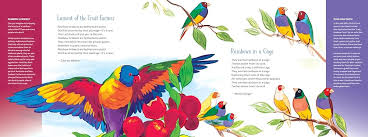
Virtually any selection gives a sense of the book’s approach. A poem by prolific author Marilyn Singer, “Rainbows in a Cage,” warns of the dangers of extinction caused by the voracious pursuit of rainbow finches: “They wanted rainbows in a cage:/finches stolen from the wild./A different time, a different age.” Singer uses the poetic form of the triolet, while other poems in the collection are composed in free verse.  This compact form, using only two different rhymes, is perfect for conveying her message.  The birds’ beauty does not excuse their exhaustion by selfish collectors. At the same time, she contextualizes the events by noting that different standards have applied in the past.  Jamey Christoph’s picture of the sought-after birds sitting on branches shows the bright and pastel colors that attracted collectors.  The explanatory text gives historical background and summarizes the results of the birds’ popularity: “the demand for Gouldian flinches became so great they were nearly trapped and caged out of existence.”

Lee Wardlaw points out the unfairness of judging a species only by its obvious beauty in “The Fruit Fly’s Secret.”  Yes, butterflies are lovely, but “just because/they flit and flirt/on wings of rainbow hues” they have deflected attention from the equally significant fruit fly.  Viewed under a microscope, the colors of these insects are revealed, elevating them from their lowly habitats in “drains and sinks and mops” or rotting fruit.  The text box describes how photomicroscopy documents how they refract light, and also interacts with the poem itself.  Wardlaw includes quotes from different authors extolling the beauty of butterflies; the text refers back to the poem by attributing each quote (Victor Hugo, Oscar Wilde, Bashō, and more).

Editor Matt Forrest Esenwine’s own poetry is also part of the book. “Alien Fountain” responds with awe to the unexpected phenomenon of the Fly Geyser, a “peculiar/accident/that could/only have/been created/by human ignorance/and Nature’s/resilient/soul.”  This result of an energy company’s drilling for geothermal water in the 1960s produced a strangely stunning appearance, captured in Christoph’s illustration.  The algae growing on mounds of limestone caused an explosion of color, “giving the geyser its otherworldly appearance.” As in all the explanations, concise presentation of facts works in parallel with literary language.

I cannot recommend this book highly enough.  It sets a high bar for authors and artists aspiring to link science and the arts without sacrificing aesthetic and linguistic distinction.

Turning Over a New Leaf

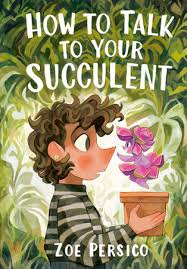
How to Talk to Your Succulent – written and illustrated by Zoe Persico
Tundra Books, 2025

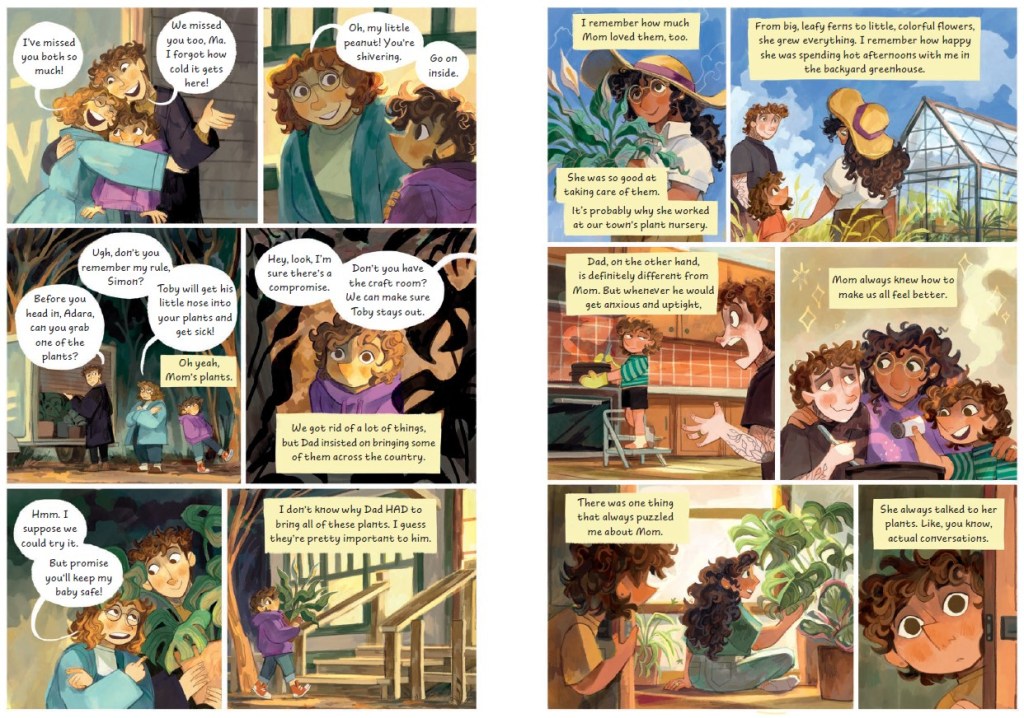
In Zoe Persico’s incredibly inventive graphic novel, Adara’s mother has recently died. She and her father leave California to move in with her grandmother in Michigan. The potential subjects of graphic novels are unlimited, and How to Talk to Your Succulent is not the first one to deal with grief, or strained relationships of parents and children. It is, however, outstanding in its sensitivity, bold graphics, and experimentation with fantasy and reality as equal components of a young girl’s search for the truth. Persico quietly presents a scenario that defies reality, and then proceeds to immerse the reader in a world where it is utterly plausible.

If you are skeptical about human communication with plants, this book will demonstrate the irrelevance of that reservation. Adara is sad and uprooted, even though her grandmother is a pillar of flexible strength. Her father is trying, somewhat helplessly, to cope with his own desolation and anger, which he approaches by inadvertently discouraging his daughter from expressing her feelings. What could be worse than this agonizing moment in all their lives? As it turns out, Adara’s mother had quietly used a special power. Not only did she have the proverbial green thumb at growing plants, she could actually communicate with them: “Like, you know, actual conversations.”

Adara’s grandmother, who resembles a child’s ideal image of a non-judgmental old person as both youthful and wise, also keeps a garden and greenhouse. When Adara’s father realizes that she has taken to wearing her mother’s earrings, which resemble tiny plants, he takes her to visit a nursery where she can select an actual plant of her own. This gesture is the closest he can come to acknowledging her feelings of isolation. At the greenhouse she meets Perle, short for Perle von Nurnberg, a delicately beautiful succulent who, for a devastatingly brief second Adara believes to be speaking in her mother’s voice. Then comes the epiphany: “I can talk to plants just like Mom! I knew it! I knew it!”

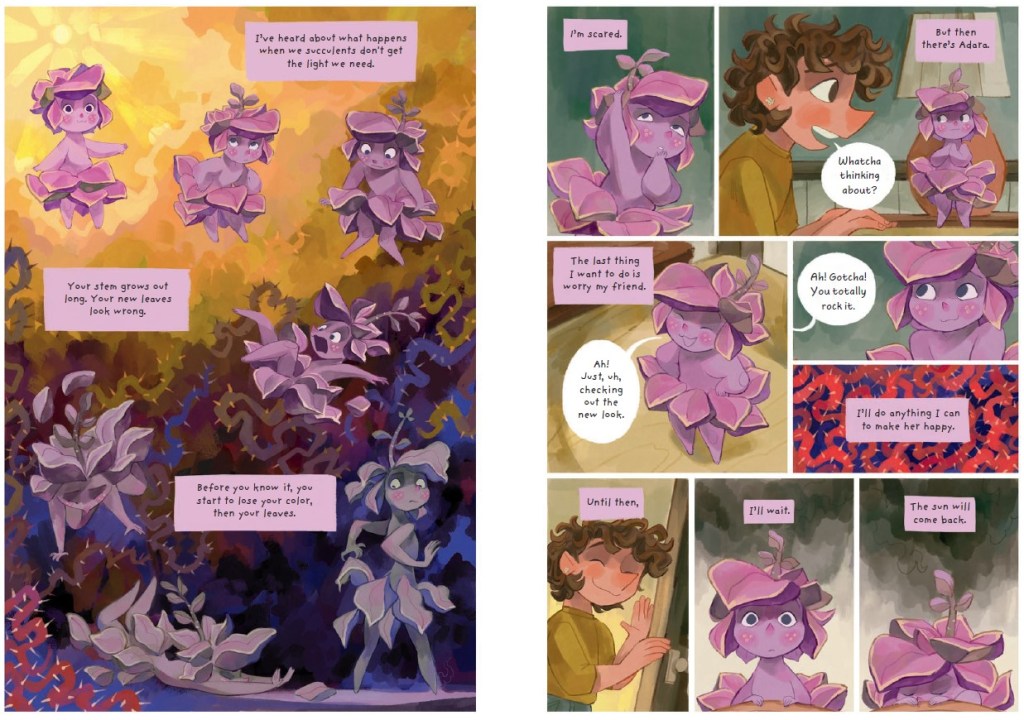
There is nothing affected about this unusual series of circumstances. Readers are not asked to suspend disbelief, but to enter Adara’s emotional state without preconceptions. Broadening her narrow circle of relatives, she also meets a new best friend, Winnie, a frustrated artist whose own mother is demanding and unappreciative of her daughter’s talents. Still, she has a living mother and Adara does not. But other people, as Adara learns, have their own problems and also need to be protected in order to thrive. Perle, the plant who demonstrates Adara’s maternal inheritance, is threatened with extinction if Adara cannot learn that same lesson as it applies to her.

The artwork of How to Talk to Your Succulent is inseparable from the text. Persico uses earth colors, jewel tones, and gradations of light in a setting that combines the spaciousness of nature with the enclosed scale of a greenhouse. People’s emotions register with expressive brush strokes, as do the fantastic plants who interact with each other and intersect with humans. The author’s note reaffirms her commitment, both artistic and emotional, to connecting with the reader. She includes mixed media photographic images, a visual and textual demonstration of her method, and even a guide to the plants at the root of her story. Equally innovative for its graphics and its exploration of emotional vulnerability, this book will bloom with every re-reading.

Uri Shulevitz 1935-2025

Uri Shulevitz died on February 15.  The breadth of his artistic vision was outstanding, demonstrated both in books which he wrote and illustrated, and in others that he illustrated in collaboration with another author.  Many were deep explorations of Jewish themes, while others were more universal in scope. Chance was a masterpiece, integrating his entire life’s work in both words and pictures (I have also written about him here and here). The title indicates his conviction that his survival as a refugee from the Nazis, and, therefore, his entire career as an artist, was fundamentally a result of random events.  The book earned many distinctions; unfortunately, a Sydney Taylor award was not among them.

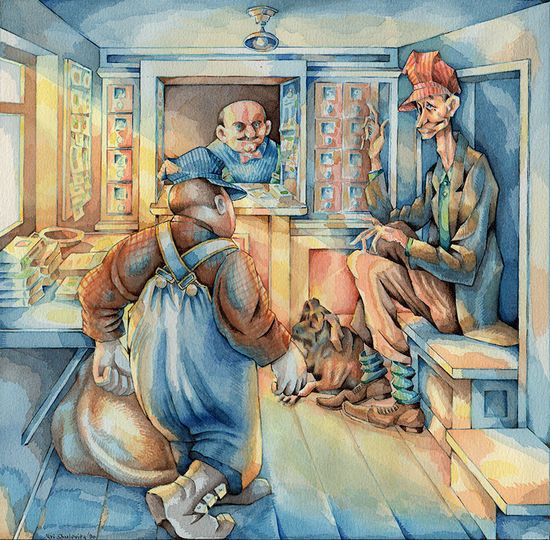
I would like to call attention to one long out-of-print work by Mr. Shulevitz, his quirky, and even disturbing, Toddlecreek Post Office. (Farrar, Straus and Giroux, 1990). Like several of his other books, it adopts a tone from folklore. The small village of Toddlecreek has a small post office. It resembles an ordinary house, with tall windows, flower boxes, and an American flag indicating its purpose. The name of the postmaster is Vernon Stamps, reinforcing the idea that the story is something of a parable. (Some of his neighbors are named Mrs. Woolsox; Charlie Ax the logger; and the garrulous and nostalgic Dexter Shuffles.) Mr. Stamps is busy and efficient, but also compassionate, helping everyone in the community and even welcoming animals to his overcrowded enterprise.

Into this paradise, one unfortunate day, the postal inspector intrudes.  Her presence is immediately disturbing, and the animals react before she even sets about her task. “Birds’ songs diminished…Bees’ buzzing ceased, or so it seemed. The small dogs stopped barking, and stared.” The inspector examines the post office’s records, as well as the evidence that unofficial, but humane, activities are also promoted there. There are books to read, and announcements for barn dances on the bulletin board. She announces that the post office will be closed. Vernon is stunned, but he senses that resistance to this decision is futile. He locks up and leaves.

If readers are not already saddened by this point, Shulevitz makes clear that the post office’s closure leaves a terrible gap in the life of the community.  There is a sense of shock in the rumors about Silken, Vernon’s part wolf and part sled dog companion. The animal has disappeared. “Some say she went north to join the wolves. Others say she was killed by a hunter.” 

What motivated Shulevitz to end the book on an unambiguous note of sadness? He was a great artist and humanist who had lived through the worst conditions imposed by tyranny.  Toddlecreek has been ruined.  “It is not on any map, it is bypassed by travelers and forgotten by time. And now, like any other small village, Toddlecreek has no post office.” Yet, unlike the residents of this unfortunate town, he did survive to produce an unforgettable body literature and artwork for both children and adults.

What Makes Us Happy

I Would Give You My Tail – written by Tanya Tagaq, illustrated by Qavavau Manumie
Tundra Books, 2025

This tender, subtle, book, about a boy awaiting the birth of a sibling, is set among the Indigenous people of Nunavut, northern Canada. It is both unique to their culture and universal in its expression of gratitude, both to people and the environment in which they live. The title refers to a conversation between two hares, echoed by other animals, and finally by the brother welcoming his new sister to the world they will share. The language seamlessly weaves together the language of the physical world and metaphor. The pictures, created in colored pencil, draw from Inuit folklore, as well as the specific qualities of the characters.  Sharing is a concept central to the book, part of the overall vision of happiness passed from one generation to the next.

Assuming a child’s perspective in a book for children may seem natural, but it’s not so easily accomplished. Here, from the first page, readers will empathize with the boy, Kalluk’s, feelings of expectation and some anxiety, as he awaits a profound event in his life.  Tanya Tagaq is straightforward in presenting the situation: “Kalluk’s mother is in labor and about to have a baby.” Even the repetition of seemingly redundant terms, “labor,” and “about to have a baby,” reflects the way that children incorporate reality. Qavavau Manumie’s illustration shows the pregnant mother touching her kneeling son in a gesture of reassurance, before he sets out to bring his grandmother to help.

Unhappiness is, realistically, part of Kalluk’s range of feelings at this moment. He asks two hares why they are happy, and learns how the qualities that they need to survive, speed and cleverness, are fulfilling ones. A brook is happy because of the fish who inhabit it. Mothers, animals or human, are happy with the offspring to their care. Explanations are kept to a minimum. Kalluk can sense the sincerity of all the responses.

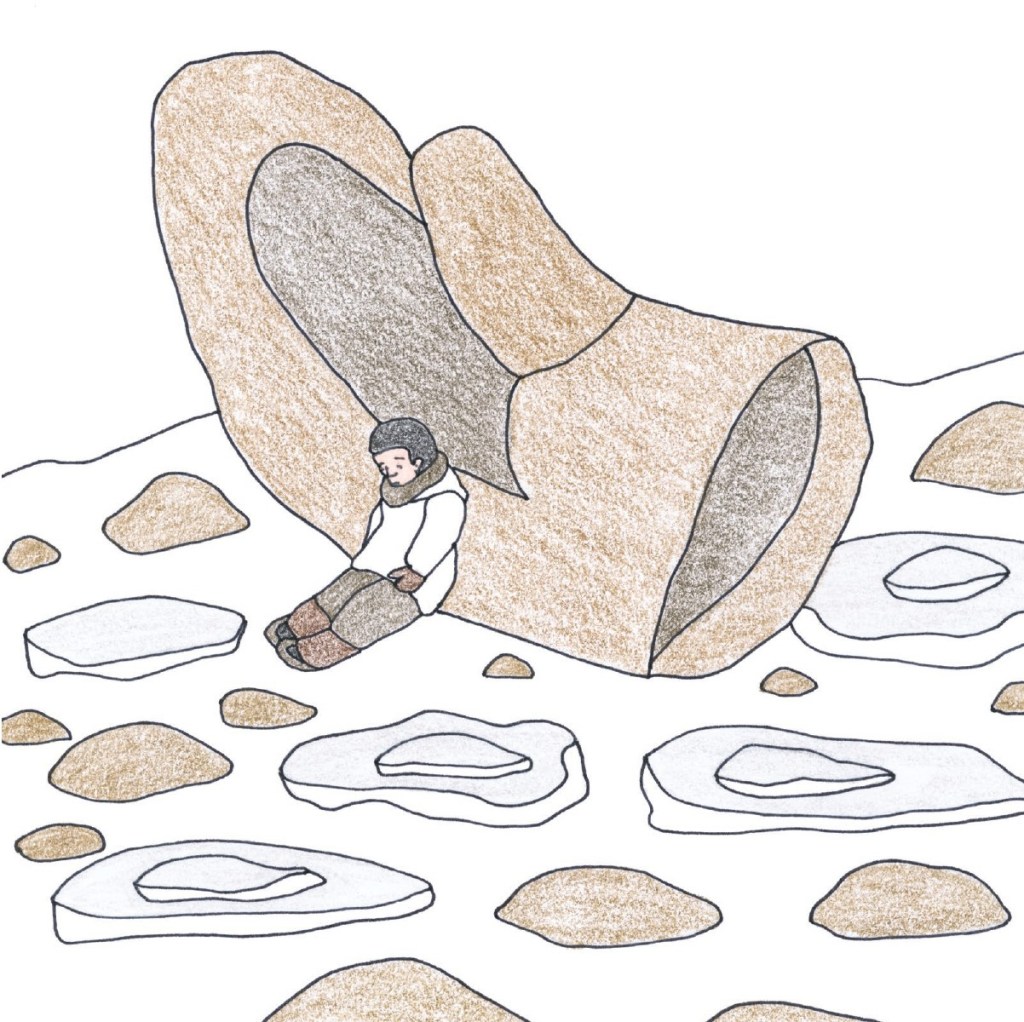
A picture of Kalluk seated with his back against a giant mitten embodies his feelings of gratitude tinged with sadness. He clearly misses his mother, thinks of the warm mittens she has created for him, and sends her “all the love in his heart.” The way in which that message is convened does not need to be articulated.

Meeting his grandparents, Kalluk has reached the confirmation of all the previous lessons about gratitude and love. His grandmother, Anaanattiaq in their North Qikiqtaaluk dialect, is unapologetically depicted as old; she “stands up slowly, bones creaking and cane shaking.”  Any diminished physical strength is no obstacle, as she states purposefully, “Let’s go greet the new one.” Walking home, the boy asks her about her source of happiness. When she answers “peace,” he requests an elaboration. This dialogue is different from those with the animals. She tells him in the most direct language that peace grows inside each person, as he or she makes a series of choices in life. The right choices will make you proud, and grant “lots of peace,” the kind that is meant to be shared.

When Kalluk and Anaanattiaq come upon “a conspiracy of ravens,” the squawking, lively birds are friendly towards them.  Their requirement for happiness is “knowledge,” a slight variation of the other animals’ answers. Their grandmother, the ravens assure Kalluk, is full of knowledge. That knowledge is put to the most important use when she arrives at Kalluk’s home, where his mother has already given birth and his breastfeeding the baby whom he is now prepared to teach everything he has learned.  Gratitude for food, water, family, and the ability to choose well, are the gifts he brings to her, as well along with a declaration of love.  I Would Give You My Tail is like a perfect circle, enclosing the reader in the complete circle of Kalluk’s journey.

Parent-Child Conversations

Fantastic Lou: Little Comics from Real Life – written and illustrated by Qin Leng
Tundra Books, 2025

All good children’s books are also good books for adults, but some seem specifically designed for both audiences. Qin Leng’s graphic chapter book, picture book, or collection of “little comics,” is definitely in the latter category. The cover, with a brightly smiling child radiating assertiveness, alludes to some of the mid-twentieth century comic classics. The wry interpretation of parenting issues also brings to mind the work of Liana Finck. Yet Fantastic Lou is also fantastic for children, reflecting their thoughts and feelings about everyday situations and important relationships.

The interminable experience of playing a board game is, at the same time, a way to have some quiet and meaningful interaction with a Lou, her child.  The existential unfairness, mixed with boredom, might even be irritating to adults. “You fell in a hole. That means you gotta go back to square one.” An adult might feel bereft at that news, but a child’s understandable rage is difficult to dismiss. Leng captures the whole range of responses in her lively and delicate pictures, drawn in ink and digitally colored.

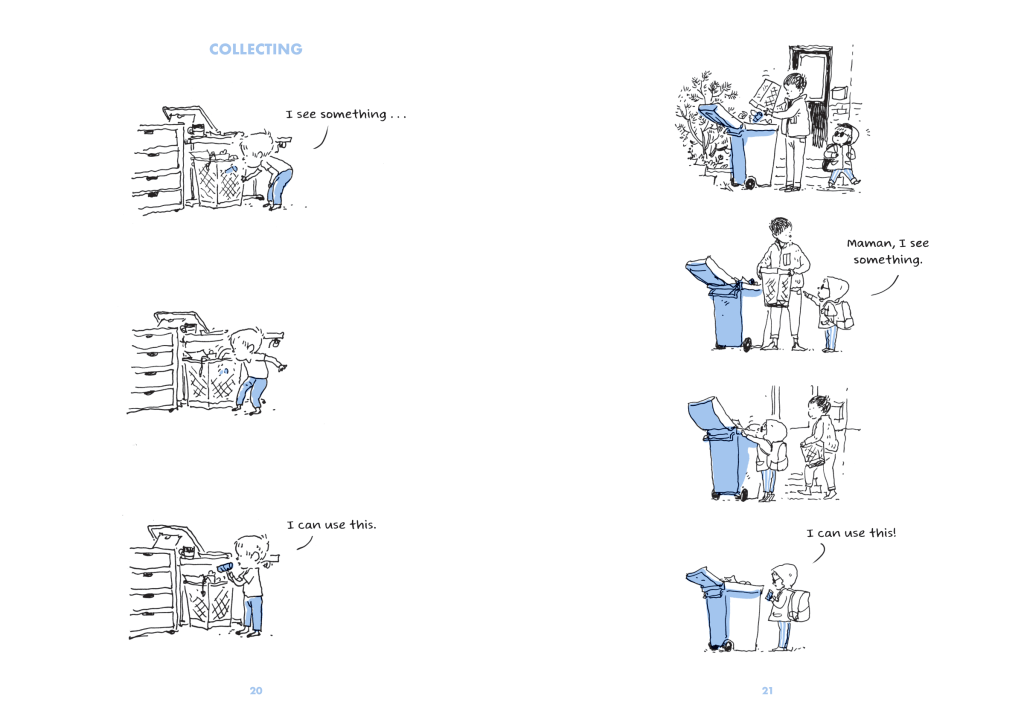
Collecting may have different meanings for children and adults. Leng focuses on how a child finds meaning in an object that seems useless to his parents.  Forget well-intentioned recycling. Lou extracts a series of items, explaining the process with clear simplicity. Language also reflects the difference between Lou and Maman: “I see something, Maman. I can use this.”  What further justification is needed for pulling things out of the trash?  The reader is left to imagine the infinite uses implied in Lou’s artistic vision. 

Lou’s image of his future self is as clear as his prospective plans for thrown-away collectible. In “When I Am Bigger,” he divides his life so far into two stags, and projects a third one based on growing size and increased power.  After all, that is how adults appear to children.  The adjacent chapter, “Montréal Trip,” takes that abstract idea and offers a concrete example of his special status as a child.  The prospect of boarding the plane is exciting enough, but, in fact, his small and vulnerable size is granted equal status to the most privileged travelers: “Priority boarding for VIP members and passengers traveling with young children…”

Children are VIPs in Leng’s work. Sequences of constant motion, flights of imagination, and attempts to make sense of adult decisions, add up to childhood itself.