Learning from Color

A Universe of Rainbows – poems selected by Matt Forrest Esenwine, illustrated by Jamey Christoph
Eerdmans Books for Young Readers, 2025

To paraphrase Mark Twain oft quoted remark about the weather, everybody talks about STEAM (science, technology, engineering, arts, and mathematics), but nobody does anything about it.  A Universe of Rainbows is a picture book that fulfills the ideal of combining education about these seemingly disparate fields.  An anthology of poems rooted in rainbows and color, it includes works by well-known authors and others whose work may be less familiar.  Each poem is accompanied by a boldly colored illustrated, and by a column of informational text. The breadth and range of the content and styles is amazing.
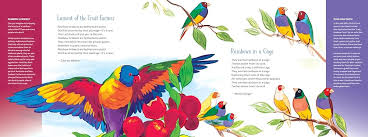
Virtually any selection gives a sense of the book’s approach. A poem by prolific author Marilyn Singer, “Rainbows in a Cage,” warns of the dangers of extinction caused by the voracious pursuit of rainbow finches: “They wanted rainbows in a cage:/finches stolen from the wild./A different time, a different age.” Singer uses the poetic form of the triolet, while other poems in the collection are composed in free verse.  This compact form, using only two different rhymes, is perfect for conveying her message.  The birds’ beauty does not excuse their exhaustion by selfish collectors. At the same time, she contextualizes the events by noting that different standards have applied in the past.  Jamey Christoph’s picture of the sought-after birds sitting on branches shows the bright and pastel colors that attracted collectors.  The explanatory text gives historical background and summarizes the results of the birds’ popularity: “the demand for Gouldian flinches became so great they were nearly trapped and caged out of existence.”

Lee Wardlaw points out the unfairness of judging a species only by its obvious beauty in “The Fruit Fly’s Secret.”  Yes, butterflies are lovely, but “just because/they flit and flirt/on wings of rainbow hues” they have deflected attention from the equally significant fruit fly.  Viewed under a microscope, the colors of these insects are revealed, elevating them from their lowly habitats in “drains and sinks and mops” or rotting fruit.  The text box describes how photomicroscopy documents how they refract light, and also interacts with the poem itself.  Wardlaw includes quotes from different authors extolling the beauty of butterflies; the text refers back to the poem by attributing each quote (Victor Hugo, Oscar Wilde, Bashō, and more).

Editor Matt Forrest Esenwine’s own poetry is also part of the book. “Alien Fountain” responds with awe to the unexpected phenomenon of the Fly Geyser, a “peculiar/accident/that could/only have/been created/by human ignorance/and Nature’s/resilient/soul.”  This result of an energy company’s drilling for geothermal water in the 1960s produced a strangely stunning appearance, captured in Christoph’s illustration.  The algae growing on mounds of limestone caused an explosion of color, “giving the geyser its otherworldly appearance.” As in all the explanations, concise presentation of facts works in parallel with literary language.

I cannot recommend this book highly enough.  It sets a high bar for authors and artists aspiring to link science and the arts without sacrificing aesthetic and linguistic distinction.
Turning Over a New Leaf

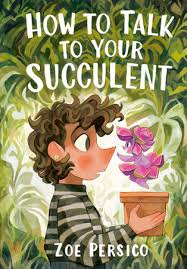
How to Talk to Your Succulent – written and illustrated by Zoe Persico
Tundra Books, 2025

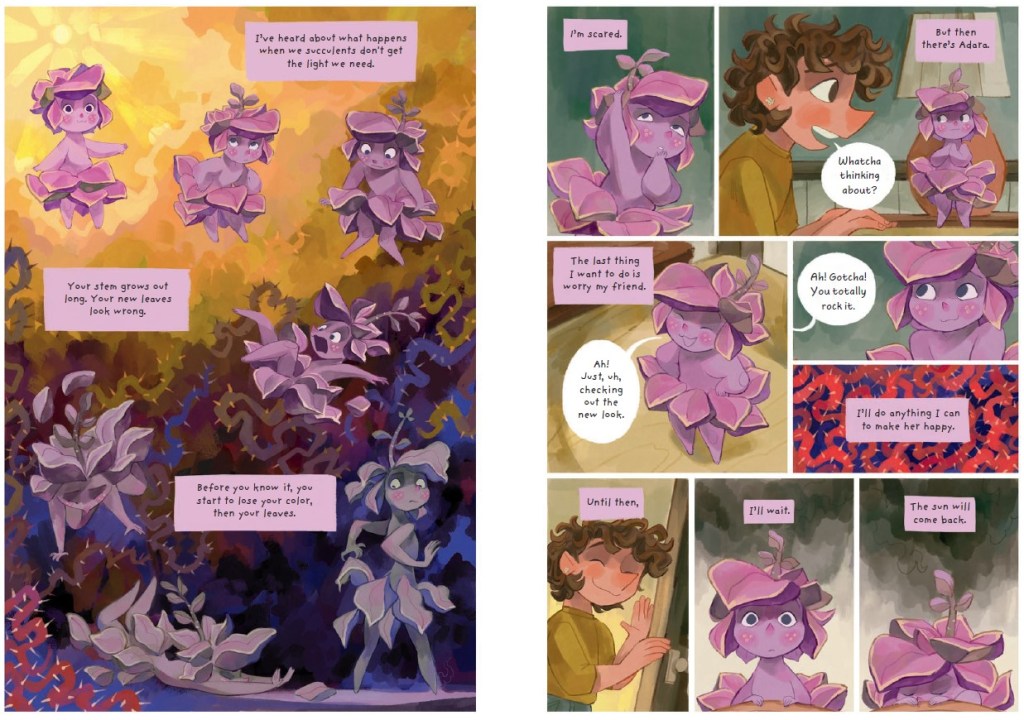
In Zoe Persico’s incredibly inventive graphic novel, Adara’s mother has recently died. She and her father leave California to move in with her grandmother in Michigan. The potential subjects of graphic novels are unlimited, and How to Talk to Your Succulent is not the first one to deal with grief, or strained relationships of parents and children. It is, however, outstanding in its sensitivity, bold graphics, and experimentation with fantasy and reality as equal components of a young girl’s search for the truth. Persico quietly presents a scenario that defies reality, and then proceeds to immerse the reader in a world where it is utterly plausible.

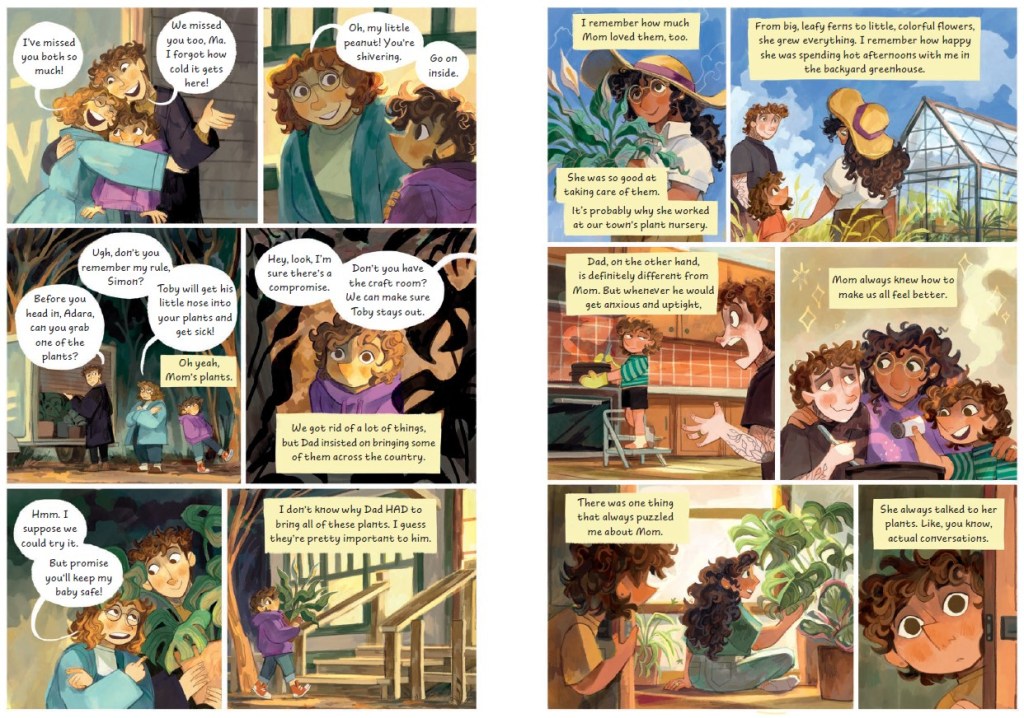
If you are skeptical about human communication with plants, this book will demonstrate the irrelevance of that reservation. Adara is sad and uprooted, even though her grandmother is a pillar of flexible strength. Her father is trying, somewhat helplessly, to cope with his own desolation and anger, which he approaches by inadvertently discouraging his daughter from expressing her feelings. What could be worse than this agonizing moment in all their lives? As it turns out, Adara’s mother had quietly used a special power. Not only did she have the proverbial green thumb at growing plants, she could actually communicate with them: “Like, you know, actual conversations.”

Adara’s grandmother, who resembles a child’s ideal image of a non-judgmental old person as both youthful and wise, also keeps a garden and greenhouse. When Adara’s father realizes that she has taken to wearing her mother’s earrings, which resemble tiny plants, he takes her to visit a nursery where she can select an actual plant of her own. This gesture is the closest he can come to acknowledging her feelings of isolation. At the greenhouse she meets Perle, short for Perle von Nurnberg, a delicately beautiful succulent who, for a devastatingly brief second Adara believes to be speaking in her mother’s voice. Then comes the epiphany: “I can talk to plants just like Mom! I knew it! I knew it!”

There is nothing affected about this unusual series of circumstances. Readers are not asked to suspend disbelief, but to enter Adara’s emotional state without preconceptions. Broadening her narrow circle of relatives, she also meets a new best friend, Winnie, a frustrated artist whose own mother is demanding and unappreciative of her daughter’s talents. Still, she has a living mother and Adara does not. But other people, as Adara learns, have their own problems and also need to be protected in order to thrive. Perle, the plant who demonstrates Adara’s maternal inheritance, is threatened with extinction if Adara cannot learn that same lesson as it applies to her.

The artwork of How to Talk to Your Succulent is inseparable from the text. Persico uses earth colors, jewel tones, and gradations of light in a setting that combines the spaciousness of nature with the enclosed scale of a greenhouse. People’s emotions register with expressive brush strokes, as do the fantastic plants who interact with each other and intersect with humans. The author’s note reaffirms her commitment, both artistic and emotional, to connecting with the reader. She includes mixed media photographic images, a visual and textual demonstration of her method, and even a guide to the plants at the root of her story. Equally innovative for its graphics and its exploration of emotional vulnerability, this book will bloom with every re-reading.

Uri Shulevitz 1935-2025

Uri Shulevitz died on February 15.  The breadth of his artistic vision was outstanding, demonstrated both in books which he wrote and illustrated, and in others that he illustrated in collaboration with another author.  Many were deep explorations of Jewish themes, while others were more universal in scope. Chance was a masterpiece, integrating his entire life’s work in both words and pictures (I have also written about him here and here). The title indicates his conviction that his survival as a refugee from the Nazis, and, therefore, his entire career as an artist, was fundamentally a result of random events.  The book earned many distinctions; unfortunately, a Sydney Taylor award was not among them.

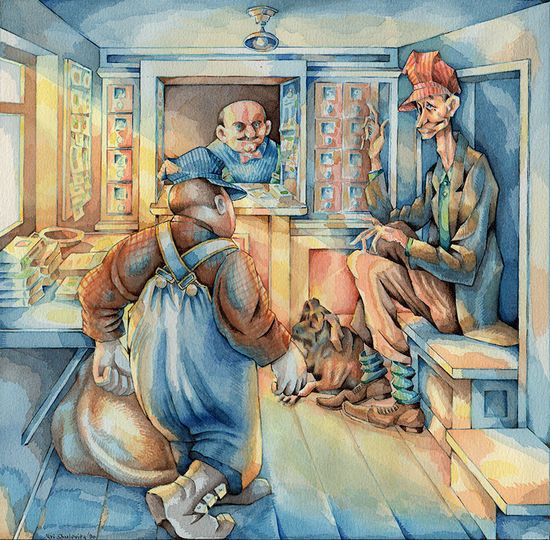
I would like to call attention to one long out-of-print work by Mr. Shulevitz, his quirky, and even disturbing, Toddlecreek Post Office. (Farrar, Straus and Giroux, 1990). Like several of his other books, it adopts a tone from folklore. The small village of Toddlecreek has a small post office. It resembles an ordinary house, with tall windows, flower boxes, and an American flag indicating its purpose. The name of the postmaster is Vernon Stamps, reinforcing the idea that the story is something of a parable. (Some of his neighbors are named Mrs. Woolsox; Charlie Ax the logger; and the garrulous and nostalgic Dexter Shuffles.) Mr. Stamps is busy and efficient, but also compassionate, helping everyone in the community and even welcoming animals to his overcrowded enterprise.

Into this paradise, one unfortunate day, the postal inspector intrudes.  Her presence is immediately disturbing, and the animals react before she even sets about her task. “Birds’ songs diminished…Bees’ buzzing ceased, or so it seemed. The small dogs stopped barking, and stared.” The inspector examines the post office’s records, as well as the evidence that unofficial, but humane, activities are also promoted there. There are books to read, and announcements for barn dances on the bulletin board. She announces that the post office will be closed. Vernon is stunned, but he senses that resistance to this decision is futile. He locks up and leaves.

If readers are not already saddened by this point, Shulevitz makes clear that the post office’s closure leaves a terrible gap in the life of the community.  There is a sense of shock in the rumors about Silken, Vernon’s part wolf and part sled dog companion. The animal has disappeared. “Some say she went north to join the wolves. Others say she was killed by a hunter.” 

What motivated Shulevitz to end the book on an unambiguous note of sadness? He was a great artist and humanist who had lived through the worst conditions imposed by tyranny.  Toddlecreek has been ruined.  “It is not on any map, it is bypassed by travelers and forgotten by time. And now, like any other small village, Toddlecreek has no post office.” Yet, unlike the residents of this unfortunate town, he did survive to produce an unforgettable body literature and artwork for both children and adults.

Fairy Architects

The Tallest Tree House – written and illustrated by Elly MacKay
Running Press Kids, 2019

Fairies usually live in tiny, beautiful, dwellings. Sometimes these are made of obvious materials: leaves, twigs, moss, and other natural elements. Often a child who loves fairies created them, or at least happens upon them and lovingly interacts with their inhabitants (for example this and this). In Elly MacKay’s The Tallest Tree House, there are two fairies, no humans. Both fairies have architectural aspirations as does this mouse). Their names are Mip and Pip, and they are somewhat competitive; at least Mip is. She actually challenges Pip to a contest: “Whoever makes the best tree house by sundown wins!” This impulsive idea doesn’t take into account the fact that Pip is currently reading a book about architecture. 

Elly MacKay’s illustrations are theatrical; she describes her method in inspiring detail (I reviewed another of her books here). Looking at her cut-out figures, carefully placed in stage settings, I was reminded a bit of the Cottingley fairy episode, a well-intentioned fraud when two girls in early 20th century Britain convinced a credulous public that they had photographed fairies. Of course, there is no fraud here; Mip and Pip are real and they create their own home. But the delicacy and care involved in bringing them to life seem related.

Even looking at the two friends, Pip seems more serious. In addition to his reading, he has a tall, pointed leaf for a head covering. Mip, in contrast, sports a comically oversized mushroom cap.  Pip draws blueprints based on his planning.  He carries a, presumably, well-stocked toolbox and uses a pulley. The sight of Mip’s obviously fragile tall tower worries him, because he cares about her more than he does about winning. Eventually, they work as a team, together completing “a winning piece of architecture.” 

Several qualities set this book apart in children’s fairy literature.  There is the tortoise and hare allusion, and the friendly warning that you need technology as well as patience to build a fairy house.  The composition resembles a theater set, and even includes sound effects, such as a terrifying BOOM in huge font when Mip’s shoddy tower collapses.  The book is not unique in excluding human observers, but it does feature an unusually independent fairy world.  Next time you build a house for fairies, read Pip’s book and bring along some simple machines.

What Makes Us Happy

I Would Give You My Tail – written by Tanya Tagaq, illustrated by Qavavau Manumie
Tundra Books, 2025

This tender, subtle, book, about a boy awaiting the birth of a sibling, is set among the Indigenous people of Nunavut, northern Canada. It is both unique to their culture and universal in its expression of gratitude, both to people and the environment in which they live. The title refers to a conversation between two hares, echoed by other animals, and finally by the brother welcoming his new sister to the world they will share. The language seamlessly weaves together the language of the physical world and metaphor. The pictures, created in colored pencil, draw from Inuit folklore, as well as the specific qualities of the characters.  Sharing is a concept central to the book, part of the overall vision of happiness passed from one generation to the next.

Assuming a child’s perspective in a book for children may seem natural, but it’s not so easily accomplished. Here, from the first page, readers will empathize with the boy, Kalluk’s, feelings of expectation and some anxiety, as he awaits a profound event in his life.  Tanya Tagaq is straightforward in presenting the situation: “Kalluk’s mother is in labor and about to have a baby.” Even the repetition of seemingly redundant terms, “labor,” and “about to have a baby,” reflects the way that children incorporate reality. Qavavau Manumie’s illustration shows the pregnant mother touching her kneeling son in a gesture of reassurance, before he sets out to bring his grandmother to help.

Unhappiness is, realistically, part of Kalluk’s range of feelings at this moment. He asks two hares why they are happy, and learns how the qualities that they need to survive, speed and cleverness, are fulfilling ones. A brook is happy because of the fish who inhabit it. Mothers, animals or human, are happy with the offspring to their care. Explanations are kept to a minimum. Kalluk can sense the sincerity of all the responses.

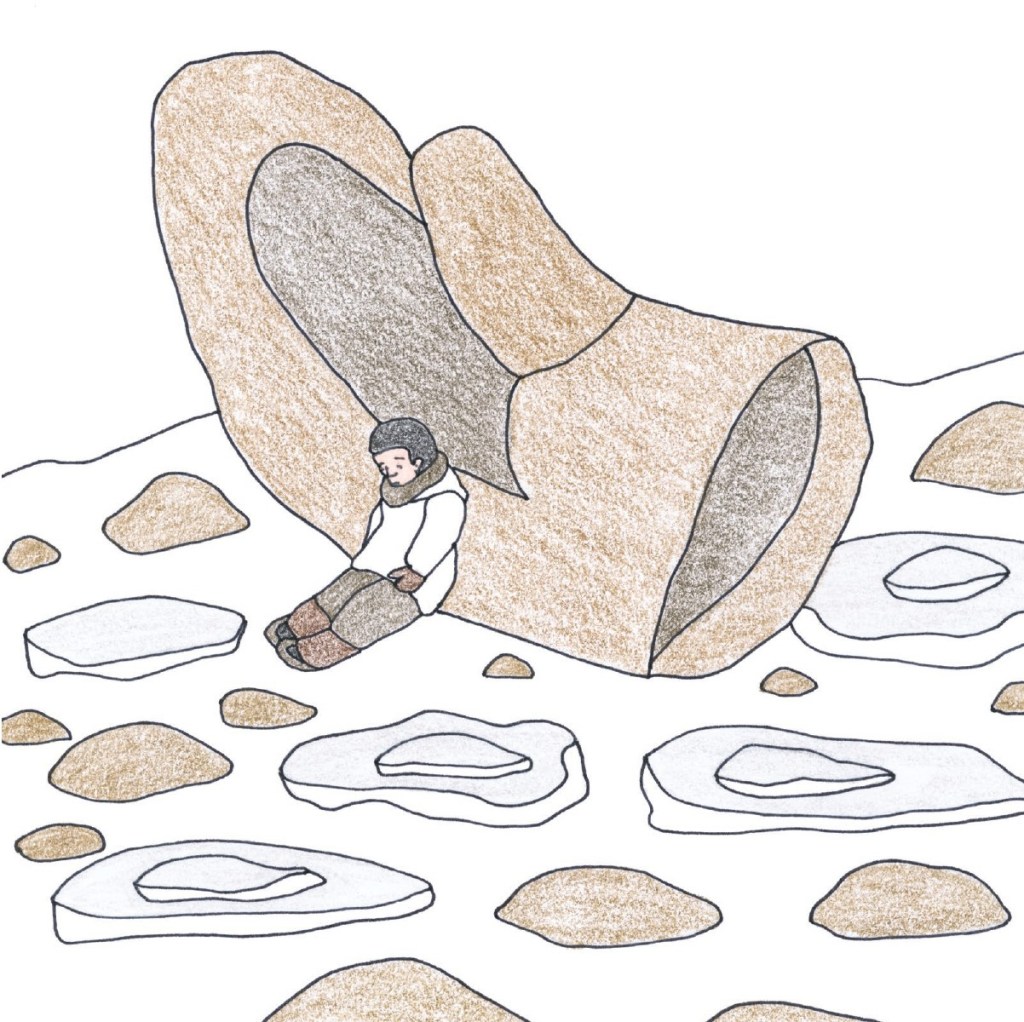
A picture of Kalluk seated with his back against a giant mitten embodies his feelings of gratitude tinged with sadness. He clearly misses his mother, thinks of the warm mittens she has created for him, and sends her “all the love in his heart.” The way in which that message is convened does not need to be articulated.

Meeting his grandparents, Kalluk has reached the confirmation of all the previous lessons about gratitude and love. His grandmother, Anaanattiaq in their North Qikiqtaaluk dialect, is unapologetically depicted as old; she “stands up slowly, bones creaking and cane shaking.”  Any diminished physical strength is no obstacle, as she states purposefully, “Let’s go greet the new one.” Walking home, the boy asks her about her source of happiness. When she answers “peace,” he requests an elaboration. This dialogue is different from those with the animals. She tells him in the most direct language that peace grows inside each person, as he or she makes a series of choices in life. The right choices will make you proud, and grant “lots of peace,” the kind that is meant to be shared.

When Kalluk and Anaanattiaq come upon “a conspiracy of ravens,” the squawking, lively birds are friendly towards them.  Their requirement for happiness is “knowledge,” a slight variation of the other animals’ answers. Their grandmother, the ravens assure Kalluk, is full of knowledge. That knowledge is put to the most important use when she arrives at Kalluk’s home, where his mother has already given birth and his breastfeeding the baby whom he is now prepared to teach everything he has learned.  Gratitude for food, water, family, and the ability to choose well, are the gifts he brings to her, as well along with a declaration of love.  I Would Give You My Tail is like a perfect circle, enclosing the reader in the complete circle of Kalluk’s journey.

80th Anniversary of Liberation of Auschwitz

Today, the New York Times published an important opinion piece by Ruth Franklin about Anne Frank. The singular tragedy referred to in her title is both her death, and the erasure of her Jewish identity in popular culture.  Francine Prose’s book, Anne Frank: The Book, the Life, the Afterlife (2009) and Dara Horn’s chapter on Frank, “Everyone’s (Second) Favorite Dead Jew,” in her essay collection People Love Dead Jews: Report from a Haunted Present (2021) are both illuminating on the same subject. Adults sharing books about Anne Frank, and others on related people and themes, might wish to read Franklin’s piece, as well as the books mentioned above, as an appropriate and realistic memorial and a step towards some understanding of the Shoah.  I have written about this topic before, and here, in recognition of International Holocaust Remembrance Day and the 80th anniversary of the liberation of Auschwitz, are some other relevant reviews and an interview:

Nev­er Again Will I Vis­it Auschwitz: A Graph­ic Fam­i­ly Mem­oir of Trau­ma & Inheritance

The Librar­i­an of Auschwitz: The Graph­ic Novel

A Delayed Life: The True Sto­ry of the Librar­i­an of Auschwitz

The Boy Who Drew Auschwitz: A Pow­er­ful True Sto­ry of Hope and Survival

Behind the Book­case: Miep Gies, Anne Frank, and the Hid­ing Place

Impos­si­ble Escape: A True Sto­ry of Sur­vival and Hero­ism in Nazi Europe

Interview with Steve Sheinkin, author of Impossible Escape

When I Grow Up: The Lost Auto­bi­ogra­phies of Six Yid­dish Teenagers

Tove Jansson and the Gold Spine

Wild Guests (Moomin) – written and illustrated by Riina and Sami Kaarla, based on characters created by Tove Jansson
Golden Books, 2025

Golden Books have become a big tent, in both the range of their subjects and artistic quality. When I learned that a Little Golden Book based on Tove Jansson’s beloved Moomin characters would be released, I was worried.  Recent releases, particularly those on celebrities of more interest to parents than children, have pictures of dubious quality. On the other hand, some of them are quite good, with substantial information appropriately presented and attractive artwork. (for example, biographies of Queen Elizabeth II, Audrey Hepburn and Ruth Bader Ginsburg) As it turns out, the price of joining the distinguished club of Golden Book classic authors and illustrators was not to compromise the style of Tove Jansson, the creator of the Moomins.

Although the pictures are not her original ones, Riina and Sami Kaarla have produced their own interpretation, which is respectful of Jansson’s inimitable style.

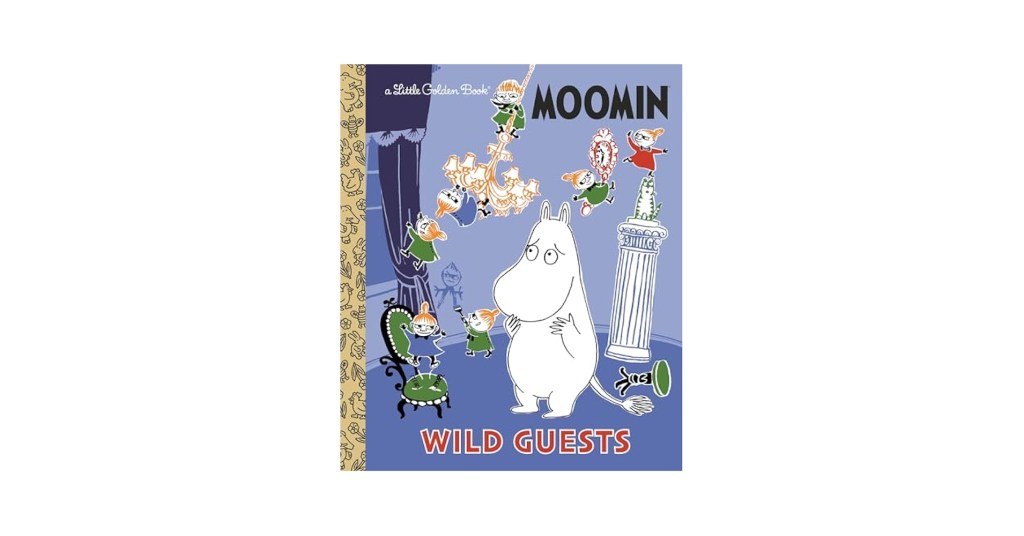
There are many characters in the Moomin universe. In Wild Guests, the title refers to some unexpected visitors, who are the mother and siblings of Mymble, who is herself a guest in the Moomin family home.  When they arrive, Moomintroll and Moominpapa are filled with excitement, while Moominmama somewhat unrealistically expects a docile crew who will happily consume strawberry juice and rhubarb pie. Instead, the Mymbles go wild.  They treat the lovely, Victorian furnished home much as the Cat in the Hat did to Sally and her brother’s parent-free zone.  While their destruction is innocent in its intention, they succeed in wrecking Snorkmaiden’s dressing table, defacing Moominpapa’s globe, and converting the kitchen into their playground.

There is a definite mid-twentieth century look to the pictures. The colors range from pastel to jewel tones, and the graphics recall paper cut-outs superimposed on a background of drawing. The wild guests are mischievous, but unmotivated by any conscious plan. (“I am Little My, and I bite because I like it.”) Their adult-like facial expressions may seem to cast some doubt on that, yet the Moomin’s home remains preserved from any serious damage. In fact, there is even helpful Elves and the Shoemaker results: a tower of carefully stacked jars and crockery, and a kettle boiling for breakfast.

It would be wonderful to use this lovely book as a gateway to Tove Jansson’s work.  However, it stands all on its own as an immersion into Moominland.

Miigiwe – Giving Away is Good

An Anishinaabe Christmas – written by Wab Kinew, illustrated by Erin Hill
Tundra Books, 2024

Finding a children’s book that may be identified as an instant classic is not to be taken for granted. One book that fits that category is An Anishinaabe Christmas. It brings to mind Dylan Thomas’s A Child’s Christmas in Wales, the versions illustrated by both Edward Ardizzone and Chris Raschka, not because of any direct similarity, because the books are very different. Both classics evoke a particular, but also universal, immersion in childhood. You leave the book, and return to it, with a feeling of peacefulness without sentimentality.

A young child from an Indigenous community is going with his parents to visit their extended family on the reservation.  It is winter solstice, an inseparable element of their culture’s celebration of Christmas. Baby, as he is called in the book, looks serious, even puzzled, as his mother and father bundle him up and get ready for their car trip. Their evident excitement is in contrast to his hesitation; this experience is typical of childhood. He is concerned that Santa will not find him away from their home. The cultural signifier of this gift-giving figure so common in the West then transitions to the specific deep roots on the Anishinaabe people.

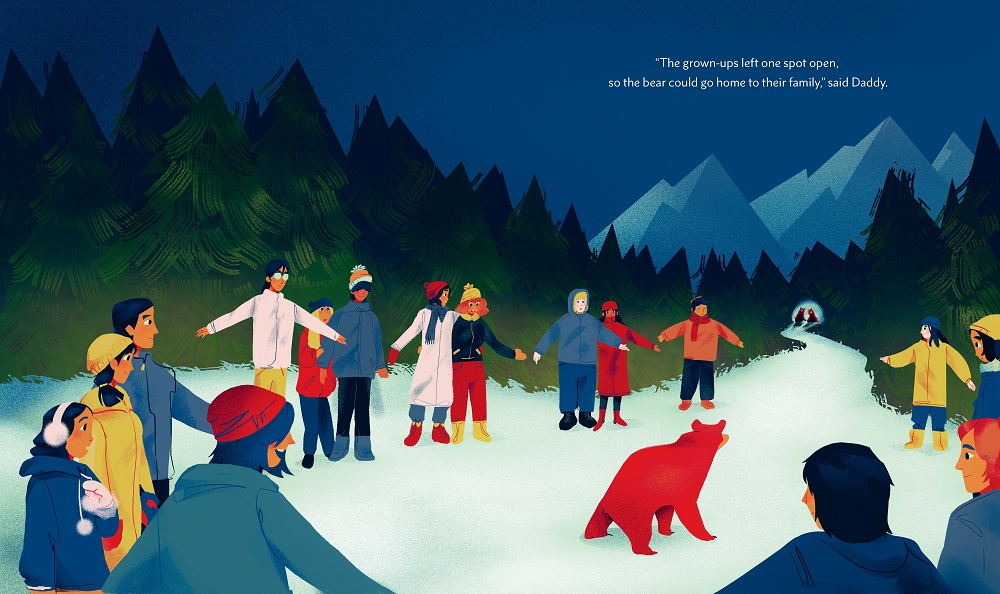
As they drive from the city to the country, the family passes a sign warning not to feed the bears. This prompts a memory that connects Baby to her heritage, and to the natural world that is part of it. Her father repeats the story of how he and other adults had formed a protective circle so that a lost bear cub could find its home. The idea of communalities between humans and animals is organic to the picture, without any ideological explanations. “The bear has a family?” Baby asks. Of course it does, and the father not only answers, but uses the opportunity to introduce words in their native language. (Wab Kinew includes these terms in a glossary at the end of the book, along with an explanation of the cultural syncretism combining Christmas with Indigenous traditions.) The bear also has makwa, family, although it is distinct from the human one.  The bears’ makwa  will “snuggle up in their dens with their babies for Christmas.”

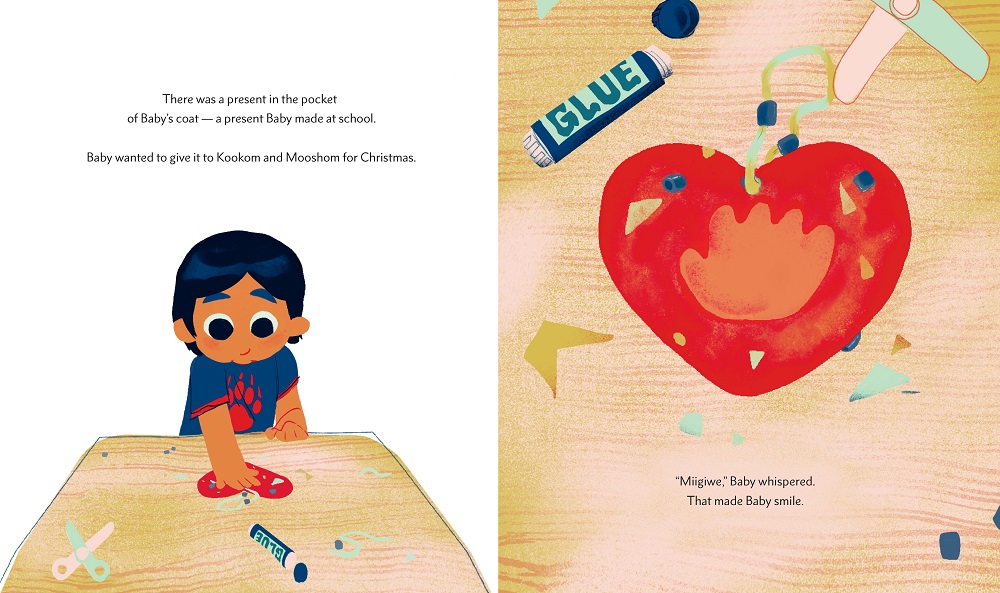
One thing the bear cub will not do is craft a gift for his grandparents, Kookom and Mooshom. The picture of this project is composed of carefully spaced elements, each one of which represents something important: creativity, love, simplicity, focus. Glue, scissors, a red paper heart, become a concrete expression of miigiwe, that Baby’s father has explained: “That means ‘giving away.’ And it’s good.”

The pictures by Erin Hill alternate outdoor panoramas, domestic interiors, and framed scenes of specific activities. A view of the family seated around a wood stove is set an angle and viewed from a slight elevation. Relatives embrace, but there is empty space between different sections of the picture.  Kookom and Mooshom are thrilled to see their grandchild, but they listen carefully to his narration of the car trip. He has processed the truths his father communicated and his repeats them, with understanding, to the older generation. Do you have grandparents? Are you a grandparent? Do you remember your grandparents? You will never forget these scenes.  The family goes outdoors, where they sing about the poetry of winter while playing drums. Whatever winter holiday you celebrate, An Anishinaabe Christmas will resonate as strongly as that chorus.

You’ve Got Delicious Cuban Food

Guava and Grudges – by Alexis Castellanos
Bloomsbury, 2024

Sometimes it seems that there are an infinite number of possible homages to The Shop Around the Corner and You’ve Got Mail, specifically in young adult fictionGuava and Grudges, by Alexis Castellanos, more than justifies a new entry in this category, with strong characters, great description and dialogue, and affectionately accurate allusions to Cuban American culture.  The protagonists spar, but can’t deny their attachment to one another from their first encounter.  Family opposition is tough, if not on the Romeo and Juliet level.  Food obsession is far from essential to liking this novel, but dedication to one’s craft, in this case cuisine, is certainly central to the plot.

Ana María Ybarra and Miguel Fuentes are both Cuban American high school students whose families own popular bakeries in Seattle.  They meet in L.A. at a college tour, although Ana María has serious doubts about her future as a U.C.L.A. student.  Her dream is to become a pastry chef, unconstrained by the traditional expectations of her father, who has always been wary of innovations at Café y Más, their establishment.  (Ana María’s original ideas have been kept “a dark secret” from her family.) Miguel’s last name is Fuentes, but he is a member of the Morales family through his mother.  As Ana María painfully admits, “hating the Morales family was something I was born into and that I had accepted as a family tradition.” In case you needed a reminder that some family traditions can be ugly, here it is.

The plot contains elements of miscommunication, but the core of Ana María and Miguel’s affection is never seriously in doubt.  The looming specter of college applications only forces Ana María to a different commitment, and to hope that her entry in a culinary contest run by her favorite publication will lead to a scholarship. The outcome of the competition is handled well in the novel, as Castellanos carefully avoids pandering to the reader’s expectations.  Social media is also part of the story, because expertly produced food without a visual media presence is worthless, as everyone knows.  The author’s verbal flourishes create images that are just as powerful. Mishandled groceries lead to damaged goods: “‘Stupid milks,’ I mutter, dropping down to the floor with the desiccated croissants in my hands. They look so shriveled and sad. Is there a market for croissant raisins?”

The support of Ana María’s mother helps to offset her father’s often-oppressive parenting. A great best friend and a sister whose personality serves as a foil also enrich the cast.  Miguel isn’t perfect, but nor is he a self-centered male who must be redeemed by a girl’s love.  Guava and Grudges is rich is more ways than one, and includes a recipe for guava cream cheese thumbprint cookies.

Family Stories and Food

Electra and the Charlotte Russe – written by Corinne Demas Bliss, illustrated by Michael Garland
Boyds Mills Press, 1997

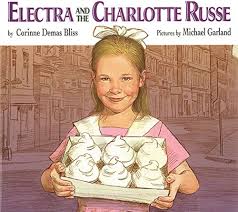
When I was growing up in New York, the charlotte russe was a popular pastry, though the peak of its popularity was already gone by the post-World War II era. At the time, I wasn’t aware that I was enjoying a part of New York food lore in its decline, but that still had meaning for my parents’ generation.  In Electra and the Charlotte Russe, a Greek-American family, living in an ethnically mixed Bronx neighborhood, is the center of the nostalgic story.  In her author’s note, Corinne Demas Bliss writes that the book is based a story which her mother, Electra, had related about her own Bronx childhood in the 1920s.  Whatever your background, and whether or not you have ever eaten the delicate pastry enclosed in a paper sleeve, you will probably respond to the essence of Demas’s tale and Michael Garland’s almost photorealist pictures.

Once upon a time, there were many children’s picture books with extensive text. Electra opens with a portrait of the little girl and her mother. Electra is entrusted with an important errand. She will go to the local bakery to purchase six charlotte russes for her mother’s guests. These are Mrs. Papadapoulos, Mrs. Marcopoulos and her daughter, Athena. The guest without a melodic Greek last name is Miss Smith, who is learning Greek from Electra’s mother, in preparation for her upcoming marriage to Mr. Demetropoulis.  If you think this is an overly idealized portrait of immigrant communities, the motive behind the Greek language lessons is for the future Mrs. Demetropoulis “to understand what his relatives said behind her back.”

On the way Electra meets her friend, Murray Schwartz, whose tongue has turned green from eating a gumball.  A much older neighbor, Mr. Melnikoff, waxes nostalgic about the charlotte russes of his own past, calling them “a dessert fit for a princess.” The extended text occupies some pages, while others have only one or two sentences. A typical New York City apartment building, as rendered by Michael Garland, seems shaded in ombre light and colors, accompanied by the brief instructions to Electra not to run even though she is in a hurry.  Mrs. Zimmerman at the bakery repeats that prophetic warning to her young customer.

When Electra trips, damaging the exquisite works of art in her bakery carton, she tries to fix them. This leads, of course, to eating some of the whipped cream. A two-page spread shows four scenes of Electra’s face and hands as she attempts to even out the cream.  Every step of the process is detailed in sequence, from Electra’s entrance into her apartment building, to her settling on several landings with the pastries, and finally reaching her home. “They didn’t look quite like charlotte russes anymore, but at least they did look all the same.”

Fortunately, Electra’s mother had prepared other delicacies: baklava, diples, loukoumades and kourabedes. The guests enjoy the now transformed and unidentifiable charlottes russes. After they leave, Electra’s mother explains to her the concept of remorse. “Remorse is when you wish you hadn’t done something that you did.” But she isn’t angry with her daughter, and the book closes with Electra sitting on her mother’s lap.  Perhaps she would have been less forgiving if her guests had not enjoyed the gathering, or the pastries denuded of whipped cream. But I doubt that would have made a difference.