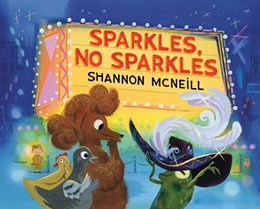
Sparkles, No Sparkles – written and illustrated by Shannon McNeill Tundra Books, 2024
Sparkles, No Sparkles has the same underlying premise as Shannon McNeill’s earlier picture book, Wheels, No Wheels. Children categorize objects and experiences somewhat differently than adults do. While wheels are functional, sparkles are decorative. But you may need them to put on a show. When some sparkle-free species decide they would like to enhance their appearance with sparkles, they appropriate them from a theater. An usher becomes involved, even though stopping animals from stealing props had not been part of his job.
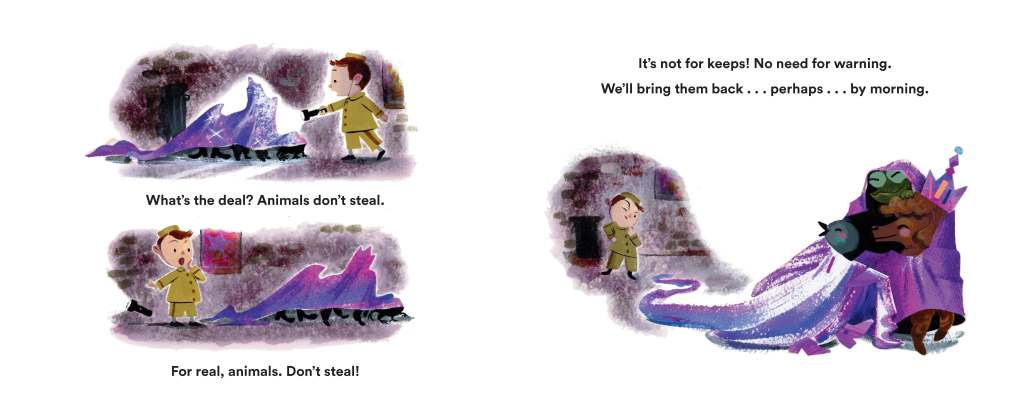
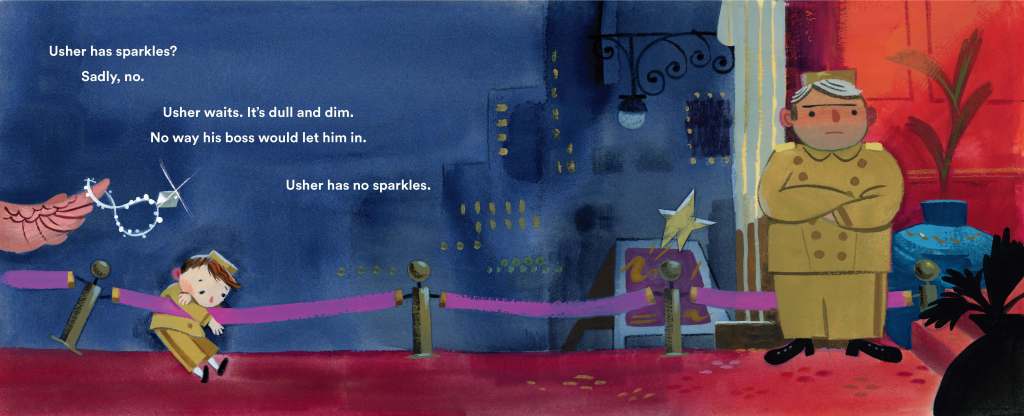
Young readers will share the usher’s confusion, and frustration. After all, he’s right. “For real, animals. Don’t steal!” The animals claim to be only borrowing the sparkles. A frog wearing a cape, a dog bearing a crown, and a pigeon striding in boots, are all excited to be part of a show. The usher would like to break out of his role and participate, too, but, as is often the case, his boss would never allow this sign of freedom.
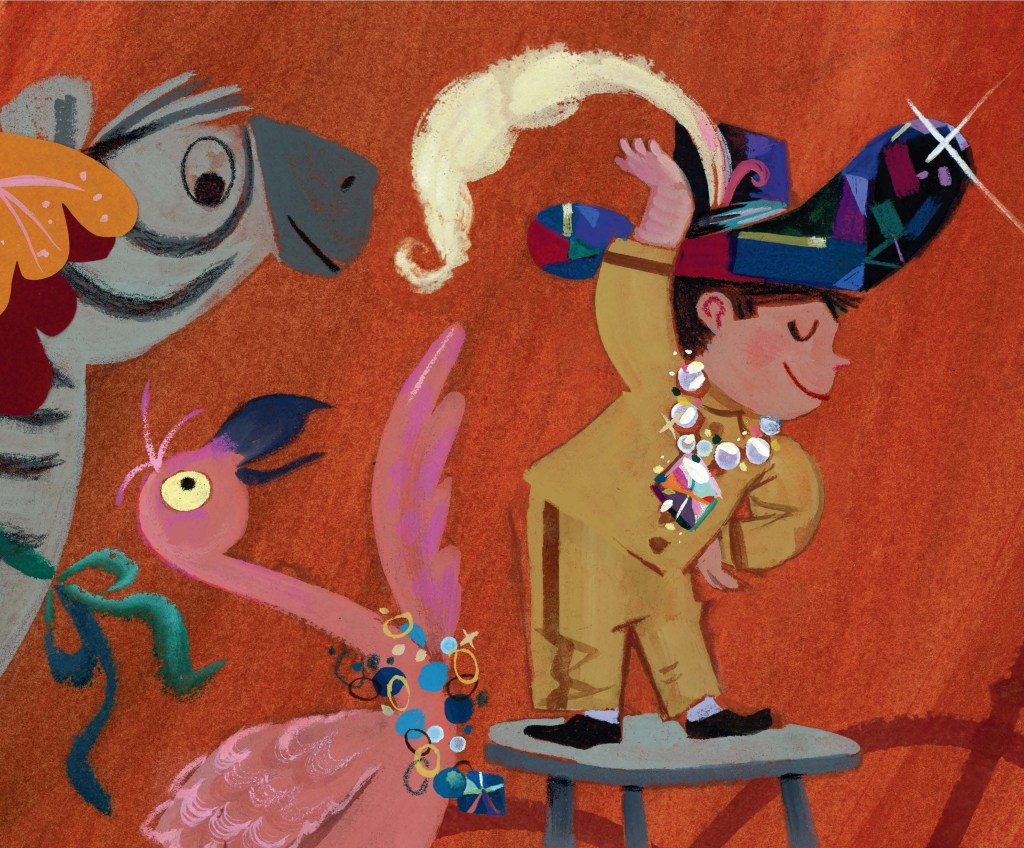
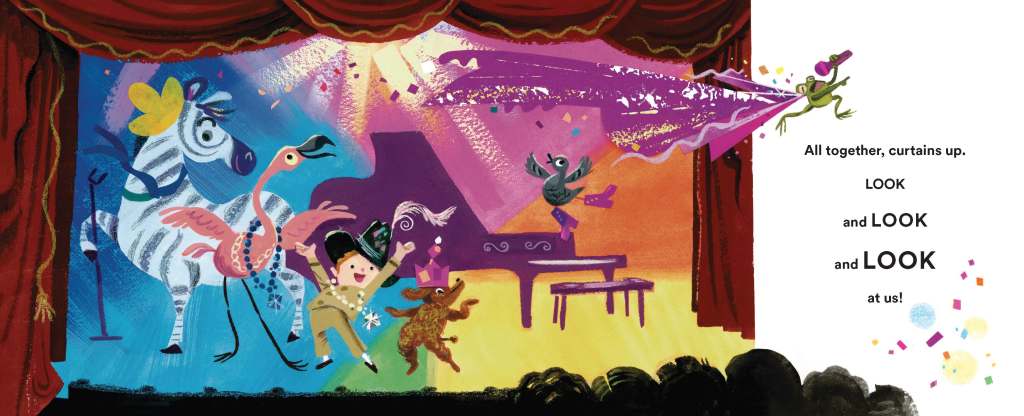
McNeill’s pictures are filled with subdued colors and jewel tones. The presence of sparkles is actually rather understated. When the usher eventually gets his sparkles, he is reminiscent of a little boy in a Maurice Sendak book, making a gracious gesture as he breaks free of adult constraints. The curtain rises, and the usher is part of a proud cast. A zebra, flamingo, and dog dance in line while the purple-caped frog croons into a microphone. “Look, and LOOK and LOOK at us! they demand, as children will.There is a moment of tension when the actual professionals realize that their props, sparkles included, are missing. These items are still making the rounds, but eventually they return, in a blaze of sparkly fireworks. Sparkles are an unlimited quantity in this ode to unbridled creativity.
Just Another Perfect Day – written by Jillian Harris and Justin Pasutto, illustrated by Morgan Goble Tundra Books, 2025
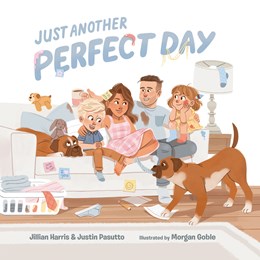
The family in Just Another Perfect Day, by Jillian Harris and Justin Pasutto, illustrated by Morgan Goble, is appealing in its imperfection. No one in the book seems quite as frustrated or depressed as Alexander in Judith Viorst and Ray Cruz’s classic, Alexander and the Terrible, Horrible, No Good, Very Bad Day(1972), although one child, Leo, does actually spit out a sandwich when it disappoints him. The sarcasm of the title is also refreshing. Basically, this not atypical family has some typical problems, which push everyone to the breaking point, but not over it. The text rhymes, the pictures are bright and colorful, and the message is reassuring without being preachy.
The family’s home is comfortable, if not generic. It is set on spacious grounds and appears welcoming. But problems begin to crop up as soon as the reader enters the interior space. Annie and Leo have overslept and are not nearly ready for school. Any parent knows the chain reaction that will cause. Mom wakes up, looking at her phone with surprise; three different clocks have malfunctioned, and one is analog. Dad, who hasn’t shaved yet, tries to walk two difficult dogs, holding things up further. Multitasking won’t work, because everyone is too far behind to catch up.
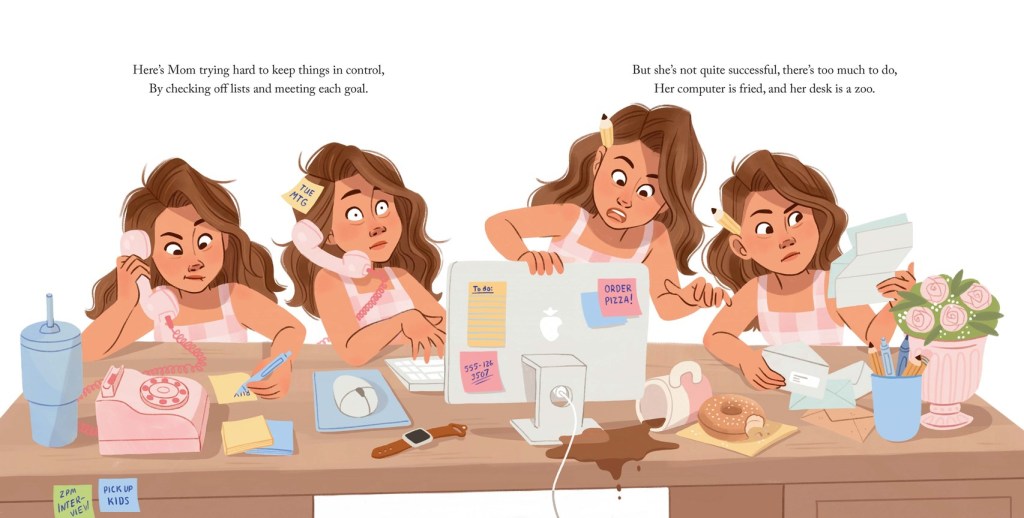
Once the kids are at school, Mom tries to salvage the day at work in a particularly evocative scene. In a cinematic sequence of images, she is seen “checking off lists and meeting each goal,” a phrase filled with irony. Her computer, which is covered with sticky note reminders, isn’t actually working. Her coffee has spilled, and the bagel with one bite out of it shows that she doesn’t even have time to eat properly. Even a lovely pink phone dial phone and matching vase of roses, evoking a simpler (maybe) era, can’t make up for the chaos.
This day has to turn around or the book will end in disaster. Everyone is exhausted, but their energy kicks in enough for an impromptu dance in the kitchen as they eagerly anticipate take-out food. When the delivery driver gets lost, the work together to cook up some pasta. Maybe the meatballs were left over in the fridge. If the cheery dance seemed fun, but improbable, the dinner is a believable conclusion. There is still a sticky note on Mom’s hair, and paint on Annie’s face from her ill-fated art project, but everyone seems to have accepted the inevitability of days like this, which are “less than great.” Baths, reading time, and family togetherness are the recipe, they conclude that “makes it all work.” This cheery and unpretentious story is close enough to perfect.
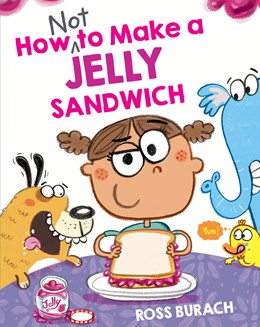
How Not to Make a Jelly Sandwich – written and illustrated by Ross Burach Scholastic Press, 2026
There are an endless number of projects that demand instructions for adult readers. For children, some of these may seem quite pointless. Ross Burach’s How Not to Make a Jelly Sandwich gets right to the point, providing clear guidelines for the preparation of a culinary favorite. There is not even any peanut butter here, just jelly, apparently grape or maybe strawberry. There is a determined little girl, and some animals to help.
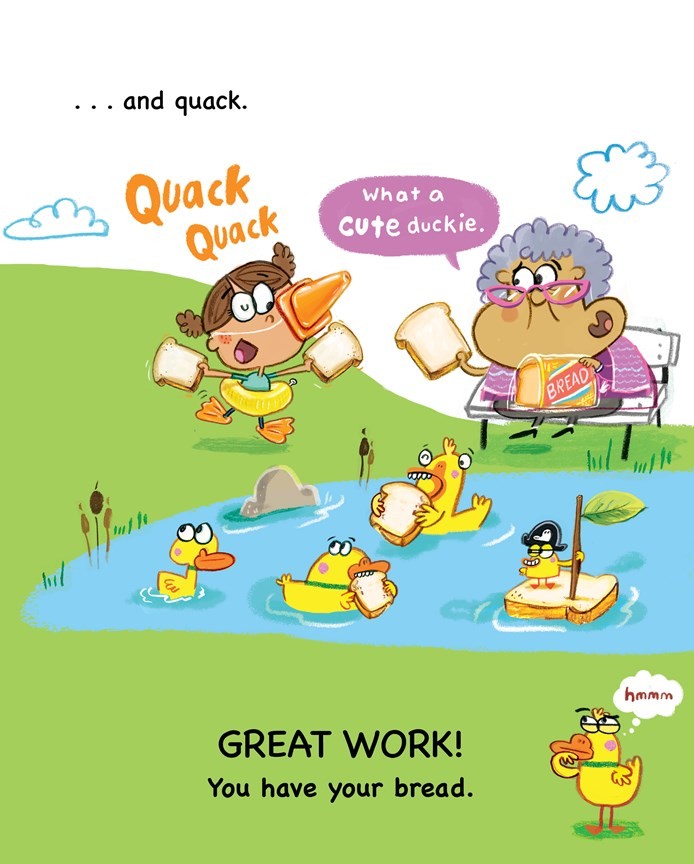
Starting from the beginning, she draws plans on an architect’s planning board. Nothing will be taken for granted. There are only “five simple steps,” cutting out grownup nonsense about specialized qualities of the ingredients. She begins with a trip to the supermarket, where she purchases scuba diving equipment and bread, distributing the latter to some ducks in a pond. The series of detours in making a sandwich are a kind of parody of self-important instructional literature. For kids, they are just funny.
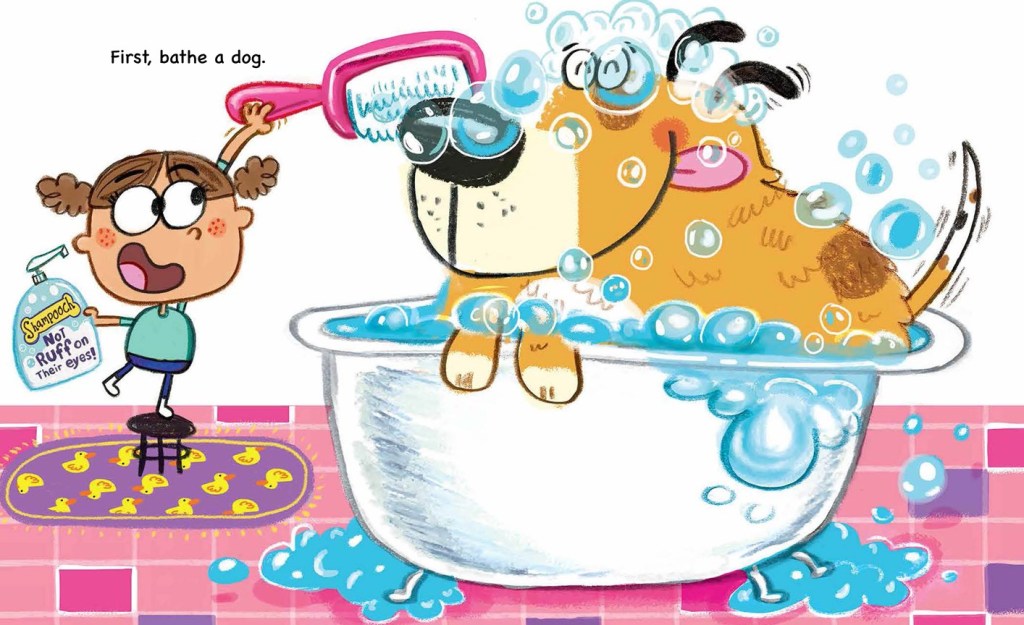
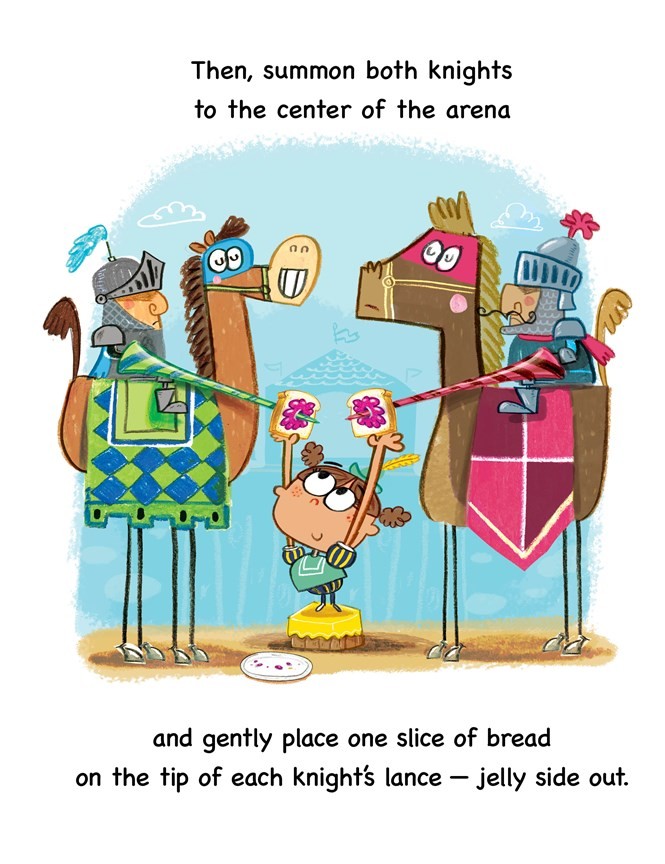
The next step is bathing a dog (other children’s authors have also handled the pet-bathing conundrum), followed by directing a medieval pageant. It may seem like a digression, but the dog’s tail will become a jam knife. Here is where spectacle becomes part of the sandwich preparation, involving placing bread and jelly on the tips of the knights’ lances. Since cultivating the right attitude is often considered essential, the girl uses positive reinforcement with hamsters, who will employ their unicycles to cut the sandwich in half. Seemingly useless activities often have an ultimate goal, especially to children.
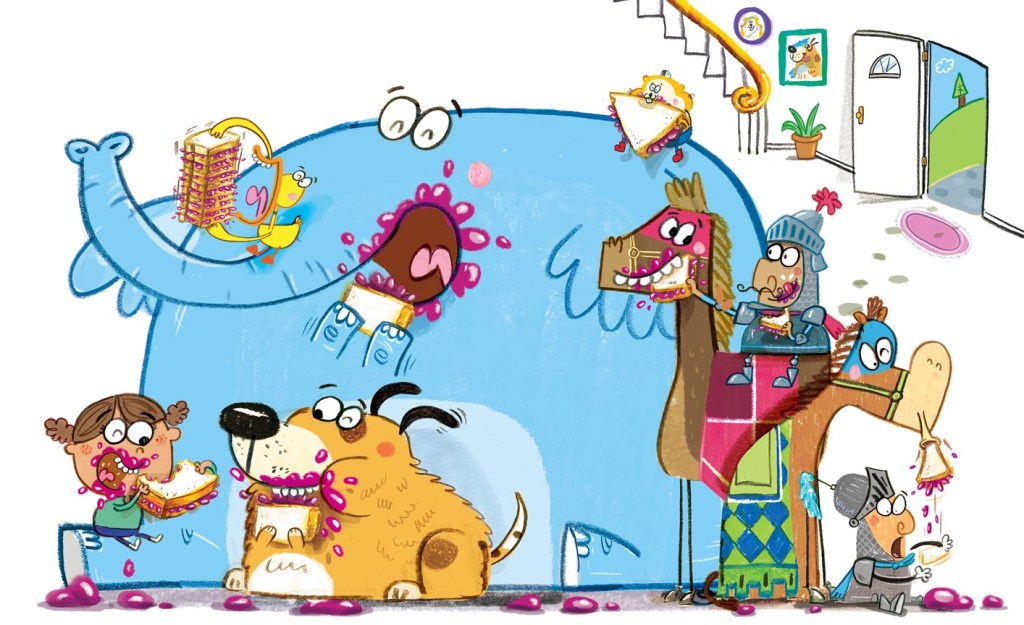
The reward for all of these focused series of actions is a jelly-sandwich eating event, including everyone who has helped, or temporarily hindered, the sandwich construction. Returning to the title, with its “Not” inserted between “How” and “to,” according to the author information on the back cover, the author is having ironic fun with a typical school assignment. How much room for creativity is available when listing instructions on demand? Backmatter offers some more unorthodox suggestions for sandwich prep, and children will undoubtedly come up with more.
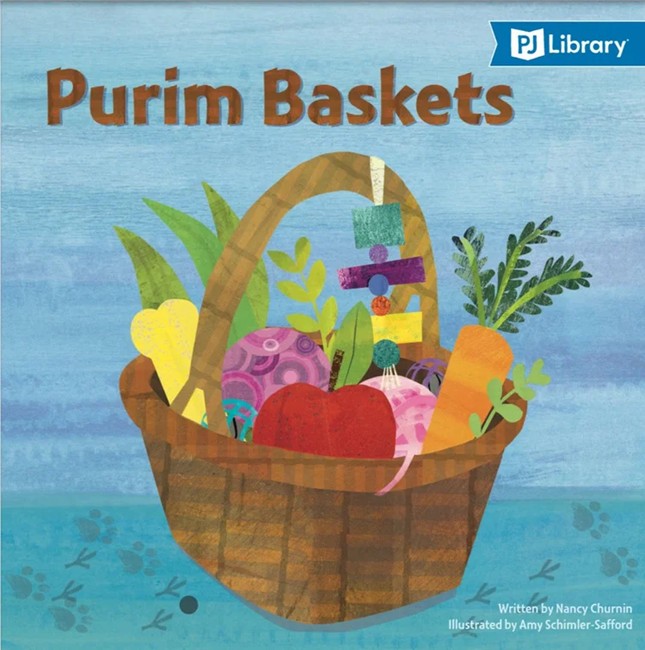
Purim Baskets – written by Nancy Churnin, illustrated by Amy Schimler-Safford PJ Publishing, 2026
The Jewish holiday of Purim, which this year is observed on March 3 (beginning at sundown on March 2), is a joyous event. Celebrating the heroism of Queen Esther in saving the Jews from annihilation at the hands of the evil Haman, it includes several mitzvot (obligations), and other traditions. One requirement is the sending of mishloach manot/shalach manos, to friends and neighbors. These “sending of portions” are small baskets or bags containing at least two different food items. (There is a separate mitzvah requiring tzedakah, charity, to those in need) But customs evolve, and more elaborate packages often now arrive on your doorstep on this holiday. In their lovely board book for your readers or listeners, Nancy Churnin (whom I have interviewed as well as reviewed) and Amy Schimler-Safford explore some possibilities, beyond hamantaschen. What might you offer to animal friends if they were part of your holiday?
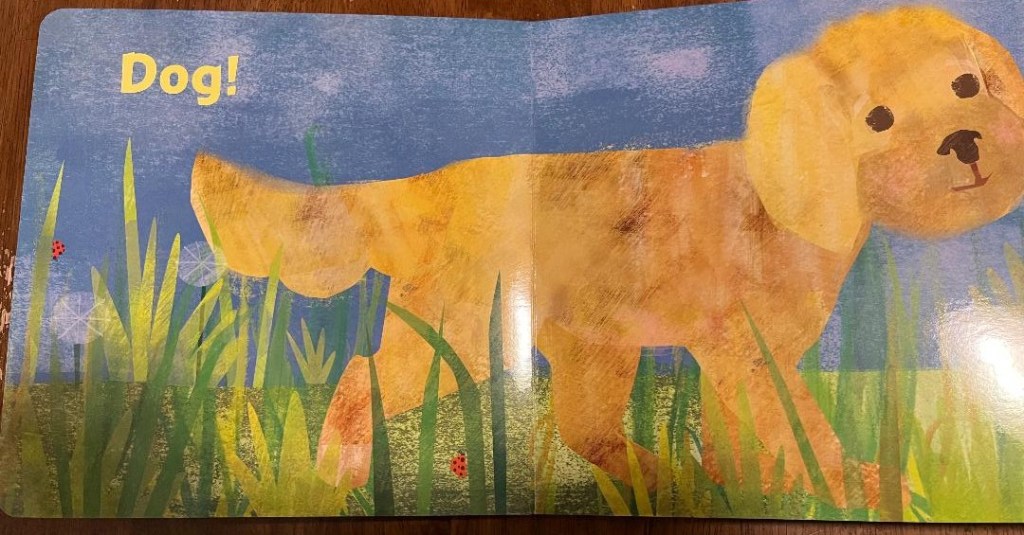
The basket on the cover is a clue to what is inside. An apple, carrot, and leafy greens are joined by a bright yellow bone and a wiffle ball. As the book begins, Churnin poses the question, about what these baskets contain. Her answer is “That depends!” If your recipient is a golden-colored dog depicted, like the other animals, on a two- page spread, then a ball might be nice. For a cat, a basket of yarn in bright hues. Even a fish shouldn’t be excluded; its dedicated basket might offer some coral and aquarium accessories.
Schimler-Safford’s pictures are painterly, with rich colors that will appeal to children. The animals’ importance is signified by how much space they occupy in the pages, regardless of if they are big, like dogs, or smaller, like fish. To an adult sharing the book with kids there is an element of humor. Animals do not actually need their own mishloach manot. To a child, it might seem natural that they deserve one. Of course, human-oriented gifts would not be what these beloved creatures want or deserve.
Churnin concludes with another question, “What’s in your Purim basket?” with the same contingent answer. As any child knows, humans like different gifts, too.
Hello Baby, It’s Me, Alfie – written by Maggie Hutchings, illustrated by Dawn Lo Tundra Books, 2026
A long time ago, 1938, or 1931 if you lived in France, Babar the Elephant learned of his triplets’ birth with the sound of a cannon. Since them, many more children’s books have appeared with the purpose, more explicit than in the work of Jean de Brunhoff, of preparing older siblings for the birth of a new baby. Hello Baby, It’s Me, Alfie belongs in the top rank of these works. Narrated from the point of view of Alfie, the soon-to-be big brother, Maggie Hutchings’ and Dawn Lo’s picture book is totally believable. It is also artistically distinguished, illustrated with vibrant colors reminiscent of Fauvist painting, rendered with pencil crayons and gouache. Hello Baby is funny, tender, and thematically consistent. Each page is full of carefully composed images placed at varying angles, adding up to fully realized home life, both indoors and outside. When Alfie promises that “my heart is pretty big. So I’m sure I’ll find space for you,” your own heart will resonate with empathy.
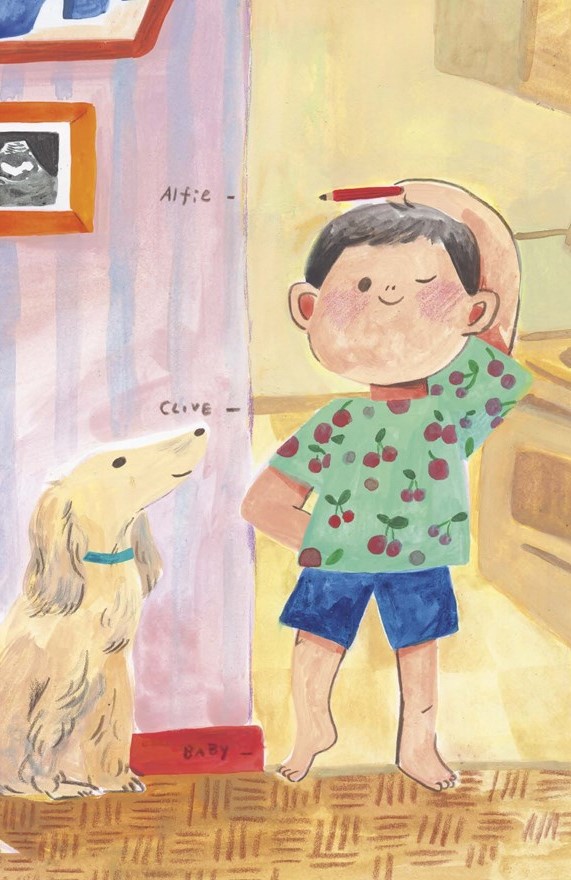
The consistent motif that defines the book is Alfie’s curiosity and love, framed by the famous fruit comparisons used to measure a baby-on-the-way. Someone, probably his devoted parents, have explained the baby’s growth to Alfie, and he is constantly adjusting his expectations. The endpapers prepare us with big, splashy examples of children’s artwork. Fruit is a great subject when you are learning to draw. We enter Alfie’s kitchen, where his bearded and apron-wearing dad is cooking, while his Mom patiently explains that a baby is growing inside her. Alfie’s wide-eyed expression registers surprise, perhaps disbelief.
You know Alfie’s parents, or at least you have met them or seen them in our neighborhood. They are real people, Mom in her green maternity overalls and Dad holding an ultrasound image to show Alfie who is soon to arrive. Alfie is excited to follow the fruit comparison. He is even wearing a tee shirt covered with bright red cherries as he notes his own height, and learns that the unborn sibling, at 12 weeks, is “as big as a perfect plum” It helps to be concrete when providing children with explanations, especially for events with monumental consequences.
There is a fine line between emotion and sentimentality; Hutchings and Lo succeed in evoking a strong response without veering into patronizing territory. When Alife lies against his mother’s belly and feels the baby kick, he interprets this prenatal action as a sign of love, reminding the now mango-sized creature that his older brother is full of love, as well. Alfie communicates essential information to his sibling, including the fact that sometimes fear is part of life. When his dog is frightened of thunderstorms, Alfie hugs him.. This statement is not random; he intuits how vulnerable this future baby, now the size of a mere cauliflower, might feel when he joins their family.
At Alfie’s fourth birthday party, the pictures highlight a lovely bit of formality, with his mother now wearing a black and white polka-dotted dress accented by a pearl necklace. Dad takes a photo portrait of the scene. If you are a parent, I know you may be thinking that Alfie doesn’t actually know what to expect. The addition of a baby is not, at least at first, going to be unmitigated joy for him. It will be difficult. Again, there is an allusion to past and future feelings. Alfie has painted a rainbow for the baby, but he ran out of the yellow needed to complete his creation. “That’s what the crying was about.” Maybe. He is upset enough to need a reassuring embrace from his father. His mother is now really large, but still almost beatifically calm.
The book ends, not with the typical picture of a newborn, but with Alfie looking into the crib that his father has carefully assembled. The inside of the dustcover is a prenatal growth chart measured by pictures of produce. I will summarize by returning to Babar, because the stunning visual quality of this book elevates it way above the level of handy didactic works on the same theme: “Truly it is not easy to bring up a family…But how nice the babies are! I wouldn’t know how to get along without them any more.” Words to live by, for Alfie and his growing family.
Hanukah Money – written by Sholem Aleichem, translated and adapted by Uri Shulevitz and Elizabeth Shub, illustrated by Uri Shulevitz Greenwillow Books, 1978
This year’s celebration of Chanukah has been marked by a horrific tragedy. The slaughter of 15 people, with many more injured, is now inseparable from the religious and cultural festival this year, but it cannot destroy the meaning of the holiday. The great Yiddish author Sholem Aleichem (1859-1916) often wrote about both suffering and resilience. In his short story “Hanukah Money,” translated and adapted, and illustrated by Uri Shulevitz (who died earlier this year), Sholem Aleichem relates the tale of two young brothers eager to receive the traditional gift of gelt while their family observes the holiday. (Everyone knows of Sholem Aleichem, and you can find more of my reviews of Shulevitz’s brilliant work here and here and here.)
The boys’ mother is busy cooking latkes (potato pancakes). Their father recites the blessing on the candles. He understands the boys’ impatience, and rewards them with their small gift. While they spin their dreidels, their father and Uncle Bennie play checkers, discussing strategies of the game as if it had grave importance: “‘What’s to be done, what’s to be done, what’s to be done?’ intones father.” More relatives arrive and bring coins. The boys’ innocence, within their clearly impoverished home, reflects both their unawareness of material deprivation, and their joy in this occasional opportunity to delight in relative plenty. Even counting the coins becomes a ritual and a game framed by playful language: “One chetvertak and one chetvertak makes two chetvertaks, and another chetvertak makes three chetvertaks, and two grivenniks is three chetvertaks…”
Shulevitz’s pictures, resembling sepia engravings, feature exaggeratedly comic figures. The children seem like small adults and the adults themselves have child-like limitations. Some of the objects surrounding them are Hebrew prayer books, a wall of Jerusalem’s Tower of David, and a chanukyiah (menorah) displayed in the window. When one brother dreams that the cook, Breineh, flies into the room, she is carrying a platter, not of latkes, but of paper bills. “Motl swallows rubles like pancakes,” before going back to sleep. Money is abstract and fungible, but available food fills an immediate need. The boys’ needs are briefly fulfilled in the unique customs of the Festival of Lights.
Weiwei’s Winter Solstice – written and illustrated by Michelle Jing Chan Bloomsbury Children’s Books, 2025
Even if you are familiar with traditions surrounding Chinese New Year, you may not know about an adjacent celebration, Dōngzhi; author and illustrator Michelle Jing Chan explains the origins and significance of this winter solstice festival. Falling between December 21-23, it is sometimes known as “Little New Year,” and points towards longer days, coming warmth and light, and good fortune. The book itself if full of bright colors and supportive family relationships, as Weiwei adjusts to life in a new home, where “there are no hummingbirds or chrysanthemums” and “it’s too cold for a screen on the door.”
Weiwei’s family is identifiably a real one. Her grandfather, Yeye, enthusiastically dresses her for the cold weather, but they also seem aware of her unhappiness. Once they are prepared, their outing in the icy outdoors becomes a delight. Set against a backdrop of snow, Weiwei, in her bright blue parka and red boots, notes how the frozen river “sparkles like a mirror,” and each family member is engaged with nature. Still, when they return home, and begin to prepare the special treat associated with Dōngzhi, I couldn’t help finding their kitchen to be a welcome respite from the admittedly scenic outdoors. It’s both spacious and cozy and everyone seems absorbed in the task. (Chan includes a recipe for black sesame tāng yuán in the backmatter.) I particularly like the contrast between blue and white, from the floor tiles to items of clothing, as Weiwei drops balls of dough into broth.
Sadly, the grandmother has died, and one moving two-page spread depicts the family showing reverence to deceased ancestors (image), serving them tea and special foods. There is a smiling portrait of the grandmother on a shelf, accompanied by plants, fruits, and incense. Sense impressions rise from the page. Facial expressions connote, not sadness, but loving memories. Sensory metaphors also convey difficult feelings. Yeye explains to his granddaughter that tāng yuán itself mimics the sound of the word for togetherness. He confesses to having felt sadness when he first moved to America. Eventually, senses, and the emotions they corroborate, make sense to Weiwei, and she compares the delicious sensation of eating tang yuán with deep contentment: “I feel like a golden sun.” Weiwei’s Winter Solstice is a graceful homage to tradition and family, as well as to change.
Lights at Night – written by Tasha Hilderman, illustrated by Maggie Zeng Tundra Books 2025
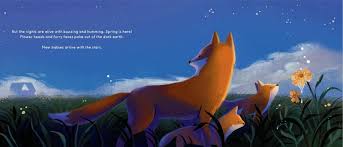
There are two families observing the rhythms of the year in Lights at Night. One is human and the other canine, specifically foxes. Dream-like images with changing shades of color include realistic details, both natural and cultural. Children experience the wonder, but also the reassurance, of the four seasons and their special features, from football in autumn to storms in spring. While the fox family does not kindle holiday lights around the time of the winter solstice, they also appear to respond to the changes. Tasha Hilderman’s soothing poetic text complements Maggie Zeng’s visual immersion in the excitement of one year. Children find joy, not boredom, in the repetition of familiar events.
A powerful storm is just unsettling enough to make the shelter of home more of a comfort. Crayon drawn strikes of lightening emanate from a house, enclosed in a photograph, and also cross its border. Inside, a strong of lights and beds configured as tents add the sense of drama that children like. Note the plush fox in a small sleeping bag. The fox family lacks the domestic props, but is just as attuned to the environmental changes. Of course, animals’ lives are more closely defined by the seasons. In spring, “new babies arrive with the stars.”
Campfires come in summer; riding the bus to school and harvesting wheat are tied to autumn. One of my favorite images in the book is a natural and unobtrusive celebration of multicultural holidays. Christmas trees, Diwali lights, a Muslim family welcoming visitors, and a Kwanzaa lamp grace the neighborhood, along with a Jewish family’s observance of Chanukah. If you look closely, you will see that the correctly depicted nine branch chanukiyah (menorah) has its candle farthest to the left partly obscured by the window frame. This is not an error, just a small visual element lending authenticity to the way in which someone placed the lights, which must be visible from the outside.
At the end of the book, the two children share an album and a box of crayons. The volume is open to the photo with lightning, enhanced by the children’s artwork. The actual fox looks up the moon.
Together We Are Family – written and illustrated by Emily Hamilton Bloomsbury Children’s Books, 2025
Wonderful children’s books each have their own outstanding qualities. There is no one formula for producing the authenticity and beauty inherent in a distinctive picture book. Emily Hamilton’s Together We Are Family features a tone of empathy with kids, simplicity that is not patronizing, and pictures that are reminiscent of children’s artwork without mere imitation.
In the opening picture, the mother lowers her body slightly to speak with her daughter, a young girl using a walker. The mother’s words are enclosed in a speech bubble bordered by unconnected dashes rather than a continuous curved line. “You are you and I am me. Together, we are family.” There is nothing trite about those words to a child. The facing page shows family portraits framed and posted in their home. Each scene captures a moment: a bird carrying off part of a girl’s ice cream cone, a father holding one daughter and an older daughter’s face peering over the bottom of the photo, sisters on the beach with their back to the viewer.
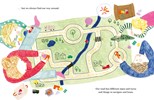
Hamilton’s illustrations are rendered in watercolor and pencil, along with Photoshop. Simply using media that children might also prefer, including colored pencils and paint, does not necessarily convince readers that the illustrator identifies with their point of view. The primary colors and naïve brushstrokes need to be accompanied by a sense of identification. In a terrific two-page spread, Hamilton presents a bird’s eye view of a family that embodies the metaphor of finding their way together. Sitting around a floor mat designed as a town with roads connecting the community, each family member chooses a different activity, but they are working in harmony. The father “drives” a red car in a traffic circle, while one child drives a similar vehicle on her mother’s pants leg. The mother builds a structure with blocks. The younger girl, who is moving a toy alligator, which seems more fanciful and less related to the overall purpose of the game, is just as integrated into the scene.
Frustration is also part of a child’s life, as Hamilton visualizes without judgment. Putting on her shoes is a challenge for the young girl, as is climbing stairs without the aid of her walker. As with all children, whether or not they have special needs, anger can erupt unpredictably, as “the moods that catch you unawares.” While her older sister calmly picks up a piece of fruit at their picnic, the younger girl, frowning, tosses a sandwich into the air. The chaotic merriment of a party is off putting to the child, who stays close to her mother watching the scene with some discomfort. Anyone, young or old, who has ever experienced frenetic social activity as less than an unalloyed joy will relate to this scene.
In a sensitive author’s note, Hamilton explains how her daughter’s disability has influenced their life as a family in specific ways, but she emphasizes how all families inevitably cope with difficulties through support and love. Together We Are Family resonates with that truth for all readers.
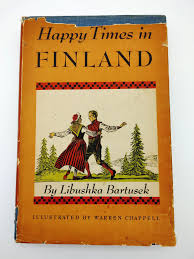
Happy Times in Finland – written by Libushka Bartusek, illustrated by Warren Chappell Alfred A. Knopf, 1941
Everyone knows that Finland is allegedly the happiest country in the world. You certainly can’t take these simplistic measures too seriously, and comparing Finland to other countries with entirely different histories, economies, and demographics is useless. I recently reread an unusual childhood favorite, which I had bought at a library used book sale. Its appeal to me at the time remains vague. I would read almost anything, and it had lovely pictures and promised to tell a story about a distant part of the world. Happy Times in Finland, by Libushka Bartusek, was published in 1941. At that point, it was indisputably not happy at all. Having been invaded by the Soviet Union, they eventually allied with Germany in that country’s war with its Russian enemy. This was a bad choice, but it is not reflected in the book, which takes place in the idyllic time period before the war.
There is minimal plot and character development in the book, but a lot of folklore. To summarize the improbable premise, Juhani Malmberg, a Chicago Boy Scout with Finnish immigrant parents, goes to visit his ancestral homeland. He is able to take this expensive trip due to the generosity of his father’s employer at a furniture factory, Mr. Adams. Finland is known for, besides an improbable level of happiness, abundant high-quality wood. A furniture manufacturer would be eager to see firsthand the source of his best supplies. Since Mr. Malmberg is such a loyal employee, his benevolent boss actually takes Juhani along, for free! He has the opportunity to see his beloved grandparents, as well as his aunt, uncle, and cousins. In addition, Juhani becomes an ambassador from the American Scouts to their Finnish counterparts. Aside from missing his parents, there’s a lot of happiness here.
Poetic language fulfills expectations about a land endowed with natural resources, and steeped in literature. Approaching land, Juhani seems to be expecting a myth and he finds one: “Sure enough, there it was, just as his mother said it would be: an expanse of water, blue as sapphire, with green islands dotting it, as though some giant had scattered a mammoth handful of emeralds on a silver-streaked scarf.” Not only the environment, but its people, are described with hyperbole. Oddly, almost everyone is blond. Finland has a Swedish minority; the name “Malmberg” indicates that his father’s family is descended from this group. His cousins’ last name is Kallio, of Finnish origin.
Finnish is not a Scandinavian language, but is related most closely to Estonian and Hungarian. (A glossary of Finnish words is included at the end of the book.) Here is a description of Juhani’s aunt, a veritable Amazon of pale beauty: “She was tall and blond, so blond, in fact, that Juhani thought she was white-haired…she had great dignity…he felt as though he were at the feet of some exceedingly beautiful statue, all made of silver and bronze and pearl…her teeth gleamed like mother-of-pear.” There are even references to “Viking blood.”
The few realistic elements stand out because of their minimal role in the story. Aunt Kallio, Aiti to her children, has favorites among her offspring. Her older son, Jussi, will vicariously fulfill her own dream by becoming an architect, a career closed to women. Eero, the younger boy, is not academically oriented. Unlike his parents, he prefers manual labor. She keeps her disappointment to herself, only thinking how he lacks “initiative.” “Oh, me! she sighed, one could not be everything.” This statuesque symbol of perfection is unable to tolerate individual differences.
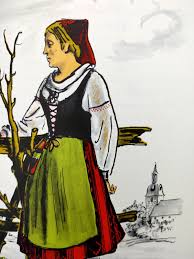
Warren Chappell’s illustrations, some in color and others sepia, appear to be lithographs. They are stylized images, whether portraying men in a sauna or women clothed in traditional costumes for festivals. There is a haunting image of a blind storyteller who recites Finnish epic poetry. Mr. Adams recognizes that the Kalevala’s metrics had influenced Longfellow’s composition of Hiawatha. The Old World and the New touch one another in this tale of immigrant roots, written as the shadow of fascism descended on Europe. It’s blatantly out-of-date and also oddly appealing, just for that reason.








 Imaginary Elevators