These Penguins Are Not All Alike

Welcome to the Penguin Cruise: A Seek-and-Find Adventure – written and illustrated by Haluka Nohana
Chronicle Books, 2025

These penguins do not even all dress alike. They are mechanics, explorers, athletes, musicians, and artists. Aboard their adventurous cruise, they have as many different professions as the residents of Celesteville in Babar the King. When the book begins, Chibi the Penguin and his family are about to board ship for a cruise. The magnificent vessel, which opens from the center as a four-page spread, contains every activity possible enroute to a mysterious location. Cutaway images of the ship invite readers inside, as in Richard Scarry’s works or the European wimmelbooks that inspired him and continue to be fascinating to children (see more here).

Look-and-find is a subcategory of these books. Searching for objects and people is entertaining and educational, but the pictures alone just reflect a view of the world as crowded with endlessly interesting experiences. The penguin theme adds a specific dimension. Wearing a variety of outfits over their simple black and white, these creatures read books, watch movies, prepare and eat meals, and pilot a massive ship.

Then the essential Gold Mermaid statuette disappears, offering Haluka Nohana the opportunity to quote Walt Whitman as the Oceano Penguino’s officer is alerted to her disappearance: “O Captain! My Captain!” A stop on Turtle Isle allows passengers to relax on terra firma, and also to search for a mermaid. Subtle overlapping among the pictures, with small differences, calls for careful reading and viewing. The film-watching penguins change in number and position an empty bed has sleeping occupants, the captain is assisted by a crew member. The Fire Dragon adds a magical touch as he interacts with passengers. What exactly is he doing on the cruise?

At the end of the book there is an additional inventory of items to find. But even once located, trips on the Oceano Penguino have not been exhausted. Leaping dolphins, penguin dance parties, and the elusive Phantom Thief Lupenguin merit many turns of the page, with or without mermaids.

Little New Year

Weiwei’s Winter Solstice – written and illustrated by Michelle Jing Chan
Bloomsbury Children’s Books, 2025

Even if you are familiar with traditions surrounding Chinese New Year, you may not know about an adjacent celebration, Dōngzhi; author and illustrator Michelle Jing Chan explains the origins and significance of this winter solstice festival.  Falling between December 21-23, it is sometimes known as “Little New Year,” and points towards longer days, coming warmth and light, and good fortune.  The book itself if full of bright colors and supportive family relationships, as Weiwei adjusts to life in a new home, where “there are no hummingbirds or chrysanthemums” and “it’s too cold for a screen on the door.”

Weiwei’s family is identifiably a real one. Her grandfather, Yeye, enthusiastically dresses her for the cold weather, but they also seem aware of her unhappiness. Once they are prepared, their outing in the icy outdoors becomes a delight.  Set against a backdrop of snow, Weiwei, in her bright blue parka and red boots, notes how the frozen river “sparkles like a mirror,” and each family member is engaged with nature. Still, when they return home, and begin to prepare the special treat associated with Dōngzhi, I couldn’t help finding their kitchen to be a welcome respite from the admittedly scenic outdoors. It’s both spacious and cozy and everyone seems absorbed in the task. (Chan includes a recipe for black sesame tāng yuán in the backmatter.) I particularly like the contrast between blue and white, from the floor tiles to items of clothing, as Weiwei drops balls of dough into broth.

Sadly, the grandmother has died, and one moving two-page spread depicts the family showing reverence to deceased ancestors (image), serving them tea and special foods. There is a smiling portrait of the grandmother on a shelf, accompanied by plants, fruits, and incense. Sense impressions rise from the page. Facial expressions connote, not sadness, but loving memories. Sensory metaphors also convey difficult feelings. Yeye explains to his granddaughter that tāng yuán itself mimics the sound of the word for togetherness. He confesses to having felt sadness when he first moved to America. Eventually, senses, and the emotions they corroborate, make sense to Weiwei, and she compares the delicious sensation of eating tang yuán with deep contentment: “I feel like a golden sun.” Weiwei’s Winter Solstice is a graceful homage to tradition and family, as well as to change.

Bewitched, Bothered, and Bewildered

The Witching Hour – written by Jennifer Harris, illustrated by Adelina Lirius
Tundra Books, 2025

My mother used to refer to “the witching hour,” that time late in the day when babies, toddlers, and young children seem to act a bit possessed. Whether because they have managed their impulses as best as they can for many hours, or need limits and reassurance, or are just exhausted, this can be a difficult moment for parents. The “hour” may seem like multiple hours.  Jennifer Harris and Adelina Lirius (I reviewed another of her works here) have captured the phenomenon so perfectly in their new picture book that you and your children will be under their spell. Indeed, as Harris solemnly states, “Anything can happen in the witching hour.”

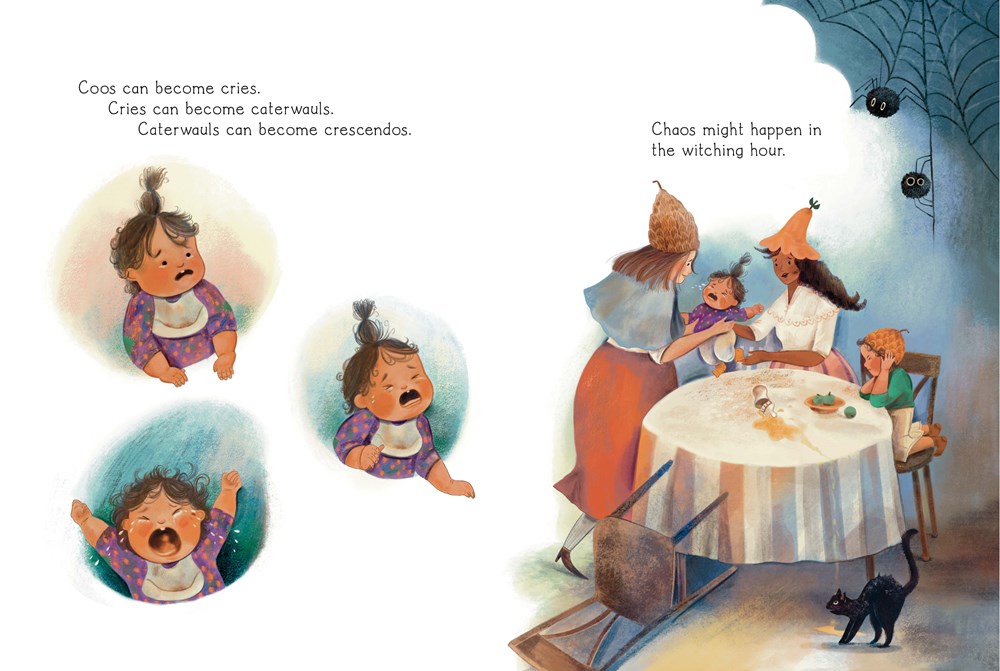
The two mothers in the book are paragons of patience, trying every inventive solution you might imagine, and then some.  First, the acknowledge that anything, “or even nothing at all,” can set the chaos in motion.  A baby overturns a cup of liquid on a table enclosed in a lovely tree trunk. Yes, we all recognize that scene.  An older child wearing an acorn cap looks on, clearly worried about the next phase.  The author is honest in calling it “chaos.” It takes both moms to extricate the screaming toddler from her highchair. An adult chair is overturned, a black cat arches its back, and the sibling covers her ears in terror.

One of the most frustrating features of the witching hour, when it happens, is escalation. “Coos can become cries.  Cries can become caterwauls. Caterwauls can become crescendos.”  Harris uses every figure of speech at her disposal: alliteration, onomatopoeia, literary allusions, rhythm.  Perhaps your child can be calmed by a favorite stuffed animal. The moms try a variety of real wildlife, finally settling on the owl. You know the feeling of relief: “Definitely the owl. Thank goodness for the owl.”

If you were hoping for fairies, you won’t be disappointed.  They arrive and join in the music and dancing, in a kinetic scene of joy mixed with desperation. Lirius’s fabulous pictures evoke an entire universe where the fantastic and the familiar are effortlessly blended. Earth colors predominate and the domestic interiors are as welcoming as those in Dutch still paintings. One mom holds the baby, who looks momentarily transfixed. The other mom is dancing upside down, her feet fixed to a magical broom.  Fairies usually command attention, but here they are a great audience. When the show ends (who could sustain that level of energy), the moms come down to earth. 

There are still many comforting possibilities to try: “this bottle, this banana, this bat.” The moms are creative and full of hope, waiting for the moon to signal that at least for today, it’s time to sleep. Suspension of disbelief sets in for this lovely family of nurturing witches. Tomorrow they we ready to start again, with all the resources at their disposal. For readers, this home of friendly spider webs, baskets of knitting yarn, and a quaint wood stove, seems uncannily real. For the duration of the story, you will be living among friends, and the supernatural is just, natural.

Learning French with McDuff

McDuff Goes to School – written by Rosemary Wells, illustrated by Susan Jeffers
Hyperion Books for Children, 2001

If you have never read any of the picture books about McDuff, the little terrier who is adopted by a loving couple living in a charming village in the 1930s, you have missed a modern classic. They are collaborations between two legendary authors and artists, Rosemary Wells and Susan Jeffers. McDuff Goes to School is the fifth in the series, and it holds a particular interest in the category of children’s books that informally present a new language (other example include Pizza in Pienza, Eat, Leo, Eat and My Sister is Sleeping). 

McDuff lives at number nine Elm Road, a location as essential to the series as Paddington’s address at 32 Windsor Gardens. One day, a new, French family moves in next door. They also have a dog, and, no, she is not a French poodle. That detail is consistent with the understated realism of Wells and Jeffers’ creation. The first conversation between the two dogs is bilingual: “’Woof! Said McDuff. ‘Ouf,’ said Marie.” Note the use of italics for a foreign word.

Marie, the new dog, has owners who are as kind as Fred and Lucy, the couple who adopted McDuff.  Celeste and Pierre de Gaulle (well, I guess their last name is the equivalent of a French-speaking French poodle), agree with Fred and Lucy that their respective pets need to attend obedience school. Mainly, Celeste seems to be in charge, and she is extremely determined. Lucy, realistically, too busy taking care of her baby, and Fred is “too tired after a day’s work” to train a dog. These are totally reasonable explanations, with no apologies offered; they are not inept dog owners.

Celeste’s daily repetition of commands to “assieds-toi!” and “Saute!” are translated in a glossary at the end of the book.  Children will get a real sense of the gap in communication between speakers of different languages, and also appreciate the advantages of bilingualism.  It turns out that McDuff’s apparent lack of progress in school is due to his attentiveness; he is listening to Celeste and learning to understand her language like a native.

As in every McDuff book, all of the humans are smartly dressed. The men wear argyle vests and driving caps. The women have lovely but practical collared dresses and t-strap pumps. Celeste even wears a Chanel-style pastel blue sweater and skirt set.  The book concludes with a luncheon en plein air, including cheese, French bread, fruit, and an American, probably apple, pie. There is even a checked tablecloth.  Both the dogs have earned ribbons.

Uri Shulevitz 1935-2025

Uri Shulevitz died on February 15.  The breadth of his artistic vision was outstanding, demonstrated both in books which he wrote and illustrated, and in others that he illustrated in collaboration with another author.  Many were deep explorations of Jewish themes, while others were more universal in scope. Chance was a masterpiece, integrating his entire life’s work in both words and pictures (I have also written about him here and here). The title indicates his conviction that his survival as a refugee from the Nazis, and, therefore, his entire career as an artist, was fundamentally a result of random events.  The book earned many distinctions; unfortunately, a Sydney Taylor award was not among them.

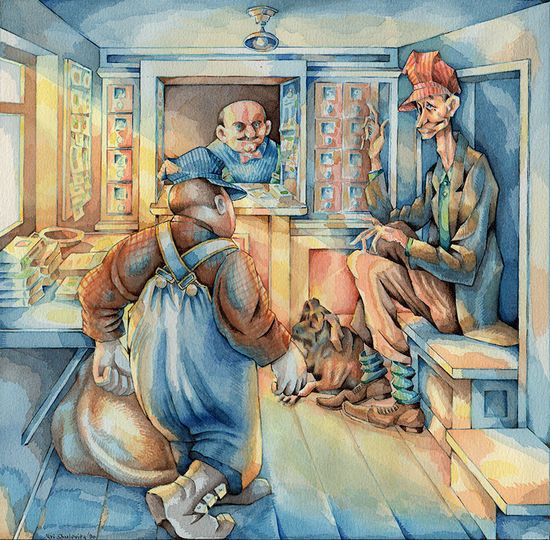
I would like to call attention to one long out-of-print work by Mr. Shulevitz, his quirky, and even disturbing, Toddlecreek Post Office. (Farrar, Straus and Giroux, 1990). Like several of his other books, it adopts a tone from folklore. The small village of Toddlecreek has a small post office. It resembles an ordinary house, with tall windows, flower boxes, and an American flag indicating its purpose. The name of the postmaster is Vernon Stamps, reinforcing the idea that the story is something of a parable. (Some of his neighbors are named Mrs. Woolsox; Charlie Ax the logger; and the garrulous and nostalgic Dexter Shuffles.) Mr. Stamps is busy and efficient, but also compassionate, helping everyone in the community and even welcoming animals to his overcrowded enterprise.

Into this paradise, one unfortunate day, the postal inspector intrudes.  Her presence is immediately disturbing, and the animals react before she even sets about her task. “Birds’ songs diminished…Bees’ buzzing ceased, or so it seemed. The small dogs stopped barking, and stared.” The inspector examines the post office’s records, as well as the evidence that unofficial, but humane, activities are also promoted there. There are books to read, and announcements for barn dances on the bulletin board. She announces that the post office will be closed. Vernon is stunned, but he senses that resistance to this decision is futile. He locks up and leaves.

If readers are not already saddened by this point, Shulevitz makes clear that the post office’s closure leaves a terrible gap in the life of the community.  There is a sense of shock in the rumors about Silken, Vernon’s part wolf and part sled dog companion. The animal has disappeared. “Some say she went north to join the wolves. Others say she was killed by a hunter.” 

What motivated Shulevitz to end the book on an unambiguous note of sadness? He was a great artist and humanist who had lived through the worst conditions imposed by tyranny.  Toddlecreek has been ruined.  “It is not on any map, it is bypassed by travelers and forgotten by time. And now, like any other small village, Toddlecreek has no post office.” Yet, unlike the residents of this unfortunate town, he did survive to produce an unforgettable body literature and artwork for both children and adults.

Fairy Architects

The Tallest Tree House – written and illustrated by Elly MacKay
Running Press Kids, 2019

Fairies usually live in tiny, beautiful, dwellings. Sometimes these are made of obvious materials: leaves, twigs, moss, and other natural elements. Often a child who loves fairies created them, or at least happens upon them and lovingly interacts with their inhabitants (for example this and this). In Elly MacKay’s The Tallest Tree House, there are two fairies, no humans. Both fairies have architectural aspirations as does this mouse). Their names are Mip and Pip, and they are somewhat competitive; at least Mip is. She actually challenges Pip to a contest: “Whoever makes the best tree house by sundown wins!” This impulsive idea doesn’t take into account the fact that Pip is currently reading a book about architecture. 

Elly MacKay’s illustrations are theatrical; she describes her method in inspiring detail (I reviewed another of her books here). Looking at her cut-out figures, carefully placed in stage settings, I was reminded a bit of the Cottingley fairy episode, a well-intentioned fraud when two girls in early 20th century Britain convinced a credulous public that they had photographed fairies. Of course, there is no fraud here; Mip and Pip are real and they create their own home. But the delicacy and care involved in bringing them to life seem related.

Even looking at the two friends, Pip seems more serious. In addition to his reading, he has a tall, pointed leaf for a head covering. Mip, in contrast, sports a comically oversized mushroom cap.  Pip draws blueprints based on his planning.  He carries a, presumably, well-stocked toolbox and uses a pulley. The sight of Mip’s obviously fragile tall tower worries him, because he cares about her more than he does about winning. Eventually, they work as a team, together completing “a winning piece of architecture.” 

Several qualities set this book apart in children’s fairy literature.  There is the tortoise and hare allusion, and the friendly warning that you need technology as well as patience to build a fairy house.  The composition resembles a theater set, and even includes sound effects, such as a terrifying BOOM in huge font when Mip’s shoddy tower collapses.  The book is not unique in excluding human observers, but it does feature an unusually independent fairy world.  Next time you build a house for fairies, read Pip’s book and bring along some simple machines.

What Makes Us Happy

I Would Give You My Tail – written by Tanya Tagaq, illustrated by Qavavau Manumie
Tundra Books, 2025

This tender, subtle, book, about a boy awaiting the birth of a sibling, is set among the Indigenous people of Nunavut, northern Canada. It is both unique to their culture and universal in its expression of gratitude, both to people and the environment in which they live. The title refers to a conversation between two hares, echoed by other animals, and finally by the brother welcoming his new sister to the world they will share. The language seamlessly weaves together the language of the physical world and metaphor. The pictures, created in colored pencil, draw from Inuit folklore, as well as the specific qualities of the characters.  Sharing is a concept central to the book, part of the overall vision of happiness passed from one generation to the next.

Assuming a child’s perspective in a book for children may seem natural, but it’s not so easily accomplished. Here, from the first page, readers will empathize with the boy, Kalluk’s, feelings of expectation and some anxiety, as he awaits a profound event in his life.  Tanya Tagaq is straightforward in presenting the situation: “Kalluk’s mother is in labor and about to have a baby.” Even the repetition of seemingly redundant terms, “labor,” and “about to have a baby,” reflects the way that children incorporate reality. Qavavau Manumie’s illustration shows the pregnant mother touching her kneeling son in a gesture of reassurance, before he sets out to bring his grandmother to help.

Unhappiness is, realistically, part of Kalluk’s range of feelings at this moment. He asks two hares why they are happy, and learns how the qualities that they need to survive, speed and cleverness, are fulfilling ones. A brook is happy because of the fish who inhabit it. Mothers, animals or human, are happy with the offspring to their care. Explanations are kept to a minimum. Kalluk can sense the sincerity of all the responses.

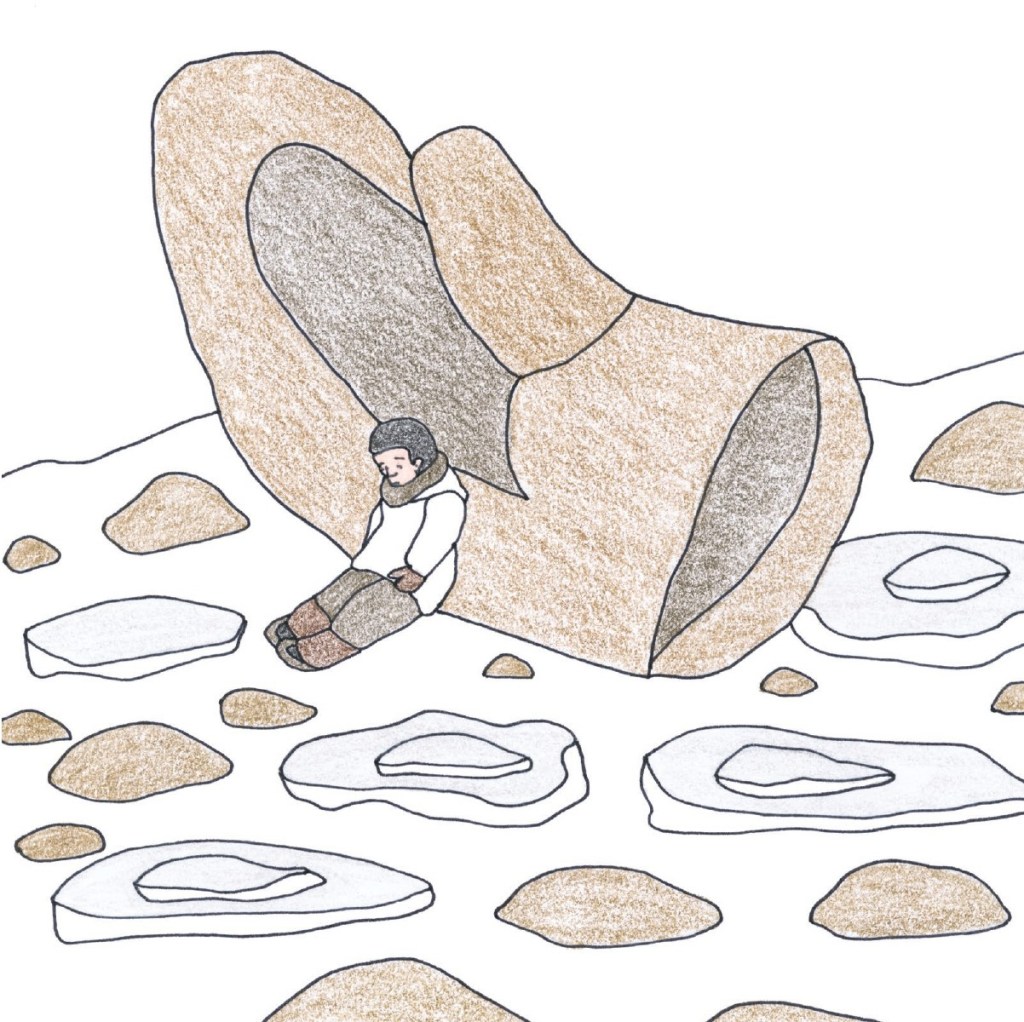
A picture of Kalluk seated with his back against a giant mitten embodies his feelings of gratitude tinged with sadness. He clearly misses his mother, thinks of the warm mittens she has created for him, and sends her “all the love in his heart.” The way in which that message is convened does not need to be articulated.

Meeting his grandparents, Kalluk has reached the confirmation of all the previous lessons about gratitude and love. His grandmother, Anaanattiaq in their North Qikiqtaaluk dialect, is unapologetically depicted as old; she “stands up slowly, bones creaking and cane shaking.”  Any diminished physical strength is no obstacle, as she states purposefully, “Let’s go greet the new one.” Walking home, the boy asks her about her source of happiness. When she answers “peace,” he requests an elaboration. This dialogue is different from those with the animals. She tells him in the most direct language that peace grows inside each person, as he or she makes a series of choices in life. The right choices will make you proud, and grant “lots of peace,” the kind that is meant to be shared.

When Kalluk and Anaanattiaq come upon “a conspiracy of ravens,” the squawking, lively birds are friendly towards them.  Their requirement for happiness is “knowledge,” a slight variation of the other animals’ answers. Their grandmother, the ravens assure Kalluk, is full of knowledge. That knowledge is put to the most important use when she arrives at Kalluk’s home, where his mother has already given birth and his breastfeeding the baby whom he is now prepared to teach everything he has learned.  Gratitude for food, water, family, and the ability to choose well, are the gifts he brings to her, as well along with a declaration of love.  I Would Give You My Tail is like a perfect circle, enclosing the reader in the complete circle of Kalluk’s journey.

Owl Writes by Candlelight

Cozy Winter Day – written and illustrated by Eliza Wheeler
Nancy Paulsen Books (Penguin Random House), 2024

Here is another one of my many posts about past, imaginary, or longed-for snow (for example here and here and here and here and here and here). It also falls into the category of personified animals performing sweet, graceful, and productive tasks (Miguel Tanco is another master of this art).  Beautifully realized scenes of domestic interiors, as well as the outdoors also characterize this lovely new picture book by Eliza Wheeler (I reviewed another of her books for Jewish Book Council). Not only does an owl compose the story of her village by candlelight, but a hedgehog weaves baskets and a rabbit, who uses a wheelchair, paints at an easel.

The endpapers and the introductory list of characters immediately made me ask, where are the toys? I don’t mean this with any disdain at all! The brightly colored and detailed figures are reminiscent of the kind of traditional, non-electric miniature animals you can still find as playthings.  The Hopps family have names out of a mid-century t.v. sitcom: Bud, Dot, Sis, and Herb.  However, Herb is the artist with a disability, setting this story in the fortunately more realistic and inclusive present.  The beaver family is of Celtic origin, judging by their name, McPaddy.  An interesting choice was to include both Ms. Polly, a porcupine, and Otto and Una Heddle, who seem to be hedgehogs. 

The book’s plot is not the main point. Rather, it is the warm and harmonious community of creatures enjoying the winter.  In the Hopps’ family kitchen, Pop is frying up something delicious on an antique wood stove while Dad enters with a bag of groceries. The baby, sitting in his highchair, seems impatient, but not enough to make the parents frantic.  Otto the hedgehog “gathers bundles of yarn,” although it’s not clear if he is going to knit or if he is helping Una, who is bringing snacks.  All the animal parents are clearly nurturing.

The featured adjective in the title is “cozy,” and miniature spaces represent the essence of this quality. There are two pages explaining the characteristics of a “nook.” These small areas can be dedicated to different purposes: reading, painting, eating breakfast, or hiding.  Sometimes they are shared, but often they are places where animals can be quietly alone. On the other hand, Acorn Village requires a lot of labor, if you can apply that term to making paper chains and building with blocks, as well as pulling children on sleds and preparing food.  Consuming food is also a big part of life here.

Everything in the book adds up to restful sleep. The bedtime scene is dark, with pastel-colored bedding and a blue and white starry night sky.  “Let’s have a Cozy Winter Day again tomorrow.” Capitalized letters make it clear that tomorrow will involve repetition of today. That reassuring quality is the point of living in Acorn Village.