These Penguins Are Not All Alike

Welcome to the Penguin Cruise: A Seek-and-Find Adventure – written and illustrated by Haluka Nohana
Chronicle Books, 2025

These penguins do not even all dress alike. They are mechanics, explorers, athletes, musicians, and artists. Aboard their adventurous cruise, they have as many different professions as the residents of Celesteville in Babar the King. When the book begins, Chibi the Penguin and his family are about to board ship for a cruise. The magnificent vessel, which opens from the center as a four-page spread, contains every activity possible enroute to a mysterious location. Cutaway images of the ship invite readers inside, as in Richard Scarry’s works or the European wimmelbooks that inspired him and continue to be fascinating to children (see more here).

Look-and-find is a subcategory of these books. Searching for objects and people is entertaining and educational, but the pictures alone just reflect a view of the world as crowded with endlessly interesting experiences. The penguin theme adds a specific dimension. Wearing a variety of outfits over their simple black and white, these creatures read books, watch movies, prepare and eat meals, and pilot a massive ship.

Then the essential Gold Mermaid statuette disappears, offering Haluka Nohana the opportunity to quote Walt Whitman as the Oceano Penguino’s officer is alerted to her disappearance: “O Captain! My Captain!” A stop on Turtle Isle allows passengers to relax on terra firma, and also to search for a mermaid. Subtle overlapping among the pictures, with small differences, calls for careful reading and viewing. The film-watching penguins change in number and position an empty bed has sleeping occupants, the captain is assisted by a crew member. The Fire Dragon adds a magical touch as he interacts with passengers. What exactly is he doing on the cruise?

At the end of the book there is an additional inventory of items to find. But even once located, trips on the Oceano Penguino have not been exhausted. Leaping dolphins, penguin dance parties, and the elusive Phantom Thief Lupenguin merit many turns of the page, with or without mermaids.

Invitation to a Voyage

Journey of the Humpbacks – written by Juliana Muñoz Toro, illustrated by Dipacho, translated from the Spanish by Lawrence Schimel
Eerdmans Books for Young Readers, 2025

Although this fabulous informational book about humpback whales has not relation to Baudelaire’s poem, “L’invitation au voyage,” I could not help thinking of its title and famous refrain when I turned the first page.  The author states her purpose: “This is an invitation for us to go on a journey. We don’t need a backpack or shoes. Just our eyes wide open.” Every book fits this description. By framing the experience of reading this way, Juliana Muñoz Toro raises expectations and meets them. Baudelaire invites readers to encounter a world where “Là, tout n’est qu’ordre et beauté,/Luxe, calme et volupté,” (“There, there is nothing but order and beauty,/Richness, calm and beauty.”) Instead of dream world, Muñoz Toro, and illustrator Dipacho, extend an invitation to the natural order and beauty of the environment.  Science books for young readers need not omit a sense of wonder.

I won’t try to summarize the wealth of information in this book about the often misunderstood sea mammal, the humpback whale, otherwise known as Megaptera novaiangliae. Did you know that its Latin name means “giant-winged New Englanders?” Probably not, even though you may associate whales with New England, where this one was originally sighted by Europeans.  To orient you on your journey, Dipacho’s elegant graphics, paired with captions, text boxes, and color judiciously added to black-and-white.  Some of the questions even present the answer upside down, adding the sense of a game.  To help you envision scale, a parade of Emperor Penguins sits atop the huge creature, whose principal features are carefully labeled.

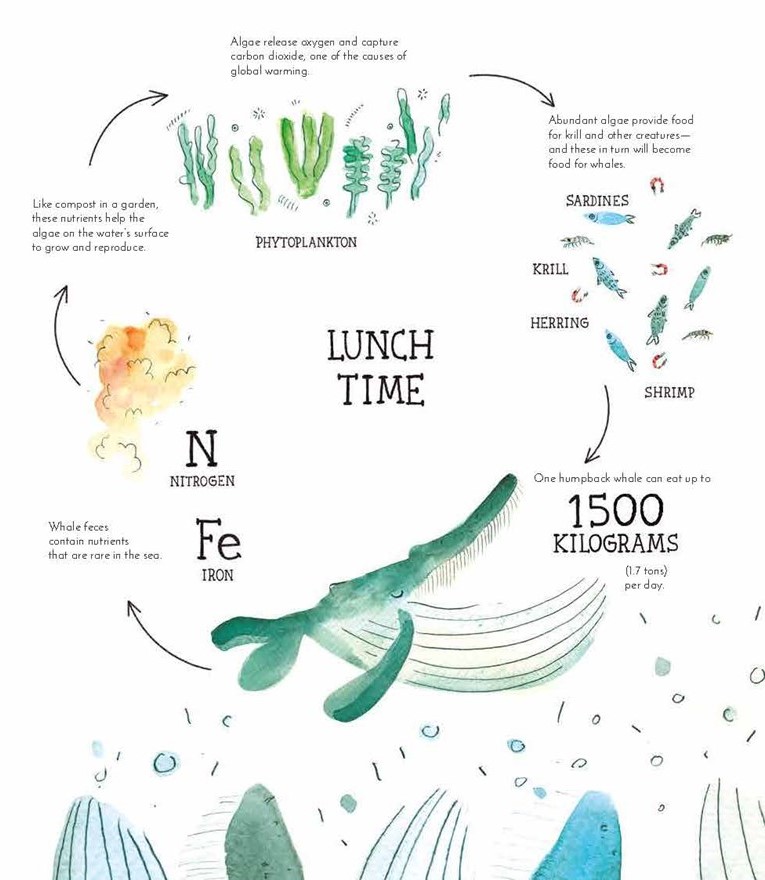
If you come to the book with some basic knowledge of humpback whales, you will still learn a great deal. Nothing is necessarily obvious, including the basic fact that every part of the environment is related to one another. “Nothing that happens in the water does so in isolation.”  “Lunch time” involves a nutrients provided by algae, sardines, and krill.

The pictures are meticulously accurate, but also personify the whales a bit, with their balletic movements that seem almost joyful.  Referring to the segments of their day as “nap time, “ “time for adventures,” and, of course, “time to breathe,” sets a tone of familiarity, but also awe: “The breathing of humpback whales is long and deliberate, as if they were meditating.” Note the phrase “as if.” 

When people appear, they are comically observant, watching the whales and taking notes of what they see. Here Dipacho presents richer colors than in the extensive factual scenes, as he brings humans into the picture.  They are important and provide perspective, but they don’t compromise the whales’ starring role. In fact, a wonderful two-page spread categorizing the baleen whale family (image) identifies the humpback, with a touch of humor, as “the protagonist of this book.”  Another concise and complete section on the whale’s reproductive life is, again, accurate and also performative.

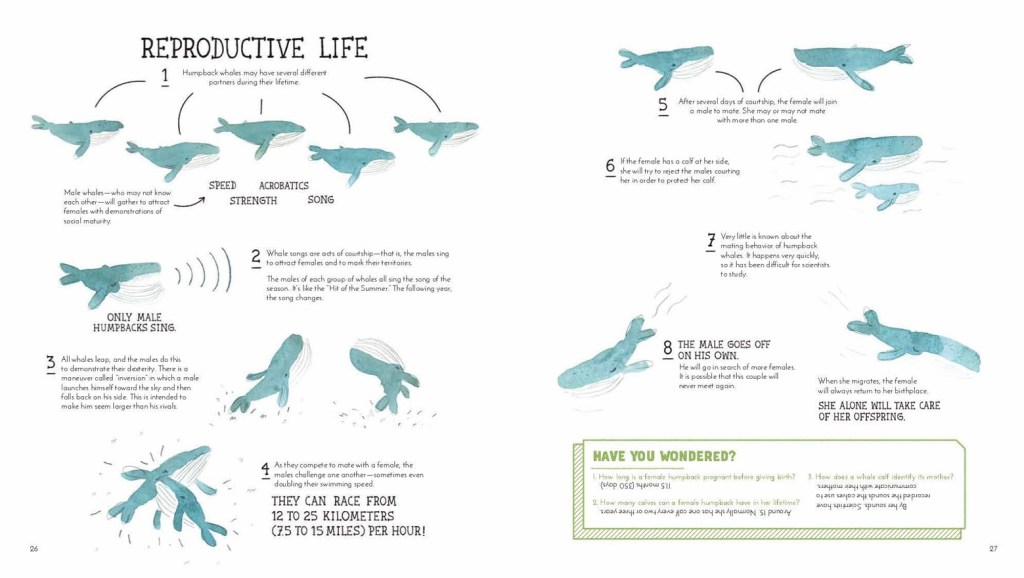
Steps numbered in sequence give the facts and also allow the reader to draw her own conclusions. “She alone will take care of her offspring.” The “Have You Wondered” section reveals how a calf learns to identify its mother.  The book’s backmatter declares that it was created by “a team of people who love whales.” By this point, you will not have any doubt of that essential fact.

Listen Carefully

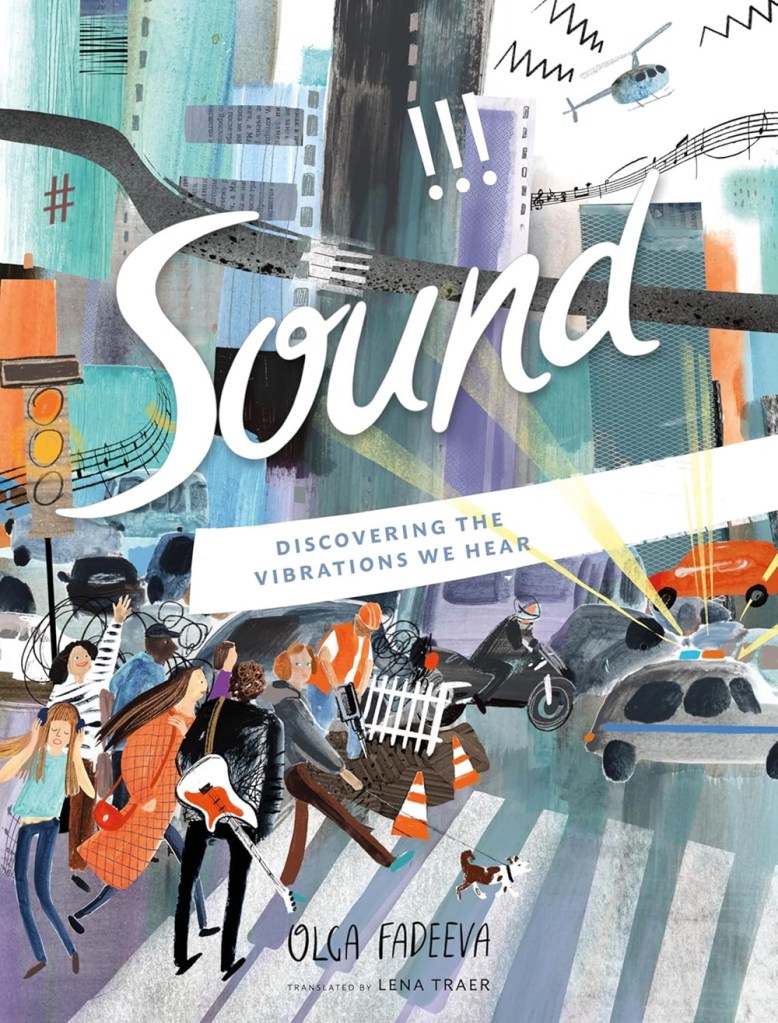
Sound: Discovering the Vibrations We Hear – written and illustrated by Olga Fadeeva, translated from the Russian by Lena Traer
Eerdmans Books for Young Readers, 2025

Imagine for a moment that you are about to pick up a children’s book explaining the physics of sound. How do we hear and transmit noises? Then being to page through it, noticing that the illustrations, in acrylic paint and water, would be worth the proverbial price of admission. Then, as you begin to read, you realize that the ambitions behind this project go way beyond the scope of what you had anticipated. Author and artist Olga Fadeeva has produced an information-rich picture book that moves among physics, biology, history both distant and recent, spoken and signed languages, culture from music to architecture, and technology. That list is still incomplete.

Sound requires careful attention and rewards it on every level.  Opening the book, we see a mother cradling a baby; this is the setting for how we first experience sound. Then, we enter a kitchen, the familiar setting for objects emitting noises, so ordinary that we might ignore them: a boiling teakettle, a clock, a phone, a pot of soup. There is no division between the informational and artistic components of this picture, or in any other section of the book.  Aware of how attention is naturally segmented, Fadeeva places her intriguing introductory premise in a rhombus that is actually in inside of an open window. The metaphor is perfect. A window is opening onto the meaning of sound.

Some pages use different sizes and colors of font, and have captions, as well as words that are sound effects framing the text. There are carefully employed graphics, such as a line indicating the intensity of decibels, or the organs of hearing and speaking labeled and described. The progression among topics is not frenetic; every idea is clearly linked to the ones preceding and following.  While Fadeeva cannot anticipate every question about sound, there are many common sources of wonder that are clarified. How do bats hear? What are some common birdcalls?  What is distinctive about underwater sounds?

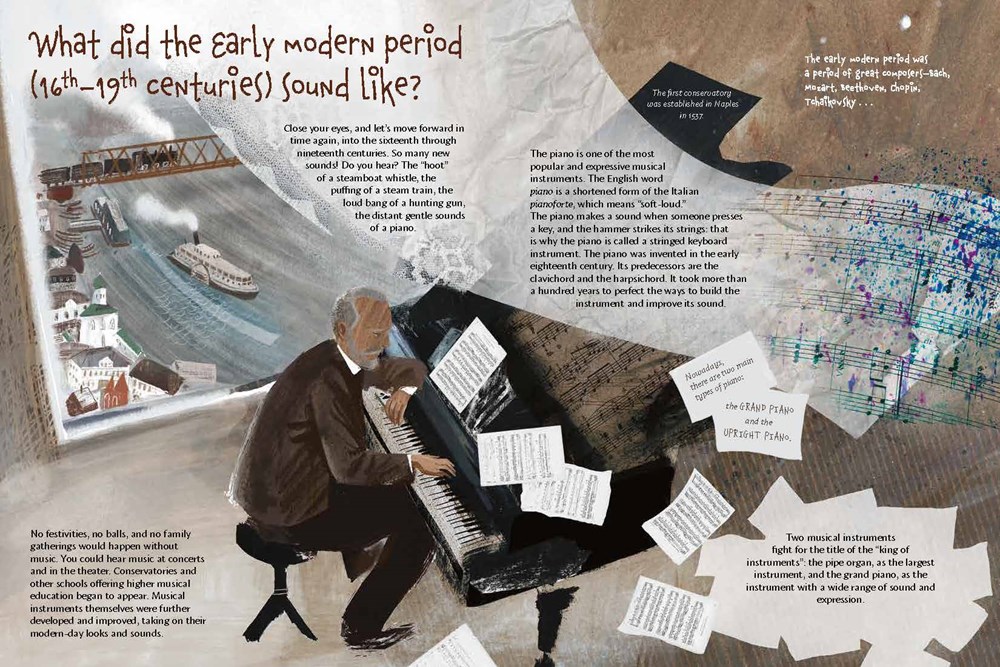
There are other angles from which to explore sound and Fadeeva credits young readers with the curiosity to include them. She actively engages them with invitations to consider different contexts.  What was sound like in prehistory? How did the audience hear in the amphitheaters of the ancient world? (images). Medieval music makes an appearance, visualized with the excitement of charging knights and the lovely concert of flute, timbrel, bagpipe, and lute. Musical notation has its own pages. Even if children have never read music, they will be drawn in by the basic premise: “How can you write down music on a page – and turn it back into sound?” Glamorous performers and intricate pages of notes give the effect of collage. Pages on recording sound includes images of antique devices, and the question of “How do you fill the world with sound?” is followed by a concise but detailed answer superimposed on a dial telephone. Even the cord is covered with words.

The concluding endpapers feature brightly colored pictures and instructions for experiments.  Even after this incredible excursion into the world of sound, children may still want to fill a plastic bottle with buttons or beans, and create an orchestra.  Sound is an intricate and engaging performance for children and adult audiences.

Fairy Architects

The Tallest Tree House – written and illustrated by Elly MacKay
Running Press Kids, 2019

Fairies usually live in tiny, beautiful, dwellings. Sometimes these are made of obvious materials: leaves, twigs, moss, and other natural elements. Often a child who loves fairies created them, or at least happens upon them and lovingly interacts with their inhabitants (for example this and this). In Elly MacKay’s The Tallest Tree House, there are two fairies, no humans. Both fairies have architectural aspirations as does this mouse). Their names are Mip and Pip, and they are somewhat competitive; at least Mip is. She actually challenges Pip to a contest: “Whoever makes the best tree house by sundown wins!” This impulsive idea doesn’t take into account the fact that Pip is currently reading a book about architecture. 

Elly MacKay’s illustrations are theatrical; she describes her method in inspiring detail (I reviewed another of her books here). Looking at her cut-out figures, carefully placed in stage settings, I was reminded a bit of the Cottingley fairy episode, a well-intentioned fraud when two girls in early 20th century Britain convinced a credulous public that they had photographed fairies. Of course, there is no fraud here; Mip and Pip are real and they create their own home. But the delicacy and care involved in bringing them to life seem related.

Even looking at the two friends, Pip seems more serious. In addition to his reading, he has a tall, pointed leaf for a head covering. Mip, in contrast, sports a comically oversized mushroom cap.  Pip draws blueprints based on his planning.  He carries a, presumably, well-stocked toolbox and uses a pulley. The sight of Mip’s obviously fragile tall tower worries him, because he cares about her more than he does about winning. Eventually, they work as a team, together completing “a winning piece of architecture.” 

Several qualities set this book apart in children’s fairy literature.  There is the tortoise and hare allusion, and the friendly warning that you need technology as well as patience to build a fairy house.  The composition resembles a theater set, and even includes sound effects, such as a terrifying BOOM in huge font when Mip’s shoddy tower collapses.  The book is not unique in excluding human observers, but it does feature an unusually independent fairy world.  Next time you build a house for fairies, read Pip’s book and bring along some simple machines.