Fairy Architects

The Tallest Tree House – written and illustrated by Elly MacKay
Running Press Kids, 2019

Fairies usually live in tiny, beautiful, dwellings. Sometimes these are made of obvious materials: leaves, twigs, moss, and other natural elements. Often a child who loves fairies created them, or at least happens upon them and lovingly interacts with their inhabitants (for example this and this). In Elly MacKay’s The Tallest Tree House, there are two fairies, no humans. Both fairies have architectural aspirations as does this mouse). Their names are Mip and Pip, and they are somewhat competitive; at least Mip is. She actually challenges Pip to a contest: “Whoever makes the best tree house by sundown wins!” This impulsive idea doesn’t take into account the fact that Pip is currently reading a book about architecture. 

Elly MacKay’s illustrations are theatrical; she describes her method in inspiring detail (I reviewed another of her books here). Looking at her cut-out figures, carefully placed in stage settings, I was reminded a bit of the Cottingley fairy episode, a well-intentioned fraud when two girls in early 20th century Britain convinced a credulous public that they had photographed fairies. Of course, there is no fraud here; Mip and Pip are real and they create their own home. But the delicacy and care involved in bringing them to life seem related.

Even looking at the two friends, Pip seems more serious. In addition to his reading, he has a tall, pointed leaf for a head covering. Mip, in contrast, sports a comically oversized mushroom cap.  Pip draws blueprints based on his planning.  He carries a, presumably, well-stocked toolbox and uses a pulley. The sight of Mip’s obviously fragile tall tower worries him, because he cares about her more than he does about winning. Eventually, they work as a team, together completing “a winning piece of architecture.” 

Several qualities set this book apart in children’s fairy literature.  There is the tortoise and hare allusion, and the friendly warning that you need technology as well as patience to build a fairy house.  The composition resembles a theater set, and even includes sound effects, such as a terrifying BOOM in huge font when Mip’s shoddy tower collapses.  The book is not unique in excluding human observers, but it does feature an unusually independent fairy world.  Next time you build a house for fairies, read Pip’s book and bring along some simple machines.

Miigiwe – Giving Away is Good

An Anishinaabe Christmas – written by Wab Kinew, illustrated by Erin Hill
Tundra Books, 2024

Finding a children’s book that may be identified as an instant classic is not to be taken for granted. One book that fits that category is An Anishinaabe Christmas. It brings to mind Dylan Thomas’s A Child’s Christmas in Wales, the versions illustrated by both Edward Ardizzone and Chris Raschka, not because of any direct similarity, because the books are very different. Both classics evoke a particular, but also universal, immersion in childhood. You leave the book, and return to it, with a feeling of peacefulness without sentimentality.

A young child from an Indigenous community is going with his parents to visit their extended family on the reservation.  It is winter solstice, an inseparable element of their culture’s celebration of Christmas. Baby, as he is called in the book, looks serious, even puzzled, as his mother and father bundle him up and get ready for their car trip. Their evident excitement is in contrast to his hesitation; this experience is typical of childhood. He is concerned that Santa will not find him away from their home. The cultural signifier of this gift-giving figure so common in the West then transitions to the specific deep roots on the Anishinaabe people.

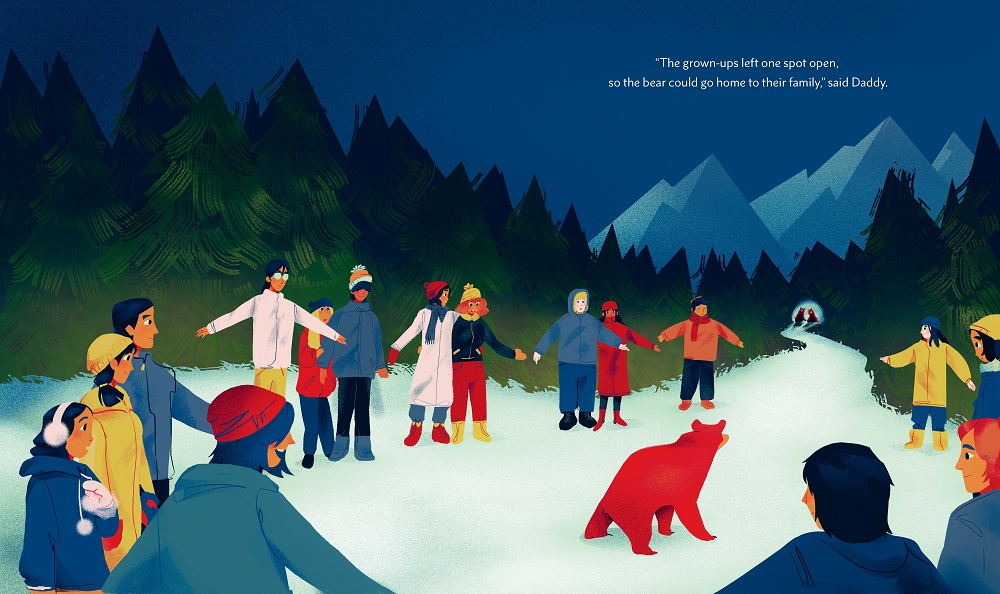
As they drive from the city to the country, the family passes a sign warning not to feed the bears. This prompts a memory that connects Baby to her heritage, and to the natural world that is part of it. Her father repeats the story of how he and other adults had formed a protective circle so that a lost bear cub could find its home. The idea of communalities between humans and animals is organic to the picture, without any ideological explanations. “The bear has a family?” Baby asks. Of course it does, and the father not only answers, but uses the opportunity to introduce words in their native language. (Wab Kinew includes these terms in a glossary at the end of the book, along with an explanation of the cultural syncretism combining Christmas with Indigenous traditions.) The bear also has makwa, family, although it is distinct from the human one.  The bears’ makwa  will “snuggle up in their dens with their babies for Christmas.”

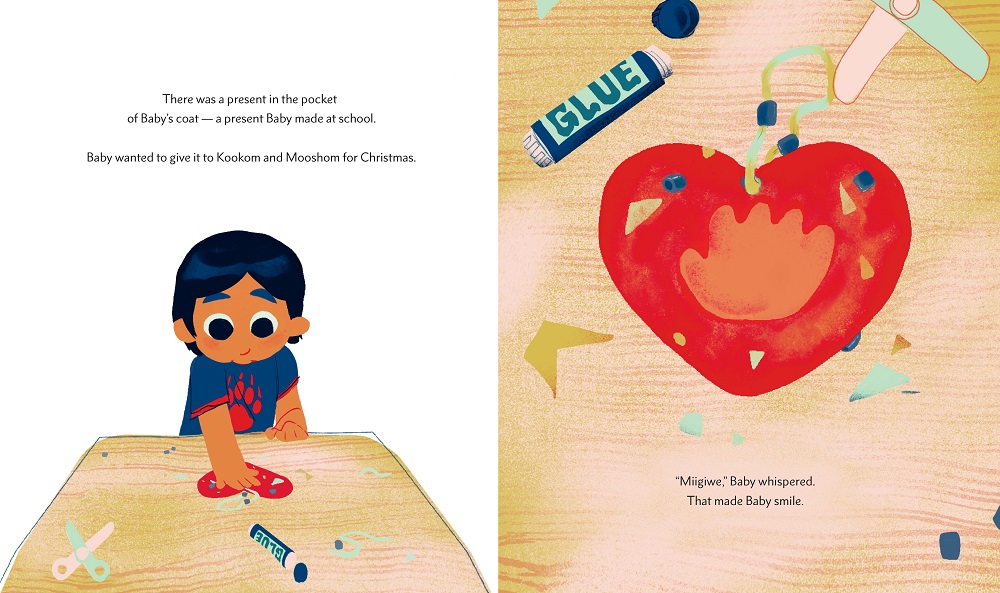
One thing the bear cub will not do is craft a gift for his grandparents, Kookom and Mooshom. The picture of this project is composed of carefully spaced elements, each one of which represents something important: creativity, love, simplicity, focus. Glue, scissors, a red paper heart, become a concrete expression of miigiwe, that Baby’s father has explained: “That means ‘giving away.’ And it’s good.”

The pictures by Erin Hill alternate outdoor panoramas, domestic interiors, and framed scenes of specific activities. A view of the family seated around a wood stove is set an angle and viewed from a slight elevation. Relatives embrace, but there is empty space between different sections of the picture.  Kookom and Mooshom are thrilled to see their grandchild, but they listen carefully to his narration of the car trip. He has processed the truths his father communicated and his repeats them, with understanding, to the older generation. Do you have grandparents? Are you a grandparent? Do you remember your grandparents? You will never forget these scenes.  The family goes outdoors, where they sing about the poetry of winter while playing drums. Whatever winter holiday you celebrate, An Anishinaabe Christmas will resonate as strongly as that chorus.