Jews and Trees

Pavel and the Tree Army – Heidi Smith Hyde and Elisa Vavouri,
Kar-Ben Publishing, 2019

pavel cover.jpg

Before there was a Green New Deal, there was a New Deal that was green.  President Franklin Roosevelt and his advisors established the Civilian Conservation Corps, a program through which American men between the ages of seventeen and twenty-eight could earn a living during the Great Depression and contribute to a far-sighted commitment to conserve natural resources at the same time. Participants engaged in a variety of tasks, including flood control, fire prevention, and the prevention of soil erosion. Heidi Smith Hyde and Elisa Vavouri have given young readers, as well as caregivers and educators, a fictionalized glimpse at a lesser-known fact about this program: a number of the participants were Jewish, and some were new Americans.

My first thought on opening this book was that its very existence is a wonderful idea. There are many excellent children’s books about Jews in the American military, Jews as crusaders for civil rights, Jews in the arts.  Here is a focused look at one specific New Deal program, with a legacy of overwhelming importance today.  Hyde and Vavouri tell the story of Pavel and Anatoly, two Jewish immigrants from Russia whose rabbi has told them about the outstanding opportunity awaiting men willing to work hard and earn a living, at the same time helping the country to which they felt gratitude and loyalty.  Even imperfect English skills would not discourage their enrollment in the corps.  In one two page spread, we see a line of “hungry people, hoping for a scrap of bread or a bowl of warm soup,” blending into an image of Pavel’s rabbi on Shabbat, informing him hopefully about the scope of the program. Soon the familiar urban scene changes to a much lonelier one, where Pavel and Anatoly contemplate “a dry, dusty land dotted with wheat fields and farmhouses.”  The exciting idea has become a much more difficult reality, as some of their fellow workers deride their foreign accents and question their ability to be productive members of a team.

The book achieves a good balance between confronting reality and offering hope.  Pavel, Anatoly, and the other immigrants feel the sting of intense prejudice against Jews, Italians, or anyone who did not conform to their narrow view of America held by some of the men: “You don’t belong in the Civilian Conservation Corps.  You’re not real Americans. I bet you don’t even know America’s national anthem.” Suffice it to say, in addition to digging trenches and cutting timber, Pavel and his friends pursue a new goal with nothing less than total attention: learning to sing “The Star-Spangled Banner” correctly, and with all the fervor of someone born under a dictatorship who could now enjoy the promise of democracy.

Hyde and Vavouri’s presentation of Jewish religious practices in the American military is quite realistic. The men do what they can to retain some observance, such as resting and singing on Shabbat while others go to the movies. At the same time, they are clearly shown eating chicken, mashed potatoes, and apple pie with the other corps members.  Today, when divisions between American Jews based on affiliation and level of practice have become so rigid, it is refreshing to see a book for children that describes a time when things were different.  The books reinforces Jewish teachings about ecology in an unobtrusive way, as when the kind sergeant points out to an insecure Pavel that, just as the saplings need time to take root, he and the other immigrants will also become rooted in the land. It is, unfortunately, not a coincidence that none of the book’s characters are African-American.  The CCC, like other New Deal programs, offered limited positions for people of color, and was segregated by race. This fact offers an opportunity for discussion when reading the book.

pavel int

Vavouri’s color palette reflects both nature and the Corps, with the green of the land matching the workers’ uniforms, along with a blue lake and a roaring orange campfire.  Then there is the flag: red, white, and blue.  Pavel and the Tree Army offers children a vital lesson in American democracy for today.
It’s Not Like There Are Any Buildings…

The Not-So Great Outdoors – Madeline Kloepper, Tundra Books, 2019

outdoors-cover

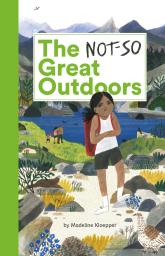
“I have no idea why we have to ‘venture into the great outdoors’” this summer.”  So begins the skeptical young narrator in Madeline Kloepper’s story of a city kid forced to vacation in the forest of the Pacific Northwest. When I opened the book, I shared her crankiness.

outdoors-city

Why would anyone want to leave the inviting city scene from which her parents are about to exile her? Kloepper, a poet who sings the praises of the outdoors, takes care to depict the urban scene as attractively as she does the verdant world that comes next in the book.  Local artisans sells their wares on the street, residents sit at lovely cafés, and a bearded guitarist passes the hat.  I didn’t want to leave.

outdoors-woods

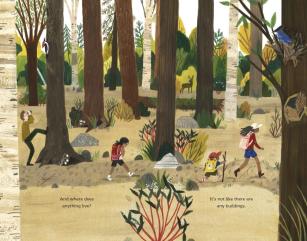
The book has a clever and convincing structure. On each page, the narrator expresses her frustration at the desolate environment of the not-so-great outdoors.  The picture accompanying her complaints highlights the depth and beauty of the environment.  So, “It’s not like there are any buildings’ is set against a majestic scene of towering trees. The girl’s father looks upwards, aiming his camera at a woodpecker, while she lugs her backpack on the trail and scowls at the ground. Her irritated realization that “There’s no electricity” shows her moping on a log while her parents and little brother enjoy a campfire and singalong. Then, midway through the book, the girl has a breakthrough, realizing that the dreaded outdoors has it amenities: “songbirds instead of street performers,” food cooked outdoors which tastes better than the fare in a downtown restaurant.  The transition between the two mindsets happens in a subtle way, but seems to be transformative, as she and her family lie under the stars, pointing up at the night sky: “I don’t even mind that I’m missing my favorite show.”

Kloepper’s color palette is gorgeous and deep, with different shades of green and brown, marine blue, and a cranberry red for standout items such as the brother’s sweater or the family car.  People have expressive faces and animals such as huge bears or smaller beavers become the equivalent of her city neighbors.  The detail in small items—cooking utensils, flowers, blankets—adds realism to the story, although the humorous touch of a Sasquatch running in the woods implies that this is also a fable.  Keep an open mind and you may discover new things!

It doesn’t take an open mind to wait for more works from this gifted artist, or to return to her earlier books. You can enjoy reading The Not-So- Great Outdoors in a sleeping bag, or sitting at a sidewalk café.


One Shoe, Two Shoes, Grey Mouse, Blue Shoes

One Shoe Two Shoes – Caryl Hart and Edward Underwood, Bloomsbury Children’s Books, 2019

shoecover

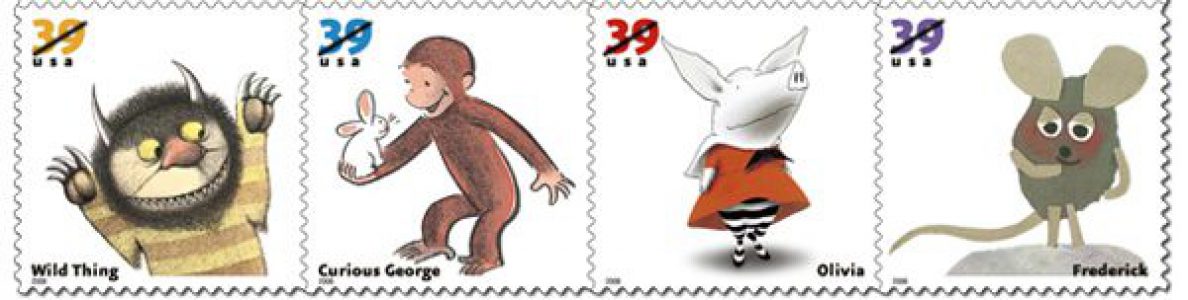
One Shoe Two Shoes draws on a long tradition of children’s rhyme and illustration to create a memorable and appealing world where they will want to return again and again. Using bright colors and familiar words to make the simplest elements funny and exciting, Caryl Hart and Edward Underwood invite comparisons to some of the most inventive authors and artists for children.  Their mice racing in roller skates and hiding in wooden clogs recall Leo Lionni’s paper collage creatures and P. D. Eastman’s dogs, as well as some of the classic mid-century Golden Book artists.  At the same time, characterizing the book’s style as “retro” does not quite do justice to its particular attractions.

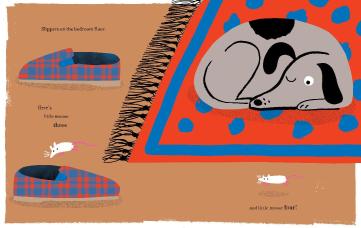
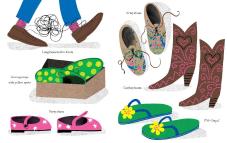
There are several characters in One Shoe Two Shoes: a hapless dog, mice, people, and the shoes themselves.  The dog, who will both fetch and stretch when commanded by an owner portrayed, like all the people in the book, only from the torso down.  Children listening to the story will share the dog’s perspective.  He is constantly shoeplaidsurprised by a playful and clever set of mice.  Sometimes they nest quietly in the footwear, but in other scenes they pop out of boxes or raucously ride skates.  While the dog seems taken aback by the mice’s stratagems, he is not upset and continues to eat, run, and sleep, even if it is with one eye open. Children will appreciate his flexibility.
shoe-sweater

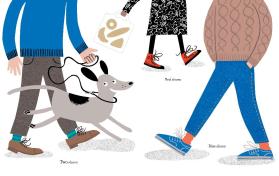
The faceless people also seem friendly, a varied cast of characters with different shoes to fill. There is the dog’s owner, wearing striped socks and brown oxfords. There is another person, maybe his twin, in jeans and a fisherman’s sweater.  A woman in a black floral dress and red high tops totes a bag of croissants, French bread, and a scone.

Then there is the schoolgirl who could be an older Madeline, wearing white socks and Mary Janes and carrying a stylish red book bag.  Underwood has invited into the book representatives of the human world to anchor the animal’s adventures; they provide an element of realism within the fantasy of mice acting out on purpose and eluding everyone’s control.

Then there are the mice, and the shoes.  The mice are spry and adorable. They might just want to rest in a bedroom slipper, but they definitely enjoy creating an amusement park ride out of a shoebox, taking turns sliding down the cover while their friends wait patiently in line.

allshoes

Underwood’s shoes themselves move through the book in a fantastic parade. Note that no comma in the title slows them down.  They move in singles and in pairs; classic cowboy books, whimsical flip-flops, but also “artsy shoes” splattered with Jackson Pollock-like splashes of color and shoes with laces so long that they are connected to one another in a delicately whirling tangle.

Hart’s text keeps the book moving as quickly as the mice.  Simple rhymes, counting, and brief descriptions of action and shoes (“Green pumps/with yellow spots,” “Pitter Patter/Sniff/Lick/SCATTER”) are all integrated together.  The book is artfully designed by Goldy Broad, with letters alternating in size and level on the page, emphasizing the quick movements and pace of the all involved, from shoes to people.  One Shoe Two Shoes is a perfect fit for young readers.

Not the Little Mermaid

Mermaid Dreams – Kate Pugsley, Tundra Books, 2019

mermaid4 (2)

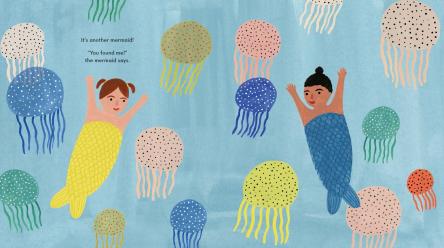
Who doesn’t love a mermaid? With a fin in both worlds, this fantastic creature seems to appeal to the human desire to be more than one thing at once.  In Mermaid Dreams, author and illustrator Kate Pugsley adds a new resident to the undersea world when Maya, a bored and lonely little girl, finds herself transformed into an agile and beautiful being.  With bold colors and simple shapes reminiscent of both Maira Kalman and Leo Lionni. Pugsley places childhood wishes in a believable setting, which will draw young readers into Maya’s world of nature and dreams.

mermaid3

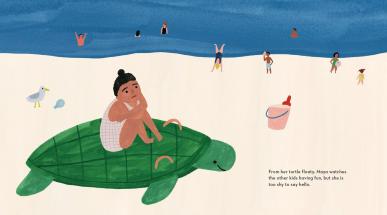
The book’s endpapers are a parade of coral, jellyfish, sea anemones, starfish, and more, against a white background.  They are not in the sea; these visual elements of the story have an independent life as part of Maya’s imagination.  We first meet her on a beach scene that looks promising: “The air smells fresh and salty.  The sand feels warm and soft between her toes.” Yet Maya is disappointed when she realizes that a day off for Mom and Dad may not meet her own expectations. Her request that her parents play with her is met with the thoughtless rejection of kind, but tired, adults: “Maybe later. We want to relax now.”  Maya sits sadly on her turtle floaty, then lies back, closes her eyes, and loses herself in thoughts of wonderful escape.

mermaid4

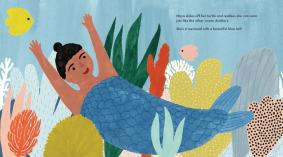
Suddenly, she awakens, riding a real turtle and discovering her new powers to move “just like the other ocean dwellers.  She’s a mermaid with a beautiful blue tail!” Who needs parents and beach umbrellas when you have seahorses, coral reefs, and an octopus?

mermaid2

The problem with that octopus is that “It has eight wonderful legs, but it can’t hold a conversation.”  Maya’s need for adventure meets her longing for companionship when she “sees an unusual shape in the distance,” which turns out to be Pearl, another child/mermaid. Neither Maya nor Pearl conform to the slinky Ariel image of their species. They are rounded, solid, little girls with lots of energy and no search for a prince.

The girls play together in the multicolored ocean, and their friendship survives on land as well.  Maya and Pearl walk into the sunset, Pearl holding on to a giant pink jellyfish kite floating in the air. This could be the start of a beautiful friendship. Mermaid Dreams invites children to test the waters of independence from parents, and reassures them that they are not alone in this quest.  Using the language of a child’s dream world and the shapes and colors of their own crayon box perspective, Kate Pugsley adds a new vibrancy to the enduring mermaid myth.  And Tundra books has done it again with ocean-based picture books.


You’re the Best: The Blue Ribbon Puppies

The Blue Ribbon Puppies – Crockett Johnson, Scholastic, 1987 (reprint of 1958 edition)

brpuppies

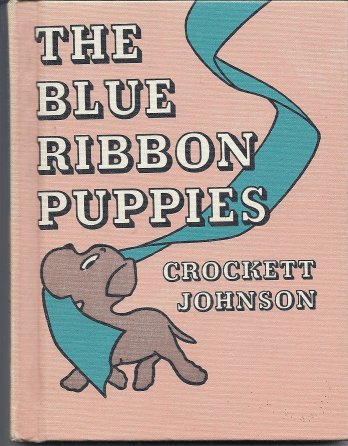
Classic children’s author Crockett Johnson, (1906-1975), creator of the immortal story of children’s creativity, Harold and the Purple Crayon, has a lesser-known but comforting book about the inanity of prizes. I thought about it in the wake of the American Library Association’s recently announced Youth Media Awards, including the Newbery, Caldecott, and others, recognizing excellence in books for children. This year’s announcements also included the awards given by the Asian Pacific-American Librarians Association, and the Sydney Taylor Awards of the Association of Jewish Libraries. Winners included: Hello, Lighthouse; Islandborn; All-of-Kind Family Hanukkah; Sweep: The Story of a Girl and Her Monster; A Moon for Moe and Mo; and Through the Window: Views of Marc Chagall.

As always, there were some objections on social media to books that were apparently slighted, with some critics and readers claiming there were political motivations behind the choices. Some of the discussions were thought-provoking and insightful; others were negative and ad hominem.  There are many wonderful books published each year for children; it would almost seem better to replace the “winner-take-all” mentality of the awards with a list of recommended books, all distinguished. (The ALA does publish a list of Notable Books, but even this long list has books notable by their absence.)

These thoughts bring me to The Blue Ribbon Puppies, originally published in 1958, before the frequent suggestions that we have supposedly weakened children’s ability to withstand disappointment by rewarding them for every refrigerator quality artwork or lost sports match.  Crockett Johnson’s children and large, diverse, puppies, could come from Harold’s purple crayon. The boy and girl in the book, unnamed and generic, are trying to select the best-in-show to win a blue ribbon, but they just can’t seem to sign on to arbitrary adult standards. Instead, each flawed puppy gets an award. “He is too fat,” becomes “the best FAT puppy,” (extremely problematic term for any future reprint), along with prizes for “the best SPOTTY puppy,” “the best LONG puppy,” (they should meet H.A. and Margret Rey’s Pretzel), and “the best PLAIN puppy.” Each puppy is given an oversized blue ribbon, engulfing them in a likely annoying way. No wonder that the last page just shows the untied ribbons strewn on the floor.  Even the boy and girl award themselves identical blue ribbons, making it clear to children that they also deserve distinctions, whatever their special qualities may be.

The Blue Ribbon Puppies is perfect to read aloud, but its controlled vocabulary also makes it an ideal beginning reader. Wherever you stand on the nurturing vs. socializing children spectrum, it’s a good reminder that prizes are zero-sum games and that books without special seals may also deserve blue ribbons.

Reading about Mom and Dad Felt Wonderful

Great Job, Mom! – Holman Wang, Tundra Books, 2019
Great Job, Dad! – Holman Wang, Tundra Books, 2019

Great Job Dad.jpgGreat Job Mom.jpg

Artist and author Holman Wang’s two companion volumes describe the phenomenal talents and brilliant multitasking of an ordinary mom and an ordinary dad. The books are immersive, as readers enter a tiny world of exquisitely crafted felt figures and their accompanying accessories.  Here is what the books are not: gimmicky.  If you are at all skeptical that 1:6 scale figures produced by needle-felting, a process which the author accurately terms “a painstaking process,” offers a warm and authentic perspective on parenting, read the books!  Both books feature a perfect balance of miniature detail and the “big picture” of a child’s sense of security in a super-competent and loving parent.

In a “Behind the Scenes” section at the end of each book, Wang, the creator, along with his twin brother Jack, of the Cozy Classics board books, reveals the process behind his productions.  Comparing himself to a film director, he explains how, after having crafted his figures and made or located “pint-sized props,” he builds sets and photographs them, using the cinematic technique of “forced perspective.”  The intricacy of this process is reflected in the books’ illustrations, each one a completely realized scene of family life.

library dad

Each picture is accompanied by one brief page of text, an expression of gratitude for Mom and Dad’s many talents.  “By night he’s our librarian/with stacks of books piled high,” shows Dad with his arms around son and daughter, reading them bedtime stories from the impressive collection in their room.  The current selection is The Hockey Sweater, from 1985, Roch Carrier and Sheldon Cohen’s affectionate tribute to Canadian hockey. Other books lying on the quilt and gracing the shelves include The Wizard of Oz, Where the Wild Things Are, and The Book with No Pictures, linking generations and genres.  Even the quilt itself, decorated with Russian nesting dolls, is both literary and child-friendly.

judge dad

Now and then Dad has a tougher job: “He sometimes has to serve as judge/to find who’s in the wrong.” Arms crossed and looking more stern than in the other pictures, Dad has to adjudicate between two kids pointing the finger at one another over who made a mess at the picnic table, while the family dog, like a side figure in a Brueghel painting, goes after a bottle of ketchup and some fallen French fries.  Dad is also a chauffeur pushing a stroller, and an architect building a structure out of bridge chairs and a table.

mom actor

Mom is just as versatile. Her professions include curator of refrigerator artwork, and impromptu actor: “At times she has an actor’s flair–/without a line rehearsed.” What could have been the boring conclusion to a supermarket trip becomes a performance, as Mom turns a shopping bag into a pirate’s hat, a juice bottle into a spyglass, and a baguette into a sword.  Her kids are an appreciative audience.


mom journalist

And her journalism skills are not wasted when she captures her little girl’s playtime on a cell phone camera.  This mom is active and strong, concentrating with great focus on everything she does. Her search for socks in a laundry basket is as meaningful as an archeologist’s search for artifacts in a cave.


If you have never attempted to turn wool into felt figures, you may not realize that each figure, as Wang explained in a 2016 interview, may require between twenty and forty hours to complete.  The posing and photographing of the book’s scenes is an even longer investment in time.  On a much more modest scale, if you even try to experiment with the made-for-kids version of this art form as a hobby, with, for example, the wool felting book from the versatile Klutz series, you will realize how committed Wang must feel to this medium as the best way to illustrate the challenges of parenting.  Reading these books, which succeed in making a complex process look simple and natural, one can only tell the author, “Great job, Mr. Wang.”


Chiune Sugihara: A True Hero

Passage to Freedom – Ken Mochizuki and Dom Lee, Lee & Low Books, 1997

passage cover

On Monday, January 27, many people and organizations around the world will observe International Holocaust Remembrance Day, honoring the memories of those lost to Nazi terror.  On that day in 1945, Soviet soldiers liberated the death camp of Auschwitz-Birkenau. (On the Jewish calendar, Yom HaShoah, which will fall this year on Thursday, May 2, commemorates the Jewish lives lost to the disaster.)

I posted a blog several weeks ago about a recently released book, Thirty Minutes Over Oregon, about a failed Japanese attempt to bomb a small town in Oregon during World War II.  One of the defining untruths about that book was the author’s characterization of the bomber as a “noble figure.”  I suggested that, for a true portrait of nobility during the War, readers return to a much older book, Passage to Freedom, the story of Japanese diplomat Chiune Sugihara. Sugihara’s undeniable act of heroism in defying his own government when he personally took responsibility for issuing visas to thousands of desperate Jews in Lithuania, where he was serving as vice consul, allowing them to flee east, to China and Japan, and eventually to safety in other countries.

Ken Mochizuki and Dom Lee, who collaborated on the outstanding historical picture book about the internment of Japanese Americans, Baseball Saved Us (1993), tell Sugihara’s story from the point of view of his son, Hiroki, a child at the time of his father’s courageous decision.  Hiroki Sugihara provides an afterword about the events described and his personal response to them.  The simplicity of the text realistically conveys the experience of a young child undergoing a chaotic experience, but finding meaning through the ethical decisions of adults who chose to resist immoral social norms by following their own moral compass.  The sepia toned pictures capture the feeling of watching an old newsreel, yet they are also both immediate and timeless.

passage-boy

A young Jewish boy stares out at the reader, holding the food item which Sugihara had given him the money to purchase. His expression echoes that of so many photographs from the era, ones in which the confusion and fear of children faced with inexplicable adult actions are manifest.  Another picture frames Sugihara and his son in a window pane.  The diplomat looks out, in the process of thinking through the ominous facts about his position.  Hiroki looks on in confusion, which the text resolves:

“My father cabled his superiors yet a third time, and I knew the answer by the look in his eyes. That night, he said to my mother, ‘I have to do something. I may have to disobey my government, but if I don’t, I will be disobeying God.’”

The final illustration shows a line of railroad tracks narrowing to the horizon.  One creased document sits in the center of the tracks at their widest point. Perhaps it fell from the departing train, as the story relates how, even as trains pulled away, “My father still handed permission papers out the window.” The picture also suggests an opposite and ghostly image, of trains which pulled away full of Jews who would never return.

In every way, Sugihara was the embodiment of heroism, in stark contrast to the “hero” of Thirty Minutes Over Oregon. Although that book was supposedly about reconciliation, the bomber appears never to have come to terms to his blind obedience to a fascist government. His acknowledgement that ritual suicide might be the only response if the people of his intended target did not forgive him proves how little he had learned about courage and sacrifice.  Chiune Sugihara and his family were stigmatized even after the War, but were eventually honored at the Yad Vashem memorial to “Righteous Gentiles” in Israel. Passage to Freedom is a book to read, reread, and share with our children and students, especially as recent surveys report how knowledge of the Holocaust is receding dangerously into the past in the United States and elsewhere.

passage-to-freedom-interior-mochizuki-and-lee-e1474862299959


Sibling Pet Rivalry

Princess Puffybottom…and Darryl – Susin Nielsen and Olivia Chin Mueller, Tundra Books, 2019

princess puffybottom cover.jpg

As long as there are siblings reading books, or having books read to them, the rivalry between them will remain a popular topic for children’s books.  Here the siblings are a cat and dog pair, the cat being a pampered and only child of a partially off-screen and unnamed couple of stylish women, at least it appears they are stylish from our cat’s eye perspective of the richly drawn and colored pictures.  You may appreciate this book if you love cats and/or dogs, but you really don’t have to in order to empathize with both Princess Puffybottom and the perfectly innocent canine whom she fears will replace her.

princess puffybottom perfect

Books about the anticipated arrival of a new baby often emphasize the rewarding aspect of this experience, one which may elude an older sibling for months or even years as everyone lavishes attention on the addition to their family.  Susin Nielsen and Olivia Chin Mueller do not overplay the analogy between humans and animals here.  Princess Puffybottom is unmistakably a cat.  “Life was good,” she thinks, because she lounges in a softly lined bed surrounded by cat toys, and spends more time sleeping on couches than a child ever would.

But when Puffybottom’s idyllic life is interrupted by the arrival of an annoying dog, whom she characterizes as “horrible,” “disgusting,” and “an animal,” the cat’s reactions seem a little more like that of an angry child, even if she is more articulate in describing just how awful the new “sibling is.” Yet even the most distraught older sibling would be unlikely to try Puffybottom’s desperate but calculated approaches to getting rid of the dog.  She tries to hypnotize him, as well as tricking him into destroying her owner’s lovely red stiletto heels. (A child older enough to figure out how to do that would likely not feel intense resentment at a newcomer.)

princess puffybottom preg

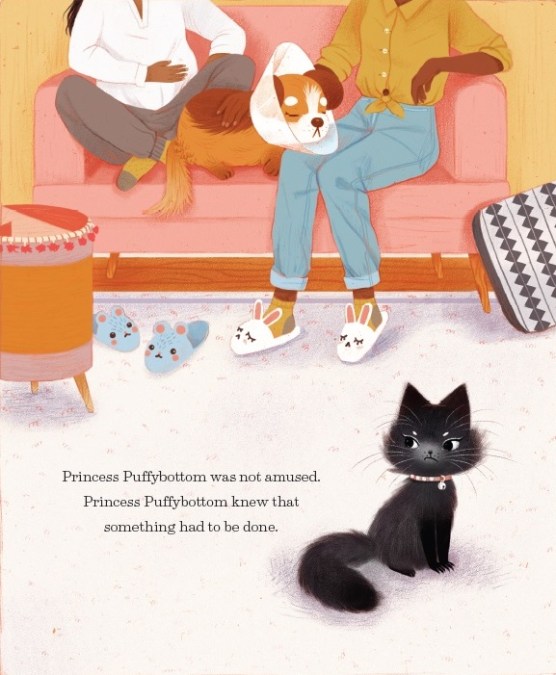
Nielsen’s text is understated and funny. Children will relate to its simplicity and adults will understand all that is left unsaid about their children’s feelings. Chin Mueller’s pictures are incredible, both simple and lavish.  The colors are bright and realistic details stand out in every scene, from the delicate floral tattoo on a woman’s arm to the painting on a wall featuring a fierce orange tiger behind bright green leaves.  The most interesting choice by the illustrator is to depict the animals’ owners in several scenes as incomplete figures.  We see their torsos but not their heads, giving the small animal, or child’s, perspective.  What we do see of them is specific to every scene, whether their boots, jeans, and skirt as they hold the new intruder Darryl on a leash, or the seated couple in a domestic scene which really inflames Princess Puffybottom: one woman, wearing bunny slippers, pets the injured dog, while her companion crosses her legs and rests a hand on her enlarging middle.

One other sure to be remarked upon feature of this lovely book is the identity of the couple: same –  sex and interracial. They appear, as they should, without comment. To the pets, as to our children, they are just the people who care for them.  Princess Puffybottom…and Darryl contains unstated progress, along with distinctive artwork portraying a constant part of children’s lives.  There are many reasons to enjoy this book.

Struggle, Change, and Poetry

This Promise of Change – Jo Ann Allen Boyce and Debbie Levy, Bloomsbury, 2019

changecover

Award-winning author and poet Debbie Levy (see my interview of her here) has collaborated with civil rights veteran Jo Ann Allen Boyce to tell Boyce’s story of being a young pioneer fighting to desegregate the high school in her home town of Clinton, Tennessee.  The book is a symphony of poetry and courage. Allen Boyce and Levy use verse, historical documents, and Boyce’s memories to recount the unforgettable pain and frustration, as well as the personal strength and triumph, of her struggle. The result is a riveting account of how unjust laws and deeply ingrained prejudice impacted the lives of African-Americans, as well as a glorious tribute to language and its power to both articulate and change experiences. (also see reviews of Levy’s work here and here)

Although the court-ordered desegregation in Clinton took place in 1956, before the Little Rock Nine and before Ruby Bridges attended a white school in New Orleans, many fewer Americans are aware of this timeline.  In an extended “Epilogue,” the authors reflect on the reasons for this omission.  The lives of African American residents of the town, as in the rest of the segregated South, were characterized by a kind of double existence, a precarious balance between friends and enemies, their own supportive communities and white neighbors blinded by prejudice.  Some of these neighbors, who interacted positively with Allen Boyce and her family, became seemingly deranged by hatred when compelled by law to surrender a small part of the power and control which they had enjoyed for generations by allowing African American students to attend school with their own children.  The authors capture the psychological destructiveness of this situation by alternating chapters in which Allen Boyce describes the events and individuals of this paradox.

A visit to the supermarket by people of color was governed by elaborate rules, in which

“We do not enter that aisle
while the white person is contemplating
baked goods.
This is not a bread rule, you understand;
it applies to milk and scouring powder, too.”

The narrator’s voice is seemingly detached, as when she describes the similar process by which African-American women could be permitted to try on hats at a milliner’s without contaminating the goods for white customers.  In other chapters, Allen Boyce expresses confusion, rage, faith, and determination.  Every attack becomes an indelible memory: “But you can’t unhear/what you hear,” when a child in a store calls her a filthy name. There is significant nuance to Allen Boyce’s reactions.  White people may show compassion under limited circumstances, but fail to support integration because of their total investment in an unjust system.  The book is not populated only by heroes and villains, although both play a role, but also by failed human beings who support racial inequality every day when, like President Eisenhower, they only reluctantly admit a need for some change.

The range of poetic forms in the book is breathtaking.  In her notes, Levy describes this choice as a tribute to Allen Boyce’s voice, developed by a mother who insisted on the importance of using English correctly and eloquently.  There is free verse, but also sonnets, ballads, haiku, villanelle, and other forms.  These poems are not meant to amaze the reader with technical virtuosity; each one is adapted to relating a specific part of Allen Boyce’s experience.  There is irony framed in rhyme as she comments on the temporary calm in the town enforced by the presence of soldiers:

“Decency rises
Decency won
Decency spurred
by a soldier, a gun.”

The precision of “Do the Math” uses equations and an acrostic to turn chaos into controlled forms, while the sonnet sequence of “Down the Hill” elevates her father’s choice to move the family to California:

“Abandoning the cause that I embraced,
retreating from a stand I know is right.
The risks I took, the dangers that I faced –
what purpose served if I don’t stay to fight?”

An extended section at the end of the book includes the authors’ explanations of the book’s genesis, historical background, lists of additional sources, photographs, and a timeline, making This Promise of Change an excellent choice for both individual reading and classroom use. Jo Ann Allen Boyce and Debbie Levy have succeeded in combining artistic distinction and historical truth in this outstanding work for young readers, caregivers, and educators.


Jada Jones’s Rocky Friendship

Jada Jones Rock Star – Kelly Starling Lyons and Vanessa Brantley Newton, Penguin Workshop, 2017

jjcover

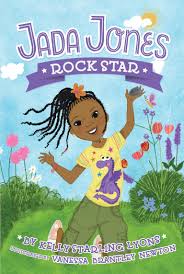
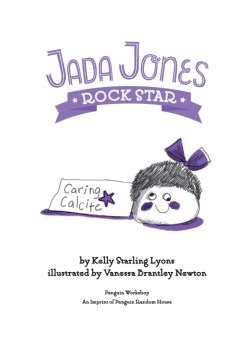
In this first volume of three Jada Jones stories, with a fourth to be released in the spring, Kelly Starling Lyons introduced her bright and appealing fourth grade heroine. Jada is as consumed by her interest in rocks as by a deep sense of loss when her best friend Mari moves away.  Even with supportive parents and a younger brother who looks up to her, Jada can’t shake the blues even though her father, a blues musician as well as an engineer, has assured her that the blues “don’t last forever.” Her librarian mom’s empathy and involvement are also imperfect substitutes for her missing companion.  Young readers who have endured the pain of competition for friends will easily relate to Jada’s situation.  For all her fascination with sedimentary, igneous, and metamorphic rocks, her sadness feeling like half of a pair seems overwhelming.

Starling Lyon’s text is simple, suitable for early chapter book readers, but she pairs kids’ language with subtle metaphors, adding depth to Jada’s story.  Jada’s forced smile is “All teeth with no joy,” and her persistent feelings about her friend become “my missing-Mari ache was back.” On the more positive side, her joy in geology is totally believable, as she rhapsodizes about the mineral specimens which Mari sends her:  “Light green and sharp like the point of a star. Peach and grainy like glitter mixed with sand.  Blue with stripes like ocean waves.” As Jada begins to hope that her friendship with science project partners Lena and Simone might bring back her sense of belonging, she learns that people have different ways of responding when they feel hurt or threatened.  Starling Lyon has created a young female character who loves science and is also a social being, not a caricature of intellect without feelings.

jjinsidecover

Another selling point of this engaging book: it’s purple. The illustrations are black and white drawings with purple elements, including a t-shirts, a lunch bag, and even her classmate’s beautiful black curls.  Jada writes in a lavender science journal, and her friend Mari’s letters appear in blocks of purple font.   Brantley Newton’s cast of characters are examples of her inimitable joyous style (I reviewed another of her beautiful books here).  Even anger and sadness are part of a range of emotions to be embraced and celebrated.  Jada and her possible nemesis Simone face one another, Simone’s arms crossed defensively and Jada clutching her purple backpack in anger.

Later, all three girls jump rope together, having resolved their differences, Jada having learned an important truth: “Each time I sailed over the rope, I felt a thrill kind of like finding a stone. I never thought of jumping and rock hunting as having something in common.”

Jada Jones Rock Star acknowledges the difficulties and the joys of childhood for early chapter book readers. Caregivers and educators will recognize Jada’s dilemma and remember the tough spots when kids learn about empathy. The book concludes with a purple list of “Jada’s Rules for Being a Rock Star,” perfect for sharing and discussion.