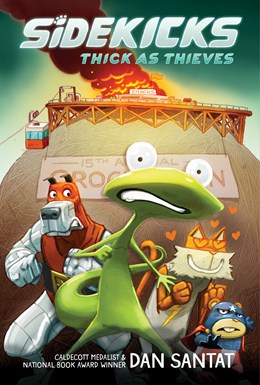
Sidekicks: Thick as Thieves – written and illustrated by Dan Santat Scholastic Graphix, 2026
Sidekicks: Thick as Thieves, is the second volume of Dan Santat’s Sidekicks series. This graphic novel combines frenetic action with thoughtful dialogue about some serious questions. Among these are the nature of families, the difficulty of making tough decisions, and accepting that no one is skilled at everything he or she tries to do. And for adults, add to that list how difficult it might be to retire, even if you are a superhero.
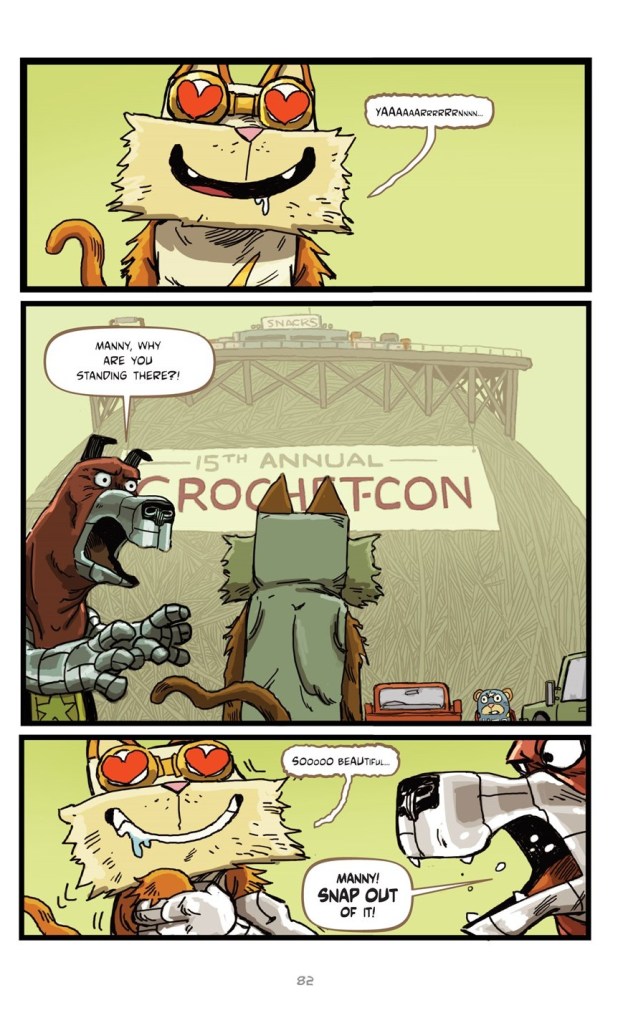
When the book opens, Captain Amazing, also known as Harry James Blake, is about to, reluctantly, take a vacation. His sister Kelly is accompanying him to Crochet-Con, a convention of hobbyists that includes the display of a gargantuan ball of yarn. Harry has recently taken up the hobby, and he‘s not good at it. He won’t win any prizes, except for participation. But he’s getting older, and now that his peanut allergy has been revealed by his nemesis, Dr. Havoc, his superhero days have been further compromised.
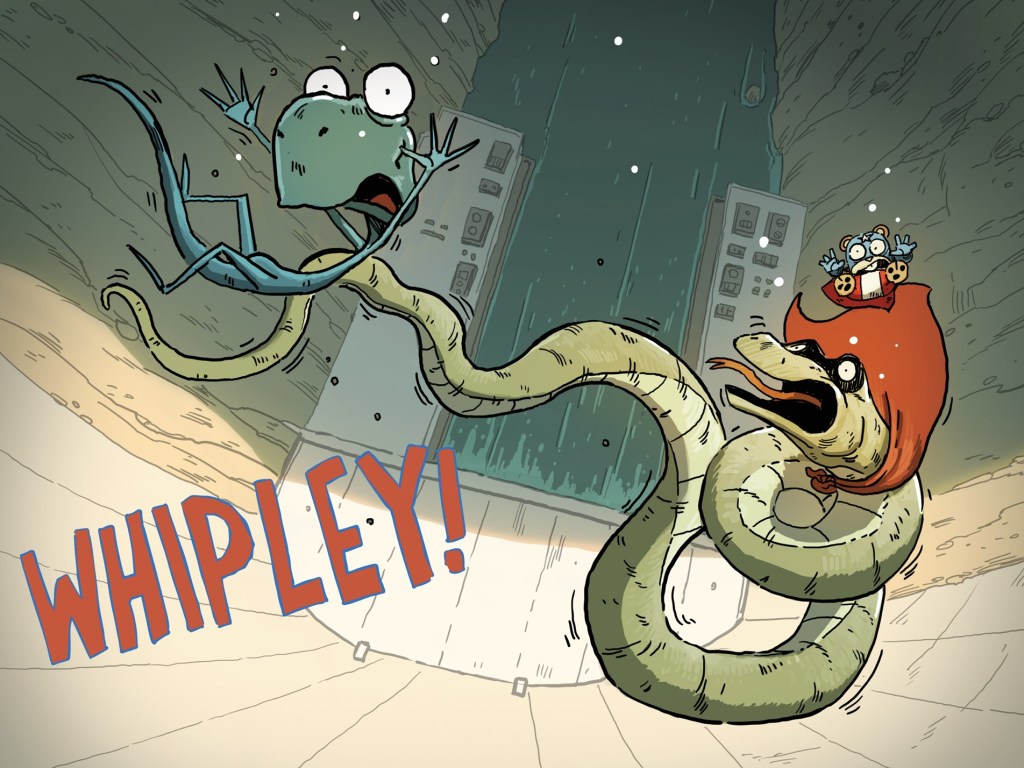
Meanwhile, back at the Society of Superheroes, there has been a data breach, and also a possible betrayal. Shifty, Roscoe, Manny, and Fluffy are trying to put the pieces together, and Shifty’s brother, Whipley, makes a surprise appearance. The two siblings are thick as thieves, sort of. Shifty looks up to Whipley as a paternal figure, but in a complex series of revelations, it turns out that Whipley’s morals are rather flexible. Is anything and everything permitted if someone claims that he is only taking questionable actions to care for someone he loves?
Santat’s bad guys are scary, and the damage they inflict shows viscerally on their victims’ faces. Classic superhero action and robotic terror are confronted by gentle animals, confused, but also clever. When Manny confesses his insecurities to Roscoe, “But I was worthless at the world’s biggest ball of yarn…I made careless mistakes,” Manny’s canine friend reassures him: “I have, too. That’s why we work together. You got my back, and I got yours.” Santat’s gift for neatly summarizing difficult issues is visible here, as in all his books. Without a trace of condescension, he reminds readers that no one is perfect, but, just maybe, good can still defeat evil.
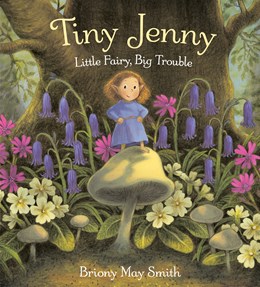
Tiny Jenny: Little Fairy, Big Trouble – written and illustrated by Briony May Smith Anne Schwartz Books, 2024
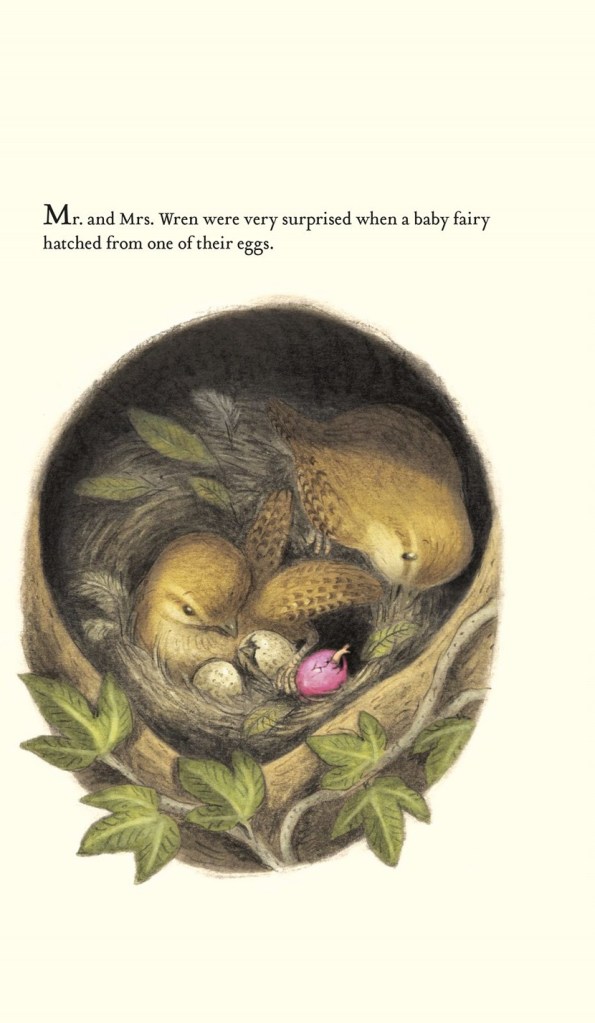
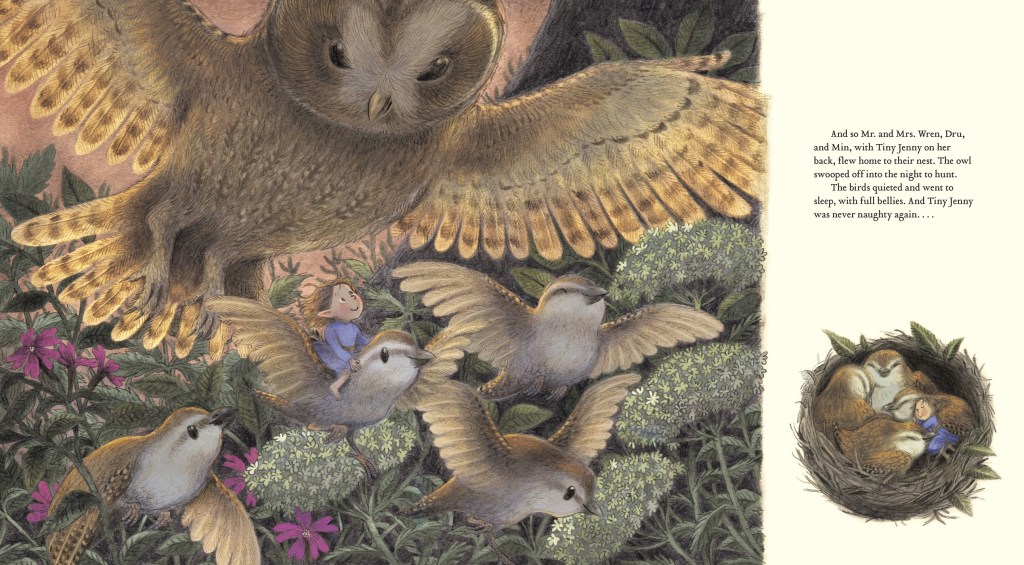
Briony May Smith‘s Jenny is a changeling, a fairy hatched from a wren’s egg, much to the family’s surprise. She has no wings, sort of like the reverse of Horton’s long-anticipated newborn in Horton Hatches the Egg. Like Hans Christian Andersen’s Thumbelina, she has to navigate her way through a dangerous world. There are many lovely books about fairies who have a range of origins and play a variety of roles (see my reviews here and here and here). The wrens name her Tiny Jenny and dedicate themselves to raising her, but perhaps not thinking through all the potential problems.
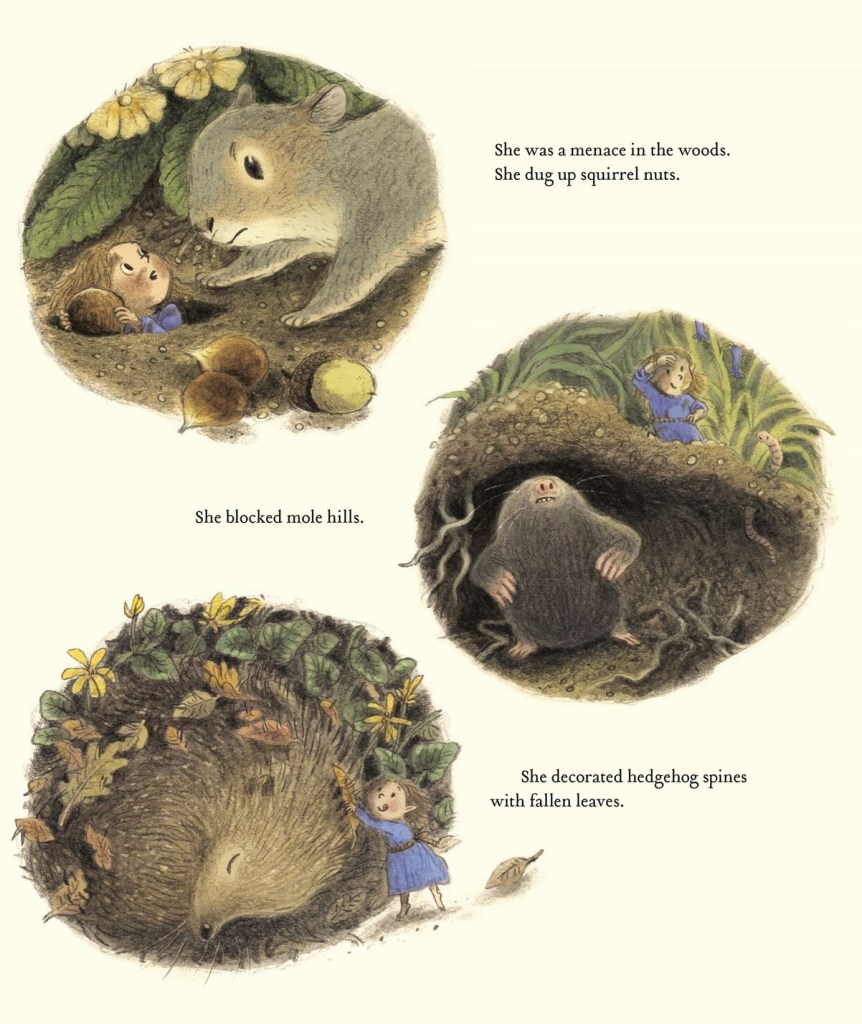
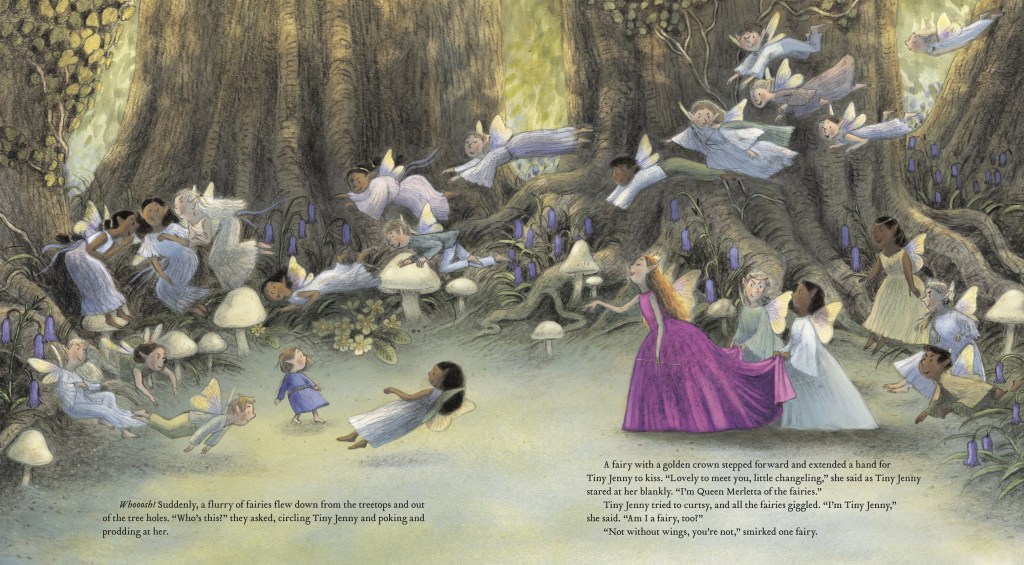
Wrens can fly, but wingless Jenny cannot. She manages pretty well, finding stems and brambles to eat, and even decorating her friend the hedgehog with leaves. Not every part of her day concerns survival. One day, Jenny overhears some of her woodland friends, or least creatures she had thought were her friends, talking about her. It isn’t pretty. They find her most endearing traits to be annoying. When a wise owl uses his renowned quality to point out that she is not a wren, but a fairy, he also encourages her to go out and find some of her own kind to prove her true identity. She stumbles into a fairy ring, an action generally associated with bad results, at least for non-fairies. She is pictured among a circle of oversized, from her point of view, mushrooms, as she looks up quizzically. All of a sudden Tiny Jenny finds herself surrounded by fairies. There are boy and girl fairies, ones in flowing dresses and others in trousers. They move effortlessly because, unlike Jenny, they have wings. These fairies are not so nice. They prod her skeptically. Merletta, their queen, extends her hand to Jenny for the required kiss. Naturally, “Tiny Jenny stared at her blankly.” One fairy actually smirks at Jenny’s confusion, and her lack of wings.
The solution to her problem seems imminent, as Queen Merlette assures Jenny that she only needs wings in order to complete her fairy transformation. Then come those ominous fairy tale words: “But first you must prove yourself worthy.” What follows is a kind of mild fairy hazing. Jenny is relegated to the back of the line of fairies wielding wild garlic and bluebells. Disillusionment follows, as Jenny learns that fairies are not nearly as nice as wrens. Instead of foraging for food, they steal. Queen Merletta is a proto-dictator, calling out commands to “ATTACK.” When they inform Jenny that she has passed their test, she responds with the self-assurance rooted in the unconditional love of her wren parents. “No, I don’t want to be a fairy,…You’re mean, you’re bullies.” Jenny doesn’t care about getting wings anymore. Soon she is home, eating mushrooms, and sleeping in her nest, while reserving the right to occasionally be restive and annoying. There’s no place like home.
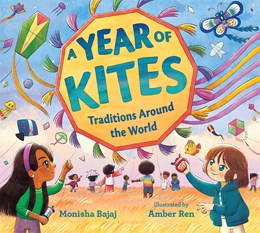
A Year of Kites: Traditions Around the World – written by Monisha Bajaj, illustrated by Amber Ren Bloomsbury Children’s Books, 2026
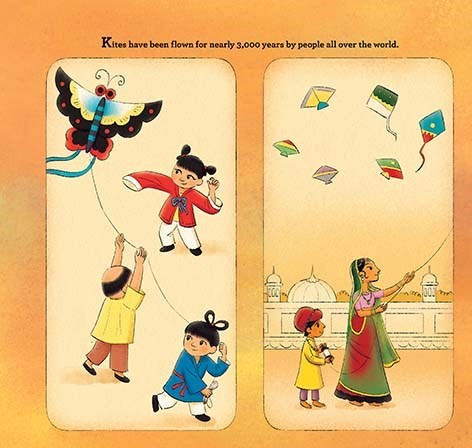
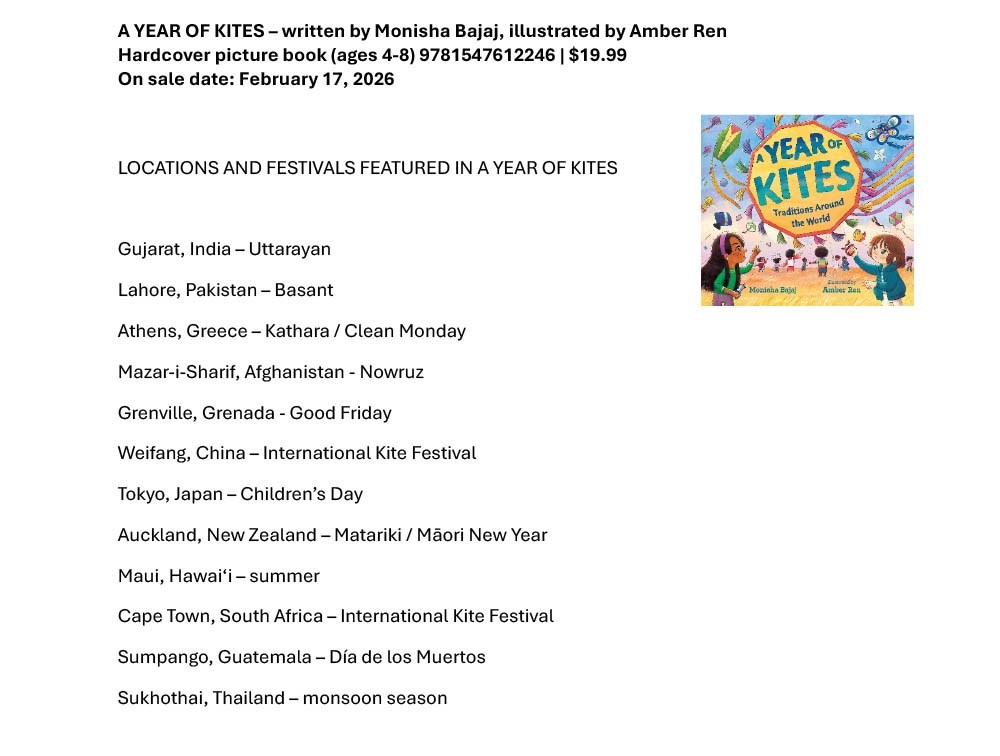
A Year of Kites is a wonderful picture book whose unusual subject matter is matched by its quality. Children, and adults, find the ideas of kites appealing. They start as paper, string, and other materials. With some human ingenuity they take flight, without passengers, all on their own. Readers may be familiar with some cultural expressions of kites, but this book presents detailed information about much less familiar examples of these beautiful airborne structures. A simple premise introduces the story: “Kites have been flown for nearly 3,000 years by people all over the world.” Each subsequent two-page spread features a fictional child from one of these places, including India, Afghanistan, China, New Zealand, and many more. There are brief descriptions of the festivals that include kite flying, as well as invented personal details. (In New Zealand, Kaia includes a secret message for her grandmother on the inside of her kite.).
Some of the celebrations may complement those that are better known outside of their own cultures. The festival of Diwali may resonate with readers who have never heard of Uttarayan, marking the end of winter with colorful kites, particularly in Gujarat. Lunar New Year evokes images of Chinese kites, and the koi-shaped kites created in Japan are also popular. The sections on these holidays offer background information as a necessary context for the aesthetic appeal of these kites. The fact that Cape Town, South Africa, hosts the largest international event surrounding kites deserves the same level of attention. There are even workshops that teach the craft, and prizes awarded for excellence.
Monisha Bajaj’s text reflects the way that children connect information and personalized characters in learning. Amber Wen’s softly colored images of children show an international cast as similar to one another in their expressions of delight, but distinctive in customs. A culminating image brings together these citizens of the world (image) as they let loose their butterflies, fish, and geometric forms into the sky.
Sparkles, No Sparkles – written and illustrated by Shannon McNeill Tundra Books, 2024
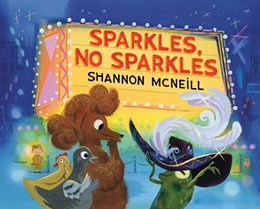
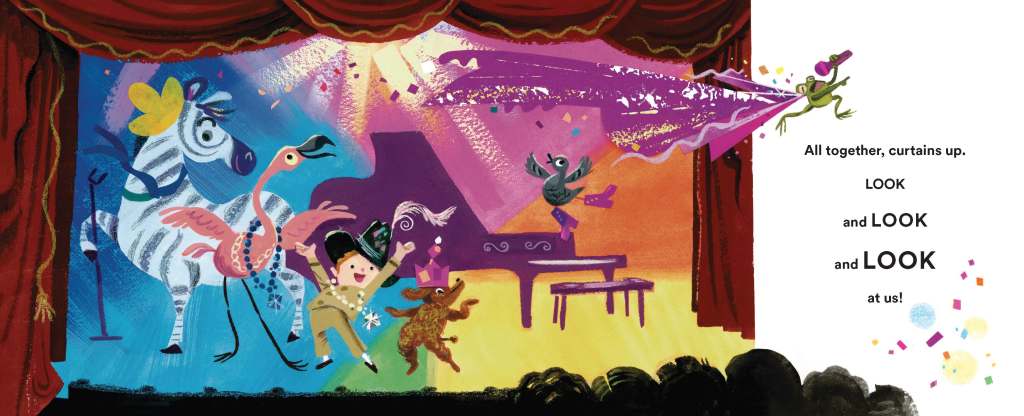
Sparkles, No Sparkles has the same underlying premise as Shannon McNeill’s earlier picture book, Wheels, No Wheels. Children categorize objects and experiences somewhat differently than adults do. While wheels are functional, sparkles are decorative. But you may need them to put on a show. When some sparkle-free species decide they would like to enhance their appearance with sparkles, they appropriate them from a theater. An usher becomes involved, even though stopping animals from stealing props had not been part of his job.
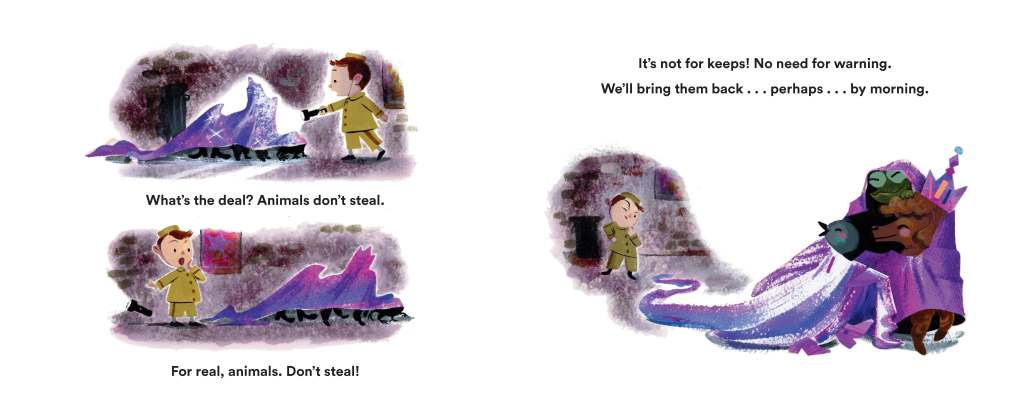
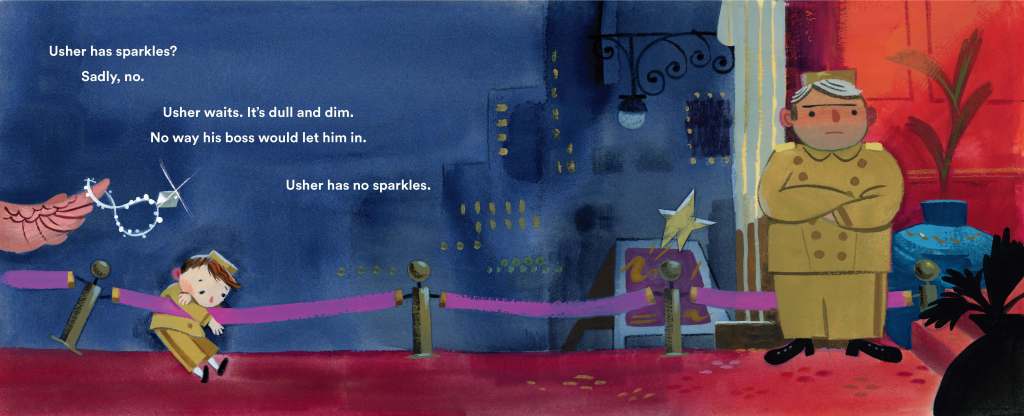
Young readers will share the usher’s confusion, and frustration. After all, he’s right. “For real, animals. Don’t steal!” The animals claim to be only borrowing the sparkles. A frog wearing a cape, a dog bearing a crown, and a pigeon striding in boots, are all excited to be part of a show. The usher would like to break out of his role and participate, too, but, as is often the case, his boss would never allow this sign of freedom.
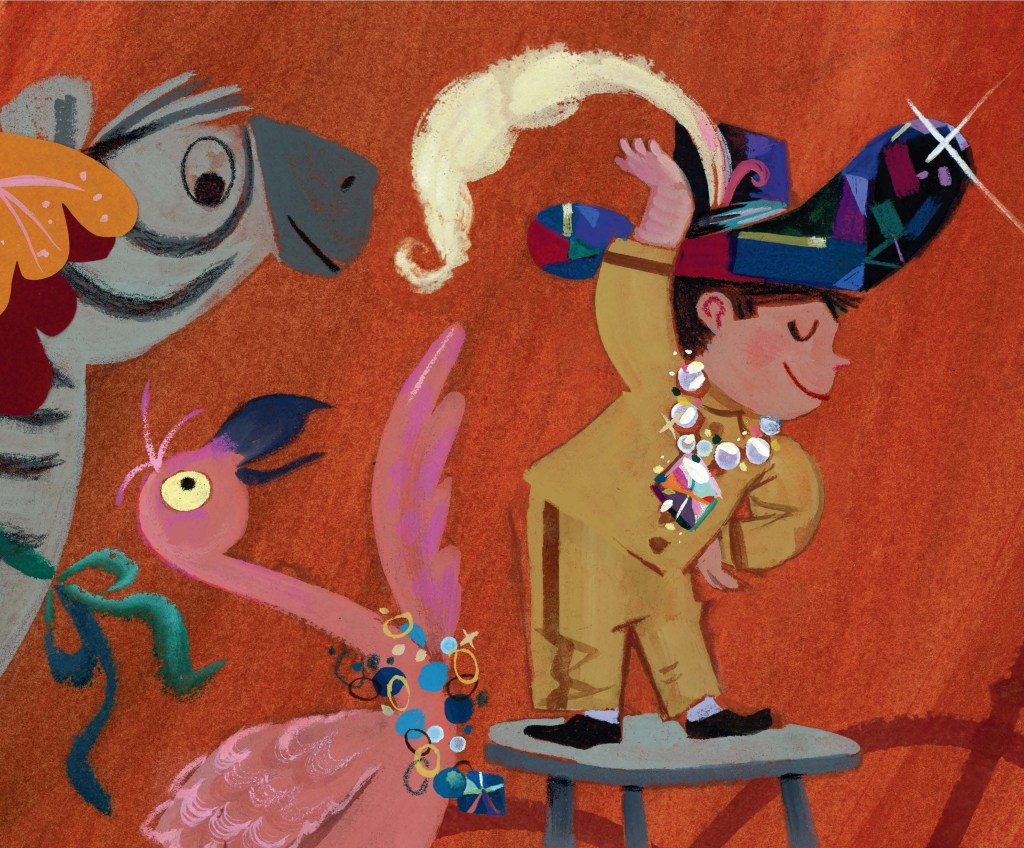
McNeill’s pictures are filled with subdued colors and jewel tones. The presence of sparkles is actually rather understated. When the usher eventually gets his sparkles, he is reminiscent of a little boy in a Maurice Sendak book, making a gracious gesture as he breaks free of adult constraints. The curtain rises, and the usher is part of a proud cast. A zebra, flamingo, and dog dance in line while the purple-caped frog croons into a microphone. “Look, and LOOK and LOOK at us! they demand, as children will.There is a moment of tension when the actual professionals realize that their props, sparkles included, are missing. These items are still making the rounds, but eventually they return, in a blaze of sparkly fireworks. Sparkles are an unlimited quantity in this ode to unbridled creativity.
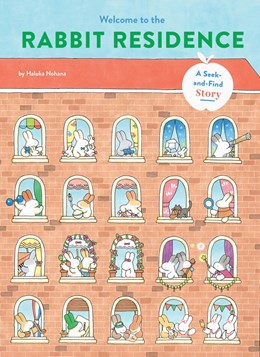
Welcome to the Rabbit Residence: A Seek-and-Find Story – written and illustrated by Haluka Nohana Chronicle Books, 2026
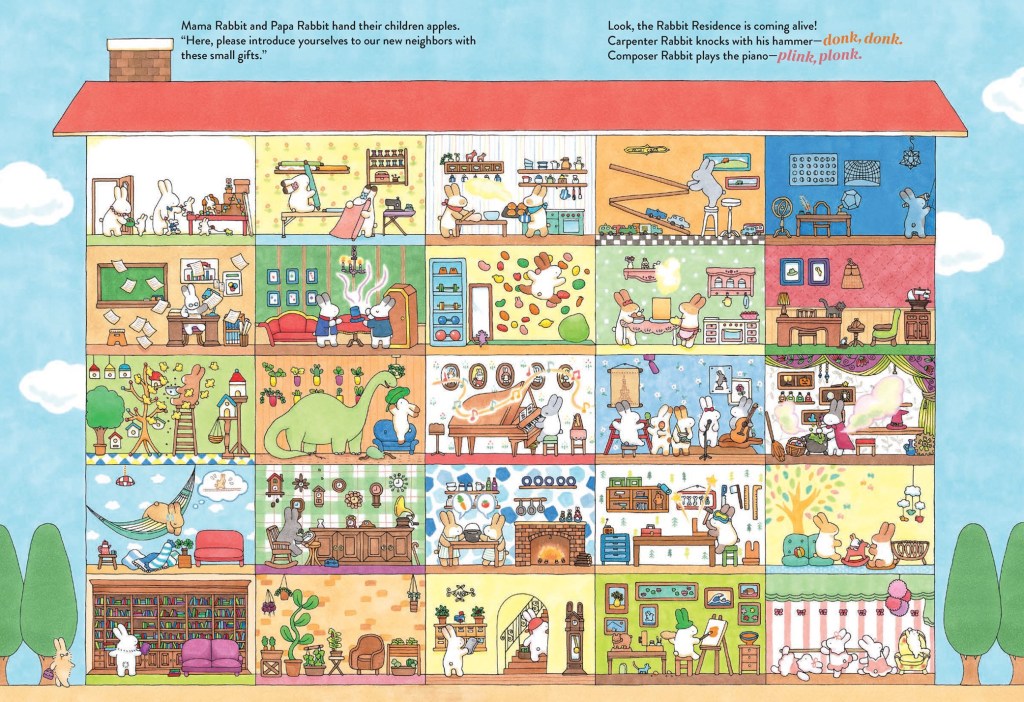
Following her earlier book about animals having fun while living in detailed habitats, author and artist Haluka Nohana has now invited readers to a rabbit residence full of activity. Even early in the morning, there’s a lot going on, even if not everyone is awake. Each room is a complete picture in itself, but the sum total of the cutaway house is a collective delight. The endpapers introduce the rabbits residing in the house. There are bakers, a wizard, a painter, a dinosaur keeper, a band, and many other essential professions. There are quintuplets, not so unusual for rabbits, a clockmaker for an old-fashioned touch, and a sleepy rabbit holding a blanket. He must be too young to have a job. There is a four-page fold-out spread with text and a full view of the house, and subsequent pictures describe the action, and the text suggests indirectly that reader might want to look for a particular rabbit pastime. “Composer Rabbit plays the piano. – plink, plonk.” Some of the onomatopoeia seems as if it might be taken directly from the original text in Japanese, which adds an intriguing note: “Meanwhile, Painter Rabbit is painting, peta, peta.” The sounds connected to rabbit tailoring are “choki, choki.”
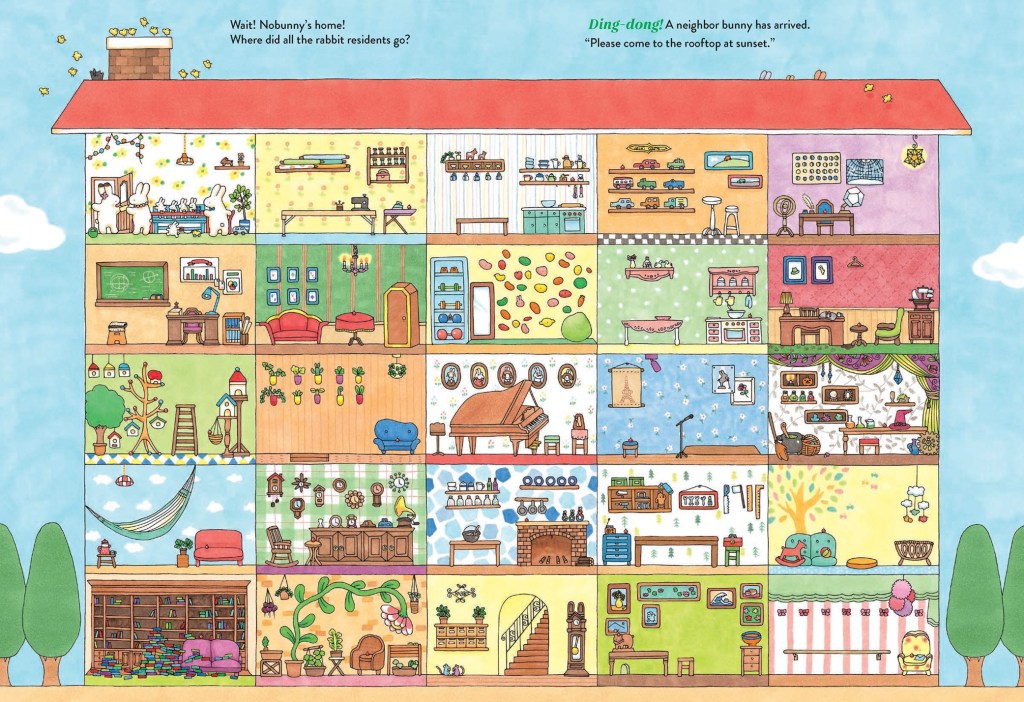
It’s easy to make rabbits appear cute, but these are quite distinctive, even within that category. They are rounded and fluffy, a bit similar to Moomins. Lots of accessories, as well as brushstrokes denoting movement, add to their strangely realistic appeal. A rabbit exercising seems to have fallen and is seeing stars. A dinosaur with a long neck, maybe an apatosaurus, leans down into the room below to offer a plant to a clockmaker. There is some ambiguity in these scenes, including magic involving a genie rabbit, whose swirling body may or may not be related to the waft of fragrant steam emanating from the kitchen. A mildly dissonant picture shows an almost empty house, framed by the question, “Wait! Nobunny’s home! Where did all the rabbit residents go?” The rooms appear different without all the busy rabbits. Books are strewn about the library. A lone telescope has no astronomer, and the magician’s studio shows an empty hat and a cauldron at mid-stir. It turns out that this swanky building has a rooftop open for a party, with all the familiar tenants as well as the light of shooting stars.
Just Another Perfect Day – written by Jillian Harris and Justin Pasutto, illustrated by Morgan Goble Tundra Books, 2025
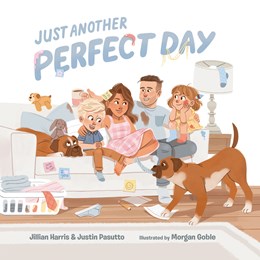
The family in Just Another Perfect Day, by Jillian Harris and Justin Pasutto, illustrated by Morgan Goble, is appealing in its imperfection. No one in the book seems quite as frustrated or depressed as Alexander in Judith Viorst and Ray Cruz’s classic, Alexander and the Terrible, Horrible, No Good, Very Bad Day(1972), although one child, Leo, does actually spit out a sandwich when it disappoints him. The sarcasm of the title is also refreshing. Basically, this not atypical family has some typical problems, which push everyone to the breaking point, but not over it. The text rhymes, the pictures are bright and colorful, and the message is reassuring without being preachy.
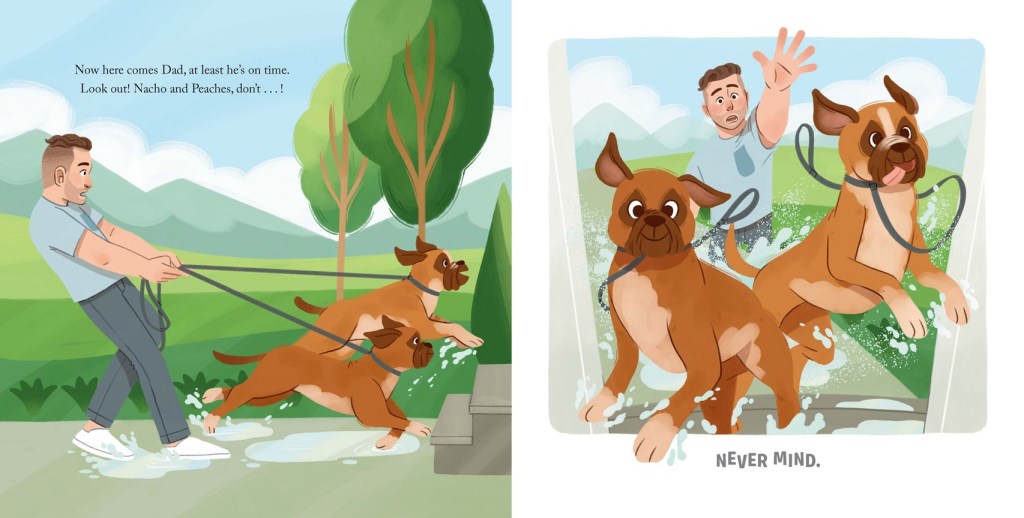
The family’s home is comfortable, if not generic. It is set on spacious grounds and appears welcoming. But problems begin to crop up as soon as the reader enters the interior space. Annie and Leo have overslept and are not nearly ready for school. Any parent knows the chain reaction that will cause. Mom wakes up, looking at her phone with surprise; three different clocks have malfunctioned, and one is analog. Dad, who hasn’t shaved yet, tries to walk two difficult dogs, holding things up further. Multitasking won’t work, because everyone is too far behind to catch up.
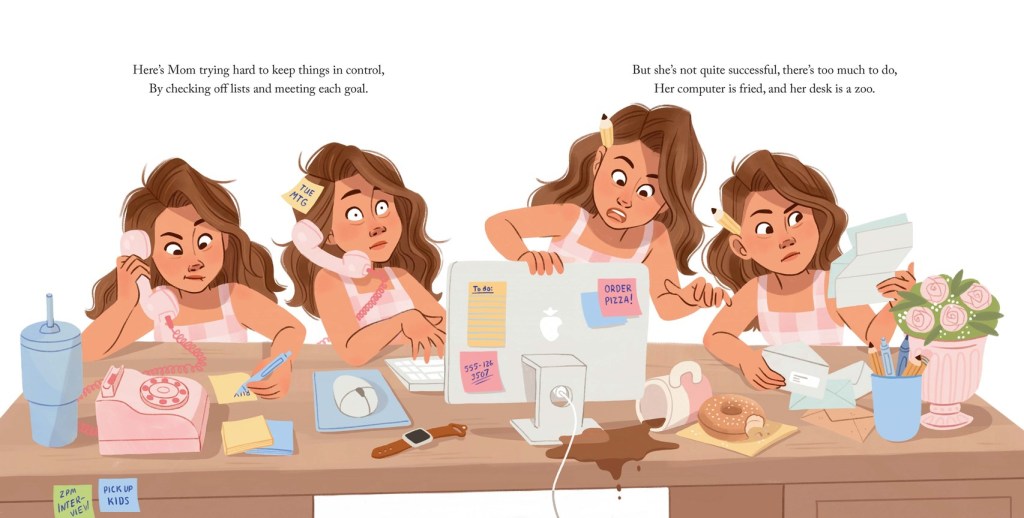
Once the kids are at school, Mom tries to salvage the day at work in a particularly evocative scene. In a cinematic sequence of images, she is seen “checking off lists and meeting each goal,” a phrase filled with irony. Her computer, which is covered with sticky note reminders, isn’t actually working. Her coffee has spilled, and the bagel with one bite out of it shows that she doesn’t even have time to eat properly. Even a lovely pink phone dial phone and matching vase of roses, evoking a simpler (maybe) era, can’t make up for the chaos.
This day has to turn around or the book will end in disaster. Everyone is exhausted, but their energy kicks in enough for an impromptu dance in the kitchen as they eagerly anticipate take-out food. When the delivery driver gets lost, the work together to cook up some pasta. Maybe the meatballs were left over in the fridge. If the cheery dance seemed fun, but improbable, the dinner is a believable conclusion. There is still a sticky note on Mom’s hair, and paint on Annie’s face from her ill-fated art project, but everyone seems to have accepted the inevitability of days like this, which are “less than great.” Baths, reading time, and family togetherness are the recipe, they conclude that “makes it all work.” This cheery and unpretentious story is close enough to perfect.
The Many Problems of Rochel-Leah – written by Jane Yolen, illustrated by Felishia Henditirto Apples & Honey Press, 2024
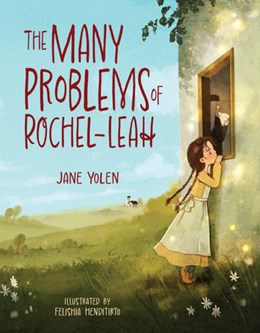
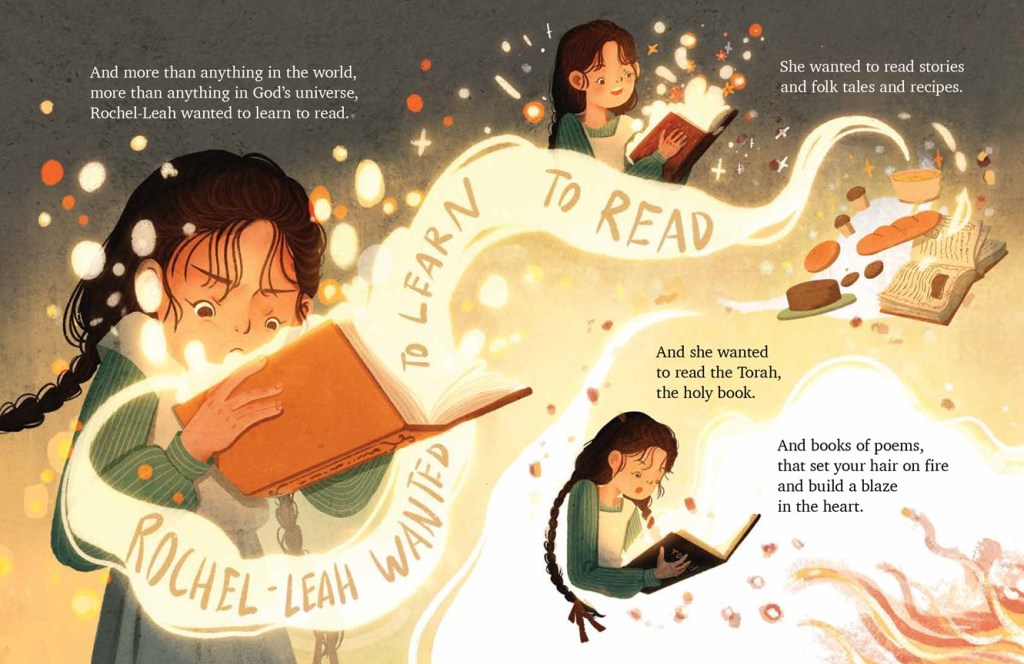
In this truthful fable by Jane Yolen, who explains in the afterword that the story is based on one passed down in her family, Rochel-Leah does not fight the patriarchy. (I’ve reviewed other books by the inimitable and prolific Jane Yolen here and here and here and here and here and here and here and here.) Instead, as girls and women have done through the ages, she subverts it. Rochel-Leah is a Jewish girl growing up in Eastern Europe in the 1830s. She works hard, as her family struggles with poverty. Her father is a bottler, and her mother takes on traditional tasks in the home. But Rochel-Leah wants to read. (images) She will not give up her dream, even when confronted with resistance from family, community, and even the town rabbi. This man, who has dedicated himself to learning, cannot bring himself to permit extending that essential part of his culture to a girl. (I’ve written elsewhere about the gender roles in the Old Country when these shtetl dwellers move to the New World, and I’ve reviewed books about Jewish children’s literature that take on the topic here and here and here.)
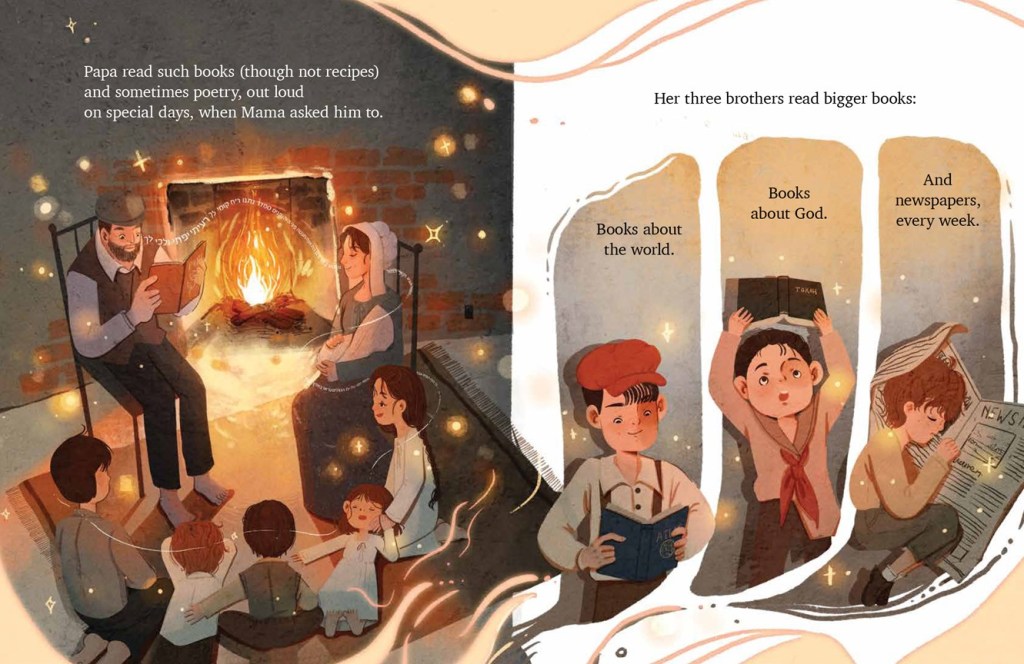
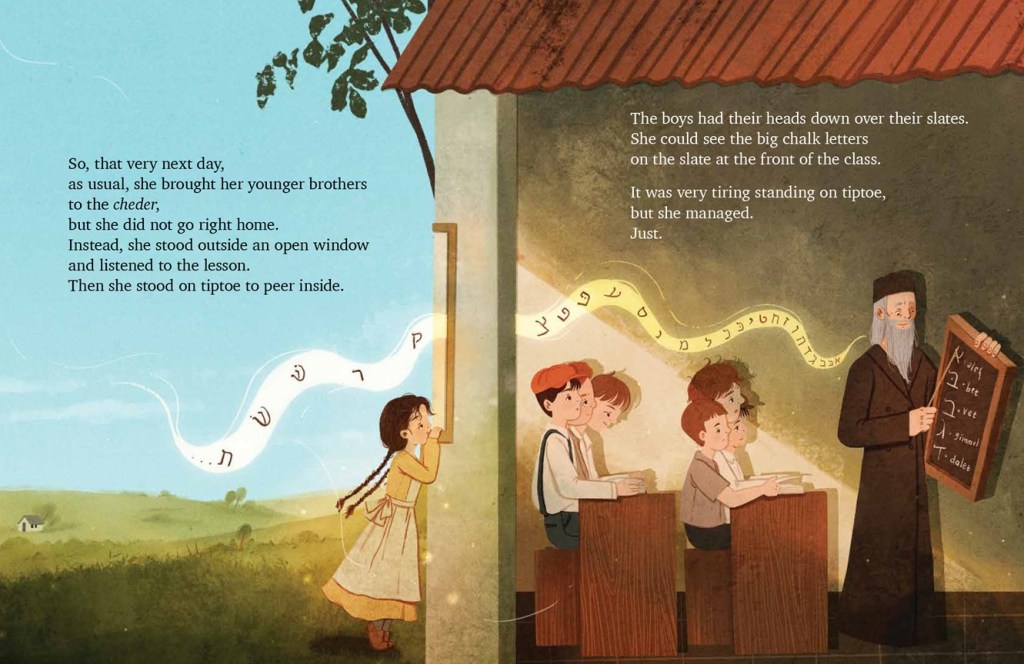
Rochel-Leah’s desire to read is all-encompassing. She longs to read recipes, folk tales, and poetry, but she also wants to read the word of God in the Torah. In Felishia Henditirto’s picture, Rochel-Leah is consumed by this passion, stated on a wave of fragrant steam coming from the cooking pot that defines a woman’s role. In her home, literacy is respected and embraced. Her father reads aloud to the family, and her brothers have the privilege of reading books and newspapers. They learn Hebrew in their cheder, and also Yiddish and Russian. Pictures of them sitting attentively in a primitive schoolroom are a stark contrast to Rochel-Leah’s exclusion from this setting.
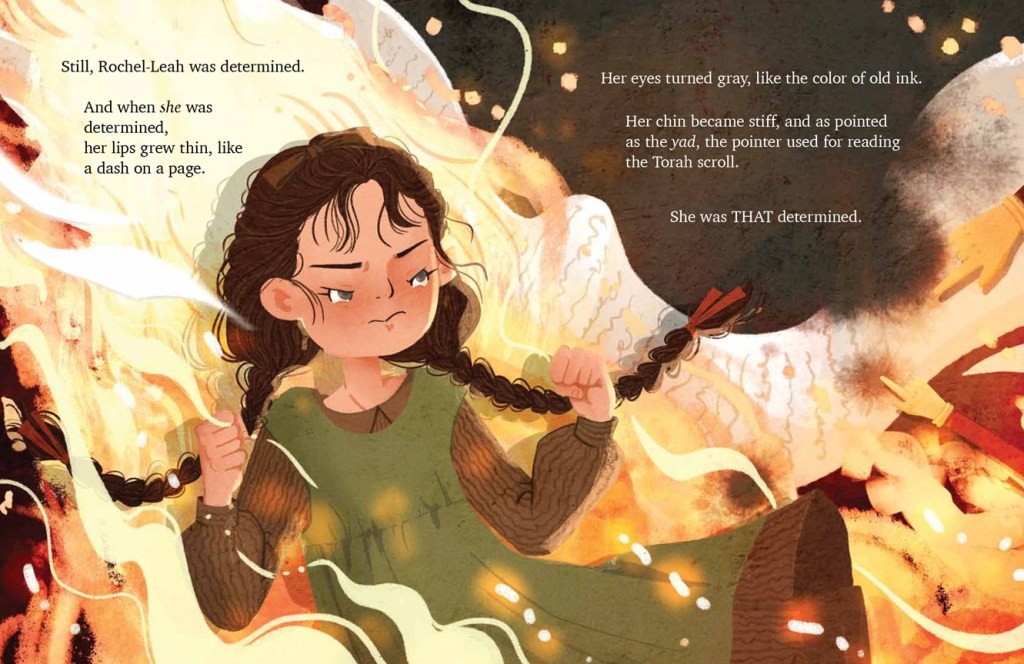
Instead, she is angry, but also “determined.” In Yolen’s metaphor, Rochel-Leah’s “lips grew think, like a dash on a page,” and ‘her eyes turned gray, like the color of old ink.” So consumed is she with the desire to learn that her chin becomes as pointed as a yad, used for pointing to the letters of a Torah scroll.
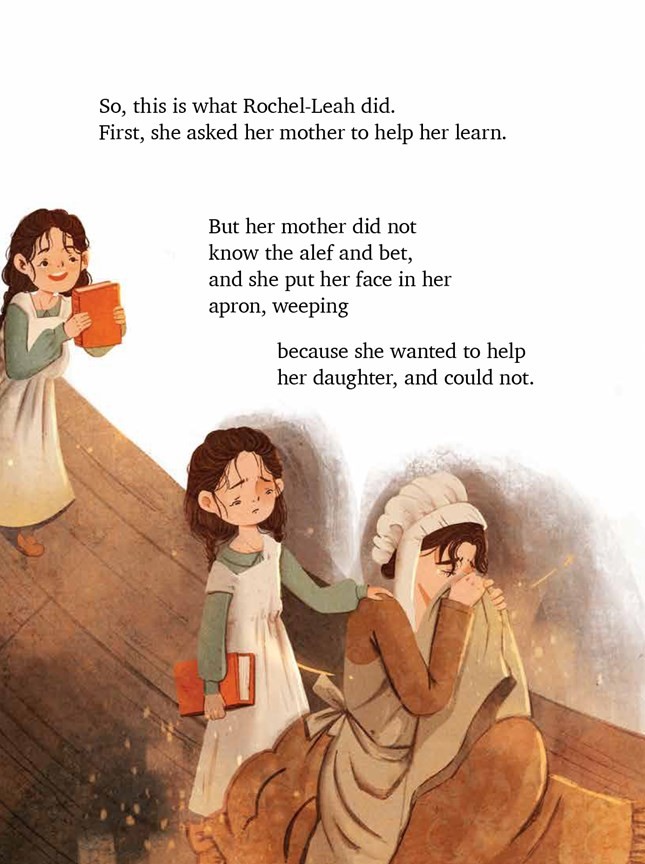
The rejection of women is painful for a girl who needs support. Her mother actually weeps because she cannot help her. (image) Her father counters reality by denying that she has any cause for complaint, and her brothers laugh at her. (images). Most people would give up, but Rochel-Leah has a strength of unknown origin. She will confront the rabbi.
This devoted scholar is walking through the woods “reading poetry to the birds.” Is he so unworldly that this humble activity is important to him, or is his choice of audience one more example of his complete lack of awareness of women’s humanity? The rabbi informs her that rules cannot be broken. How much wisdom does that answer denote? Rochel-Leah’s inventive solution is to stand outside her brothers’ school and listen to the lessons taking place. A picture of this stark division shows the letters of the Hebrew alphabet flowing through the wall, defying the restrictions against who can learn them. Then, she physically elevates herself on a ladder. She has forced the rabbi to take notice, and he concedes that rules cannot be broken, but they may be bent. He finally understands the depth of Rochel-Leah’s commitment, although he can only accept it as, to some extent, an exception. She is invited in to learn, but will have to hide in a closet if an inspector comes in. This closet is literal, as well as figurative.
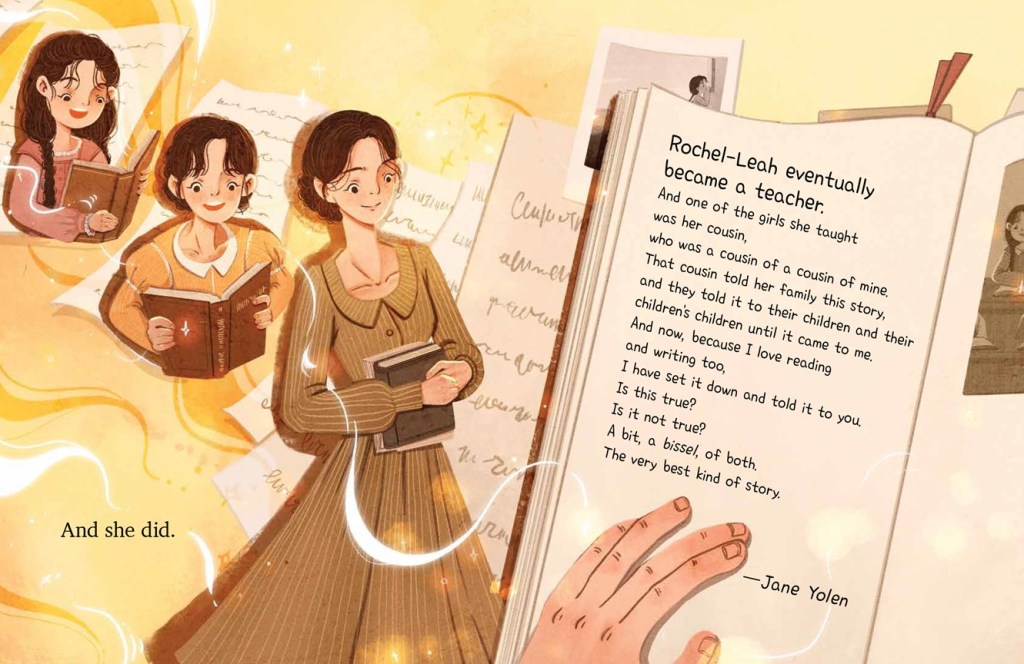
Rochel-Leah grows up to become a teacher. Change eventually arrives, with many Jewish women now fully participating in the life of the mind that was denied them in the past.
Little Monk Writes Rain – written and illustrated by Hsu-Kung Liu, translated by Rachel Wāng Yῠng-Hsín Eerdmans Books for Young Readers, 2026
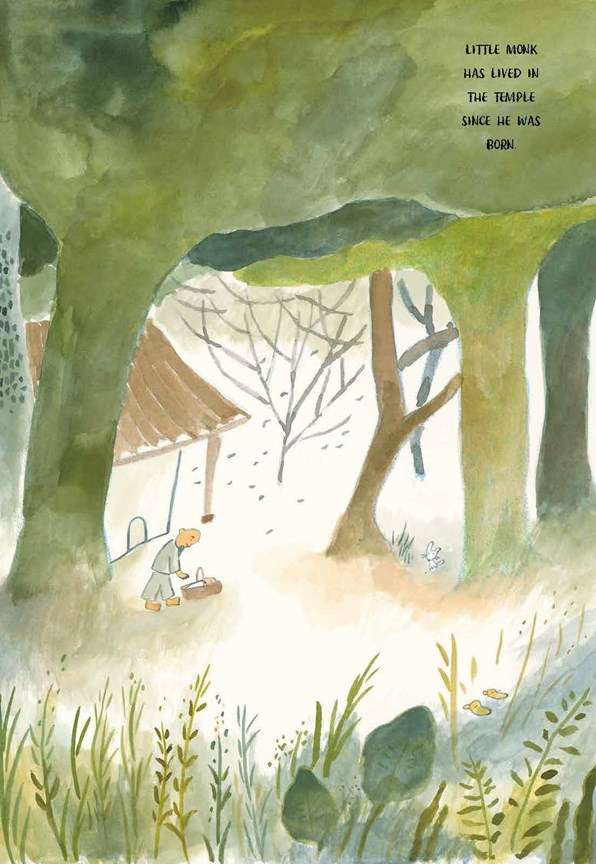
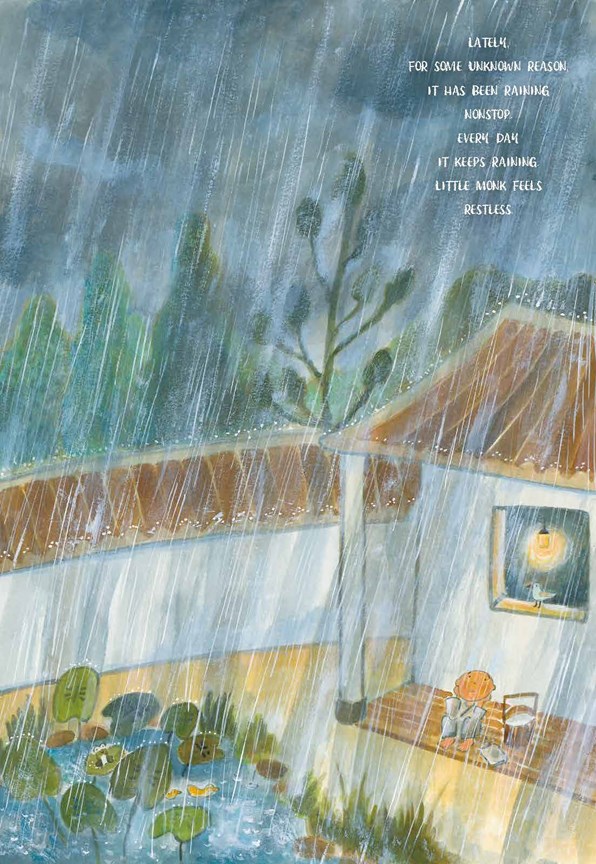
This exceptionally beautiful and gently philosophical picture book is about a Buddhist monk who has difficulty learning written language, with the exception of one Chinese character. He is singularly focused on writing the character for “rain,” and this limited but powerful ability persists throughout all the onslaughts, as well as the peaceful times, of his life. The book opens vertically, like a writing tablet. Delicate watercolor and ink drawings reflect traditional art, without mere imitation. When the book begins, the character is a young boy. Of course, character has two meanings here, an individual human and a symbol for written expression.
He first appears at the monastery in a tiny woven basket; as he grows, he is integrated into the community of prayer and manual labor, as well as reading and writing. For better or worse, he is not completely isolated from the outside world. A mention of casual cruelty makes this clear, because “Little Monk is not able to learn to read. And sometimes, other people laugh at him.” Those people are shown as children peering through a doorway. One has a bird on his head, an allusion to innocence, or perhaps of something worse. That oddly positioned bird may point do a different and less excusable deficiency, lack of empathy.
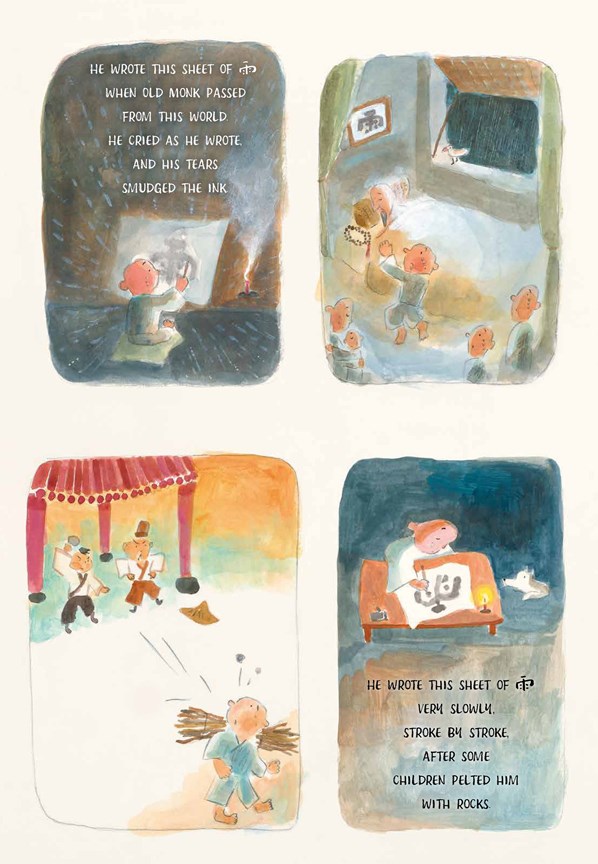
Suddenly, “for some unknown reason,” it begins to rain incessantly. Joining an older monk indoors, the little monk learns to write the character for rain. After introduction of the character, whenever it appears in the book, it is simply left standing without any guide to pronunciation. The reader may choose to read the character as “rain,” or to research how to pronounce it and attempt to do so. This seems a deliberate feature of the book, given that the nature of language, at least as people use it every day, is as framed by “some unknown reason” as the rain itself.
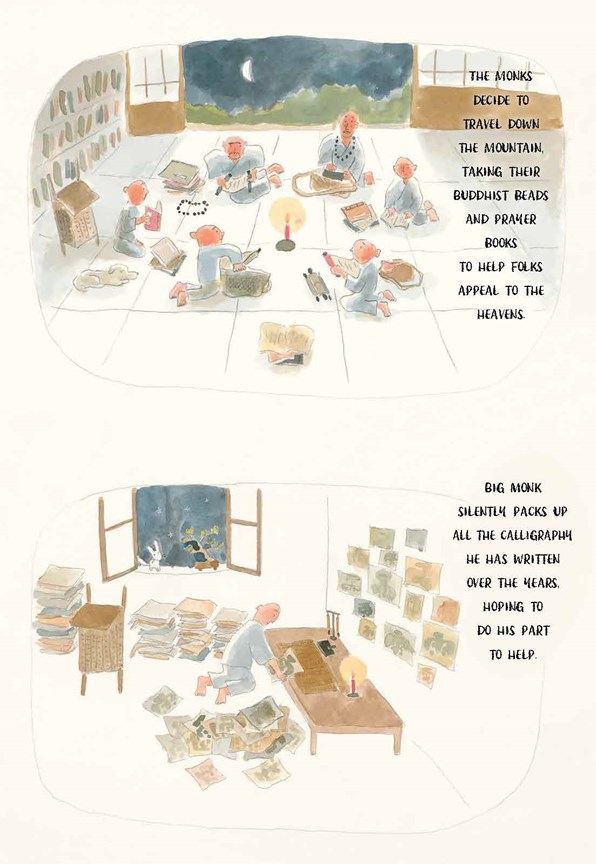
As in a fairy tale, the hero persists against adversity. Every day he performs his work tasks, but also writes the one character he has been able to master. Over the years, he grows up, becoming “Big Monk,” but his inner character remains unchanged. Then the environment suffers a reversal, and a drought threatens the world. The monks take responsibility for leading others in prayers to end the drought. They are well-equipped and organized, “taking their Buddhist beads and prayer books to help folks appeal to the heavens.” There is no sense of superiority in their actions. Meanwhile, Big Monk also prepares, by gathering together his impressive collection of calligraphy, all consisting of the one character for rain..
A vertical two pace spread is a magnificent scene washed in red and gold, of a plaza where ordinary “folks” pray while important men and “splendid altars” dazzle. “Even the Emperor is here.” When the monks arrive, they also appear important to the reader, wearing their crown-like broad hats and bearing their sacred scrolls. But their clothes are “shabby.” In folklore, many times the high and mighty are brought low by their sense of self-importance. At first the monks are unable to respond, feeling faint and weakened by the intense heat. But, seeing the distinguished shifu, for all their knowledge, reduced to angry and petty squabbling, they gather to pray. Big Monk cannot read the prayers, but opens his basket of rain characters and is “flooded with memories.”
Now the monk has a biography. He remembers a conversation overheard long ago. He learned that he was an orphan who had been brought to the monastery. At the age of five, he began to learn writing. His teacher, originally a child, grew old, and the died. The cruelty mentioned earlier in the book intensifies in his memories, as he is “pelted with rocks.” All his thoughts of the past, and all his distinctive qualities, together form a response. He offers his sheets of writing to the heavens and the rain begins. An “ecstatic” crowd of people personifies the rain, elevated above the rain drops with joy.
Little Monk Writes Rain does not use the word “dyslexia.” An afterword, as thoughtful in tone as the rest of the book, explains that some people have difficulties learning to read. Hsu-Kung Liu presents thoughts and questions about the relationship between pictures, words, and the stories that they record. He reminds readers that sometimes “one word means everything.” Of course, those readers may be either children or adults. This remarkable book is a work of art, and a bridge to understanding life itself.
When We Flew Away: A Novel of Anne Frank Before the Diary – by Alice Hoffman Scholastic Press, 2024
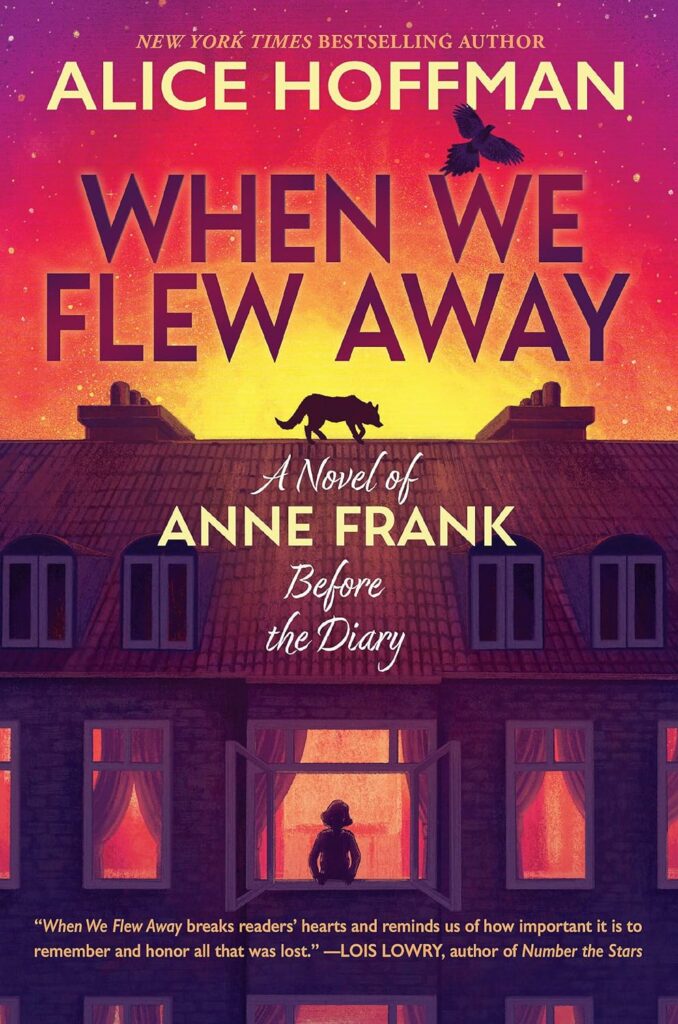
When I first learned about When We Flew Away, I was slightly skeptical, even though Alice Hoffman is a very fine author. There are so many attempts to simplify or universalize the experience of Anne Frank, as well as honest misunderstandings of her life and legacy. Before reading this middle-grade and young adult novel, I recommend two adult books that do an excellent job explaining and contextualizing Anne Frank and her diary. These are Ruth Franklin’s The Many Lives of Anne Frank (2025), and Francine Prose’s Anne Frank: The Book, The Life, The Afterlife (2009). Cynthia Ozick wrote a powerful article in The New Yorker in 1997 on the same theme, called “Who Owns Anne Frank?”
As the above-mentioned authors have both clarified and deplored, Frank’s message has been distorted in order to convert her into a bland symbol of universal forgiveness. The history of the Holocaust, as well as her own understanding of Jewish culture, religion, and identity, were lost in the process. More accurately, they have been deliberately erased. Alice Hoffman does not attempt to document Frank’s experience in hiding. Instead, she imagines, based on the record and her own interpretations, what the young Anne was like before her family was forced into their desperate choice. This novel is about a young girl’s family, her emotions, and her response to the development of violent antisemitism in the Netherlands, the country that was supposed to have been a refuge for her German Jewish family. (To correct misconceptions about the alleged heroism of most non-Jewish Dutch citizens, read Nina Siegel’s thorough account in the anthology The Diary Keepers: World War II in the Netherlands, as Written by the People Who Lived Through It.)
Anne’s close relationship with her father is central to the story, but Hoffman also offers a much more nuanced view of Anne’s mother than the limited perception of their tensions. The diary does record conflict, but Hoffman includes the plausible view that Edith Frank had a deep love for her daughter, although her personality caused her to express this in a less direct way. Ruth Franklin corroborates this idea in her work.
The move to the Secret Annex is preceded by increasing levels of oppression. “Life became smaller. People stopped talking about the future.” Without imitating Anne’s own future writings, Hoffman captures the sense of confinement, which would gradually worsen. The metaphor of flight, which will never become literally possible, is woven throughout the narrative. Looking at a Jewish boy who has been tormented by children in the street, Anne perceives the truth about their present lives: “Anne looked at the boy and he stared back across the distance between them. They lived in a land without birds, a country in which there were no laws that would protect them, a place where it wasn’t possible to be a child anymore.”
When We Flew Away is understated in its ambitions, but it does succeed in restoring a measure of realism and humanity to Anne Frank in the form of a compelling and believable story.
The Curious Life of Cecilia Payne – written by Laura Alary, illustrated by Yas Imamura Eerdmans Books for Young Readers, 2026
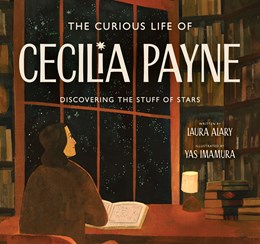
Cecilia Payne-Gaposchkin: her name has the ring of poetry. Before she married Russian scientist Sergei Gaposchkin, she was Cecilia Payne, a brilliant and curious young woman born in the U.K., who later emigrated to the U.S. to pursue studies at Harvard. In Laura Alary and Yas Imamura’s picture book biography (I previously reviewed an Imamura book here), Cecilia Payne’s intellectual gifts and incredible persistence pave the way to her unlikely success as an astrophysicist in an era when women confronted almost insurmountable obstacles. The adjective of the title refers both to Payne’s inquiring mind, and to the way that her distinguished career evolved.
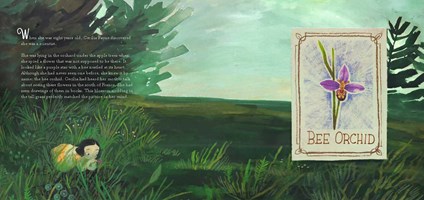
The book begins with a significant statement: “When she was eight years old, Cecilia Payne discovered she was a scientist.” Alary asserts that Cecilia knew this essential fact, not merely an aspiration, about herself. Yet she begins at ground level, only later pursuing the stars. At first, Cecilia notices a bee orchid, a flower that, according to her mother, did not grow in England. The scientific method begins to form in her mind, like the bee enclosed in this flower. She continues to examine the flower, but also promises herself that she will not allow herself to become discouraged by resistance to her ideas.
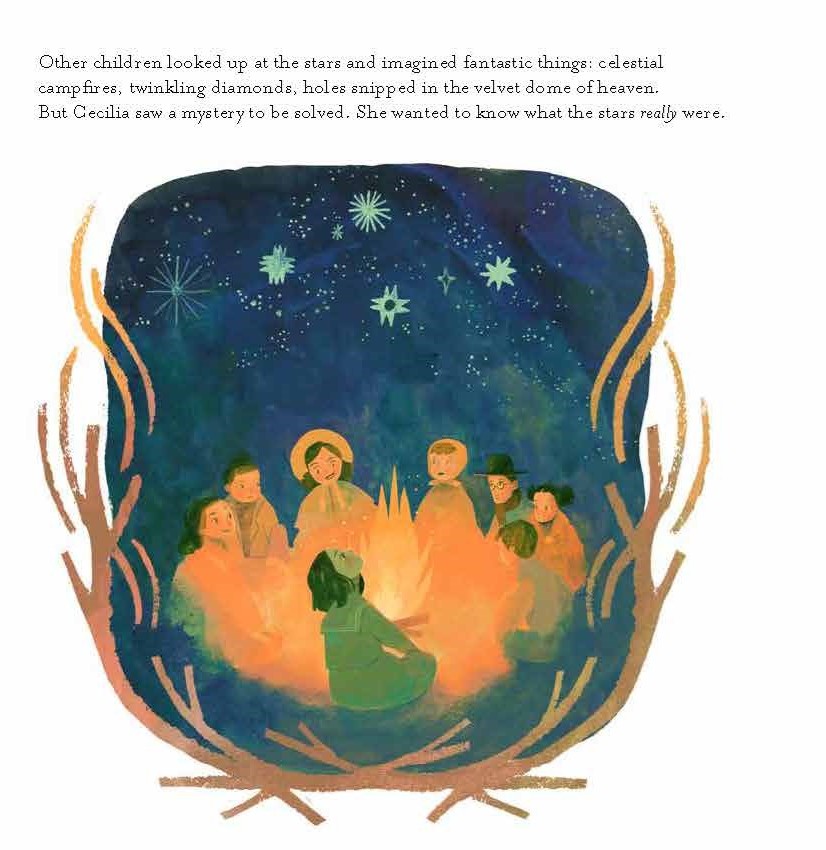
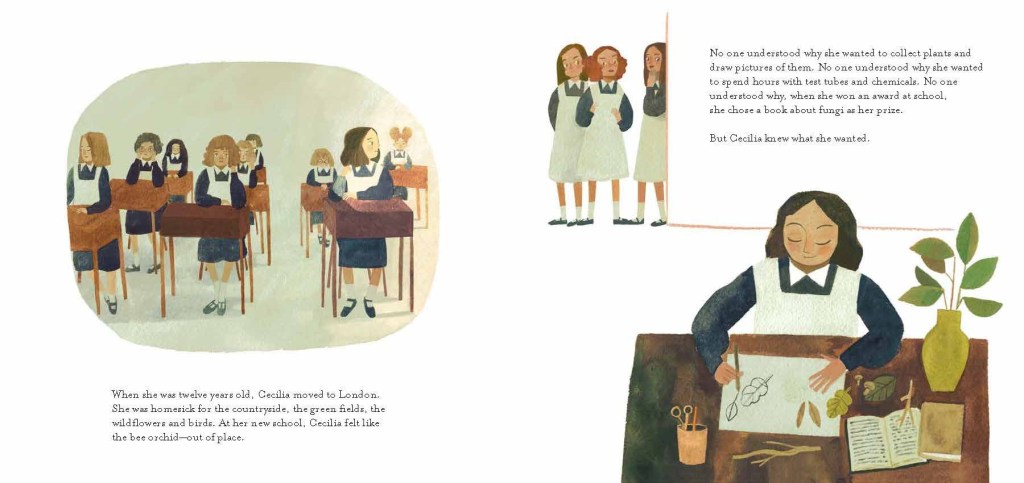
The qualities that drew Cecilia to the study of nature contrast with the social expectations surrounding her. When other children see “twinkling diamonds” in the heavens, she is compelled to determine the actual substance and origin of these beautiful visions.Fortunately, a teacher promotes Cecilia’s scientific literacy, but she encounters setbacks when her family moves to London, where, in a new school, she is isolated by her singular love of knowledge. Imamura’s picture captures both this potentially destructive social deficit, as well as Cecilia’s healthy response. Seated at her desk, she is the only girl looking, not distracted, but intently focused. A group of girls observe her drawing natural objects, but their apparent disapproval cannot dissuade Cecilia from her purpose.
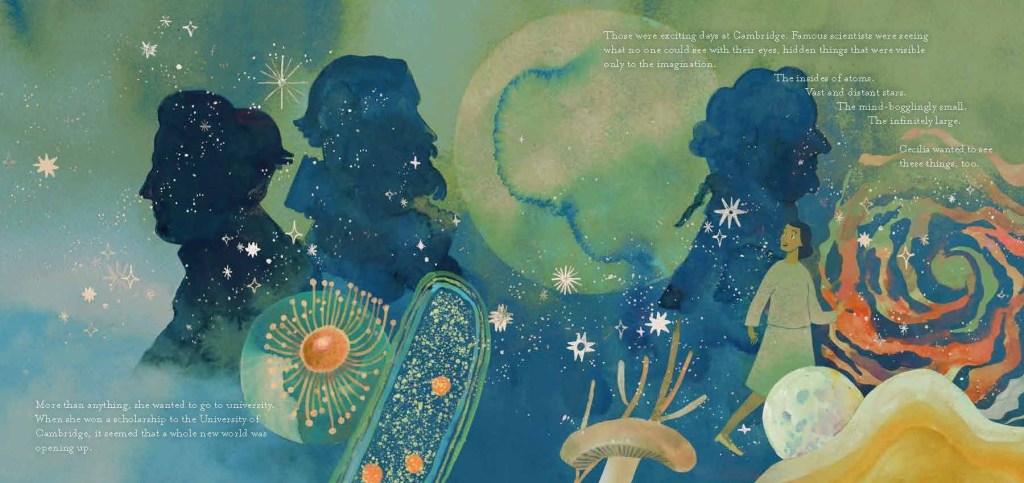
If childhood disdain is difficult, the adult version can be even worse. Arriving at Cambridge University, Payne is thrilled to be in the midst of possibilities. Knowledge is not limited to what is immediately visible. Against a background of male profiles, Imamura envisions a young woman who believes herself to be part of this world, but problems will emerge. Soon she be observing the skies with a telescope, but on the planet earth, men make the rules. Forced to sit by herself in a lecture hall filled with arrogant male scholars, Payne’s determination is forged even further by adversity. Imamura’s quiet depiction of this scene is free of overt drama, but clearly sends a message about the reality that Payne will repeatedly confront.
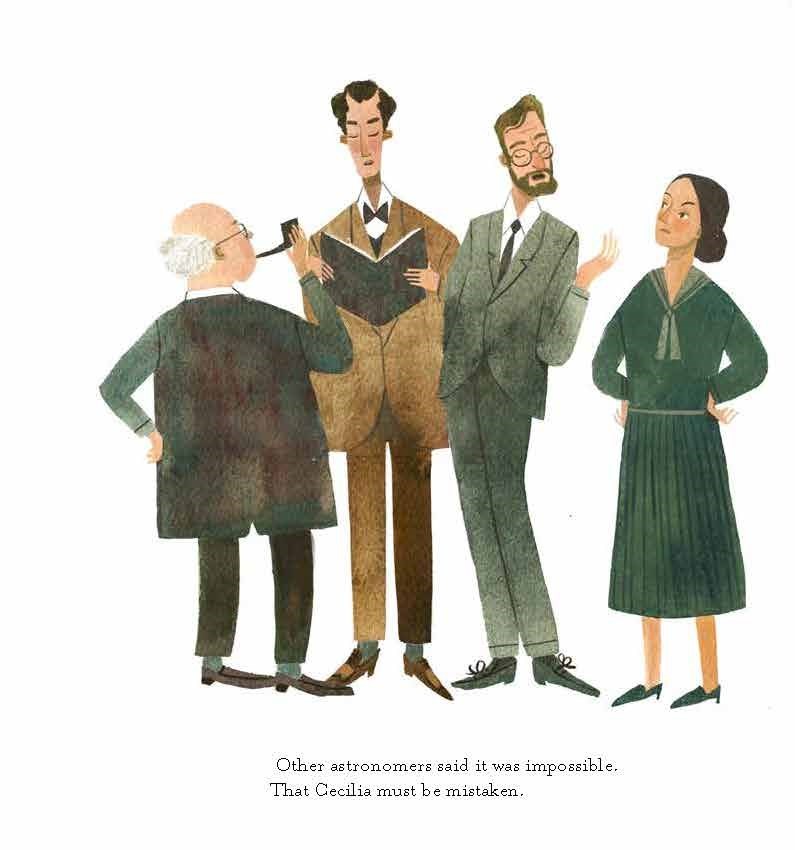
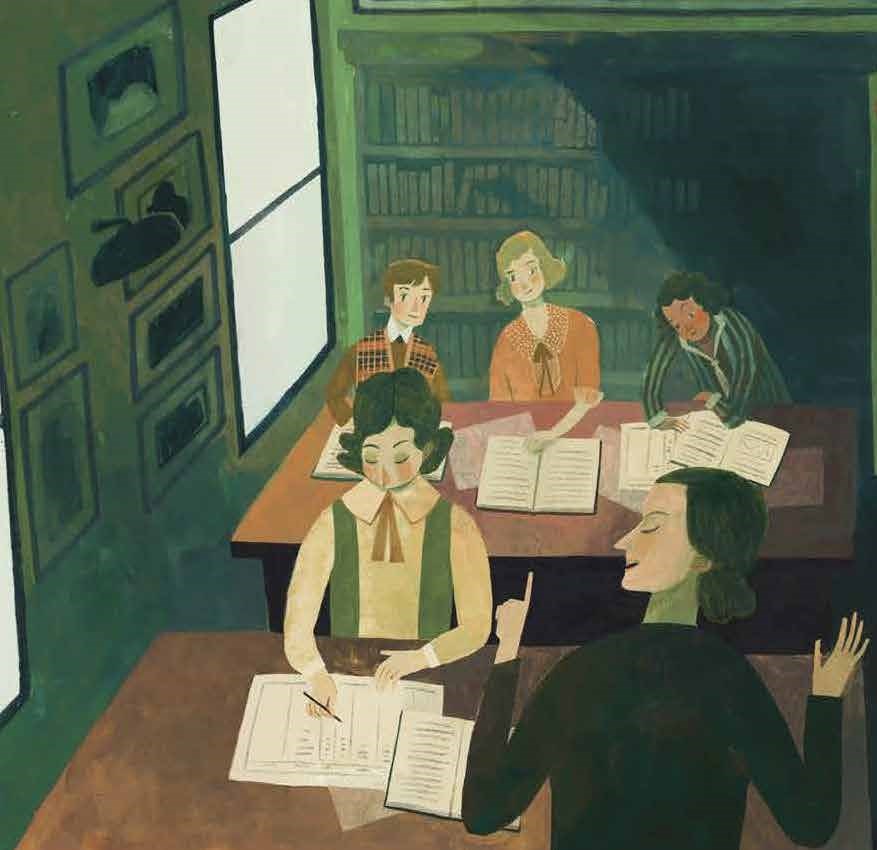
Arriving at Harvard, Payne finds both the proverbial room of one’s own, and the support of other women scientists, but also, a thick layer of disdain beneath the hypocritical veneer of hypocrisy. Imamura’s vision of this phenomenon is perfect. Attempting to explain to her male colleagues her revolutionary hypothesis about the true substance of stars, she is subjected to Harvard mansplaining. One distinguished perpetrator smokes his pipe and looks away, as if her ideas don’t even merit attention. Another stares into a book, while a third, gesturing with his hands for emphasis, informs her that she is wrong. In a later scene of understated triumph, Payne engages with her students, encouraging their questions and treating them with respect.
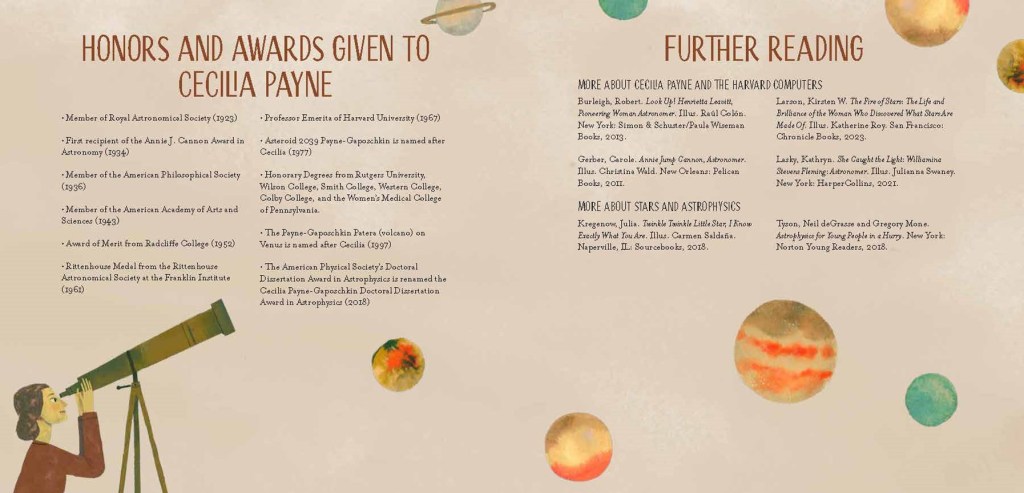
There are many excellent picture books about women in the sciences (for example, I have previously reviewed biographies of Emmy Noether, Lise Meitner, and Rosalind Franklin). Brilliance and determination are not always enough to assure fairness. The detailed backmatter of The Curious Life of Cecilia Payne offers clarification about her life, times, and successful career, with Imamura’s beautiful illustrations complementing the information, as it does everywhere in this outstanding and inspiring book.


 Imaginary Elevators