My Best Friend Is a Butternut Squash – written by Heather Smith, illustrated by Kass Reich Tundra Books, 2026
It’s hard to see how the title of Heather Smith and Kass Reich’s new picture book could not be intriguing. Is it literal, or a metaphor? Children sometimes develop attachments to unusual toys, or, in psychological parlance, “transitional objects.” In My Best Friend is a Butternut Squash, a boy named Alex adopts the vegetable of the title, and grants it personhood with crayons and imagination. Soon he is taking it out for walks in a stroller and identifying him, when asked, as a two-month-old baby.
Like a purely imaginary friend, the butternut squash can be a different age on different days. One day Alex cradles it in his arms; the next day they are twins, dressing alike and anticipating one another’s thoughts and words. Alex’s mom is really good-natured, even bestowing a kiss on this beloved companion. There is no limit to the possibilities for dramatic entertainment, including a “spectacular sword fight” that is completely harmless. Reich’s gouache and colored pencil drawings capture a child’s point of view, but they are also sophisticated, matching the expression on Alex’s face with that of his endlessly flexible friend, who can be a fairy, a pirate, or even a doctor. The doctor scenario has a bit of heartbreak. Like all children, Alex experiences anxiety, answering the squash-doctor’s question about his symptoms with the troubling answer, “It’s my heart…Sometimes I think it’s shrinking.” The squash wisely advises Alex not to worry, reassuring him that he has “a very big heart,” a quality the reader has already suspected about this sensitive boy.
The butternut squash has a backstory. His original home was Alex’s grandfather’s garden. Maybe uprooting him has created problems that Alex had not suspected, like being excluded from games in the schoolyard. Other children don’t necessarily share Alex’s “big heart,” in accepting the inevitable square peg who won’t fit the round hole, especially if he is an item of produce in a human world. When Alex meets Trudy, he learns that her special object is an old alarm clock, with the disturbingly personified accident of broken hands. Then the other shoe drops, with Alex admitting that the butternut squash’s eventual fate is to be compost. Uh oh.
Just when adults reading this charmingly idiosyncratic book with children might become concerned, the kids work it out. Alex and Trudy find a solution to the transient nature of squashes, clocks, and maybe everything. They defy convention and create their own universe of play, where art supplies and affection are more important than fitting in.
Mint to Be – by Katie Cicatelli-Kuc Scholastic, 2025
I don’t want to give up away any keep developments in my review of this wonderful young adult, or adult, novel. Mint To Be is the second in a series from Katie Cicatelli-Kuc, set in Briar Glen, a New England Village whose competing coffee shops debuted in Pumpkin Spice & Everything Nice. It has a Scratch and Sniff sticker on the cover, and it also features a romance potentially fraught with conflict. If readers find that the novel evokes a holiday movie, no brand mentioned, they may feel validated when the heroine’s mom, after comparing a new romance to a five-month-old baby, admits that her optimism may be partly rooted in watching such staples: “I don’t know. Maybe I’ve been watching too many holiday movies. But I’ve always thought that you and Aidan would end up together some day. It’s a parent thing.”
Aidan is Aiden Cooper-Gallo. He and Emma Sherman have been friends forever, literally, since their early childhood. Neither character is a cloying stereotype. Aidan has some difficulties with anxiety, but is never diagnosed with a specific, reductive, condition. Emma is accomplished and ambitious. It’s clear that she intuitively understands Aidan’s vulnerabilities and is always there to help him. She is also obsessed with New York City. Her acceptance as a transfer student to a private high school there, panics Aidan. But he is not the kind of friend, regardless of his intense feelings, to undermine Emma’s dreams. Chapters alternative between Emma and Aidan’s voices, and flashbacks, both recent and longer ago, build consistent characters.
Emma is somewhat reluctant to decode her own feelings, which makes her easy prey, or, to use a much less judgmental term, vulnerable, to finding her first boyfriend at Easton Academy. His name is Sam, and he privileged and arrogant. No, he’s not a monster. He even seems to be sincerely attached to Emma, and makes some effort to understand her attachment to the small town which is her home. He doesn’t relate to dogs, unlike Emma and Aidan. Aidan’s dog, Mackerel, is mildly personified, not enough to be silly, but he is a character in the novel.
Going back to Emma’s mom, her “parent thing” is wholly positive. None of the adults, or almost adults, close to Emma, including her parents, older sister Kerry, and Jo of the eponymous Cup o’ Jo café, try to force decisions on her. The same is true for Aidan, whose grandparents are also supportive and kind, although Grandma has a welcome, acerbic touch: “Like I said, I’ve seen his type a million times.” Both Emma and Aidan need to reach their own conclusions.
Even when Sam reveals his true colors, one of which is a definite shade of controlling, there is nothing exaggerated about either his actions or Emma’s response. Even if everyone in Mint to Be follows a certain course, it is not, regardless of the title, completely predetermined.
It is halfway through May. I am posting a follow-up to my recent comments on Jewish American Heritage Month, and Asian American Heritage Month, at School Library Journal. Please find that post here, which includes links to previous attempts to understand that publication’s policy about celebrating both communities in May.
After my recent post, I did contact the editors of SLJ, and their parent company, Media Source Inc., about their April features on the upcoming month of May, when Asian American Heritage Month is observed. My previous post lists all the articles. In addition, I found this one from Edith Campbell’s SLJ blog in May, specifically referring to the history of Asian American Heritage Month.
I also noted that Library Journal, but notSchool Library Journal, did acknowledge Jewish American Heritage Month with one list.
Apparently, the journal dedicated specifically to books for children and young adults has a different policy regarding Jewish American-themed books, which may be of interest, and certainly importance, to all readers. The purpose of paying specific attention to a particular group’s heritage is not only to highlight resources for the use of that group, but to educate everyone about the group’s heritage. We all benefit from this show of intellectual curiosity, literacy, and a truthful approach to the broad spectrum of American culture.
To use an outdated expression based on antique technology, I feel regret at sounding like a broken record. Nevertheless, I need to reiterate the most important component of my distress. If SLJ were just determined to avoid the volatile issue of Israel and Palestine, they could focus exclusively on Jewish American-themed books not rooted in that part of the Jewish experience. In fact, these books compose the majority of Jewish-themed children’s and young adult books! The only explanation, as I have written before, is an intrinsic prejudice against Jewish Americans, as part of the Jewish people. Apparently, SLJ is uncomfortable with our presence within the wonderful array of American children’s books reflecting our country’s diversity.
Rumpelstiltskin – retold by Mac Barnett, illustrated by Carson Ellis Orchard Books (Scholastic), 2026
Folklorists and authors, from the Brothers Grimm to Jane Yolen, have been drawn to the story of Rumpelstiltskin, the calculating little man who tries to deprive a woman of her child. Artists, from the classic illustrators Arthur Rackham and Walter Crane, to Paul Zelinksky and Paul Galdone, have depicted its characters in strikingly different styles. Now, Mac Barnett and Carson Ellis have created their own response to this haunting tale.
As many fairy tales do, this one begins with a poor girl and her struggling father. Older readers familiar with the genre may anticipate a change in social and economic class, but younger ones may not. This girl is highly capable, “climbing trees and whittling sticks and catching tadpoles with her bare hands.” Ellis shows the young craftswoman intent on her work, with her father a distant figure in the background. He is a miller, but, although that is his professions, Barnett gives him a distinct, and irritating, personality. He has a “big mouth” and he brags. Life cannot be easy for his daughter.
The miller is either so socially inept or so bold, that he strikes up a conversation with the king, who is passing through town. This king is no more humble than his working class subject; Barnett reports that he is “chewed on a pheasant wing,” and “took a sip from a chalice,” as he casually strikes a deal with the miller to, possible, marry the laborer’s daughter. The king is a hard man to impress. Neither beauty nor personality strike him as unusual. But when the miller claims that his daughter can spin straw into gold, the king is sold.
Soon the girl is living in a castle, where she learns that there are two possibilities for her future in this nightmarish scenario of the patriarchy. She will either produce the gold or be killed. Before long, Rumpelstiltskin shows up, although she knows him only as “the little man.” Psychologically, he isn’t diminutive, but, rather, truncated. Taunting her with his amazing ability to actually turn the straw into gold, he demands successively greater payment for saving her life. Eventually, his price is her first-born child.
As people will do, the girl, now a queen, puts this terrible eventuality out of her mind. She has a little boy, and her love for him is so absorbing that she cannot imagine that her tormentor will force her to make good on her desperate promise. Among other elements, Rumpelstiltskin is a story about the power of language. The man returns, and tells the queen that she has three days to guess his name. Of course, he assumes that she will never be able to come up with his odd moniker, and the three days allow him to indulge his cruelty. Barnett and Ellis weave words and text together in a cascade of colorful guesses. “Cuthbert, Argyle, Ludvig, and Boniface,” are all possibilities, rolled out on Ellis’s elegant scroll of cursive words. The list grows to three pages, placed against white space for maximum effect. “Nidnod, Sheepshanks, and Lancelong” are all rejected. The queen’s son has the modest name of Tom, after both his father and grandfather, which, as Barnett points out, would not seem to deserve the honor.
Improbable events happen in fairy tales. The queen’s final guess causes smoke to spew out of Rumpelstiltskin’s ears in rage. The combination of fantastic and plainspoken words and imagery gives this version of the tale an inimitable twist. The queen survives, even if the men in the story are never held accountable for their stunning selfishness.
Audrey Hepburn: An Illustrated Biography – written by Eileen Hofer, illustrated by Christopher Longé, translated from the French by Christopher Bradley Abrams ComicArts, 2025
The subject of Eileen Hofer and Christopher Longé’s meticulously thorough graphic biography is portrayed as embodying the trait know as imposter syndrome. This incredibly gifted actress, stunningly beautiful woman, devoted mother, and tireless humanitarian actress was not convinced that she deserved any of those accolades. While not an uncommon human problem, in general, it may be less prevalent in those who achieved her phenomenal level of success. One of the many outstanding feature of this book, which is actually aimed at an adult audience but is completely appropriate for young adult readers (there have been several picture-book biographies of Audrey for younger readers, such as the ones I reviewed here and here and here and here) is its unassuming, but convincing, tone. Laying out the facts of Hepburn’s life, from her childhood in war-torn Europe to her death (1929-1993.) Every vignette and conversation included supports a consistent interpretation, while leaving room for the always unanswered questions about any life.
Author and illustrator avoid melodrama in chronicling the painful nature of Hepburn’s early life. Her British father, Joseph Ruston Hepburn, was something of a manipulative con artist who saw marriage to her Dutch aristocrat mother, Ella van Heemstra, as a route to social and financial success. Worse, he was an ardent supporter of fascism; Hepburn’s mother, for a time, joined him in his alliance with this brutal movement. Hofer pays careful attention to part of Hepburn’s history, including Dutch collaboration and virulent antisemitism. Her participation in resistance activities is placed in context, existing alongside her ambition to become a ballet dancer.
After the war, Hepburn continued to study ballet, but the interruption in her training, and her tall height, closed off that field to her. Throughout her life she expressed disappointment about this turn of events, which seem also to have sensitized her to a sense of failure. But ballet’s loss was an unparalleled gain to theater and film. From bit parts in The Lavender Hill Mob and Monte Carlo Baby, she went on to the starring role on the stage in Colette’s Gigi and the movies that have become indelibly identified with her legacy. Hofer and Longé approach both analytically and lyrically, this timeless series of images of Hepburn’s dramatic transformations, in Sabrina, My Fair Lady, Breakfast at Tiffany’s, How to Steal a Million, Two for the Road, and more.
Longé’s illustrations assume a particular vision of Hepburn and those who shared her life. Rather than photographic realism, they combine different aspects of her character and experience to create a believable image. Neither Hepburn, her parents, her husbands, nor her directors and co-stars look exactly as readers may remember them. Instead, with minimalist strokes in black ink he captures the essence of who they were and how they behaved. Ultimately, her father’s calculating oppressiveness, husband Mel Ferrer’s controlling nature, and second husband Andrea Dotti’s duplicity, all unfold in a balanced vision. There is almost a resigned sense of people’s imperfections in the book, making Hepburn’s commitments seem even more worthy of wonder. Even if you have read other books about Audrey Hepburn, this one deserves careful attention. If the young adult readers in your life are unfamiliar with her life, here is an opportunity to correct that unfortunate gap.
Let’s Have a Sleepover: A Kat and Mouse Book, 2 – written and illustrated by Salina Yoon Bloomsbury Children’s Books, 2026
Kat and Mouse, the very different but certainly not mismatched friends, are back. In Salina Yoon’s second book in the series (and I’ve reviewed other books by her here and here and here), they once again have to negotiate some disagreements, but their underlying affection for one another, and respect for difference, are reassuring. The book is also funny, illustrated with bold colors and text in fonts and sizes that correspond to changing circumstances.
If you remember from their first outing, Kat and Mouse expressed opposite ideas about food. Now they are about to have a sleepover, and Mouse has high expectations. “It will be the sleepover I have always dreamed about!” Yoon’s rendition of a mid-century turntable will certainly make that a reality. Mouse, on the other hand, wants to read, and also build a fort. But the fort-building project is actually a cozy reading nook. No wonder Kat is a little frustrated. She has other ideas for the structure.
Having already listened to Mouse’s reading aloud of “Three Blind Mice,” Kat envisions something a bit more dramatic, better suited to an extrovert. Their friendship is characterized by compromise more than conflict. Winnie the Pooh and Christopher Robin, Frog and Toad, George and Martha, all have their own perspectives but still manage to get along.
Mouse suggests a new role. It’s not exactly new, given the “Three Blind Mice” performance, but it has a new name, “narrator.” The sheets used as walls for the reading fort will become stage curtains. Mouse will read aloud the story of Cinderella, while Kat, costumed in a pink cape and hat, delivers a heartfelt performance of the lead role. Indeed, Kat is the “belle of the ball,” and Mouse is happy. They are best friends, they both enjoyed eating chips, even if Mouse found Kat’s loud crunching to be a distraction. The sleepover more than meets their expectations, as it will for readers of the series.
Who Hid the Stars?: How Light Pollution Changes Our World– written by Valentina Gottardi, Maciej Michno, and Danio Miserocchi, illustrated by Valentina Gottardi, translated from the Italian by Sylvia Notini Eerdmans Books for Young Readers, 2026
Sometimes books about environmental pollution adopt an all-or-nothing approach. Given the grave dangers posed to our natural world, and the fact that books for children inherently require some simplification, this is not surprising. In Who Hid the Stars? How Light Pollution Changes Our World, the authors’ and illustrator’s approach is more nuanced. The book’s premise is that artificial light is useful, but also involves potential damage to plants, animals, and humans. We are responsible for balancing the costs and benefits of technologies that make modern life possible, and for devising solutions to the negative effects they impose.
Graphic sophistication defines this work. Individual chapters present different species affected by artificial light. Small birds, such as the American robin, have their daily cycle of song and their search for food altered by the glare of streetlights. The crucial nest-building activities of swallows and sparrows is altered by lights that, in effect, mislead the birds in their selection of sites. “They may even choose streetlights or roof lights: though this protects them from nocturnal predators, they risk not being able to sleep at night if the light is too bright.” While the information is entirely accurate, there is an almost novelistic tone. Without personifying the birds, the authors convey a poignant note of empathy. Imagine choosing a home because of its appealing brightness, only to find that you are losing sleep! Some of the section titles are also poetic, such as “Confident Birds,” “Lost Birds,” and “Fatal Lights.”
Bats are on most readers’ top-ten nocturnal animals lists. The authors’ language clearly confirms that affection. “It’s not uncommon to spot a quick, silent movement in the nighttime air near a streetlamp – it may well be a bat…Some species, like the common pipistrelle,…feel at home in cities.”
The detailed section on fireflies demystifies their characteristic glow, explaining the chemical reaction that causes it. While people enjoy watching them light up the night, these insects avoid predators as they “produce toxins that make them taste disgusting.” As if you did not already identify with the fireflies’ dilemma, “In artificial lighting, fireflies often become disoriented, complicating their search for a mate and diminishing their own lighting…Only the luckiest fireflies can meet in the dark shadow of a building or in a dark hedge. STEAM books do not have to sacrifice literary polish in order to educate children!
The aesthetic of this lovely work is varied. Much of the text, appropriately, is placed on a dark background, although some chapter, including “Perennial Leaves,” feature predominately green against a bright yellow. There is even a slight steampunk element in some of the pictures, with Victorian curving lines, and the ornate antique lamps of “Night Lights.” Finally, Valentina Gottardi makes a definitive statement about the importance of the “A” in STEAM books with several two-page spreads depicting an illuminated, or semi-illuminated, world. These are untitled. Their meaning is implicit, as they contextualize the science in the book in both the natural and human-constructed world. Look at the owl peering down from the balcony, and the white articles of clothing hanging from a laundry line. A minimal number of yellow and gold lights emerge from streetlamps and the windows of homes. Light is wonderful, but it needs to be employed with respect and care.
Playmakers: The Jewish Entrepreneurs Who Created the Toy Industry in America – Michael Kimmel W.W. Norton & Company, 2026
Anyone who writes a book may make errors. Even careful fact-checking and research cannot prevent every mistake. Editors are responsible for helping authors and publishers avoid this problem. Authors may check carefully if they know they are lacking information, especially if they are dealing with a subject outside of their area of expertise. This blog is about Playmakers, a book for adults about the role of Jews in developing the mid-twentieth century toy industry in America. (Readers of my blog may have noticed my interest in both doll fiction and Jewish themes.) Michael Kimmel has provided a great deal of interesting, sometimes surprising, information about the Jewish foundations of America’s culture of childhood.
The book’s title is somewhat misleading. In fact, much of Kimmel’s material branches beyond the toy industry, including lengthy discussions of comic books, parenting advice, and children’s literature. Of course, these areas are related to toy production and consumption, and he establishes that connection. But he seems to have been much less informed about children’s literature than one would have expected of an author choosing to address the links between children’s books and playthings. My purpose is not to point out minor errors, but to question how both Kimmel and his editors produced a work, which is receiving favorable reviews, clearly compromised by his lack of familiarity with children’s literature.
In his acknowledgements, Kimmel refers to “my ignorance of the fields I was trampling through that led me to near-daily discoveries,” expressing commendable enthusiasm about broadening his knowledge. He cites the help of many scholars, but they were apparently more involved in fields other than children’s books. Here are some of the serious errors which compromised his discussion of “The People of the Children’s Book,” as he cleverly calls them. The titles of Virginia Lee Burton’s and Gene Zion and Margaret Bloy Graham’s iconic picture books are not Mike and His Steam Shovel, or The Dirty Dog. These works are among the most popular and acclaimed pictures books for children; their titles are indelibly associated with the development of children’s literature in the United States. He also omits Margaret Bloy Graham entirely, referring only to Zion.
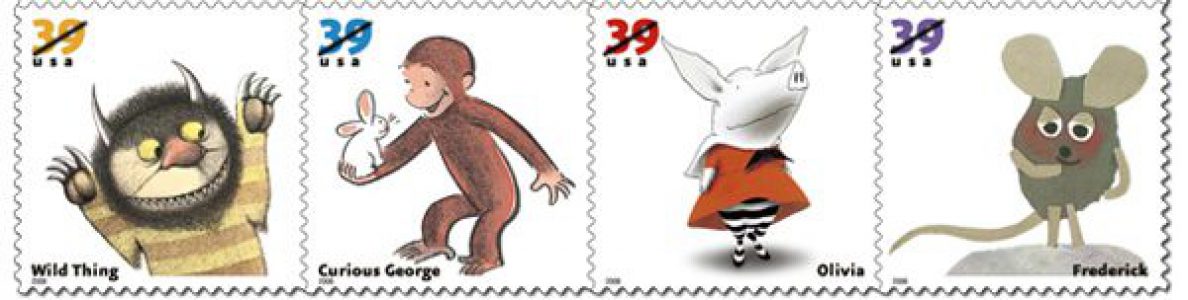
Leo Lionni, the artist, designer, and author of many innovative books for children, including Frederick, Swimmy, Little Blue and Little Yellow, did not emigrate to the United States as a child. He was, as Kimmel reports, a Sephardic Jew born in 1910. His mother was not Jewish, and, although he had briefly spent some time in the U.S. as a child, his family returned to Europe. He emigrated with his wife and family in 1939, when he was 29 years old, fleeing Hitler. Given Kimmel’s emphasis on antisemitism as a significant factor in his book’s thesis, the timing of Lionni’s arrival is not irrelevant. Lionni’s autobiography, Between Worlds, is an essential book for anyone writing about his life and work. (Peter Spier, another Caldecott-winning illustrator, who created an illustrated U.S. Constitution, was also from the Netherlands, and also Jewish through his father. Spier was a survivor of Theresienstadt , and emigrated to the U.S. in 1950.)
“I am Eloise. I am six. I am a city child.” Many readers do not realize that the creator of Eloise, Kay Thompson, was also of Jewish heritage. Kimmel includes references to her work and her Jewish identity, but confuses the facts. Thompson, an actress and vocal coach as well as an author, was known to inhabit the character of Eloise by speaking in her distinctively haughty childlike voice. She never, however, voiced the part of that prodigiously annoying little girl, in spite of Kimmel’s definitive claim that “She heard her voice so vividly that in the animated films, she insisted on always performing the voice part of Eloise.” There was a live Playhouse 90 production of Eloise, two Disney live action movies in 2003, and a 2006 animated series. In none of these did Thompson voice the character of her unforgettable creation. An accurate and extremely readable source of information about Thompson is Sam Irvin’s Kay Thompson: From Funny Face to Eloise. I recommend watching the Disney adaptations just to see Julie Andrews as Nanny.
Kimmel credits Jane Yolen for her influential role, and refers to the interesting fact that she wrote a children’s novel, Wizard’s Hall, which pre-dates Harry Potter and features similar elements to that blockbuster. He refers to Yolen in the past tense: “Jane Yolen, born in 1939 to Ukrainian immigrant parents, wrote mostly fantasy fiction for children” (emphasis mine). Please don’t retire Jane Yolen! She has written over 400 books and is still writing (this one was published in 2024). We hope to see more from her! While many of her books involve fantasy, she has created works in other genres and frequently addresses Jewish themes. The Devil’s Arithmetic (1988) is considered to be one of the first works of fiction for children to discuss the Holocaust. It is an odd omission to neglect this crucial book, which in fact, incorporates fantasy into its historical narrative. Given the context of Jewish identity in Playmakers, Yolen’s specifically Jewish-themed works would seem as crucial as her fantasy books (some of which also have Jewish themes, such as The Last Tsar’s Dragons).
Kimmel is correct that children’s books have historically been gendered in their expected audience, but neither Charlotte’s Web nor Mr. Popper’s Penguins could be categorized as an example of a “girl’s adventure tale,” about “a cute and lovable creature that could be domesticated.” Uri Shulevitz’s brilliant, penultimate, book Chanceis not a graphic novel, but an illustrated memoir (and serves a shadow text to his last book). Jean de Brunhoff, listed by Kimmel as a legendary non-Jewish author and artist, actually had Jewish heritage. Admittedly, this fact is not widely known, but Kimmel carefully documents the somewhat hidden Jewish background of many other figures.
I still recommend reading Kimmel’s book. You will learn a great deal about the Jewish origins of Teddy Bears, Barbie, and Lionel trains. There is a fascinating section on the development of Black dolls, and the marketing of toys by gender. Kimmel chose to include children’s literature as a prominent topic within his argument. Having decided to integrate that field into his discussion of toys, he or his editors needed to have looked further into its sources.
Red River Rose – Carole Lindstrom Bloomsbury Children’s Books, 2026
In Red River Rose, Carole Lindstrom further develops the characters she presented in her picture book with Aly McNight, The Gift of the Great Buffalo. As Lindstrom explains in her author’s note, Rose’s story is rooted in a commitment to telling a story related to Laura Ingalls Wilder’s Little House books, from an indigenous perspective. Lindstrom’s work is not a refutation of Wilder’s, but her own, original, interpretation of the conflicts between settlers of European origin and the original inhabitants of lands in the Americas. Red River Rose is set during the late 19th century, specifically the North-West Resistance in Saskatchewan of 1885. At that time, First Nations and Métis peoples fought the Canadian government’s seizure of their lands.
Lindstrom’s distinctive narrative style is compelling. Her characters are individuals, not archetypes. Rose frequently refers to the moral ambiguities inherent in her choices, including that of armed resistance. Her father is courageous, particularly in comparison to other men in the community, and to Catholic clergy, who caution against resistance and advocate a passive acceptance of the Métis’s seemingly hopeless determination to reclaim their land. Rose’s mother is equally strong, holding her family together through deep love and a command of essential domestic skills.
Rose visualizes the beauty of her land and community, and Lindstrom’s poetic language communicates to readers the roots of the Métis’ intense identification with their home. “Rose wanted to burn the memory of the ferry sitting atop the sparkling water and the hawks soaring off in the distance into her brain forever. If she were a painter, she knew exactly what she would paint.” That identification allows her to counter the contempt of teachers or religious leaders who warn against the Métis’s struggle, warning Rose to “keep that talk at home” when she raises the possibility of fighting against oppression.
Ambroise, a boy Rose’s age, is her companion and equal; the two work together to devise plans that will support those adults who will fight against the government. Eventually, Rose assumes an active role herself, forced by circumstances to blur the boundaries between childhood and adulthood. Rose is highly intelligent; nothing in her character suggests duplicity, but she learns to use every skill necessary to acquire information, communicate it to others, and make her own decisions. Her father’s increasing trust in Rose affirms her choices, as when she remembers having supported her people by helping to locate a herd of buffalo. At that time, her father’s response was a complex mixture of anger at the risks Rose had taken, and gratitude for her bravery.
That conflicted response takes form in Rose’s consciousness. Her father reports the Métis battle against the Canadian Mounted Police, characterizing the fight as “a thing of beauty.” At the same time, Rose experiences grief for everyone’s losses, even for the Police and their families. She also recognizes the potential for change, as when “mean girl” Melanie, who had shown only contempt for the idea of resistance, begins to seem like a different person. The impact of fear and suffering had brought out aspects of her character that Rose had never seen. “Under different circumstances, she could learn to like Melanie.”
Victory has different forms. Although they did not achieve their ultimate goal, Rose, her family, and her community had the integrity to stand up “for themselves, for their homes, and for their way of life.” Red River Rose is not a story of glorious triumph, but of the refusal of individuals working together to protect what they love, and to sustain their vision of justice.
Fritz: A Mushroom Story – written and illustrated by Kelsey Garrity-Riley Tundra Books, 2026
Fritz is a quiet chanterelle mushroom. He likes hats, which is a good thing, because he always appears to be wearing one, as well as a red cardigan. Fritz is quiet and introverted. Books for children about people who prefer solitude or quiet activities to raucous socializing are a welcome phenomenon, and not a new one. Nor are books that emphasize that people with different, even opposite personalities, can still be friends (other examples can be found here and here and here). The mycological element in Fritz: A Mushroom Story is appealing, but Kelsey Garrity-Riley is not simply following a trend. Her mushroom child is his own person.
The details that support Fritz’s character are specific and not exaggerated. No, he doesn’t only sit curled up in a blanket reading books, although reading mysteries with his dad is one of his preferred pastimes. So is building boats out of acorns. It looks fun and simple, and messy enough to require a scraps of paper, depicted in a lovely collage style, to absorb the glue. His culinary tastes on sensible. Rose-hip ice cream and cream of chestnut soup are clearly appropriate for different temperatures. He’s not rebellious enough to reverse their seasons, but rather content with his choices.
Socializing is definitely part of Fritz’s life. Garrity-Riley’s pictures, rendered in gouache, collage, pencil, and ink, feature a subdued palette with moments of brightness, much like Fritz’s day. In an outing to the playground shades of green predominate, while a bright red slide just off center emphasizes that Fritz can have fun. Other scenes of offer balance, including a smaller circle of friends, and sometimes “only one friend” for cozy indoor play. Red-roofed dollhouses populated with mushroom dolls stored in a basket seem perfect. Just when it might seem that solitude is not important to Fritz, Garrity-Riley reminds us that “often,” that state is exactly right for him. Reading in bed, his mushroom dolls placed at carefully composed angles, is just right.
Pip is Fritz’s more outgoing friend. The contrast between them is not so dramatic. Pip enjoys theater and music, with all the character traits that implies. Since he is a fly agaric, otherwise known as amanita muscaria, his body is square and his top a dome. At one point, the two pals are playing hide-and-seek, and when Pip finds Fritz, the latter declares, “Actually…I don’t think I’m ready to be found yet.” But their time together is harmonious, as they share different flavors of ice cream and “different ways to be wonderful.” There is a fine line between reassurance and preaching, and between resignation to unchangeable traits and celebration of them. Fritz: A Mushroom Story captures that truth by speaking directly to young readers about difference, accompanied by the colors of a mycological childhood they will recognize as their own.