In the Pocket

The Newest Gnome – written and illustrated by Lauren Soloy
Tundra Books, 2025

The Pocket is where the gnomes live, in Lauren Soloy’s remarkable universe of small creatures dedicated to choosing hats, telling stories, and generally explaining and appreciating the world. I was impressed with the first gnome book, The Hidden World of Gnomes, and I’m thrilled that Soloy and Tundra believed in them, and that they merited a second look (I’m also a fan of Soloy’s other work, as you can see here and here and here).  Although the gnome books are rooted in tradition and folklore, they are also new and singular.

When the book begins, the existing gnomes, including Cob Tiggy, Twiggy Dell, Minoletta, and Beatrix Nut, are about to welcome a newcomer to the Pocket.  These creatures, whose names evoke both Beatrix Potter and a kind of cosmopolitan flare (Minoletta, Hotchi-Mossy), need to meet in their mushroom circle to discuss the latest Pocket resident. When Grolly Maru arrives, they sense the need for reassurance, similar to Winnie the Pooh’s helpful and sustaining words: “Everything will be all right.”

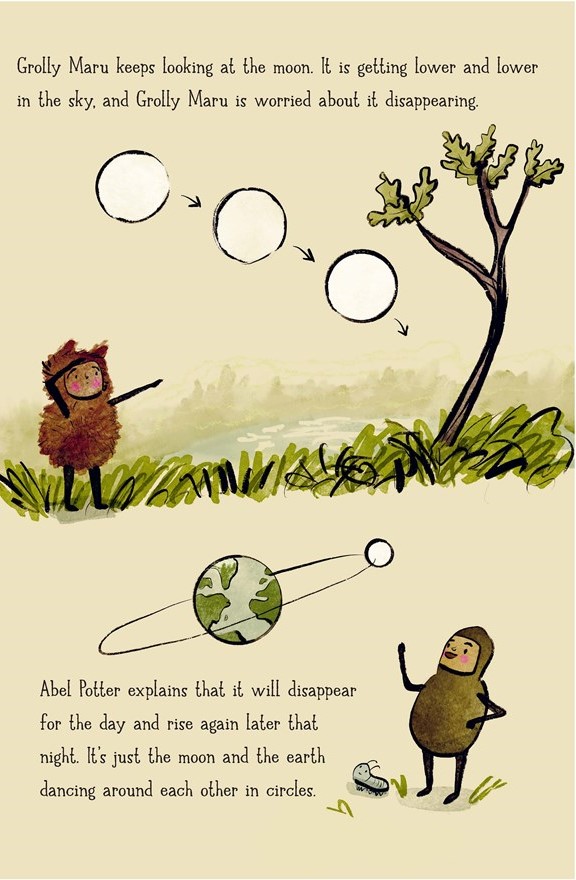
After a good night’s sleep under the mushrooms, the gnomes will be prepared to teach Grolly Maru essential skills. As in Babar’s Celesteville, every inhabitant has a specific job and role to play. When Grolly Maru expresses concern that the changing moon may eventually disappear, does this reflect and anxious personality, or just a basic lack of familiarity with the environment?  It’s up to the reader to decide, but since Abel Potter shows Grolly Maru other round and spherical items from nature, it doesn’t matter.

The pictures feature gnomes interacting with one another, along with close-ups of objects that fill their lives: dandelions, yarrow, marbles, ants, and suggested exercises.  There is a recipe for Bonnie Plum’s baked apple with blackberries, which, considering the scale of gnome to ingredients requires both hardware and strength.  The gnomes are artisans, designing grass baskets: “It’s not as easy as it looks!” (Who would expect it to be easy?). Their overarching purpose is constant fidelity to the idea that each individual is unique, but that we are all part of something greater. Lauren Soloy’s artistic vision is fully realized, in a universe of beauty and comfort, populated by small beings with great wisdom.

Bewitched, Bothered, and Bewildered

The Witching Hour – written by Jennifer Harris, illustrated by Adelina Lirius
Tundra Books, 2025

My mother used to refer to “the witching hour,” that time late in the day when babies, toddlers, and young children seem to act a bit possessed. Whether because they have managed their impulses as best as they can for many hours, or need limits and reassurance, or are just exhausted, this can be a difficult moment for parents. The “hour” may seem like multiple hours.  Jennifer Harris and Adelina Lirius (I reviewed another of her works here) have captured the phenomenon so perfectly in their new picture book that you and your children will be under their spell. Indeed, as Harris solemnly states, “Anything can happen in the witching hour.”

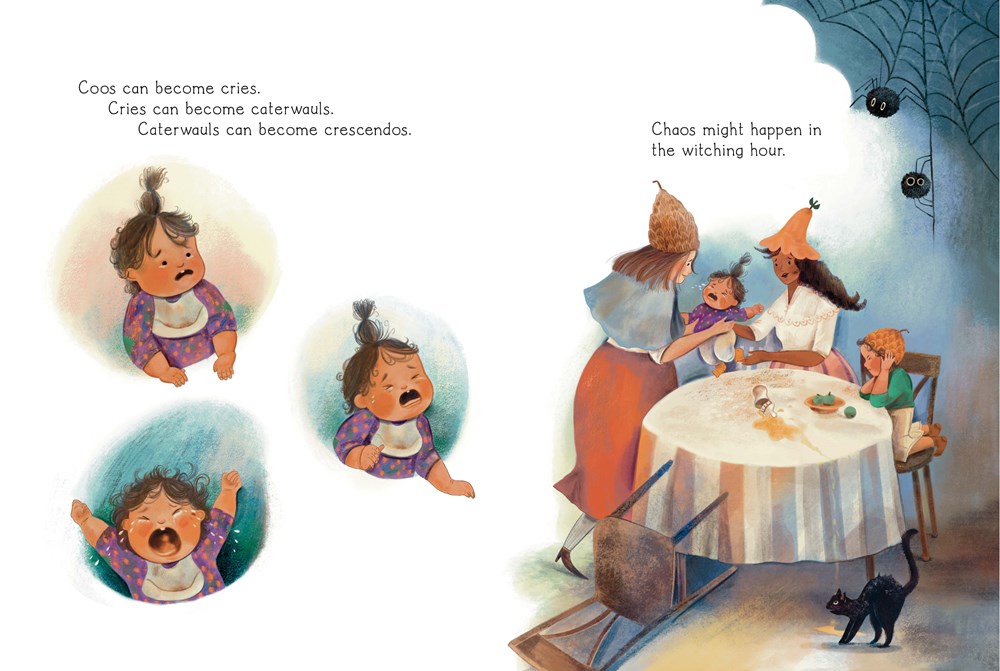
The two mothers in the book are paragons of patience, trying every inventive solution you might imagine, and then some.  First, the acknowledge that anything, “or even nothing at all,” can set the chaos in motion.  A baby overturns a cup of liquid on a table enclosed in a lovely tree trunk. Yes, we all recognize that scene.  An older child wearing an acorn cap looks on, clearly worried about the next phase.  The author is honest in calling it “chaos.” It takes both moms to extricate the screaming toddler from her highchair. An adult chair is overturned, a black cat arches its back, and the sibling covers her ears in terror.

One of the most frustrating features of the witching hour, when it happens, is escalation. “Coos can become cries.  Cries can become caterwauls. Caterwauls can become crescendos.”  Harris uses every figure of speech at her disposal: alliteration, onomatopoeia, literary allusions, rhythm.  Perhaps your child can be calmed by a favorite stuffed animal. The moms try a variety of real wildlife, finally settling on the owl. You know the feeling of relief: “Definitely the owl. Thank goodness for the owl.”

If you were hoping for fairies, you won’t be disappointed.  They arrive and join in the music and dancing, in a kinetic scene of joy mixed with desperation. Lirius’s fabulous pictures evoke an entire universe where the fantastic and the familiar are effortlessly blended. Earth colors predominate and the domestic interiors are as welcoming as those in Dutch still paintings. One mom holds the baby, who looks momentarily transfixed. The other mom is dancing upside down, her feet fixed to a magical broom.  Fairies usually command attention, but here they are a great audience. When the show ends (who could sustain that level of energy), the moms come down to earth. 

There are still many comforting possibilities to try: “this bottle, this banana, this bat.” The moms are creative and full of hope, waiting for the moon to signal that at least for today, it’s time to sleep. Suspension of disbelief sets in for this lovely family of nurturing witches. Tomorrow they we ready to start again, with all the resources at their disposal. For readers, this home of friendly spider webs, baskets of knitting yarn, and a quaint wood stove, seems uncannily real. For the duration of the story, you will be living among friends, and the supernatural is just, natural.

Turning Over a New Leaf

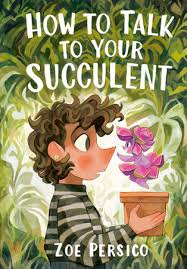
How to Talk to Your Succulent – written and illustrated by Zoe Persico
Tundra Books, 2025

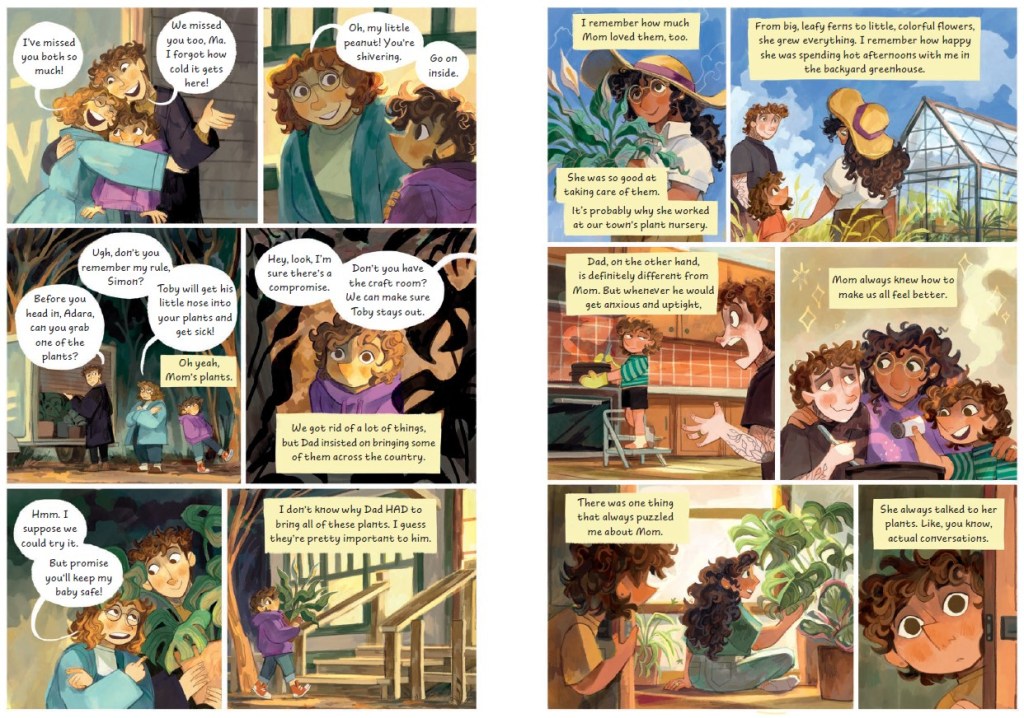
In Zoe Persico’s incredibly inventive graphic novel, Adara’s mother has recently died. She and her father leave California to move in with her grandmother in Michigan. The potential subjects of graphic novels are unlimited, and How to Talk to Your Succulent is not the first one to deal with grief, or strained relationships of parents and children. It is, however, outstanding in its sensitivity, bold graphics, and experimentation with fantasy and reality as equal components of a young girl’s search for the truth. Persico quietly presents a scenario that defies reality, and then proceeds to immerse the reader in a world where it is utterly plausible.

If you are skeptical about human communication with plants, this book will demonstrate the irrelevance of that reservation. Adara is sad and uprooted, even though her grandmother is a pillar of flexible strength. Her father is trying, somewhat helplessly, to cope with his own desolation and anger, which he approaches by inadvertently discouraging his daughter from expressing her feelings. What could be worse than this agonizing moment in all their lives? As it turns out, Adara’s mother had quietly used a special power. Not only did she have the proverbial green thumb at growing plants, she could actually communicate with them: “Like, you know, actual conversations.”

Adara’s grandmother, who resembles a child’s ideal image of a non-judgmental old person as both youthful and wise, also keeps a garden and greenhouse. When Adara’s father realizes that she has taken to wearing her mother’s earrings, which resemble tiny plants, he takes her to visit a nursery where she can select an actual plant of her own. This gesture is the closest he can come to acknowledging her feelings of isolation. At the greenhouse she meets Perle, short for Perle von Nurnberg, a delicately beautiful succulent who, for a devastatingly brief second Adara believes to be speaking in her mother’s voice. Then comes the epiphany: “I can talk to plants just like Mom! I knew it! I knew it!”

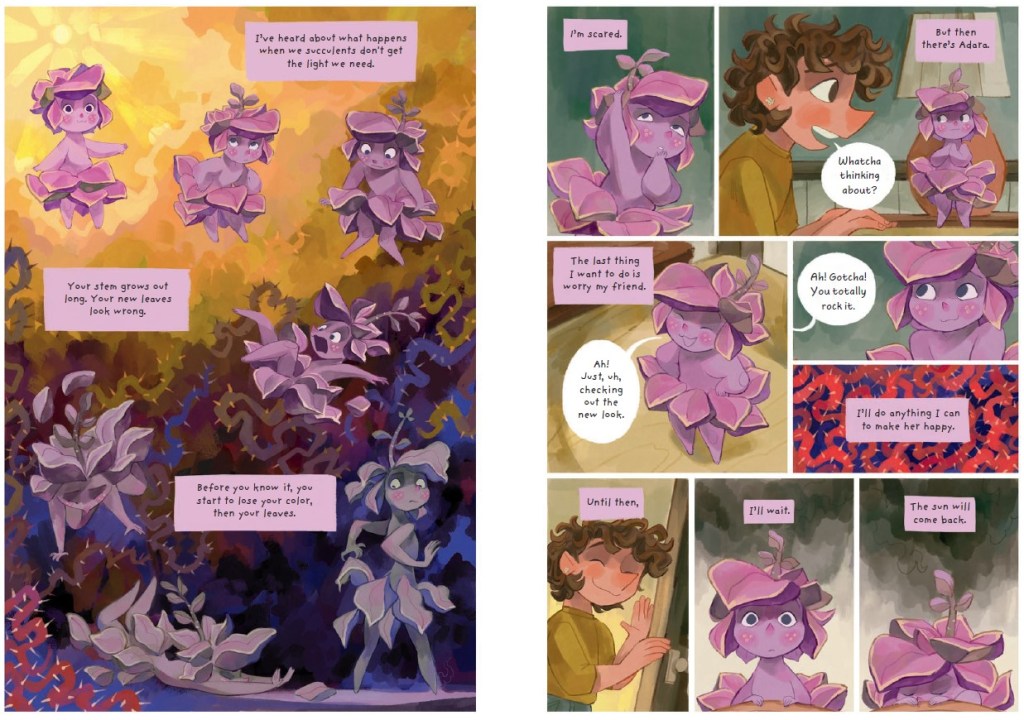
There is nothing affected about this unusual series of circumstances. Readers are not asked to suspend disbelief, but to enter Adara’s emotional state without preconceptions. Broadening her narrow circle of relatives, she also meets a new best friend, Winnie, a frustrated artist whose own mother is demanding and unappreciative of her daughter’s talents. Still, she has a living mother and Adara does not. But other people, as Adara learns, have their own problems and also need to be protected in order to thrive. Perle, the plant who demonstrates Adara’s maternal inheritance, is threatened with extinction if Adara cannot learn that same lesson as it applies to her.

The artwork of How to Talk to Your Succulent is inseparable from the text. Persico uses earth colors, jewel tones, and gradations of light in a setting that combines the spaciousness of nature with the enclosed scale of a greenhouse. People’s emotions register with expressive brush strokes, as do the fantastic plants who interact with each other and intersect with humans. The author’s note reaffirms her commitment, both artistic and emotional, to connecting with the reader. She includes mixed media photographic images, a visual and textual demonstration of her method, and even a guide to the plants at the root of her story. Equally innovative for its graphics and its exploration of emotional vulnerability, this book will bloom with every re-reading.

Fairy Architects

The Tallest Tree House – written and illustrated by Elly MacKay
Running Press Kids, 2019

Fairies usually live in tiny, beautiful, dwellings. Sometimes these are made of obvious materials: leaves, twigs, moss, and other natural elements. Often a child who loves fairies created them, or at least happens upon them and lovingly interacts with their inhabitants (for example this and this). In Elly MacKay’s The Tallest Tree House, there are two fairies, no humans. Both fairies have architectural aspirations as does this mouse). Their names are Mip and Pip, and they are somewhat competitive; at least Mip is. She actually challenges Pip to a contest: “Whoever makes the best tree house by sundown wins!” This impulsive idea doesn’t take into account the fact that Pip is currently reading a book about architecture. 

Elly MacKay’s illustrations are theatrical; she describes her method in inspiring detail (I reviewed another of her books here). Looking at her cut-out figures, carefully placed in stage settings, I was reminded a bit of the Cottingley fairy episode, a well-intentioned fraud when two girls in early 20th century Britain convinced a credulous public that they had photographed fairies. Of course, there is no fraud here; Mip and Pip are real and they create their own home. But the delicacy and care involved in bringing them to life seem related.

Even looking at the two friends, Pip seems more serious. In addition to his reading, he has a tall, pointed leaf for a head covering. Mip, in contrast, sports a comically oversized mushroom cap.  Pip draws blueprints based on his planning.  He carries a, presumably, well-stocked toolbox and uses a pulley. The sight of Mip’s obviously fragile tall tower worries him, because he cares about her more than he does about winning. Eventually, they work as a team, together completing “a winning piece of architecture.” 

Several qualities set this book apart in children’s fairy literature.  There is the tortoise and hare allusion, and the friendly warning that you need technology as well as patience to build a fairy house.  The composition resembles a theater set, and even includes sound effects, such as a terrifying BOOM in huge font when Mip’s shoddy tower collapses.  The book is not unique in excluding human observers, but it does feature an unusually independent fairy world.  Next time you build a house for fairies, read Pip’s book and bring along some simple machines.