Ready, Set, Anne

Anne: The Chapter Book Collection – adapted by Kallie George, illustrated by Abigail Halpin
Tundra Books, 2025

Anne Dares – adapted by Kallie George, illustrated by Abigail Halpin
Tundra Books, 2023
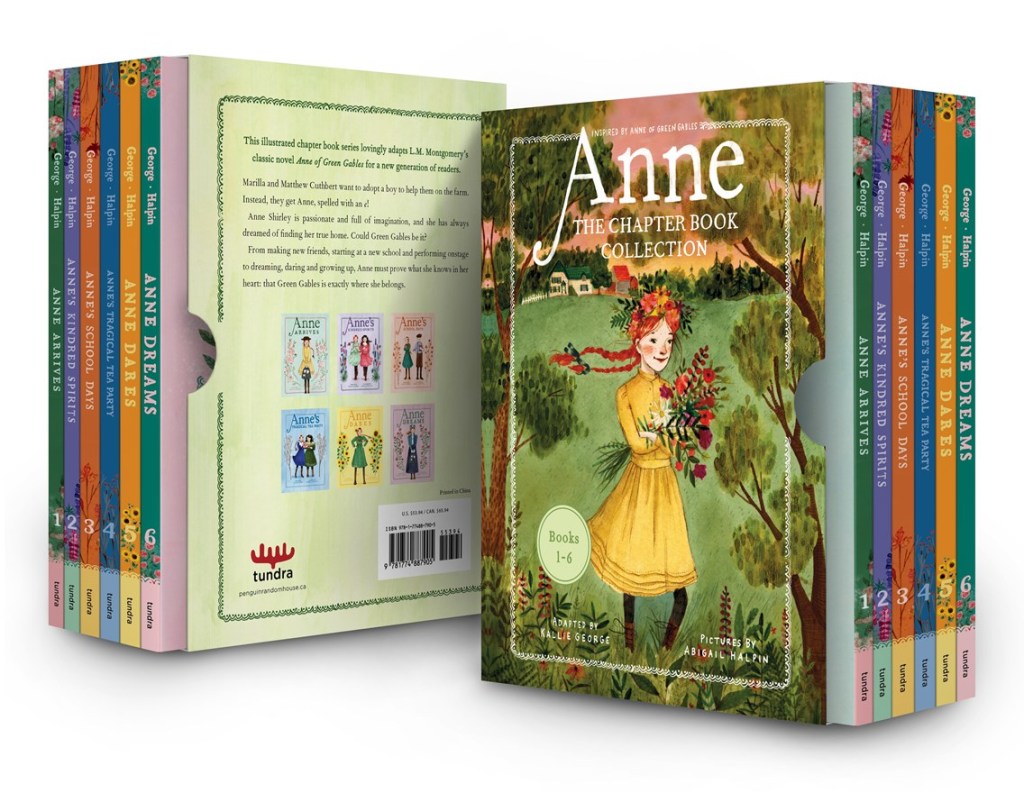
For fans of Kallie George and Abigail Halpin’s wonderful collaboration in bringing the work of Lucy Maud Montgomery to chapter book readers, Tundra has issued a boxed set of paperback editions.  As you will read on my earlier posts (see here and here and here and here), this series is both an accessible introduction to the original Anne of Green Gables, and each volume a  wonderful illustrated novel that stands on its own merits.  Abigail Halpin’s pictures offer her own perspective on the characters and setting, and Kallie George has succeeded in writing an homage to Montgomery’s vision, not a bland imitation.

In Anne Dares, the bold aspect of Anne Shirley’s personality propels her to take some risks.  These include the physically daring walking on the edge of a fence, as well as the courage to perform in her school’s recital. The fence-walking stunt even requires her to ignore the advice of kindred spirit Diana. Ever conscious of a dramatic situation, Anne assures her friend, “And if I do perish,…you can have my pearl-bead ring.

Her performance involves facing her apparent nemesis, Josie Pye, as well as Gilbert Blythe, the boy whose thoughtless teasing will prove to be a mere mask over his true feelings. Her new puff sleeved dress, a gift from her beloved father figure, Matthew, gives her some of the strength she needs in front of an audience.  The dress is both a cherished article of clothing, as well as a tangible proof of the love that now characterizes her home life, although her initial arrival had provoked skepticism.  On stage, at first “she thought she might faint.” Daring or not, she is still afraid. Fortunately, “she knew she must live up to those puffed sleeves.”  Montgomery’s heroine, re-imagined by Kallie George and Abigail Halpin, lives in two worlds, where undeniable difficulties and dreams of beauty are intertwined.
Not Just Any Store

Our Corner Grocery Store – written by Joanne Schwartz, illustrated by Laura Beingessner
Tundra Books, 2025

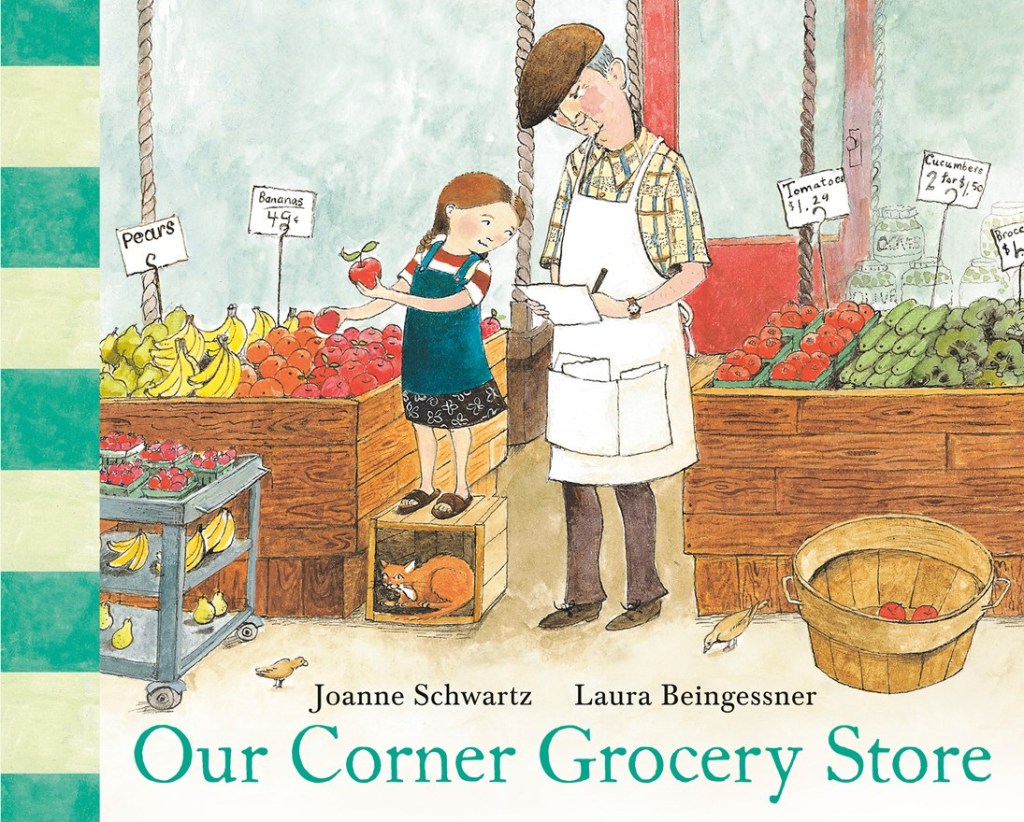
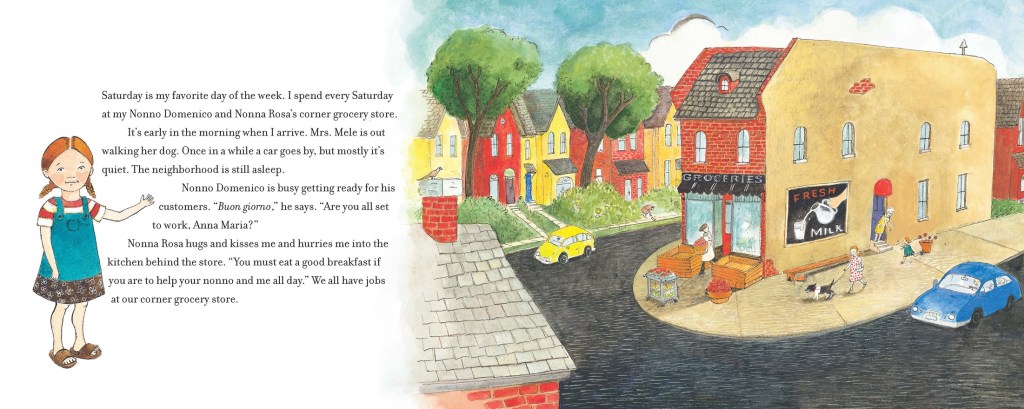
Tundra Books has reissued Joanne Schwartz’s and Laura Beingessner’s classic  picture book, about family and community. Originally published in 2009, this ode from a child’s perspective to her loving grandparents and their unpretentious shop seems instantly familiar. Anna Maria describes her Nonno Domenico and Nonna Rosa’s corner establishment, where the provide every food needed by residents of the town. At the same time, Schwartz’s words and Beingessner’s images almost startle with their simplicity.  The place where Anna Maria helps out is practical and magical. 

Even Anna Maria’s inventory has a poetic sound: “On one side we have the apples, oranges, pears, bananas and strawberries.  On the other side are tomatoes and cucumbers, broccoli and green beans.” (image) Clear organization and aesthetically pleasing display are a testament to the store’s importance.  Anna Maria and Nonno Domenico collaborate on ensuring that everything is in order. Even standing on a crate, Anna Maria does not reach her grandfather’s height, but they are coequal partners in quality control.

Detail defines Beingessner’s illustrations, along with careful composition and bright colors.  Anna Maria is precise in her descriptions. She traces her steps: “There are only two short aisles in our corner grocery store. When I come inside, I have to close the boor before I can get to the counter.” An adult might minimize the need to establish scale this way, but to a child it matters. The bottom of the page with text sets out several small items, including a box of paints and a slice of pizza.  On the facing page, the store becomes a cutaway doll house, with each room individually constructed. You will want to look at this page for a long time, noticing the floral upholstery on the armchair, Nonna in her green dress making coffee, and the incredible array of miniature products juxtaposed on their shelf. 

Children use metaphor without self-consciousness.  To Anna Maria, baguettes resemble swords and cornbread “looks like big, flat stones.” When her friend Charlie visits, both children become artists, drawing with chalk on the sidewalk in a kind of meta reference to the illustrator’s work. (image).  A pirate and a girl seem to be self-portraits, proudly signed by the painters. Of course, the neighborhood children are valued customers, treated with respect by the proprietors.

They order their sandwiches with specific requests, “’Provolone, please,’ someone calls. ‘Mortadella and Havarti for me,’ somebody else says.” Observing the cold cuts and cheese passing through the slicing machine is part of the process.   Soon, separate components are transformed by Nonno into an unforgettable sandwich. It’s almost a theatrical production, and even the cat is intrigued.

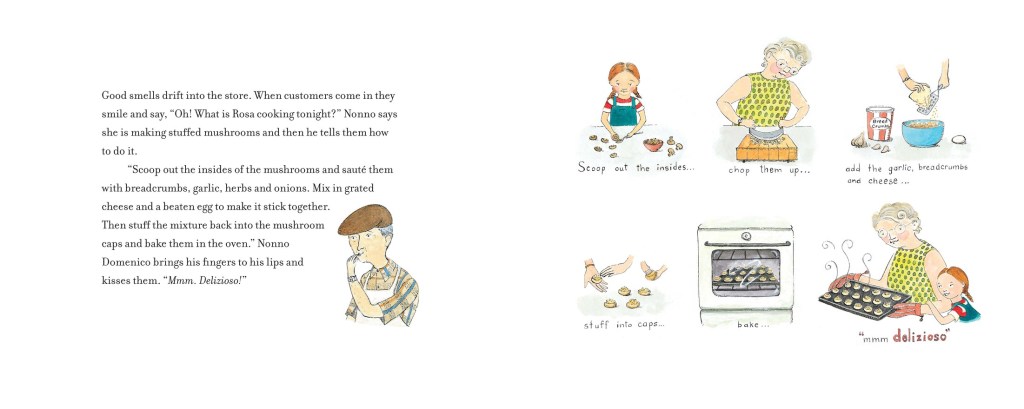
Every picture in the book stands alone as a work of art, and also advances the building of characters.  The delicious smells filling the store attract customers, who ask Nonno what dish Nonna is cooking. He recites the recipe, and then completes his expression of love, raising his fingers to his lips and kissing them. A visual timeline of the stuffed mushrooms’ creation appears on the facing page.  The entire book is delizioso.
In the Pocket

The Newest Gnome – written and illustrated by Lauren Soloy
Tundra Books, 2025

The Pocket is where the gnomes live, in Lauren Soloy’s remarkable universe of small creatures dedicated to choosing hats, telling stories, and generally explaining and appreciating the world. I was impressed with the first gnome book, The Hidden World of Gnomes, and I’m thrilled that Soloy and Tundra believed in them, and that they merited a second look (I’m also a fan of Soloy’s other work, as you can see here and here and here).  Although the gnome books are rooted in tradition and folklore, they are also new and singular.

When the book begins, the existing gnomes, including Cob Tiggy, Twiggy Dell, Minoletta, and Beatrix Nut, are about to welcome a newcomer to the Pocket.  These creatures, whose names evoke both Beatrix Potter and a kind of cosmopolitan flare (Minoletta, Hotchi-Mossy), need to meet in their mushroom circle to discuss the latest Pocket resident. When Grolly Maru arrives, they sense the need for reassurance, similar to Winnie the Pooh’s helpful and sustaining words: “Everything will be all right.”

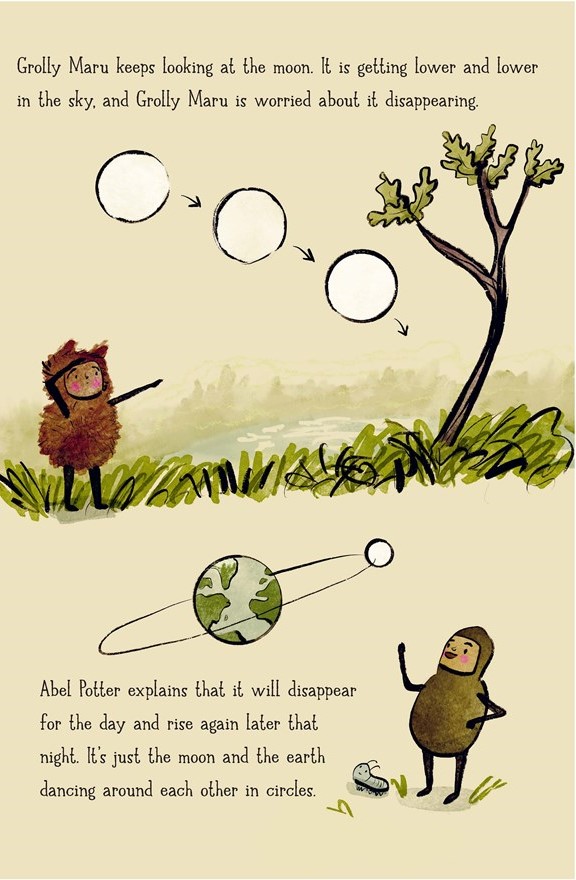
After a good night’s sleep under the mushrooms, the gnomes will be prepared to teach Grolly Maru essential skills. As in Babar’s Celesteville, every inhabitant has a specific job and role to play. When Grolly Maru expresses concern that the changing moon may eventually disappear, does this reflect and anxious personality, or just a basic lack of familiarity with the environment?  It’s up to the reader to decide, but since Abel Potter shows Grolly Maru other round and spherical items from nature, it doesn’t matter.

The pictures feature gnomes interacting with one another, along with close-ups of objects that fill their lives: dandelions, yarrow, marbles, ants, and suggested exercises.  There is a recipe for Bonnie Plum’s baked apple with blackberries, which, considering the scale of gnome to ingredients requires both hardware and strength.  The gnomes are artisans, designing grass baskets: “It’s not as easy as it looks!” (Who would expect it to be easy?). Their overarching purpose is constant fidelity to the idea that each individual is unique, but that we are all part of something greater. Lauren Soloy’s artistic vision is fully realized, in a universe of beauty and comfort, populated by small beings with great wisdom.

Sisters You Won’t Forget

Stella & Marigold: Mermaids and Mix-Ups – written by. Annie Barrows, illustrated by Sophie Blackall
Chronicle Books, 2025

The second volume in Annie Barrows and Sophie Blackall’s series about an unforgettable pair of sisters continues their adventures, and the development of their relationship. Stella & Marigold established that their closeness, characterized by both unrelenting love and occasional friction, was as believably narrated as Beverly Cleary’s Ramona books (astute readers of my blog will recognize that its title derives from a quote in Ramona the Brave.) The outward similarities between the two series are not superficial, but rather are based on the way which both sets of books communicate how it feels to be a child, without a touch of condescension. Both also invite adults to identify with characters, whether by remembering their childhood or following along as Stella and Marigold’s parents, teachers, and grownup friends, who also propel the plot. (I reviewed the first Stella & Marigold book here.)

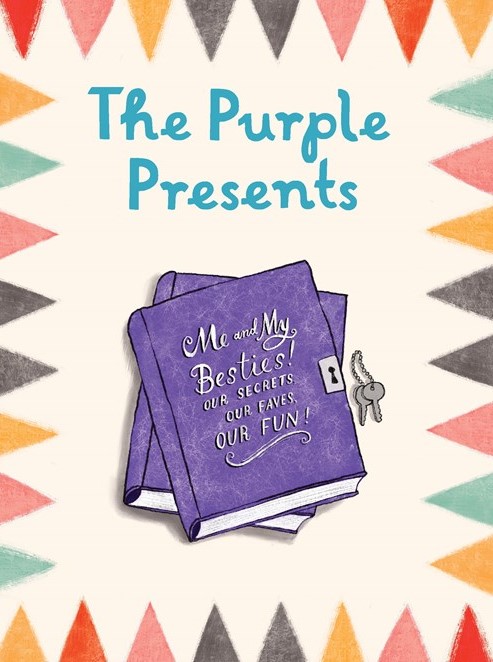
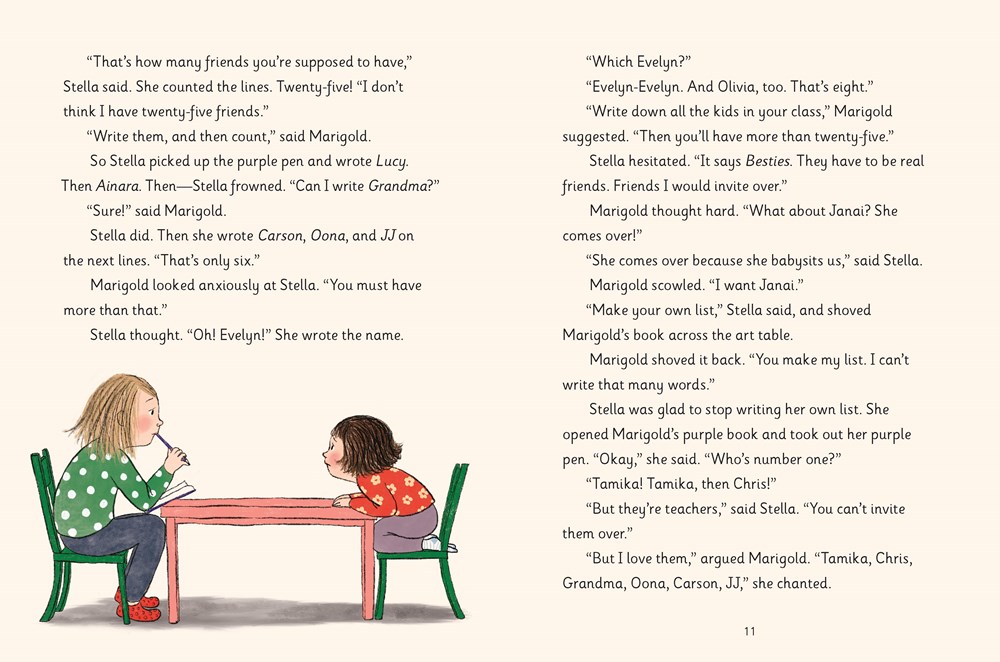
Each chapter may be read independently, but are interconnected. The book begins with a gift which the sisters receive from their Aunt Judy. Like many of her gifts, this one turns out to be a Trojan horse. A sparkly purple covered diary with high-pressure demand to record “Me and My Besties! Our Secrets, Our Faves, Our Fun!” sets Stella and Marigold on a series of attempts to find friends worthy to fill in the blanks. Even though this involves some distress, it eventually leads to an understanding of friendship and empathy, minus the high-stakes categories.

In “Snow, Snow, Snow!” Stella tries to win the friendship of a classmate by using mind control to ensure a snowstorm. When their teacher, Mr. Banagal, intends to dissuade the children by calling this “magical thinking,” Barrows reveals how differently adults and children sometimes interpret reality. His phrase has the opposite result. After all, what else could magical thinking be but “encouraging?” Adults will read this passage with recognition, but not a sense of superiority unless they don’t remember what it felt like to fruitfully “misinterpret” adult’s language. Barrows does employ a little bit of gentle humor at adults’ expense when Teacher Kaitlin carefully avoids direct praise of Marigold’s artwork, instead focusing on one quality:

“Wow, your picture is so detailed”…She always said things like that. Never, “Your picture is great…the best I ever saw.”

Blackall’s pictures feature her ability to convey a character’s feelings with slight alterations of their features. (I reviewed another of her books here.) A range of crayon-box colors, and careful composition of images against white background, give every page of the book its own impact. Stella and Marigold sit across from one another at a table, as they collaborate on coping with the diary. Marigold desperately tries to get her father’s attention when he is absorbed in his work; his temporary rejection leaves her curled into a question mark, embodying her feelings about why his priorities would be so misplaced.

There are so many series about girls and their friendships; many of these are terrific. Stella & Marigold fits securely into the category of classic.

A Bridge to Somewhere

Late Today – written by Jungyoon Huh, illustrated by Myungae Lee, translated from the Korean by Aerin Park
Eerdmans Books for Young Readers, 2025

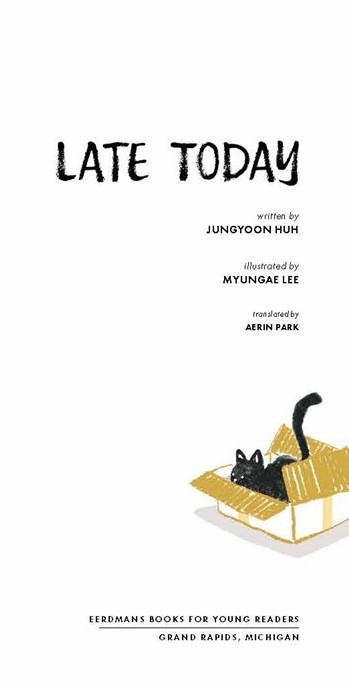
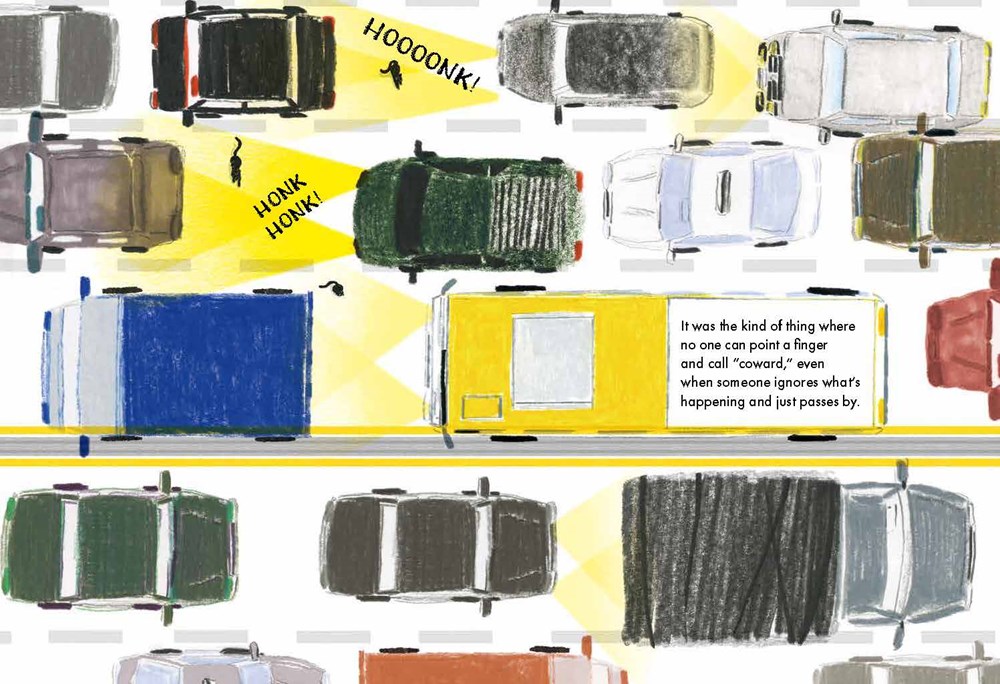
The opening endpapers of Late Today show an overcast sky. The following two pages feature the consequence, a bridge accompanied by the warning that “Morning rush hour traffic is congested all over Seoul,” with the report’s words alternating in word of the report alternating in level relative to the image.  The title page shows an adorable kitten with golden brown eyes that match the lid of the carton which has become her bed. Readers join the traffic jam and the rescue mission.

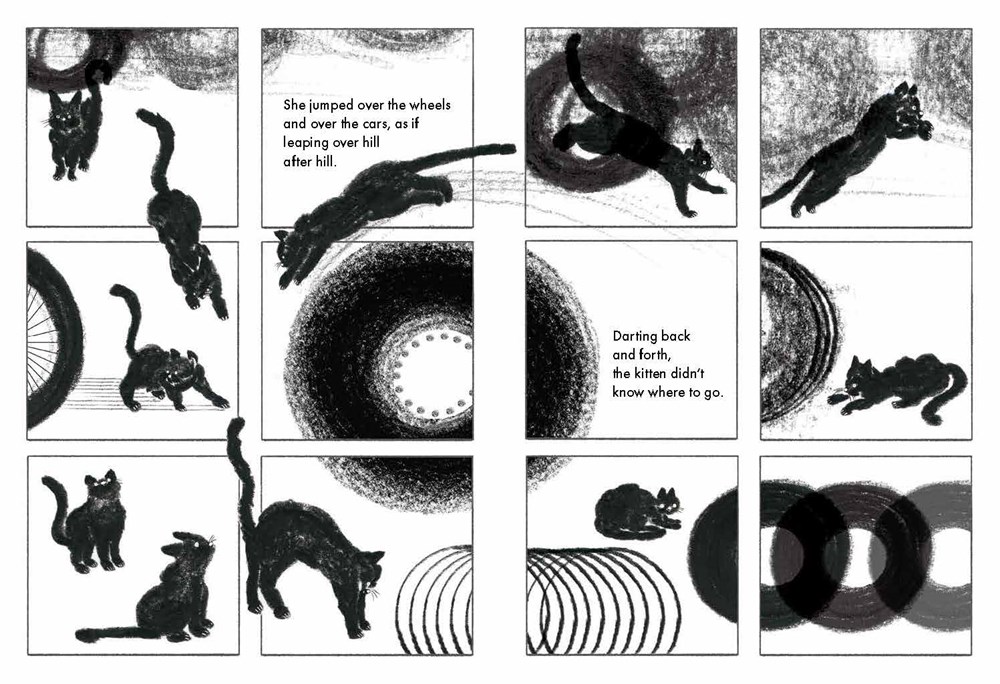
Jungyoon Huh’s minimalist text (ably translated by Aerin Park) conveys just exactly the amount of information needed.  Myungae Lee’s illustrations, rendered in colored pencils and oil pastels, combine black and white scenes, graphic novel panels, and earth and jewel tones against white background. They are beautiful in their simplicity, but also convey motion, sense impressions, and the imminent threat of losing a kitten on a traffic-clogged bridge.  The black font ranges in size, with some pages reminding me of the lettering used in Margaret Wise Brown and Leonard Weisgard’s The Noisy Book, and sequels. (The Winter Noisy Book is illustrated by Charles G. Shaw.)

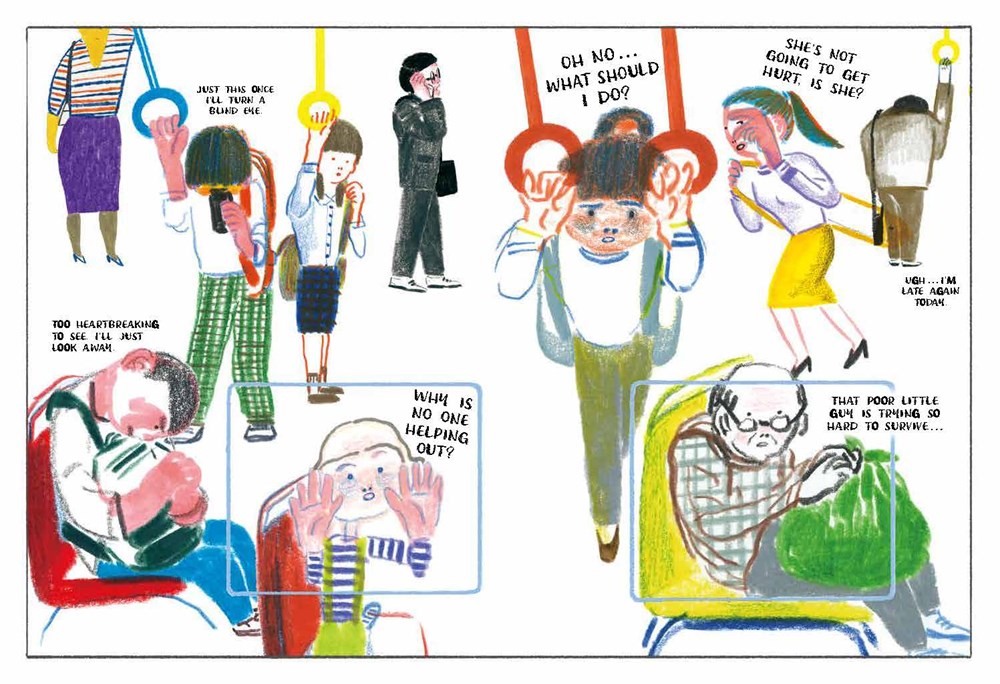
Public transportation passengers, each in isolation, express their own thoughts about the danger, and their appropriate response to the kitten’s plight.  Parents and caregivers sharing the book with children will want to discuss all the implications of these natural, but possibly inadequate, emotions: “Why is no one helping out,” “Too heartbreaking to see. I’ll just look away,” and Oh no…what should I do?” One incredible two-page spread is a bird’s eye view of the vehicles, each one inadvertently threatening the tiny kitten weaving between them. The text is enclosed in a rectangle similar in size to the vehicles themselves, the words visualizing the ominous situation.

Cinematic techniques dedicate to full pages to a darkening storm, and another two to pelting raindrops.  Readers pause and take a deep breath. Then, a driver rescues the kitten, his or her hands cradling the animal in a gesture of human kindness. Someone has intervened at exactly the right moment. The cars and buses move. Everyone is relieved.  Being late is sometimes exactly right.

The Year Is a Circle

Lights at Night – written by Tasha Hilderman, illustrated by Maggie Zeng
Tundra Books 2025

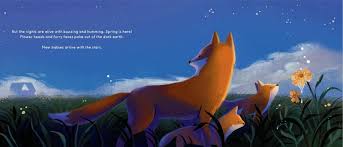
There are two families observing the rhythms of the year in Lights at Night. One is human and the other canine, specifically foxes.  Dream-like images with changing shades of color include realistic details, both natural and cultural.  Children experience the wonder, but also the reassurance, of the four seasons and their special features, from football in autumn to storms in spring. While the fox family does not kindle holiday lights around the time of the winter solstice, they also appear to respond to the changes.  Tasha Hilderman’s soothing poetic text complements Maggie Zeng’s visual immersion in the excitement of one year. Children find joy, not boredom, in the repetition of familiar events.

A powerful storm is just unsettling enough to make the shelter of home more of a comfort.  Crayon drawn strikes of lightening emanate from a house, enclosed in a photograph, and also cross its border.  Inside, a strong of lights and beds configured as tents add the sense of drama that children like. Note the plush fox in a small sleeping bag. The fox family lacks the domestic props, but is just as attuned to the environmental changes. Of course, animals’ lives are more closely defined by the seasons. In spring, “new babies arrive with the stars.”

Campfires come in summer; riding the bus to school and harvesting wheat are tied to autumn. One of my favorite images in the book is a natural and unobtrusive celebration of multicultural holidays.  Christmas trees, Diwali lights, a Muslim family welcoming visitors, and a Kwanzaa lamp grace the neighborhood, along with a Jewish family’s observance of Chanukah. If you look closely, you will see that the correctly depicted nine branch chanukiyah (menorah) has its candle farthest to the left partly obscured by the window frame.  This is not an error, just a small visual element lending authenticity to the way in which someone placed the lights, which must be visible from the outside.

At the end of the book, the two children share an album and a box of crayons. The volume is open to the photo with lightning, enhanced by the children’s artwork. The actual fox looks up the moon.

The Other Side of Trouble

Trouble Dog: From Shelter Dog to Conservation Hero – written by Carol A. Foote, illustrated by Larry Day
Eerdmans Books for Young Readers, 2025

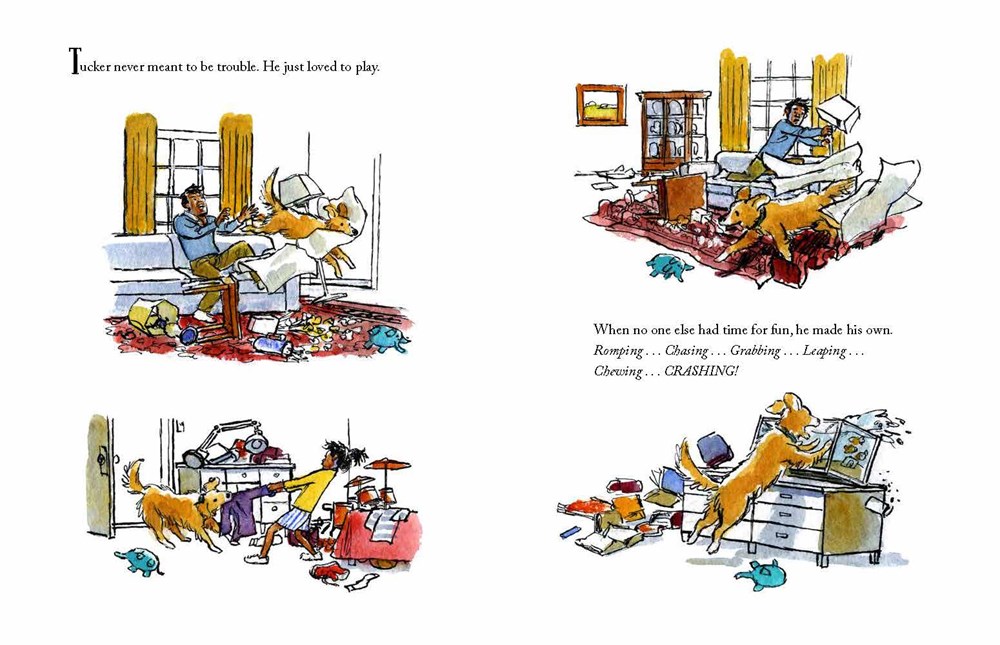
There is a lot of action in Trouble Dog. There is also an abundance of information, a likeable main human character, and a surprising amount of humor.  Carol A. Foote has combined two real-life conservation dogs into one fictional hybrid named Tucker.  Caught in a cycle of adoption and rejection, he is always returned to the animal shelter that has given up on placing him. Then, along comes Laura, a classic heroine who refuses to give up on an unlikely pet who has driven everyone else to distraction. Larry Day’s pictures are full of action and color, setting a motion Laura and Tucker’s journey from trouble to success.

The opening end papers introduce Tucker in some typically frenetic canine activity. Then it escalates, as every home the shelter finds for him is subjected to chaos.  Tucker manages to overturn an aquarium and books in one place. He grabs a girl’s sweater and won’t let go. A man attempting to read his newspaper looks enraged as Tucker grabs it and leaves a litter of overturned items in his wake.  When we next see him, Tucker is a lonely prisoner in a cage, “watching everyone pass him by.”

Laura is a sturdy figure with a ponytail, flannel shirt, and jeans.  She is as no-nonsense as Mary Poppins, and she also intuits something about Tucker that everyone has missed. His energy can be put to good use.  Even though her home is quickly as disordered as every other place Tucker has been, she has a vision and the practical sense to implement it.  Dogs, as readers learn in Foote’s detailed backmatter, have a highly developed sense of smell.  Laura observes Tucker carefully and evaluates his routine and abilities.  She isn’t just kind and patient, but methodical, as well. 

Eventually Tucker gets a job, or a series of jobs. The details in the text are embedded in words as colorful as the pictures. “Tucker’s first job was to find rosy wolf snails in Hawaii.” (image). He travels the world, sniffing out “moon bears in China, mountain lions in Chile, and elephants in the jungles of Myanmar” in a narrative as exciting as one by Jules Verne, but rooted in the truth.  In a two-page spread, Tucker crosses the gutter between pages. An elephant marches ahead of him, dwarfing the dog in size, but not in energy.  Three researchers form a determined row in the background, to his left.  The image captures the cooperation necessary for Tucker to succeed in helping scientists to learn about species in need of protection.

Not every outing produces results easily. In Zambia, Laura’s optimism is tested, looking for cheetah scat and coming up short.  When Laura insists that “I trust Tucker,” who finally leads them to the right location, she is not relying only on her affection for the dog. Through hard work and astute decisions, she and Tucker have become a team.

Four pages of additional information and photographs are organized in a question-and-answer format, giving the bigger picture of how conservation animals, as well as other service animals, provide essential services.  A selected bibliography is accompanied by an oval portrait of Laura and Tucker relaxing at home. I hope that no one misses one title, by Alexandra Horowitz, Inside of a Dog: Young Readers Edition: What Dogs See, Smell, and Know. Just parenthetically, the title refers to the famous quip usually attributed to Groucho Marx: “Outside of a dog, a book is man’s best friend. Inside of a dog, it’s too dark to read.”  It’s definitely not too dark to read inside this book.

Imagining Who Wore Them

Little Shoes – written by David A. Robertson, illustrated by Maya McKibbin
Tundra Books, 2025

Many Indigenous children, in both Canada and the U.S., suffered the trauma of being removed from their families and placed in residential schools funded by the government and often controlled by different Christian denominations.  Deprived of their heritage, and often subject to physical and emotional abuse, these children would be lost to history if not for concerted efforts to publicize their experience and to demand restitution and atonement.  Little Shoes is a picture book by acclaimed author David A. Robertson (see my reviews here and here and here), a member of Norway House Cree Nation, illustrated by Maya McKibbin, of Ojibwe, Irish, and Yoeme heritage (Robertson and McKibbin have collaborated before). They have taken on the weighty task of presenting a catastrophic loss to young readers, but also offering hope and determination.  With poetic text and images of family life that are both familiar and mystical in tone, they have achieved this goal.

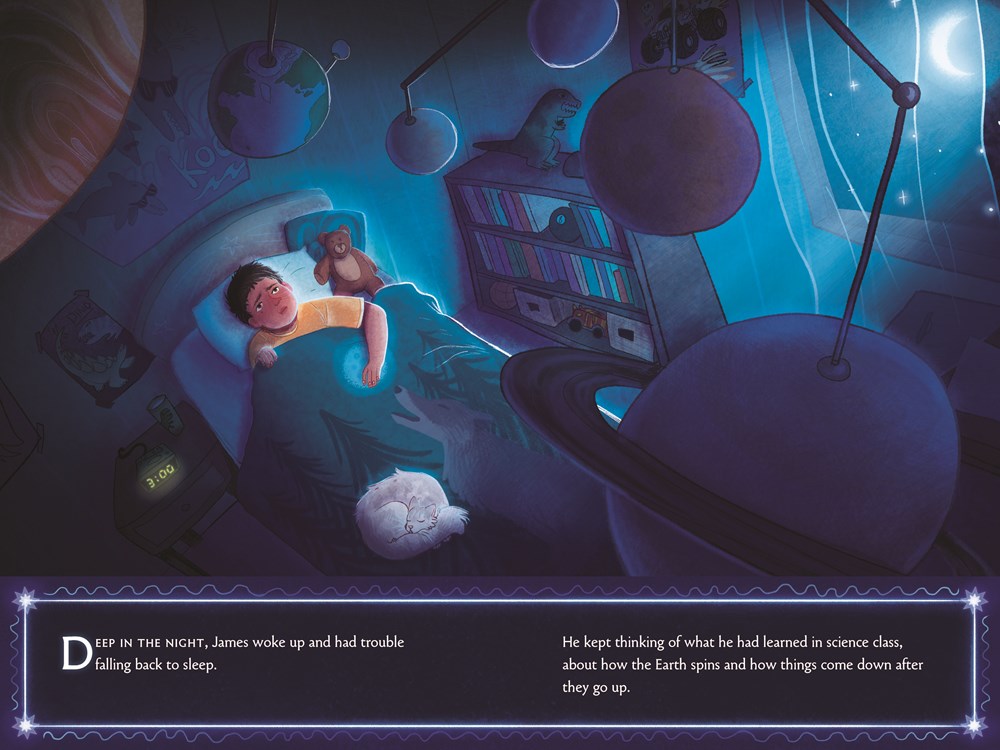
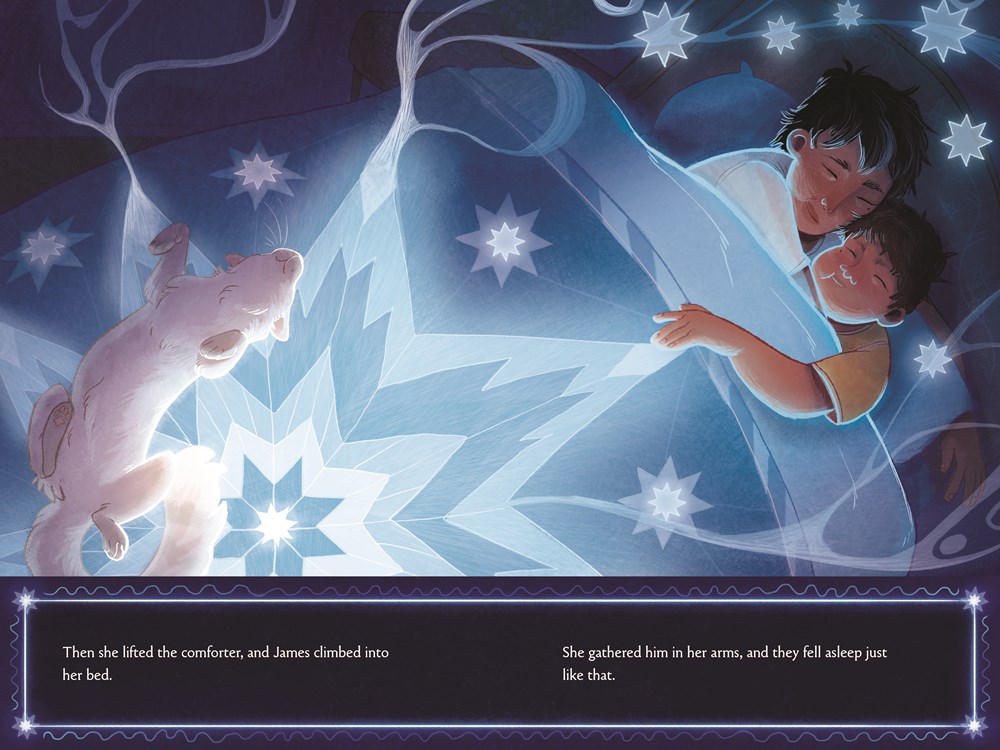
The endpapers feature constellations, introducing a central theme of each person’s place in the universe.  James, who understands the principles of astronomy from his science class, opens the curtains in his room to the moonlight. He asks his mother to clarify how and why his feet remain firmly on the ground if the Earth is spinning in space. The answer is only one of several which his mother will frame truthfully, and also use to elaborate on other questions which will naturally follow. She reassures him that his Kōkom’s, (grandmother’s) explanation about their origins is valid, but adds, “even though you’re from the stars, your home is right here with me.”

The love between a parent and child, and the enveloping warmth of his community, are anchors in James’s life.  His intense curiosity places demands on a parent who is obviously committed but exhausted, when he returns to her room with a request to hear about “every single constellation,” His own attempt to visualize and trace them in the night sky is insufficient.  The dialogues between children and their caregivers are open ended, and the book swerves from the dimensions of the cosmos to the specific history of injustice that remains unresolved.

James and his kōkom set out for one of their frequent walks, but his time it is transformed into a march.  A daily experience becomes a metamorphosis, and his grandmother takes on the role of teaching about a part of their lives that is far more difficult to internalize that the motions of the planets. The little shoes of the title are those of Indigenous children whose deaths are acknowledged by Kōkom with the haunting phrase that they “had gone to residential school but had not come home.”  Shoes as a metonym for children who have died seems to capture a sense of a life that is unnaturally cut short. Other articles of clothing are perhaps less universal, and small shoes also reflect the scale of the children relative to adults, both those who loved them and those who inflicted torture.  A similar allusion to this loss has been used in many memorials to child victims of the Holocaust. (Of course, while some of those children, like the Indigenous victims, died of abuse, neglect, and disease, many were murdered immediately upon arrival at a death camp.  Chronicling atrocities requires acknowledging both what they share and common and how they differ.)

Robertson and McKibben do not attempt a simplistic response to James’s fears. He interprets the frightening facts through the lens of loneliness, asking his mother how his own grandmother had coped with the deprivation of her isolation in the residential school.  His mother responds that her sister and she had “cuddled,” paralleled by McKibbin’s image of mother and son sharing the same physical contact. Their bond is unbreakable, even if mitigated by anguish.  The honesty of Little Shoes is an antidote to fear.

Stage Door

The Rehearsal Club – Kate Fodor and Laurie Petrou
Groundwood Books, 2025

Kate Fodor and Laurie Petrou’s new middle-grade novel, about aspiring actresses and quirky kids, is quite a production.  Alternating between two eras, it does not involve time travel, but rather involves a mystery in the past which contemporary characters have committed to solve.  If this description sounds somewhat formulaic, the novel transcends the very formula that frames its story.  While several familiar elements are there; the magic of theater, coming of age narratives, sibling and friendship rivalries, and intergenerational tensions, they avoid all the clichés associated with this popular literary and cinematic tradition.

The Rehearsal Club is a wonderful book.

Paloma “Pal” Gallagher is a twelve-year old girl who has just moved from Arizona to New York City, where her older sister, Naomi, is pursuing a career in theatre.  Pal’s parents are both librarians, and her mother has a new job in the New York Public Library system. Pal is outgoing and socially awkward at the same time, but she finds a crew of similarly category-resisting friends who provide one another with mutual support. The women’s residence where Naomi lives has a long history, but is now facing financial extinctions. Chapters set in 1954 follow two young mid-century characters, Olive and Posy, with contrasting personalities and different approaches to finding success on Broadway.  Meanwhile, in the present, Pal’s parents take off for a librarians’ conference and Pal, temporarily and surreptitiously, moves in with Naomi, and becomes part of her distinctive milieu.

The authors capture perfectly the competitiveness and camaraderie of theater life, in both the past and present. If it seems idealized to have such striking differences between Olive and Posy, the resolution of their dreams as parallel, more than intersecting, actually works.  At every point when the reader is asked to suspend disbelief just a bit, a surprise intervenes.  There are so many antecedents for the idea of conflict mixed with solidarity in this setting, that adding a new element seems improbable.  Melanie Crowder’s Mazie, for a young adult audience, is also inventive in simultaneously paying homage to clichés while dismantling them, and Shira and Esther’s Double Dream Debut by Anna E. Jordan plays with mistaken identity and explores Yiddish theater.

Characters age in The Rehearsal Club. The young and insecure Olive becomes an ageing grande dame with some decidedly unattractive qualities, but also a core of honesty and toughness. In fact, she reminded me a little of Mrs. Basil E. Frankweiler, for those qualities as well as for her impatience with the idea of patronizing children.  Young people need to learn from older ones, and, fortunately, the advice offered by people with more experience actually has value. 

As the authors explain in their afterword, there was a rehearsal club in New York. That reality was an inspiration for the story of Pal, Olive, Posy, and all the others determined to break a leg and perform to great acclaim.  But only the imaginative and skilled approach of Fodor and Petrou allowed brought the script to life.

Giving a Young Woman Her Voice

Adi of Boutanga: A Story from Cameroon – written by Alain Serge Dzotop, illustrated by Marc Daniau
Eerdmans Books for Young Readers, 2025 (originally published in French, 2019, Translated by the author)

Adi of Boutanga is an important book. That quality would not necessarily make it appealing, let alone essential, to read, but there are many other reasons why it is just that. A voice that resonates with the truth, beautiful illustrations and innovative graphics, a compelling story, and a deep sense of conviction will all enfold the reader in its narrative fabric.

Adi is fourth grader living in a nomadic community, the Mbororos, in Cameroon. Although they are traditionally herders, their economy has changed; Adi’s father transports passengers on his motorcycle and her mother sells Makala (doughnuts) in the marketplace. Adi’s identity is defined by family relationships: “I prefer to stay the big sister of Fadimatou, Zénabou, Youssoufa, Daïro, Souaïbou, and baby Mohamadou.”

Children cannot control their own lives, even to the limited extent that adults are able to do so. Adi loves attending her school, which she describes as a “gift” to the village by Mama Ly and Monsieur, generous benefactors. The process of learning to read may seem inherently magical to many children, but Dzotop captures the poetry of this experience and gives Adi a voice:

      Before the school was given to our village, words were invisible to us. We
      could hear them, but we couldn’t see or touch them. I even thought a
      a strong wind might steal them as soon as they left our mouths. But that
      wasn’t true.

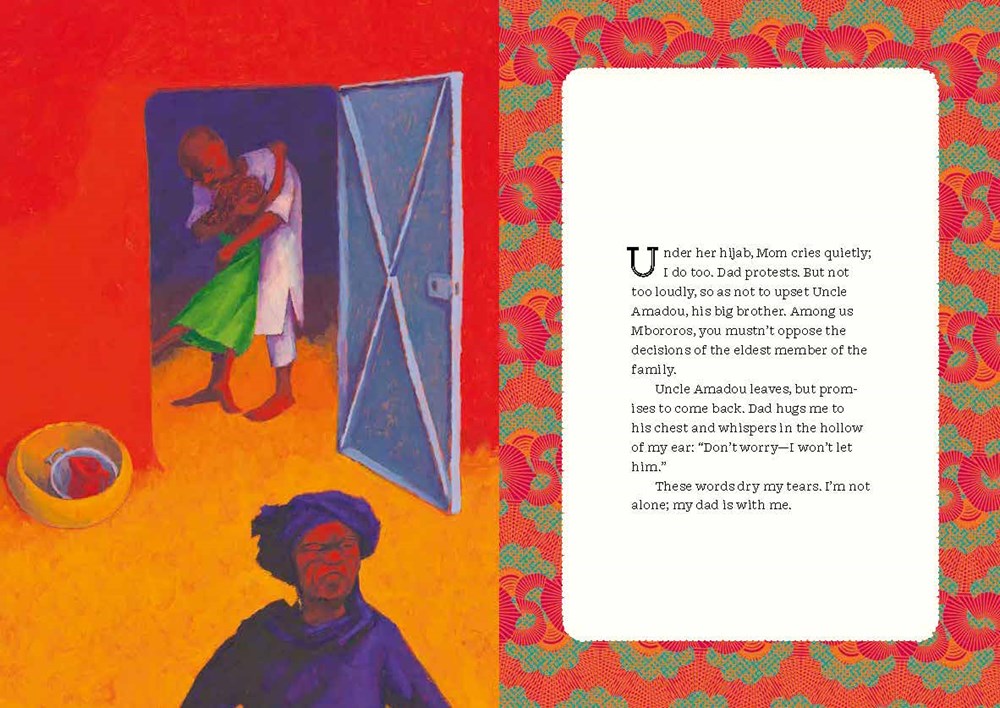
Although there may seem to be a fable-like quality to the book, the characters are not generic. Adi’s mother embraces her daughter’s individuality, responding to Adi’s frequent laughter with the suggestion that her daughter has “swallowed a thousand weaverbirds.” But the warmth and protectiveness of Adi’s life is shattered when her uncle arrives to inform the family that, although still a child, she must marry. Her father and uncle assume opposite patriarchal roles, one caring and the other transactional. “They throw words at each other. Words that hit like stones.”

Saving their daughter means that Adi’s parents must send her away. She goes to Boutanga, where her benefactors have established a school for girls that fosters creativity and dignity. Even if this solution is not a global one, it is enough for Adi and an example for all. Eventually, when she has arrived at the point in her young adult life when she is able to choose, Adi finds love with a man who respects and understands her. Mastering language has been a key to her growth, “catching words… putting them in the right order and making sure they say the right thing.”

The book is not composed only of words, but of images that organically emerge from the culture which they represent. Pages with illustrations alternate with blocks of text set against traditional fabric patterns. Human figures allude to sculpture but have kinetic movement. Earth tones are the setting for the book’s quiet drama, with deep blue sea and red skies framing Adi’s journey. Adi of Boutanga is not a moral lesson, but a work of art that interweaves modern aspirations of freedom for women with the unique threads of a specific culture. It is a book to read, share with children, and read again.