The Happiest Country, a Long Time Ago

Happy Times in Finland – written by Libushka Bartusek, illustrated by Warren Chappell
Alfred A. Knopf, 1941
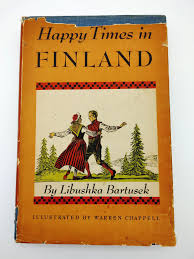
Everyone knows that Finland is allegedly the happiest country in the world.  You certainly can’t take these simplistic measures too seriously, and comparing Finland to other countries with entirely different histories, economies, and demographics is useless.  I recently reread an unusual childhood favorite, which I had bought at a library used book sale. Its appeal to me at the time remains vague. I would read almost anything, and it had lovely pictures and promised to tell a story about a distant part of the world. Happy Times in Finland, by  Libushka Bartusek, was published in 1941. At that point, it was indisputably not happy at all.  Having been invaded by the Soviet Union, they eventually allied with Germany in that country’s war with its Russian enemy.  This was a bad choice, but it is not reflected in the book, which takes place in the idyllic time period before the war.

There is minimal plot and character development in the book, but a lot of folklore.  To summarize the improbable premise, Juhani Malmberg, a Chicago Boy Scout with Finnish immigrant parents, goes to visit his ancestral homeland.  He is able to take this expensive trip due to the generosity of his father’s employer at a furniture factory, Mr. Adams.  Finland is known for, besides an improbable level of happiness, abundant high-quality wood. A furniture manufacturer would be eager to see firsthand the source of his best supplies. Since Mr. Malmberg is such a loyal employee, his benevolent boss actually takes Juhani along, for free! He has the opportunity to see his beloved grandparents, as well as his aunt, uncle, and cousins.  In addition, Juhani becomes an ambassador from the American Scouts to their Finnish counterparts.  Aside from missing his parents, there’s a lot of happiness here.
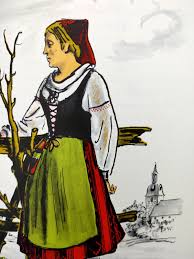
Poetic language fulfills expectations about a land endowed with natural resources, and steeped in literature.  Approaching land, Juhani seems to be expecting a myth and he finds one: “Sure enough, there it was, just as his mother said it would be: an expanse of water, blue as sapphire, with green islands dotting it, as though some giant had scattered a mammoth handful of emeralds on a silver-streaked scarf.”  Not only the environment, but its people, are described with hyperbole. Oddly, almost everyone is blond.  Finland has a Swedish minority; the name “Malmberg” indicates that his father’s family is descended from this group. His cousins’ last name is Kallio, of Finnish origin.

Finnish is not a Scandinavian language, but is related most closely to Estonian and Hungarian. (A glossary of Finnish words is included at the end of the book.) Here is a description of Juhani’s aunt, a veritable Amazon of pale beauty: “She was tall and blond, so blond, in fact, that Juhani thought she was white-haired…she had great dignity…he felt as though he were at the feet of some exceedingly beautiful statue, all made of silver and bronze and pearl…her teeth gleamed like mother-of-pear.” There are even references to “Viking blood.”

The few realistic elements stand out because of their minimal role in the story.  Aunt Kallio, Aiti to her children, has favorites among her offspring.  Her older son, Jussi, will vicariously fulfill her own dream by becoming an architect, a career closed to women. Eero, the younger boy, is not academically oriented. Unlike his parents, he prefers manual labor. She keeps her disappointment to herself, only thinking how he lacks “initiative.” “Oh, me! she sighed, one could not be everything.”  This statuesque symbol of perfection is unable to tolerate individual differences.

Warren Chappell’s illustrations, some in color and others sepia, appear to be lithographs.  They are stylized images, whether portraying men in a sauna or women clothed in traditional costumes for festivals. There is a haunting image of a blind storyteller who recites Finnish epic poetry.  Mr. Adams recognizes that the Kalevala’s metrics had influenced Longfellow’s composition of Hiawatha. The Old World and the New touch one another in this tale of immigrant roots, written as the shadow of fascism descended on Europe. It’s blatantly out-of-date and also oddly appealing, just for that reason.

Bewitched, Bothered, and Bewildered

The Witching Hour – written by Jennifer Harris, illustrated by Adelina Lirius
Tundra Books, 2025

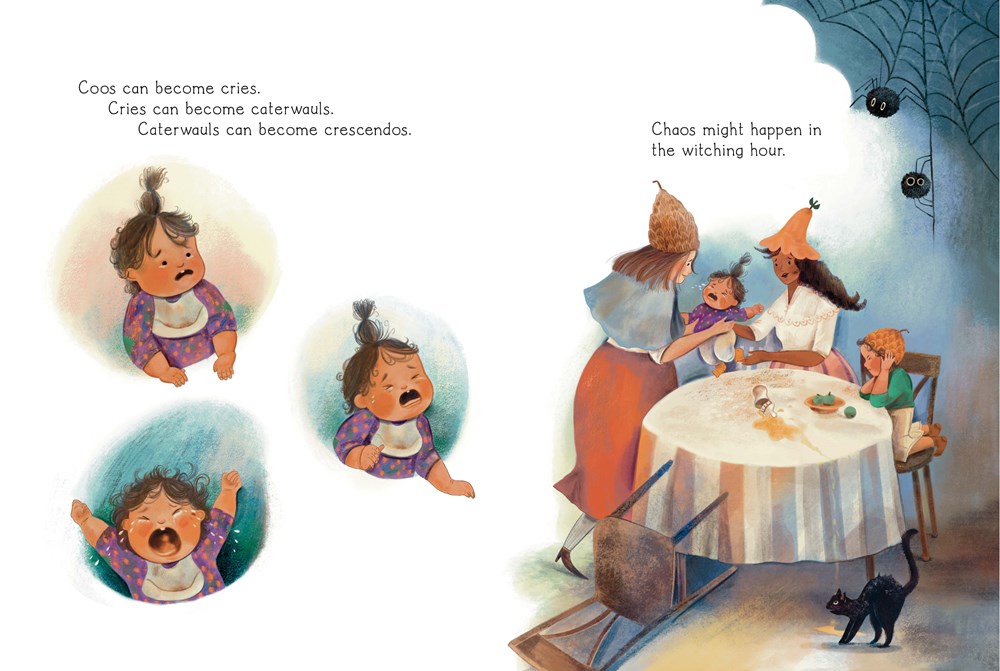
My mother used to refer to “the witching hour,” that time late in the day when babies, toddlers, and young children seem to act a bit possessed. Whether because they have managed their impulses as best as they can for many hours, or need limits and reassurance, or are just exhausted, this can be a difficult moment for parents. The “hour” may seem like multiple hours.  Jennifer Harris and Adelina Lirius (I reviewed another of her works here) have captured the phenomenon so perfectly in their new picture book that you and your children will be under their spell. Indeed, as Harris solemnly states, “Anything can happen in the witching hour.”

The two mothers in the book are paragons of patience, trying every inventive solution you might imagine, and then some.  First, the acknowledge that anything, “or even nothing at all,” can set the chaos in motion.  A baby overturns a cup of liquid on a table enclosed in a lovely tree trunk. Yes, we all recognize that scene.  An older child wearing an acorn cap looks on, clearly worried about the next phase.  The author is honest in calling it “chaos.” It takes both moms to extricate the screaming toddler from her highchair. An adult chair is overturned, a black cat arches its back, and the sibling covers her ears in terror.

One of the most frustrating features of the witching hour, when it happens, is escalation. “Coos can become cries.  Cries can become caterwauls. Caterwauls can become crescendos.”  Harris uses every figure of speech at her disposal: alliteration, onomatopoeia, literary allusions, rhythm.  Perhaps your child can be calmed by a favorite stuffed animal. The moms try a variety of real wildlife, finally settling on the owl. You know the feeling of relief: “Definitely the owl. Thank goodness for the owl.”

If you were hoping for fairies, you won’t be disappointed.  They arrive and join in the music and dancing, in a kinetic scene of joy mixed with desperation. Lirius’s fabulous pictures evoke an entire universe where the fantastic and the familiar are effortlessly blended. Earth colors predominate and the domestic interiors are as welcoming as those in Dutch still paintings. One mom holds the baby, who looks momentarily transfixed. The other mom is dancing upside down, her feet fixed to a magical broom.  Fairies usually command attention, but here they are a great audience. When the show ends (who could sustain that level of energy), the moms come down to earth. 

There are still many comforting possibilities to try: “this bottle, this banana, this bat.” The moms are creative and full of hope, waiting for the moon to signal that at least for today, it’s time to sleep. Suspension of disbelief sets in for this lovely family of nurturing witches. Tomorrow they we ready to start again, with all the resources at their disposal. For readers, this home of friendly spider webs, baskets of knitting yarn, and a quaint wood stove, seems uncannily real. For the duration of the story, you will be living among friends, and the supernatural is just, natural.

Color of Grief

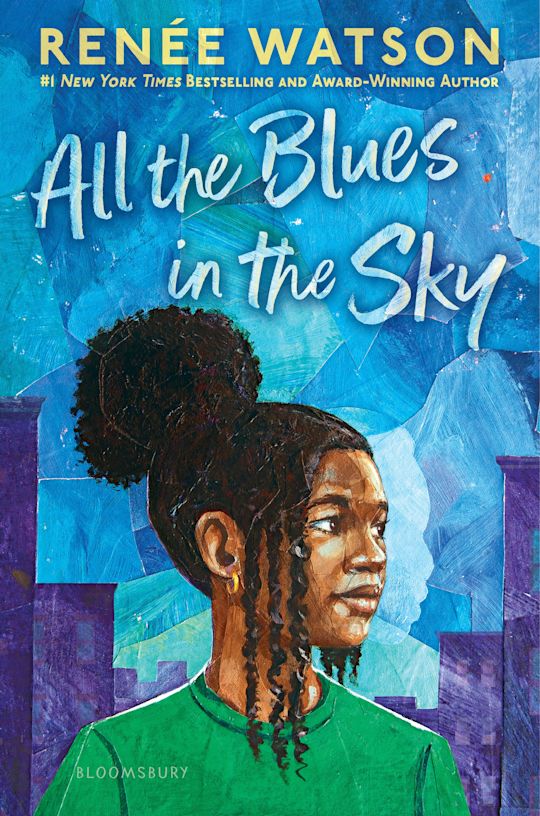
All the Blues in the Sky – by Renée Watson
Bloomsbury Children’s Books, 2024

Sage is a thirteen-year-old girl whose best friend is killed by a reckless driver. This terrible event happens on Sage’s birthday. The terms “losing” someone, or “passing away,” would be completely inadequate to describe the shock, numbness, and internalized rage that follow the accident.  Renée Watson’s verse novel gives Sage a voice in each chapter, narrated from the unaffected perspective of a person confronting emotions that would level a strong adult. With the same sensitivity to the process of growing up shown in her other works (which I have reviewed here and here and here), Watson creates characters who are vulnerable, but also strong.

In All the Blues in the Sky the experiences that test Sage are not the ordinary, but still difficult ones, of every adolescence, although those experiences, such as having divorced parents, are the framework for her growth.  Her parents are supportive, as is Aunt Ini, her surrogate grandmother.  She even has the benefit of a grief counseling group facilitated by Ms. Carver, who is nothing if not patient and professional. Mr. Dixon, Sage’s dedicated math teacher, offers slightly irritating, but totally sincere, life lessons: “Understanding angle relationships in math will help you understand your personal, real-life relationships…There are people –like transversal lines – that cross paths with you, only for a moment.”

There are other people in her life who are grieving.  Zay’s grandmother has died, and she admits relief at the end of her suffering. DD’s brother was killed by the police.  Ebony’s father had a heart attack. Sage is forced to constantly evaluate which types of death are hardest for survivors. No one has been able to answer this question.  Her friend’s death was abrupt and senseless. Sage never had a chance to say good-bye. Other survivors had to helplessly watch a long period of illness preceding a death.  Another troubling part of Sage’s role, which is only implicit in the novel, is her specific relationship to the person who died. She is not a sister, mother, or child, but a friend.  When a relationship is not formally recognized, the most profound sadness can seem somehow less important, although her friend’s family certainly honors Sage’s role in their loved one’s life.

For almost the entire book, Sage’s friend remains unnamed.  There could be many narrative, and psychological, reasons for this choice.  Articulating her name is too difficult, too final.  Nameless, she is both a real person and a tangible symbol for anyone who has grieved.  Words cannot capture the friend’s unique qualities, although Sage gives many examples of their closeness, and even of the tensions that leave her with unresolved guilt.  But specific, mundane, questions are more important than generalities: “What will her parents do with the posters on the wall?” Sage asks, “What will they do with her jean and T-shirts and sweaters/ and sneakers and sandals and socks and leggings and bracelets/ and earrings…”

Sage grieves, but she also falls in love, and begins to fulfill her dream of learning to fly.  More losses are in store, and Watson never minimizes their depth with platitudes. “If I live long enough to be an adult/and if I have children when I am an adult/I will tell them as much as I can about all the loss…” The phrase. “If I live long enough” from a girl of thirteen is terrible, but Sage’s resolve to tell her children the truth is something of a triumph.

Not Scary, Really

This Book is Dangerous! (A Narwhal and Jelly Picture Book #1) – written and illustrated by Ben Clanton
Tundra Books, 2025

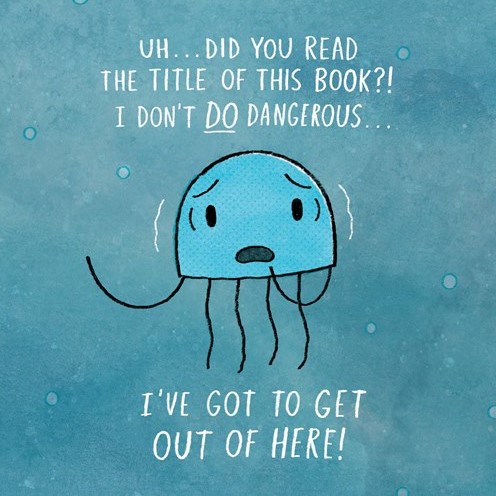
What is the difference between Narwhal and Jelly, the sea creature duo from Ben Clanton, when they appear in a picture book or in their previous format, graphic novels (see here and here and here)? This is not a rhetorical question. While in This Book is Dangerous! they inhabit a larger format with a somewhat more intense narrative pace, they still have the same lovably sincere personalities.  There is a narrower range of characters and fewer digressions. Jelly is focused on his fears, given the title of his picture book debut.

Jelly is rendered in Clanton’ inimitable style, with a touch of Ed Emberley simplicity. His inverted eyebrows and down-turned mouth ask the reader what on earth, or in the sea, is going on: “UH…DID YOU READ THE TITLE OF THIS BOOK?!” The redundant punctuation tells you just how terrified he is.  Soon he is caught in a maze of signs urging caution, peril, and the need to stop. Jelly believes that the reader can help him to decode them and offer advice.

There are sea serpents with sharp teeth and a cannon which may or may not be non-functional. Jelly is actually transformed into a dark red cannonball, as Clanton extends the character’s legs, opens his eyes wide, and reverse the direction of the eyebrows.  Children relate to artwork that seems to contain elements of their own.

The drama settles down, and the book briefly returns to the idiosyncrasies of the graphic novels.  A page entitled “SOME NEARBY ITEMS” also reminded me The Everything in the Whole Wide World Museum: With Lovable Furry Old Grover, although the stakes are higher. Jelly needs support, but he may have some problems depending on “PRICKLY UNDERSEA PINEAPPLE,” or “RANDOM CACTUS.”

Jelly becomes angry, disappointed with the reader who, as in The Monster at the End of This Book, does not seem to understand the gravity of his problem. After all, someone who cannot help him extricate himself from danger is as dangerous as the book itself and all the horrors it contains. When Jelly finds some courage, along with ingenuity, and a bit of luck, he feels calmer, safer, and happy to meet his old friend Narwhal for a nostalgic ending.  His warning not to read the book over again is not to be taken literally.

Writing Is Heroic

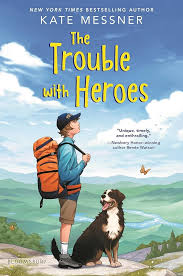
The Trouble with Heroes – by Kate Messner
Bloomsbury Children’s Books, 2025

“I’m still sad and I’m still angry sometimes, because so much stuff isn’t fair and grief is totally on that list.” That sentence, from a letter to a dead woman whose gravestone he defaced in a moment of rage, is by Finn Connelly, a boy in middle school. His father, a New York City firefighter, survived 9/11/2001, only to succumb years later, during the Covid-19 pandemic. This novel in verse, by acclaimed author Kate Messner, is getting excellent reviews. Instead of just adding to them, I will make a few points about some questions that the book raises.

It seems counterintuitive that novels in verse should have become so popular. Reading poetry is not in the mainstream of middle-grade or young adult literature.  Having read many of these books, it has become obvious that the most attractive feature of this genre maybe its short length. Each chapter is a short poem, often, but not always, in a conversational or free verse form.  The Trouble with Heroes is not this kind of facile example, which relieves the author of the obligation to create a narrative with continuity between each part. Simply dividing sentences of prose into shorter lines does not add up to poetry.  Whenever I read an accomplished book in verse for young readers (I have, for example, reviewed other examples here and here and here), I am impressed that the author has thoughtfully crafted a distinctive voice for a range of characters, often using a variety of metric forms.

Middle-grade literature is full of angry kids. Childhood and adolescence provide many reasons to be angry, and Finn’s motives are severe enough to grant him a kind of instant empathy. Still, vandalizing someone’s grave is awful, and needs to be met with a strong response. Should that response be a punishment, an opportunity for growth, or perhaps a mere acknowledgement that being a victim does not excuse victimizing others?  Finn earns the reader’s respect, not because his life is unbearably sad, but by his honest, caustic, and introspective reactions to everything life has thrown in his path. We would still feel sympathy for what he has suffered, but that emotion alone does not make a character worth the reader’s attention for over 300 pages.

The adults in Finn’s life are imperfect, from his mother, worn down by her own burdens, to his supportive grandmother, to the teacher who expects him to turn in poems about heroes. One truth that emerges from Finn’s story is that each person is trapped in his own experience, which can never be fully shared. At the same time, Finn struggles, and learns how to accept the flawed, tarnished, human beings who care about him.  Whenever adults do their best to impart survival skills, learned from their own experiences, the author needs to weigh the validity of the child’s response.  Finn is not obligated to be fair, but Messner succeeds in creating a character whose contradictions are believable.

Finally, there are recipes in some of the poems.  I was relieved by that, because Finn enjoys food, and his family bakery plays a role in the plot.  I was afraid he was going to be thrown into mountain climbing in the Adirondacks because Edna, the woman whose grave he vandalized, had touched people’s lives through her commitment to hiking.  The outdoors are not necessarily the ideal setting for every single human being to undergo life-affirming epiphanies. How appropriate was the choice, by Edna’s daughter, to enforce hiking as an alternative to more punitive consequences? Readers may differ on the answer, but I appreciated the references to other areas of Finn’s life that did not involve potentially brutal geography, wild animals, and a mother’s totally realistic fears for her son.

Learning French with McDuff

McDuff Goes to School – written by Rosemary Wells, illustrated by Susan Jeffers
Hyperion Books for Children, 2001

If you have never read any of the picture books about McDuff, the little terrier who is adopted by a loving couple living in a charming village in the 1930s, you have missed a modern classic. They are collaborations between two legendary authors and artists, Rosemary Wells and Susan Jeffers. McDuff Goes to School is the fifth in the series, and it holds a particular interest in the category of children’s books that informally present a new language (other example include Pizza in Pienza, Eat, Leo, Eat and My Sister is Sleeping). 

McDuff lives at number nine Elm Road, a location as essential to the series as Paddington’s address at 32 Windsor Gardens. One day, a new, French family moves in next door. They also have a dog, and, no, she is not a French poodle. That detail is consistent with the understated realism of Wells and Jeffers’ creation. The first conversation between the two dogs is bilingual: “’Woof! Said McDuff. ‘Ouf,’ said Marie.” Note the use of italics for a foreign word.

Marie, the new dog, has owners who are as kind as Fred and Lucy, the couple who adopted McDuff.  Celeste and Pierre de Gaulle (well, I guess their last name is the equivalent of a French-speaking French poodle), agree with Fred and Lucy that their respective pets need to attend obedience school. Mainly, Celeste seems to be in charge, and she is extremely determined. Lucy, realistically, too busy taking care of her baby, and Fred is “too tired after a day’s work” to train a dog. These are totally reasonable explanations, with no apologies offered; they are not inept dog owners.

Celeste’s daily repetition of commands to “assieds-toi!” and “Saute!” are translated in a glossary at the end of the book.  Children will get a real sense of the gap in communication between speakers of different languages, and also appreciate the advantages of bilingualism.  It turns out that McDuff’s apparent lack of progress in school is due to his attentiveness; he is listening to Celeste and learning to understand her language like a native.

As in every McDuff book, all of the humans are smartly dressed. The men wear argyle vests and driving caps. The women have lovely but practical collared dresses and t-strap pumps. Celeste even wears a Chanel-style pastel blue sweater and skirt set.  The book concludes with a luncheon en plein air, including cheese, French bread, fruit, and an American, probably apple, pie. There is even a checked tablecloth.  Both the dogs have earned ribbons.

A Case of Mistaken Identity

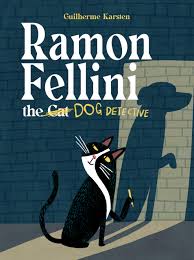
Ramon Fellini the Dog Detective – written and illustrated by Guilherme Karsten
Eerdmans Books for Young Readers, 2025

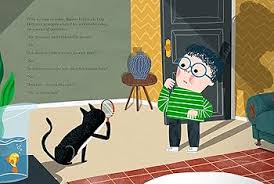
Sometimes people believe what they want to believe, in spite of evidence to the contrary. Children have their own frame of reference for viewing the world. Whether you choose to call it innocence, or just a still untested belief that no one would lie to them, sometimes they interpret events differently than an adult would.  The endearing boy who narrates Ramon Fellini the Dog Detective needs to determine who overturned his fishbowl, leaving one fish missing and the remaining one “terrified.” When a self-proclaimed Dog Detective shows up at his door, offering to help, he is relieved, if momentarily confused. This dog looks just like a cat.

Guilherme Karsten has created a believable character. In his striped shirt, curly dark hair, and oversized glasses, the boy is an image of curiosity combined with trust.  The dog resembles a cat because his costume is “impeccable.” The questions posed by this detective are searching, and, if his methods seemed “strange,” the boy still has confidence that he will find the culprit.  One might think that a close up revealing the dog’s interrogation of the remaining fish would invite skepticism. The fish “looked like it had just seen a ghost,” and the detective extends his very feline tongue towards the fishbowl. But the boy has suspended his disbelief. (Suspension of belief is a theme in Karsten’s work.)

Every picture conveys character. The dog detective mirrors the black and white of the venetian blinds, as he lifts one of the slates to peer outside. One of his eyes half closes exactly like the aperture. But while the blinds are just an object, the dog looks notably sly.  Meanwhile, the boy looks on in appreciation of the detective’s skills.  Even after this supposedly canine Sherlock insists on taking a walk with the fish in its bowl to search for clues, the boy is only worried that his pet will be cold.

Will children think of the boy as foolish? No; just look at the abundant evidence and expertise the dog detective shows, even using a pointer to indicate his deduction about the fish’s escape. When Fellini hands him a post card from the fish’s destination, the boy has even more support for his faith in good deeds.  The dog detective is “AMAZING,” “a legend,” and even “a boy’s best friend.” (images).  The price of the boy’s happiness is not clear. After all, the fish is gone, and the boy is left with the deep satisfaction of having benefited by the detective’s incredible skills and dedication.  What has he really lost?

D.E.A.R. (Drop Everything and Read about Stella and Marigold)

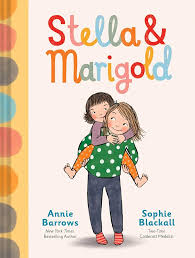
Stella & Marigold – written by Annie Barrows, illustrated by Sophie Blackall
Chronicle Books, 2024

Stella and Marigold are each brave, in their own way. Marigold is the younger of the two sisters, but it would be inaccurate to call her a “pest.” This first in a series of adventures about two sisters is not merely an homage to Beverly Cleary, but Beezus and Ramona are somehow omnipresent in the best way.  Cleary virtually invented the portrait of sisters as a complex, and yet easily identifiable, story for young readers.  Annie Barrows‘ narration appeals to exactly the right level, and Sophie Blackall’s gorgeous colored pictures create an unforgettable image of the girls, from Marigold’s birth to their imaginative channeling of pioneer children in a snowstorm.

Each chapter is a showcase for Stella and Marigold’s unbreakable bond and their boundless inventiveness.  Their understanding parents are the perfect audience, and also are there to guide them when a situation demands adult intervention.  In “Lost and Found in the Meerkat Mound,” a trip to the zoo with their father culminates in a visit to the “crabby little animals who live in big groups under the ground.”

After the rather sedentary turtles and the hilarious gibbons, the meerkats should offer a calm conclusion to the day. Instead, Marigold gets lost in the special tunnel built to give children a good view of the habitat.  At home after Marigold’s rescue, the sisters draw pictures; Marigold’s is an appropriate angry swirl of black lines. Stella’s simple reassurance that “Everyone gets lost sometimes. Even grown-ups,” is not enough to make her sister feel better, so she “reminds” her of when the Vice President had visited their city and benefited from Marigold’s assistance. Marigold accepts the truth of the story, not because she is gullible, but because her trust is so deeply rooted.

Less dramatically, “The Lucky Half” converts the visit of a plumber to retrieve Marigold’s purple hairclip. When the girls’ mother is less than thrilled at this turn of events, Stella devises an alternative explanation to carelessness. The bathroom is the only room in their house with magic powers, enabling all the mundane items there to move independently. She even provides the odd detail to make her story somehow more credible. Her response to Marigold’s asking if toys also had this superpower, is an emphatic “no.” The magic only applies to clips, toothpaste, and brushes, and only for “four minutes each night.”  Stella, like Barrows and Blackall, knows exactly how to make a story believable through the perfect combination of details.  The book is dedicated to Lore Segal, “who knows about kids and stories,” granting that author the same kind of honorary status as grandmother to Stella and Marigold that Beverly Cleary holds.  Fortunately, there is more to look forward to in September, when the second book in the series is released.    

Turning Over a New Leaf

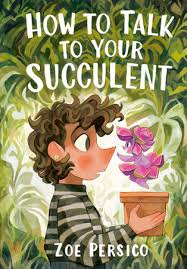
How to Talk to Your Succulent – written and illustrated by Zoe Persico
Tundra Books, 2025

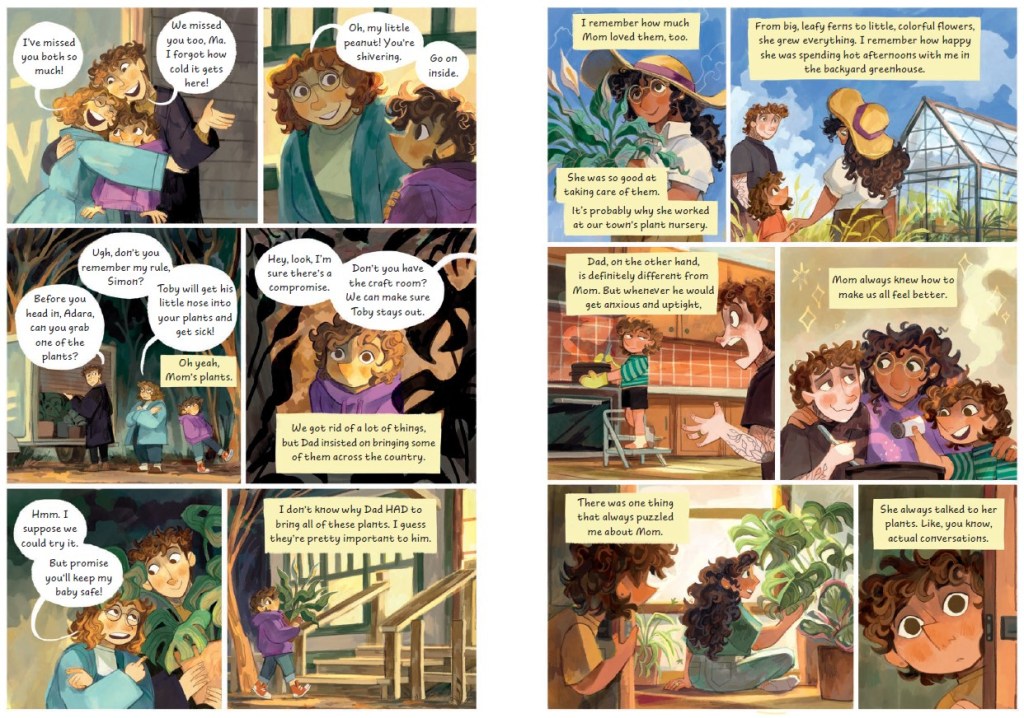
In Zoe Persico’s incredibly inventive graphic novel, Adara’s mother has recently died. She and her father leave California to move in with her grandmother in Michigan. The potential subjects of graphic novels are unlimited, and How to Talk to Your Succulent is not the first one to deal with grief, or strained relationships of parents and children. It is, however, outstanding in its sensitivity, bold graphics, and experimentation with fantasy and reality as equal components of a young girl’s search for the truth. Persico quietly presents a scenario that defies reality, and then proceeds to immerse the reader in a world where it is utterly plausible.

If you are skeptical about human communication with plants, this book will demonstrate the irrelevance of that reservation. Adara is sad and uprooted, even though her grandmother is a pillar of flexible strength. Her father is trying, somewhat helplessly, to cope with his own desolation and anger, which he approaches by inadvertently discouraging his daughter from expressing her feelings. What could be worse than this agonizing moment in all their lives? As it turns out, Adara’s mother had quietly used a special power. Not only did she have the proverbial green thumb at growing plants, she could actually communicate with them: “Like, you know, actual conversations.”

Adara’s grandmother, who resembles a child’s ideal image of a non-judgmental old person as both youthful and wise, also keeps a garden and greenhouse. When Adara’s father realizes that she has taken to wearing her mother’s earrings, which resemble tiny plants, he takes her to visit a nursery where she can select an actual plant of her own. This gesture is the closest he can come to acknowledging her feelings of isolation. At the greenhouse she meets Perle, short for Perle von Nurnberg, a delicately beautiful succulent who, for a devastatingly brief second Adara believes to be speaking in her mother’s voice. Then comes the epiphany: “I can talk to plants just like Mom! I knew it! I knew it!”

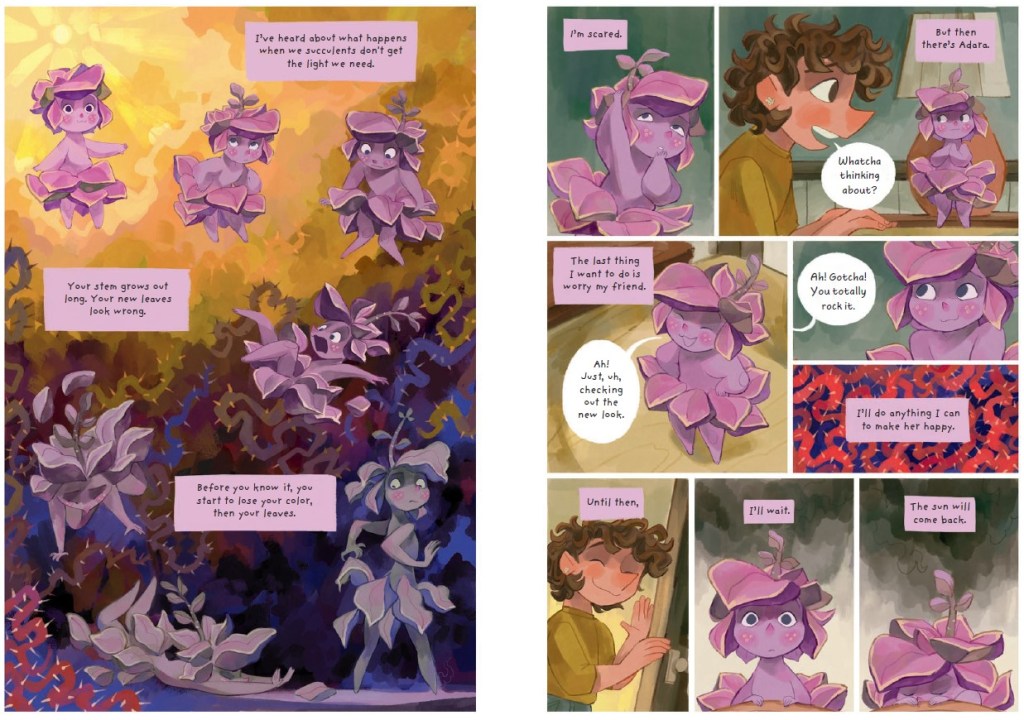
There is nothing affected about this unusual series of circumstances. Readers are not asked to suspend disbelief, but to enter Adara’s emotional state without preconceptions. Broadening her narrow circle of relatives, she also meets a new best friend, Winnie, a frustrated artist whose own mother is demanding and unappreciative of her daughter’s talents. Still, she has a living mother and Adara does not. But other people, as Adara learns, have their own problems and also need to be protected in order to thrive. Perle, the plant who demonstrates Adara’s maternal inheritance, is threatened with extinction if Adara cannot learn that same lesson as it applies to her.

The artwork of How to Talk to Your Succulent is inseparable from the text. Persico uses earth colors, jewel tones, and gradations of light in a setting that combines the spaciousness of nature with the enclosed scale of a greenhouse. People’s emotions register with expressive brush strokes, as do the fantastic plants who interact with each other and intersect with humans. The author’s note reaffirms her commitment, both artistic and emotional, to connecting with the reader. She includes mixed media photographic images, a visual and textual demonstration of her method, and even a guide to the plants at the root of her story. Equally innovative for its graphics and its exploration of emotional vulnerability, this book will bloom with every re-reading.

Uri Shulevitz 1935-2025

Uri Shulevitz died on February 15.  The breadth of his artistic vision was outstanding, demonstrated both in books which he wrote and illustrated, and in others that he illustrated in collaboration with another author.  Many were deep explorations of Jewish themes, while others were more universal in scope. Chance was a masterpiece, integrating his entire life’s work in both words and pictures (I have also written about him here and here). The title indicates his conviction that his survival as a refugee from the Nazis, and, therefore, his entire career as an artist, was fundamentally a result of random events.  The book earned many distinctions; unfortunately, a Sydney Taylor award was not among them.

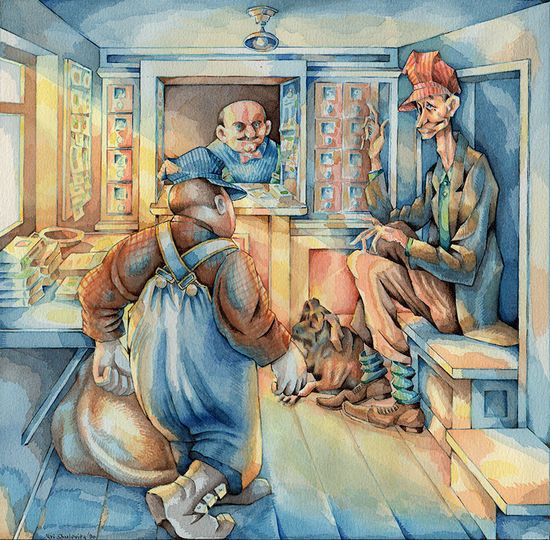
I would like to call attention to one long out-of-print work by Mr. Shulevitz, his quirky, and even disturbing, Toddlecreek Post Office. (Farrar, Straus and Giroux, 1990). Like several of his other books, it adopts a tone from folklore. The small village of Toddlecreek has a small post office. It resembles an ordinary house, with tall windows, flower boxes, and an American flag indicating its purpose. The name of the postmaster is Vernon Stamps, reinforcing the idea that the story is something of a parable. (Some of his neighbors are named Mrs. Woolsox; Charlie Ax the logger; and the garrulous and nostalgic Dexter Shuffles.) Mr. Stamps is busy and efficient, but also compassionate, helping everyone in the community and even welcoming animals to his overcrowded enterprise.

Into this paradise, one unfortunate day, the postal inspector intrudes.  Her presence is immediately disturbing, and the animals react before she even sets about her task. “Birds’ songs diminished…Bees’ buzzing ceased, or so it seemed. The small dogs stopped barking, and stared.” The inspector examines the post office’s records, as well as the evidence that unofficial, but humane, activities are also promoted there. There are books to read, and announcements for barn dances on the bulletin board. She announces that the post office will be closed. Vernon is stunned, but he senses that resistance to this decision is futile. He locks up and leaves.

If readers are not already saddened by this point, Shulevitz makes clear that the post office’s closure leaves a terrible gap in the life of the community.  There is a sense of shock in the rumors about Silken, Vernon’s part wolf and part sled dog companion. The animal has disappeared. “Some say she went north to join the wolves. Others say she was killed by a hunter.” 

What motivated Shulevitz to end the book on an unambiguous note of sadness? He was a great artist and humanist who had lived through the worst conditions imposed by tyranny.  Toddlecreek has been ruined.  “It is not on any map, it is bypassed by travelers and forgotten by time. And now, like any other small village, Toddlecreek has no post office.” Yet, unlike the residents of this unfortunate town, he did survive to produce an unforgettable body literature and artwork for both children and adults.