Turning Over a New Leaf

How to Talk to Your Succulent – written and illustrated by Zoe Persico
Tundra Books, 2025
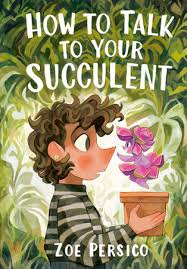
In Zoe Persico’s incredibly inventive graphic novel, Adara’s mother has recently died. She and her father leave California to move in with her grandmother in Michigan. The potential subjects of graphic novels are unlimited, and How to Talk to Your Succulent is not the first one to deal with grief, or strained relationships of parents and children. It is, however, outstanding in its sensitivity, bold graphics, and experimentation with fantasy and reality as equal components of a young girl’s search for the truth. Persico quietly presents a scenario that defies reality, and then proceeds to immerse the reader in a world where it is utterly plausible.

If you are skeptical about human communication with plants, this book will demonstrate the irrelevance of that reservation. Adara is sad and uprooted, even though her grandmother is a pillar of flexible strength. Her father is trying, somewhat helplessly, to cope with his own desolation and anger, which he approaches by inadvertently discouraging his daughter from expressing her feelings. What could be worse than this agonizing moment in all their lives? As it turns out, Adara’s mother had quietly used a special power. Not only did she have the proverbial green thumb at growing plants, she could actually communicate with them: “Like, you know, actual conversations.”
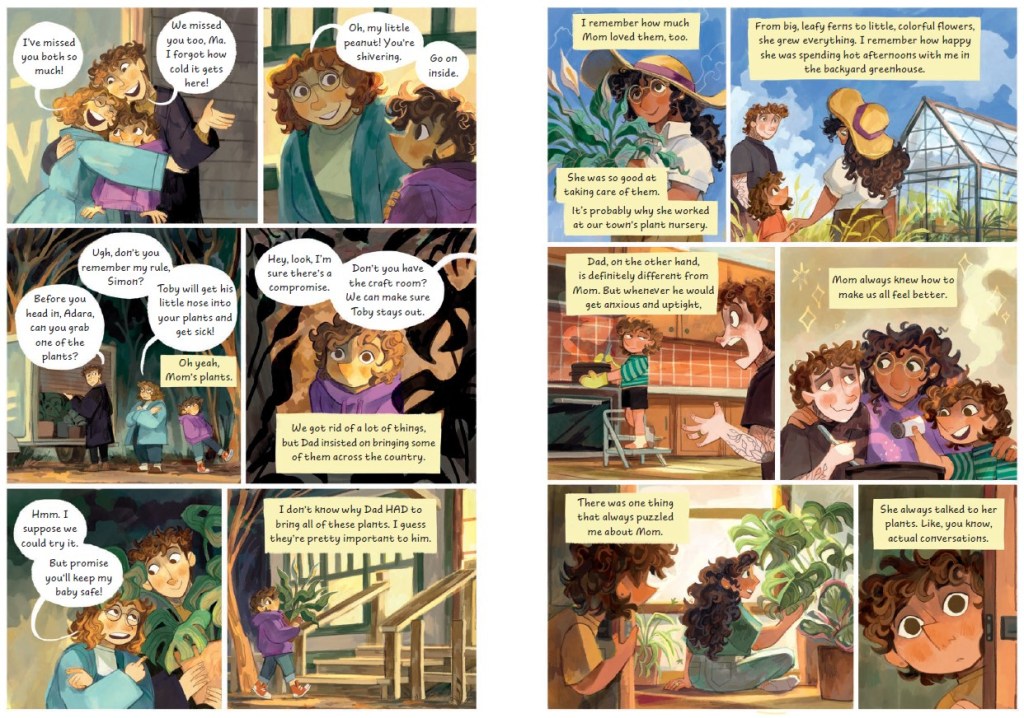
Adara’s grandmother, who resembles a child’s ideal image of a non-judgmental old person as both youthful and wise, also keeps a garden and greenhouse. When Adara’s father realizes that she has taken to wearing her mother’s earrings, which resemble tiny plants, he takes her to visit a nursery where she can select an actual plant of her own. This gesture is the closest he can come to acknowledging her feelings of isolation. At the greenhouse she meets Perle, short for Perle von Nurnberg, a delicately beautiful succulent who, for a devastatingly brief second Adara believes to be speaking in her mother’s voice. Then comes the epiphany: “I can talk to plants just like Mom! I knew it! I knew it!”

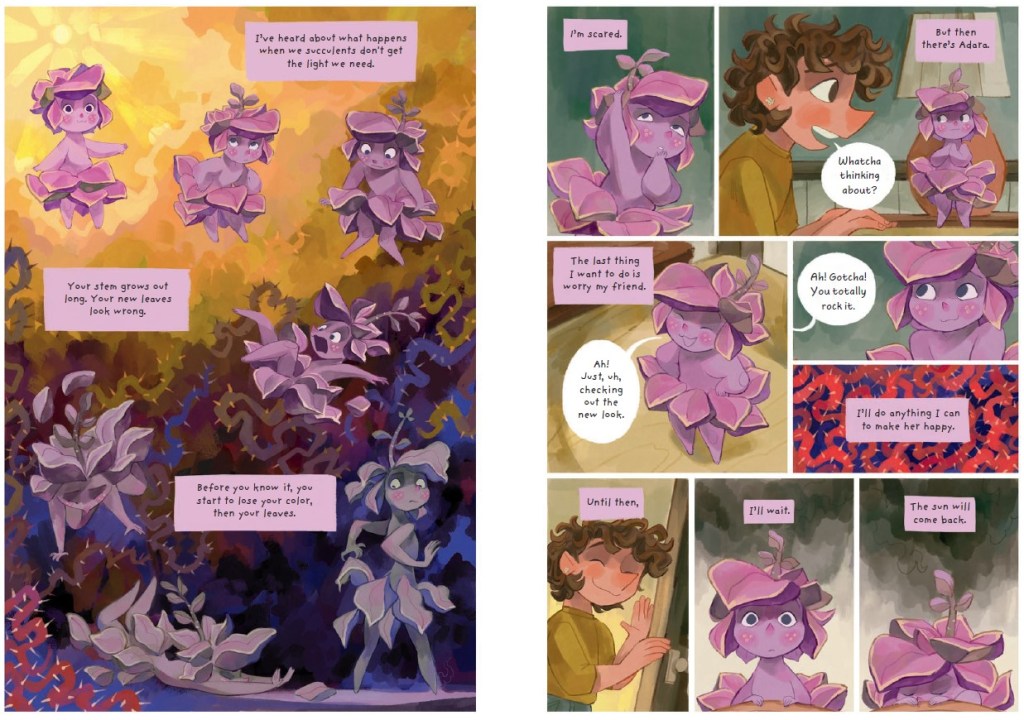
There is nothing affected about this unusual series of circumstances. Readers are not asked to suspend disbelief, but to enter Adara’s emotional state without preconceptions. Broadening her narrow circle of relatives, she also meets a new best friend, Winnie, a frustrated artist whose own mother is demanding and unappreciative of her daughter’s talents. Still, she has a living mother and Adara does not. But other people, as Adara learns, have their own problems and also need to be protected in order to thrive. Perle, the plant who demonstrates Adara’s maternal inheritance, is threatened with extinction if Adara cannot learn that same lesson as it applies to her.

The artwork of How to Talk to Your Succulent is inseparable from the text. Persico uses earth colors, jewel tones, and gradations of light in a setting that combines the spaciousness of nature with the enclosed scale of a greenhouse. People’s emotions register with expressive brush strokes, as do the fantastic plants who interact with each other and intersect with humans. The author’s note reaffirms her commitment, both artistic and emotional, to connecting with the reader. She includes mixed media photographic images, a visual and textual demonstration of her method, and even a guide to the plants at the root of her story. Equally innovative for its graphics and its exploration of emotional vulnerability, this book will bloom with every re-reading.
Uri Shulevitz 1935-2025

Uri Shulevitz died on February 15.  The breadth of his artistic vision was outstanding, demonstrated both in books which he wrote and illustrated, and in others that he illustrated in collaboration with another author.  Many were deep explorations of Jewish themes, while others were more universal in scope. Chance was a masterpiece, integrating his entire life’s work in both words and pictures (I have also written about him here and here). The title indicates his conviction that his survival as a refugee from the Nazis, and, therefore, his entire career as an artist, was fundamentally a result of random events.  The book earned many distinctions; unfortunately, a Sydney Taylor award was not among them.

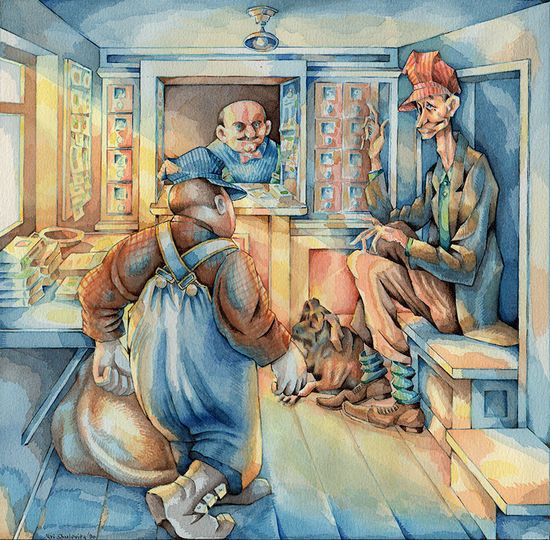
I would like to call attention to one long out-of-print work by Mr. Shulevitz, his quirky, and even disturbing, Toddlecreek Post Office. (Farrar, Straus and Giroux, 1990). Like several of his other books, it adopts a tone from folklore. The small village of Toddlecreek has a small post office. It resembles an ordinary house, with tall windows, flower boxes, and an American flag indicating its purpose. The name of the postmaster is Vernon Stamps, reinforcing the idea that the story is something of a parable. (Some of his neighbors are named Mrs. Woolsox; Charlie Ax the logger; and the garrulous and nostalgic Dexter Shuffles.) Mr. Stamps is busy and efficient, but also compassionate, helping everyone in the community and even welcoming animals to his overcrowded enterprise.

Into this paradise, one unfortunate day, the postal inspector intrudes.  Her presence is immediately disturbing, and the animals react before she even sets about her task. “Birds’ songs diminished…Bees’ buzzing ceased, or so it seemed. The small dogs stopped barking, and stared.” The inspector examines the post office’s records, as well as the evidence that unofficial, but humane, activities are also promoted there. There are books to read, and announcements for barn dances on the bulletin board. She announces that the post office will be closed. Vernon is stunned, but he senses that resistance to this decision is futile. He locks up and leaves.

If readers are not already saddened by this point, Shulevitz makes clear that the post office’s closure leaves a terrible gap in the life of the community.  There is a sense of shock in the rumors about Silken, Vernon’s part wolf and part sled dog companion. The animal has disappeared. “Some say she went north to join the wolves. Others say she was killed by a hunter.” 

What motivated Shulevitz to end the book on an unambiguous note of sadness? He was a great artist and humanist who had lived through the worst conditions imposed by tyranny.  Toddlecreek has been ruined.  “It is not on any map, it is bypassed by travelers and forgotten by time. And now, like any other small village, Toddlecreek has no post office.” Yet, unlike the residents of this unfortunate town, he did survive to produce an unforgettable body literature and artwork for both children and adults.

Fairy Architects

The Tallest Tree House – written and illustrated by Elly MacKay
Running Press Kids, 2019

Fairies usually live in tiny, beautiful, dwellings. Sometimes these are made of obvious materials: leaves, twigs, moss, and other natural elements. Often a child who loves fairies created them, or at least happens upon them and lovingly interacts with their inhabitants (for example this and this). In Elly MacKay’s The Tallest Tree House, there are two fairies, no humans. Both fairies have architectural aspirations as does this mouse). Their names are Mip and Pip, and they are somewhat competitive; at least Mip is. She actually challenges Pip to a contest: “Whoever makes the best tree house by sundown wins!” This impulsive idea doesn’t take into account the fact that Pip is currently reading a book about architecture. 

Elly MacKay’s illustrations are theatrical; she describes her method in inspiring detail (I reviewed another of her books here). Looking at her cut-out figures, carefully placed in stage settings, I was reminded a bit of the Cottingley fairy episode, a well-intentioned fraud when two girls in early 20th century Britain convinced a credulous public that they had photographed fairies. Of course, there is no fraud here; Mip and Pip are real and they create their own home. But the delicacy and care involved in bringing them to life seem related.

Even looking at the two friends, Pip seems more serious. In addition to his reading, he has a tall, pointed leaf for a head covering. Mip, in contrast, sports a comically oversized mushroom cap.  Pip draws blueprints based on his planning.  He carries a, presumably, well-stocked toolbox and uses a pulley. The sight of Mip’s obviously fragile tall tower worries him, because he cares about her more than he does about winning. Eventually, they work as a team, together completing “a winning piece of architecture.” 

Several qualities set this book apart in children’s fairy literature.  There is the tortoise and hare allusion, and the friendly warning that you need technology as well as patience to build a fairy house.  The composition resembles a theater set, and even includes sound effects, such as a terrifying BOOM in huge font when Mip’s shoddy tower collapses.  The book is not unique in excluding human observers, but it does feature an unusually independent fairy world.  Next time you build a house for fairies, read Pip’s book and bring along some simple machines.

What Makes Us Happy

I Would Give You My Tail – written by Tanya Tagaq, illustrated by Qavavau Manumie
Tundra Books, 2025

This tender, subtle, book, about a boy awaiting the birth of a sibling, is set among the Indigenous people of Nunavut, northern Canada. It is both unique to their culture and universal in its expression of gratitude, both to people and the environment in which they live. The title refers to a conversation between two hares, echoed by other animals, and finally by the brother welcoming his new sister to the world they will share. The language seamlessly weaves together the language of the physical world and metaphor. The pictures, created in colored pencil, draw from Inuit folklore, as well as the specific qualities of the characters.  Sharing is a concept central to the book, part of the overall vision of happiness passed from one generation to the next.

Assuming a child’s perspective in a book for children may seem natural, but it’s not so easily accomplished. Here, from the first page, readers will empathize with the boy, Kalluk’s, feelings of expectation and some anxiety, as he awaits a profound event in his life.  Tanya Tagaq is straightforward in presenting the situation: “Kalluk’s mother is in labor and about to have a baby.” Even the repetition of seemingly redundant terms, “labor,” and “about to have a baby,” reflects the way that children incorporate reality. Qavavau Manumie’s illustration shows the pregnant mother touching her kneeling son in a gesture of reassurance, before he sets out to bring his grandmother to help.

Unhappiness is, realistically, part of Kalluk’s range of feelings at this moment. He asks two hares why they are happy, and learns how the qualities that they need to survive, speed and cleverness, are fulfilling ones. A brook is happy because of the fish who inhabit it. Mothers, animals or human, are happy with the offspring to their care. Explanations are kept to a minimum. Kalluk can sense the sincerity of all the responses.

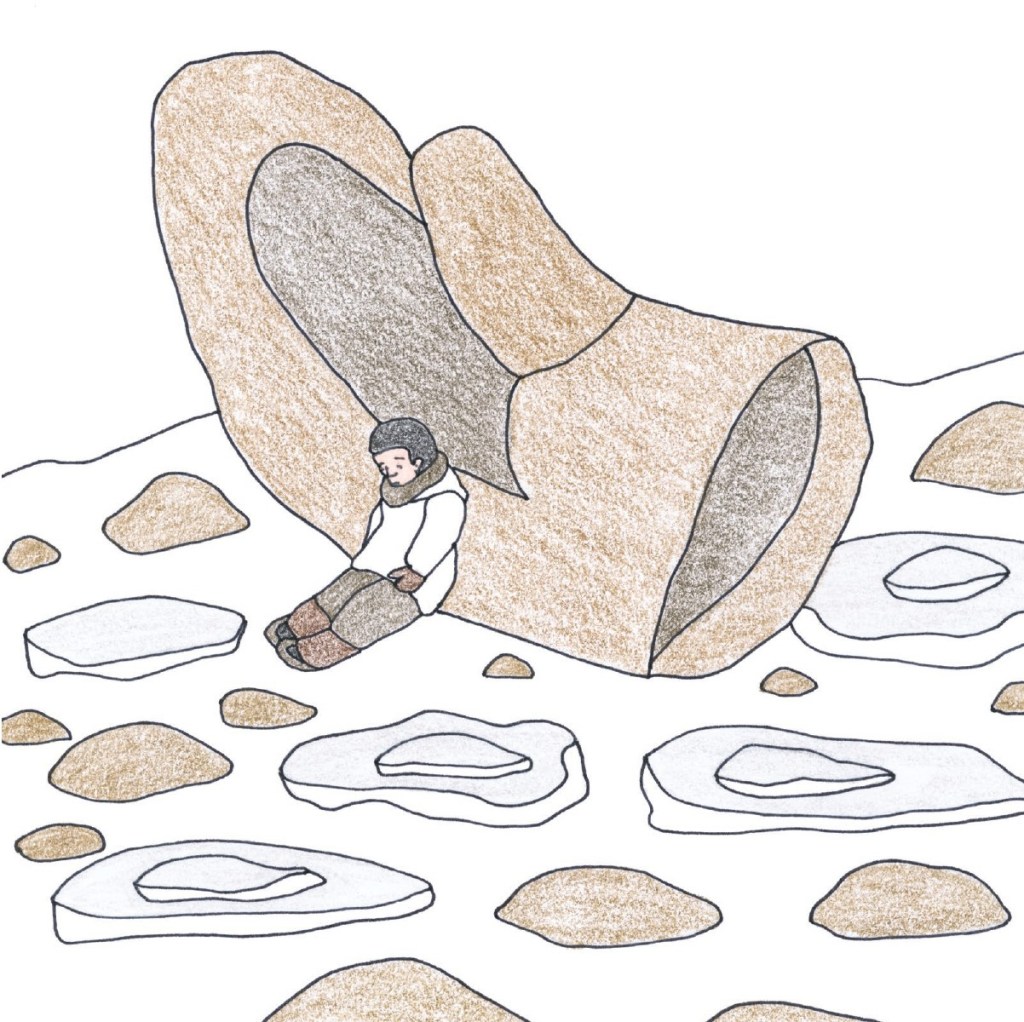
A picture of Kalluk seated with his back against a giant mitten embodies his feelings of gratitude tinged with sadness. He clearly misses his mother, thinks of the warm mittens she has created for him, and sends her “all the love in his heart.” The way in which that message is convened does not need to be articulated.

Meeting his grandparents, Kalluk has reached the confirmation of all the previous lessons about gratitude and love. His grandmother, Anaanattiaq in their North Qikiqtaaluk dialect, is unapologetically depicted as old; she “stands up slowly, bones creaking and cane shaking.”  Any diminished physical strength is no obstacle, as she states purposefully, “Let’s go greet the new one.” Walking home, the boy asks her about her source of happiness. When she answers “peace,” he requests an elaboration. This dialogue is different from those with the animals. She tells him in the most direct language that peace grows inside each person, as he or she makes a series of choices in life. The right choices will make you proud, and grant “lots of peace,” the kind that is meant to be shared.

When Kalluk and Anaanattiaq come upon “a conspiracy of ravens,” the squawking, lively birds are friendly towards them.  Their requirement for happiness is “knowledge,” a slight variation of the other animals’ answers. Their grandmother, the ravens assure Kalluk, is full of knowledge. That knowledge is put to the most important use when she arrives at Kalluk’s home, where his mother has already given birth and his breastfeeding the baby whom he is now prepared to teach everything he has learned.  Gratitude for food, water, family, and the ability to choose well, are the gifts he brings to her, as well along with a declaration of love.  I Would Give You My Tail is like a perfect circle, enclosing the reader in the complete circle of Kalluk’s journey.