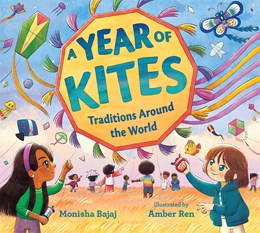
A Year of Kites: Traditions Around the World – written by Monisha Bajaj, illustrated by Amber Ren Bloomsbury Children’s Books, 2026
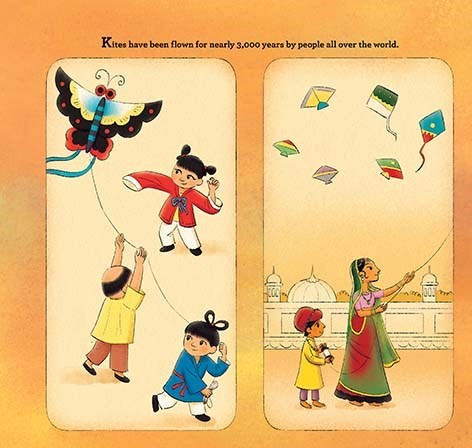
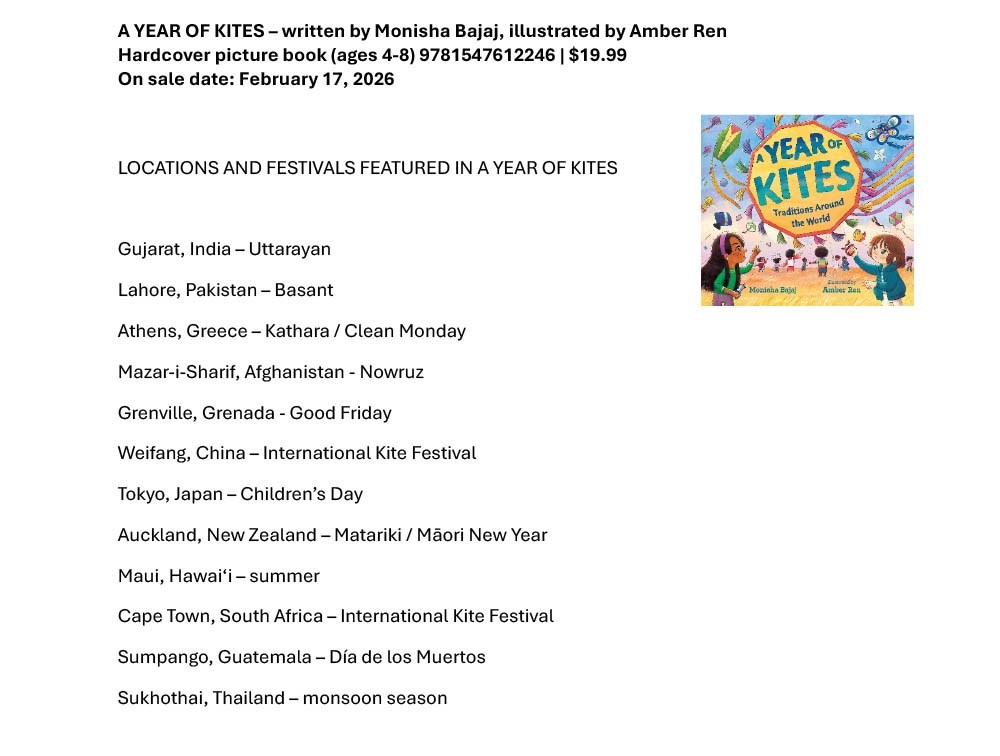
A Year of Kites is a wonderful picture book whose unusual subject matter is matched by its quality. Children, and adults, find the ideas of kites appealing. They start as paper, string, and other materials. With some human ingenuity they take flight, without passengers, all on their own. Readers may be familiar with some cultural expressions of kites, but this book presents detailed information about much less familiar examples of these beautiful airborne structures. A simple premise introduces the story: “Kites have been flown for nearly 3,000 years by people all over the world.” Each subsequent two-page spread features a fictional child from one of these places, including India, Afghanistan, China, New Zealand, and many more. There are brief descriptions of the festivals that include kite flying, as well as invented personal details. (In New Zealand, Kaia includes a secret message for her grandmother on the inside of her kite.).
Some of the celebrations may complement those that are better known outside of their own cultures. The festival of Diwali may resonate with readers who have never heard of Uttarayan, marking the end of winter with colorful kites, particularly in Gujarat. Lunar New Year evokes images of Chinese kites, and the koi-shaped kites created in Japan are also popular. The sections on these holidays offer background information as a necessary context for the aesthetic appeal of these kites. The fact that Cape Town, South Africa, hosts the largest international event surrounding kites deserves the same level of attention. There are even workshops that teach the craft, and prizes awarded for excellence.
Monisha Bajaj’s text reflects the way that children connect information and personalized characters in learning. Amber Wen’s softly colored images of children show an international cast as similar to one another in their expressions of delight, but distinctive in customs. A culminating image brings together these citizens of the world (image) as they let loose their butterflies, fish, and geometric forms into the sky.
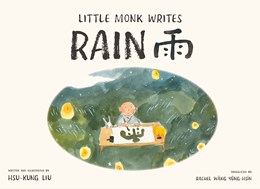
Little Monk Writes Rain – written and illustrated by Hsu-Kung Liu, translated by Rachel Wāng Yῠng-Hsín Eerdmans Books for Young Readers, 2026
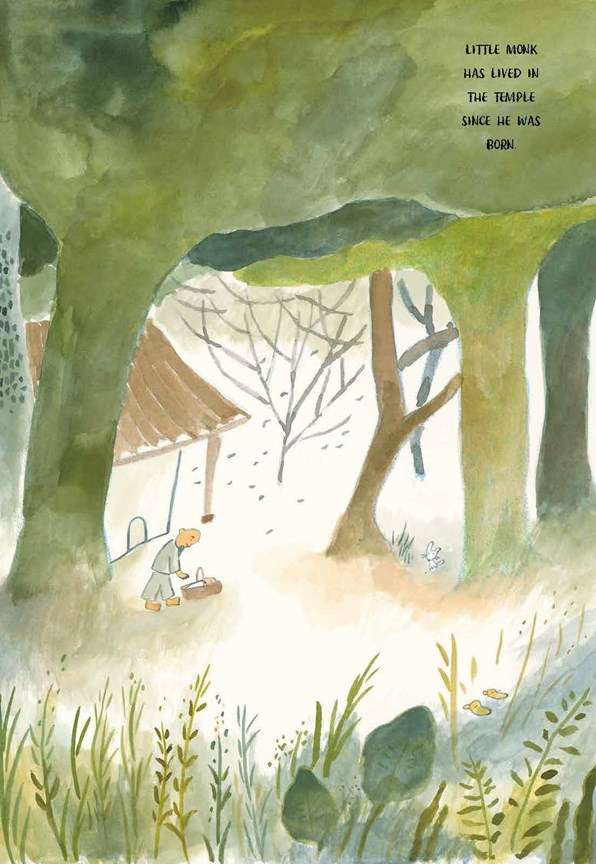
This exceptionally beautiful and gently philosophical picture book is about a Buddhist monk who has difficulty learning written language, with the exception of one Chinese character. He is singularly focused on writing the character for “rain,” and this limited but powerful ability persists throughout all the onslaughts, as well as the peaceful times, of his life. The book opens vertically, like a writing tablet. Delicate watercolor and ink drawings reflect traditional art, without mere imitation. When the book begins, the character is a young boy. Of course, character has two meanings here, an individual human and a symbol for written expression.
He first appears at the monastery in a tiny woven basket; as he grows, he is integrated into the community of prayer and manual labor, as well as reading and writing. For better or worse, he is not completely isolated from the outside world. A mention of casual cruelty makes this clear, because “Little Monk is not able to learn to read. And sometimes, other people laugh at him.” Those people are shown as children peering through a doorway. One has a bird on his head, an allusion to innocence, or perhaps of something worse. That oddly positioned bird may point do a different and less excusable deficiency, lack of empathy.
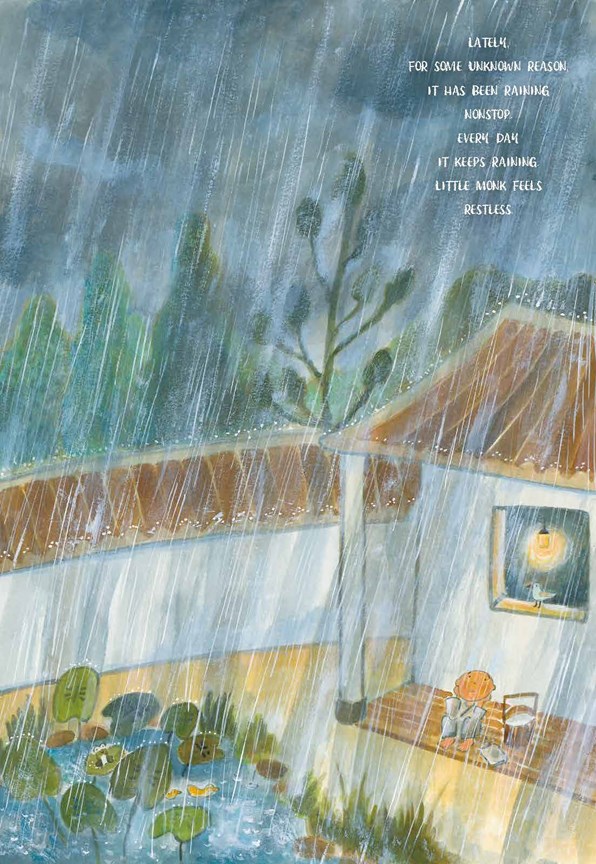
Suddenly, “for some unknown reason,” it begins to rain incessantly. Joining an older monk indoors, the little monk learns to write the character for rain. After introduction of the character, whenever it appears in the book, it is simply left standing without any guide to pronunciation. The reader may choose to read the character as “rain,” or to research how to pronounce it and attempt to do so. This seems a deliberate feature of the book, given that the nature of language, at least as people use it every day, is as framed by “some unknown reason” as the rain itself.
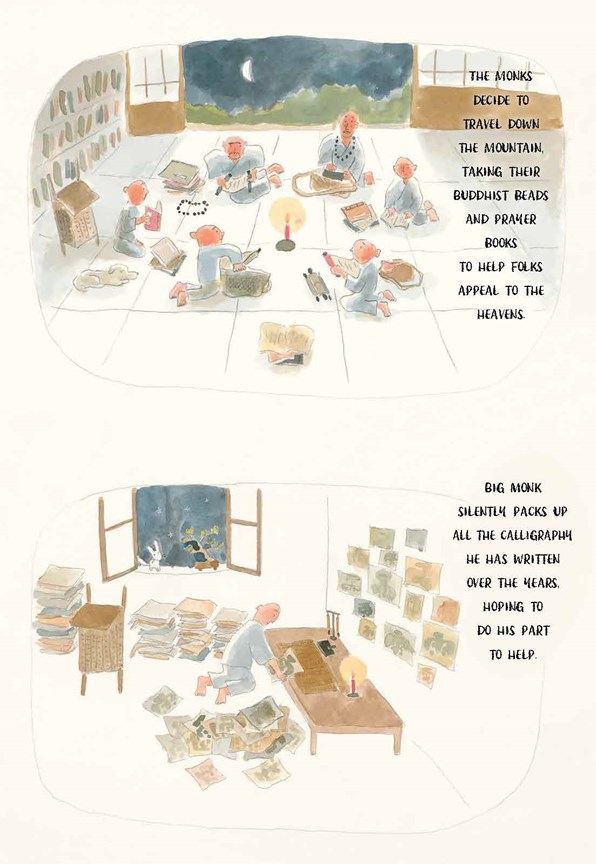
As in a fairy tale, the hero persists against adversity. Every day he performs his work tasks, but also writes the one character he has been able to master. Over the years, he grows up, becoming “Big Monk,” but his inner character remains unchanged. Then the environment suffers a reversal, and a drought threatens the world. The monks take responsibility for leading others in prayers to end the drought. They are well-equipped and organized, “taking their Buddhist beads and prayer books to help folks appeal to the heavens.” There is no sense of superiority in their actions. Meanwhile, Big Monk also prepares, by gathering together his impressive collection of calligraphy, all consisting of the one character for rain..
A vertical two pace spread is a magnificent scene washed in red and gold, of a plaza where ordinary “folks” pray while important men and “splendid altars” dazzle. “Even the Emperor is here.” When the monks arrive, they also appear important to the reader, wearing their crown-like broad hats and bearing their sacred scrolls. But their clothes are “shabby.” In folklore, many times the high and mighty are brought low by their sense of self-importance. At first the monks are unable to respond, feeling faint and weakened by the intense heat. But, seeing the distinguished shifu, for all their knowledge, reduced to angry and petty squabbling, they gather to pray. Big Monk cannot read the prayers, but opens his basket of rain characters and is “flooded with memories.”
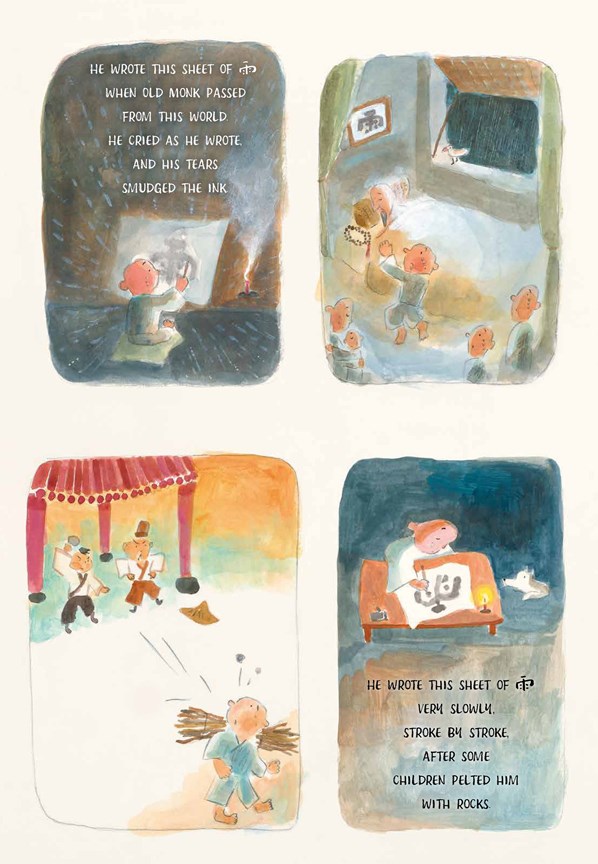
Now the monk has a biography. He remembers a conversation overheard long ago. He learned that he was an orphan who had been brought to the monastery. At the age of five, he began to learn writing. His teacher, originally a child, grew old, and the died. The cruelty mentioned earlier in the book intensifies in his memories, as he is “pelted with rocks.” All his thoughts of the past, and all his distinctive qualities, together form a response. He offers his sheets of writing to the heavens and the rain begins. An “ecstatic” crowd of people personifies the rain, elevated above the rain drops with joy.
Little Monk Writes Rain does not use the word “dyslexia.” An afterword, as thoughtful in tone as the rest of the book, explains that some people have difficulties learning to read. Hsu-Kung Liu presents thoughts and questions about the relationship between pictures, words, and the stories that they record. He reminds readers that sometimes “one word means everything.” Of course, those readers may be either children or adults. This remarkable book is a work of art, and a bridge to understanding life itself.
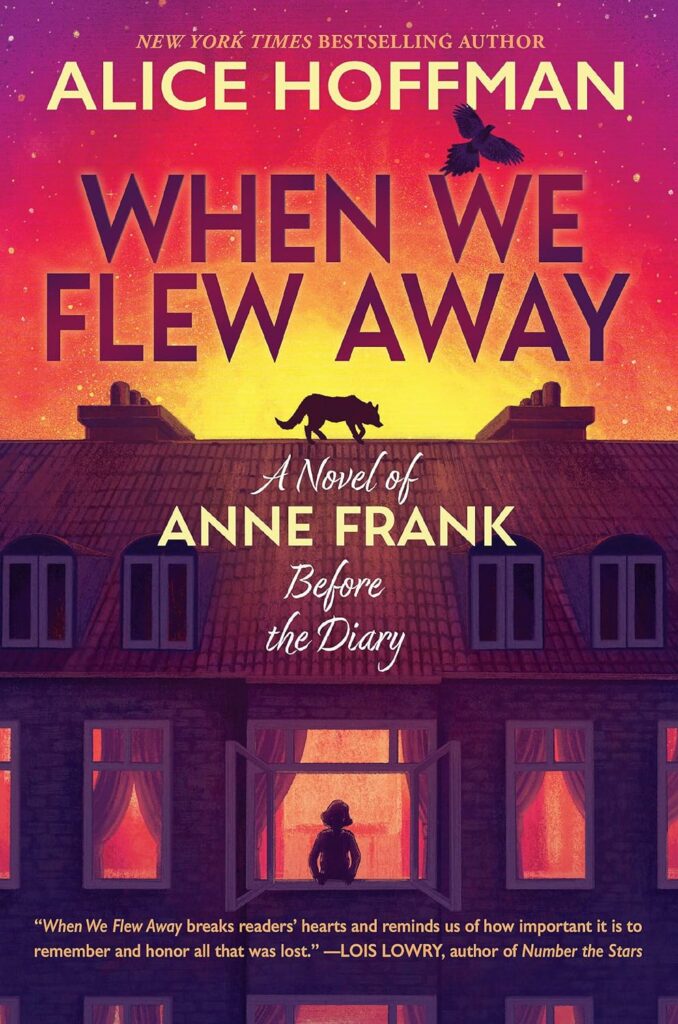
When We Flew Away: A Novel of Anne Frank Before the Diary – by Alice Hoffman Scholastic Press, 2024
When I first learned about When We Flew Away, I was slightly skeptical, even though Alice Hoffman is a very fine author. There are so many attempts to simplify or universalize the experience of Anne Frank, as well as honest misunderstandings of her life and legacy. Before reading this middle-grade and young adult novel, I recommend two adult books that do an excellent job explaining and contextualizing Anne Frank and her diary. These are Ruth Franklin’s The Many Lives of Anne Frank (2025), and Francine Prose’s Anne Frank: The Book, The Life, The Afterlife (2009). Cynthia Ozick wrote a powerful article in The New Yorker in 1997 on the same theme, called “Who Owns Anne Frank?”
As the above-mentioned authors have both clarified and deplored, Frank’s message has been distorted in order to convert her into a bland symbol of universal forgiveness. The history of the Holocaust, as well as her own understanding of Jewish culture, religion, and identity, were lost in the process. More accurately, they have been deliberately erased. Alice Hoffman does not attempt to document Frank’s experience in hiding. Instead, she imagines, based on the record and her own interpretations, what the young Anne was like before her family was forced into their desperate choice. This novel is about a young girl’s family, her emotions, and her response to the development of violent antisemitism in the Netherlands, the country that was supposed to have been a refuge for her German Jewish family. (To correct misconceptions about the alleged heroism of most non-Jewish Dutch citizens, read Nina Siegel’s thorough account in the anthology The Diary Keepers: World War II in the Netherlands, as Written by the People Who Lived Through It.)
Anne’s close relationship with her father is central to the story, but Hoffman also offers a much more nuanced view of Anne’s mother than the limited perception of their tensions. The diary does record conflict, but Hoffman includes the plausible view that Edith Frank had a deep love for her daughter, although her personality caused her to express this in a less direct way. Ruth Franklin corroborates this idea in her work.
The move to the Secret Annex is preceded by increasing levels of oppression. “Life became smaller. People stopped talking about the future.” Without imitating Anne’s own future writings, Hoffman captures the sense of confinement, which would gradually worsen. The metaphor of flight, which will never become literally possible, is woven throughout the narrative. Looking at a Jewish boy who has been tormented by children in the street, Anne perceives the truth about their present lives: “Anne looked at the boy and he stared back across the distance between them. They lived in a land without birds, a country in which there were no laws that would protect them, a place where it wasn’t possible to be a child anymore.”
When We Flew Away is understated in its ambitions, but it does succeed in restoring a measure of realism and humanity to Anne Frank in the form of a compelling and believable story.
Hanukah Money – written by Sholem Aleichem, translated and adapted by Uri Shulevitz and Elizabeth Shub, illustrated by Uri Shulevitz Greenwillow Books, 1978
This year’s celebration of Chanukah has been marked by a horrific tragedy. The slaughter of 15 people, with many more injured, is now inseparable from the religious and cultural festival this year, but it cannot destroy the meaning of the holiday. The great Yiddish author Sholem Aleichem (1859-1916) often wrote about both suffering and resilience. In his short story “Hanukah Money,” translated and adapted, and illustrated by Uri Shulevitz (who died earlier this year), Sholem Aleichem relates the tale of two young brothers eager to receive the traditional gift of gelt while their family observes the holiday. (Everyone knows of Sholem Aleichem, and you can find more of my reviews of Shulevitz’s brilliant work here and here and here.)
The boys’ mother is busy cooking latkes (potato pancakes). Their father recites the blessing on the candles. He understands the boys’ impatience, and rewards them with their small gift. While they spin their dreidels, their father and Uncle Bennie play checkers, discussing strategies of the game as if it had grave importance: “‘What’s to be done, what’s to be done, what’s to be done?’ intones father.” More relatives arrive and bring coins. The boys’ innocence, within their clearly impoverished home, reflects both their unawareness of material deprivation, and their joy in this occasional opportunity to delight in relative plenty. Even counting the coins becomes a ritual and a game framed by playful language: “One chetvertak and one chetvertak makes two chetvertaks, and another chetvertak makes three chetvertaks, and two grivenniks is three chetvertaks…”
Shulevitz’s pictures, resembling sepia engravings, feature exaggeratedly comic figures. The children seem like small adults and the adults themselves have child-like limitations. Some of the objects surrounding them are Hebrew prayer books, a wall of Jerusalem’s Tower of David, and a chanukyiah (menorah) displayed in the window. When one brother dreams that the cook, Breineh, flies into the room, she is carrying a platter, not of latkes, but of paper bills. “Motl swallows rubles like pancakes,” before going back to sleep. Money is abstract and fungible, but available food fills an immediate need. The boys’ needs are briefly fulfilled in the unique customs of the Festival of Lights.
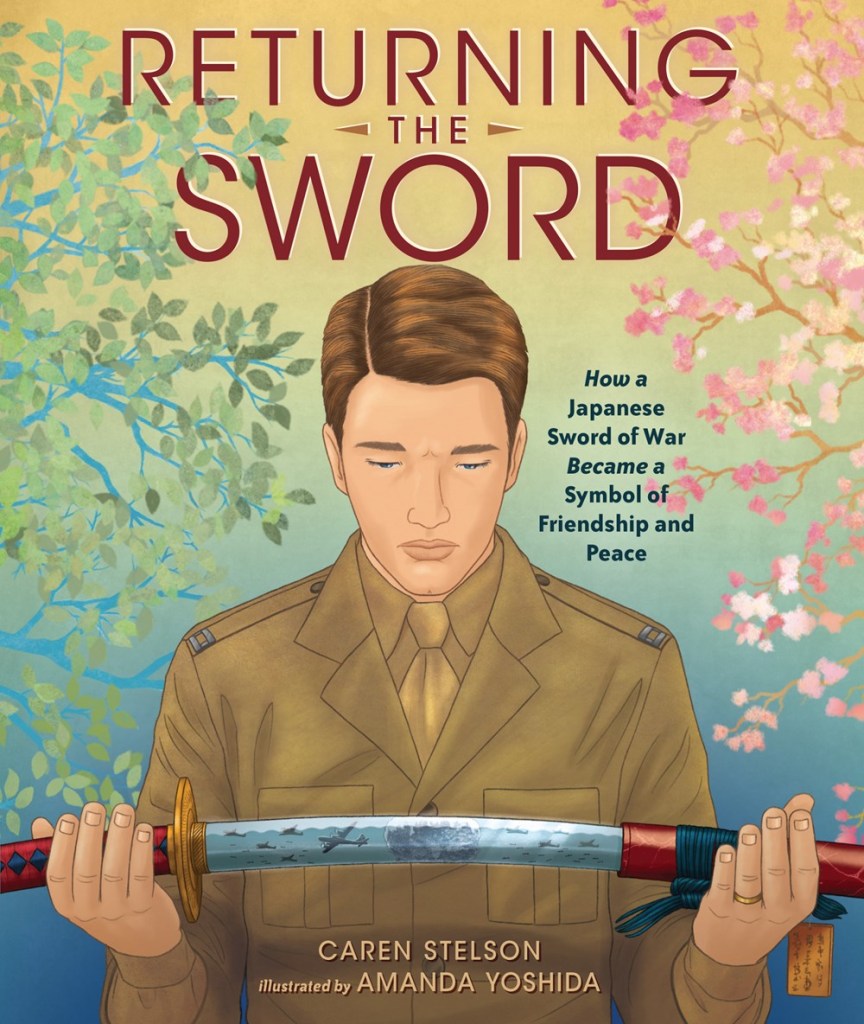
Returning the Sword: How a Japanese Sword of War Became a Symbol of Friendship and Peace – written by Caren Stelson, illustrated by Amanda Yoshida Carolrhoda Books, 2025
There is an understandable connection, for many readers, to books that promise a hopeful vision of reconciliation after conflict. I have read and reviewed many books in this category. While I respect the principle of deriving a positive lesson from a disastrous historical event, I have difficulty with facile messages of friendship in the absence of context. Returning the Sword has beautiful illustrations by Amanda Yoshida, and the text by Caren Stelson is obviously the product of sincere beliefs. She is a serious author committed to writing about important topics. However, I am troubled by the book’s almost complete absence of accurate information about Japanese aggression before and during World War II, and its depiction of the Japanese people as the sole victims of that conflict (as was also done here).
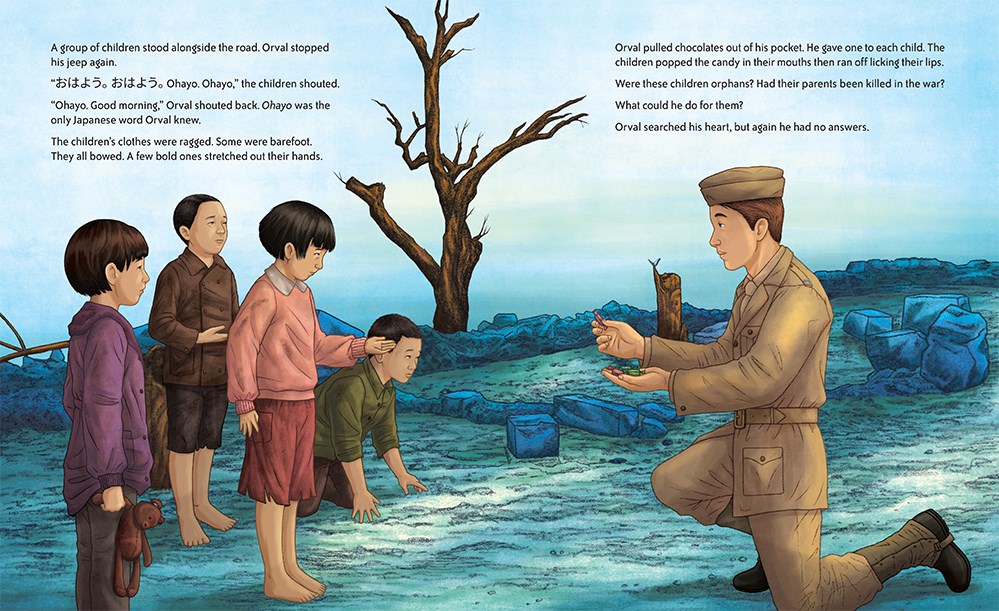
Stelson relates the story of Orval Amdahl, a man who served in the U.S. Marines during World War II and in the postwar occupation of Japan. He was horrified by the death and destruction wrought by the atomic bomb, a response shared by people throughout the world. Although more people were actually killed in the firebombing of Tokyo, inflicting death by radiation poisoning in the cities of Hiroshima and Nagasaki was conceived as a different category of weapon, one to be avoided ever again.
The decision to use that weapon to end the war, while one with terrible consequences, did not occur in a vacuum, but readers would never learn that from the book. Reporting Captain Amdahl’s reaction in Nagasaki, Stelson writes that “The city had been destroyed by a terrible bomb,” and “So many people had lost nearly everything important to them in this terrible war.” The starving children he meets, and the other civilian victims, had been living under a fascist regime that inflicted torture and murder throughout the countries they occupied, and upon the Allied soldiers who fought against Japan’s imperial forces. The Rape of Nanking, the Bataan Death March, the abuse of Korean “comfort women,” and other atrocities, are completely absent, not even indirectly suggested in an age-appropriate way. I am not suggesting that these sources be directly presented to children, which would be totally inappropriate, but they could be offered as a context for adults sharing the book, since Japanese suffering is uniquely at the center of its message.
Like many soldiers who served in the Pacific, Captain Amdahl returned home with a souvenir sword. This item continued to plague him psychologically, and he ultimately decided that he would like to return it to, as he interpreted it, its “rightful owner.” Stelson describes the swords as works of art and family treasures. The craftsmanship used to create them is somehow allowed to displace their actual purpose as symbols of military might, and also, to a lesser extent in World War II, as actual weapons used to perpetrate atrocities I prefer not to describe here. The U.S. military leaders who encouraged soldiers to appropriate them are cast as heartless. Captain Amdahl enters a room where the swords are “piled eight feet high,” and selects one to take home. This scene struck me as an inversion of the often-described encounter between the liberators of Nazi concentration camps and the bodies they discovered. The swords themselves are personified as lifeless victims.
Eventually, Captain Amdahl contacts Tadahiro Motomura, the son of the sword’s owner. Mr. Motomura writes of how his father did not talk about the war, but expressed his sadness at the loss of his sword: “At the end of the war, it hurt him to give it up.” (Without describing atrocities, the author might have suggested the incomplete nature of this statement. Even a mild indication of its irony, such as “The Japanese had caused great suffering in the countries they occupied. Still, Mr. Motomura felt sad about the loss of his family heirloom,” would have been closer to the truth.) Unlike in Germany, where an incomplete, and ultimately truncated, version of denazification was U.S. policy, in Japan a decision was made, in the context of the Cold War, to avoid forcing responsibility on the defeated nation. The emperor remained as a figurehead and there was virtually no educational program to ensure that the Japanese understand anyone’s suffering other than their own.
Captain Amdahl and Mr. Motomura believed that their personal reconciliation had embodied the idea of “peace with honor.” Perhaps if they had each come to terms with the historical realities that brought so much destruction, culminating in the terrible choice of using an atomic weapon, their decision would have been more meaningful. The book’s visual beauty, and even the ideal of reconciliation, could prompt a serious discussion with children about the consequences of both totalitarianism and violence. Historical facts and the idea of accountability would need to be part of that dialogue.
Little Shoes – written by David A. Robertson, illustrated by Maya McKibbin Tundra Books, 2025
Many Indigenous children, in both Canada and the U.S., suffered the trauma of being removed from their families and placed in residential schools funded by the government and often controlled by different Christian denominations. Deprived of their heritage, and often subject to physical and emotional abuse, these children would be lost to history if not for concerted efforts to publicize their experience and to demand restitution and atonement. Little Shoes is a picture book by acclaimed author David A. Robertson (see my reviews here and here and here), a member of Norway House Cree Nation, illustrated by Maya McKibbin, of Ojibwe, Irish, and Yoeme heritage (Robertson and McKibbin have collaborated before). They have taken on the weighty task of presenting a catastrophic loss to young readers, but also offering hope and determination. With poetic text and images of family life that are both familiar and mystical in tone, they have achieved this goal.
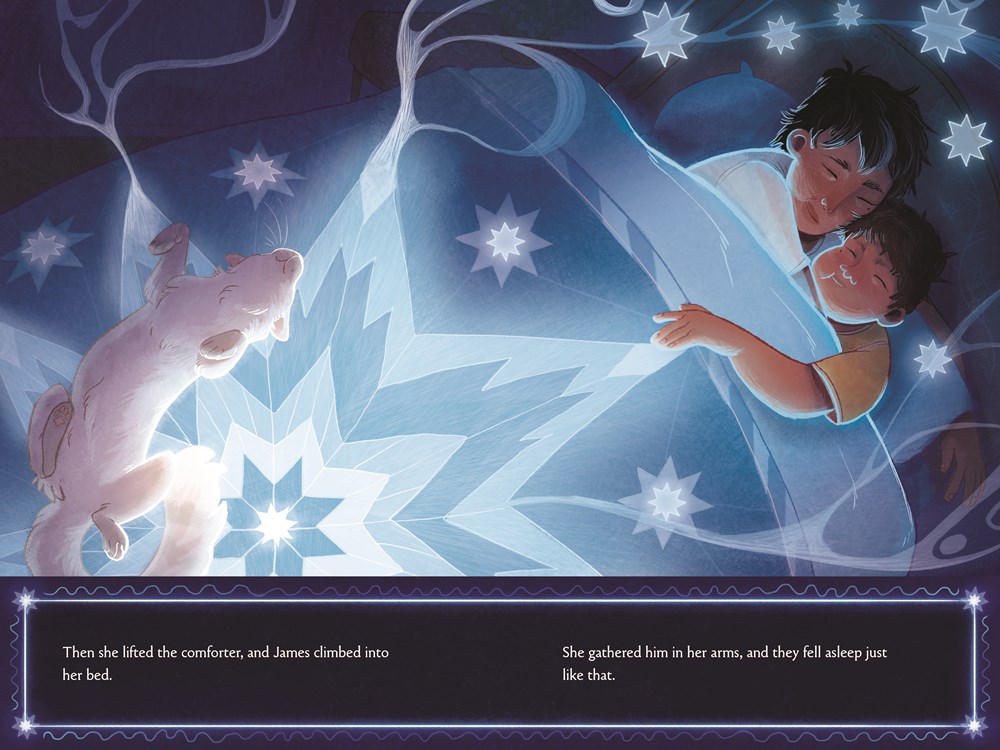
The endpapers feature constellations, introducing a central theme of each person’s place in the universe. James, who understands the principles of astronomy from his science class, opens the curtains in his room to the moonlight. He asks his mother to clarify how and why his feet remain firmly on the ground if the Earth is spinning in space. The answer is only one of several which his mother will frame truthfully, and also use to elaborate on other questions which will naturally follow. She reassures him that his Kōkom’s, (grandmother’s) explanation about their origins is valid, but adds, “even though you’re from the stars, your home is right here with me.”
The love between a parent and child, and the enveloping warmth of his community, are anchors in James’s life. His intense curiosity places demands on a parent who is obviously committed but exhausted, when he returns to her room with a request to hear about “every single constellation,” His own attempt to visualize and trace them in the night sky is insufficient. The dialogues between children and their caregivers are open ended, and the book swerves from the dimensions of the cosmos to the specific history of injustice that remains unresolved.
James and his kōkom set out for one of their frequent walks, but his time it is transformed into a march. A daily experience becomes a metamorphosis, and his grandmother takes on the role of teaching about a part of their lives that is far more difficult to internalize that the motions of the planets. The little shoes of the title are those of Indigenous children whose deaths are acknowledged by Kōkom with the haunting phrase that they “had gone to residential school but had not come home.” Shoes as a metonym for children who have died seems to capture a sense of a life that is unnaturally cut short. Other articles of clothing are perhaps less universal, and small shoes also reflect the scale of the children relative to adults, both those who loved them and those who inflicted torture. A similar allusion to this loss has been used in many memorials to child victims of the Holocaust. (Of course, while some of those children, like the Indigenous victims, died of abuse, neglect, and disease, many were murdered immediately upon arrival at a death camp. Chronicling atrocities requires acknowledging both what they share and common and how they differ.)
Robertson and McKibben do not attempt a simplistic response to James’s fears. He interprets the frightening facts through the lens of loneliness, asking his mother how his own grandmother had coped with the deprivation of her isolation in the residential school. His mother responds that her sister and she had “cuddled,” paralleled by McKibbin’s image of mother and son sharing the same physical contact. Their bond is unbreakable, even if mitigated by anguish. The honesty of Little Shoes is an antidote to fear.
The History of Jerusalem: An Illustrated Story of 4,000 Years – written by Vincent Lemire, illustrated by Christophe Gaultier, coloring by Marie Galopin, translated from the French by Amanda Axsom Abrams ComicArts, 2024 (originally published in French, Les Arènes, 2022)
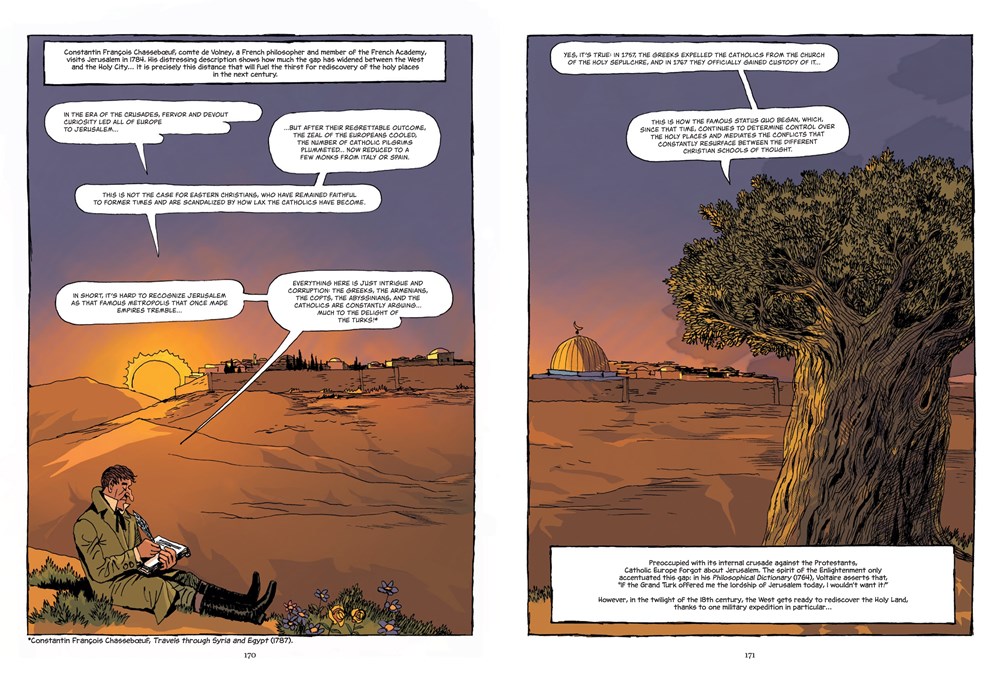
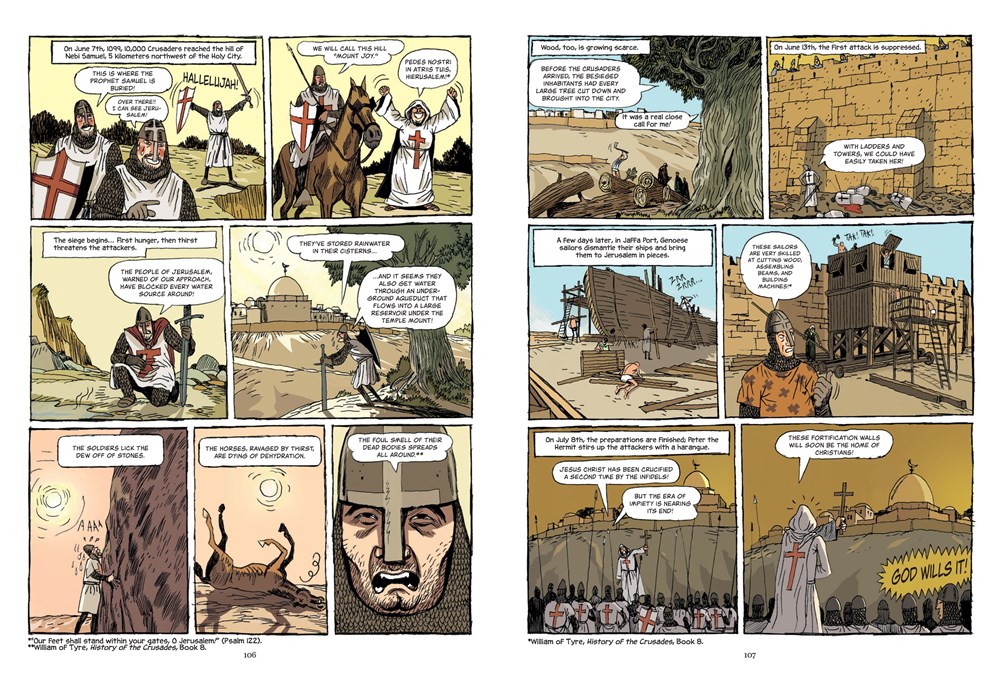
The narrative premise of this graphic history is that a 4,000 year-old olive tree is uniquely placed to teach readers about Jerusalem’s contested past. If that seems an unlikely approach, its success is only one of the many surprises in this unusual book. Dense with facts, yet a at the same time utterly absorbing and swiftly paced, The History of Jerusalem is also both provocative and balanced. The illustrations allude to classic comics, while subverting the idea that anyone involved has superpowers. Even great historical figures, and mythical ones, are viewed realistically, from different angles. It would be impossible to interpret the history of this city without controversy; Lemire and Gaultier do not avoid that essential truth. Instead, they maintain an appropriate level of respect and skepticism about both the past and the future. The book may be intended for adults, but it is equally appropriate for young adult readers, and would be an excellent complement to other, more ideological, resources.
The opening image of the tree, Zeitoun or Olivia, promises some divisiveness, or perhaps coexistence. After all, the word bubbles proclaim “Hello!” “Shalom” and “Salam!” She lays out the vast panorama of the city, echoing the biblical tale of creation: “In the beginning, when this story started, there was nothing…” Then the nothingness fills with geography, history, religion, ethnic groups, famous and influential people who impacted Jerusalem’s move towards centrality. Vincent Lemire chooses each event with great care, allowing different perspectives to emerge. There are events so loaded with meaning that their inclusion may seem unnecessary. The near sacrifice of Isaac, or Jesus at the Last Supper, command an immediate, probably pre-determined response. Yet they are equally weighted with panels dedicated to other hinge moments. The correspondence between former Arab mayor of Jerusalem, Yousef al-Khalidi and Zionist leader Theodore Herzl also reveals world-changing consequences. Christophe Gaultier depicts the serious and careful intent of Khalidi, seated at his desk with inkwell and steaming cup of coffee. When he writes to Herzl, “The concept of Zionism in itself is beautiful…My God, historically it is indeed your land,” the future appears in one way. When he follows those words with “We Arabs and Turks view ourselves as guardians of Jerusalem’s holy places…in the name of God…leave Palestine alone!” that future veers in a different direction.
The presence of each group taking root is documented. Lemire emphasizes both biblical accounts whose literal veracity can be disputed, and abundant archeological evidence of an ongoing Jewish presence, including autonomous kingdoms. Hellenistic, Roman, and Persian domination never erased a Jewish presence, nor did the western Christian Crusades, dedicated to brutally removing the Islamic control of the Holy Land. The rich Islamic civilization that developed from the mid 7th century C.E. eventually regained power and flourished under the Ottomans, until British victory in World War I brought it to an end. While there were continuing struggles for power throughout the centuries, Lemire seems to suggest a relatively equitable sharing of space by Jews, Christians, and Muslims, until the British Balfour Declaration promoted the idea of a Jewish homeland in Palestine. This assertion does not seem to be based as much in contempt for Jewish aspirations, as in an overly idyllic view of the region prior to the British mandate.
It is impossible to summarize the book’s depth, and sensitivity to the competing claims that inevitably threatened any permanent harmony. But at every point when I began to sense bias, the author provided counter examples. The exclusion of refugees from the Holocaust, the refusal to accept partition by the U.N., and other obstructions to a successful resolution are mentioned; blame is apportioned among the British, the Hashemite Kingdom of Jordan, and extremist elements on all sides. I felt uneasy at the faint implication that “Ashkenazi” Jews were somehow less indigenous to Jerusalem than Sephardim. The reference to Yasser Arafat’s “moving speech” at the U.N., in light of his extreme corruption, is, at best, ingenuous. Yet these are relatively minor exceptions to the tone of generosity and hope. A book with this range could not avoid controversy and still attempt complexity. Lemire and Gaultier construct a solid edifice built on fact, myths, and deeply held beliefs. They refrain from assigning unique blame to anyone, and also avoid judging the validity of Jewish conviction that the modern state of Israel represents self-determination. The lonely olive tree holds out hopes for a reasonable solution, of “two independent but allied states” built on mutual respect.
Beyond Courage: The Untold Story of Jewish Resistance During the Holocaust – by Doreen Rappaport Candlewick Press, 2012
Today is Yom HaShoah, Holocaust Remembrance Day, on the Jewish calendar. It seems almost redundant to point out that high-quality educational materials for young readers about this tragedy are essential. Now, as fewer survivors are here to tell their stories, and as a political climate of hatred and repression escalates antisemitism, we are even more obligated to continue telling the truth about the genocide of Europe’s Jews. (I have written many reviews in this area; a few relevant interviews can be found here and here and here and here and here).
Doreen Rappaport is a distinguished author of non-fiction for children (see, for example, here and here). I recommend Beyond Courage for many reasons. It is meticulously researched, carefully and accessibly presented, and illustrated with photographs, maps, and other documents. The book does not presuppose previous knowledge, but is also written, like all her work, in an intelligent tone that never patronizes the reader. There are five sections, each one focused on the heroism of those who defied death in their acts of resistance. The chapter titles encompass different components of these acts, from motivation, “The Realization,” and “Saving the Future,” to locations, “In the Ghettos,” and “In the Camps,” to dramatic depictions of the ultimate results, “Partisan Warfare.”
The choice to write about resistance is a crucial one. First, it allows children ten and older to process one part of the Holocaust; graphic descriptions of mass murder may be inappropriate for readers this young. Most importantly, it refutes the lie that Jews went, as the expressions states, like sheep to the slaughter. Examples of the true meaning of courage are not abstractions, especially as we live in a time when alleged leaders have chosen to abdicate all responsibility to their countries and allow dictators to seize total power.
Rappaport ends the book with a poem. (There is also extensive backmatter with further information and additional resources. In the notorious concentration camp of Theresienstadt, which the Nazis designed as a “model camp” to deceive the world about the Final Solution, many inmates created paintings and literature. Franta Bass, who was eleven years old at the time, wrote:
I am a Jew and will be a Jew forever. Even if I should die from hunger, never will I submit. I will always fight for my people, on my honor. I will never be ashamed of them, I give my word.”
McDuff Goes to School – written by Rosemary Wells, illustrated by Susan Jeffers Hyperion Books for Children, 2001
If you have never read any of the picture books about McDuff, the little terrier who is adopted by a loving couple living in a charming village in the 1930s, you have missed a modern classic. They are collaborations between two legendary authors and artists, Rosemary Wells and Susan Jeffers. McDuff Goes to School is the fifth in the series, and it holds a particular interest in the category of children’s books that informally present a new language (other example include Pizza in Pienza, Eat, Leo, Eat and My Sister is Sleeping).
McDuff lives at number nine Elm Road, a location as essential to the series as Paddington’s address at 32 Windsor Gardens. One day, a new, French family moves in next door. They also have a dog, and, no, she is not a French poodle. That detail is consistent with the understated realism of Wells and Jeffers’ creation. The first conversation between the two dogs is bilingual: “’Woof! Said McDuff. ‘Ouf,’ said Marie.” Note the use of italics for a foreign word.
Marie, the new dog, has owners who are as kind as Fred and Lucy, the couple who adopted McDuff. Celeste and Pierre de Gaulle (well, I guess their last name is the equivalent of a French-speaking French poodle), agree with Fred and Lucy that their respective pets need to attend obedience school. Mainly, Celeste seems to be in charge, and she is extremely determined. Lucy, realistically, too busy taking care of her baby, and Fred is “too tired after a day’s work” to train a dog. These are totally reasonable explanations, with no apologies offered; they are not inept dog owners.
Celeste’s daily repetition of commands to “assieds-toi!” and “Saute!” are translated in a glossary at the end of the book. Children will get a real sense of the gap in communication between speakers of different languages, and also appreciate the advantages of bilingualism. It turns out that McDuff’s apparent lack of progress in school is due to his attentiveness; he is listening to Celeste and learning to understand her language like a native.
As in every McDuff book, all of the humans are smartly dressed. The men wear argyle vests and driving caps. The women have lovely but practical collared dresses and t-strap pumps. Celeste even wears a Chanel-style pastel blue sweater and skirt set. The book concludes with a luncheon en plein air, including cheese, French bread, fruit, and an American, probably apple, pie. There is even a checked tablecloth. Both the dogs have earned ribbons.
The Gift of the Great Buffalo – written by Carole Lindstrom, illustrated by Aly McKnight Bloomsbury Children’s Books
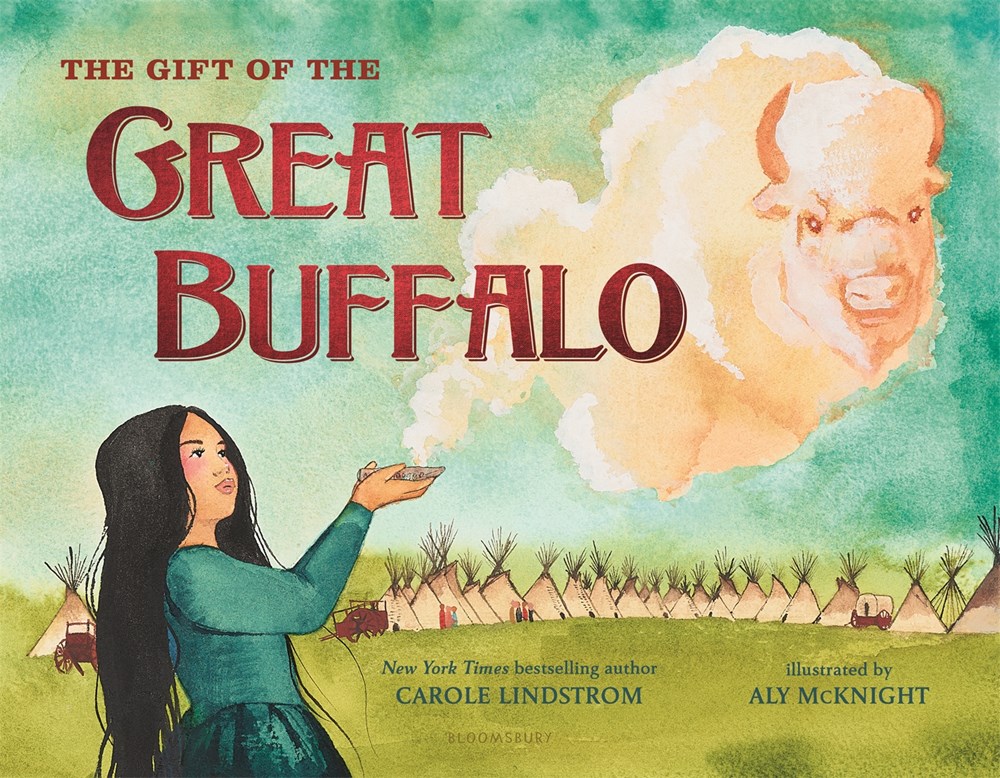
Rose lives on the prairies, in a Métis-Obijwe indigenous community. Preparing for the buffalo hunt that will sustain her people, she is eager to actively take part. This elegant picture book takes place in the 1880s, and, like Laura Ingalls Wilder’s Little House on the Prairie series, Rose’s dwelling is small and homemade. However, as author Carole Lindstrom explains in her detailed “Author’s Note,” she was motivated to tell Rose’s story by her own sense of distance from Wilder’s accounts. The Gift of the Buffalo offers the perspective of the Native Americans who are a shadowy and distorted presence in Little House. Lindstrom and the artist, Aly McKnight have not created a rebuke, but rather, an alternative and illuminating vision.
I have written about the complexity of Laura Ingalls Wilder’s works (see here and here and here and here and here), which, along with racism, include a great deal of ambiguity about how a young girl interprets the conflicting messages of her parents and community about the people whose land they have appropriated. The Gift of the Buffalo would stand alone for its excellence, even without the essential commentary that Lindstrom and Ally McKnight offer about the reality of an autonomous world, which is not merely a frustrating background for the story of Wilder’s pioneers. Rose is an intelligent and perceptive child. When her father discourages her from accompanying him on the buffalo hunt, insisting that “that’s no place for you. Besides, Ma needs you more,” she cannot accept his restriction.
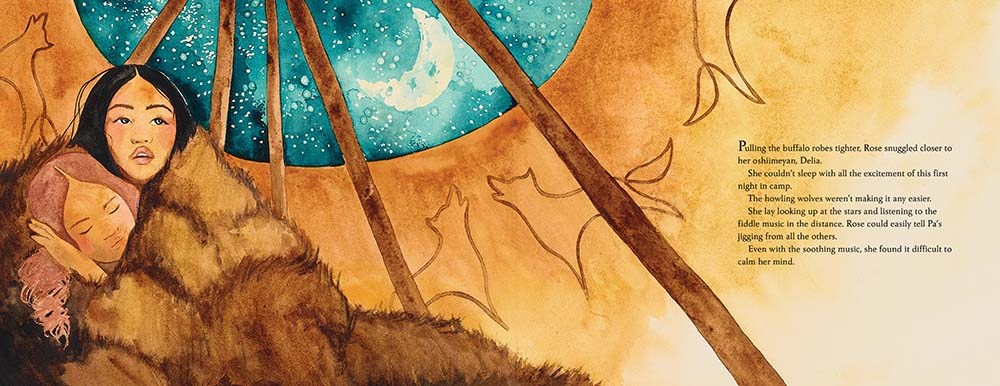
Rose’s decision to defy her father is not based principally on her individual needs, although there is an implicit statement about the independence of a young girl. She is deeply concerned about her family and friends. Lying in bed next to her oshiimeyan (younger sister), both of them enveloped in buffalo robes, she is excited about the hunt. When she later hears adults express concern about their lack of success, she knows that she will need to step forward. Pragmatism is connected to spirituality; Rose will communicate directly with the spirit of the animals that, in the Métis consciousness, will give their lives to sustain their fellow beings.
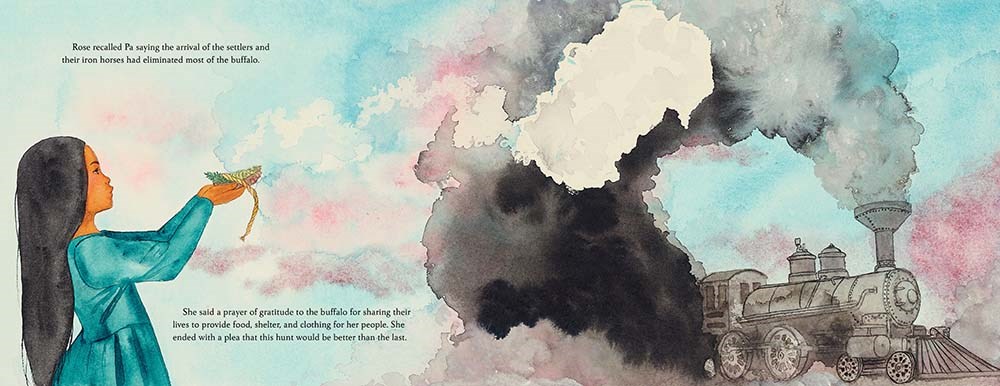
The watercolor and graphite illustrations are stunningly beautiful. Earth and jewel colors, expressive faces, and alternating dark and light, frame realistic depictions infused with metaphor. Rose, in a blue dress that complements the lighter blue of the sky, offers up a prayer of gratitude, in advance, expecting that the buffalo will “provide food, shelter, and clothing for her people.” Her father sometimes wears a wolf skin when hunting, and Rose assumes the mantle of his authority by putting on the special garment and identifying with the wolf. This ritual enables her to hear the buffalo assure her that her efforts will be productive: “We offer our lives for our relatives.” This evidence of mutual connection contrasts sharply with the exploitation of settlers, who had exhausted the supply of animals, even hunting for sport.
After the hunt, Rose’s father gently admonishes her. She had located the buffalo, but only by breaking his rule. His suggestion that she might, in the future, accompany him on a hunt, shows recognition of her needs as well as those of the tribe. Readers will find familiar elements in Rose’s story of independence and growth, as well as an invitation to learn about a different house, family, and world.













 Imaginary Elevators