The Newest Gnome – written and illustrated by Lauren Soloy Tundra Books, 2025
The Pocket is where the gnomes live, in Lauren Soloy’s remarkable universe of small creatures dedicated to choosing hats, telling stories, and generally explaining and appreciating the world. I was impressed with the first gnome book, The Hidden World of Gnomes, and I’m thrilled that Soloy and Tundra believed in them, and that they merited a second look (I’m also a fan of Soloy’s other work, as you can see here and here and here). Although the gnome books are rooted in tradition and folklore, they are also new and singular.
When the book begins, the existing gnomes, including Cob Tiggy, Twiggy Dell, Minoletta, and Beatrix Nut, are about to welcome a newcomer to the Pocket. These creatures, whose names evoke both Beatrix Potter and a kind of cosmopolitan flare (Minoletta, Hotchi-Mossy), need to meet in their mushroom circle to discuss the latest Pocket resident. When Grolly Maru arrives, they sense the need for reassurance, similar to Winnie the Pooh’s helpful and sustaining words: “Everything will be all right.”
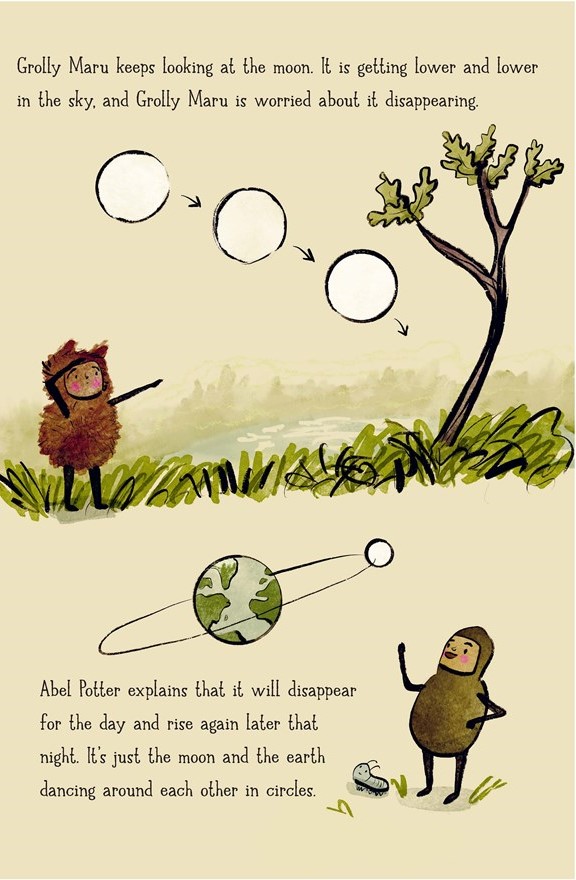
After a good night’s sleep under the mushrooms, the gnomes will be prepared to teach Grolly Maru essential skills. As in Babar’s Celesteville, every inhabitant has a specific job and role to play. When Grolly Maru expresses concern that the changing moon may eventually disappear, does this reflect and anxious personality, or just a basic lack of familiarity with the environment? It’s up to the reader to decide, but since Abel Potter shows Grolly Maru other round and spherical items from nature, it doesn’t matter.
The pictures feature gnomes interacting with one another, along with close-ups of objects that fill their lives: dandelions, yarrow, marbles, ants, and suggested exercises. There is a recipe for Bonnie Plum’s baked apple with blackberries, which, considering the scale of gnome to ingredients requires both hardware and strength. The gnomes are artisans, designing grass baskets: “It’s not as easy as it looks!” (Who would expect it to be easy?). Their overarching purpose is constant fidelity to the idea that each individual is unique, but that we are all part of something greater. Lauren Soloy’s artistic vision is fully realized, in a universe of beauty and comfort, populated by small beings with great wisdom.
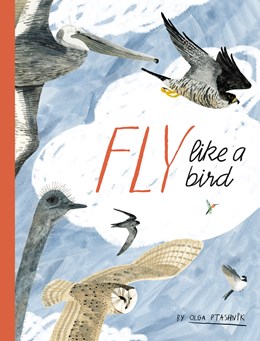
Fly Like a Bird – written and illustrated by Olga Ptashnik Eerdmans Books for Young Readers, 2025
Breaking the mold may be a harsh-sounding metaphor for a children’s book about birds, which contains within itself a story of natural insecurity and a parent’s reassurance. Fly Like a Bird does actually break a mold in the “STEAM” books genre. The text and the artwork, by Olga Ptashnik, are both wonderful. Children, and adults, will also learn a lot about a wide range of birds.
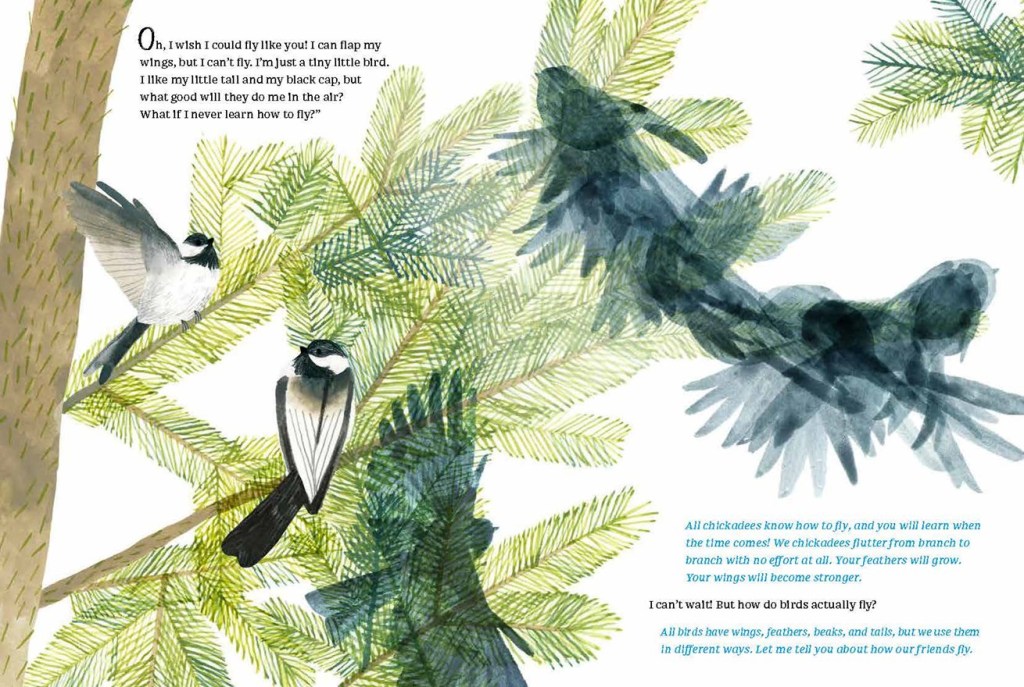
A young chickadee expresses concern about the possibility that she will never accomplish the daunting task of learning to fly. Ptashnik captures the inner life a child with her words: “I can flap my wings, but I can’t fly. I’m just a tiny little bird…What if I never learn to fly?”
Right away, children will be drawn to the book’s tone and central idea. The question-and-answer format alternates black and blue font, as the parent answers with accessible information about different birds and their unique qualities. Digital artwork produces the colors of nature: green, gray, blue, black, red, in different shades.
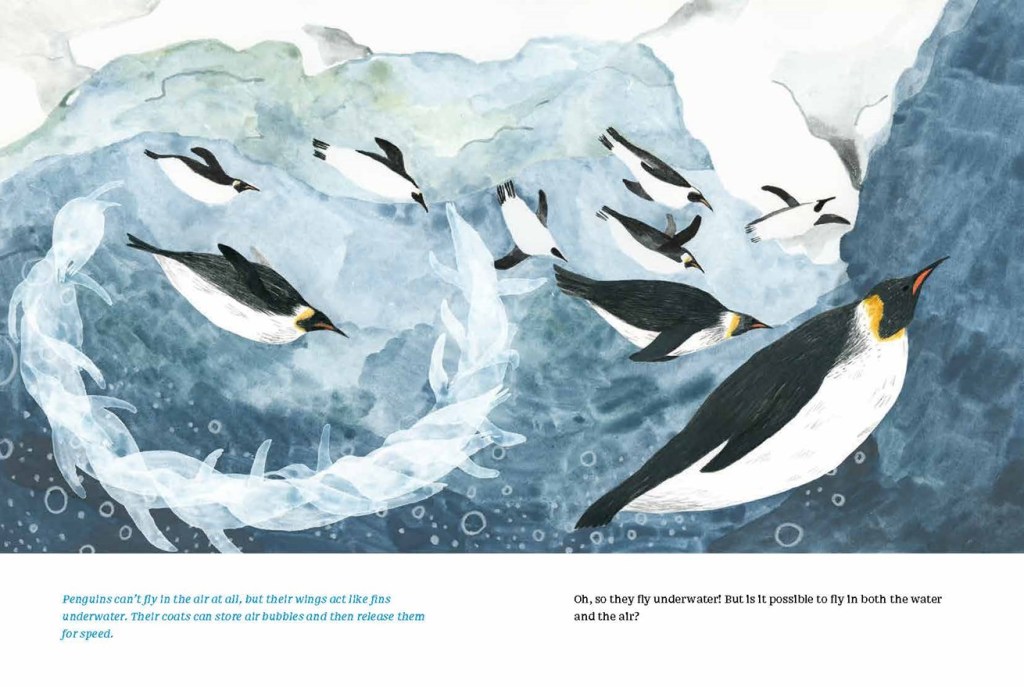
Hummingbirds are tiny; how do they produce the intense vibrations that give them their names, and also find nectar to drink? Penguins can’t fly, but their speedy swimming more than compensates for this unusual difference. The young bird processes the information: “Oh, so they fly underwater! But is it possible to fly in both the water and air?”
The peregrine falcon images bring the reader to a more human-populated location, as they fly high above elegant buildings and swoop down with incredible speed.
Each picture is composed to invite focus on different aspects of the scene. A large falcon appears commanding, hovering over the rooftops. A chain of apparently connected birds descends, and more distant birds appear smaller as they alight on structures and rise up further into the sky. Ptashnik anthropomorphizes a bit more here, breaking the fourth wall. The young bird expresses feelings of vulnerability associated with humans: “…but I don’t want to hurt other birds! How can tiny birds like us protect ourselves from predators?”
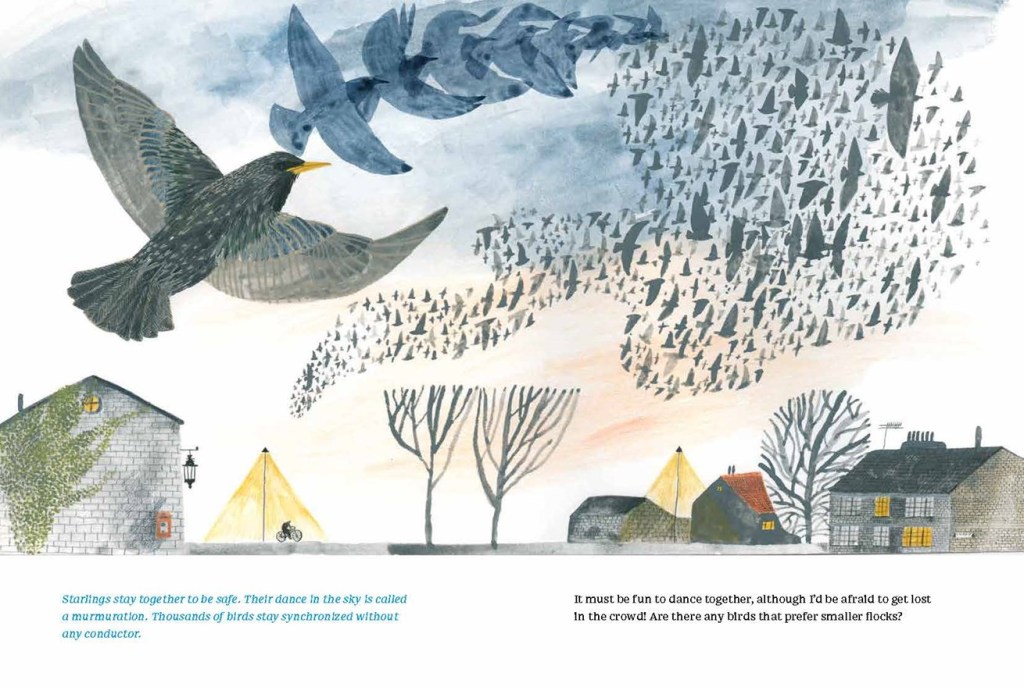
A flock of starlings forms a “murmuration,” as “Thousands of birds stay synchronized without any conductor.” Again, the varying scale of the scene elements are a quiet drama. On the ground, a person riding a bicycle appears very small. Above, the murmuration is a symphony in motion. I was reminded of the fish learning about solidarity in Leo Lionni’s Swimmy.
The book concludes with two pages summarizing the star players, from hummingbirds to black-capped chickadees. Everyone eventually learns to fly, swim, swoop, and find nectar, when the time is right.
Journey of the Humpbacks – written by Juliana Muñoz Toro, illustrated by Dipacho, translated from the Spanish by Lawrence Schimel Eerdmans Books for Young Readers, 2025
Although this fabulous informational book about humpback whales has not relation to Baudelaire’s poem, “L’invitation au voyage,” I could not help thinking of its title and famous refrain when I turned the first page. The author states her purpose: “This is an invitation for us to go on a journey. We don’t need a backpack or shoes. Just our eyes wide open.” Every book fits this description. By framing the experience of reading this way, Juliana Muñoz Toro raises expectations and meets them. Baudelaire invites readers to encounter a world where “Là, tout n’est qu’ordre et beauté,/Luxe, calme et volupté,” (“There, there is nothing but order and beauty,/Richness, calm and beauty.”) Instead of dream world, Muñoz Toro, and illustrator Dipacho, extend an invitation to the natural order and beauty of the environment. Science books for young readers need not omit a sense of wonder.
I won’t try to summarize the wealth of information in this book about the often misunderstood sea mammal, the humpback whale, otherwise known as Megaptera novaiangliae. Did you know that its Latin name means “giant-winged New Englanders?” Probably not, even though you may associate whales with New England, where this one was originally sighted by Europeans. To orient you on your journey, Dipacho’s elegant graphics, paired with captions, text boxes, and color judiciously added to black-and-white. Some of the questions even present the answer upside down, adding the sense of a game. To help you envision scale, a parade of Emperor Penguins sits atop the huge creature, whose principal features are carefully labeled.
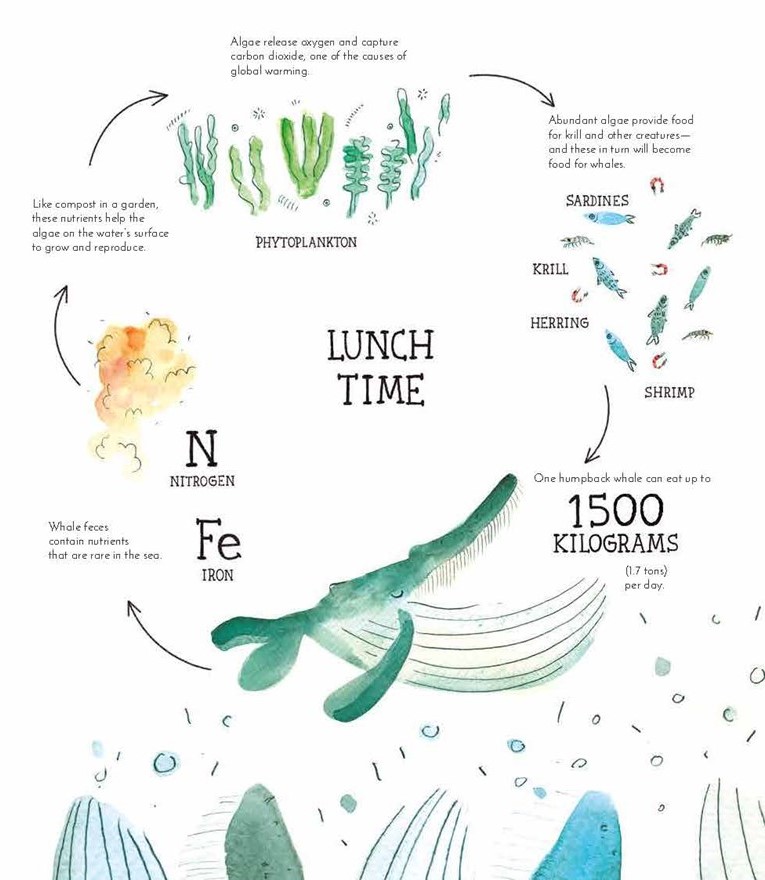
If you come to the book with some basic knowledge of humpback whales, you will still learn a great deal. Nothing is necessarily obvious, including the basic fact that every part of the environment is related to one another. “Nothing that happens in the water does so in isolation.” “Lunch time” involves a nutrients provided by algae, sardines, and krill.
The pictures are meticulously accurate, but also personify the whales a bit, with their balletic movements that seem almost joyful. Referring to the segments of their day as “nap time, “ “time for adventures,” and, of course, “time to breathe,” sets a tone of familiarity, but also awe: “The breathing of humpback whales is long and deliberate, as if they were meditating.” Note the phrase “as if.”
When people appear, they are comically observant, watching the whales and taking notes of what they see. Here Dipacho presents richer colors than in the extensive factual scenes, as he brings humans into the picture. They are important and provide perspective, but they don’t compromise the whales’ starring role. In fact, a wonderful two-page spread categorizing the baleen whale family (image) identifies the humpback, with a touch of humor, as “the protagonist of this book.” Another concise and complete section on the whale’s reproductive life is, again, accurate and also performative.
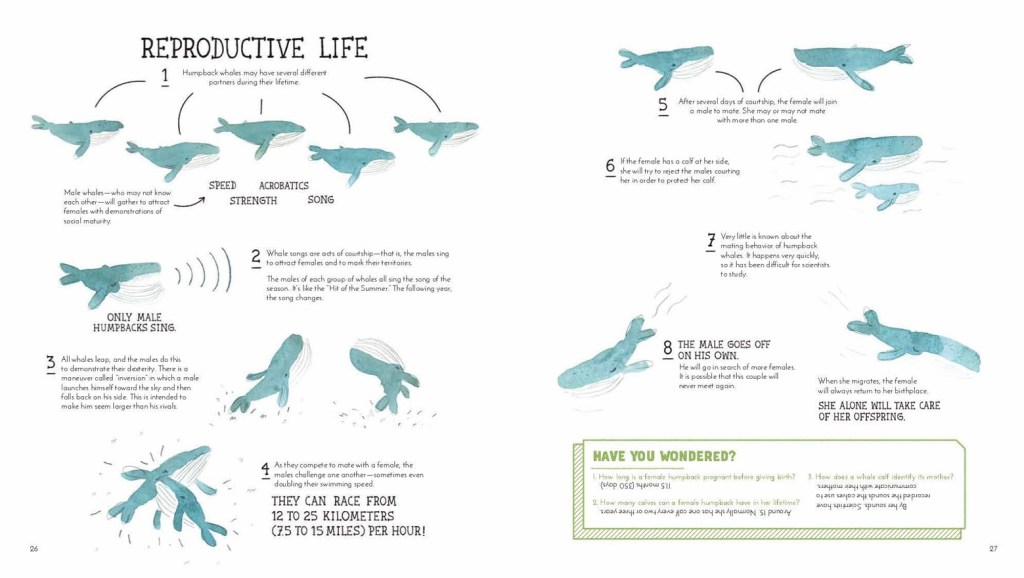
Steps numbered in sequence give the facts and also allow the reader to draw her own conclusions. “She alone will take care of her offspring.” The “Have You Wondered” section reveals how a calf learns to identify its mother. The book’s backmatter declares that it was created by “a team of people who love whales.” By this point, you will not have any doubt of that essential fact.
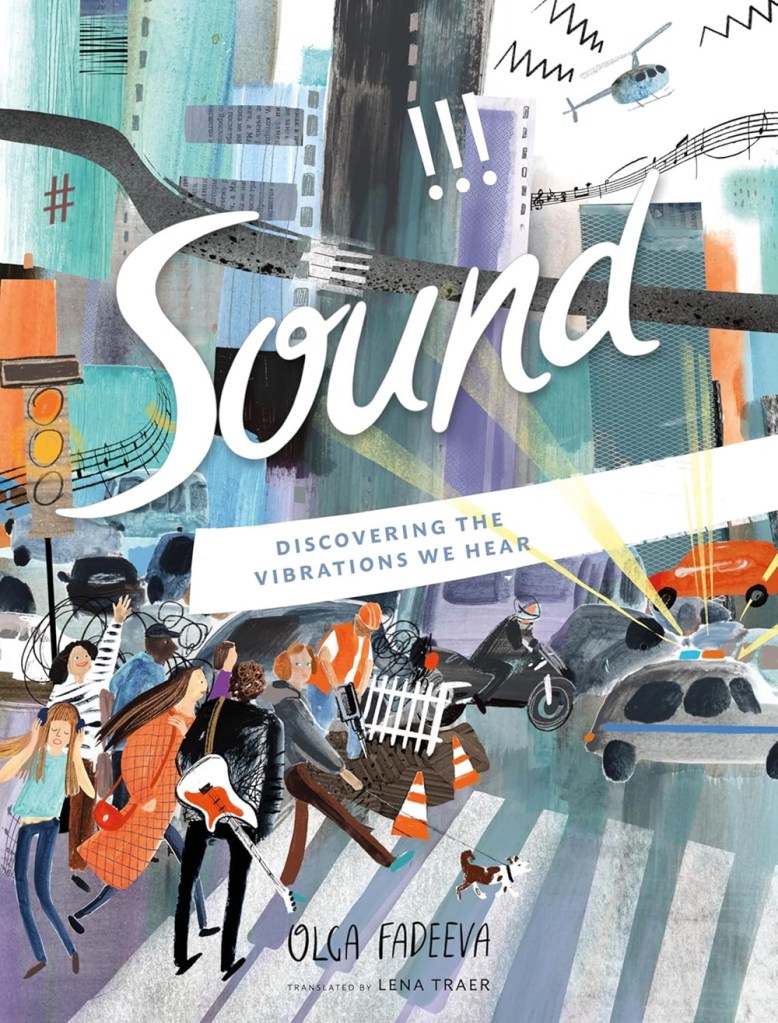
Sound: Discovering the Vibrations We Hear – written and illustrated by Olga Fadeeva, translated from the Russian by Lena Traer Eerdmans Books for Young Readers, 2025
Imagine for a moment that you are about to pick up a children’s book explaining the physics of sound. How do we hear and transmit noises? Then being to page through it, noticing that the illustrations, in acrylic paint and water, would be worth the proverbial price of admission. Then, as you begin to read, you realize that the ambitions behind this project go way beyond the scope of what you had anticipated. Author and artist Olga Fadeeva has produced an information-rich picture book that moves among physics, biology, history both distant and recent, spoken and signed languages, culture from music to architecture, and technology. That list is still incomplete.
Sound requires careful attention and rewards it on every level. Opening the book, we see a mother cradling a baby; this is the setting for how we first experience sound. Then, we enter a kitchen, the familiar setting for objects emitting noises, so ordinary that we might ignore them: a boiling teakettle, a clock, a phone, a pot of soup. There is no division between the informational and artistic components of this picture, or in any other section of the book. Aware of how attention is naturally segmented, Fadeeva places her intriguing introductory premise in a rhombus that is actually in inside of an open window. The metaphor is perfect. A window is opening onto the meaning of sound.
Some pages use different sizes and colors of font, and have captions, as well as words that are sound effects framing the text. There are carefully employed graphics, such as a line indicating the intensity of decibels, or the organs of hearing and speaking labeled and described. The progression among topics is not frenetic; every idea is clearly linked to the ones preceding and following. While Fadeeva cannot anticipate every question about sound, there are many common sources of wonder that are clarified. How do bats hear? What are some common birdcalls? What is distinctive about underwater sounds?
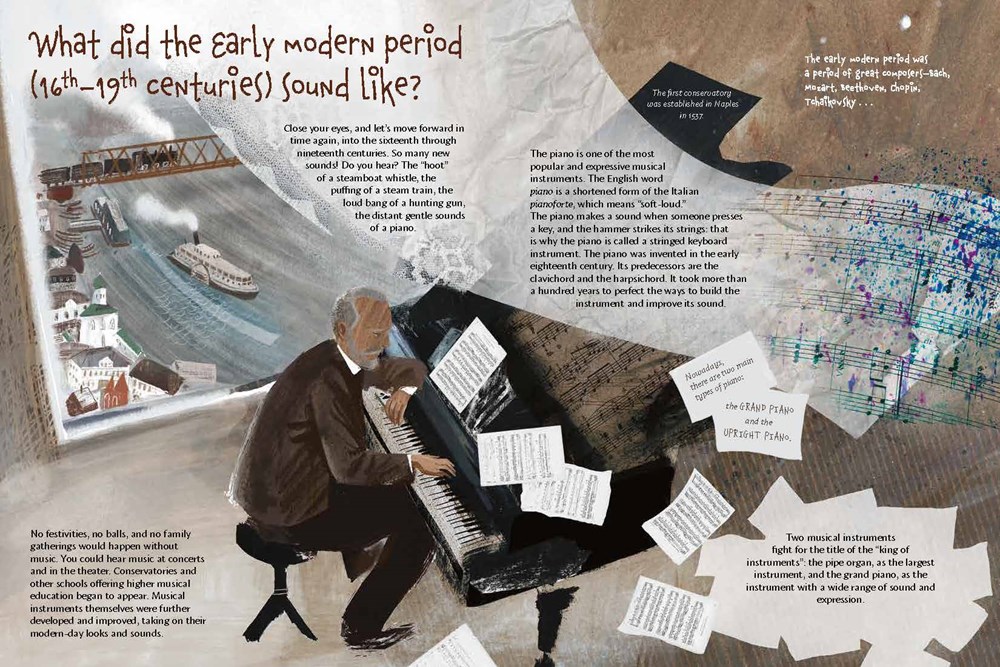
There are other angles from which to explore sound and Fadeeva credits young readers with the curiosity to include them. She actively engages them with invitations to consider different contexts. What was sound like in prehistory? How did the audience hear in the amphitheaters of the ancient world? (images). Medieval music makes an appearance, visualized with the excitement of charging knights and the lovely concert of flute, timbrel, bagpipe, and lute. Musical notation has its own pages. Even if children have never read music, they will be drawn in by the basic premise: “How can you write down music on a page – and turn it back into sound?” Glamorous performers and intricate pages of notes give the effect of collage. Pages on recording sound includes images of antique devices, and the question of “How do you fill the world with sound?” is followed by a concise but detailed answer superimposed on a dial telephone. Even the cord is covered with words.
The concluding endpapers feature brightly colored pictures and instructions for experiments. Even after this incredible excursion into the world of sound, children may still want to fill a plastic bottle with buttons or beans, and create an orchestra. Sound is an intricate and engaging performance for children and adult audiences.
Spaghetti: A Mouse and His Treasure – written and illustrated by Merrilees Brown Tundra Books, 2025
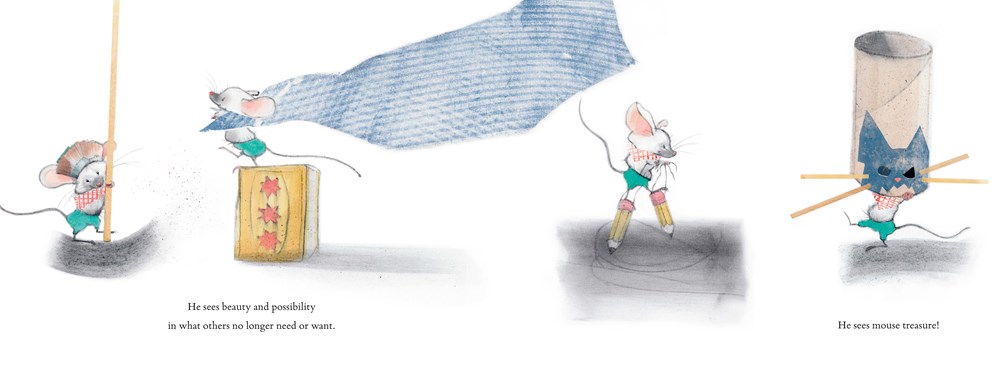
Collecting is a fantastic hobby, or maybe it is just an annoying compulsion. One person’s desirable object is another person’s clutter. Author and artist Merrilees Brown transforms this truism into a wonderful story about Spaghetti, a creative mouse who “sees beauty and possibility in what others no longer want or need.” Named after one of his favorite media, this charming character is rendered in graphite, oil paint, print, humor, and affectionate details.
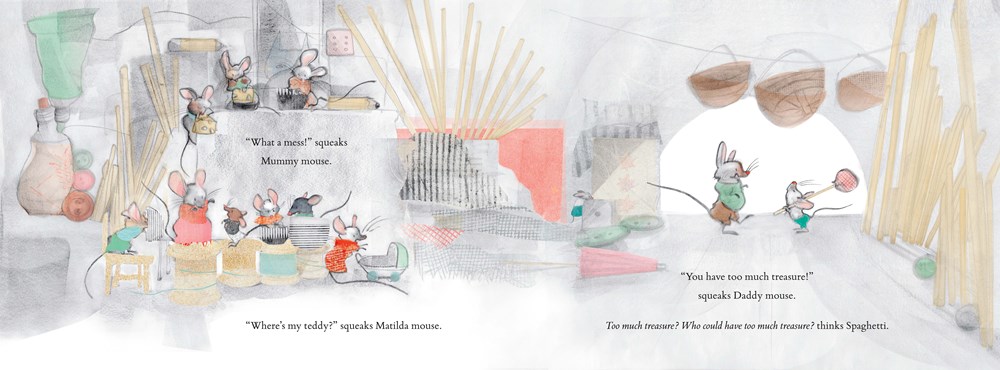
Since mice have large families, Spaghetti has a rapt audience for his pencil stilts, cat face costume, and even his carefully composed box of cast-offs waiting to find a use. Yet other members of his clan are annoyed by his endless projects. Mummy complains of the mess and Daddy makes the puzzling statement that “You have too much treasure”” as if that were possible. Spaghetti responds with conviction, and even a hint of defiance, literally immersing himself in the multicolored materials he will bring to life.
Spaghetti recognizes that he has a problem, so he “puts on his thinking cap.” Children have the pleasure of seeing this expression visualized as one of the mouse’s creations. Crafts are sometimes distinguished from works of art by their usefulness, but this distinction can be permeable. Spaghetti decides to emphasize the incredible properties of pasta, building something practical for everyone in his home. Engineering meets art in his Calder-influenced amusement park. (There are other picture book mice with artistic sensibilities and kinetic skills; I’ve reviewed three of them here and here and here.)
Spaghetti’s self-assurance allows him to persist, even when others fail to recognize the importance of his vocations. At the same time, he is as flexible as a strand of spaghetti, letting young readers know that being true to oneself doesn’t require dismissing other viewpoints. Best of all, he succeeds in combining three different values: collecting, creativity, and love for his family.
Stella & Marigold: Mermaids and Mix-Ups – written by. Annie Barrows, illustrated by Sophie Blackall Chronicle Books, 2025
The second volume in Annie Barrows and Sophie Blackall’s series about an unforgettable pair of sisters continues their adventures, and the development of their relationship. Stella & Marigold established that their closeness, characterized by both unrelenting love and occasional friction, was as believably narrated as Beverly Cleary’s Ramona books (astute readers of my blog will recognize that its title derives from a quote in Ramona the Brave.) The outward similarities between the two series are not superficial, but rather are based on the way which both sets of books communicate how it feels to be a child, without a touch of condescension. Both also invite adults to identify with characters, whether by remembering their childhood or following along as Stella and Marigold’s parents, teachers, and grownup friends, who also propel the plot. (I reviewed the first Stella & Marigold book here.)
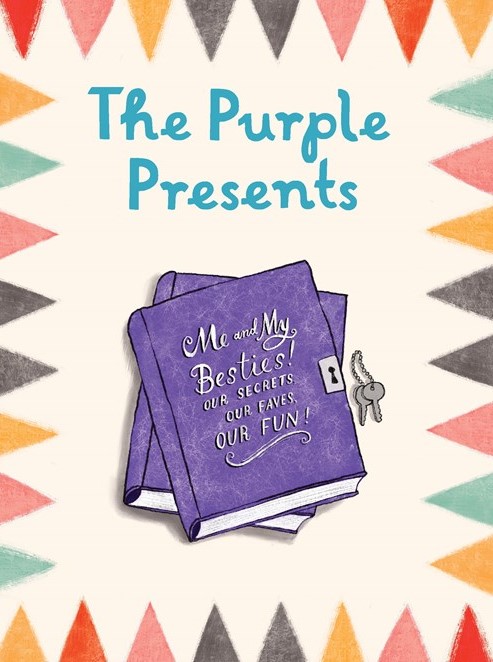
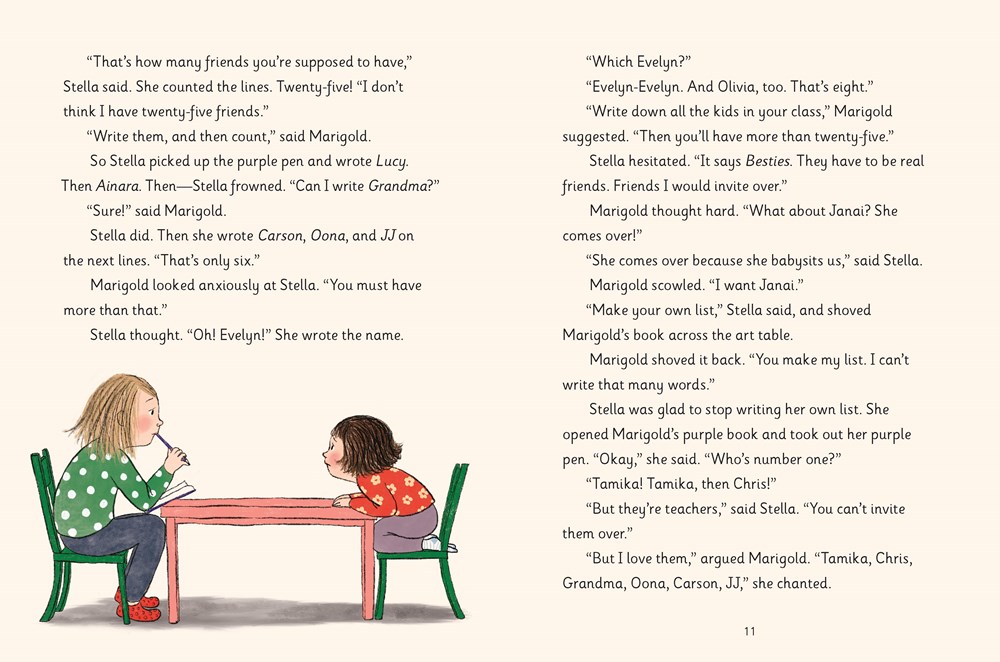
Each chapter may be read independently, but are interconnected. The book begins with a gift which the sisters receive from their Aunt Judy. Like many of her gifts, this one turns out to be a Trojan horse. A sparkly purple covered diary with high-pressure demand to record “Me and My Besties! Our Secrets, Our Faves, Our Fun!” sets Stella and Marigold on a series of attempts to find friends worthy to fill in the blanks. Even though this involves some distress, it eventually leads to an understanding of friendship and empathy, minus the high-stakes categories.
In “Snow, Snow, Snow!” Stella tries to win the friendship of a classmate by using mind control to ensure a snowstorm. When their teacher, Mr. Banagal, intends to dissuade the children by calling this “magical thinking,” Barrows reveals how differently adults and children sometimes interpret reality. His phrase has the opposite result. After all, what else could magical thinking be but “encouraging?” Adults will read this passage with recognition, but not a sense of superiority unless they don’t remember what it felt like to fruitfully “misinterpret” adult’s language. Barrows does employ a little bit of gentle humor at adults’ expense when Teacher Kaitlin carefully avoids direct praise of Marigold’s artwork, instead focusing on one quality:
“Wow, your picture is so detailed”…She always said things like that. Never, “Your picture is great…the best I ever saw.”
Blackall’s pictures feature her ability to convey a character’s feelings with slight alterations of their features. (I reviewed another of her books here.) A range of crayon-box colors, and careful composition of images against white background, give every page of the book its own impact. Stella and Marigold sit across from one another at a table, as they collaborate on coping with the diary. Marigold desperately tries to get her father’s attention when he is absorbed in his work; his temporary rejection leaves her curled into a question mark, embodying her feelings about why his priorities would be so misplaced.
There are so many series about girls and their friendships; many of these are terrific. Stella & Marigold fits securely into the category of classic.
Lights at Night – written by Tasha Hilderman, illustrated by Maggie Zeng Tundra Books 2025
There are two families observing the rhythms of the year in Lights at Night. One is human and the other canine, specifically foxes. Dream-like images with changing shades of color include realistic details, both natural and cultural. Children experience the wonder, but also the reassurance, of the four seasons and their special features, from football in autumn to storms in spring. While the fox family does not kindle holiday lights around the time of the winter solstice, they also appear to respond to the changes. Tasha Hilderman’s soothing poetic text complements Maggie Zeng’s visual immersion in the excitement of one year. Children find joy, not boredom, in the repetition of familiar events.
A powerful storm is just unsettling enough to make the shelter of home more of a comfort. Crayon drawn strikes of lightening emanate from a house, enclosed in a photograph, and also cross its border. Inside, a strong of lights and beds configured as tents add the sense of drama that children like. Note the plush fox in a small sleeping bag. The fox family lacks the domestic props, but is just as attuned to the environmental changes. Of course, animals’ lives are more closely defined by the seasons. In spring, “new babies arrive with the stars.”
Campfires come in summer; riding the bus to school and harvesting wheat are tied to autumn. One of my favorite images in the book is a natural and unobtrusive celebration of multicultural holidays. Christmas trees, Diwali lights, a Muslim family welcoming visitors, and a Kwanzaa lamp grace the neighborhood, along with a Jewish family’s observance of Chanukah. If you look closely, you will see that the correctly depicted nine branch chanukiyah (menorah) has its candle farthest to the left partly obscured by the window frame. This is not an error, just a small visual element lending authenticity to the way in which someone placed the lights, which must be visible from the outside.
At the end of the book, the two children share an album and a box of crayons. The volume is open to the photo with lightning, enhanced by the children’s artwork. The actual fox looks up the moon.
Trouble Dog: From Shelter Dog to Conservation Hero – written by Carol A. Foote, illustrated by Larry Day Eerdmans Books for Young Readers, 2025
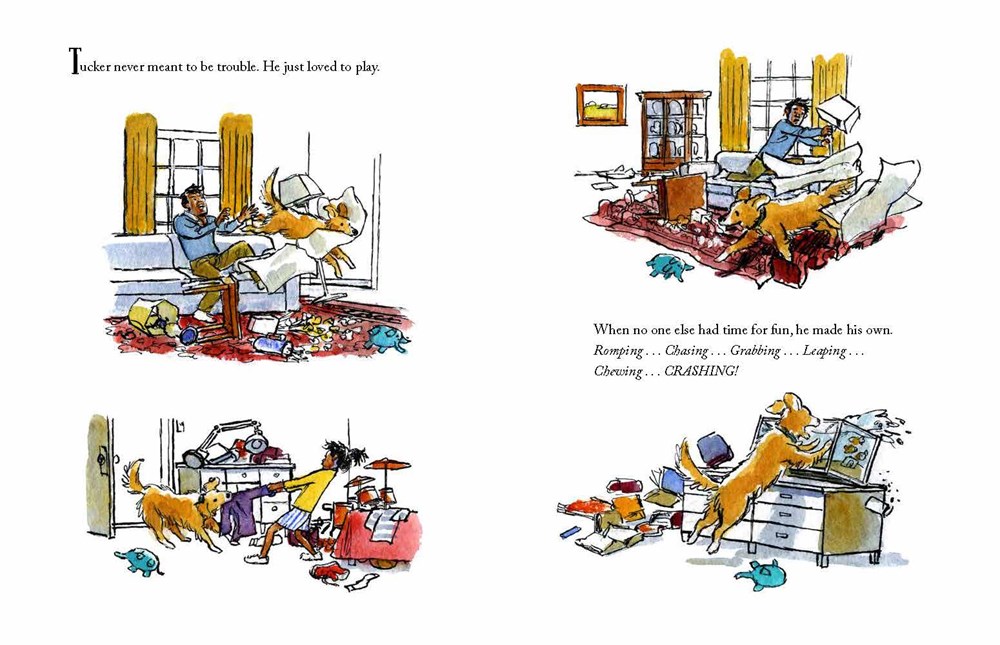
There is a lot of action in Trouble Dog. There is also an abundance of information, a likeable main human character, and a surprising amount of humor. Carol A. Foote has combined two real-life conservation dogs into one fictional hybrid named Tucker. Caught in a cycle of adoption and rejection, he is always returned to the animal shelter that has given up on placing him. Then, along comes Laura, a classic heroine who refuses to give up on an unlikely pet who has driven everyone else to distraction. Larry Day’s pictures are full of action and color, setting a motion Laura and Tucker’s journey from trouble to success.
The opening end papers introduce Tucker in some typically frenetic canine activity. Then it escalates, as every home the shelter finds for him is subjected to chaos. Tucker manages to overturn an aquarium and books in one place. He grabs a girl’s sweater and won’t let go. A man attempting to read his newspaper looks enraged as Tucker grabs it and leaves a litter of overturned items in his wake. When we next see him, Tucker is a lonely prisoner in a cage, “watching everyone pass him by.”
Laura is a sturdy figure with a ponytail, flannel shirt, and jeans. She is as no-nonsense as Mary Poppins, and she also intuits something about Tucker that everyone has missed. His energy can be put to good use. Even though her home is quickly as disordered as every other place Tucker has been, she has a vision and the practical sense to implement it. Dogs, as readers learn in Foote’s detailed backmatter, have a highly developed sense of smell. Laura observes Tucker carefully and evaluates his routine and abilities. She isn’t just kind and patient, but methodical, as well.
Eventually Tucker gets a job, or a series of jobs. The details in the text are embedded in words as colorful as the pictures. “Tucker’s first job was to find rosy wolf snails in Hawaii.” (image). He travels the world, sniffing out “moon bears in China, mountain lions in Chile, and elephants in the jungles of Myanmar” in a narrative as exciting as one by Jules Verne, but rooted in the truth. In a two-page spread, Tucker crosses the gutter between pages. An elephant marches ahead of him, dwarfing the dog in size, but not in energy. Three researchers form a determined row in the background, to his left. The image captures the cooperation necessary for Tucker to succeed in helping scientists to learn about species in need of protection.
Not every outing produces results easily. In Zambia, Laura’s optimism is tested, looking for cheetah scat and coming up short. When Laura insists that “I trust Tucker,” who finally leads them to the right location, she is not relying only on her affection for the dog. Through hard work and astute decisions, she and Tucker have become a team.
Four pages of additional information and photographs are organized in a question-and-answer format, giving the bigger picture of how conservation animals, as well as other service animals, provide essential services. A selected bibliography is accompanied by an oval portrait of Laura and Tucker relaxing at home. I hope that no one misses one title, by Alexandra Horowitz, Inside of a Dog: Young Readers Edition: What Dogs See, Smell, and Know. Just parenthetically, the title refers to the famous quip usually attributed to Groucho Marx: “Outside of a dog, a book is man’s best friend. Inside of a dog, it’s too dark to read.” It’s definitely not too dark to read inside this book.
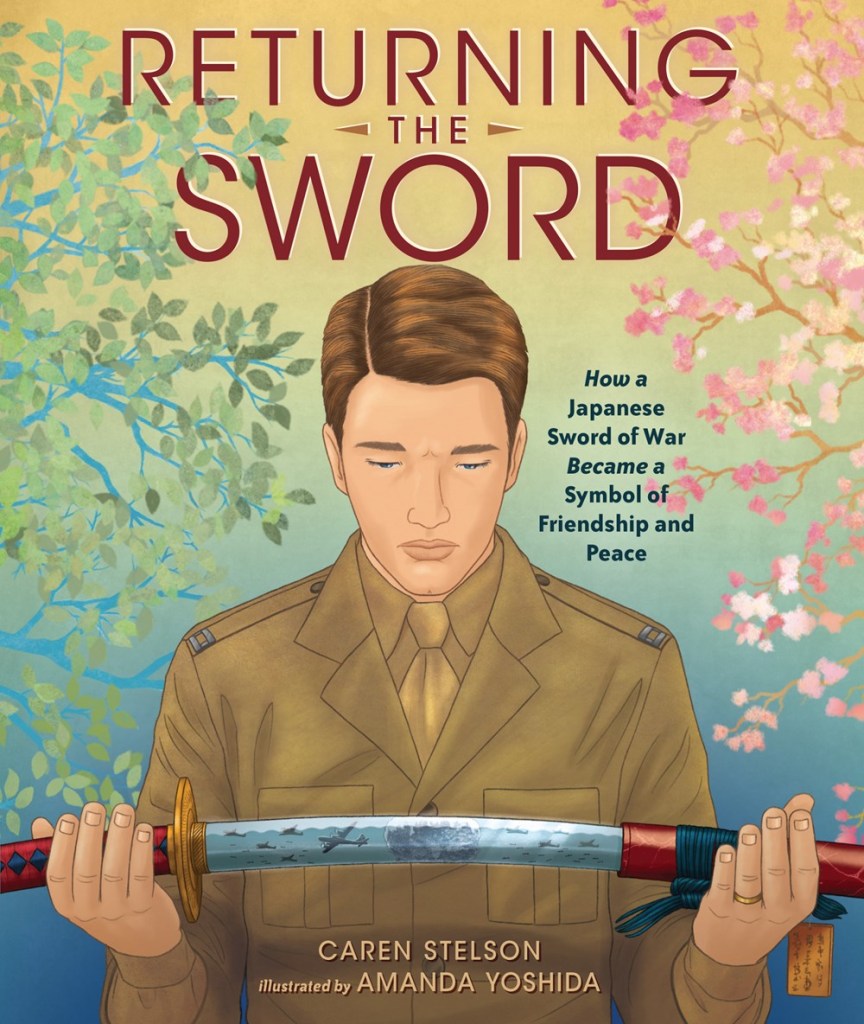
Returning the Sword: How a Japanese Sword of War Became a Symbol of Friendship and Peace – written by Caren Stelson, illustrated by Amanda Yoshida Carolrhoda Books, 2025
There is an understandable connection, for many readers, to books that promise a hopeful vision of reconciliation after conflict. I have read and reviewed many books in this category. While I respect the principle of deriving a positive lesson from a disastrous historical event, I have difficulty with facile messages of friendship in the absence of context. Returning the Sword has beautiful illustrations by Amanda Yoshida, and the text by Caren Stelson is obviously the product of sincere beliefs. She is a serious author committed to writing about important topics. However, I am troubled by the book’s almost complete absence of accurate information about Japanese aggression before and during World War II, and its depiction of the Japanese people as the sole victims of that conflict (as was also done here).
Stelson relates the story of Orval Amdahl, a man who served in the U.S. Marines during World War II and in the postwar occupation of Japan. He was horrified by the death and destruction wrought by the atomic bomb, a response shared by people throughout the world. Although more people were actually killed in the firebombing of Tokyo, inflicting death by radiation poisoning in the cities of Hiroshima and Nagasaki was conceived as a different category of weapon, one to be avoided ever again.
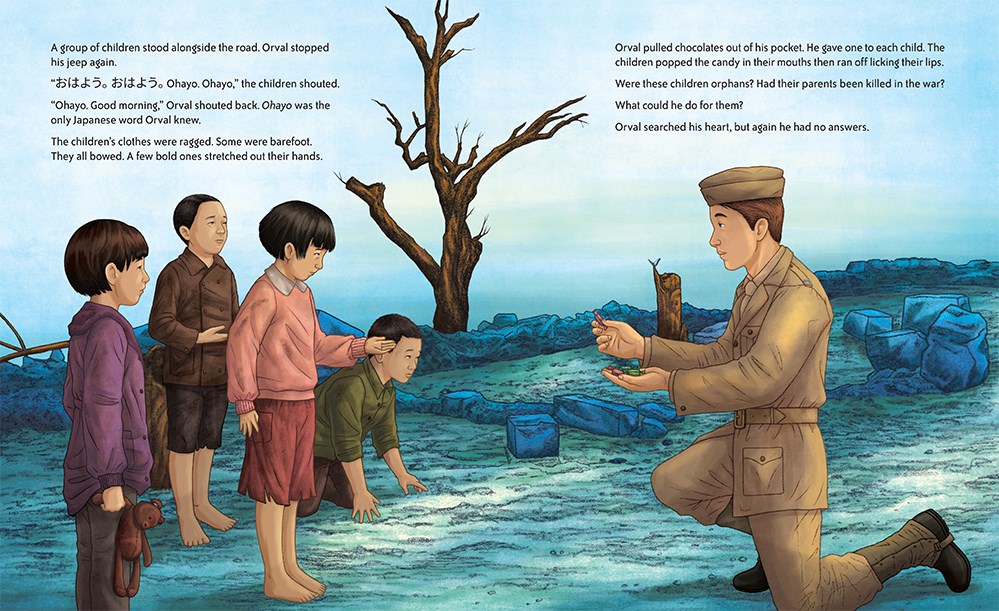
The decision to use that weapon to end the war, while one with terrible consequences, did not occur in a vacuum, but readers would never learn that from the book. Reporting Captain Amdahl’s reaction in Nagasaki, Stelson writes that “The city had been destroyed by a terrible bomb,” and “So many people had lost nearly everything important to them in this terrible war.” The starving children he meets, and the other civilian victims, had been living under a fascist regime that inflicted torture and murder throughout the countries they occupied, and upon the Allied soldiers who fought against Japan’s imperial forces. The Rape of Nanking, the Bataan Death March, the abuse of Korean “comfort women,” and other atrocities, are completely absent, not even indirectly suggested in an age-appropriate way. I am not suggesting that these sources be directly presented to children, which would be totally inappropriate, but they could be offered as a context for adults sharing the book, since Japanese suffering is uniquely at the center of its message.
Like many soldiers who served in the Pacific, Captain Amdahl returned home with a souvenir sword. This item continued to plague him psychologically, and he ultimately decided that he would like to return it to, as he interpreted it, its “rightful owner.” Stelson describes the swords as works of art and family treasures. The craftsmanship used to create them is somehow allowed to displace their actual purpose as symbols of military might, and also, to a lesser extent in World War II, as actual weapons used to perpetrate atrocities I prefer not to describe here. The U.S. military leaders who encouraged soldiers to appropriate them are cast as heartless. Captain Amdahl enters a room where the swords are “piled eight feet high,” and selects one to take home. This scene struck me as an inversion of the often-described encounter between the liberators of Nazi concentration camps and the bodies they discovered. The swords themselves are personified as lifeless victims.
Eventually, Captain Amdahl contacts Tadahiro Motomura, the son of the sword’s owner. Mr. Motomura writes of how his father did not talk about the war, but expressed his sadness at the loss of his sword: “At the end of the war, it hurt him to give it up.” (Without describing atrocities, the author might have suggested the incomplete nature of this statement. Even a mild indication of its irony, such as “The Japanese had caused great suffering in the countries they occupied. Still, Mr. Motomura felt sad about the loss of his family heirloom,” would have been closer to the truth.) Unlike in Germany, where an incomplete, and ultimately truncated, version of denazification was U.S. policy, in Japan a decision was made, in the context of the Cold War, to avoid forcing responsibility on the defeated nation. The emperor remained as a figurehead and there was virtually no educational program to ensure that the Japanese understand anyone’s suffering other than their own.
Captain Amdahl and Mr. Motomura believed that their personal reconciliation had embodied the idea of “peace with honor.” Perhaps if they had each come to terms with the historical realities that brought so much destruction, culminating in the terrible choice of using an atomic weapon, their decision would have been more meaningful. The book’s visual beauty, and even the ideal of reconciliation, could prompt a serious discussion with children about the consequences of both totalitarianism and violence. Historical facts and the idea of accountability would need to be part of that dialogue.
Taro Gomi’s Big Book of Verbs – written and illustrated by Taro Gomi Chronicle Books, 2025 (Original Japanese edition, 2020)
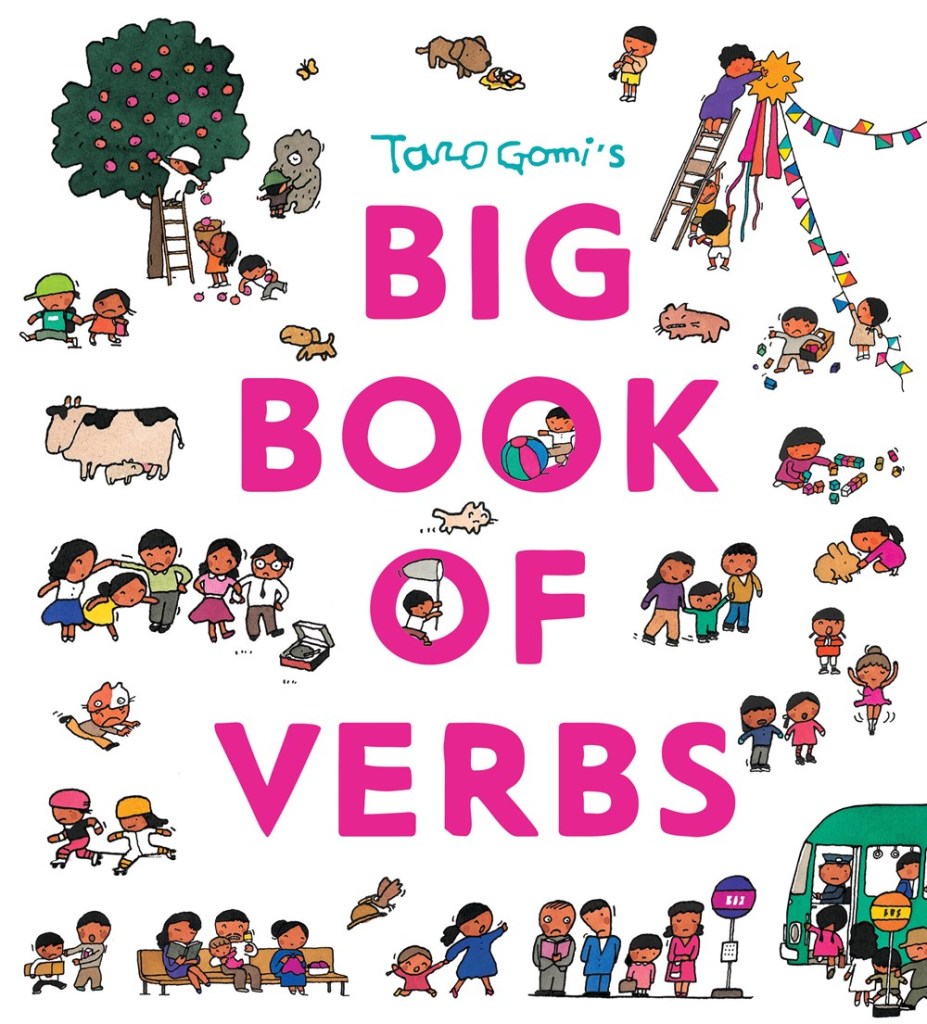
Children like to move, whether they are playing, responding to instructions, or participating in daily routines. Unlike for many adults, those routines do not yet seem perfunctory or automatic. In Taro Gomi’s Big Book of Verbs, the artist breaks down those actions, labels them, and imbues them with individualized characters.
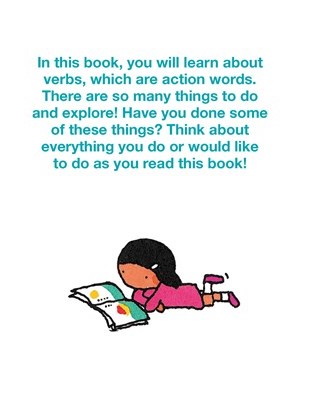
Why dedicate this type of children’s dictionary exclusively to verbs? Taro Gomi’s Big Book of Verbs is more inclusive in its parts of speech. As Gomi points out in his brief introduction, “There are so many things to do and explore! Have you done some of these things?” Of course, you have, and Gomi encourages readers to think carefully about each action’s meanings, whether rejecting a breakfast food, fighting with classmates, or boarding a bus.
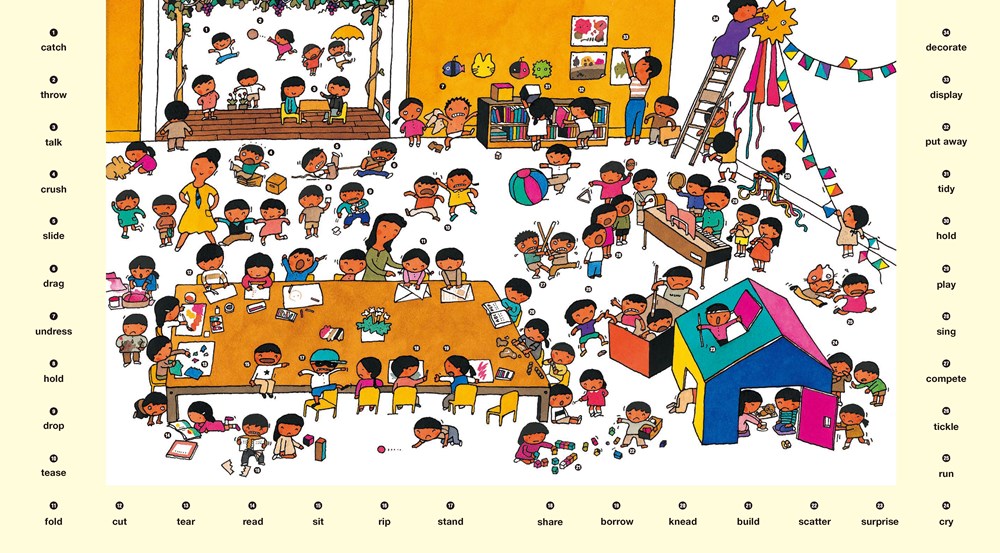
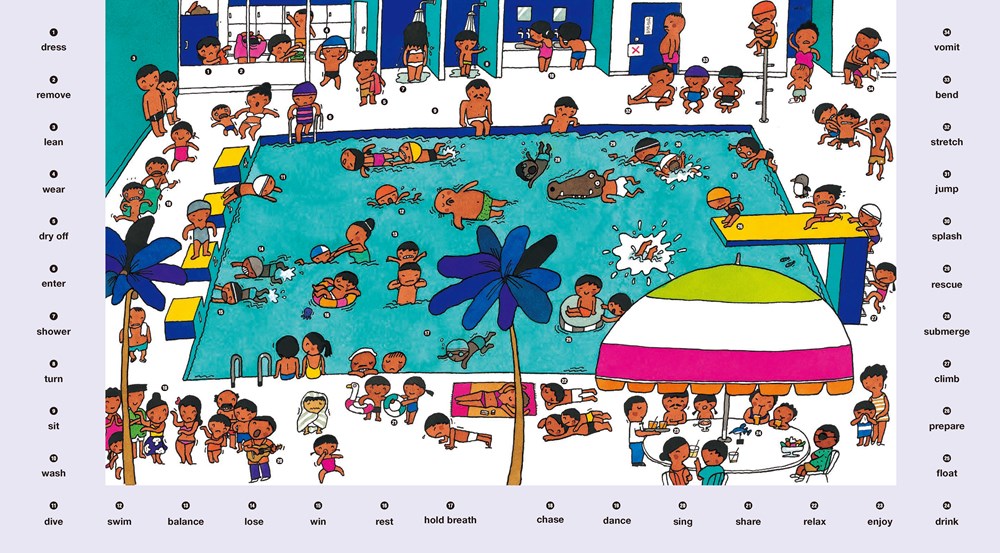
Gomi’s signature style features people with simple features that express a lot. Each word is numbered and corresponds to a picture. “Harvest” demonstrates the effort involved in pulling a plant from the ground. A day at the swimming pool encompasses a range of emotions, from fear to happiness. Sometimes feelings are more subtle. While the child about to leap from the diving board may be a bit frightened, she is also simply ready to “prepare” for her leap. Gomi never romanticizes childhood; both adults and children will appreciate the way that he portrays reality. Conflict, discomfort, and frustration are tied to actions, but so are joy, silliness, and determination.
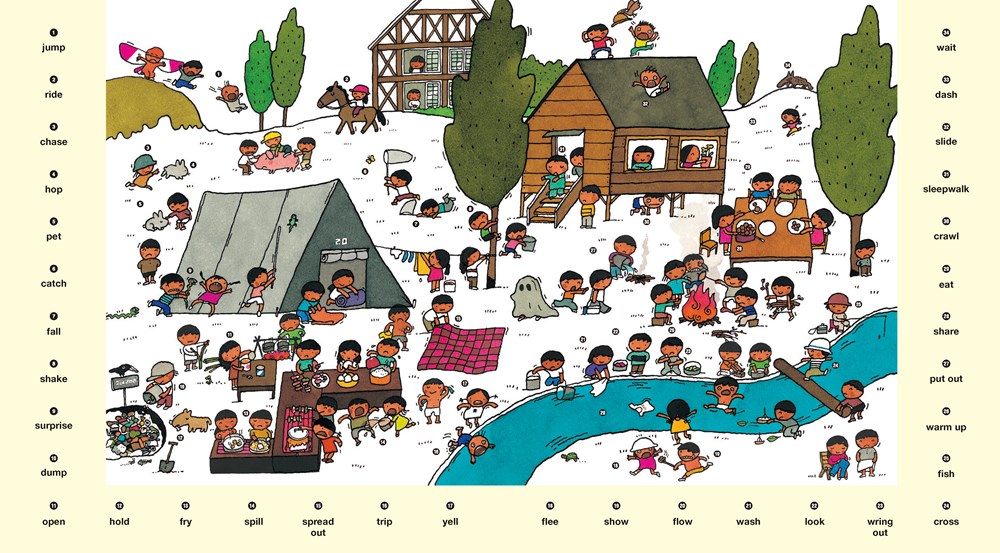
There are a number of humorous surprises tucked into the book. At the zoo, there are some lions who are as selfish and angry as the human visitors. (There’s also a calm elephant family, and monkeys having a great time.) An indoor arena features people skating, playing soccer, dancing ballet (“twirl”), and, as part of these interactions, defining both “apologize” and “forgive.” Yes, those are action words, too. The camping scene includes someone sleepwalking.
As in many books of this genre, including Richard Scarry’s classics, the possibilities of finding new elements of interest seem infinite. Why is that boy breaking a fence in the farm scene? Is the child drawing in his classroom tired or triumphant when he holds up his crayon? Two apes are relaxing near a t.v.; the one reclining defines the word “chill.” As Winnie-the-Pooh famously stated about bees, you never can tell with verbs.
























 Imaginary Elevators