The Happiest Country, a Long Time Ago

Happy Times in Finland – written by Libushka Bartusek, illustrated by Warren Chappell
Alfred A. Knopf, 1941
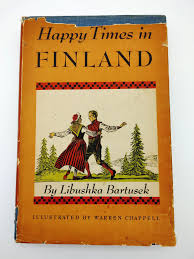
Everyone knows that Finland is allegedly the happiest country in the world.  You certainly can’t take these simplistic measures too seriously, and comparing Finland to other countries with entirely different histories, economies, and demographics is useless.  I recently reread an unusual childhood favorite, which I had bought at a library used book sale. Its appeal to me at the time remains vague. I would read almost anything, and it had lovely pictures and promised to tell a story about a distant part of the world. Happy Times in Finland, by  Libushka Bartusek, was published in 1941. At that point, it was indisputably not happy at all.  Having been invaded by the Soviet Union, they eventually allied with Germany in that country’s war with its Russian enemy.  This was a bad choice, but it is not reflected in the book, which takes place in the idyllic time period before the war.

There is minimal plot and character development in the book, but a lot of folklore.  To summarize the improbable premise, Juhani Malmberg, a Chicago Boy Scout with Finnish immigrant parents, goes to visit his ancestral homeland.  He is able to take this expensive trip due to the generosity of his father’s employer at a furniture factory, Mr. Adams.  Finland is known for, besides an improbable level of happiness, abundant high-quality wood. A furniture manufacturer would be eager to see firsthand the source of his best supplies. Since Mr. Malmberg is such a loyal employee, his benevolent boss actually takes Juhani along, for free! He has the opportunity to see his beloved grandparents, as well as his aunt, uncle, and cousins.  In addition, Juhani becomes an ambassador from the American Scouts to their Finnish counterparts.  Aside from missing his parents, there’s a lot of happiness here.
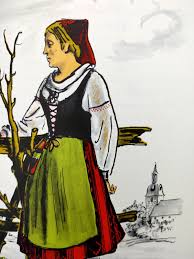
Poetic language fulfills expectations about a land endowed with natural resources, and steeped in literature.  Approaching land, Juhani seems to be expecting a myth and he finds one: “Sure enough, there it was, just as his mother said it would be: an expanse of water, blue as sapphire, with green islands dotting it, as though some giant had scattered a mammoth handful of emeralds on a silver-streaked scarf.”  Not only the environment, but its people, are described with hyperbole. Oddly, almost everyone is blond.  Finland has a Swedish minority; the name “Malmberg” indicates that his father’s family is descended from this group. His cousins’ last name is Kallio, of Finnish origin.

Finnish is not a Scandinavian language, but is related most closely to Estonian and Hungarian. (A glossary of Finnish words is included at the end of the book.) Here is a description of Juhani’s aunt, a veritable Amazon of pale beauty: “She was tall and blond, so blond, in fact, that Juhani thought she was white-haired…she had great dignity…he felt as though he were at the feet of some exceedingly beautiful statue, all made of silver and bronze and pearl…her teeth gleamed like mother-of-pear.” There are even references to “Viking blood.”

The few realistic elements stand out because of their minimal role in the story.  Aunt Kallio, Aiti to her children, has favorites among her offspring.  Her older son, Jussi, will vicariously fulfill her own dream by becoming an architect, a career closed to women. Eero, the younger boy, is not academically oriented. Unlike his parents, he prefers manual labor. She keeps her disappointment to herself, only thinking how he lacks “initiative.” “Oh, me! she sighed, one could not be everything.”  This statuesque symbol of perfection is unable to tolerate individual differences.

Warren Chappell’s illustrations, some in color and others sepia, appear to be lithographs.  They are stylized images, whether portraying men in a sauna or women clothed in traditional costumes for festivals. There is a haunting image of a blind storyteller who recites Finnish epic poetry.  Mr. Adams recognizes that the Kalevala’s metrics had influenced Longfellow’s composition of Hiawatha. The Old World and the New touch one another in this tale of immigrant roots, written as the shadow of fascism descended on Europe. It’s blatantly out-of-date and also oddly appealing, just for that reason.

Bewitched, Bothered, and Bewildered

The Witching Hour – written by Jennifer Harris, illustrated by Adelina Lirius
Tundra Books, 2025

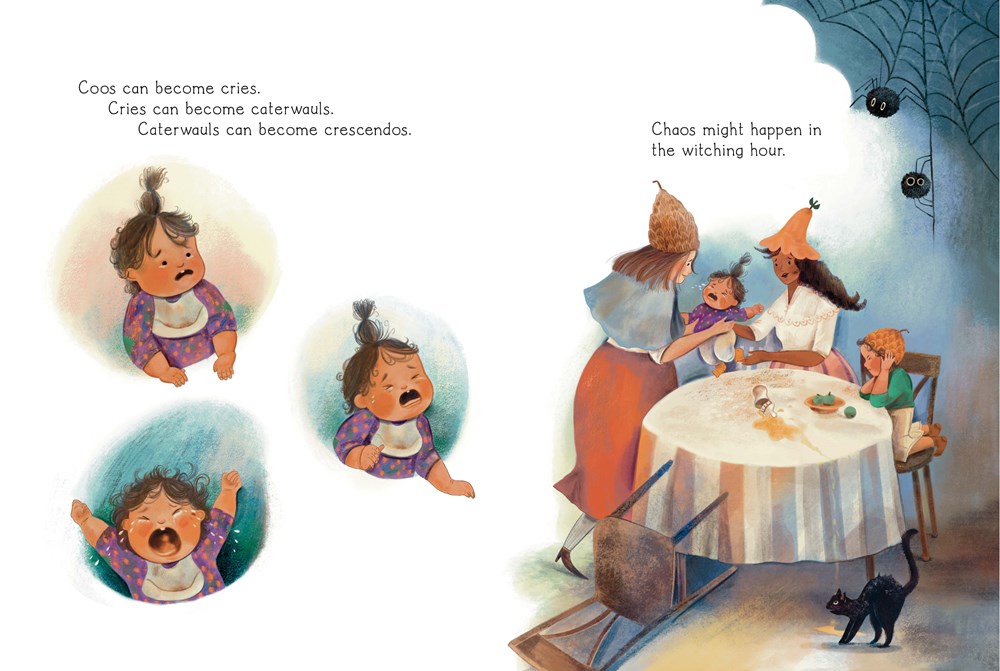
My mother used to refer to “the witching hour,” that time late in the day when babies, toddlers, and young children seem to act a bit possessed. Whether because they have managed their impulses as best as they can for many hours, or need limits and reassurance, or are just exhausted, this can be a difficult moment for parents. The “hour” may seem like multiple hours.  Jennifer Harris and Adelina Lirius (I reviewed another of her works here) have captured the phenomenon so perfectly in their new picture book that you and your children will be under their spell. Indeed, as Harris solemnly states, “Anything can happen in the witching hour.”

The two mothers in the book are paragons of patience, trying every inventive solution you might imagine, and then some.  First, the acknowledge that anything, “or even nothing at all,” can set the chaos in motion.  A baby overturns a cup of liquid on a table enclosed in a lovely tree trunk. Yes, we all recognize that scene.  An older child wearing an acorn cap looks on, clearly worried about the next phase.  The author is honest in calling it “chaos.” It takes both moms to extricate the screaming toddler from her highchair. An adult chair is overturned, a black cat arches its back, and the sibling covers her ears in terror.

One of the most frustrating features of the witching hour, when it happens, is escalation. “Coos can become cries.  Cries can become caterwauls. Caterwauls can become crescendos.”  Harris uses every figure of speech at her disposal: alliteration, onomatopoeia, literary allusions, rhythm.  Perhaps your child can be calmed by a favorite stuffed animal. The moms try a variety of real wildlife, finally settling on the owl. You know the feeling of relief: “Definitely the owl. Thank goodness for the owl.”

If you were hoping for fairies, you won’t be disappointed.  They arrive and join in the music and dancing, in a kinetic scene of joy mixed with desperation. Lirius’s fabulous pictures evoke an entire universe where the fantastic and the familiar are effortlessly blended. Earth colors predominate and the domestic interiors are as welcoming as those in Dutch still paintings. One mom holds the baby, who looks momentarily transfixed. The other mom is dancing upside down, her feet fixed to a magical broom.  Fairies usually command attention, but here they are a great audience. When the show ends (who could sustain that level of energy), the moms come down to earth. 

There are still many comforting possibilities to try: “this bottle, this banana, this bat.” The moms are creative and full of hope, waiting for the moon to signal that at least for today, it’s time to sleep. Suspension of disbelief sets in for this lovely family of nurturing witches. Tomorrow they we ready to start again, with all the resources at their disposal. For readers, this home of friendly spider webs, baskets of knitting yarn, and a quaint wood stove, seems uncannily real. For the duration of the story, you will be living among friends, and the supernatural is just, natural.

Tune In

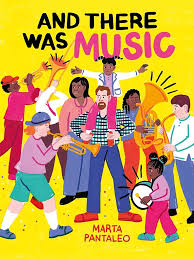
And There Was Music – written and illustrated by Marta Pantaleo, translated from the Italian by Debbie Bibo
Eerdmans Books for Young Readers, 2025

Sometimes children’s books address a question that may seem obvious. How can you explain the meaning of music, the way that people use it to communicate regardless of whether they share a language or a culture? Marta Pantaleo’s And There Was Music offers an answer through spare, poetic language, and bright imagery.  Her answer is non-academic, not definitional. Instead, she approaches the subject through examples that are diverse enough to constitute a whole. Music is shared by everyone, arises from our senses, memories, and emotions, and utilizes different instruments, as well as our voices and bodies, to make itself heard.

The book’s text is pitch perfect.  It alternates statements and questions: “When you listen to music, your heart changes rhythm. Can you hear it?  Some of the statements may seem self-evident: “If you are sad, it can make you feel better.” Still, they need to be said.  The feelings evoked by listening to, or making, music, are largely involuntary: “You don’t decide all this. It just happens.” Some statements are broader, with social and political implications: “Music is a bridge that unites us.”

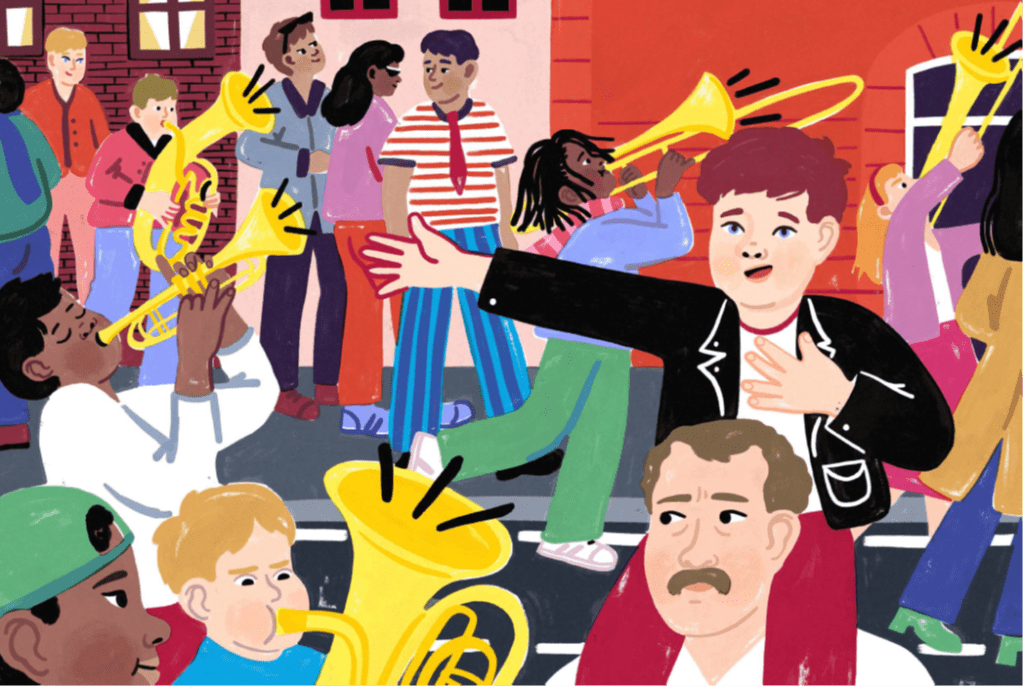
A book composed of generalities about music would be less useful than this one. Readers of. Pantaleo’s work will learn about several distinctive forms of music, which are briefly explained a section at the end of the book. There are bagpipes, acoustic guitars, drums, harmonicas, and brass band.  Musicians are from India, Bali, New Orleans, the American South, and Hawaii, and, of course, from your own community.  The illustrations are boldly colored, and influenced by traditional art.  (The also remind me of Maira Kalman’s work.) They also portray activity, but caught in a specific moment, as in a snapshot.  A girl moves her hands across a piano keyboard, her eyes closed in concentration. A gospel choir captures “hope,” with their voices and hands. A girl sings in the bathtub with a brush as her microphone.  Each image is its own performance.

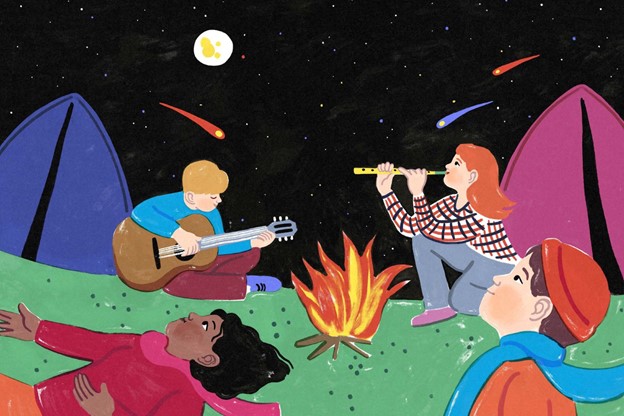
The design of the book and the composition of each page are also key notes to its success. Four young people surround a campfire. Each one has equal weight in contributing to the whole. A boy strums the guitar. A girl plays a flute. Two others do not play instruments, but they look up towards the sky at shooting stars and the moon.  “Music is connection,” yet, at the same, time each individual in the scene experiences it differently.

The melody of words, the harmony of voices, the choreography of figures, all make And There Was Music instrumental in helping children to understand this form of language. After you share it with them you will both continue to hear the echoes.

Music is connection.

Learning French with McDuff

McDuff Goes to School – written by Rosemary Wells, illustrated by Susan Jeffers
Hyperion Books for Children, 2001

If you have never read any of the picture books about McDuff, the little terrier who is adopted by a loving couple living in a charming village in the 1930s, you have missed a modern classic. They are collaborations between two legendary authors and artists, Rosemary Wells and Susan Jeffers. McDuff Goes to School is the fifth in the series, and it holds a particular interest in the category of children’s books that informally present a new language (other example include Pizza in Pienza, Eat, Leo, Eat and My Sister is Sleeping). 

McDuff lives at number nine Elm Road, a location as essential to the series as Paddington’s address at 32 Windsor Gardens. One day, a new, French family moves in next door. They also have a dog, and, no, she is not a French poodle. That detail is consistent with the understated realism of Wells and Jeffers’ creation. The first conversation between the two dogs is bilingual: “’Woof! Said McDuff. ‘Ouf,’ said Marie.” Note the use of italics for a foreign word.

Marie, the new dog, has owners who are as kind as Fred and Lucy, the couple who adopted McDuff.  Celeste and Pierre de Gaulle (well, I guess their last name is the equivalent of a French-speaking French poodle), agree with Fred and Lucy that their respective pets need to attend obedience school. Mainly, Celeste seems to be in charge, and she is extremely determined. Lucy, realistically, too busy taking care of her baby, and Fred is “too tired after a day’s work” to train a dog. These are totally reasonable explanations, with no apologies offered; they are not inept dog owners.

Celeste’s daily repetition of commands to “assieds-toi!” and “Saute!” are translated in a glossary at the end of the book.  Children will get a real sense of the gap in communication between speakers of different languages, and also appreciate the advantages of bilingualism.  It turns out that McDuff’s apparent lack of progress in school is due to his attentiveness; he is listening to Celeste and learning to understand her language like a native.

As in every McDuff book, all of the humans are smartly dressed. The men wear argyle vests and driving caps. The women have lovely but practical collared dresses and t-strap pumps. Celeste even wears a Chanel-style pastel blue sweater and skirt set.  The book concludes with a luncheon en plein air, including cheese, French bread, fruit, and an American, probably apple, pie. There is even a checked tablecloth.  Both the dogs have earned ribbons.

A Case of Mistaken Identity

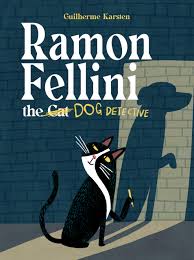
Ramon Fellini the Dog Detective – written and illustrated by Guilherme Karsten
Eerdmans Books for Young Readers, 2025

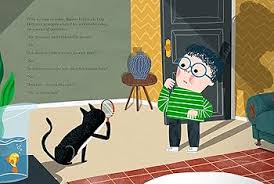
Sometimes people believe what they want to believe, in spite of evidence to the contrary. Children have their own frame of reference for viewing the world. Whether you choose to call it innocence, or just a still untested belief that no one would lie to them, sometimes they interpret events differently than an adult would.  The endearing boy who narrates Ramon Fellini the Dog Detective needs to determine who overturned his fishbowl, leaving one fish missing and the remaining one “terrified.” When a self-proclaimed Dog Detective shows up at his door, offering to help, he is relieved, if momentarily confused. This dog looks just like a cat.

Guilherme Karsten has created a believable character. In his striped shirt, curly dark hair, and oversized glasses, the boy is an image of curiosity combined with trust.  The dog resembles a cat because his costume is “impeccable.” The questions posed by this detective are searching, and, if his methods seemed “strange,” the boy still has confidence that he will find the culprit.  One might think that a close up revealing the dog’s interrogation of the remaining fish would invite skepticism. The fish “looked like it had just seen a ghost,” and the detective extends his very feline tongue towards the fishbowl. But the boy has suspended his disbelief. (Suspension of belief is a theme in Karsten’s work.)

Every picture conveys character. The dog detective mirrors the black and white of the venetian blinds, as he lifts one of the slates to peer outside. One of his eyes half closes exactly like the aperture. But while the blinds are just an object, the dog looks notably sly.  Meanwhile, the boy looks on in appreciation of the detective’s skills.  Even after this supposedly canine Sherlock insists on taking a walk with the fish in its bowl to search for clues, the boy is only worried that his pet will be cold.

Will children think of the boy as foolish? No; just look at the abundant evidence and expertise the dog detective shows, even using a pointer to indicate his deduction about the fish’s escape. When Fellini hands him a post card from the fish’s destination, the boy has even more support for his faith in good deeds.  The dog detective is “AMAZING,” “a legend,” and even “a boy’s best friend.” (images).  The price of the boy’s happiness is not clear. After all, the fish is gone, and the boy is left with the deep satisfaction of having benefited by the detective’s incredible skills and dedication.  What has he really lost?

Uri Shulevitz 1935-2025

Uri Shulevitz died on February 15.  The breadth of his artistic vision was outstanding, demonstrated both in books which he wrote and illustrated, and in others that he illustrated in collaboration with another author.  Many were deep explorations of Jewish themes, while others were more universal in scope. Chance was a masterpiece, integrating his entire life’s work in both words and pictures (I have also written about him here and here). The title indicates his conviction that his survival as a refugee from the Nazis, and, therefore, his entire career as an artist, was fundamentally a result of random events.  The book earned many distinctions; unfortunately, a Sydney Taylor award was not among them.

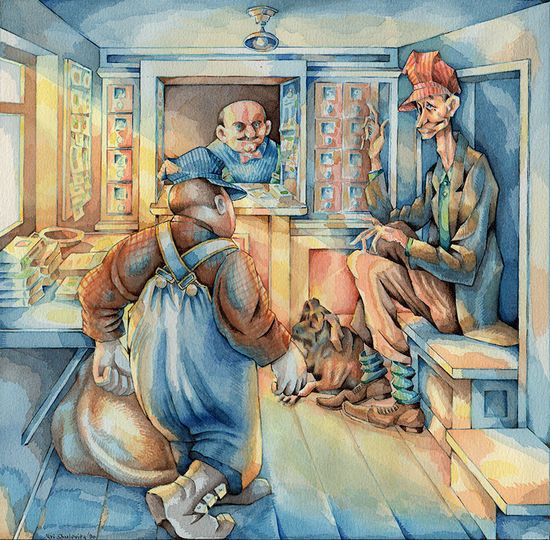
I would like to call attention to one long out-of-print work by Mr. Shulevitz, his quirky, and even disturbing, Toddlecreek Post Office. (Farrar, Straus and Giroux, 1990). Like several of his other books, it adopts a tone from folklore. The small village of Toddlecreek has a small post office. It resembles an ordinary house, with tall windows, flower boxes, and an American flag indicating its purpose. The name of the postmaster is Vernon Stamps, reinforcing the idea that the story is something of a parable. (Some of his neighbors are named Mrs. Woolsox; Charlie Ax the logger; and the garrulous and nostalgic Dexter Shuffles.) Mr. Stamps is busy and efficient, but also compassionate, helping everyone in the community and even welcoming animals to his overcrowded enterprise.

Into this paradise, one unfortunate day, the postal inspector intrudes.  Her presence is immediately disturbing, and the animals react before she even sets about her task. “Birds’ songs diminished…Bees’ buzzing ceased, or so it seemed. The small dogs stopped barking, and stared.” The inspector examines the post office’s records, as well as the evidence that unofficial, but humane, activities are also promoted there. There are books to read, and announcements for barn dances on the bulletin board. She announces that the post office will be closed. Vernon is stunned, but he senses that resistance to this decision is futile. He locks up and leaves.

If readers are not already saddened by this point, Shulevitz makes clear that the post office’s closure leaves a terrible gap in the life of the community.  There is a sense of shock in the rumors about Silken, Vernon’s part wolf and part sled dog companion. The animal has disappeared. “Some say she went north to join the wolves. Others say she was killed by a hunter.” 

What motivated Shulevitz to end the book on an unambiguous note of sadness? He was a great artist and humanist who had lived through the worst conditions imposed by tyranny.  Toddlecreek has been ruined.  “It is not on any map, it is bypassed by travelers and forgotten by time. And now, like any other small village, Toddlecreek has no post office.” Yet, unlike the residents of this unfortunate town, he did survive to produce an unforgettable body literature and artwork for both children and adults.

Fairy Architects

The Tallest Tree House – written and illustrated by Elly MacKay
Running Press Kids, 2019

Fairies usually live in tiny, beautiful, dwellings. Sometimes these are made of obvious materials: leaves, twigs, moss, and other natural elements. Often a child who loves fairies created them, or at least happens upon them and lovingly interacts with their inhabitants (for example this and this). In Elly MacKay’s The Tallest Tree House, there are two fairies, no humans. Both fairies have architectural aspirations as does this mouse). Their names are Mip and Pip, and they are somewhat competitive; at least Mip is. She actually challenges Pip to a contest: “Whoever makes the best tree house by sundown wins!” This impulsive idea doesn’t take into account the fact that Pip is currently reading a book about architecture. 

Elly MacKay’s illustrations are theatrical; she describes her method in inspiring detail (I reviewed another of her books here). Looking at her cut-out figures, carefully placed in stage settings, I was reminded a bit of the Cottingley fairy episode, a well-intentioned fraud when two girls in early 20th century Britain convinced a credulous public that they had photographed fairies. Of course, there is no fraud here; Mip and Pip are real and they create their own home. But the delicacy and care involved in bringing them to life seem related.

Even looking at the two friends, Pip seems more serious. In addition to his reading, he has a tall, pointed leaf for a head covering. Mip, in contrast, sports a comically oversized mushroom cap.  Pip draws blueprints based on his planning.  He carries a, presumably, well-stocked toolbox and uses a pulley. The sight of Mip’s obviously fragile tall tower worries him, because he cares about her more than he does about winning. Eventually, they work as a team, together completing “a winning piece of architecture.” 

Several qualities set this book apart in children’s fairy literature.  There is the tortoise and hare allusion, and the friendly warning that you need technology as well as patience to build a fairy house.  The composition resembles a theater set, and even includes sound effects, such as a terrifying BOOM in huge font when Mip’s shoddy tower collapses.  The book is not unique in excluding human observers, but it does feature an unusually independent fairy world.  Next time you build a house for fairies, read Pip’s book and bring along some simple machines.

What Makes Us Happy

I Would Give You My Tail – written by Tanya Tagaq, illustrated by Qavavau Manumie
Tundra Books, 2025

This tender, subtle, book, about a boy awaiting the birth of a sibling, is set among the Indigenous people of Nunavut, northern Canada. It is both unique to their culture and universal in its expression of gratitude, both to people and the environment in which they live. The title refers to a conversation between two hares, echoed by other animals, and finally by the brother welcoming his new sister to the world they will share. The language seamlessly weaves together the language of the physical world and metaphor. The pictures, created in colored pencil, draw from Inuit folklore, as well as the specific qualities of the characters.  Sharing is a concept central to the book, part of the overall vision of happiness passed from one generation to the next.

Assuming a child’s perspective in a book for children may seem natural, but it’s not so easily accomplished. Here, from the first page, readers will empathize with the boy, Kalluk’s, feelings of expectation and some anxiety, as he awaits a profound event in his life.  Tanya Tagaq is straightforward in presenting the situation: “Kalluk’s mother is in labor and about to have a baby.” Even the repetition of seemingly redundant terms, “labor,” and “about to have a baby,” reflects the way that children incorporate reality. Qavavau Manumie’s illustration shows the pregnant mother touching her kneeling son in a gesture of reassurance, before he sets out to bring his grandmother to help.

Unhappiness is, realistically, part of Kalluk’s range of feelings at this moment. He asks two hares why they are happy, and learns how the qualities that they need to survive, speed and cleverness, are fulfilling ones. A brook is happy because of the fish who inhabit it. Mothers, animals or human, are happy with the offspring to their care. Explanations are kept to a minimum. Kalluk can sense the sincerity of all the responses.

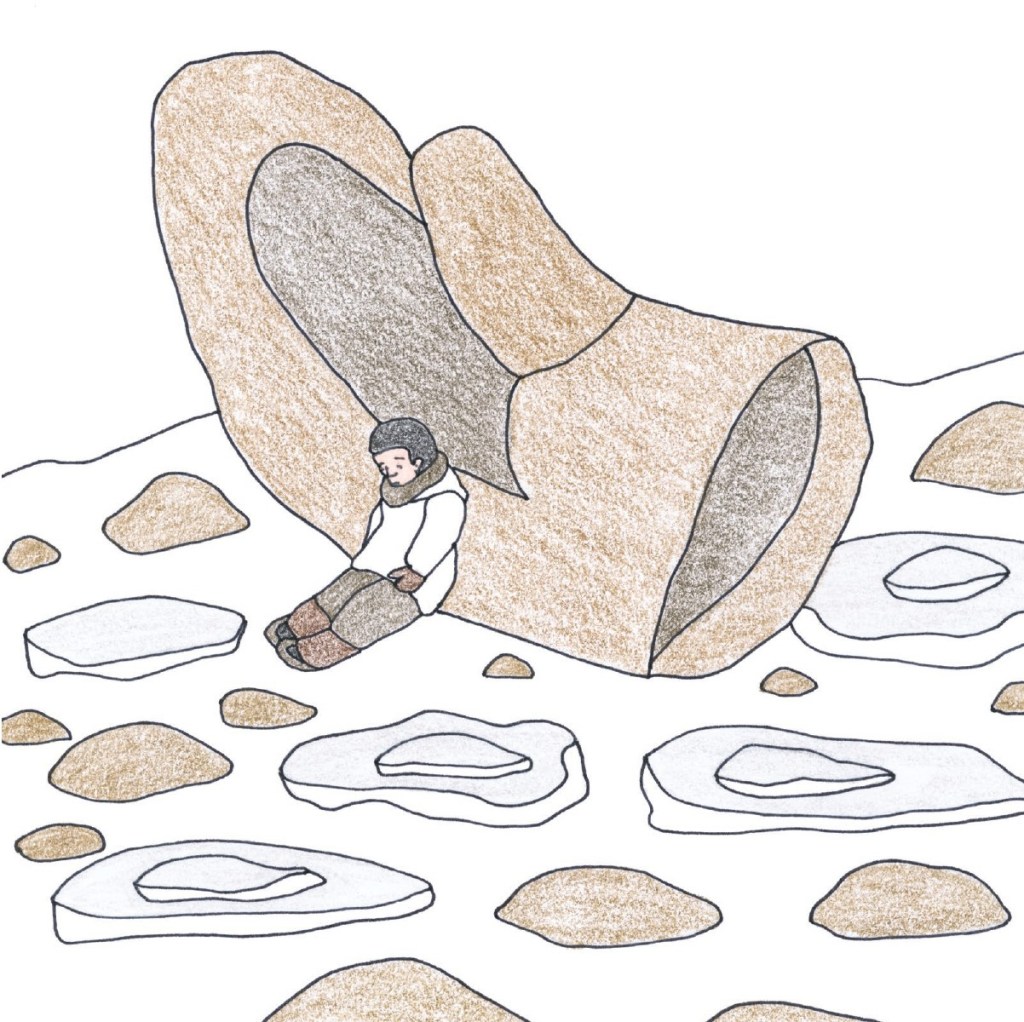
A picture of Kalluk seated with his back against a giant mitten embodies his feelings of gratitude tinged with sadness. He clearly misses his mother, thinks of the warm mittens she has created for him, and sends her “all the love in his heart.” The way in which that message is convened does not need to be articulated.

Meeting his grandparents, Kalluk has reached the confirmation of all the previous lessons about gratitude and love. His grandmother, Anaanattiaq in their North Qikiqtaaluk dialect, is unapologetically depicted as old; she “stands up slowly, bones creaking and cane shaking.”  Any diminished physical strength is no obstacle, as she states purposefully, “Let’s go greet the new one.” Walking home, the boy asks her about her source of happiness. When she answers “peace,” he requests an elaboration. This dialogue is different from those with the animals. She tells him in the most direct language that peace grows inside each person, as he or she makes a series of choices in life. The right choices will make you proud, and grant “lots of peace,” the kind that is meant to be shared.

When Kalluk and Anaanattiaq come upon “a conspiracy of ravens,” the squawking, lively birds are friendly towards them.  Their requirement for happiness is “knowledge,” a slight variation of the other animals’ answers. Their grandmother, the ravens assure Kalluk, is full of knowledge. That knowledge is put to the most important use when she arrives at Kalluk’s home, where his mother has already given birth and his breastfeeding the baby whom he is now prepared to teach everything he has learned.  Gratitude for food, water, family, and the ability to choose well, are the gifts he brings to her, as well along with a declaration of love.  I Would Give You My Tail is like a perfect circle, enclosing the reader in the complete circle of Kalluk’s journey.

Parent-Child Conversations

Fantastic Lou: Little Comics from Real Life – written and illustrated by Qin Leng
Tundra Books, 2025

All good children’s books are also good books for adults, but some seem specifically designed for both audiences. Qin Leng’s graphic chapter book, picture book, or collection of “little comics,” is definitely in the latter category. The cover, with a brightly smiling child radiating assertiveness, alludes to some of the mid-twentieth century comic classics. The wry interpretation of parenting issues also brings to mind the work of Liana Finck. Yet Fantastic Lou is also fantastic for children, reflecting their thoughts and feelings about everyday situations and important relationships.

The interminable experience of playing a board game is, at the same time, a way to have some quiet and meaningful interaction with a Lou, her child.  The existential unfairness, mixed with boredom, might even be irritating to adults. “You fell in a hole. That means you gotta go back to square one.” An adult might feel bereft at that news, but a child’s understandable rage is difficult to dismiss. Leng captures the whole range of responses in her lively and delicate pictures, drawn in ink and digitally colored.

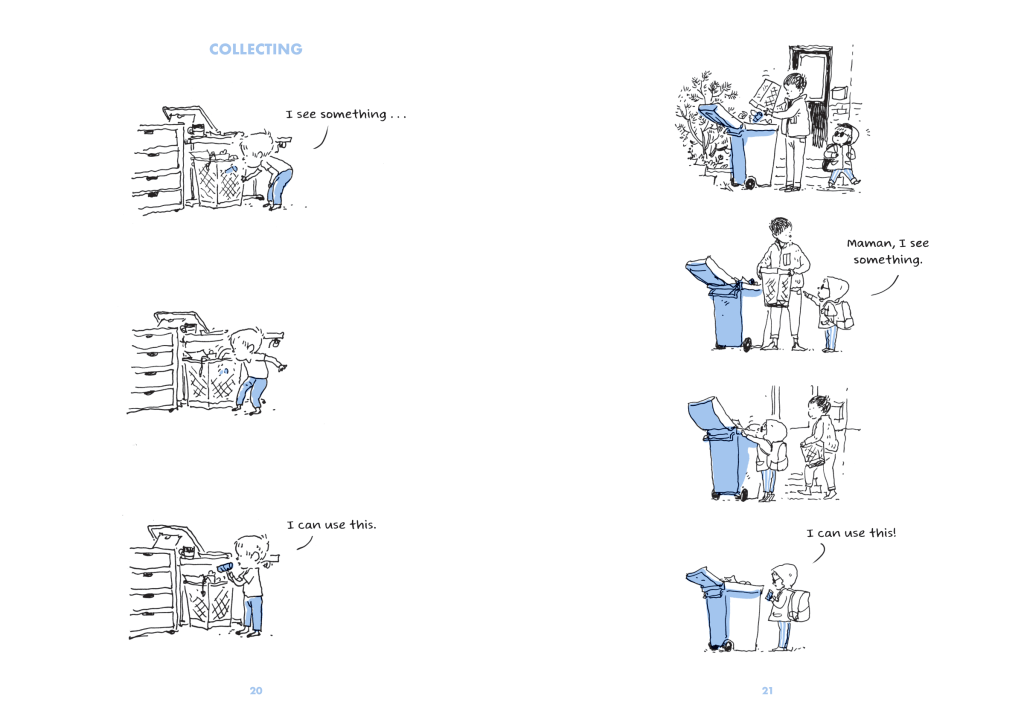
Collecting may have different meanings for children and adults. Leng focuses on how a child finds meaning in an object that seems useless to his parents.  Forget well-intentioned recycling. Lou extracts a series of items, explaining the process with clear simplicity. Language also reflects the difference between Lou and Maman: “I see something, Maman. I can use this.”  What further justification is needed for pulling things out of the trash?  The reader is left to imagine the infinite uses implied in Lou’s artistic vision. 

Lou’s image of his future self is as clear as his prospective plans for thrown-away collectible. In “When I Am Bigger,” he divides his life so far into two stags, and projects a third one based on growing size and increased power.  After all, that is how adults appear to children.  The adjacent chapter, “Montréal Trip,” takes that abstract idea and offers a concrete example of his special status as a child.  The prospect of boarding the plane is exciting enough, but, in fact, his small and vulnerable size is granted equal status to the most privileged travelers: “Priority boarding for VIP members and passengers traveling with young children…”

Children are VIPs in Leng’s work. Sequences of constant motion, flights of imagination, and attempts to make sense of adult decisions, add up to childhood itself.

Family Stories and Food

Electra and the Charlotte Russe – written by Corinne Demas Bliss, illustrated by Michael Garland
Boyds Mills Press, 1997

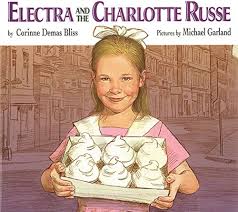
When I was growing up in New York, the charlotte russe was a popular pastry, though the peak of its popularity was already gone by the post-World War II era. At the time, I wasn’t aware that I was enjoying a part of New York food lore in its decline, but that still had meaning for my parents’ generation.  In Electra and the Charlotte Russe, a Greek-American family, living in an ethnically mixed Bronx neighborhood, is the center of the nostalgic story.  In her author’s note, Corinne Demas Bliss writes that the book is based a story which her mother, Electra, had related about her own Bronx childhood in the 1920s.  Whatever your background, and whether or not you have ever eaten the delicate pastry enclosed in a paper sleeve, you will probably respond to the essence of Demas’s tale and Michael Garland’s almost photorealist pictures.

Once upon a time, there were many children’s picture books with extensive text. Electra opens with a portrait of the little girl and her mother. Electra is entrusted with an important errand. She will go to the local bakery to purchase six charlotte russes for her mother’s guests. These are Mrs. Papadapoulos, Mrs. Marcopoulos and her daughter, Athena. The guest without a melodic Greek last name is Miss Smith, who is learning Greek from Electra’s mother, in preparation for her upcoming marriage to Mr. Demetropoulis.  If you think this is an overly idealized portrait of immigrant communities, the motive behind the Greek language lessons is for the future Mrs. Demetropoulis “to understand what his relatives said behind her back.”

On the way Electra meets her friend, Murray Schwartz, whose tongue has turned green from eating a gumball.  A much older neighbor, Mr. Melnikoff, waxes nostalgic about the charlotte russes of his own past, calling them “a dessert fit for a princess.” The extended text occupies some pages, while others have only one or two sentences. A typical New York City apartment building, as rendered by Michael Garland, seems shaded in ombre light and colors, accompanied by the brief instructions to Electra not to run even though she is in a hurry.  Mrs. Zimmerman at the bakery repeats that prophetic warning to her young customer.

When Electra trips, damaging the exquisite works of art in her bakery carton, she tries to fix them. This leads, of course, to eating some of the whipped cream. A two-page spread shows four scenes of Electra’s face and hands as she attempts to even out the cream.  Every step of the process is detailed in sequence, from Electra’s entrance into her apartment building, to her settling on several landings with the pastries, and finally reaching her home. “They didn’t look quite like charlotte russes anymore, but at least they did look all the same.”

Fortunately, Electra’s mother had prepared other delicacies: baklava, diples, loukoumades and kourabedes. The guests enjoy the now transformed and unidentifiable charlottes russes. After they leave, Electra’s mother explains to her the concept of remorse. “Remorse is when you wish you hadn’t done something that you did.” But she isn’t angry with her daughter, and the book closes with Electra sitting on her mother’s lap.  Perhaps she would have been less forgiving if her guests had not enjoyed the gathering, or the pastries denuded of whipped cream. But I doubt that would have made a difference.