Let It Snow

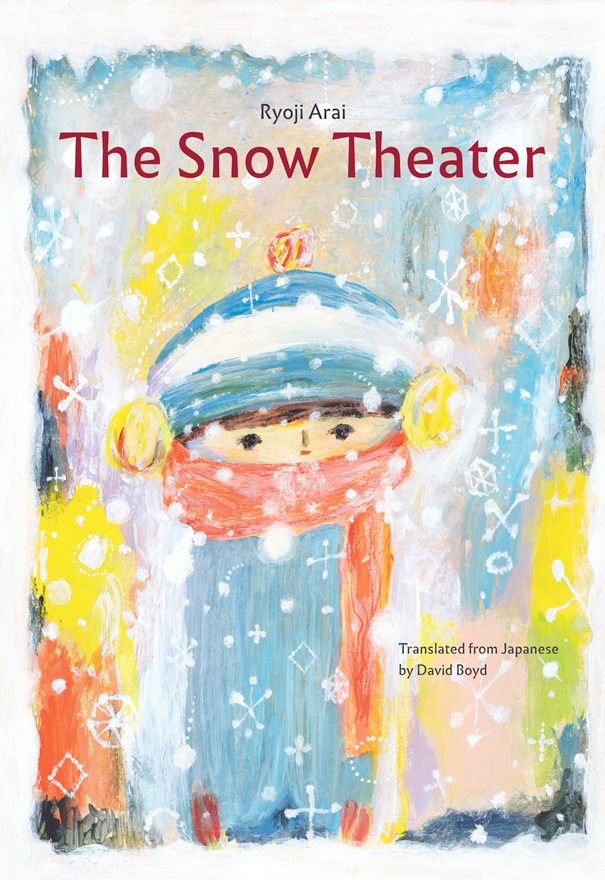
The Snow Theater – written and illustrated by Ryoji Arai, translated from the Japanese by David Boyd
Enchanted Lion Books, 2025

The art of Ryoji Arai’s The Snow Theater demands strong adjectives: intense, stunning, original, but also: unpretentious, dream-like, and accessible. The reason for this contrast, aside from the artist’s incredible gifts, is the imagery’s blend of naiveté and sophistication, with splashes of color as well as carefully delineated figures. Arai’s pictures capture what it feels like to be a child, and specifically to be captivated by the experience of snow. Snow as theater is not at all artificial, from a child’s point of view. It is a gift, perhaps unanticipated, that then takes on different qualities, including joy. It is familiar, but can also be strange.

There are innumerable children’s picture books about snow, and many are excellent, beginning with the Ezra Jack Keats classic The Snowy Day (see some other examples here and here and here and here and here and here and here). The Snow Theater is not unique, but both its design and philosophy and language are distinctive enough to merit acclaim (it is translated by David Boyd, who has translated some of the Chirri and Chirra books, also published in English by Enchanted Lion). It opens indoors, where two boys are “keeping warm” and “looking at a book.” The first picture has the reader looking towards them from outside, where they are framed in the window, almost like residents of a dollhouse. Then, a two-page spread is divided into several more specific descriptions of their activity, and one larger scene of it result. At first they are sharing a picture book about butterflies in a cooperative spirit. Then, the friend of the boy who lives in the house “badly wants to borrow the book,” and the idyll is ruined. That adjective, “badly,” prepares you for the act of, perhaps accidental, aggression that results when the book is damaged.

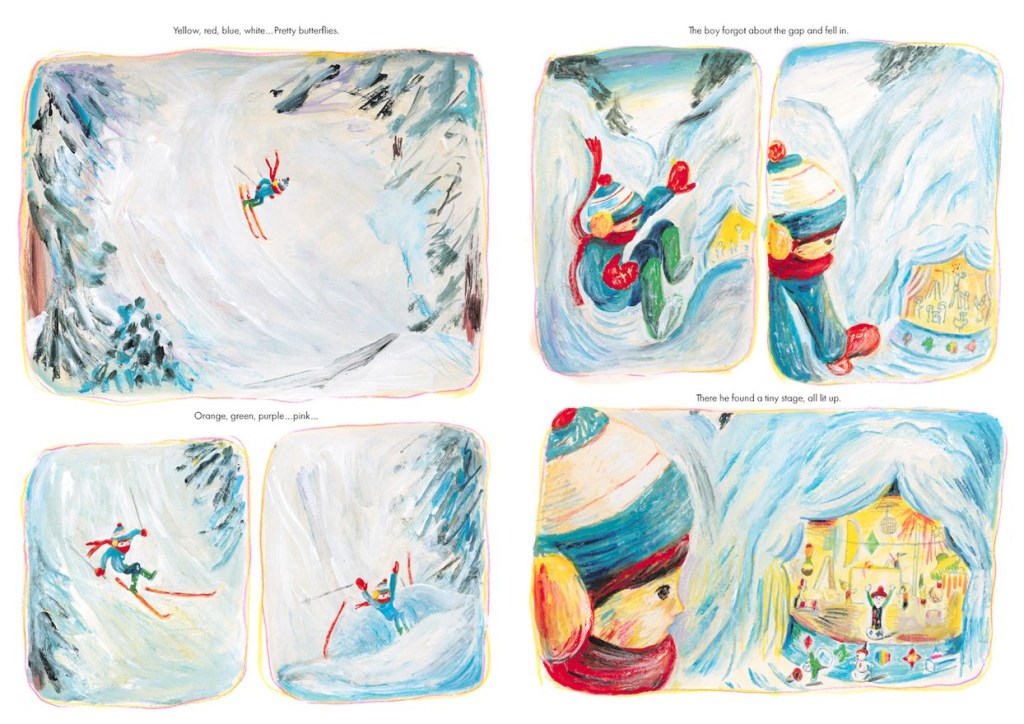
Now the boy is devastated. Worse, the book is actually one of his father’s favorites, adding a dimension of anxiety to an already tense situation. Arai traces the arc of the boy’s feelings. They boy had wanted to share the book with his friend, not only because they both liked butterflies, but in order to communicate its special status in his family. Worried, he leaves the house and begins to ski through the snow. Suddenly, he finds himself looking into a miniature theatrical production. There are “snow people,” including ballerinas. They surround him physically, occupying his senses. Then the scale seems to change, as he sees “a large theater in front of him.” Yet the performers, who include singers, still appear to be tiny. “Everybody floated quietly to their places, like freshly fallen snow.” There are echoes of Tchaikovsky’s Nutcracker, with impressionistic colors. Snow people reflect the color of rainbows. Icicles are suspended from their limbs and odd pieces of scenery, like an Easter Island head, occupy the elaborate background.

Then the show ends. As in The Nutcracker, viewers wonder if the performance was a dream, or if the protagonist had really undertaken a mysterious journey. The kinetic, and ephemeral, experience of a snowstorm seems to have been the boy’s escape from emotional difficulty. He reaches across the snow to find his friend against a field of butterflies, only some of which are enclosed within a book. The boy’s father appears with the awaited resolution: “Let’s get you home.” A cup of hot cocoa by a warm stove brings back domestic security, but the song of the snow people is reprised in the boy’s memory.

Roman Holiday

Piccolo – written and illustrated by Dan Yaccarino
Christy Ottaviano Books (Little, Brown and Company), 2025

Piccolo is not actually set in Rome, but rather in Bella Città, a marvelous place where animals speak Italian, visit cultural treasures, and eat delicious gelato. A lively shrew who enjoys riding his moped and frequenting cafés, the title character has several friends who help him when he goes in search of his favorite hazelnut ice cream. There are several detours along the way, and Piccolo will never say “no” to an amusing distraction, or a chance to help out.

Dan Yaccarino’s picture book world is generally reassuring. Populated by people, and the animals who sometimes are similar to them, his stories maintain a balance of challenges and happiness. Whether in Every Friday, whose father and son pair enjoy a special weekly time together, Doug Unplugged, where a young robot breaks free of his charger, or I Am a Story, an ode to literacy, readers connect to his colorful images and comfortingly familiar characters.  Every Yaccarino book is different, but identifiable for its warmth and humanity.

Piccolo has created a list with his fountain pen while sipping espresso and planning his day. He “loves his friends very much,” and the truth of this statement, while obvious, is also proven by multiple examples.  Enzo the hedgehog, Mr. Rosso the fox, and Brother Mantis are all greeted with an enthusiastic Buongiorno or Ciao.

Piccolo’s need for gelato is not so pressing that he can’t help Mr. Rosso, an artist, to carry his painting to the museum, or to ensure that Mrs. Gallina and her chicks safely cross a busy street. (This errand seems like an homage to Robert McCloskey’s Boston street scene in Make Way for Ducklings.)

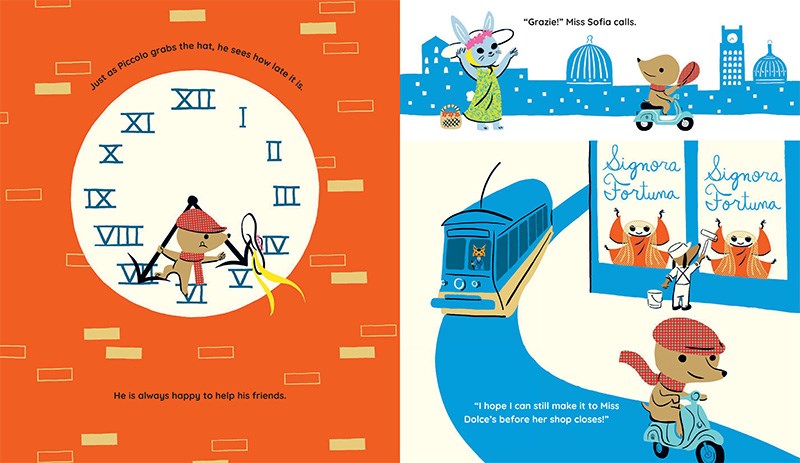
The cinematic scenes include Piccolo racing to rescue his friend Sofia’s hat by climbing to the top of Tempo Tower clutching the hands of its clock with bravery and skill. In another artist’s vision, this feat could be frightening, but Piccolo’s determined expression makes it clear that he is not taking an unnecessary risk.  Not every one of his detours is so dramatic. He is also happy to retrieve a soccer ball from the fountain and play for a while, and to assist a young crocodile with his necktie.  Yaccarino can easily devote his attention to the smallest actions as well as the most difficult ones. There is some real tension when Piccolo reaches the gelateria and presses his nose against the glass, his purple shadow illustrating the hour, and that “he is too late.” But when Miss Dolce arrives, her leftover hazelnut gelato becomes a simple problem to solve. Grazie, Dan Yaccarino, for this affectionate introduction to Italian culture, perfectly designed for young, and older, readers.

Little New Year

Weiwei’s Winter Solstice – written and illustrated by Michelle Jing Chan
Bloomsbury Children’s Books, 2025

Even if you are familiar with traditions surrounding Chinese New Year, you may not know about an adjacent celebration, Dōngzhi; author and illustrator Michelle Jing Chan explains the origins and significance of this winter solstice festival.  Falling between December 21-23, it is sometimes known as “Little New Year,” and points towards longer days, coming warmth and light, and good fortune.  The book itself if full of bright colors and supportive family relationships, as Weiwei adjusts to life in a new home, where “there are no hummingbirds or chrysanthemums” and “it’s too cold for a screen on the door.”

Weiwei’s family is identifiably a real one. Her grandfather, Yeye, enthusiastically dresses her for the cold weather, but they also seem aware of her unhappiness. Once they are prepared, their outing in the icy outdoors becomes a delight.  Set against a backdrop of snow, Weiwei, in her bright blue parka and red boots, notes how the frozen river “sparkles like a mirror,” and each family member is engaged with nature. Still, when they return home, and begin to prepare the special treat associated with Dōngzhi, I couldn’t help finding their kitchen to be a welcome respite from the admittedly scenic outdoors. It’s both spacious and cozy and everyone seems absorbed in the task. (Chan includes a recipe for black sesame tāng yuán in the backmatter.) I particularly like the contrast between blue and white, from the floor tiles to items of clothing, as Weiwei drops balls of dough into broth.

Sadly, the grandmother has died, and one moving two-page spread depicts the family showing reverence to deceased ancestors (image), serving them tea and special foods. There is a smiling portrait of the grandmother on a shelf, accompanied by plants, fruits, and incense. Sense impressions rise from the page. Facial expressions connote, not sadness, but loving memories. Sensory metaphors also convey difficult feelings. Yeye explains to his granddaughter that tāng yuán itself mimics the sound of the word for togetherness. He confesses to having felt sadness when he first moved to America. Eventually, senses, and the emotions they corroborate, make sense to Weiwei, and she compares the delicious sensation of eating tang yuán with deep contentment: “I feel like a golden sun.” Weiwei’s Winter Solstice is a graceful homage to tradition and family, as well as to change.

Lunch Matters

I Like Cheese! (A Kat and Mouse Book)– written and illustrated by Salina Yoon
Bloomsbury Children’s Books, 2025

Sharing and comparing lunch may be important for children, or for cats and mice playing the role of children.  In Salina Yoon’s universe, animals are particularly sensitive and believable stand-ins for humans. (for example, a penguin and an octopus or an elephant). In this brightly colored graphic novel, Kat and Mouse compare lunches; one of them has seemingly higher culinary standards than the other. Will this affect their friendship? 

While I can’t call it an homage to Russell Hoban and Lillian Hoban’s Bread and Jam for Frances, it’s impossible to read Yoon’s book without that classic in mind.  Debbi Michiko Florence wrote her own version of lunchtime differences in Jasmine Toguchi, Mochi Queen.  In Yoon’s wonderful picture book about beginning school, Bear’s Big Day, the title character is unable to touch his lunchbox because of anxiety over the new experience.

When they meet for lunch, Mouse simply brings “only the best food there is!” Mouse brings that food—cheese—in a no-frills lunchbox, while Kat’s stupendous meal overflows from a family-sized basket.  Every day she brings a different creation, from a sub sandwich that takes up two pages, as well as another two with its name surrounded by Broadway lights. Nevertheless, Mouse is completely secure in his choice, even describing its subtlety, “sweet and savory, but still mild, with a hint of nuttiness – a true delight!”

While there is no overt competitiveness damaging their friendship, gradually Kat becomes curious. Then, Mouse starts to question his own uninterrupted happiness with cheese. Could he actually be boring? Kat even suggests a trial separation.  Not surprisingly for adults, this drastic experiment is unnecessary. Young readers will be reassured about different tastes coexisting, and even strengthening friendship. (as is also the point of It Is Okay by Ye Guo).  Yoon always succeeds in leavening her appealing books with an unobtrusive message. If eating alone leaves you gloomy, and bluer than blue cheese itself, it may be time to reconsider what matters.

In the Pocket

The Newest Gnome – written and illustrated by Lauren Soloy
Tundra Books, 2025

The Pocket is where the gnomes live, in Lauren Soloy’s remarkable universe of small creatures dedicated to choosing hats, telling stories, and generally explaining and appreciating the world. I was impressed with the first gnome book, The Hidden World of Gnomes, and I’m thrilled that Soloy and Tundra believed in them, and that they merited a second look (I’m also a fan of Soloy’s other work, as you can see here and here and here).  Although the gnome books are rooted in tradition and folklore, they are also new and singular.

When the book begins, the existing gnomes, including Cob Tiggy, Twiggy Dell, Minoletta, and Beatrix Nut, are about to welcome a newcomer to the Pocket.  These creatures, whose names evoke both Beatrix Potter and a kind of cosmopolitan flare (Minoletta, Hotchi-Mossy), need to meet in their mushroom circle to discuss the latest Pocket resident. When Grolly Maru arrives, they sense the need for reassurance, similar to Winnie the Pooh’s helpful and sustaining words: “Everything will be all right.”

After a good night’s sleep under the mushrooms, the gnomes will be prepared to teach Grolly Maru essential skills. As in Babar’s Celesteville, every inhabitant has a specific job and role to play. When Grolly Maru expresses concern that the changing moon may eventually disappear, does this reflect and anxious personality, or just a basic lack of familiarity with the environment?  It’s up to the reader to decide, but since Abel Potter shows Grolly Maru other round and spherical items from nature, it doesn’t matter.

The pictures feature gnomes interacting with one another, along with close-ups of objects that fill their lives: dandelions, yarrow, marbles, ants, and suggested exercises.  There is a recipe for Bonnie Plum’s baked apple with blackberries, which, considering the scale of gnome to ingredients requires both hardware and strength.  The gnomes are artisans, designing grass baskets: “It’s not as easy as it looks!” (Who would expect it to be easy?). Their overarching purpose is constant fidelity to the idea that each individual is unique, but that we are all part of something greater. Lauren Soloy’s artistic vision is fully realized, in a universe of beauty and comfort, populated by small beings with great wisdom.

What If I Never Fly?

Fly Like a Bird – written and illustrated by Olga Ptashnik
Eerdmans Books for Young Readers, 2025

Breaking the mold may be a harsh-sounding metaphor for a children’s book about birds, which contains within itself a story of natural insecurity and a parent’s reassurance. Fly Like a Bird does actually break a mold in the “STEAM” books genre.  The text and the artwork, by Olga Ptashnik, are both wonderful.  Children, and adults, will also learn a lot about a wide range of birds.

A young chickadee expresses concern about the possibility that she will never accomplish the daunting task of learning to fly. Ptashnik captures the inner life a child with her words: “I can flap my wings, but I can’t fly. I’m just a tiny little bird…What if I never learn to fly?”

Right away, children will be drawn to the book’s tone and central idea. The question-and-answer format alternates black and blue font, as the parent answers with accessible information about different birds and their unique qualities. Digital artwork produces the colors of nature: green, gray, blue, black, red, in different shades.

Hummingbirds are tiny; how do they produce the intense vibrations that give them their names, and also find nectar to drink? Penguins can’t fly, but their speedy swimming more than compensates for this unusual difference. The young bird processes the information: “Oh, so they fly underwater! But is it possible to fly in both the water and air?”

The peregrine falcon images bring the reader to a more human-populated location, as they fly high above elegant buildings and swoop down with incredible speed.

Each picture is composed to invite focus on different aspects of the scene. A large falcon appears commanding, hovering over the rooftops.  A chain of apparently connected birds descends, and more distant birds appear smaller as they alight on structures and rise up further into the sky.  Ptashnik anthropomorphizes a bit more here, breaking the fourth wall. The young bird expresses feelings of vulnerability associated with humans: “…but I don’t want to hurt other birds! How can tiny birds like us protect ourselves from predators?”

A flock of starlings forms a “murmuration,” as “Thousands of birds stay synchronized without any conductor.” Again, the varying scale of the scene elements are a quiet drama.  On the ground, a person riding a bicycle appears very small. Above, the murmuration is a symphony in motion. I was reminded of the fish learning about solidarity in Leo Lionni’s Swimmy.

The book concludes with two pages summarizing the star players, from hummingbirds to black-capped chickadees.  Everyone eventually learns to fly, swim, swoop, and find nectar, when the time is right.

Not So Fragile

Broken – written and illustrated by X. Fang
Tundra Books, 2025

A picture book by X. Fang has an unmistakable identity (see my reviews here and here). The actual species of the mysterious visitors in We Are Definitely Human may be ambiguous, and the vivid dream imagery of Dim Sum Palace seamlessly transforms to the warmth of a family restaurant. Broken is about the unbreakable bond between a grandmother and her grandchild, and also the reassuring truth that many things that are broken can be repaired (grandparents being a constant presence in children’s books, as seen in my list at the beginning of this review). Maybe the new object will appear identical to the old one, or perhaps some small difference will be evidence that its importance is not compromised by a beautiful, jagged crack and some glue. The sturdy, rounded characters who populate Fang’s earlier books are back, but they are not repetitive. She has a specific visual interpretation of humanity and it is inimitable.

A little girl, Mei Mei, introduces the story with an invitation and an outright confession: “Let me tell you the story of the day I broke Ama’s cup.” A day at Ama’s house is full of unspoken comfort, but sometimes boredom. Thick dashes connect the girl’s activities, like a familiar board game.

Then it happens. Having made the conscious decision to frighten Ama’s cate, the girl bumps into a table and hurls the cup towards its trajectory. Not only does it break, but the damage results in three pieces. Appealing to young readers with a direct statement of her guilt, the girl futilely tries to escape her own fears. What if Ama’s unconditional love has conditions attached?

The girl’s senses become exaggerated. Her grandmother calls to her, maybe in anger. That may seem unlikely to an adult reader, but only her warm smile convinces Mei Mei that nothing fundamental has changed. Ama brings her some cake. Mei Mei has the opportunity to blame the broken cup on the hapless cat, but she can’t bring herself to be dishonest. A full page picture of the cat’s accusatory stare is the counterpoint to Mei Mei’s closed eyes behind her oversized glasses.
Overcome with anxiety, she hides in the closet, obviously a temporary solution. Fang even includes a helpful graphic of Mei Mei in silhouette profile, the truth emerging from her insides in arrows that turn into words of apology.

Mei does not only forgive her; she offers an explanation. Repairs make meaningful objects stronger. Each one tells a story. Ama takes on a new identity, as a “fixer,” in a series of portraits framed with old-fashioned photo corners. She is a super competent, and also compassionate, role model to her beloved and unique granddaughter.

Treasured Pasta

Spaghetti: A Mouse and His Treasure – written and illustrated by Merrilees Brown
Tundra Books, 2025

Collecting is a fantastic hobby, or maybe it is just an annoying compulsion.  One person’s desirable object is another person’s clutter. Author and artist Merrilees Brown transforms this truism into a wonderful story about Spaghetti, a creative mouse who “sees beauty and possibility in what others no longer want or need.” Named after one of his favorite media, this charming character is rendered in graphite, oil paint, print, humor, and affectionate details. 

Since mice have large families, Spaghetti has a rapt audience for his pencil stilts, cat face costume, and even his carefully composed box of cast-offs waiting to find a use. Yet other members of his clan are annoyed by his endless projects.  Mummy complains of the mess and Daddy makes the puzzling statement that “You have too much treasure”” as if that were possible.  Spaghetti responds with conviction, and even a hint of defiance, literally immersing himself in the multicolored materials he will bring to life.

Spaghetti recognizes that he has a problem, so he “puts on his thinking cap.” Children have the pleasure of seeing this expression visualized as one of the mouse’s creations. Crafts are sometimes distinguished from works of art by their usefulness, but this distinction can be permeable.  Spaghetti decides to emphasize the incredible properties of pasta, building something practical for everyone in his home.  Engineering meets art in his Calder-influenced amusement park. (There are other picture book mice with artistic sensibilities and kinetic skills; I’ve reviewed three of them here and here and here.)

Spaghetti’s self-assurance allows him to persist, even when others fail to recognize the importance of his vocations. At the same time, he is as flexible as a strand of spaghetti, letting young readers know that being true to oneself doesn’t require dismissing other viewpoints. Best of all, he succeeds in combining three different values: collecting, creativity, and love for his family.

The Year Is a Circle

Lights at Night – written by Tasha Hilderman, illustrated by Maggie Zeng
Tundra Books 2025

There are two families observing the rhythms of the year in Lights at Night. One is human and the other canine, specifically foxes.  Dream-like images with changing shades of color include realistic details, both natural and cultural.  Children experience the wonder, but also the reassurance, of the four seasons and their special features, from football in autumn to storms in spring. While the fox family does not kindle holiday lights around the time of the winter solstice, they also appear to respond to the changes.  Tasha Hilderman’s soothing poetic text complements Maggie Zeng’s visual immersion in the excitement of one year. Children find joy, not boredom, in the repetition of familiar events.

A powerful storm is just unsettling enough to make the shelter of home more of a comfort.  Crayon drawn strikes of lightening emanate from a house, enclosed in a photograph, and also cross its border.  Inside, a strong of lights and beds configured as tents add the sense of drama that children like. Note the plush fox in a small sleeping bag. The fox family lacks the domestic props, but is just as attuned to the environmental changes. Of course, animals’ lives are more closely defined by the seasons. In spring, “new babies arrive with the stars.”

Campfires come in summer; riding the bus to school and harvesting wheat are tied to autumn. One of my favorite images in the book is a natural and unobtrusive celebration of multicultural holidays.  Christmas trees, Diwali lights, a Muslim family welcoming visitors, and a Kwanzaa lamp grace the neighborhood, along with a Jewish family’s observance of Chanukah. If you look closely, you will see that the correctly depicted nine branch chanukiyah (menorah) has its candle farthest to the left partly obscured by the window frame.  This is not an error, just a small visual element lending authenticity to the way in which someone placed the lights, which must be visible from the outside.

At the end of the book, the two children share an album and a box of crayons. The volume is open to the photo with lightning, enhanced by the children’s artwork. The actual fox looks up the moon.

The Other Side of Trouble

Trouble Dog: From Shelter Dog to Conservation Hero – written by Carol A. Foote, illustrated by Larry Day
Eerdmans Books for Young Readers, 2025

There is a lot of action in Trouble Dog. There is also an abundance of information, a likeable main human character, and a surprising amount of humor.  Carol A. Foote has combined two real-life conservation dogs into one fictional hybrid named Tucker.  Caught in a cycle of adoption and rejection, he is always returned to the animal shelter that has given up on placing him. Then, along comes Laura, a classic heroine who refuses to give up on an unlikely pet who has driven everyone else to distraction. Larry Day’s pictures are full of action and color, setting a motion Laura and Tucker’s journey from trouble to success.

The opening end papers introduce Tucker in some typically frenetic canine activity. Then it escalates, as every home the shelter finds for him is subjected to chaos.  Tucker manages to overturn an aquarium and books in one place. He grabs a girl’s sweater and won’t let go. A man attempting to read his newspaper looks enraged as Tucker grabs it and leaves a litter of overturned items in his wake.  When we next see him, Tucker is a lonely prisoner in a cage, “watching everyone pass him by.”

Laura is a sturdy figure with a ponytail, flannel shirt, and jeans.  She is as no-nonsense as Mary Poppins, and she also intuits something about Tucker that everyone has missed. His energy can be put to good use.  Even though her home is quickly as disordered as every other place Tucker has been, she has a vision and the practical sense to implement it.  Dogs, as readers learn in Foote’s detailed backmatter, have a highly developed sense of smell.  Laura observes Tucker carefully and evaluates his routine and abilities.  She isn’t just kind and patient, but methodical, as well. 

Eventually Tucker gets a job, or a series of jobs. The details in the text are embedded in words as colorful as the pictures. “Tucker’s first job was to find rosy wolf snails in Hawaii.” (image). He travels the world, sniffing out “moon bears in China, mountain lions in Chile, and elephants in the jungles of Myanmar” in a narrative as exciting as one by Jules Verne, but rooted in the truth.  In a two-page spread, Tucker crosses the gutter between pages. An elephant marches ahead of him, dwarfing the dog in size, but not in energy.  Three researchers form a determined row in the background, to his left.  The image captures the cooperation necessary for Tucker to succeed in helping scientists to learn about species in need of protection.

Not every outing produces results easily. In Zambia, Laura’s optimism is tested, looking for cheetah scat and coming up short.  When Laura insists that “I trust Tucker,” who finally leads them to the right location, she is not relying only on her affection for the dog. Through hard work and astute decisions, she and Tucker have become a team.

Four pages of additional information and photographs are organized in a question-and-answer format, giving the bigger picture of how conservation animals, as well as other service animals, provide essential services.  A selected bibliography is accompanied by an oval portrait of Laura and Tucker relaxing at home. I hope that no one misses one title, by Alexandra Horowitz, Inside of a Dog: Young Readers Edition: What Dogs See, Smell, and Know. Just parenthetically, the title refers to the famous quip usually attributed to Groucho Marx: “Outside of a dog, a book is man’s best friend. Inside of a dog, it’s too dark to read.”  It’s definitely not too dark to read inside this book.