Tune In

And There Was Music – written and illustrated by Marta Pantaleo, translated from the Italian by Debbie Bibo
Eerdmans Books for Young Readers, 2025
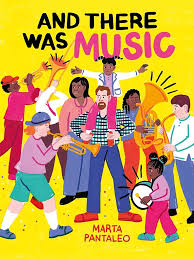
Sometimes children’s books address a question that may seem obvious. How can you explain the meaning of music, the way that people use it to communicate regardless of whether they share a language or a culture? Marta Pantaleo’s And There Was Music offers an answer through spare, poetic language, and bright imagery.  Her answer is non-academic, not definitional. Instead, she approaches the subject through examples that are diverse enough to constitute a whole. Music is shared by everyone, arises from our senses, memories, and emotions, and utilizes different instruments, as well as our voices and bodies, to make itself heard.

The book’s text is pitch perfect.  It alternates statements and questions: “When you listen to music, your heart changes rhythm. Can you hear it?  Some of the statements may seem self-evident: “If you are sad, it can make you feel better.” Still, they need to be said.  The feelings evoked by listening to, or making, music, are largely involuntary: “You don’t decide all this. It just happens.” Some statements are broader, with social and political implications: “Music is a bridge that unites us.”
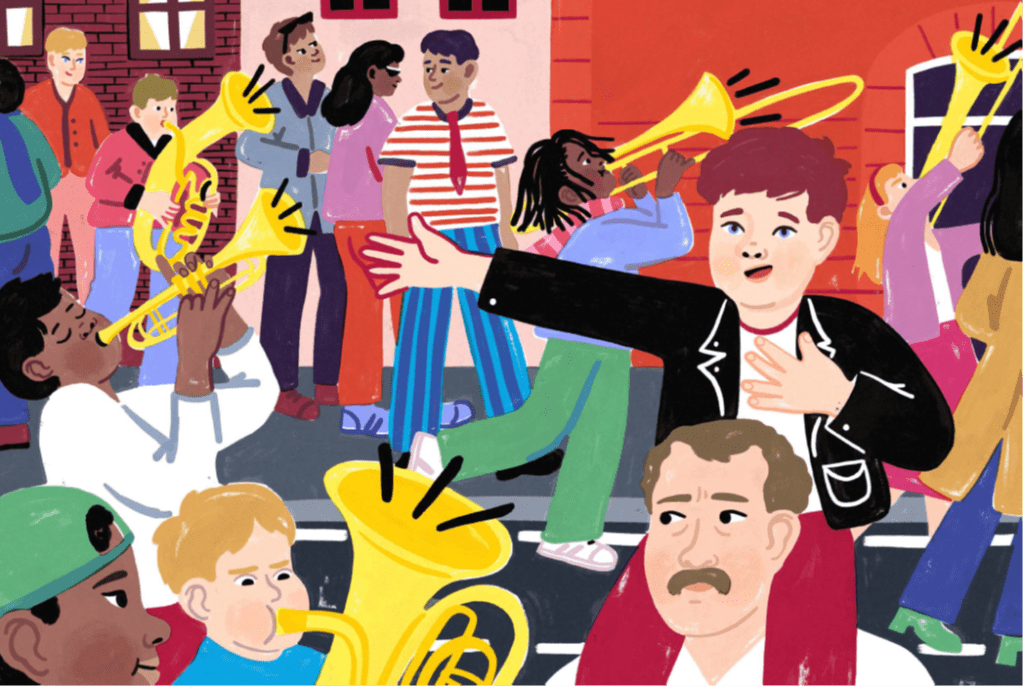
A book composed of generalities about music would be less useful than this one. Readers of. Pantaleo’s work will learn about several distinctive forms of music, which are briefly explained a section at the end of the book. There are bagpipes, acoustic guitars, drums, harmonicas, and brass band.  Musicians are from India, Bali, New Orleans, the American South, and Hawaii, and, of course, from your own community.  The illustrations are boldly colored, and influenced by traditional art.  (The also remind me of Maira Kalman’s work.) They also portray activity, but caught in a specific moment, as in a snapshot.  A girl moves her hands across a piano keyboard, her eyes closed in concentration. A gospel choir captures “hope,” with their voices and hands. A girl sings in the bathtub with a brush as her microphone.  Each image is its own performance.

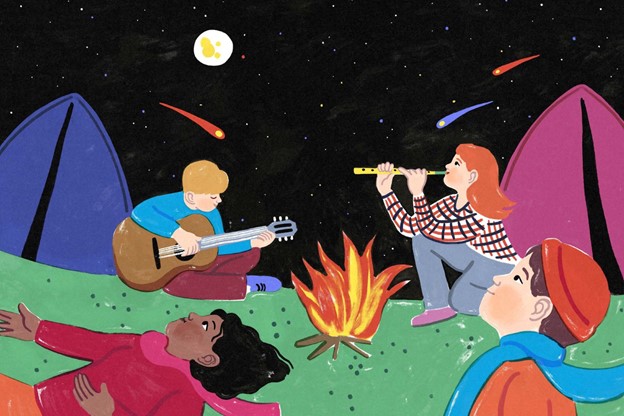
The design of the book and the composition of each page are also key notes to its success. Four young people surround a campfire. Each one has equal weight in contributing to the whole. A boy strums the guitar. A girl plays a flute. Two others do not play instruments, but they look up towards the sky at shooting stars and the moon.  “Music is connection,” yet, at the same, time each individual in the scene experiences it differently.
The melody of words, the harmony of voices, the choreography of figures, all make And There Was Music instrumental in helping children to understand this form of language. After you share it with them you will both continue to hear the echoes.

Music is connection.

Picking Out Plants and Turning Bad Moods Around

Everyday Bean (Tiny Bean’s Big Adventures, Book #1) – written and illustrated by Stephanie Graegin
Tundra Books, 2025

There are many book series chronicling the adventures of best friends, some human and some animals. Frog and Toad, Ivy and Bean, Stella and Marigold, Mouse and Mole, Elephant and Piggie, are only some of the best-known and loved. The relationship between grandparents and their grandchildren also constitutes the core of picture and chapter books, as well as middle-grade novels (see a list of examples at the opening of this review). In Everyday Bean, Stephanie Graegin has given a little hedgehog and her grandma the same kind of symmetry as peer friendships, but simultaneously the unique empathy and protectiveness of a grandparent, and the loving trust of a grandchild. There is continuity with other books celebrating both friendship and family (such as the books by Lore Segal) but Graegin also offers a new verbal and visual picture of a unique connection.

A key element of Everyday Bean is balance. Each short chapter is an independent story, linking together in a thematic whole. Bean is tiny. Grandma is bigger, from Bean’s perspective, but still small from the viewpoint of the reader. We meet each one of them against a background of white space, emphasizing the scale of these personified animals. As they toast marshmallows together, Bean invents a story about “tiny ghosts,’ while Grandma prefers one about “giant marshmallows.” Bean reminisces about the blanket her grandmother had created for her when she was a baby. Somewhat mysteriously, the blanket kept shrinking, and ultimately became a bandana (another common kidlit theme). The reduction in size is not translated into reduced importance. While in Goldilocks and the Three Bears, each diminishing bowl of porridge, chair, or bed, is fraught with tension, the disparities in size between Bean and her grandma, blanket and bandana, all give a sense of security.

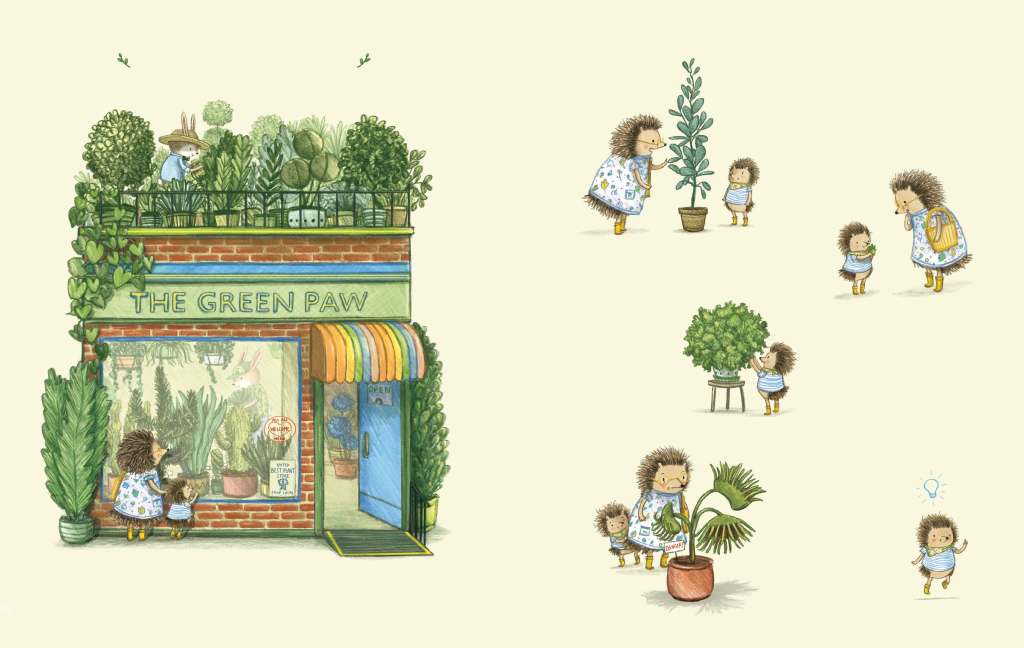
A visit to the plant nursery is one example of Graegin’s understated method. Mr. Green, the store owner, is a rabbit who is carefully attending his lush assortment of plants in the store window. The balcony of his brick shop is also densely filled with plants, in contrast to the following page, where white space allows Bean and Grandma to examine each possible plant without distraction. The exchange between the two is brief; they can intuit each other’s thoughts in this situation. The round, prickly cactus that Bean selects is perfect, because it embodies the qualities of both Bean and Grandma in each other’s eyes.

In “A Box for Bean,” Graegin revisits the cliché about a child preferring to play with an empty box to an elaborate toy. Grandma helps Bean construct a house out of the box, but then respects the child’s imagination, as Bean experiments with the box as a spaceship, pirate ship, and ice cream truck. There is a quiet image of parallel enjoyment, as Bean colors in the box while Grandma sits outside, in her own space, reading. This picture gives further evidence of the pair’s smallness, as flowers dwarf the box and Grandma’s teacup rests on a mushroom.

“Bean’s Bad Mood,” presents the difficult test of how a parent or grandparent responds to a child’s intense emotions. I was reminded of Little Bear, where the mother’s tenderness serves as a gentle test of reality, as in an imagined trip to the moon. Sophie’s patient grandma in Rosemary Wells’s Time Out for Sophie also came to mind. As Bean lies prone on the floor, enclosed in her “dramatic moping mood,” Grandma calmly assures her that bad moods are inevitable. In fact, she has anticipated this event: “I knew this would happen someday…Just be back by next Thursday. I’ll make you a sandwich.” Unhappiness cannot be avoided, but something simple to eat might mitigate its effects. Her well-stocked kitchen is neat and orderly. A portrait of Bean hangs on the wall. Grandmother and granddaughter wear matching boots, with only the older hedgehog using eyeglasses. Bean’s posture of mild defiance, with hand on hip, faces Grandma’s slight stoop, and her use of both hands to hold a cup. Each note in Everyday Bean resonates.

Learning French with McDuff

McDuff Goes to School – written by Rosemary Wells, illustrated by Susan Jeffers
Hyperion Books for Children, 2001

If you have never read any of the picture books about McDuff, the little terrier who is adopted by a loving couple living in a charming village in the 1930s, you have missed a modern classic. They are collaborations between two legendary authors and artists, Rosemary Wells and Susan Jeffers. McDuff Goes to School is the fifth in the series, and it holds a particular interest in the category of children’s books that informally present a new language (other example include Pizza in Pienza, Eat, Leo, Eat and My Sister is Sleeping). 

McDuff lives at number nine Elm Road, a location as essential to the series as Paddington’s address at 32 Windsor Gardens. One day, a new, French family moves in next door. They also have a dog, and, no, she is not a French poodle. That detail is consistent with the understated realism of Wells and Jeffers’ creation. The first conversation between the two dogs is bilingual: “’Woof! Said McDuff. ‘Ouf,’ said Marie.” Note the use of italics for a foreign word.

Marie, the new dog, has owners who are as kind as Fred and Lucy, the couple who adopted McDuff.  Celeste and Pierre de Gaulle (well, I guess their last name is the equivalent of a French-speaking French poodle), agree with Fred and Lucy that their respective pets need to attend obedience school. Mainly, Celeste seems to be in charge, and she is extremely determined. Lucy, realistically, too busy taking care of her baby, and Fred is “too tired after a day’s work” to train a dog. These are totally reasonable explanations, with no apologies offered; they are not inept dog owners.

Celeste’s daily repetition of commands to “assieds-toi!” and “Saute!” are translated in a glossary at the end of the book.  Children will get a real sense of the gap in communication between speakers of different languages, and also appreciate the advantages of bilingualism.  It turns out that McDuff’s apparent lack of progress in school is due to his attentiveness; he is listening to Celeste and learning to understand her language like a native.

As in every McDuff book, all of the humans are smartly dressed. The men wear argyle vests and driving caps. The women have lovely but practical collared dresses and t-strap pumps. Celeste even wears a Chanel-style pastel blue sweater and skirt set.  The book concludes with a luncheon en plein air, including cheese, French bread, fruit, and an American, probably apple, pie. There is even a checked tablecloth.  Both the dogs have earned ribbons.

A Different House, A Different Perspective

The Gift of the Great Buffalo – written by Carole Lindstrom, illustrated by Aly McKnight
‎Bloomsbury Children’s Books

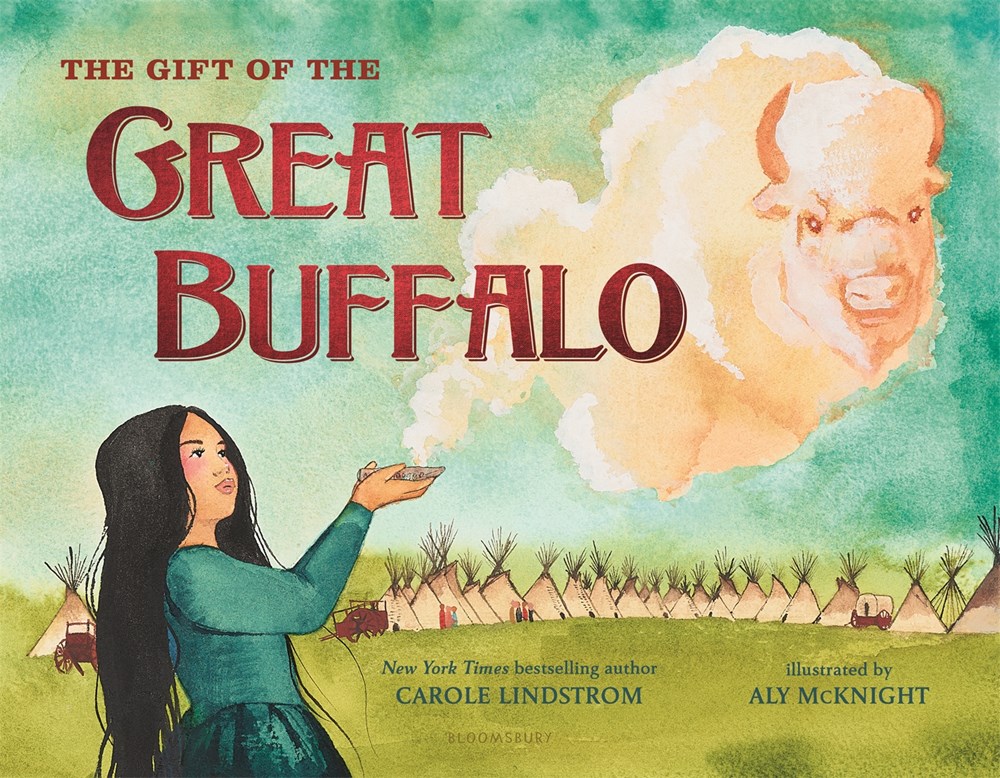
Rose lives on the prairies, in a Métis-Obijwe indigenous community. Preparing for the buffalo hunt that will sustain her people, she is eager to actively take part.  This elegant picture book takes place in the 1880s, and, like Laura Ingalls Wilder’s Little House on the Prairie series, Rose’s dwelling is small and homemade.  However, as author Carole Lindstrom explains in her detailed “Author’s Note,” she was motivated to tell Rose’s story by her own sense of distance from Wilder’s accounts.  The Gift of the Buffalo offers the perspective of the Native Americans who are a shadowy and distorted presence in Little House. Lindstrom and the artist, Aly McKnight have not created a rebuke, but rather, an alternative and illuminating vision.

I have written about the complexity of Laura Ingalls Wilder’s works (see here and here and here and here and here), which, along with racism, include a great deal of ambiguity about how a young girl interprets the conflicting messages of her parents and community about the people whose land they have appropriated.  The Gift of the Buffalo would stand alone for its excellence, even without the essential commentary that Lindstrom and Ally McKnight offer about the reality of an autonomous world, which is not merely a frustrating background for the story of Wilder’s pioneers.  Rose is an intelligent and perceptive child. When her father discourages her from accompanying him on the buffalo hunt, insisting that “that’s no place for you. Besides, Ma needs you more,” she cannot accept his restriction. 

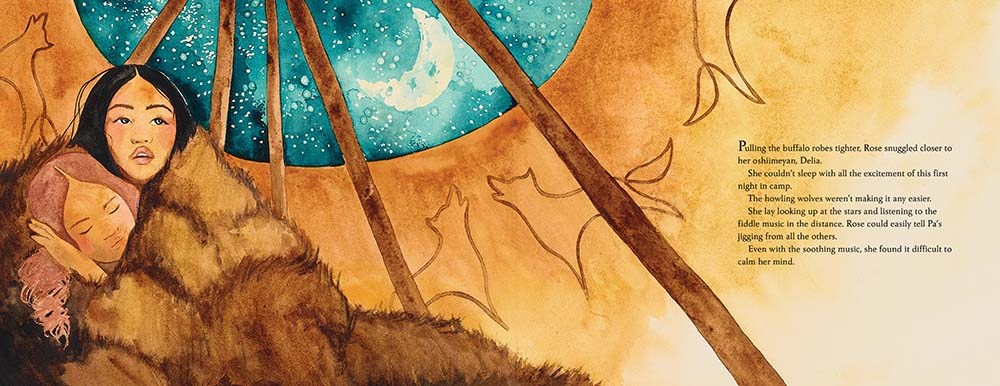
Rose’s decision to defy her father is not based principally on her individual needs, although there is an implicit statement about the independence of a young girl. She is deeply concerned about her family and friends. Lying in bed next to her oshiimeyan (younger sister), both of them enveloped in buffalo robes, she is excited about the hunt.  When she later hears adults express concern about their lack of success, she knows that she will need to step forward. Pragmatism is connected to spirituality; Rose will communicate directly with the spirit of the animals that, in the Métis consciousness, will give their lives to sustain their fellow beings. 

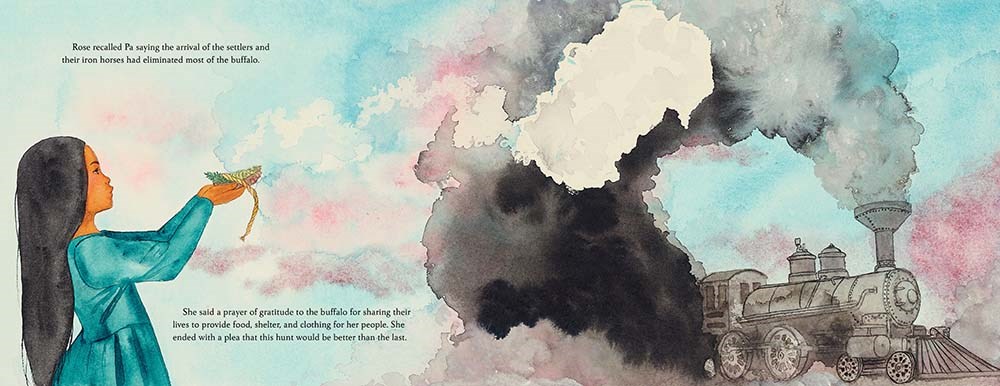
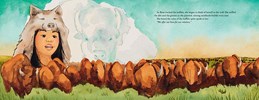
The watercolor and graphite illustrations are stunningly beautiful.  Earth and jewel colors, expressive faces, and alternating dark and light, frame realistic depictions infused with metaphor.  Rose, in a blue dress that complements the lighter blue of the sky, offers up a prayer of gratitude, in advance, expecting that the buffalo will “provide food, shelter, and clothing for her people.” Her father sometimes wears a wolf skin when hunting, and Rose assumes the mantle of his authority by putting on the special garment and identifying with the wolf. This ritual enables her to hear the buffalo assure her that her efforts will be productive: “We offer our lives for our relatives.” This evidence of mutual connection contrasts sharply with the exploitation of settlers, who had exhausted the supply of animals, even hunting for sport.

After the hunt, Rose’s father gently admonishes her. She had located the buffalo, but only by breaking his rule.  His suggestion that she might, in the future, accompany him on a hunt, shows  recognition of her needs as well as those of the tribe.  Readers will find familiar elements in Rose’s story of independence and growth, as well as an invitation to learn about a different house, family, and world.

Learning from Color

A Universe of Rainbows – poems selected by Matt Forrest Esenwine, illustrated by Jamey Christoph
Eerdmans Books for Young Readers, 2025

To paraphrase Mark Twain oft quoted remark about the weather, everybody talks about STEAM (science, technology, engineering, arts, and mathematics), but nobody does anything about it.  A Universe of Rainbows is a picture book that fulfills the ideal of combining education about these seemingly disparate fields.  An anthology of poems rooted in rainbows and color, it includes works by well-known authors and others whose work may be less familiar.  Each poem is accompanied by a boldly colored illustrated, and by a column of informational text. The breadth and range of the content and styles is amazing.

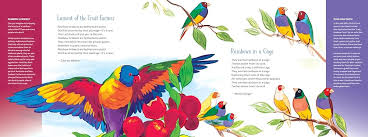
Virtually any selection gives a sense of the book’s approach. A poem by prolific author Marilyn Singer, “Rainbows in a Cage,” warns of the dangers of extinction caused by the voracious pursuit of rainbow finches: “They wanted rainbows in a cage:/finches stolen from the wild./A different time, a different age.” Singer uses the poetic form of the triolet, while other poems in the collection are composed in free verse.  This compact form, using only two different rhymes, is perfect for conveying her message.  The birds’ beauty does not excuse their exhaustion by selfish collectors. At the same time, she contextualizes the events by noting that different standards have applied in the past.  Jamey Christoph’s picture of the sought-after birds sitting on branches shows the bright and pastel colors that attracted collectors.  The explanatory text gives historical background and summarizes the results of the birds’ popularity: “the demand for Gouldian flinches became so great they were nearly trapped and caged out of existence.”

Lee Wardlaw points out the unfairness of judging a species only by its obvious beauty in “The Fruit Fly’s Secret.”  Yes, butterflies are lovely, but “just because/they flit and flirt/on wings of rainbow hues” they have deflected attention from the equally significant fruit fly.  Viewed under a microscope, the colors of these insects are revealed, elevating them from their lowly habitats in “drains and sinks and mops” or rotting fruit.  The text box describes how photomicroscopy documents how they refract light, and also interacts with the poem itself.  Wardlaw includes quotes from different authors extolling the beauty of butterflies; the text refers back to the poem by attributing each quote (Victor Hugo, Oscar Wilde, Bashō, and more).

Editor Matt Forrest Esenwine’s own poetry is also part of the book. “Alien Fountain” responds with awe to the unexpected phenomenon of the Fly Geyser, a “peculiar/accident/that could/only have/been created/by human ignorance/and Nature’s/resilient/soul.”  This result of an energy company’s drilling for geothermal water in the 1960s produced a strangely stunning appearance, captured in Christoph’s illustration.  The algae growing on mounds of limestone caused an explosion of color, “giving the geyser its otherworldly appearance.” As in all the explanations, concise presentation of facts works in parallel with literary language.

I cannot recommend this book highly enough.  It sets a high bar for authors and artists aspiring to link science and the arts without sacrificing aesthetic and linguistic distinction.

Uri Shulevitz 1935-2025

Uri Shulevitz died on February 15.  The breadth of his artistic vision was outstanding, demonstrated both in books which he wrote and illustrated, and in others that he illustrated in collaboration with another author.  Many were deep explorations of Jewish themes, while others were more universal in scope. Chance was a masterpiece, integrating his entire life’s work in both words and pictures (I have also written about him here and here). The title indicates his conviction that his survival as a refugee from the Nazis, and, therefore, his entire career as an artist, was fundamentally a result of random events.  The book earned many distinctions; unfortunately, a Sydney Taylor award was not among them.

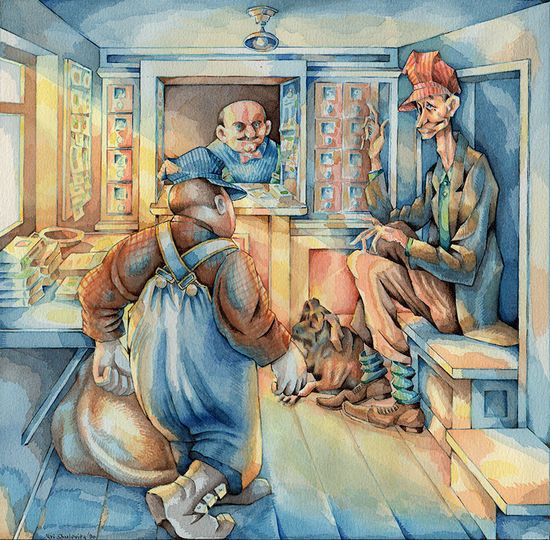
I would like to call attention to one long out-of-print work by Mr. Shulevitz, his quirky, and even disturbing, Toddlecreek Post Office. (Farrar, Straus and Giroux, 1990). Like several of his other books, it adopts a tone from folklore. The small village of Toddlecreek has a small post office. It resembles an ordinary house, with tall windows, flower boxes, and an American flag indicating its purpose. The name of the postmaster is Vernon Stamps, reinforcing the idea that the story is something of a parable. (Some of his neighbors are named Mrs. Woolsox; Charlie Ax the logger; and the garrulous and nostalgic Dexter Shuffles.) Mr. Stamps is busy and efficient, but also compassionate, helping everyone in the community and even welcoming animals to his overcrowded enterprise.

Into this paradise, one unfortunate day, the postal inspector intrudes.  Her presence is immediately disturbing, and the animals react before she even sets about her task. “Birds’ songs diminished…Bees’ buzzing ceased, or so it seemed. The small dogs stopped barking, and stared.” The inspector examines the post office’s records, as well as the evidence that unofficial, but humane, activities are also promoted there. There are books to read, and announcements for barn dances on the bulletin board. She announces that the post office will be closed. Vernon is stunned, but he senses that resistance to this decision is futile. He locks up and leaves.

If readers are not already saddened by this point, Shulevitz makes clear that the post office’s closure leaves a terrible gap in the life of the community.  There is a sense of shock in the rumors about Silken, Vernon’s part wolf and part sled dog companion. The animal has disappeared. “Some say she went north to join the wolves. Others say she was killed by a hunter.” 

What motivated Shulevitz to end the book on an unambiguous note of sadness? He was a great artist and humanist who had lived through the worst conditions imposed by tyranny.  Toddlecreek has been ruined.  “It is not on any map, it is bypassed by travelers and forgotten by time. And now, like any other small village, Toddlecreek has no post office.” Yet, unlike the residents of this unfortunate town, he did survive to produce an unforgettable body literature and artwork for both children and adults.

Family Stories and Food

Electra and the Charlotte Russe – written by Corinne Demas Bliss, illustrated by Michael Garland
Boyds Mills Press, 1997

When I was growing up in New York, the charlotte russe was a popular pastry, though the peak of its popularity was already gone by the post-World War II era. At the time, I wasn’t aware that I was enjoying a part of New York food lore in its decline, but that still had meaning for my parents’ generation.  In Electra and the Charlotte Russe, a Greek-American family, living in an ethnically mixed Bronx neighborhood, is the center of the nostalgic story.  In her author’s note, Corinne Demas Bliss writes that the book is based a story which her mother, Electra, had related about her own Bronx childhood in the 1920s.  Whatever your background, and whether or not you have ever eaten the delicate pastry enclosed in a paper sleeve, you will probably respond to the essence of Demas’s tale and Michael Garland’s almost photorealist pictures.

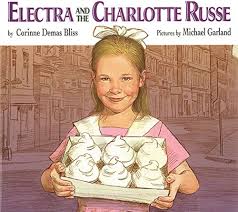
Once upon a time, there were many children’s picture books with extensive text. Electra opens with a portrait of the little girl and her mother. Electra is entrusted with an important errand. She will go to the local bakery to purchase six charlotte russes for her mother’s guests. These are Mrs. Papadapoulos, Mrs. Marcopoulos and her daughter, Athena. The guest without a melodic Greek last name is Miss Smith, who is learning Greek from Electra’s mother, in preparation for her upcoming marriage to Mr. Demetropoulis.  If you think this is an overly idealized portrait of immigrant communities, the motive behind the Greek language lessons is for the future Mrs. Demetropoulis “to understand what his relatives said behind her back.”

On the way Electra meets her friend, Murray Schwartz, whose tongue has turned green from eating a gumball.  A much older neighbor, Mr. Melnikoff, waxes nostalgic about the charlotte russes of his own past, calling them “a dessert fit for a princess.” The extended text occupies some pages, while others have only one or two sentences. A typical New York City apartment building, as rendered by Michael Garland, seems shaded in ombre light and colors, accompanied by the brief instructions to Electra not to run even though she is in a hurry.  Mrs. Zimmerman at the bakery repeats that prophetic warning to her young customer.

When Electra trips, damaging the exquisite works of art in her bakery carton, she tries to fix them. This leads, of course, to eating some of the whipped cream. A two-page spread shows four scenes of Electra’s face and hands as she attempts to even out the cream.  Every step of the process is detailed in sequence, from Electra’s entrance into her apartment building, to her settling on several landings with the pastries, and finally reaching her home. “They didn’t look quite like charlotte russes anymore, but at least they did look all the same.”

Fortunately, Electra’s mother had prepared other delicacies: baklava, diples, loukoumades and kourabedes. The guests enjoy the now transformed and unidentifiable charlottes russes. After they leave, Electra’s mother explains to her the concept of remorse. “Remorse is when you wish you hadn’t done something that you did.” But she isn’t angry with her daughter, and the book closes with Electra sitting on her mother’s lap.  Perhaps she would have been less forgiving if her guests had not enjoyed the gathering, or the pastries denuded of whipped cream. But I doubt that would have made a difference.