The Newest Gnome – written and illustrated by Lauren Soloy Tundra Books, 2025
The Pocket is where the gnomes live, in Lauren Soloy’s remarkable universe of small creatures dedicated to choosing hats, telling stories, and generally explaining and appreciating the world. I was impressed with the first gnome book, The Hidden World of Gnomes, and I’m thrilled that Soloy and Tundra believed in them, and that they merited a second look (I’m also a fan of Soloy’s other work, as you can see here and here and here). Although the gnome books are rooted in tradition and folklore, they are also new and singular.
When the book begins, the existing gnomes, including Cob Tiggy, Twiggy Dell, Minoletta, and Beatrix Nut, are about to welcome a newcomer to the Pocket. These creatures, whose names evoke both Beatrix Potter and a kind of cosmopolitan flare (Minoletta, Hotchi-Mossy), need to meet in their mushroom circle to discuss the latest Pocket resident. When Grolly Maru arrives, they sense the need for reassurance, similar to Winnie the Pooh’s helpful and sustaining words: “Everything will be all right.”
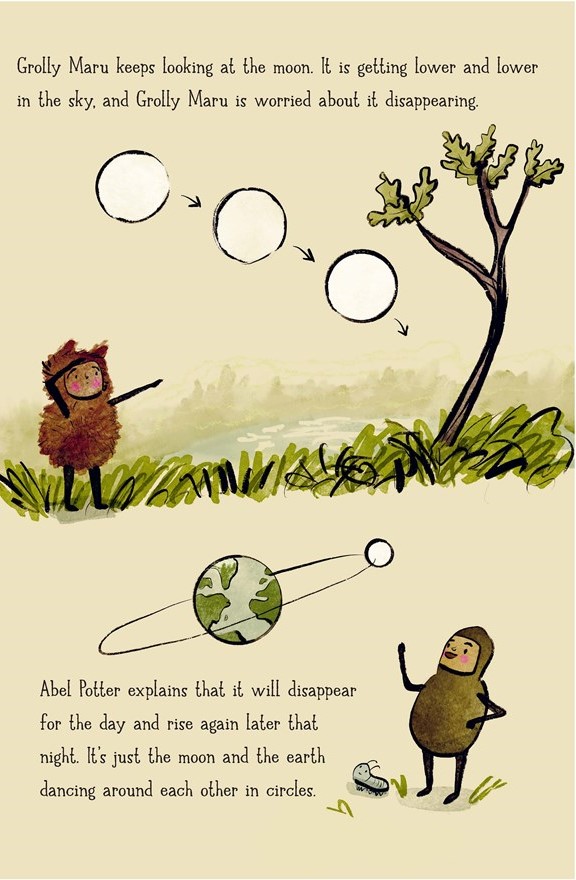
After a good night’s sleep under the mushrooms, the gnomes will be prepared to teach Grolly Maru essential skills. As in Babar’s Celesteville, every inhabitant has a specific job and role to play. When Grolly Maru expresses concern that the changing moon may eventually disappear, does this reflect and anxious personality, or just a basic lack of familiarity with the environment? It’s up to the reader to decide, but since Abel Potter shows Grolly Maru other round and spherical items from nature, it doesn’t matter.
The pictures feature gnomes interacting with one another, along with close-ups of objects that fill their lives: dandelions, yarrow, marbles, ants, and suggested exercises. There is a recipe for Bonnie Plum’s baked apple with blackberries, which, considering the scale of gnome to ingredients requires both hardware and strength. The gnomes are artisans, designing grass baskets: “It’s not as easy as it looks!” (Who would expect it to be easy?). Their overarching purpose is constant fidelity to the idea that each individual is unique, but that we are all part of something greater. Lauren Soloy’s artistic vision is fully realized, in a universe of beauty and comfort, populated by small beings with great wisdom.
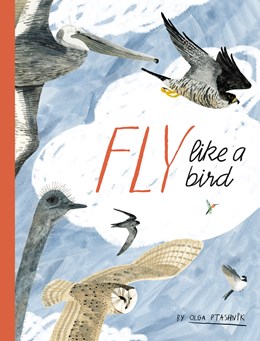
Fly Like a Bird – written and illustrated by Olga Ptashnik Eerdmans Books for Young Readers, 2025
Breaking the mold may be a harsh-sounding metaphor for a children’s book about birds, which contains within itself a story of natural insecurity and a parent’s reassurance. Fly Like a Bird does actually break a mold in the “STEAM” books genre. The text and the artwork, by Olga Ptashnik, are both wonderful. Children, and adults, will also learn a lot about a wide range of birds.
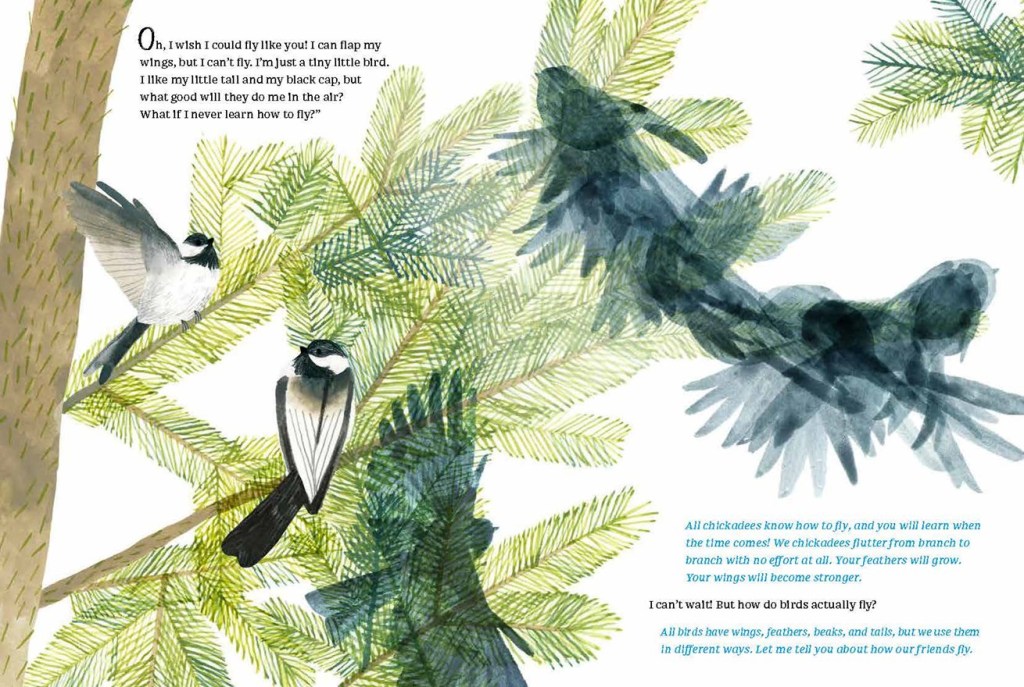
A young chickadee expresses concern about the possibility that she will never accomplish the daunting task of learning to fly. Ptashnik captures the inner life a child with her words: “I can flap my wings, but I can’t fly. I’m just a tiny little bird…What if I never learn to fly?”
Right away, children will be drawn to the book’s tone and central idea. The question-and-answer format alternates black and blue font, as the parent answers with accessible information about different birds and their unique qualities. Digital artwork produces the colors of nature: green, gray, blue, black, red, in different shades.
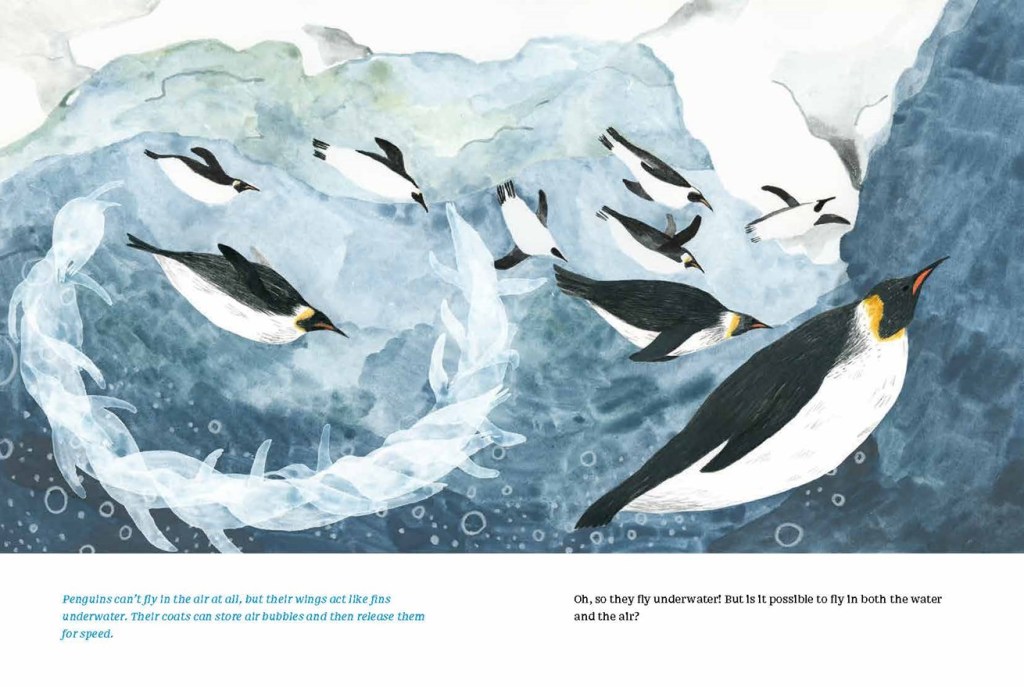
Hummingbirds are tiny; how do they produce the intense vibrations that give them their names, and also find nectar to drink? Penguins can’t fly, but their speedy swimming more than compensates for this unusual difference. The young bird processes the information: “Oh, so they fly underwater! But is it possible to fly in both the water and air?”
The peregrine falcon images bring the reader to a more human-populated location, as they fly high above elegant buildings and swoop down with incredible speed.
Each picture is composed to invite focus on different aspects of the scene. A large falcon appears commanding, hovering over the rooftops. A chain of apparently connected birds descends, and more distant birds appear smaller as they alight on structures and rise up further into the sky. Ptashnik anthropomorphizes a bit more here, breaking the fourth wall. The young bird expresses feelings of vulnerability associated with humans: “…but I don’t want to hurt other birds! How can tiny birds like us protect ourselves from predators?”
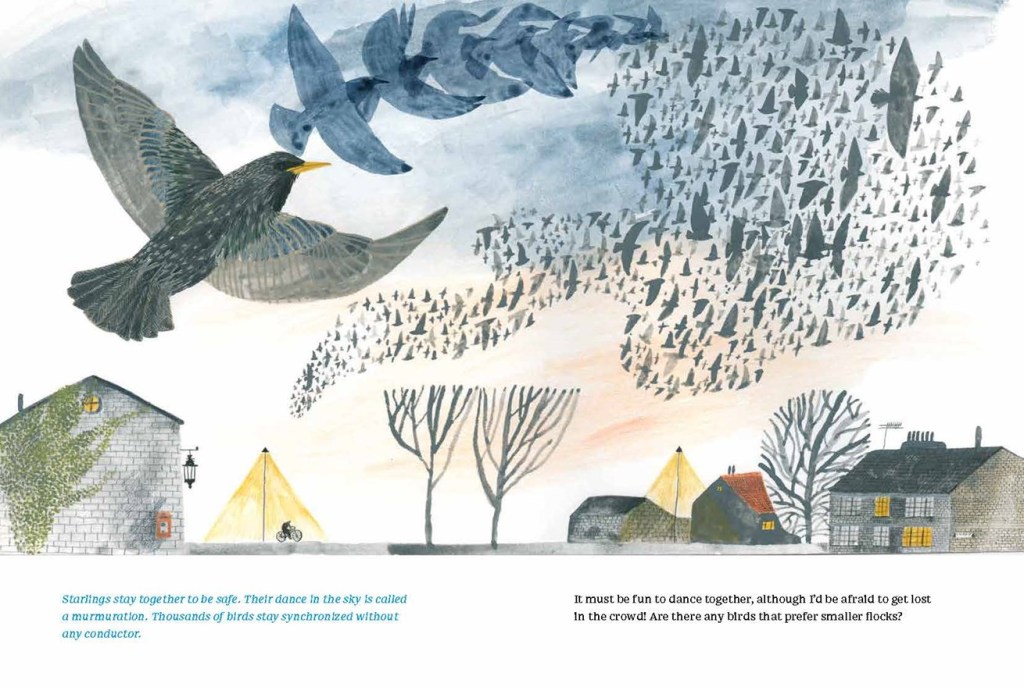
A flock of starlings forms a “murmuration,” as “Thousands of birds stay synchronized without any conductor.” Again, the varying scale of the scene elements are a quiet drama. On the ground, a person riding a bicycle appears very small. Above, the murmuration is a symphony in motion. I was reminded of the fish learning about solidarity in Leo Lionni’s Swimmy.
The book concludes with two pages summarizing the star players, from hummingbirds to black-capped chickadees. Everyone eventually learns to fly, swim, swoop, and find nectar, when the time is right.
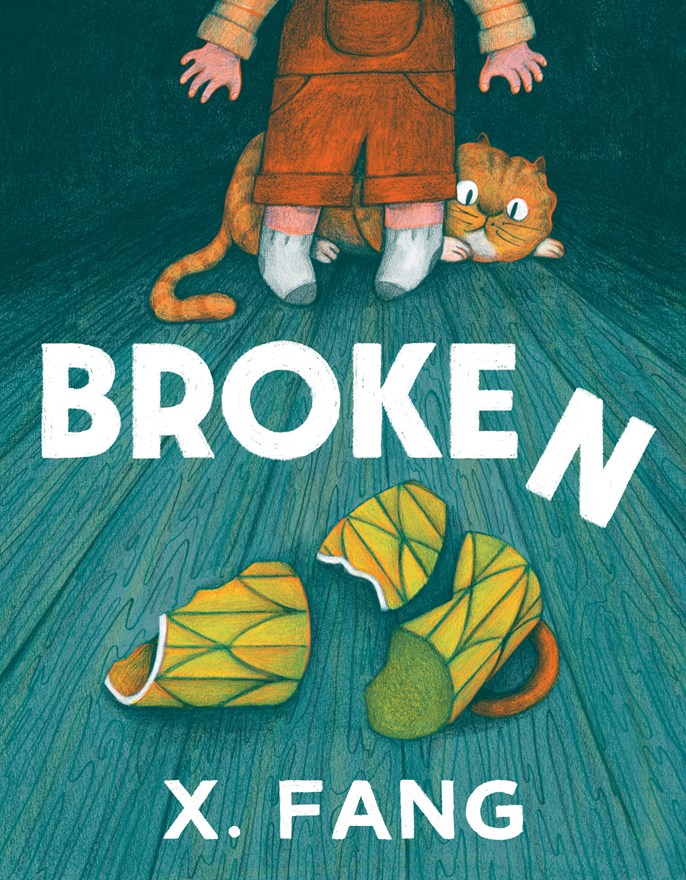
Broken – written and illustrated by X. Fang Tundra Books, 2025
A picture book by X. Fang has an unmistakable identity (see my reviews here and here). The actual species of the mysterious visitors in We Are Definitely Human may be ambiguous, and the vivid dream imagery of Dim Sum Palace seamlessly transforms to the warmth of a family restaurant. Broken is about the unbreakable bond between a grandmother and her grandchild, and also the reassuring truth that many things that are broken can be repaired (grandparents being a constant presence in children’s books, as seen in my list at the beginning of this review). Maybe the new object will appear identical to the old one, or perhaps some small difference will be evidence that its importance is not compromised by a beautiful, jagged crack and some glue. The sturdy, rounded characters who populate Fang’s earlier books are back, but they are not repetitive. She has a specific visual interpretation of humanity and it is inimitable.
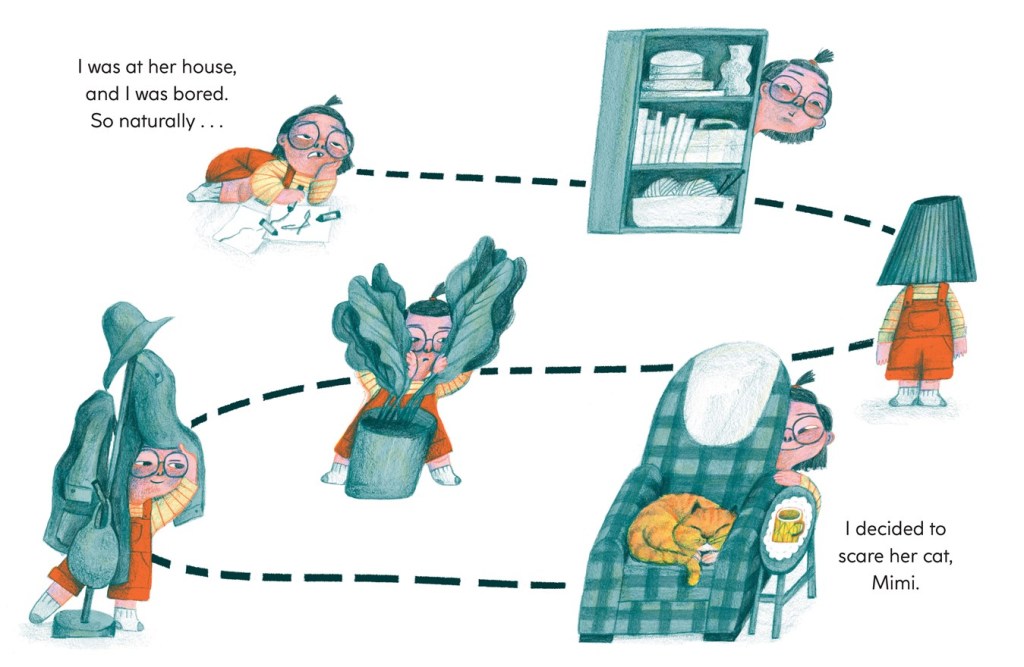
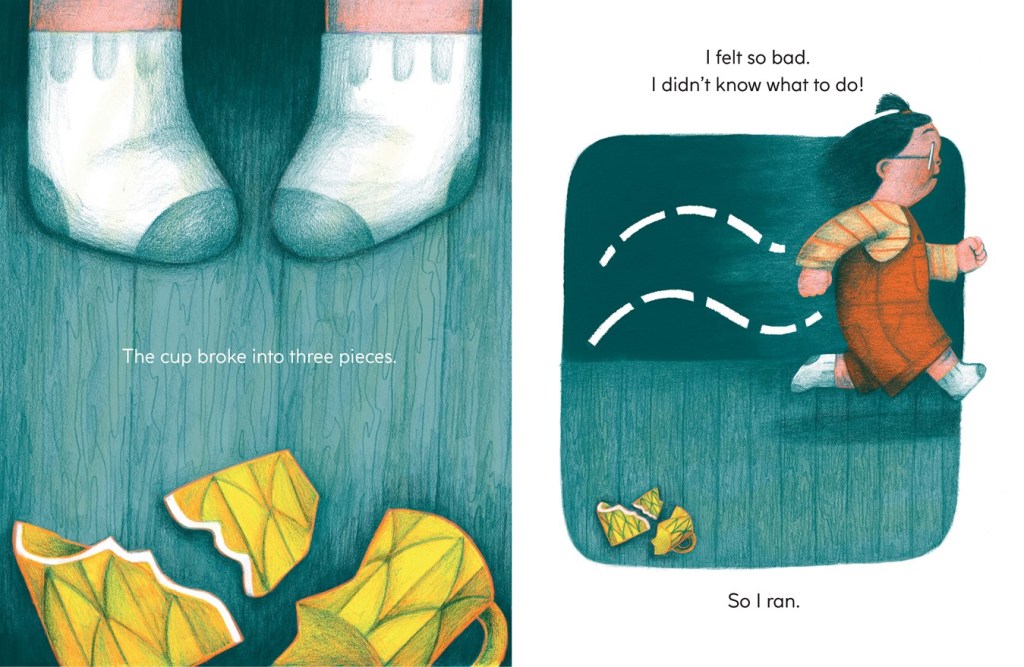
A little girl, Mei Mei, introduces the story with an invitation and an outright confession: “Let me tell you the story of the day I broke Ama’s cup.” A day at Ama’s house is full of unspoken comfort, but sometimes boredom. Thick dashes connect the girl’s activities, like a familiar board game.
Then it happens. Having made the conscious decision to frighten Ama’s cate, the girl bumps into a table and hurls the cup towards its trajectory. Not only does it break, but the damage results in three pieces. Appealing to young readers with a direct statement of her guilt, the girl futilely tries to escape her own fears. What if Ama’s unconditional love has conditions attached?
The girl’s senses become exaggerated. Her grandmother calls to her, maybe in anger. That may seem unlikely to an adult reader, but only her warm smile convinces Mei Mei that nothing fundamental has changed. Ama brings her some cake. Mei Mei has the opportunity to blame the broken cup on the hapless cat, but she can’t bring herself to be dishonest. A full page picture of the cat’s accusatory stare is the counterpoint to Mei Mei’s closed eyes behind her oversized glasses.
Overcome with anxiety, she hides in the closet, obviously a temporary solution. Fang even includes a helpful graphic of Mei Mei in silhouette profile, the truth emerging from her insides in arrows that turn into words of apology.
Mei does not only forgive her; she offers an explanation. Repairs make meaningful objects stronger. Each one tells a story. Ama takes on a new identity, as a “fixer,” in a series of portraits framed with old-fashioned photo corners. She is a super competent, and also compassionate, role model to her beloved and unique granddaughter.
Spaghetti: A Mouse and His Treasure – written and illustrated by Merrilees Brown Tundra Books, 2025
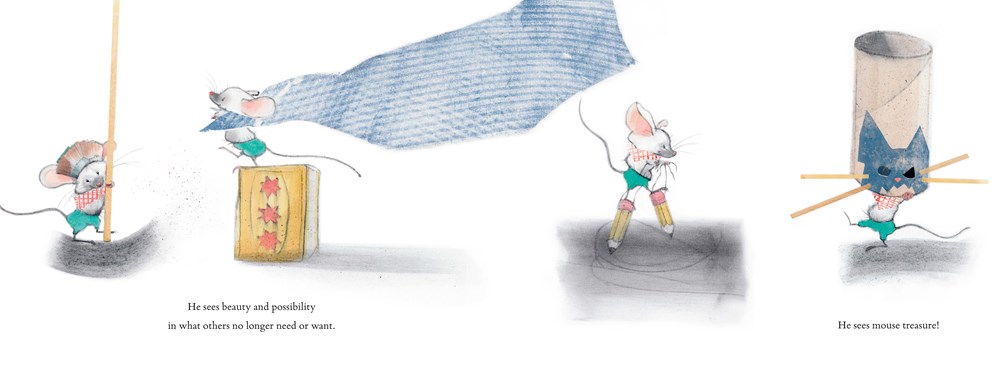
Collecting is a fantastic hobby, or maybe it is just an annoying compulsion. One person’s desirable object is another person’s clutter. Author and artist Merrilees Brown transforms this truism into a wonderful story about Spaghetti, a creative mouse who “sees beauty and possibility in what others no longer want or need.” Named after one of his favorite media, this charming character is rendered in graphite, oil paint, print, humor, and affectionate details.
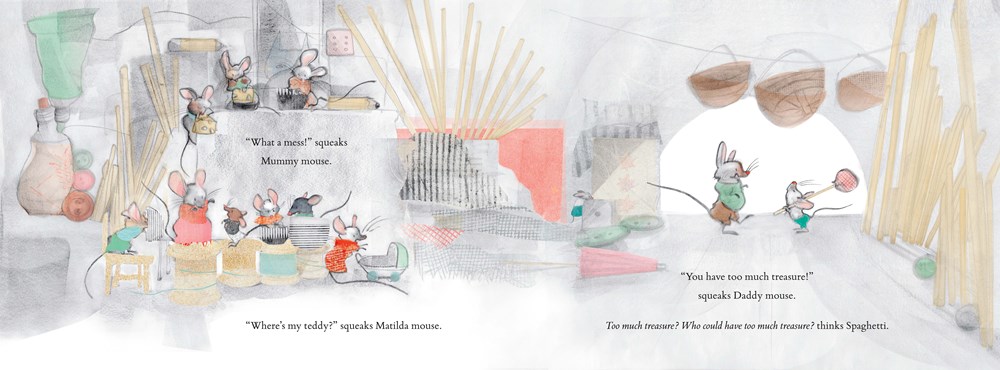
Since mice have large families, Spaghetti has a rapt audience for his pencil stilts, cat face costume, and even his carefully composed box of cast-offs waiting to find a use. Yet other members of his clan are annoyed by his endless projects. Mummy complains of the mess and Daddy makes the puzzling statement that “You have too much treasure”” as if that were possible. Spaghetti responds with conviction, and even a hint of defiance, literally immersing himself in the multicolored materials he will bring to life.
Spaghetti recognizes that he has a problem, so he “puts on his thinking cap.” Children have the pleasure of seeing this expression visualized as one of the mouse’s creations. Crafts are sometimes distinguished from works of art by their usefulness, but this distinction can be permeable. Spaghetti decides to emphasize the incredible properties of pasta, building something practical for everyone in his home. Engineering meets art in his Calder-influenced amusement park. (There are other picture book mice with artistic sensibilities and kinetic skills; I’ve reviewed three of them here and here and here.)
Spaghetti’s self-assurance allows him to persist, even when others fail to recognize the importance of his vocations. At the same time, he is as flexible as a strand of spaghetti, letting young readers know that being true to oneself doesn’t require dismissing other viewpoints. Best of all, he succeeds in combining three different values: collecting, creativity, and love for his family.
Lights at Night – written by Tasha Hilderman, illustrated by Maggie Zeng Tundra Books 2025
There are two families observing the rhythms of the year in Lights at Night. One is human and the other canine, specifically foxes. Dream-like images with changing shades of color include realistic details, both natural and cultural. Children experience the wonder, but also the reassurance, of the four seasons and their special features, from football in autumn to storms in spring. While the fox family does not kindle holiday lights around the time of the winter solstice, they also appear to respond to the changes. Tasha Hilderman’s soothing poetic text complements Maggie Zeng’s visual immersion in the excitement of one year. Children find joy, not boredom, in the repetition of familiar events.
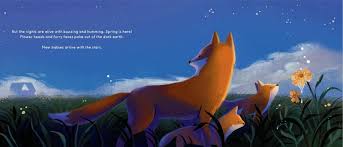
A powerful storm is just unsettling enough to make the shelter of home more of a comfort. Crayon drawn strikes of lightening emanate from a house, enclosed in a photograph, and also cross its border. Inside, a strong of lights and beds configured as tents add the sense of drama that children like. Note the plush fox in a small sleeping bag. The fox family lacks the domestic props, but is just as attuned to the environmental changes. Of course, animals’ lives are more closely defined by the seasons. In spring, “new babies arrive with the stars.”
Campfires come in summer; riding the bus to school and harvesting wheat are tied to autumn. One of my favorite images in the book is a natural and unobtrusive celebration of multicultural holidays. Christmas trees, Diwali lights, a Muslim family welcoming visitors, and a Kwanzaa lamp grace the neighborhood, along with a Jewish family’s observance of Chanukah. If you look closely, you will see that the correctly depicted nine branch chanukiyah (menorah) has its candle farthest to the left partly obscured by the window frame. This is not an error, just a small visual element lending authenticity to the way in which someone placed the lights, which must be visible from the outside.
At the end of the book, the two children share an album and a box of crayons. The volume is open to the photo with lightning, enhanced by the children’s artwork. The actual fox looks up the moon.
Trouble Dog: From Shelter Dog to Conservation Hero – written by Carol A. Foote, illustrated by Larry Day Eerdmans Books for Young Readers, 2025
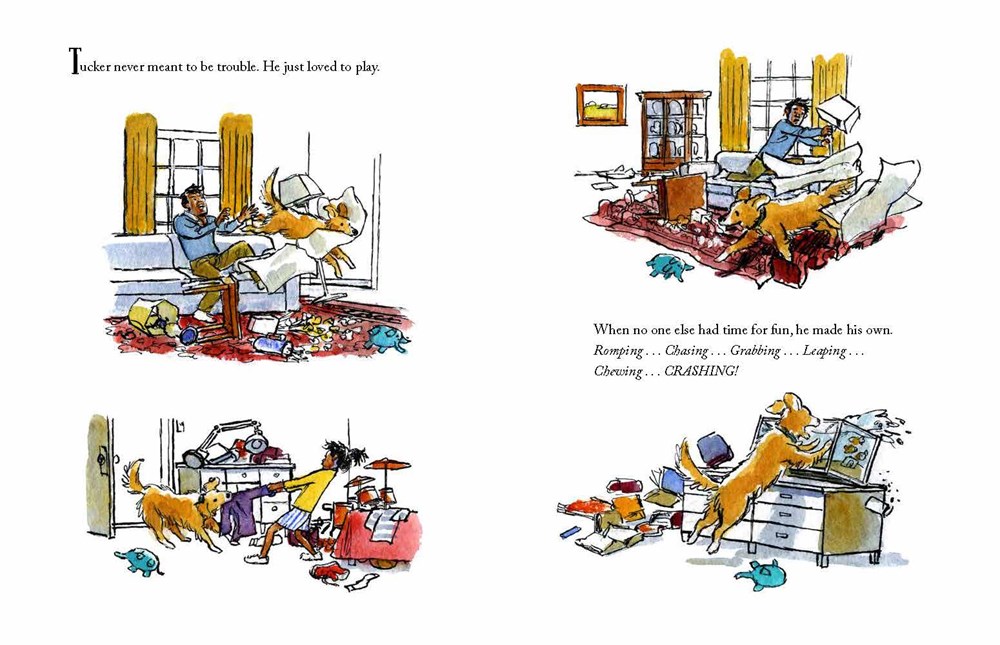
There is a lot of action in Trouble Dog. There is also an abundance of information, a likeable main human character, and a surprising amount of humor. Carol A. Foote has combined two real-life conservation dogs into one fictional hybrid named Tucker. Caught in a cycle of adoption and rejection, he is always returned to the animal shelter that has given up on placing him. Then, along comes Laura, a classic heroine who refuses to give up on an unlikely pet who has driven everyone else to distraction. Larry Day’s pictures are full of action and color, setting a motion Laura and Tucker’s journey from trouble to success.
The opening end papers introduce Tucker in some typically frenetic canine activity. Then it escalates, as every home the shelter finds for him is subjected to chaos. Tucker manages to overturn an aquarium and books in one place. He grabs a girl’s sweater and won’t let go. A man attempting to read his newspaper looks enraged as Tucker grabs it and leaves a litter of overturned items in his wake. When we next see him, Tucker is a lonely prisoner in a cage, “watching everyone pass him by.”
Laura is a sturdy figure with a ponytail, flannel shirt, and jeans. She is as no-nonsense as Mary Poppins, and she also intuits something about Tucker that everyone has missed. His energy can be put to good use. Even though her home is quickly as disordered as every other place Tucker has been, she has a vision and the practical sense to implement it. Dogs, as readers learn in Foote’s detailed backmatter, have a highly developed sense of smell. Laura observes Tucker carefully and evaluates his routine and abilities. She isn’t just kind and patient, but methodical, as well.
Eventually Tucker gets a job, or a series of jobs. The details in the text are embedded in words as colorful as the pictures. “Tucker’s first job was to find rosy wolf snails in Hawaii.” (image). He travels the world, sniffing out “moon bears in China, mountain lions in Chile, and elephants in the jungles of Myanmar” in a narrative as exciting as one by Jules Verne, but rooted in the truth. In a two-page spread, Tucker crosses the gutter between pages. An elephant marches ahead of him, dwarfing the dog in size, but not in energy. Three researchers form a determined row in the background, to his left. The image captures the cooperation necessary for Tucker to succeed in helping scientists to learn about species in need of protection.
Not every outing produces results easily. In Zambia, Laura’s optimism is tested, looking for cheetah scat and coming up short. When Laura insists that “I trust Tucker,” who finally leads them to the right location, she is not relying only on her affection for the dog. Through hard work and astute decisions, she and Tucker have become a team.
Four pages of additional information and photographs are organized in a question-and-answer format, giving the bigger picture of how conservation animals, as well as other service animals, provide essential services. A selected bibliography is accompanied by an oval portrait of Laura and Tucker relaxing at home. I hope that no one misses one title, by Alexandra Horowitz, Inside of a Dog: Young Readers Edition: What Dogs See, Smell, and Know. Just parenthetically, the title refers to the famous quip usually attributed to Groucho Marx: “Outside of a dog, a book is man’s best friend. Inside of a dog, it’s too dark to read.” It’s definitely not too dark to read inside this book.
Returning the Sword: How a Japanese Sword of War Became a Symbol of Friendship and Peace – written by Caren Stelson, illustrated by Amanda Yoshida Carolrhoda Books, 2025
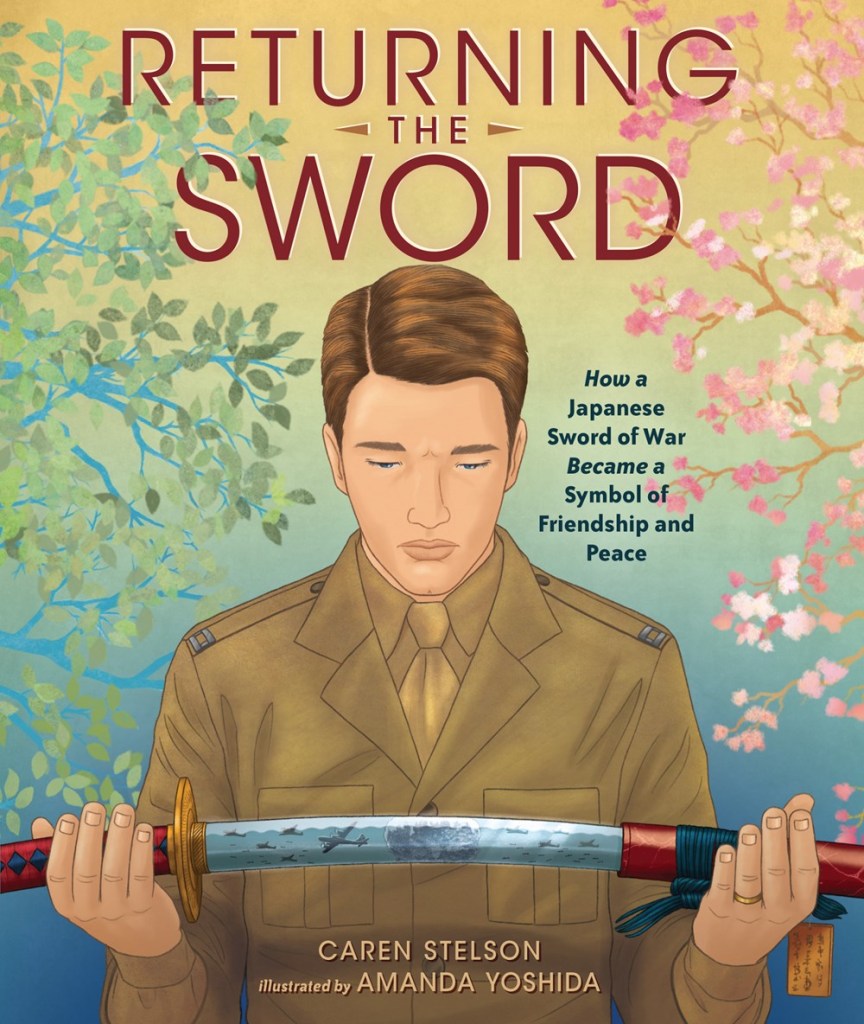
There is an understandable connection, for many readers, to books that promise a hopeful vision of reconciliation after conflict. I have read and reviewed many books in this category. While I respect the principle of deriving a positive lesson from a disastrous historical event, I have difficulty with facile messages of friendship in the absence of context. Returning the Sword has beautiful illustrations by Amanda Yoshida, and the text by Caren Stelson is obviously the product of sincere beliefs. She is a serious author committed to writing about important topics. However, I am troubled by the book’s almost complete absence of accurate information about Japanese aggression before and during World War II, and its depiction of the Japanese people as the sole victims of that conflict (as was also done here).
Stelson relates the story of Orval Amdahl, a man who served in the U.S. Marines during World War II and in the postwar occupation of Japan. He was horrified by the death and destruction wrought by the atomic bomb, a response shared by people throughout the world. Although more people were actually killed in the firebombing of Tokyo, inflicting death by radiation poisoning in the cities of Hiroshima and Nagasaki was conceived as a different category of weapon, one to be avoided ever again.
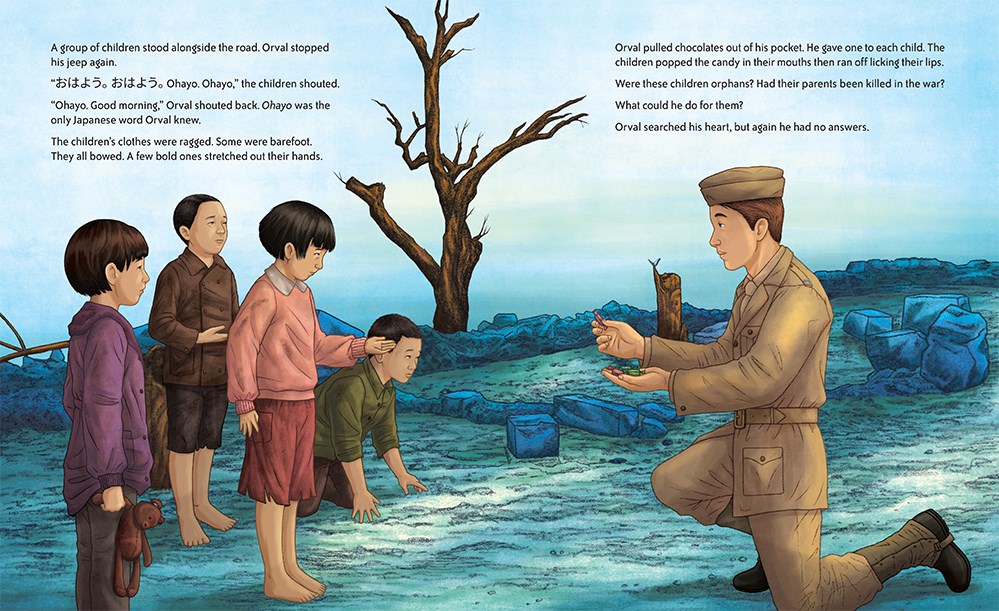
The decision to use that weapon to end the war, while one with terrible consequences, did not occur in a vacuum, but readers would never learn that from the book. Reporting Captain Amdahl’s reaction in Nagasaki, Stelson writes that “The city had been destroyed by a terrible bomb,” and “So many people had lost nearly everything important to them in this terrible war.” The starving children he meets, and the other civilian victims, had been living under a fascist regime that inflicted torture and murder throughout the countries they occupied, and upon the Allied soldiers who fought against Japan’s imperial forces. The Rape of Nanking, the Bataan Death March, the abuse of Korean “comfort women,” and other atrocities, are completely absent, not even indirectly suggested in an age-appropriate way. I am not suggesting that these sources be directly presented to children, which would be totally inappropriate, but they could be offered as a context for adults sharing the book, since Japanese suffering is uniquely at the center of its message.
Like many soldiers who served in the Pacific, Captain Amdahl returned home with a souvenir sword. This item continued to plague him psychologically, and he ultimately decided that he would like to return it to, as he interpreted it, its “rightful owner.” Stelson describes the swords as works of art and family treasures. The craftsmanship used to create them is somehow allowed to displace their actual purpose as symbols of military might, and also, to a lesser extent in World War II, as actual weapons used to perpetrate atrocities I prefer not to describe here. The U.S. military leaders who encouraged soldiers to appropriate them are cast as heartless. Captain Amdahl enters a room where the swords are “piled eight feet high,” and selects one to take home. This scene struck me as an inversion of the often-described encounter between the liberators of Nazi concentration camps and the bodies they discovered. The swords themselves are personified as lifeless victims.
Eventually, Captain Amdahl contacts Tadahiro Motomura, the son of the sword’s owner. Mr. Motomura writes of how his father did not talk about the war, but expressed his sadness at the loss of his sword: “At the end of the war, it hurt him to give it up.” (Without describing atrocities, the author might have suggested the incomplete nature of this statement. Even a mild indication of its irony, such as “The Japanese had caused great suffering in the countries they occupied. Still, Mr. Motomura felt sad about the loss of his family heirloom,” would have been closer to the truth.) Unlike in Germany, where an incomplete, and ultimately truncated, version of denazification was U.S. policy, in Japan a decision was made, in the context of the Cold War, to avoid forcing responsibility on the defeated nation. The emperor remained as a figurehead and there was virtually no educational program to ensure that the Japanese understand anyone’s suffering other than their own.
Captain Amdahl and Mr. Motomura believed that their personal reconciliation had embodied the idea of “peace with honor.” Perhaps if they had each come to terms with the historical realities that brought so much destruction, culminating in the terrible choice of using an atomic weapon, their decision would have been more meaningful. The book’s visual beauty, and even the ideal of reconciliation, could prompt a serious discussion with children about the consequences of both totalitarianism and violence. Historical facts and the idea of accountability would need to be part of that dialogue.
Adi of Boutanga: A Story from Cameroon – written by Alain Serge Dzotop, illustrated by Marc Daniau Eerdmans Books for Young Readers, 2025 (originally published in French, 2019, Translated by the author)
Adi of Boutanga is an important book. That quality would not necessarily make it appealing, let alone essential, to read, but there are many other reasons why it is just that. A voice that resonates with the truth, beautiful illustrations and innovative graphics, a compelling story, and a deep sense of conviction will all enfold the reader in its narrative fabric.
Adi is fourth grader living in a nomadic community, the Mbororos, in Cameroon. Although they are traditionally herders, their economy has changed; Adi’s father transports passengers on his motorcycle and her mother sells Makala (doughnuts) in the marketplace. Adi’s identity is defined by family relationships: “I prefer to stay the big sister of Fadimatou, Zénabou, Youssoufa, Daïro, Souaïbou, and baby Mohamadou.”
Children cannot control their own lives, even to the limited extent that adults are able to do so. Adi loves attending her school, which she describes as a “gift” to the village by Mama Ly and Monsieur, generous benefactors. The process of learning to read may seem inherently magical to many children, but Dzotop captures the poetry of this experience and gives Adi a voice:
      Before the school was given to our village, words were invisible to us. We
      could hear them, but we couldn’t see or touch them. I even thought a
      a strong wind might steal them as soon as they left our mouths. But that
      wasn’t true.
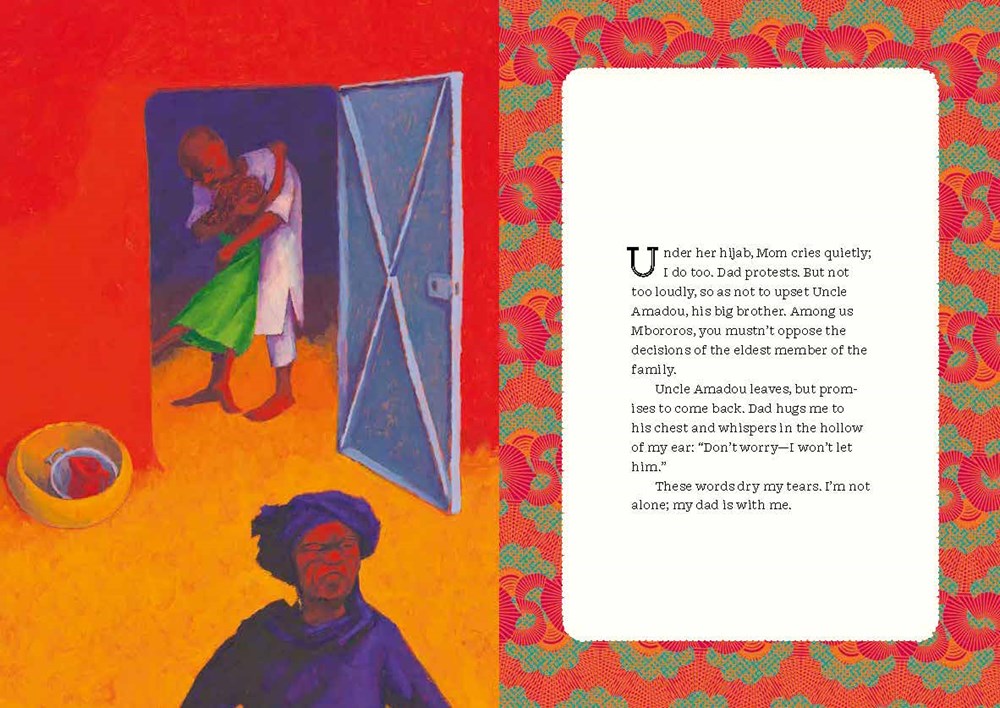
Although there may seem to be a fable-like quality to the book, the characters are not generic. Adi’s mother embraces her daughter’s individuality, responding to Adi’s frequent laughter with the suggestion that her daughter has “swallowed a thousand weaverbirds.” But the warmth and protectiveness of Adi’s life is shattered when her uncle arrives to inform the family that, although still a child, she must marry. Her father and uncle assume opposite patriarchal roles, one caring and the other transactional. “They throw words at each other. Words that hit like stones.”
Saving their daughter means that Adi’s parents must send her away. She goes to Boutanga, where her benefactors have established a school for girls that fosters creativity and dignity. Even if this solution is not a global one, it is enough for Adi and an example for all. Eventually, when she has arrived at the point in her young adult life when she is able to choose, Adi finds love with a man who respects and understands her. Mastering language has been a key to her growth, “catching words… putting them in the right order and making sure they say the right thing.”
The book is not composed only of words, but of images that organically emerge from the culture which they represent. Pages with illustrations alternate with blocks of text set against traditional fabric patterns. Human figures allude to sculpture but have kinetic movement. Earth tones are the setting for the book’s quiet drama, with deep blue sea and red skies framing Adi’s journey. Adi of Boutanga is not a moral lesson, but a work of art that interweaves modern aspirations of freedom for women with the unique threads of a specific culture. It is a book to read, share with children, and read again.
The Witching Hour – written by Jennifer Harris, illustrated by Adelina Lirius Tundra Books, 2025
My mother used to refer to “the witching hour,” that time late in the day when babies, toddlers, and young children seem to act a bit possessed. Whether because they have managed their impulses as best as they can for many hours, or need limits and reassurance, or are just exhausted, this can be a difficult moment for parents. The “hour” may seem like multiple hours. Jennifer Harris and Adelina Lirius (I reviewed another of her works here) have captured the phenomenon so perfectly in their new picture book that you and your children will be under their spell. Indeed, as Harris solemnly states, “Anything can happen in the witching hour.”
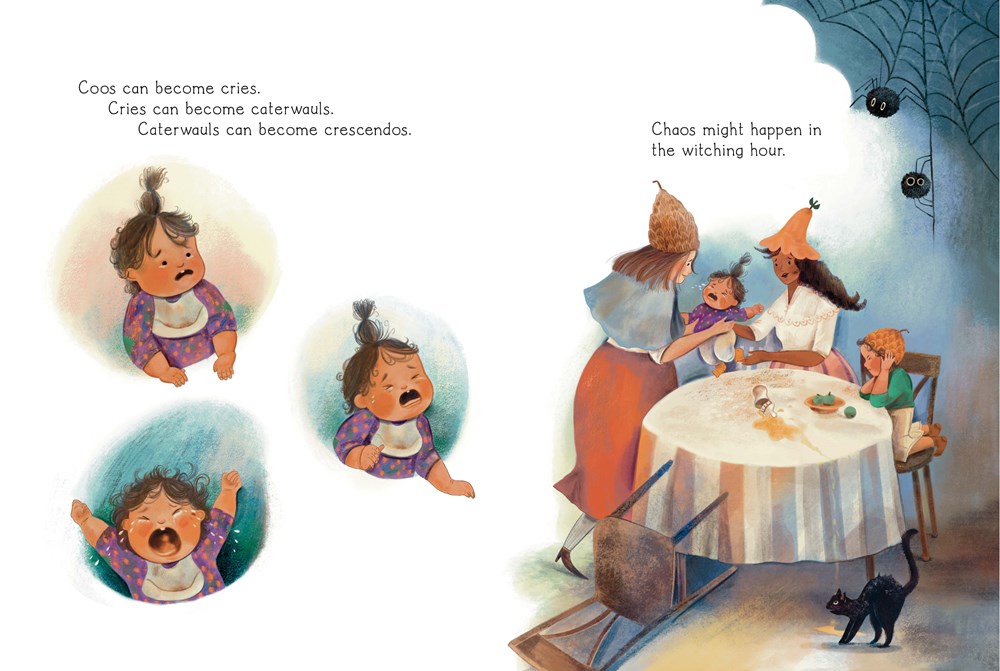
The two mothers in the book are paragons of patience, trying every inventive solution you might imagine, and then some. First, the acknowledge that anything, “or even nothing at all,” can set the chaos in motion. A baby overturns a cup of liquid on a table enclosed in a lovely tree trunk. Yes, we all recognize that scene. An older child wearing an acorn cap looks on, clearly worried about the next phase. The author is honest in calling it “chaos.” It takes both moms to extricate the screaming toddler from her highchair. An adult chair is overturned, a black cat arches its back, and the sibling covers her ears in terror.
One of the most frustrating features of the witching hour, when it happens, is escalation. “Coos can become cries. Cries can become caterwauls. Caterwauls can become crescendos.” Harris uses every figure of speech at her disposal: alliteration, onomatopoeia, literary allusions, rhythm. Perhaps your child can be calmed by a favorite stuffed animal. The moms try a variety of real wildlife, finally settling on the owl. You know the feeling of relief: “Definitely the owl. Thank goodness for the owl.”
If you were hoping for fairies, you won’t be disappointed. They arrive and join in the music and dancing, in a kinetic scene of joy mixed with desperation. Lirius’s fabulous pictures evoke an entire universe where the fantastic and the familiar are effortlessly blended. Earth colors predominate and the domestic interiors are as welcoming as those in Dutch still paintings. One mom holds the baby, who looks momentarily transfixed. The other mom is dancing upside down, her feet fixed to a magical broom. Fairies usually command attention, but here they are a great audience. When the show ends (who could sustain that level of energy), the moms come down to earth.
There are still many comforting possibilities to try: “this bottle, this banana, this bat.” The moms are creative and full of hope, waiting for the moon to signal that at least for today, it’s time to sleep. Suspension of disbelief sets in for this lovely family of nurturing witches. Tomorrow they we ready to start again, with all the resources at their disposal. For readers, this home of friendly spider webs, baskets of knitting yarn, and a quaint wood stove, seems uncannily real. For the duration of the story, you will be living among friends, and the supernatural is just, natural.
This Book is Dangerous! (A Narwhal and Jelly Picture Book #1) – written and illustrated by Ben Clanton Tundra Books, 2025
What is the difference between Narwhal and Jelly, the sea creature duo from Ben Clanton, when they appear in a picture book or in their previous format, graphic novels (see here and here and here)? This is not a rhetorical question. While in This Book is Dangerous! they inhabit a larger format with a somewhat more intense narrative pace, they still have the same lovably sincere personalities. There is a narrower range of characters and fewer digressions. Jelly is focused on his fears, given the title of his picture book debut.
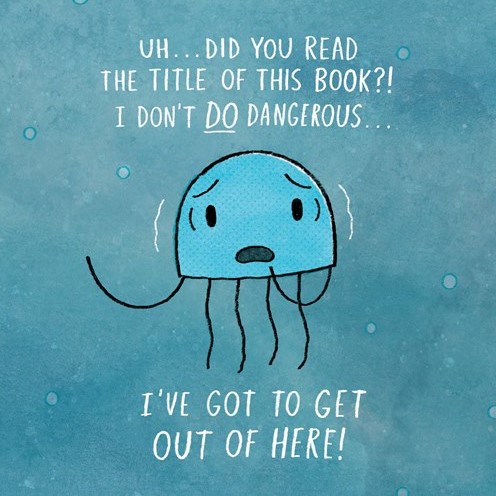
Jelly is rendered in Clanton’ inimitable style, with a touch of Ed Emberley simplicity. His inverted eyebrows and down-turned mouth ask the reader what on earth, or in the sea, is going on: “UH…DID YOU READ THE TITLE OF THIS BOOK?!” The redundant punctuation tells you just how terrified he is. Soon he is caught in a maze of signs urging caution, peril, and the need to stop. Jelly believes that the reader can help him to decode them and offer advice.
There are sea serpents with sharp teeth and a cannon which may or may not be non-functional. Jelly is actually transformed into a dark red cannonball, as Clanton extends the character’s legs, opens his eyes wide, and reverse the direction of the eyebrows. Children relate to artwork that seems to contain elements of their own.
The drama settles down, and the book briefly returns to the idiosyncrasies of the graphic novels. A page entitled “SOME NEARBY ITEMS” also reminded me The Everything in the Whole Wide World Museum: With Lovable Furry Old Grover, although the stakes are higher. Jelly needs support, but he may have some problems depending on “PRICKLY UNDERSEA PINEAPPLE,” or “RANDOM CACTUS.”
Jelly becomes angry, disappointed with the reader who, as in The Monster at the End of This Book, does not seem to understand the gravity of his problem. After all, someone who cannot help him extricate himself from danger is as dangerous as the book itself and all the horrors it contains. When Jelly finds some courage, along with ingenuity, and a bit of luck, he feels calmer, safer, and happy to meet his old friend Narwhal for a nostalgic ending. His warning not to read the book over again is not to be taken literally.

























 Imaginary Elevators